Results by title
28250 books match the query 'HISTORY' and 6388 start with t

The United States and the Global Struggle for Minerals
By Alfred E. Eckes, Jr.
University of Texas Press, 1979
In 1973–1974 soaring commodity prices and an oil embargo alerted Americans to the twin dangers of resource exhaustion and dependence on unreliable foreign materials suppliers. This period seemed to mark a watershed in history as the United States shifted from the era of relative resource abundance to relative materials scarcity.
Alfred E. Eckes’s comprehensive study shows that resource depletion and supply dislocations are not concerns unique to the 1970s. Since 1914, the quest for secure and stable supplies of industrial materials has been an important underlying theme of international relations and American diplomacy.
Although the United States has been blessed with a diversified materials base, it has pursued a minerals strategy designed to exploit low-cost, high-quality ores abroad. Eckes demonstrates how this policy has led to official protection for overseas private investments, involving a role for the Central Intelligence Agency.
Some modern historians have neglected the importance of resources in shaping diplomacy and history. This book, based on a vast variety of unutilized archival collections and recently declassified government documents, helps to correct that imbalance. In the process it illuminates an important and still timely aspect of America’s global interests.
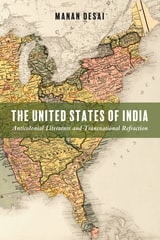
The United States of India
Anticolonial Literature and Transnational RefractionManan Desai
Temple University Press, 2020
The United States of India shows how Indian and American writers in the United States played a key role in the development of anticolonial thought in the years during and immediately following the First World War. For Indians Lajpat Rai and Dhan Gopal Mukerji, and Americans Agnes Smedley, W.E.B. Du Bois, and Katherine Mayo, the social and historical landscape of America and India acted as a reflective surface. Manan Desai considers how their interactions provided a “transnational refraction”—a political optic and discursive strategy that offered ways to imagine how American history could shed light on an anticolonial Indian future.
Desai traces how various expatriate and immigrant Indians formed political movements that rallied for American support for the cause of Indian independence. These intellectuals also developed new forms of writing about subjugation in the U.S. and India. Providing an examination of race, caste, nationhood, and empire, Desai astutely examines this network of Indian and American writers and the genres and social questions that fomented solidarity across borders.
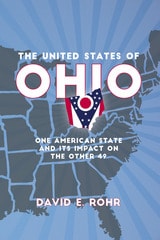
The United States of Ohio
One American State and Its Impact on the Other Forty-NineDavid E. Rohr
The Ohio State University Press, 2019
The United States of Ohio covers little-known facts about Ohio, such as how the state was the birthplace of both the National Football League and Major League Baseball and how it was Ohioans who led efforts toward racial integration in both sports. Readers will learn what makes the state a manufacturing and agricultural powerhouse—with both the largest tire company, Akron’s Goodyear, and the largest consumer products company, Cincinnati’s Proctor & Gamble, based there. The state grows, processes, and builds on a level that far outpaces the size of its population or expanse of its borders. And it is the birthplace of many prominent US figures—from Thomas Edison to John Glenn to Neil Armstrong. From sports to a century’s worth of entertainment superstars to aviation and space exploration, Ohio’s best have made for America’s greatest stories—all captured here in a look at the Buckeye State and its impact on the other forty-nine.
The Unity Movement
Its Evolution and Spiritual TeachingsNeal Vahle
Templeton Press, 2002
Prayer meetings held in 1889 in the Kansas City living room of Charles and Myrtle Fillmore were the beginning of what grew to be an international religious and educational movement. This book is an in-depth study of the people and beliefs that shaped it into one of the fastest growing movements of our time.
Neal Vahle documents the lives of the spiritual visionaries who created, organized, and led the Unity movement: Myrtle Fillmore, the 40-year-old wife and mother who was inspired by a Christian Science practitioner to cure herself of tuberculosis; Charles Fillmore, who had planned a business career but found, through study, prayer, meditation, and dream analysis, that he had another calling; H. Emily Cady, a New York City homeopathic physician whose book on Unity teachings, Lessons in Truth, was published in 1901, and has sold more than 1.6 million copies; Lowell Fillmore, eldest son of Charles and Myrtle, who clarified and popularized Unity teaching; and the other descendants of Myrtle and Charles, each of whom made immeasurable contributions.
He explores the key factors that led to the steady growth of the movement: the creation of the Unity School of Christianity; the development of Unity Village in Missouri; the evolution of "Silent Unity"; the publication program; the training of students; the development of centers and churches; and he presents and analyzes the controversies and debates within the organization. Vahle concludes the book with a look at the challenges facing the movement in the twenty-first century.
The Unity of the Nations
Joseph Ratzinger
Catholic University of America Press, 2015

The Universe in Thirteen Graphs
Charting Cosmic Discoveries Across Space and TimeChris Lintott, Jeffrey Grube, and Daina Bouquin
University of Chicago Press, 2027
See the Universe as astronomers do: These thirteen graphs distill the cutting-edge discoveries of the cosmos—from planets and stars to galaxies, to ripples in spacetime itself.
From the front page of newspapers to your favorite t-shirt, the visual language of the cosmos is pervasive. Yet while you may have seen stunning images of planets, nebulae, and even the shadow of a black hole, pretty pictures alone cannot reveal the universe. Whether you’re looking for planets outside our solar system, searching for dark matter, listening for ripples in spacetime, or looking back to very early times, to truly understand the cosmos you need graphs.
In this fully illustrated and engaging book, astronomers Chris Lintott and Jeffrey Grube and data scientist Daina Bouquin focus on thirteen graphs to offer a tour of the major astronomical discoveries of the last century. Meet the HR diagram, which tells us about stellar lives; marvel at the Hubble diagram’s evidence for the expansion of the Universe; understand special relativity through Minkowski spacetime; and turn back time to the earliest visible light of the cosmic microwave background. With fascinating stories of discovery and accessible science for understanding ongoing debates, this book proves that while a picture may be worth a thousand words, a graph can show you the universe.
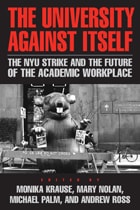
The University Against Itself
The NYU Strike and the Future of the Academic Workplaceedited by Monika Krause, Mary Nolan, Michael Palm and Andrew Ross
Temple University Press, 2008
All of the contributors were either participants in the NYU strike -- graduate students, faculty, and organizers -- or are nationally recognized as writers on academic labor. They are deeply troubled by the ramifications of corporatizing universities. Here they spell out their concerns, offering lessons from one historic strike as well as cautions about the future of all universities.
Contributors include: Stanley Aronowitz, Barbara Bowen, Andrew Cornell, Ashley Dawson, Stephen Duncombe, Steve Fletcher, Greg Grandin, Adam Green, Kitty Krupat, Gordon Lafer, Micki McGee, Sarah Nash, Cary Nelson, Matthew Osypowski, Ed Ott, Ellen Schrecker, Susan Valentine, and the editors.
The University and the People
Envisioning American Higher Education in an Era of Populist ProtestScott M. Gelber
University of Wisconsin Press, 2011
The University and the People chronicles the influence of Populism—a powerful agrarian movement—on public higher education in the late nineteenth century. Revisiting this pivotal era in the history of the American state university, Scott Gelber demonstrates that Populists expressed a surprising degree of enthusiasm for institutions of higher learning. More fundamentally, he argues that the mission of the state university, as we understand it today, evolved from a fractious but productive relationship between public demands and academic authority.
Populists attacked a variety of elites—professionals, executives, scholars—and seemed to confirm academia’s fear of anti-intellectual public oversight. The movement’s vision of the state university highlighted deep tensions in American attitudes toward meritocracy and expertise. Yet Populists also promoted state-supported higher education, with the aims of educating the sons (and sometimes daughters) of ordinary citizens, blurring status distinctions, and promoting civic engagement. Accessibility, utilitarianism, and public service were the bywords of Populist journalists, legislators, trustees, and sympathetic professors. These “academic populists” encouraged state universities to reckon with egalitarian perspectives on admissions, financial aid, curricula, and research. And despite their critiques of college “ivory towers,” Populists supported the humanities and social sciences, tolerated a degree of ideological dissent, and lobbied for record-breaking appropriations for state institutions.
The University in the Twenty-first Century
Teaching the New Enlightenment in the Digital AgeHannes Klöpper
Central European University Press, 2016
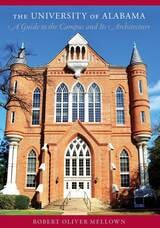
The University of Alabama
A Guide to the Campus and Its ArchitectureRobert Oliver Mellown
University of Alabama Press, 2013
In 1988 the University of Alabama Press published Robert Oliver Mellown’s The University of Alabama: A Guide to the Campus, a culmination of a decade’s worth of research into both the facts and the legends surrounding the architecture, history, and traditions of the Capstone.
Over twenty years later, this new guide brings to light the numerous additions, expansions, and renovations the university has undergone on its spacious grounds in Tuscaloosa. In addition to updated sections devoted to the university’s historic landmarks—such as Foster Auditorium, where “the stand in the schoolhouse door” occurred; Denny Chimes,where the handprints and footprints of famous Tide athletes are memorialized in concrete; and the Gorgas House, which with stood the destruction of Union troops at the end of the Civil War—new sections account for the acquisition of Bryce Hospital’s campus, the expansions at Bryant-Denny Stadium to accommodate the growing Crimson Tide fan base, and the burgeoning student recreation facilities, playing fields, and residential communities.
Chapters are arranged into various campus tours for walking or driving—Antebellum, Victorian, Early Twentieth-Century, East Quad, West Quad, Science and Engineering Corridor, Student Life, Bryce, Medical, Southeast, Athletics, and Off Campus. Alumni, prospective students and their parents, new faculty, out-of-state visitors, and foreign dignitaries will all welcome this useful, compact, and colorful guide to one of the most beautiful campuses in the country.
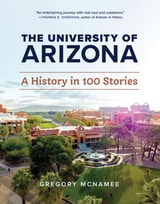
The University of Arizona
A History in 100 StoriesGregory McNamee
University of Arizona Press, 2024
The University of Arizona: A History in 100 Stories is a celebration of the people, ideas, inventions, teaching, and structures that have been part of the school’s evolution from a small land-grant institution to an internationally renowned research institution. Drawing on half a century of connection with the University of Arizona as a student, staff member, and faculty member, Gregory McNamee presents a history through the lens of a hundred subjects.
That story begins in 1885, with the establishment of the school, which quickly proved itself to be a powerhouse in its foundational “four pillars”: agriculture and earth sciences, followed by astronomy and anthropology. In the years following World War II, those four pillars became ever more important to the University, even as countless other fields of study gained prominence: optical sciences, women’s studies, the humanities, mathematics, and more. This phenomenal institution has as its setting the Sonoran Desert, and, closer to home, to a built environment that is widely considered among the most scenic in the country, from the Historic District with its buildings that are more than a century old to the latest steel-and-glass constructions on the edges of the ever-expanding campus.
McNamee relates this history in an entertaining manner, peppering discussion of serious intellectual and institutional themes with lighter moments—the origins of the university's rivalry with Arizona State, the ghosts that are said to lurk about campus, and more. Wildcats everywhere will delight in McNamee’s celebration of the people, places, learning, books, and pastimes that have distinguished our school.
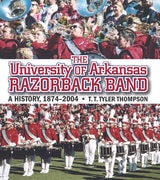
The University of Arkansas Razorback Band
A History, 1874-2004T.T. Tyler Thompson
University of Arkansas Press, 2004
From the small Cadet Band that supported the school’s military department to the “best in sight and sound” Marching Razorbacks that are a staple of the university’s athletic program, the band has provided the soundtrack to the University of Arkansas.
The rich history of the Razorback Band has spanned almost the entire existence of the University of Arkansas. This book documents the distinguished 130-year history of the band from its humble beginnings in 1874 as an adjunct to the military cadet squad to the major college organization that it is today. Both as a supporting player of the military and ROTC programs and of the athletic department, the Razorback Band has provided the spirited musical excitement required through the years, as well as performing concerts on its own for an appreciative student body and community audience with the Concert Band and Wind Ensemble. Add to that the parallel story of the evolution of an exciting basketball and volleyball spirit band—the Hogwild Band—and you have in this lavishly illustrated book the first-ever history of the music makers of the University of Arkansas.
The University of Chicago
A HistoryJohn W. Boyer
University of Chicago Press, 2015
With The University of Chicago: A History, John W. Boyer, Dean of the College since 1992, presents a deeply researched and comprehensive history of the university. Boyer has mined the archives, exploring the school’s complex and sometimes controversial past to set myth and hearsay apart from fact. The result is a fascinating narrative of a legendary academic community, one that brings to light the nature of its academic culture and curricula, the experience of its students, its engagement with Chicago’s civic community, and the conditions that have enabled the university to survive and sustain itself through decades of change.
Boyer’s extensive research shows that the University of Chicago’s identity is profoundly interwoven with its history, and that history is unique in the annals of American higher education. After a little-known false start in the mid-nineteenth century, it achieved remarkable early successes, yet in the 1950s it faced a collapse of undergraduate enrollment, which proved fiscally debilitating for decades. Throughout, the university retained its fierce commitment to a distinctive, intense academic culture marked by intellectual merit and free debate, allowing it to rise to international acclaim. Today it maintains a strong obligation to serve the larger community through its connections to alumni, to the city of Chicago, and increasingly to its global community.
Published to coincide with the 125th anniversary of the university, this must-have reference will appeal to alumni and anyone interested in the history of higher education of the United States.
The University of Chicago
A HistoryJohn W. Boyer
University of Chicago Press, 2024
One of the most influential institutions of higher learning in the world, the University of Chicago has a powerful and distinct identity, and its name is synonymous with intellectual rigor. With nearly 170,000 alumni living and working in more than one hundred and fifty countries, its impact is far-reaching and long-lasting.
With The University of Chicago: A History, John W. Boyer, Dean of the College from 1992 to 2023, thoroughly engages with the history and the lived politics of the university. Boyer presents a history of a complex academic community, focusing on the nature of its academic culture and curricula, the experience of its students, its engagement with Chicago’s civic community, and the resources and conditions that have enabled the university to sustain itself through decades of change. He has mined the archives, exploring the school’s complex and sometimes controversial past to set myth and hearsay apart from fact.
Boyer’s extensive research shows that the University of Chicago’s identity is profoundly interwoven with its history, and that history is unique in the annals of American higher education. After a little-known false start in the mid-nineteenth century, it achieved remarkable early successes, yet in the 1950s it faced a collapse of undergraduate enrollment, which proved fiscally debilitating for decades. Throughout, the university retained its fierce commitment to a distinctive, intense academic culture marked by intellectual merit and free debate, allowing it to rise to international acclaim. Today it maintains a strong obligation to serve the larger community through its connections to alumni, to the city of Chicago, and increasingly to its global community. Boyer’s tale is filled with larger-than-life characters—John D. Rockefeller, Robert Maynard Hutchins, and many other famous figures among them—and episodes that reveal the establishment and rise of today’s institution.
Newly updated, this edition extends through the presidency of Robert Zimmer, whose long tenure was marked by significant developments and controversies over subjects as varied as free speech, medical inequity, and community relations.

The University of Illinois, 1894-1904
THE SHAPING OF THE UNIVERSITYWinton U. Solberg
University of Illinois Press, 2000
The years 1894 to 1904 mark the stormy tenure of Andrew S. Draper as president of the University of Illinois. Draper, a successful superintendent of schools with no college or university experience and no credentials as a post-secondary administrator, presided over many crucial improvements in the university's physical plant, curricula, and other areas. However, he failed to infuse the university with a spirit of cohesion, and his term as president was fraught with conflict.
From his inauguration on, the autocratic Draper collided with deans and faculty who opposed both the substance of his changes and the manner in which he presented and implemented them.
This volume closely examines the Draper years from the perspectives of faculty, students, and administrators. Solberg outlines the administrative, faculty, staff, and physical infrastructure. He also reveals a vibrant and varied student life, including a whirl of social activities, literary societies, intercollegiate debate and athletics, hazing, religion, and increasingly prominent fraternities.
A sharply delineated and detailed picture of a university in transition, The University of Illinois, 1894-1904 traces the school's shift from an institution known primarily as a training ground for engineers to a full-fledged university poised to compete on the national level.
The University of Illinois
Engine of InnovationEdited by Frederick E. Hoxie
University of Illinois Press, 2017
The University of Iowa Guide to Campus Architecture
John Beldon Scott
University of Iowa Press, 2006
The University of Iowa in the Twentieth Century
An Institutional HistoryStow Persons
University of Iowa Press, 1990

The University of Manitoba
An Illustrated HistoryJ.M. Bumsted
University of Manitoba Press, 2001

The University of Michigan & China, 1845 – 2017
Neal McKenna
Michigan Publishing Services, 2017
Throughout the last two centuries U.S. administrations from President Lincoln to President Clinton have relied on U-M leaders and faculty to engage China and develop political and cultural relationships. The University of Michigan was one of the first universities in the U.S. to enroll Chinese students and has many prominent Chinese graduates, including a Nobel Laureate and the first female college president in China.
As U-M celebrates its own bicentennial, this book recounts the university's considerable history with Chinese governments, people and culture. The book also updates readers on the current and ongoing partnerships between different U-M departments and schools with Chinese institutions, and provides a list of several prominent Chinese graduates of the University of Michigan.
The University of Michigan in China
David Ward and Eugene Chen
Michigan Publishing Services, 2017
This book tells the story of twenty remarkable individuals, the country they transformed, and the University that helped them do it. There are many “firsts” in this book—first Chinese students at U-M, first female college president of China—and there are many “fathers” of disciplines: Wu Dayou, father of physics in China; Zheng Zuoxin, father of Chinese ornithology; Zeng Chengkui, father of marine botany.
While much has been written about these leaders and scholars in both English and Chinese, nowhere else is their collective story told or their shared bond with the University of Michigan celebrated.
The University of Michigan in China celebrates this nearly 200-year-old legacy.
The University of Michigan
A Pictorial HistoryRuth Bordin
University of Michigan Press, 1967
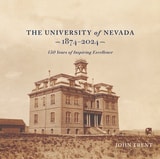
The University of Nevada, 1874-2024
150 Years of Inspiring ExcellenceJohn Trent
University of Nevada Press, 2024
As both the University’s student body and the state’s population grew, the campus was transferred to Reno in 1885-86 as an effort to secure the fledgling institution’s prospects for survival. Many of the initial class of thirty-five students resided in Morrill Hall, the only building on campus, where they also received instruction and ate their meals. As the University enhanced its academic offerings, enrollment grew to more than 1,000 students by the turn of the century. A strong belief that the University must always be changing and evolving to meet the needs of its students and answer the challenges of a particular era became the guiding forces behind the administration’s decision-making. With an increasingly diverse student body and one of the most productive academic faculties in the country, the little school on the hill expanded during its first 100 years to become a leading public university in the western United States.
Today, the University continues to achieve institutional benchmarks, including a record 5,000 graduates during the 2019–20 academic year. It is exactly this kind of student success that has always been at the heart of the Wolf Pack Family’s mission to help students find the path that is right for them, and beckon others to share in their journey.
The 150th anniversary book is published in honor of this milestone and highlights numerous parts of the University’s history, showcasing why the University of Nevada, Reno has truly been a catalyst for success and change throughout the state’s story.
The University of Oxford
A Brief HistoryLaurence Brockliss
Bodleian Library Publishing, 2018
This book offers a succinct illustrated account of the university’s colorful and controversial eight-hundred-year history, from medieval times through the Reformation and on to the nineteenth century, in which the foundations of the modern tutorial system were laid. It describes the extraordinary and influential people who shaped the development of the institution and helped to create today’s world-class research university.
Richly illustrated with archival material, prints, and portraits, this book explores how a university in a small provincial town rose to become one of the top universities in the world at the beginning of the twenty-first century.
The Unknown Travels and Dubious Pursuits of William Clark
Jo Ann Trogdon
University of Missouri Press, 2023
In this vivid history, Jo Ann Trogdon reveals William Clark’s highly questionable activities during the years before his famous journey west of the Mississippi. Delving into the details of Clark’s diary and ledger entries, Trogdon investigates evidence linking Clark to a series of plots—often called the Spanish Conspiracy—in which corrupt officials sought to line their pockets with Spanish money and to separate Kentucky from the United States. The Unknown Travels and Dubious Pursuits of William Clark gives readers a more complex portrait of the American icon than has been previously written.

The Unlevel Playing Field
A Documentary History of the African American Experience in SportDavid K. Wiggins and Patrick B. Miller
University of Illinois Press, 2003
The Unlevel Playing Field offers a rich compendium of more than 100 primary sources that chart the intertwining history of African Americans and sport. Introductions and head-notes provided by David K. Wiggins and Patrick B. Miller place each document in context, shaping an unrivaled narrative.
Readers will find dozens of accounts by Frederick Douglass, W. E. B. DuBois, Booker T. Washington, Marcus Garvey, James Weldon Johnson, Richard Wright, A. S. “Doc” Young, Eldredge Cleaver, Nikki Giovanni, John Edgar Wideman, bell hooks, James Baldwin, Roy Wilkins, Henry Louis Gates, Gerald Early, and many others.
The documents range from discussions of the color line in organized baseball during the Jim Crow era and portraits of turn-of-the-century figures like the champion sprint cyclist Marshall “Major” Taylor and boxer Jack Johnson. Writers also look at modern-day issues like the participation of black athletes in the 1968 Olympics, the place of African American women in sport, and examine pioneering figures like Jackie Robinson, Muhammad Ali, Althea Gibson, Michael Jordan, Tiger Woods, and Venus and Serena Williams.
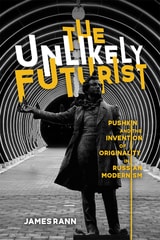
The Unlikely Futurist
Pushkin and the Invention of Originality in Russian ModernismJames Rann
University of Wisconsin Press, 2020
Through systematic and detailed readings of Futurist texts, James Rann offers the first book-length study of the tensions between the outspoken literary group and the great national poet. He observes how those in the movement engaged with and invented a new Pushkin, who by turns became a founding father to rebel against, a source of inspiration to draw from, a prophet foreseeing the future, and a monument to revive.
Rann's analysis contributes to the understanding of both the Futurists and Pushkin's complex legacy. The Unlikely Futurist will appeal broadly to scholars of Slavic studies, especially those interested in literature and modernism.
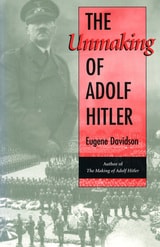
The Unmaking of Adolf Hitler
Eugene Davidson
University of Missouri Press, 2003
Available only in the USA and Canada.
The Unpast
Elite Violence and Social Control in Brazil, 1954–2000R. S. Rose
Ohio University Press, 2005
Portuguese and Brazilian slave-traders shipped at least four million slaves to Brazil—in contrast to the five hundred thousand slaves that English vessels brought to the Americas. Controlling the vast number of slaves in Brazil became of primary importance. The Unpast: Elite Violence and Social Control in Brazil, 1954–2000 documents the ways in which the brutal methods used on plantations led directly to the phenomenon of Brazilian death squads.
The Unpast examines how and why, after the abolition of slavery, elites in Brazil imported new methods of killing, torturing, or disfiguring dissidents and the poor to maintain dominance. Bringing a critical-historical analysis to events following the 1954 suicide of President Getúlio Vargas, R. S. Rose takes the reader along a fifty-year path that helped to shape a nation’s morals. He covers the misunderstood presidency of João Goulart; the overthrow of his government by a U.S.-assisted military; the appalling dictatorship that followed; the efforts to rid the countryside of troublemakers; and the ongoing attempt to cleanse the urban environment of the needy, an endeavor that produced 32,675 victims in just two Brazilian states between 1954 and 2000.
The largest and most comprehensive documentation of suspected death-squad victims ever undertaken, The Unpast is an exposé of practices and attitudes toward the poor in Latin America’s largest country.
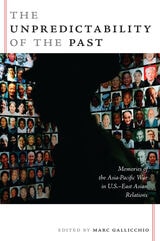
The Unpredictability of the Past
Memories of the Asia-Pacific War in U.S.-East Asian RelationsMarc Gallicchio, ed.
Duke University Press, 2007
The contributors interpret mass media sources, museum displays, monuments, film, and literature, as well as the archival sources traditionally used by historians. They explore how American ideas about Japanese history shaped U.S. occupation policy following Japan’s surrender in 1945, and how memories of the Asia-Pacific War influenced Washington and Tokyo policymakers’ reactions to the postwar rise of Soviet power. They investigate topics from the resurgence of Pearl Harbor images in the U.S. media in the decade before September 11, 2001, to the role of Chinese war museums both within China and in Chinese-Japanese relations, and from the controversy over the Smithsonian Institution’s Enola Gay exhibit to Japanese tourists’ reactions to the USS Arizona memorial at Pearl Harbor. One contributor traces how a narrative commemorating African Americans’ military service during World War II eclipsed the history of their significant early-twentieth-century appreciation of Japan as an ally in the fight against white supremacy. Another looks at the growing recognition and acknowledgment in both the United States and Japan of the Chinese dimension of World War II. By focusing on how memories of the Asia-Pacific War have been contested, imposed, resisted, distorted, and revised, The Unpredictability of the Past demonstrates the crucial role that interpretations of the past play in the present.
Contributors. Marc Gallicchio, Waldo Heinrichs, Haruo Iguchi, Xiaohua Ma, Frank Ninkovich, Emily S. Rosenberg, Takuya Sasaki, Yujin Yaguchi, Daqing Yang
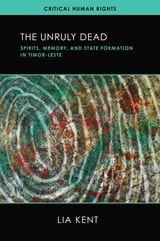
The Unruly Dead
Spirits, Memory, and State Formation in Timor-LesteLia Kent
University of Wisconsin Press, 2024
With generous, careful ethnography and incisive analysis, Kent challenges comfortable, linear narratives of transitional justice and argues that this memory work is reshaping the East Timorese social and political order—a process in which the dead are active, and sometimes disruptive, participants. Community ties and even the landscape itself are imbued with their presence and demands, and the horrific scale of mass death in recent times—at least a third of the population perished during the Indonesian occupation—means Timor-Leste’s dead have real, significant power in the country’s efforts to remember, recover, and reestablish itself.
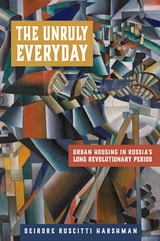
The Unruly Everyday
Urban Housing in Russia’s Long Revolutionary PeriodDeirdre Ruscitti Harshman
University of Wisconsin Press, 2027
As a result of mass urbanization from the late nineteenth century onward, an acute housing shortage in Russia and the associated “housing question” rapidly grew to such a large scale that no single group was able to tackle it in its entirety. Complicated, ideologically fraught negotiations and solutions emerged, failed, and occasionally partially succeeded over time. The Unruly Everyday unearths and detangles the contours of this history, exploring what it tells us not just about Soviet and Russian housing but about the messy process by which society changes.
Beyond tracing contestations about housing in particular, Deirdre Ruscitti Harshman explores how the concept of the “everyday” was used to critique the limitations of the present and to imagine alternatives. She argues that the ways various groups worked, sometimes collaboratively and sometimes contentiously, through these negotiations transcended neat pre- and postrevolutionary binaries, in terms of both chronology and ideology. The issues and local responses remained largely the same no matter what type of central government controlled the Kremlin. Critically, the housing problem was instead addressed by the development of various forms of local power—whose very existence and capacities undermine the perception of both tsarist and Soviet Russia as autocratic, highly centralized states.
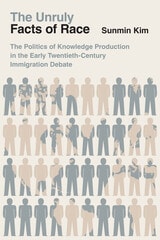
The Unruly Facts of Race
The Politics of Knowledge Production in the Early Twentieth-Century Immigration DebateSunmin Kim
University of Chicago Press, 2026
Unfortunately, we’re all too familiar with the US’s legacy of maligning immigrants. Some Americans see immigrants as inherently threatening, a blank screen onto which the nation’s worst fears are projected. But this phenomenon is neither timeless nor static. Instead, it arose and transformed alongside the unprecedented arrival of immigrants in the early twentieth century—and the federal government’s response. In The Unruly Facts of Race, sociologist Sunmin Kim explains how American ideas about race and ethnicity were transformed in the early twentieth century as an unintended consequence of anti-immigrant mobilization.
Kim presents a wealth of archival evidence, including the proceedings of the 1907 Dillingham Commission, to reconstruct how competing racialized visions of nationhood evolved in the early twentieth-century immigration debate. Immigration restrictionist politicians believed that the United States should be a White, Anglo-Saxon, and Protestant nation. However, when they mobilized researchers—some of whom were women and/or immigrants—to gather data at a massive scale to rationalize their aims, they were met with unruly facts that did not support their racial project. Newer European immigrants, as the data showed, were not much different from descendants of earlier immigrants from northern Europe. When facts failed to support the vilification of immigrants, exclusionist politicians instead turned to race as a marker of ineluctable difference to justify their aims. This led to a new principle of national belonging: the United States transitioned to a country that encompassed various European groups, including Catholics and Jews, but excluded non-White immigrants, as they were deemed too different to become a part of the nation.
Kim’s analysis shows that throughout US history, the opportunity for belonging for some immigrants was predicated on the exclusion of others. His focus on the role of facts in the early twentieth century provides a refreshing take on why the so-called “nation of immigrants” has always demonized some immigrants while cherishing others, highlighting the selection and control of immigrants as the core principles of the American nation-building project. Amid a vitriolic explosion of American immigration discourse, Kim offers a needed corrective to and context for debates around who belongs in the United States.
The Unruly Voice
Rediscovering Pauline Elizabeth HopkinsEdited by John Cullen Gruesser
University of Illinois Press, 1996
The work and times of the Black writer, editor, and intellectual
John Cullen Gruesser edits essays that explore the literary and journalistic career of Pauline Elizabeth Hopkins. A Black woman writer at the turn of the twentieth century, Hopkins worked as the unacknowledged editor-in-chief of the Colored American Magazine but also wrote short fiction, novels, nonfiction articles, and a play believed to be the first by a Black woman. Versatile and politically committed, she was fired when her strong editorial stands and non-conciliatory politics offended the new owner of Colored American Magazine.
A rare examination of an overlooked figure in Black letters, The Unruly Voice explores Hopkins’s writing and her significance for contemporary readers.
Contributors: Elizabeth Ammons; Kristina Brooks; Lois Lamphere Brown; C. K. Doreski; John Cullen Gruesser; Jennie A. Kassanoff; Kate McCullough; Nelly Y. McKay; and Cynthia D. Schrager
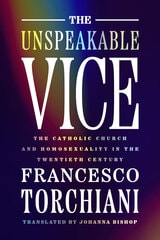
The Unspeakable Vice
The Catholic Church and Homosexuality in the Twentieth CenturyFrancesco Torchiani, Translated by Johanna Bishop
University of Wisconsin Press, 2026
As gay men and lesbian women increasingly gained recognition and acceptance in twentieth-century literature and film, and subsequently in social and political movements, the Catholic Church reacted by subtly moving away from its overt condemnation of homosexuality as an urgent moral problem and toward tacitly shunning homosexuality as an “unspeakable vice.” In this revealing history, Francesco Torchiani reconstructs the Catholic Church’s shifting attitudes toward homosexuality during this period by drawing on a vast array of internal documents and external accounts. This monograph expands the scholarship on the relationship between Catholicism and homosexuality in terms of both method and content, ultimately concluding that the Catholic Church continues to wholeheartedly condemn homosexuality despite making genuine efforts to reflect on and understand its social and cultural impact. The Unspeakable Vice therefore sheds new light on and places into historical perspective the questions the Catholic Church continues to reckon with regarding its role in contemporary society.
The Unspoken as Heritage
The Armenian Genocide and Its Unaccounted LivesHarry Harootunian
Duke University Press, 2019
The Unsteady March
The Rise and Decline of Racial Equality in AmericaPhilip A. Klinkner and Rogers M. Smith
University of Chicago Press, 1999
"[An] unflinching portrait of the leviathan of American race relations. . . . This important book should be read by all who aspire to create a more perfect union."—Publishers Weekly, starred review
"Could it be that our unswerving belief in the power of our core values to produce racial equality is nothing but a comforting myth? That is the main argument put forth by Philip Klinkner and Rogers Smith . . . The Unsteady March is disturbing because it calls into question our cherished national belief and does so convincingly. . . . [It] is beautifully written, and the social history it provides is illuminating and penetrating."—Aldon Morris, American Journal of Sociology
Winner of the Horace Mann Bond Award of the W.E.B. Du Bois Institute for Afro-American Research at Harvard University.
The Unteachables
Disability Rights and the Invention of Black Special EducationKeith A. Mayes
University of Minnesota Press, 2023
How special education used disability labels to marginalize Black students in public schools
The Unteachables examines the overrepresentation of Black students in special education over the course of the twentieth century. As African American children integrated predominantly white schools, many were disproportionately labeled educable mentally retarded (EMR), learning disabled (LD), and emotionally behavioral disordered (EBD). Keith A. Mayes charts the evolution of disability categories and how these labels kept Black learners segregated in American classrooms.
The civil rights and the educational disability rights movements, Mayes shows, have both collaborated and worked at cross-purposes since the beginning of school desegregation. Disability rights advocates built upon the opportunity provided by the civil rights movement to make claims about student invisibility at the level of intellectual and cognitive disabilities. Although special education ostensibly included children from all racial groups, educational disability rights advocates focused on the needs of white disabled students, while school systems used disability discourses to malign and marginalize Black students.
From the 1940s to the present, social science researchers, policymakers, school administrators, and teachers have each contributed to the overrepresentation of Black students in special education. Excavating the deep-seated racism embedded in both the public school system and public policy, The Unteachables explores the discriminatory labeling of Black students, and how it indelibly contributed to special education disproportionality, to student discipline and push-out practices, and to the school-to-prison pipeline effect.

The Untimely Present
Postdictatorial Latin American Fiction and the Task of MourningIdelber Avelar
Duke University Press, 1999
Avelar starts by offering new readings of works produced before the dictatorship era, in what is often considered the boom of Latin American fiction. Distancing himself from previous celebratory interpretations, he understands the boom as a manifestation of mourning for literature’s declining aura. Against this background, Avelar offers a reassessment of testimonial forms, social scientific theories of authoritarianism, current transformations undergone by the university, and an analysis of a number of novels by some of today’s foremost Latin American writers—such as Ricardo Piglia, Silviano Santiago, Diamela Eltit, João Gilberto Noll, and Tununa Mercado. Avelar shows how the ‘untimely’ quality of these narratives is related to the position of literature itself, a mode of expression threatened with obsolescence.
This book will appeal to scholars and students of Latin American literature and politics, cultural studies, and comparative literature, as well as to all those interested in the role of literature in postmodernity.
The Untried Life
The Twenty-Ninth Ohio Volunteer Infantry in the Civil WarJames T. Fritsch
Ohio University Press, 2012
Told in unflinching detail, this is the story of the Twenty-Ninth Ohio Volunteer Infantry, also known as the Giddings Regiment or the Abolition Regiment, after its founder, radical abolitionist Congressman J. R. Giddings. The men who enlisted in the Twenty-Ninth OVI were, according to its lore, handpicked to ensure each was as pure in his antislavery beliefs as its founder. Whether these soldiers would fight harder than other soldiers, and whether the people of their hometowns would remain devoted to the ideals of the regiment, were questions that could only be tested by the experiment of war.
The Untried Life is the story of these men from their very first regimental formation in a county fairground to the devastation of Gettysburg and the march to Atlanta and back again, enduring disease and Confederate prisons. It brings to vivid life the comradeship and loneliness that pervaded their days on the march. Dozens of unforgettable characters emerge, animated by their own letters and diaries: Corporal Nathan Parmenter, whose modest upbringing belies the eloquence of his writings; Colonel Lewis Buckley, one of the Twenty-Ninth’s most charismatic officers; and Chaplain Lyman Ames, whose care of the sick and wounded challenged his spiritual beliefs.
The Untried Life shows how the common soldier lived—his entertainments, methods of cooking, medical treatment, and struggle to maintain family connections—and separates the facts from the mythology created in the decades after the war.
The Unvarnished Doctrine
Locke, Liberalism, and the American RevolutionSteven M. Dworetz
Duke University Press, 1990
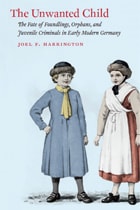
The Unwanted Child
The Fate of Foundlings, Orphans, and Juvenile Criminals in Early Modern GermanyJoel F. Harrington
University of Chicago Press, 2009
The baby abandoned on the doorstep is a phenomenon that has virtually disappeared from our experience, but in the early modern world, unwanted children were a very real problem for parents, government officials, and society. The Unwanted Child skillfully recreates sixteenth-century Nuremberg to explore what befell abandoned, neglected, abused, or delinquent children in this critical period.
Joel F. Harrington tackles this question by focusing on the stories of five individuals. In vivid and poignant detail, he recounts the experiences of an unmarried mother-to-be, a roaming mercenary who drifts in and out of his children’s lives, a civic leader handling the government’s response to problems arising from unwanted children, a homeless teenager turned prolific thief, and orphaned twins who enter state care at the age of nine. Braiding together these compelling portraits, Harrington uncovers and analyzes the key elements that link them, including the impact of war and the vital importance of informal networks among women. From the harrowing to the inspiring, The Unwanted Child paints a gripping picture of life on the streets five centuries ago.
The Unwanted
European Refugees From 1St World WarMichael Marrus
Temple University Press, 2001
The Unwritten War
American Writers and the Civil WarDaniel Aaron
University of Alabama Press, 2003
In The Unwritten War, Daniel Aaron examines the literary output of American writers—major and minor—who treated the Civil War in their works. He seeks to understand why this devastating and defining military conflict has failed to produce more literature of a notably high and lasting order, why there is still no "masterpiece" of Civil War fiction.
In his portraits and analyses of 19th- and some 20th-century writers, Aaron distinguishes between those who dealt with the war only marginally—Henry Adams, Henry James, William Dean Howells, Mark Twain-and those few who sounded the war's tragic import—Herman Melville, Walt Whitman, and William Faulkner. He explores the extent to which the war changed the direction of American literature and how deeply it entered the consciousness of American writers. Aaron also considers how writers, especially those from the South, discerned the war's moral and historical implications.
The Unwritten War was originally published by Alfred A. Knopf in 1973. The New Republic declared, [This book's] major contribution will no doubt be to American literary history. In this respect it resembles Edmund Wilson's Patriotic Gore and is certain to become an indispensable guide for anyone who wants to explore the letters, diaries, journals, essays, novels, short stories, poems-but apparently no plays-which constitute Civil War literature. The mass of material is presented in a systematic, luminous, and useful way.
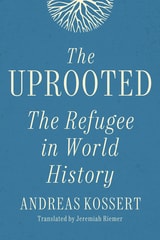
The Uprooted
The Refugee in World HistoryAndreas Kossert
Rutgers University Press, 2027
In his new book, Andreas Kossert—the renowned expert on emigration and expulsion in the twentieth century and author of the bestselling Cold Home—places the early twenty-first-century refugee movement in a wider historical context. Movingly told and interwoven with personal accounts, The Uprooted: The Refugee in World History reveals the existential experiences of uprootedness and hostility that go hand in hand with losing one's homeland and explains why refugees and displaced persons have always found it so difficult to settle into a new country. Whether they have come from East Prussia, Syria, or India, refugees are agents of world history—and with this book Kossert gives them a voice.
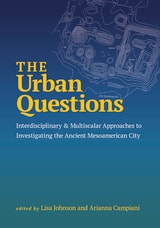
The Urban Questions
Interdisciplinary and Multiscalar Approaches to Investigating the Ancient Mesoamerican CityLisa Johnson and Arianna Campiani
University of Utah Press, 2025
This groundbreaking volume presents a fresh and comprehensive look at the urban development of Mesoamerican cities. Moving beyond traditional methods, The Urban Questions adopts a dynamic, multidisciplinary approach to understanding the complexity and diversity of ancient settlements. By examining urbanism at multiple scales—from individual events to households, neighborhoods, and entire regions—it offers a nuanced view of how these cities evolved over time.
Contributors explore key themes such as community identity, infrastructure management, and the intersection of social, political, and economic processes. Rich in both spatial and material analysis, the chapters provide insights into the lived experience of ancient Mesoamerican inhabitants and the gradual expansion of their cities. With innovative archaeological methodologies and theoretical frameworks, this volume is an essential resource for scholars of Mesoamerican studies, archaeology, and urban history, shedding new light on the dynamic nature of ancient cities.

The Urbanization of Japanese Labor, 1868-1955
Wilkinson, O. T.
University of Massachusetts Press, 1965
This book examines the transition from peasant agriculturalism to urban industrialism in Japan was in the hands of a merchant class wholly oriented toward an internal economic system when she entered the modern international world. Consequently, Japanese political administration assumed a large portion of foreign commercial and industrial activity, in its initial stages. Thus, her modern economic and industrial development served political purposes of those concerned with Japan’s international political standing. In this sense, Japan’s early modernization was a “planned” transition. The industries sponsored by subsidy and outright government ownership therefore experienced rapid technological change and expansion, while those industries devoted to consumer goods were left to traditional means of production. The demographic characteristics of Japan’s urban population clearly reflect this background. The organization of a manufacturing group along the lines of family structure was modified, but not destroyed, by the transition to urban industrialism. Thus, in marked contrast to Europe, where the family is primarily a consumer unit, in Japan is a productive unit as well. While the experience of Japan does not provide a blueprint for nations that are now undertaking industrialization, the unique evolution of her urban-industrial complexes has great abstract value, in corroborating the theoretical contention that there is a wide range of alternatives to the pattern of industrialization that prevails in the West. All those concerned with preserving the best of their existing culture, while moving into the inevitable world-wide urban-industrial future, will benefit and be encouraged by the example of Japan.
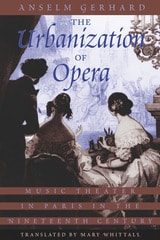
The Urbanization of Opera
Music Theater in Paris in the Nineteenth CenturyAnselm Gerhard
University of Chicago Press, 1998
"An invaluable look at this fascinating genre."—George W. Loomis, Opera News
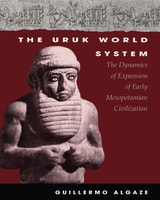
The Uruk World System
The Dynamics of Expansion of Early Mesopotamian CivilizationGuillermo Algaze
University of Chicago Press, 1993
In The Uruk World System, Guillermo Algaze concentrates instead on the unprecedented and wide-ranging process of external expansion that coincided with the rapid initial crystallization of Mesopotamian civilization. He contends that the rise of early Sumerian polities cannot be understood without also taking into account developments in surrounding peripheral areas.
Algaze reviews an extensive body of archaeological evidence for cross-cultural exchange between the nascent city-states in the Mesopotamian lowlands and communities in immediately surrounding areas. He shows that at their very inception the more highly integrated lowland centers succeeded in establishing a variety of isolated, far-flung outposts in areas at the periphery of the Mesopotamian lowlands. Embedded in an alien hinterland characterized by demonstrably less complex societies, the outposts were commonly established at the apex of preexisting regional settlement hierarchies and invariably at focal nodes astride important trade routes. Algaze argues that these early colonial out-posts served as collection points for coveted peripheral resources acquired in exchange for core manufactures and that they reflect an inherently asymmetrical system of economic hegemony that extended far beyond areas under the direct political control of Sumerian polities in southern Mesopotamia. From this he concludes that economic exploitation of less developed peripheral areas was integral to the earliest development of civilization in the ancient Near East.
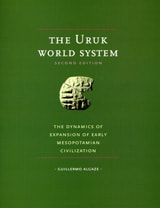
The Uruk World System
The Dynamics of Expansion of Early Mesopotamian Civilization, Second EditionGuillermo Algaze
University of Chicago Press, 2005