Results by title
28250 books match the query 'History' and 6388 start with t
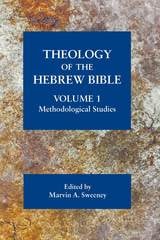
Theology of the Hebrew Bible, Volume 1
Methodological StudiesMarvin A. Sweeney
SBL Press, 2019
Diverse approaches to biblical theology
This volume presents a collection of studies on the methodology for conceiving the theological interpretation of the Hebrew Bible among Jews and Christians as well as the treatment of key issues such as creation, the land of Israel, and divine absence. Contributors include Georg Fischer, SJ, David Frankel, Benjamin J. M. Johnson, Soo J. Kim, Wonil Kim, Jacqueline E. Lapsley, Julia M. O’Brien, Dalit Rom-Shiloni, Marvin A. Sweeney, and Andrea L. Weiss.
Features:
- Examination of metaphor, repentance, and shame in the presence of God
- Ten essays addressing the nature of biblical theology from a Jewish, Christian, or critical perspective
- Discussion of the changes that have taken place in the field of biblical theology since World War II
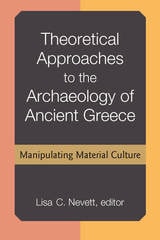
Theoretical Approaches to the Archaeology of Ancient Greece
Manipulating Material CultureLisa C. Nevett, Editor
University of Michigan Press, 2017
An introductory section exploring the emergence and growth of theoretical approaches is followed by examinations of the potential insights these approaches provide. The authors probe some of the meanings attached to ancient objects, townscapes, and cemeteries, for those who created, and used, or inhabited them.
The range of contexts stretches from the early Greek communities during the eighth and seventh centuries BCE, through Athens between the eighth and fifth centuries BCE, and on into present day Turkey and the Levant during the third and second centuries BCE. The authors examine a range of practices, from the creation of individual items such as ceramic vessels and figurines, through to the construction of civic buildings, monuments, and cemeteries. At the same time they interrogate a range of spheres, from craft production, through civic and religious practices, to funerary ritual.

Theories and Narratives
Reflections on the Philosophy of HistoryAlex Callinicos
Duke University Press, 1995
Pursuing this objective, Alex Callinicos critically confronts a number of leading attempts to reconceptualize the meaning of history, including Francis Fukuyama’s rehabilitation of Hegel’s philosophy of history and the postmodernist efforts of Hayden White and others to deny the existence of a past independent of our representations of it. In these cases philosophical arguments are pursued in tandem with discussions of historical interpretations or, respectively, Stalinism and the Holocaust. Leading theories of history—Marx’s and Weber’s—are then examined in the context of recent work by writers such as Michael Mann, W. G. Runciman, and Robert Brenner
Finally, the politics of historical theory is explored in a discussion of Marxism’s claims to be a universal theory of human progress. Contradicting current fashion, Callinicos rebuts the claims made by many postmodernists that Marxism is inherently Eurocentric in both its conceptual structures and its political practice. Marx’s project of human emancipation, he concludes, still define our political horizons.
Theories and Narratives will interest all readers for whom the role of history in the understanding of contemporary civilizations is an essential issue.
Theories of Imperialism
Wolfgang J. Mommsen
University of Chicago Press, 1982
"Theories of Imperialism is the most succinct, fairest, and most sophisticated statement I have seen of the range of theories of imperialism. Each set of theorists is come at in their own terms, described fairly, and summarized fully. The book is objective, readable, and short."—Robin W. Winks, Yale University

Theories of Translation
An Anthology of Essays from Dryden to DerridaEdited by John Biguenet and Rainer Schulte
University of Chicago Press, 1992
Most of the twenty-one pieces appear in translation, some here in English for the first time and many difficult to find elsewhere. Selections include writings by Scheiermacher, Nietzsche, Ortega, Benjamin, Pound, Jakobson, Paz, Riffaterre, Derrida, and others.
A fine companion to The Craft of Translation, this volume will be a valuable resource for all those who translate, those who teach translation theory and practice, and those interested in questions of language philosophy and literary theory.
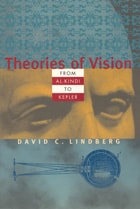
Theories of Vision from Al-kindi to Kepler
David C. Lindberg
University of Chicago Press, 1981
David C. Lindberg is professor and chairman of the department of the history of science at the University of Wisconsin, Madison.
Theorizing Histories of Rhetoric
Edited by Michelle Ballif
Southern Illinois University Press, 2013
During the decades of the 1980s and 1990s, historians of rhetoric, composition, and communication vociferously theorized historiographical motivations and methodologies for writing histories in their fields. After this fertile period of rich, contested, and impassioned theorization, scholars busily undertook the composition of numerous historical works, complicating master narratives and recovering silenced voices and rhetorical practices. Yet, though historians in these fields have gone about the business of writing histories, the discussion of theorization has been quiet. In this welcome volume, fifteen scholars consider, once again, the theory of historiography, asking difficult questions about the purposes and methodologies of writing histories of rhetoric, broadly defined, and questioning what it means, what it should mean, what it could mean to write histories of rhetoric, composition, and communication.
The topics addressed include the privileging of the literary and the textual over material artifacts as prime sources of evidence in the study of classical rhetoric, the use of rhetorical hermeneutics as a methodology for interpreting past practices, the investigation of feminist methodologies that do not fit into the dominant modes of feminist historiographical work and the examination of archives with a queer eye to better construct nondiscriminatory narratives. Contributors also explore the value of approaching historiography through the lenses of jazz improvisation and complexity theory, and the historiographical method of writing the future in ways that refigure our relationships to time and to ourselves.
Consistently thoughtful and carefully argued, these essays successfully revive the discussion of historiography in rhetoric, inspiring fresh avenues of exploration in the field.
Theorizing Myth
Narrative, Ideology, and ScholarshipBruce Lincoln
University of Chicago Press, 2000
He begins by showing that mythos yielded to logos not as part of a (mythic) "Greek miracle," but as part of struggles over political, linguistic, and epistemological authority occasioned by expanded use of writing and the practice of Athenian democracy. Lincoln then turns his attention to the period when myth was recuperated as a privileged type of narrative, a process he locates in the political and cultural ferment of the eighteenth and nineteenth centuries. Here, he connects renewed enthusiasm for myth to the nexus of Romanticism, nationalism, and Aryan triumphalism, particularly the quest for a language and set of stories on which nation-states could be founded.
In the final section of this wide-ranging book, Lincoln advocates a fresh approach to the study of myth, providing varied case studies to support his view of myth—and scholarship on myth—as ideology in narrative form.
Theorizing NGOs
States, Feminisms, and NeoliberalismVictoria Bernal and Inderpal Grewal, eds.
Duke University Press, 2014
Contributors. Sonia E. Alvarez, Victoria Bernal, LeeRay M. Costa, Inderpal Grewal, Laura Grünberg, Elissa Helms, Julie Hemment, Saida Hodžic, Lamia Karim, Sabine Lang, Lauren Leve, Kathleen O'Reilly, Aradhana Sharma
Theory And The Premodern Text
Paul Strohm
University of Minnesota Press, 2000
A major reconsideration of relations between new theories and old texts.
Medieval Studies/Literary Theory
A major reconsideration of relations between new theories and old texts. The work of Paul Strohm allies the most distinguished traditions of medieval study with the most challenging and innovative of theoretical approaches. These features, working together to revise and expand our understanding of both medieval texts and contemporary critical practice, are apparent in full and compelling force in this collection of essays, most now in print for the first time. In a range of theoretical engagements with late medieval texts, dealing with social practice, time, and narrative, this volume proposes a "practical" relation between the text and the theory that illuminates it.Insisting on the imaginative multiplicity of the text, Strohm finds in theory an augmentation of interpretive possibilities-an augmentation that sometimes requires respectful disagreement with what a work says-or seems to want known-about itself. He thus defines theory as "any standpoint from which we might challenge a text’s self-understanding." Coupled with this strategic disrespect is a new and amplified form of respect-for the text as a meaning-making system, for its unruly power and its unpredictable effects in the world.In this spirit, Strohm offers new and illustrative readings of Hoccleve’s "Male Regle" and Regiment of Princes, Ricardian coronation documents, Chaucer’s "Cook’s Tale," Capgrave’s chronicle, the Gesta Henrici Quinti, records of the king’s bench, Malory’s "Knight of the Cart," and other later medieval texts. Throughout, Strohm traverses categories of "literary" and "non-literary" in the service of a more comprehensive understanding of texts and the resourcefulness with which they accomplish their social work.Medieval Cultures Series, volume 26Translation Inquiries: University of Minnesota Press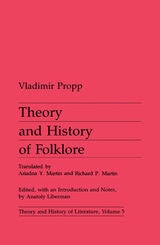
Theory and History of Folklore
Vladimir Propp
University of Minnesota Press, 1984
Theory and History of Narrative, Volume 24
Meir Sternberg
Duke University Press, 0
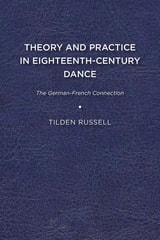
Theory and Practice in Eighteenth-Century Dance
The German-French ConnectionTilden Russell
University of Delaware Press, 2017
This book is about the intersection of two evolving dance-historical realms—theory and practice—during the first two decades of the eighteenth century. France was the source of works on notation, choreography, and repertoire that dominated European dance practice until the 1780s. While these French inventions were welcomed and used in Germany, German dance writers responded by producing an important body of work on dance theory. This book examines consequences in Germany of this asymmetrical confrontation of dance perspectives.
Between 1703 and 1717 in Germany, a coherent theory of dance was postulated that called itself dance theory, comprehended why it was a theory, and clearly, rationally distinguished itself from practice. This flowering of dance-theoretical writing was contemporaneous with the appearance of Beauchamps-Feuillet notation in the Chorégraphie of Raoul Auger Feuillet (Paris, 1700, 1701). Beauchamps-Feuillet notation was the ideal written representation of the dance style known as la belle danse and practiced in both the ballroom and the theater. Its publication enabled the spread of belle danse to the French provinces and internationally. This spread encouraged the publication of new practical works (manuals, choreographies, recueils) on how to make steps and how to dance current dances, as well as of new dance treatises, in different languages.
The Rechtschaffener Tantzmeister, by Gottfried Taubert (Leipzig, 1717), includes a translated edition of Feuillet’s Chorégraphie. Theory and Practice in Eighteenth-Century Dance addresses how Taubert and his contemporary German authors of dance treatises (Samuel Rudolph Behr, Johann Pasch, Louis Bonin) became familiar with Beauchamps-Feuillet notation and acknowledged the Chorégraphie in their own work, and how Taubert’s translation of the Chorégraphie spread its influence northward and eastward in Europe. This book also examines the personal and literary interrelationships between the German writers on dance between 1703 and 1717 and their invention of a theoria of dance as a counterbalance to dance praxis, comparing their dance-theoretical ideas with those of John Weaver in England, and assimilating them all in a cohesive and inclusive description of dance theory in Europe by 1721.
Published by University of Delaware Press. Distributed worldwide by Rutgers University Press.

Theory as Event
Humanistic Knowledge Production in Germany Since 1968Matt Erlin, André Fischer
Northwestern University Press, 2027
Shedding new light on the actors, infrastructures, and events that shaped the development of literary and cultural theory
While theory aspires by its very nature to timeless validity, the ascendency of particular intellectual paradigms at specific historical moments depends on a complex assemblage of institutional, historical, political, material, and medial factors. Theory as Event: Humanistic Knowledge Production in Germany Since 1968 reconsiders the so-called age of theory as it took shape in the German-speaking world after 1968. In invoking the term “event,” this volume draws attention to the myriad incidents and accidents that enable the creation, diffusion, and canonization of humanistic knowledge, from public controversies and debates to the circulation of various forms of print media.
By conceptualizing theory as an event, the volume also sheds new light on the quotidian, praxeological forms of knowledge production—inconspicuous but no less important acts of research, teaching, and even administration that have shaped the intellectual landscape of the humanities, from visiting professorships and habilitation defenses to the founding of new working groups. In shifting attention from the explication of individual works to these seemingly paratextual phenomena, the contributors to this collection not only offer a fresh perspective on key moments in German intellectual history; they also model a new approach to the history of ideas.

Theory in the Practice of the Nicaraguan Revolution
Bruce E. Wright
Ohio University Press, 1995
Even in the period following the electoral defeat of the Sandinista National Liberation Front (FSLN) in 1990, the revolution of 1979 continues to have a profound effect on the political economy of Nicaragua. Wright’s study, which is based on interviews with people from all walks of life—from government and party officials to academics and campesinos—as well as on the large volume of literature in both English and Spanish, focuses on the FSLN understanding of the relationships between the state, the party, and mass actors, and the nature of social classes. Wright considers the topics of agrarian reform, the development of mass organizations, the role of labor, and other aspects of the Nicaraguan political economy in order to assess their significance in theoretical as well as practical terms.

Theory of African Music, Volume I
Gerhard Kubik
University of Chicago Press, 2010
Taken together, these comprehensive volumes offer an authoritative account of the music of Africa. One of the most prominent experts on the subject, Gerhard Kubik draws on his extensive travels and three decades of study in many parts of the continent to compare and contrast a wealth of musical traditions from a range of cultures.
In the first volume, Kubik describes and examines xylophone playing in southern Uganda and harp music from the Central African Republic; compares multi-part singing from across the continent; and explores movement and sound in eastern Angola. And in the second volume, he turns to the cognitive study of African rhythm, Yoruba chantefables, the musical Kachamba family of Malaŵi, and African conceptions of space and time.
Each volume features an extensive number of photographs and is accompanied by a compact disc of Kubik’s own recordings. Erudite and exhaustive, Theory of African Music will be an invaluable reference for years to come.
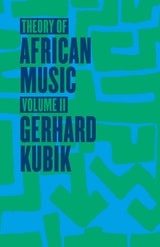
Theory of African Music, Volume II
Gerhard Kubik
University of Chicago Press, 2010
In this second volume, Kubik explores a variety of topics, including Yoruba chantefables, the musical Kachamba family of Malawˆ i, and the cognitive study of African rhythm. Drawing on his remarkable ability to make cross-cultural comparisons, Kubik illuminates every facet of the African understanding of rhythm, from timing systems to elementary pulsation. His analysis of tusona ideographs in Luchazi culture leads to an exploration of African space/time concepts that synthesizes his theories of art, rhythm, and culture.
Featuring a large number of photographs and accompanied by a compact disc of Kubik’s own recordings, Theory of African Music, Volume II, will be an invaluable reference for years to come.
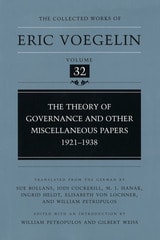
Theory of Governance and Other Miscellaneous Papers, 1921-1938 (CW32)
Eric Voegelin, Edited & Intro by William Petropulos & Gilbert Weiss, & Translated by William Petropulos, Jodi Cockerill, M. J. Hanak, Ingrid Heldt, Elisabeth von Lochner, & Sue Bollans
University of Missouri Press, 2004
This first of two volumes of Voegelin's miscellaneous papers brings together crucial writings, published for the first time, from the early, formative period of this scholar's thought. The book begins with Voegelin's dissertation on sociological method, completed under the direction of Othmar Spann and Hans Kelsen at the University of Vienna in 1922. It reveals an intimate knowledge of the writings of Georg Simmel and a skillful use of insights gained from Edmund Husserl's Logical Investigations and Ideas.
The dissertation, and other smaller pieces written at this time, addresses problems that remained of great importance to Voegelin throughout his life: the relation of insight to language, the structure of the human being, and the human's spiritual center. They disclose both Voegelin's theoretical reference points during these early years, including the thought of Henri Bergson, Othmar Spann, Georg Simmel, and Edmund Husserl, as well the young scholar's remarkably independent approach to theoretical problems.
Moreover, this volume includes a work that is fundamental to an understanding of Voegelin's theoretical development: his extended study on the "theory of governance," written between 1930 and 1932. It follows the issues that confront political society to their roots in the soul and in the soul's relationship to the ground of being.
The Theory of Governance and Other Miscellaneous Papers presents a meditative-exegetic study of texts from Augustine, Descartes, and Husserl, early examples of the meditations that became central to Voegelin's later work. Other essays included in this volume such as "Theory of Law" and "Political Theory as Human Science" develop these theoretical insights and refine Voegelin's methodological tools. This volume will be of interest to all scholars of the work of Eric Voegelin and of the refoundation of political philosophy in the twentieth century in general.

Therapeutic Revolutions
Medicine, Psychiatry, and American Culture, 1945-1970Halliwell, Martin
Rutgers University Press, 2014
Beginning with a discussion of the profound impact of World War II and the Cold War on mental health, Halliwell moves from the influence of work, family, and growing up in the Eisenhower years to the critique of institutional practice and the search for alternative therapeutic communities during the 1960s. Blending a discussion of such influential postwar thinkers as Erich Fromm, William Menninger, Erving Goffman, Erik Erikson, and Herbert Marcuse with perceptive readings of a range of cultural text that illuminate mental health issues--among them Spellbound, Shock Corridor, Revolutionary Road, and I Never Promised You a Rose Garden--this compelling study argues that the postwar therapeutic revolutions closely interlink contrasting discourses of authority and liberation.

Therapeutic Revolutions
Pharmaceuticals and Social Change in the Twentieth CenturyEdited by Jeremy A. Greene, Flurin Condrau, and Elizabeth Siegel Watkins
University of Chicago Press, 2016
This collection challenges the historical accuracy of this revolutionary narrative and offers instead a more nuanced account of the process of therapeutic innovation and the relationships between the development of medicines and social change. These assembled histories and ethnographies span three continents and use the lived experiences of physicians and patients, consumers and providers, and marketers and regulators to reveal the tensions between universal claims of therapeutic knowledge and the actual ways these claims have been used and understood in specific sites, from postwar West Germany pharmacies to twenty-first century Nigerian street markets. By asking us to rethink a story we thought we knew, Therapeutic Revolutions offers invaluable insights to historians, anthropologists, and social scientists of medicine.
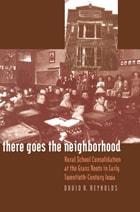
There Goes the Neighborhood
Rural School Consolidation at the Grass Roots in Early Twentieth-Century IowaDavid R. Reynolds
University of Iowa Press, 2002
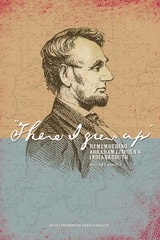
There I Grew Up
Remembering Abraham Lincoln's Indiana YouthWilliam E. Bartelt
Indiana Historical Society Press, 2008
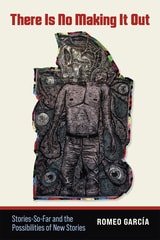
There Is No Making It Out
Stories-So-Far and the Possibilities of New StoriesRomeo García
Utah State University Press, 2025
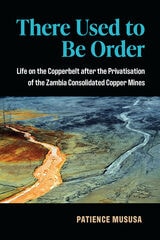
There Used to Be Order
Life on the Copperbelt after the Privatisation of the Zambia Consolidated Copper MinesPatience Mususa
University of Michigan Press, 2021
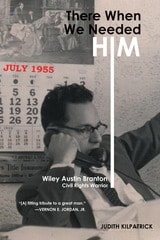
There When We Needed Him
Wiley Austin Branton, Civil Rights WarriorJudith Kilpatrick
University of Arkansas Press, 2007
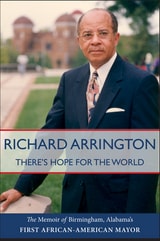
There's Hope for the World
The Memoir of Birmingham, Alabama's First African American MayorRichard Arrington
University of Alabama Press, 2008
On a sultry September morning in 1955, a young African American man, the son of share croppers, boarded a Greyhound bus in Birmingham, Alabama, to leave his home state for the first time in his life. He was headed for the University of Detroit on a teaching scholarship from MilesCollege. Richard Arrington could not have guessed then that his future as a teacher would be postponed for decades by big-city politics--and that he would serve a record-setting five terms as chief executive of Alabama’s largest city.
Under Arrington’s leadership, Birmingham rebuilt itself from a foundering, steel-driven industrial center to one of the most diversified metropolitan areas in the Southeast, with an economy fueled by health care, biomedical research, engineering, telecommunications, and banking. As mayor, Arrington’s economic legacy is impressive. When he left office, Birmingham boasted a record number of jobs and the lowest unemployment rate in its history. Additionally, Birmingham had built the strongest tax base in Alabama, expanded its city limits by 60 square miles, reduced crime to its lowest level in 25 years, and funded a $260 million school construction program. Today Birmingham is financially sound and is the only city in the Southeast with a $100 million endowment fund.
There's More to New Jersey than the Sopranos
Mappen, Marc
Rutgers University Press, 2009
Even fans of that popular show, one that held viewers captive, may be a bit disheartened to discover that the first thing that pops into minds around the world about New Jersey is a dysfunctional crime family, just an exit or two off the infamous N.J. Turnpike. But there's no need to live in fear that the only culture and history that the state is known for is, well, let's say, a bit of bada bing. Actually, the echo of the Big Bangùthe cosmic event that marked the birth of our universe some 13.7 billion years agoùwas first identified by scientists from Bell Labs in Murray Hill, New Jersey.
In this lively romp through history from the primitive past to the present day, Marc Mappen's message resonatesùThere's More to New Jersey than the Sopranos. Real tales, wise tales, tall tales abound throughout the pages of Mappen's collection, filled with zest, humor, scandal, and occasionally tragedy. Annie Oakley. Ulysses S. Grant. Benedict Arnold. Ezra Pound. Shoeless Joe Jackson. These luminaries and many others share a common bond with the state that witnessed prehistoric elephants roaming its pastures, the explosion on the USS Princeton, a Martian invasion, famous firsts like the phonograph, electric light, and movies, and, well, step aside Tony Soprano: mobster Al Capone strolling along the Atlantic City boardwalk.
Providing a lens into American history through lively prose and more than twenty-five illustrations, There's More to New Jersey than the Sopranos is as much fun as a trip to the Jersey Shore and definitely more rewarding than a night home watching televisionù simply stated, this book is one you can't refuse to read.

These Are the Breaks
The Origins of Hip HopEugene Stein
University of Illinois Press, 2027
Stein combines granular detail, oral histories, and analyses from economic geography and Black geographies to reveal the urban environment’s effect on the lives and artistic activities of young people. Himself a Bronx native, Stein grew up in the unpredictable New York City of the 1970s and witnessed a cascade of economic distress, structural racism, city-wide fiscal catastrophe, and the borough’s housing crisis. As he shows, these and other factors primed pioneering rappers, DJs, and other artists to aim at success and outclass rivals by developing new styles. Housing policies and population movements, meanwhile, both tore apart social networks and provided the need and impetus for new and nurturing cultural communities.
Expansive and innovative, These Are the Breaks chronicles how a generation of Black and Latino youth transformed hardship into identity, competition, community, and art.
These Colored United States
African American Essays from the 1920sLutz, Tom
Rutgers University Press, 1996
"This series of essays from a crucial journal of the Harlem Renaissance epitomizes the diversity of middle-class African American intellectual culture of the 1920s, while the headnotes and introduction deftly articulate the complex social and institutional matrix from which the series emerged."––George Hutchinson, University of Tennessee, author of The Harlem Renaissance in Black and White
Originally published in The Messenger, “the most vibrant and controversial black journal in the nation” at the time, these essays represent an unexamined chapter in African American cultural history and provide a unique overview of social and cultural life during this crucial decade for race relations in the United States. While most scholarly attention on African American culture in the 1920s has focused on life in the major East Coast cities or the South, these essays are written by a highly diverse, eclectic group of African American writers from thirty different states, charged with assessing African American life in their home state. Socialists and pro-business writers, cultural nationalists and assimilationists, fiction writers, sociologists, theater critics, representatives of the New Negro group, the NAACP, and the union movement, and a series of idiosyncratic, nonaligned writers help give a full sense of the diversity of African American intellectual and cultural life in the 1920s.
Amont the essayists are Anita Scott Coleman, WIlliam H. Ferris, Alice Dunbar-Nelson, Charles S. Johnson, E. Franklin Frazier, Theophilus Lewis, Wallace Thurman, Roy Wilkins, George Schuyler, and Mamie Elaine Francis. The focus on the actual lived experience of African Americans across the nation provides copious materials for cultural study unavailable in any other collection.
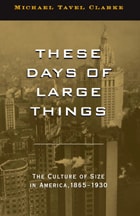
These Days of Large Things
The Culture of Size in America, 1865-1930Michael Tavel Clarke
University of Michigan Press, 2009
The United States at the turn of the twentieth century cultivated a passion for big. It witnessed the emergence of large-scale corporate capitalism; the beginnings of American imperialism on a global stage; record-level immigration; a rapid expansion of cities; and colossal events and structures like world's fairs, amusement parks, department stores, and skyscrapers. Size began to play a key role in American identity. During this period, bigness signaled American progress.
These Days of Large Things explores the centrality of size to American culture and national identity and the preoccupation with physical stature that pervaded American thought. Clarke examines the role that body size played in racial theory and the ways in which economic changes in the nation generated conflicting attitudes toward growth and bigness. Finally, Clarke investigates the relationship between stature and gender.
These Days of Large Things brings together a remarkable range of cultural material including scientific studies, photographs, novels, cartoons, architecture, and film. As a general cultural and intellectual history of the period, this work will be of interest to students and scholars in American studies, U.S. history, American literature, and gender studies.
Michael Tavel Clarke is Assistant Professor of English at the University of Calgary.
Cover photograph: "New York from Its Pinnacles," Alvin Langdon Coburn (1912). Courtesy of the George Eastman House.
"A fascinating study of the American preoccupation with physical size, this book charts new paths in the history of science, culture, and the body. A must-read for anyone puzzling over why Americans today love hulking SUVs, Mcmansions, and outsized masculine bodies."
---Lois Banner, University of Southern California
"From the Gilded Age through the Twenties, Clarke shows a nation-state obsessed with sheer size, ranging from the mammoth labor union to the 'Giant Incorporated Body' of the monopoly trust. These Days of Large Things links the towering Gibson Girl with the skyscraper, the pediatric regimen with stereotypes of the Jew. Spanning anthropology, medicine, architecture, business, and labor history, Clarke provides the full anatomy of imperial America and offers a model of cultural studies at its very best."
---Cecelia Tichi, Vanderbilt University

These Granite Islands
A NovelSarah Stonich
University of Minnesota Press, 2013
These Granite Islands is an arresting novel about a woman who, on her deathbed, recalls the haunting and fateful summer of 1936, a summer that forever changed her life. Sarah Stonich’s debut novel, set on the Iron Range of Minnesota, is an intimate and gripping story of a friendship, a portrait of marriage, and a meditation on the tragedy of loss.
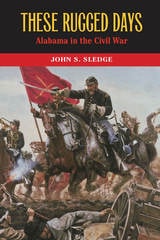
These Rugged Days
Alabama in the Civil WarJohn S. Sledge
University of Alabama Press, 2017
Alabama’s Civil War story—told with grit, grace, and truth.
In These Rugged Days: Alabama in the Civil War, John S. Sledge offers a riveting and readable account of Alabama’s Civil War saga. Focused on the conflict’s turning points within the state’s borders, Sledge recounts residents’ experiences from secession’s early days to its tumultuous collapse, when 75,000 blue-coated soldiers were on the move statewide. Sledge brings these tumultuous years to life in an impressive array of primary and secondary sources, including official records, diaries, newspapers, memoirs, correspondence, sketches, and photographs. He also highlights such colorful personalities as John Pelham, the youthful Jacksonville artillerist who was shipped home in an iron casket with a glass faceplate; Gus Askew, a nine-year-old Barbour County slave who vividly recalled the day the Yankees marched in; Augusta Jane Evans, the Mobile novelist who was given a gold pen by a daring blockade runner; and Emma Sansom, a plucky Gadsden teenager who acted as a scout and guide to Nathan Bedford Forrest.
These Rugged Days is an enthralling tale of action, courage, pride, and tragedy. The Civil War has left indelible marks on Alabama’s land, culture, economy, and people, and Sledge offers a refreshing take on the state's role in the conflict. His narrative is a dramatic account that will be enjoyed by lay readers as well as students and scholars of Alabama and the Civil War.

These Valiant Dead
Past Shakespeare'S HistoriesRobert C. Jones
University of Iowa Press, 1991
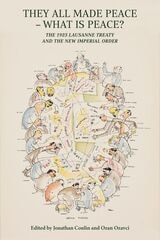
They All Made Peace—What Is Peace?
The 1923 Lausanne Treaty and the New Imperial OrderEdited by Jonathan Conlin and Ozan Ozavci
Gingko, 2023
The last of the post-World War One peace settlements, the 1923 Treaty of Lausanne departed from methods used in the Treaty of Versailles and took on a new peace-making initiative: a forced population exchange that affected one and a half million people. Like its German and Austro-Hungarian allies, the defeated Ottoman Empire had initially been presented with a dictated peace in 1920. In just two years, however, the Kemalist insurgency enabled Turkey to become the first sovereign state in the Middle East, while the Greeks, Armenians, Arabs, Egyptians, Kurds, and other communities previously under the Ottoman Empire sought their own forms of sovereignty.
Featuring historical analysis from multiple perspectives, They All Made Peace, What Is Peace? considers the Lausanne Treaty and its legacy. Chapters investigate British, Turkish, and Soviet designs in the post-Ottoman world, situate the population exchanges relative to other peacemaking efforts, and discuss the economic factors behind the reallocation of Ottoman debt and the management of refugee flows. Further chapters examine Kurdish, Arab, Iranian, Armenian, and other communities that were refused formal accreditation at Lausanne, but which were still forced to live with the consequences, consequences that are still emerging, one hundred years on.
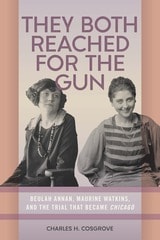
They Both Reached for the Gun
Beulah Annan, Maurine Watkins, and the Trial That Became ChicagoCharles H. Cosgrove
Southern Illinois University Press, 2024
Honorable Mention, 2025 Society of Midland Authors Award in History!
Examining the case that inspired a pop culture phenomenon
In 1924 Beulah Annan was arrested and incarcerated for killing her lover, Harry Kalsted. Six weeks later, a jury acquitted her of murder. Inspired by the sordid event, trial, and acquittal, Maurine Watkins, a reporter at the time, wrote the play Chicago, a Broadway hit that was adapted several times. Through a fresh retelling of the story of Annan and of Watkins’s play, Charles H. Cosgrove provides the first critical examination of the criminal case, and an initial exploration of the era’s social assumptions that made the message of the play so plausible in its own time. His careful historical research challenges the received portrait of Annan as a killer who got away with murder, and of Watkins as a savvy cub reporter and precocious playwright.
In They Both Reached for the Gun, Charles H. Cosgrove expertly combines inquest and police records, and interviews with Annan’s relatives, to analyze the participants, the trial, and the subsequent play. Although no one will ever know what really happened in the Kenwood apartment on Chicago’s south side one hundred years ago, Cosgrove’s interrogation shows how sensationalized Watkins’s writing was. Her reporting on the Annan case perpetuated falsehoods about Annan’s so-called “confession,” and her play gave an inaccurate portrayal of Chicago’s criminal justice system. Despite Watkins’s insistence that her drama revealed the truth about its subjects without any exaggeration, her play depicted police, prosecutors, and judges as the only “good guys” in the story, ignoring those who lied, misled, and used brutal methods to obtain forced confessions.

They Call You Back
A Lost History, A Search, A MemoirTim Z. Hernandez
University of Arizona Press, 2024
A haunting, an obsession, a calling: Tim Z. Hernandez has been searching for people his whole life. Now, in this highly anticipated memoir, he takes us along on an investigative odyssey through personal and collective history to uncover the surprising conjunctions that bind our stories together.
Hernandez’s mission to find the families of the twenty-eight Mexicans who were killed in the 1948 plane wreck at Los Gatos Canyon formed the basis for his acclaimed documentary novel All They Will Call You, which the San Francisco Chronicle dubbed “a stunning piece of investigative journalism,” and the New York Times hailed as “painstaking detective work by a writer who is the descendant of farmworkers.”
In this riveting new work, Hernandez continues his search for the plane crash victims while also turning the lens on himself and his ancestral past, revealing the tumultuous and deeply intimate experiences that have fueled his investigations—a lifelong journey haunted by memory, addiction, generational trauma, and the spirit world.
They Call You Back is the true chronicle of one man’s obsession to restore dignity to an undignified chapter in America’s past, while at the same time making a case for why we must heal our personal wounds if we are ever to heal our political ones.
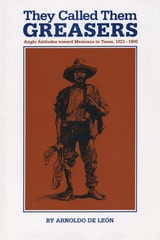
They Called Them Greasers
Anglo Attitudes toward Mexicans in Texas, 1821–1900by Arnoldo De León
University of Texas Press, 1983
Tension between Anglos and Tejanos has existed in the Lone Star State since the earliest settlements. Such antagonism has produced friction between the two peoples, and whites have expressed their hostility toward Mexican Americans unabashedly and at times violently.
This seminal work in the historical literature of race relations in Texas examines the attitudes of whites toward Mexicans in nineteenth-century Texas. For some, it will be disturbing reading. But its unpleasant revelations are based on extensive and thoughtful research into Texas' past. The result is important reading not merely for historians but for all who are concerned with the history of ethnic relations in our state.
They Called Them Greasers argues forcefully that many who have written about Texas's past—including such luminaries as Walter Prescott Webb, Eugene C. Barker, and Rupert N. Richardson—have exhibited, in fact and interpretation, both deficiencies of research and detectable bias when their work has dealt with Anglo-Mexican relations. De León asserts that these historians overlooled an austere Anglo moral code which saw the morality of Tejanos as "defective" and that they described without censure a society that permitted traditional violence to continue because that violence allowed Anglos to keep ethnic minorities "in their place."
De León's approach is psychohistorical. Many Anglos in nineteenth-century Texas saw Tejanos as lazy, lewd, un-American, subhuman. In De León's view, these attitudes were the product of a conviction that dark-skinned people were racially and culturally inferior, of a desire to see in others qualities that Anglos preferred not to see in themselves, and of a need to associate Mexicans with disorder so as to justify their continued subjugation.
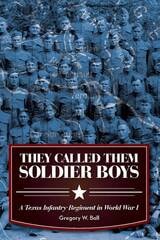
They Called Them Soldier Boys
A Texas Infantry Regiment in World War IGregory W. Ball
University of North Texas Press, 2013
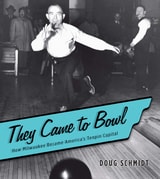
They Came to Bowl
How Milwaukee Became America’s Tenpin CapitalDoug Schmidt
Wisconsin Historical Society Press, 2007
A frozen rope. A urethane split on the drives. Chicken tracks on the telescore.* Do you know your bowling lingo? You will along with much more when you read They Came to Bowl: How Milwaukee Became America's Tenpin Capital. From the thrill of the perfect strike to the agony of a ball gone astray, anyone who has rolled a ball down the lanes will find themselves or someone they know in the people, places and stories covered in this book.
In this authoritative and lively book, Doug Schmidt traces bowling's roots from a German religious rite centuries ago to the sport that made Milwaukee famous. From the taverns and saloons that housed recreational games to the sell-out crowds and million-dollar beer sponsorships of televised tournaments, this well-illustrated book covers both sport and city, charting the changing face of bowling over the century. Packed with memorable showdowns and improbable heroes, They Came to Bowl will take you back to the changing lanes of bowling in Milwaukee — and the sport as a whole.
* frozen rope=a ball rolled with excessive speed almost straight to the pocket; urethane split=2-8-10 or 3-7-9 split caused by sharp breaking point of reactive resin balls; drives=alleys; chicken tracks=string of strikes

They Came to Japan
An Anthology of European Reports on Japan, 1543-1640Michael Cooper, Editor
University of Michigan Press, 1995
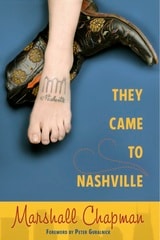
They Came to Nashville
Marshall Chapman
Vanderbilt University Press, 2010
In They Came to Nashville, Chapman records the personal stories of musicians shaping the modern history of music in Nashville, from the mouths of the musicians themselves. The trials, tribulations, and evolution of Music City are on display, as she sits down with influential figures like Kris Kristofferson, Emmylou Harris, and Miranda Lambert, and a dozen other top names, to record what brought each of them to Nashville and what inspired them to persevere. The book culminates in a hilarious and heroic attempt to find enough free time with Willie Nelson to get a proper interview. Instead, she's brought along on his raucous 2008 tour and winds up onstage in Beaumont, Texas singing "Good-Hearted Woman" with Willie.
They Came to Nashville reveals the daily struggle facing newcomers to the music business, and the promise awaiting those willing to fight for the dream.
Co-published with the Country Music Foundation Press
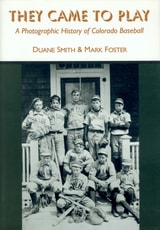
They Came to Play
A Photographic History of Colorado BaseballDuane A. Smith
University Press of Colorado, 2012
In They Came To Play: A Photographic History of Colorado Baseball, historians and avid baseball fans Duane Smith and Mark Foster have collected the finest historic baseball photographs of teams, players, and games from around the state. They are all here, the town teams, company teams, early professional clubs, and the ethnic teams that made baseball an integral part of the life and times in Colorado's mountain towns, prairie hamlets, and bustling frontier cities. Combined with the wonderful photographs and captions is an essay that brings baseball's rich heritage in Colorado to life for the reader.
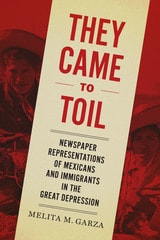
They Came to Toil
Newspaper Representations of Mexicans and Immigrants in the Great DepressionBy Melita M. Garza
University of Texas Press, 2018
As the Great Depression gripped the United States in the early 1930s, the Hoover administration sought to preserve jobs for Anglo-Americans by targeting Mexicans, including long-time residents and even US citizens, for deportation. Mexicans comprised more than 46 percent of all people deported between 1930 and 1939, despite being only 1 percent of the US population. In all, about half a million people of Mexican descent were deported to Mexico, a “homeland” many of them had never seen, or returned voluntarily in fear of deportation.
They Came to Toil investigates how the news reporting of this episode in immigration history created frames for representing Mexicans and immigrants that persist to the present. Melita M. Garza sets the story in San Antonio, a city central to the formation of Mexican American identity, and contrasts how the city’s three daily newspapers covered the forced deportations of Mexicans. She shows that the Spanish-language La Prensa not surprisingly provided the fullest and most sympathetic coverage of immigration issues, while the locally owned San Antonio Express and the Hearst chain-owned San Antonio Light varied between supporting Mexican labor and demonizing it. Garza analyzes how these media narratives, particularly in the English-language press, contributed to the racial “othering” of Mexicans and Mexican Americans. Adding an important new chapter to the history of the Long Civil Rights Movement, They Came to Toil brings needed historical context to immigration issues that dominate today’s headlines.
They Came to Wisconsin
Julia Pferdehirt
Wisconsin Historical Society Press, 2002
They Came to Wisconsin presents three themes of the state’s immigrant history: leaving the homeland, making the journey, and enduring the first year of settlement. Journal and diary entries and letters from European groups and oral histories from African American, Latino, Hmong, and Amish sources make this book dynamic and wholly inclusive. They Came to Wisconsin breaks fresh ground in presenting document-centered Wisconsin history to a young audience. More important, these firsthand stories add a real human dimension to history, helping students to compare the experiences of the varied groups who came to Wisconsin in the last two hundred years.
Distributed for the Wisconsin Historical Society Press.
They Came to Wisconsin
Teacher's Guide and Student MaterialsHarriet Brown
Wisconsin Historical Society Press, 2002
Distributed for the Wisconsin Historical Society Press.

They Fought at Anzio
John S. D. Eisenhower
University of Missouri Press, 2025
Italy, from the toe to the Alps, was the scene of the longest, bloodiest, most frustrating, and least understood series of battles fought by the Western Allies during World War II. Now, John S. D. Eisenhower offers a new look at the Italian campaign, emphasizing the Anzio offensive—an operation pushed by Winston Churchill that fell largely to American troops to carry out. It was visualized as an amphibious landing of two Allied divisions behind German lines that would force the Wehrmacht to evacuate all of Italy. But the Germans held on and, with the arrival of reinforcements, nearly wiped out the Allied troops pinned down at Anzio Beach.
By portraying that struggle from the perspectives of both commanders and foot soldiers, this prominent military historian focuses on the experiences of the individuals who fought in the Italian campaign to reveal what the battle at Anzio was all about. But more than the account of one operation, They Fought at Anzio covers the entire Italian campaign, from the landings at Salerno to the capture of Rome.
Eisenhower brings a trained eye to reconstructing the difficult terrain of battle, approaching the Anzio campaign as a contest between opposing commands striving to anticipate and counter the opponent’s moves—not as a field exercise but as a deadly struggle for survival. He analyzes the command decisions that brought about the Anzio stalemate, interspersing his account with personal experiences of the men in the trenches, the nurses of the 56th Evacuation Hospital, and the young officers witnessing the horrors of war for the first time.
As a study in command, Eisenhower’s narrative gives new credit to generals Lucian Truscott and Fred Walker and assesses both the strengths and weaknesses of General Mark Clark, allowing us to grasp the situation as it appeared to those in command. He also offers compelling portraits of German commanders Field Marshal Albert Kesselring and General Frido von Senger und Etterlin.
It has been said that Anzio was a soldier’s battle, remembered more for blood shed than for military objectives achieved. By focusing on the experiences of the soldiers who fought there and the decisions of commanders in perilous circumstances, They Fought at Anzio offers a new appreciation of the contributions of both and a new understanding of this unheralded theater of the war.
They Met at Wounded Knee
The Eastmans' StoryGretchen Cassel Eick
University of Nevada Press, 2020
They Sang for Horses
The Impact of the Horse on Navajo and Apache FolkloreLaVerne Harrell Clark
University Press of Colorado, 2001
No Native American groups placed more emphasis on the horse in their lives than did the Navajo and Apache of the Southwest. They Sang for Horses, first published in 1966 and now considered a classic, remains the only comprehensive treatment of the profound mystical influence that the horse has exerted for more than 300 years.
In this completely redesigned and expanded edition, LaVerne Harrell Clark examines how storytellers, singers, medicine men, and painters created the animal's evolving symbolic significance by adapting existing folklore and cultural symbols. Exploring the horse's importance in ceremonies, songs, prayers, customs, and beliefs, she investigates the period of the horse's most pronounced cultural impact on the Navajo and the Apache, starting from the time of its acquisition from the Spanish in the seventeenth century and continuing to the mid-1960s, when the pickup truck began to replace it as the favored means of transportation. In addition, she presents a look at how Navajos and Apaches today continue to redefine the horse's important role in their spiritual as well as material lives.
This classic work is a must for historians, readers interested in Native American folklore and mythology, and anyone who has ever been captivated by the magic and romance of the horse.
They Sought a Land
A Settlement in the Arkansas River Valley, 1840–1870William Oates Ragsdale
University of Arkansas Press, 1997
Pisgah grew and prospered, developing increasingly successful farming practices, landholding patterns, and trading strategies. But the Civil War took a heavy toll, taking workers away from farms, subjecting those left on the home front to deprivation and violence, and creating division in the community. By 1870, the people of Pisgah had dispersed into Arkansas’s larger developing society.
Absorbing to read and rich with colorful detail, They Sought a Land is an important story of the westward expansion of the United States and the settling of the American South during the nineteenth century.
They Thought They Were Free
The Germans, 1933-45Milton Mayer
University of Chicago Press, 1966
“What happened here was the gradual habituation of the people, little by little, to being governed by surprise; to receiving decisions deliberated in secret; to believing that the situation was so complicated that the government had to act on information which the people could not understand, or so dangerous that, even if the people could not understand it, it could not be released because of national security. And their sense of identification with Hitler, their trust in him, made it easier to widen this gap and reassured those who would otherwise have worried about it.”--from Chapter 13, “But Then It Was Too Late”