Results by title
28250 books match the query 'History' and 6388 start with t

Twenty-Five Years in the Black Belt
William J. Edwards
University of Alabama Press, 1993
A pioneering educator's firsthand account of building opportunity and hope in Alabama's Black Belt.
Twenty-Five Years in the Black Belt is one of the most important firsthand accounts of African American educational leadership and community development in the post-Reconstruction South. Originally published in 1918, this memoir by educator and institution-builder William J. Edwards documents his extraordinary efforts to create educational opportunities for Black citizens in Alabama's Black Belt during a period marked by segregation, economic hardship, and limited access to public resources.
Born in Snow Hill, Alabama, in 1869, Edwards rose from humble beginnings to attend the Tuskegee Institute under the leadership of Booker T. Washington. Inspired by Tuskegee's philosophy of education, self-reliance, and community advancement, he returned to rural Alabama determined to establish an institution that could provide both academic and practical instruction to African American students. His efforts led to the founding of the Snow Hill Institute in 1893, a school that became a vital center of learning and leadership for generations of Black Alabamians.
The memoir also offers valuable insight into the educational philosophies that shaped African American advancement in the late nineteenth and early twentieth centuries. Edwards reflects on the influence of Booker T. Washington, the role of industrial and vocational education, fundraising efforts in the North, the Jeanes Fund, public-school reform, and the broader movement for racial uplift through education. His account illuminates the networks of educators, supporters, and community leaders who worked to expand opportunities for African Americans throughout the South.
At once inspirational and historically significant, Twenty-Five Years in the Black Belt remains an essential source for understanding African American education, Southern race relations, and the determination of Black communities to create institutions that fostered dignity, opportunity, and progress. It stands as both a personal testament and a crucial historical document chronicling a transformative era in American history.

Twenty-Three Minutes to Eternity
The Final Voyage of the Escort Carrier USS Liscome BayJames L. Noles
University of Alabama Press, 2004

Twenty-one Texas Short Stories
Edited by William Peery
University of Texas Press, 1954
This is a splendid collection of stories about Texas by Texans—stories that appeared in leading magazines in the first half of the twentieth century.
Authors in this volume:
- Dillon Anderson
- Barry Benefield
- Charles Carver
- Margaret Cousins
- Chester T. Crowell
- Eugene Cunningham
- J. Frank Dobie
- Fred Gipson
- William Goyen
- O. Henry
- Sylvan Karchmer
- Harry Kidd, Jr.
- Mary King O’Donnell
- George Pattullo
- George Sessions Perry
- Katherine Anne Porter
- Winifred Sanford
- John W. Thomason, Jr.
- Thomas Thompson
- John Watson
- John W. Wilson

Twilight of Impunity
The War Crimes Trial of Slobodan MilosevicJudith Armatta
Duke University Press, 2010

Twilight of the American State
Pierre Schlag
University of Michigan Press, 2023
Finalist: 2024 Order of the Coif Book Award | March 3, 2025
The sudden emergence of the Trump nation surprised nearly everyone, including journalists, pundits, political consultants, and academics. When Trump won in 2016, his ascendancy was widely viewed as a fluke. Yet time showed it was instead the rise of a movement—angry, militant, revanchist, and unabashedly authoritarian.
How did this happen? Twilight of the American State offers a sweeping exploration of how law and legal institutions helped prepare the grounds for this rebellious movement. The controversial argument is that, viewed as a legal matter, the American state is not just a liberal democracy, as most Americans believe. Rather, the American state is composed of an uneasy and unstable combination of different versions of the state—liberal democratic, administered, neoliberal, and dissociative. Each of these versions arose through its own law and legal institutions. Each emerged at different times historically. Each was prompted by deficits in the prior versions. Each has survived displacement by succeeding versions. All remain active in the contemporary moment—creating the political-legal dysfunction America confronts today.
Pierre Schlag maps out a big picture view of the tribulations of the American state. The book abjures conventional academic frameworks, sets aside prescriptions for quick fixes, dispenses with lamentations about polarization, and bypasses historical celebrations of the American Spirit.

Twin Cities Sports
Games for All SeasonsSheldon Anderson
University of Arkansas Press, 2020

Twin States, Different Paths
The Politics of New Hampshire and VermontBrian L. Porto
University of Massachusetts Press, 2026
A cultural and policy history that explains why two neighboring states developed divergent attitudes toward government and culture
At first glance, New Hampshire and Vermont seem like mirror images. Separated only by the Connecticut River, the oft-termed “Twin States” share a common history, relatively small populations, and heavily mountainous and forested landscapes dotted with small towns. Yet despite their similarities, they have evolved strikingly different political cultures, with Vermont prizing cooperation and community and New Hampshire celebrating independence and freedom from government. Perhaps nowhere is this divergence in political visions more pronounced than in their respective state mottos: Vermont’s communal "Freedom and Unity" and New Hampshire’s libertarian “Live Free or Die.”
Twin States, Different Paths explores these contrasting political cultures. Brian Porto traces these differences back to the land itself: to the geology and geography that shaped early settlement, patterns of land use, and the distinct ways people built their communities. From these origins emerged two enduring civic philosophies—New Hampshire’s devotion to low taxes and limited government, and Vermont’s emphasis on equality and shared responsibility. Bringing historical and cultural analysis together with contemporary case studies, Porto examines how these traditions influence each state’s approach to today’s policy challenges, including affordable housing and public-school funding. The result is a clear, balanced portrait of how deeply rooted attitudes toward freedom, unity, and governance continue to shape public life in both states.
Written with scholarly rigor yet in an engaging and accessible style, Twin States, Different Paths fills a notable gap in the study of New England politics. It offers insights not only for scholars and students of political culture, history, and public policy, but also for general readers, policymakers, and residents who wish to understand how two neighbors—so similar in geography and spirit—continue to follow such different paths in defining the role of government and community.

Twin Towers
Gillespie, Angus K
Rutgers University Press, 1999
A readable account of both the history of the construction of the Twin Towers and the life of the people who work there.
The Twin Towers of the World Trade Center are more than office buildings. They are symbols of America, just as the Eiffel Tower and Big Ben represent their countries. Commissioned in 1962 and completed in 1976, these edifices are still the tallest man-made structures in New York City. Indeed, the builders intended the towers to make a statement about the importance of the Port of New York and New Jersey. The complex rises like Emerald City, with fountains and sculpture from what was once a dilapidated area of half-abandoned stores.
Folklorist Angus Gillespie takes us on a tour that goes back in time and continues to the present day. He recounts the political maneuvering necessary to get the State of New Jersey to agree to situate the project at its present location. Deftly presenting portraits of the men responsible for mooring the World Trade Center at its present location, Gillespie provides ample evidence that the World Trade Center backers were “second to none in self promotion.”
Twin Towers also demonstrates how engineers prepared the site and solved complex problems (wind patterns, elevator placement, ground-water complications) in order to erect the towers, each with 110 stories. And he discusses the contrast between the architectural community’s almost universal disdain for the towers’ design and the public’s enthusiastic acceptance of the buildings as a symbol of New York.
There is more to the Twin Towers than its architecture, however. People give this complex life, purpose, vibrancy, Gillespie points out. The World Trade Center houses more than 400 businesses and organizations from some 60 different countries engaged in a broad range of international business activities. Through his numerous first-hand interviews conducted with the people who daily work there, Gillespie vividly portrays the world of bankers, shippers, freight forwarders, and traders. With skill and insight, he captures what happens during a normal 24-hour day in the Twin Towers, starting with early morning food deliveries and ending with the patrols of nighttime security guards.
Twin Towers is both a fitting tribute and careful analysis of one of the most resonating symbols in American culture.

Twisted Words
Torture and Liberalism in Imperial BritainKatherine Judith Anderson
The Ohio State University Press, 2022

Two Arabs, a Berber, and a Jew
Entangled Lives in MoroccoLawrence Rosen
University of Chicago Press, 2015
Through the intellectual lives of these four men, this book explores a number of interpretative and theoretical issues that have made Arab culture distinct, especially in relationship to the West: how nothing is ever hard and fast, how everything is relational and always a product of negotiation. It showcases the vitality of the local in a global era, and it contrasts Arab notions of time, equality, and self with those in the West. Likewise, Rosen unveils his own entanglement in their world and the drive to keep the analysis of culture first and foremost, even as his own life enmeshes itself in those of his study. An exploration of faith, politics, history, and memory, this book highlights the world of everyday life in Arab society in ways that challenge common notions and stereotypes.

Two Bits
The Cultural Significance of Free SoftwareChristopher M. Kelty
Duke University Press, 2008
Drawing on ethnographic research that took him from an Internet healthcare start-up company in Boston to media labs in Berlin to young entrepreneurs in Bangalore, Kelty describes the technologies and the moral vision that bind together hackers, geeks, lawyers, and other Free Software advocates. In each case, he shows how their practices and way of life include not only the sharing of software source code but also ways of conceptualizing openness, writing copyright licenses, coordinating collaboration, and proselytizing. By exploring in detail how these practices came together as the Free Software movement from the 1970s to the 1990s, Kelty also considers how it is possible to understand the new movements emerging from Free Software: projects such as Creative Commons, a nonprofit organization that creates copyright licenses, and Connexions, a project to create an online scholarly textbook commons.

Two Dreams in One Bed
Empire, Social Life, and the Origins of the North Korean Revolution in ManchuriaHyun Ok Park
Duke University Press, 2005
Drawing on a rich archive of Korean, Japanese, and Chinese sources, Park describes how Koreans negotiated the contradictory demands of national and colonial powers. She demonstrates that the dynamics of global capitalism led the Chinese and Japanese to pursue capitalist expansion while competing for sovereignty. Decentering the nation-state as the primary analytic rubric, her emphasis on the role of global capitalism is a major innovation for understanding nationalism, colonialism, and their immanent links in social space.
Through a regional and temporal comparison of Manchuria from the late nineteenth century until 1945, Park details how national and colonial powers enacted their claims to sovereignty through the regulation of access to land, work, and loans. She shows that among Korean migrants, the complex connections among Chinese laws, Japanese colonial policies, and Korean social practices gave rise to a form of nationalism in tension with global revolution—a nationalism that laid the foundation for what came to be regarded as North Korea’s isolationist politics.

Two Lenins
A Brief Anthropology of TimeNikolai Ssorin-Chaikov
HAU, 2017
Nikolai Ssorin-Chaikov grounds his theoretical exploration in fascinating ethnographic and historical material on two Lenins: the first is the famed Soviet leader of the early twentieth century, and the second is a Siberian Evenki hunter—nicknamed “Lenin”—who experienced the collapse of the USSR during the 1990s. Through their intertwined stories, Ssorin-Chaikov unveils new dimensions of ethnographic reality by multiplying our notions of time.
Ssorin-Chaikov examines Vladimir Lenin at the height of his reign in 1920s Soviet Russia, focusing especially on his relationship with American businessperson Armand Hammer. He casts this scene against the second Lenin—the hunter on the far end of the country, in Siberia, at the far end of the century, the 1990s, who is tasked with improvising postsocialism in the economic and political uncertainties of post-Soviet transition. Moving from Moscow to Siberia to New York, and traveling form the 1920s to the 1960s to the 1990’s, Ssorin-Chaikov takes readers beyond a simple global history or cross-temporal comparison, instead using these two figures to enact an ethnographic study of the very category of time that we use to bridge different historical contexts.

Two Lives of Saint Colette
With a Selection of Letters by, to, and about ColettePierre de Vaux and Sister Perrine de Baume
Iter Press, 2022
Saint Colette of Corbie (1381–1447) was a French reformer of the Franciscan Order and the founder of seventeen convents. Though of humble origin, she attracted the support of powerful patrons and important Church officials. The two biographies translated here were authored by Pierre de Vaux, her confessor and mentor, and Perrine de Baume, a nun who for decades was Colette’s companion and confidant. Both accounts offer fascinating portraits of the saint as a pious ascetic assailed by demons and performing miracles, as well as in her role as skillful administrator and caring mother of her nuns. This is the first English translation of two biographies in Middle French of the most important female figures of the Middle Ages.

Two NATO Allies at the Threshold of War
Parker T. Hart
Duke University Press, 1990
Hart has relied on his own papers from the period, as well as on United Nations sources from the Lyndon B. Johnson Presidential Library, and on the papers of the other key participants in the Crisis, Ambassador to Greece Phillips Talbot, Ambassador to Cyprus Taylor G. Belcher, and Cyrus Vance, to provide a rare play-by-play analysis of the crisis and its resolution.
Two Stratified Sites on the Door Peninsula of Wisconsin
Ronald J. Mason
University of Michigan Press, 1966

Two Studies on Ming History
Charles O. Hucker
University of Michigan Press, 1971

Two Terminal Archaic/Early Woodland Sites in Central Michigan
Scott G. Beld
University of Michigan Press, 1991

Two Toms
Lessons from a Shoshone DoctorThomas H. Johnson
University of Utah Press, 2011
In 1969, Tom Wesaw was an 83-year-old Shoshone doctor and religious leader on the Wind River Reservation in Wyoming. He could no longer drive, which posed problems in making house calls. The arrival of young anthropologist Tom Johnson changed that. Johnson would drive Wesaw, and cook, pump water, and build fires for sweat lodges. In exchange, the elder Tom would show the younger Tom his work. The two were together so often that the people of Wind River began to refer to them affectionately by one name: Two Toms. By the light of the lamp Wesaw gave him, Johnson would write down what he learned. The Shoshone doctor wanted his student to share everything he saw and heard. Now, in Two Toms: Lessons from a Shoshone Doctor, he has.

Two Vermonts
Geography and Identity, 1865-1910Paul Searls
University of New Hampshire Press, 2006
Two Vermonts establishes a little-known fact about Vermont: that the state's fascination with tourism as a savior for a suffering economy is more than a century old, and that this interest in tourism has always been dogged by controversy. Through this lens, the book is poised to take its place as the standard work on Vermont in the Gilded Age and the Progressive Era. Searls examines the origins of Vermont's contemporary identity and some reasons why that identity ("Who is a Vermonter?") is to this day so hotly contested.
Searls divides nineteenth-century Vermonters into conceptually “uphill,” or rural/parochial, and “downhill,” or urban/cosmopolitan, elements. These two groups, he says, negotiated modernity in distinct and contrary ways. The dissonance between their opposing tactical approaches to progress and change belied the pastoral ideal that contemporary urban Americans had come to associate with the romantic notion of “Vermont.” Downhill Vermonters, espousing a vision of a mutually reinforcing relationship between tradition and progress, unilaterally endeavored to foster the pastoral ideal as a means of stimulating economic development. The hostile uphill resistance to this strategy engendered intense social conflict over issues including education, religion, and prohibition in the late nineteenth and early twentieth centuries. The story of Vermont's vigorous nineteenth-century quest for a unified identity bears witness to the stirring and convoluted forging of today's “Vermont.”
Searls's engaging exploration of this period of Vermont's history advances our understanding of the political, economic, and cultural transformation of all of rural America as industrial capitalism and modernity revolutionized the United States between 1865 and 1910. By the late Progressive Era, Vermont's reputation was rooted in the national yearning to keep society civil, personal, and meaningful in a world growing more informal, bureaucratic, and difficult to navigate. The fundamental ideological differences among Vermont communities are indicative of how elusive and frustrating efforts to balance progress and tradition were in the context of effectively negotiating capitalist transformation in contemporary America.

Two Wheels North
Bicycling the West Coast in 1909Evelyn Gibb
Oregon State University Press, 2000

Two Women in the Klondike
Mary Hitchcock
University of Alaska Press, 2025
Two Women in the Klondike created a sensation when it was first published in 1899. The idea that two well-bred socialites could survive the dangers of the north thrilled nineteenth-century readers from San Francisco to New York.
When Mary Hitchcock heard about the discovery of gold in the Klondike in 1898, she left her privileged city life for the wilds of Alaska, planning to stake her own claims. She persuaded her friend Edith Van Buren to accompany her, and the two began preparations for "roughing it." The "necessities" that they brought up the Yukon River to Dawson City, Canada, included a portable bowling alley, an ice cream maker, a Great Dane named Ivan, and a full-size circus tent.
Hitchcock relates the struggles, surprises, and pleasures of traveling in the late nineteenth century in her trademark style. She describes in diary form the people she met and her impressions of rural Alaska and Dawson City. Invaluable for its detailed descriptions of manners, food, and personalities, Hitchcock's account of the Klondike Gold Rush is an outrageous adventure for general readers, armchair travelers, and anyone interested in the lives of American women in the late 1800s.
This new, abridged version includes a map of Hitchcock's northern travels and an introduction by Terrence Cole, professor of history at the University of Alaska Fairbanks.
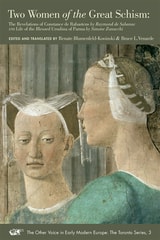
Two Women of the Great Schism
The Revelations of Constance de Rabastens by Raymond de Sabanac and Life of the Blessed Ursulina of Parma by Simone ZanacchiRaymond de Sabanac and Simone Zanacchi
Iter Press, 2010

Two Years in the Pontifical Zouaves
A Narrative of Travel, Residence, and Experience in the Roman StatesJoseph Powell
Catholic University of America Press, 2026

Two Years on the Alabama
Arthur Sinclair
University of Alabama Press, 2003
Two, Three, Many Worlds
Radical Methodologies for Global History, Volume 2005Duane J. Corpis and Ian Christopher Fletcher, eds.
Duke University Press, 0
Contributors. Abolade Adeniji, John T. Chalcraft, Duane J. Corpis, Ian Christopher Fletcher, Yaël Simpson Fletcher, Matthew Guterl, Rafael M. Hernández, Vinay Lal, R. J. Lambrose, Mukoma wa Ngugi, Masao Nishikawa, Takamitsu Ono, Nalini Persaud, Alka Roy, Micol Seigel, Christine Skwiot, Karen Sotiropoulos, Ulrike Strasser, Vijaya Teelock, Heidi Tinsman, Jyotsna Uppal, Merry Wiesner-Hanks

Two-Moon Journey
The Potawatomi Trail of DeathPeggy King Anderson
Indiana Historical Society Press, 2018

Two-Party Politics in the One-Party South
Alabama's Hill Country, 1874–1920Samuel L. Webb
University of Alabama Press, 1997
A challenge to the long-held view that the only important and influential politicians in post-Reconstruction Deep South states were Democrats.
In this insightful and exhaustively researched volume, Samuel L. Webb presents new evidence that, contrary to popular belief, voters in at least one Deep South state did not flee en masse from the Republican party after Reconstruction. As Webb demonstrates conclusively, the party gained strength among white voters in Upcountry areas of northern Alabama between 1896 and 1920. Not only did GOP presidential candidates win more than a dozen area counties but Republican congressional candidates made progress in Democratic strongholds, and local GOP officials gained control of several county courthouses.
Nor were these new Republicans simply the descendants of anti-Confederate families, as some historians have claimed. Rather, they were former independents, Greenbackers, and Populists, who, in keeping with the 1890s Populist movement, were reacting against what they perceived as the control of the Democratic party by "moneyed elites" and planter landlords. Webb also breaks with previous historical opinion by showing that ex-Populists in the Hill Country, who had been radical reformers during the 1890s, remained reform minded after 1900.
Webb's ground-breaking reassessment of Alabama state politics from Reconstruction to the 1920s describes a people whose political culture had strong roots in the democratic and egalitarian Jacksonian ideology that dominated north Alabama in the antebellum period. These people carried forward elements of Jacksonianism into the late 19th century, with its tenets continuing to influence them well into the early 20th century.

Type 42 destroyer Southampton
Jantinus Mulder
Amsterdam University Press, 2023

Type 47B Destroyer Drenthe
Jantinus Mulder
Amsterdam University Press, 2021

Type 47B Destroyer Drenthe
Jantinus Mulder
Amsterdam University Press, 2023
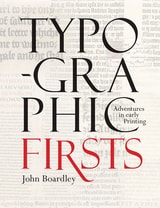
Typographic Firsts
John Boardley
Bodleian Library Publishing, 2018
Many of the standard features of printed books were designed by pioneering typographers and printers in the latter half of the fifteenth century. Johannes Gutenberg is credited with printing the first books in Europe with moveable type in the fifteenth century, but many different European printers and publishers went on to find innovative solutions to replicate the appearance of manuscript books in print and improve on them throughout the Renaissance. The illustrated examples in Typographic Firsts originate in those early decades, bringing into focus the influences and innovations that shaped the printed book and established a Western typographic canon.
From the practical challenges of polychromatic printing and sheet music printing to the techniques for illustrating books with woodcuts and producing books for children to the design of the first fonts, these stories chart the invention of the printed book, the world’s first means of mass communication. Also covering title pages, maps, printing in gold, and printing in color, this book shows how a mixture of happenstance and brilliant technological innovation came together to form the typographic and design conventions of the book.

Typologies of Humor in African Literatures
Adwoa A. Opoku-Agyemang
University of Michigan Press, 2024
The book analyzes four comedic archetypes: the Trickster, who is unapologetically amoral and entertaining; the Mimic, whose everyday dealings exude ambiguity; the Interpreter, who demonstrates the comic potential of language differences while showing how a single message can mean contrasting things; and the Deviant, who throws norms into question all the while reinforcing them. These character types and the humor they produce present a constant pursuit of balance between contrasting worldviews and frames of reference within the imbrication of different languages, classes, political factions, genders, and (un)officialdoms. The product of these rowdy relations are people who take the weirdness and run with it to generate diegetic and intradiegetic laughs. By analyzing Francophone and Anglophone African writing and how it overlays local languages, Opoku-Agyemang contributes a uniquely African voice to the primarily Western-dominated field of humor studies.

Typology and Structure of Roman Historical Reliefs
Mario Torelli
University of Michigan Press, 1992

Typophoto
New Typography and the Reinvention of Photographybrier
University of Minnesota Press, 2025
Unveiling the avant-garde fusion of photography and modern graphic design
The concept Typophoto, the synthesis of photography and typography, was coined by renowned Bauhaus artist and theorist László Moholy-Nagy and played a foundational role in the modernist graphic design movement known as the New Typography. Jessica D. Brier examines how Typophoto was embraced by early graphic designers—a group who ultimately reinvented photography as a tool of modern consumerism.
Typophoto embodied designers’ belief in photography as an efficient form of visual communication, merging the material and the visual by abstracting both typographic and photographic form and transmuting photography into graphic material through the halftone process. Uniquely situating 1920s advertising discourse alongside avant-garde theory and significant interwar photographic concepts, Brier positions Typophoto as an analytical framework for considering how photography—as process, image, material, and metaphor—was effectively reconceived through the professionalization of graphic design in Europe and the United States. This was particularly true in Germany, where the capitalist ethos driving the country’s economic recovery bolstered the belief that graphics could create ideal reader-consumers.
Tracing Typophoto from its inception through New Typography’s experiments with the medium, Brier demonstrates how photography was used as a tool for manipulating perception as it became a visual language of modern life.

Tyranny of the Market
A Critique of Theoretical FoundationsDouglas Vickers
University of Michigan Press, 1995

Tyson
From Farm to MarketMarvin Schwartz
University of Arkansas Press, 1991

the lives & times of hrh
Herman Hochstadt
National University of Singapore Press, 2020