Results by title
3703 books match the query '19th century' and 853 start with t
The Style of Hawthorne's Gaze
Regarding SubjectivityJohn Dolis
University of Alabama Press, 1993
Examining subjectivity and narrative perception in Hawthorne’s literary art.
The Style of Hawthorne’s Gaze is an unusual and insightful work that employs a combination of critical strategies drawn from art history, philosophy, psychoanalysis, and contemporary aesthetic and literary theory to explore Nathaniel Hawthorne’s narrative technique and his unique vision of the world. Dolis studies Hawthorne’s anti-technological and essentially Romantic view of the external world and examines the recurring phenomena of lighting, motion, aspectivity, fragmentation, and imagination as they relate to his descriptive techniques.
Dolis sets the world of Hawthorne’s work over and against the aesthetic and philosophical development of the world understood as a “view”, from its inception in the camera obscura and perspective in general, to its 19th-century articulation in photography. In light of this general technology of the image, and drawing upon a wide range of contemporary critical theories, Dolis begins his study of Hawthorne at the level of description, where the world of the work first arises in the reader’s consciousness. Dolis shows how the work of Heidegger, Merleau-Ponty, Freud, Lacan, and Derrida can provide fresh insights into the sophisticated style of Hawthorne’s perception of and system for representing reality.
The Subject of Modernism
Narrative Alterations in the Fiction of Eliot, Conrad, Woolf, and JoyceTony E. Jackson
University of Michigan Press, 1994
The Sunday Paper
A Media HistoryPaul Moore and Sandra Gabriele
University of Illinois Press, 2022
The Sutton-Taylor Feud
The Deadliest Blood Feud in TexasChuck Parsons
University of North Texas Press, 2009
The Sweetness of Freedom
Stories of ImmigrantsMartha Aladjem Bloomfield
Michigan State University Press, 2010
The Sweetness of Freedom presents an eclectic grouping of late nineteenth- and twentieth-century immigrants' narratives and the personal artifacts, historical documents, and photographs these travelers brought on their journeys to Michigan. Most of the oral histories in this volume are based on interviews conducted with the immigrants themselves.
Some of the immigrants presented here hoped to gain better education and jobs. Others—refugees—fled their homelands because of war, poverty, repression, religious persecution, or ethnic discrimination. All dreamt of freedom and opportunity. They tell why they left their homelands, why they chose to settle in Michigan, and what they brought or left behind. Some wanted to preserve their heritage, religious customs, traditions, and ethnic identity. Others wanted to forget past conflicts and lost family members. Their stories reveal how they established new lives far away from home, how they endured homesickness and separation, what they gave up and what they gained.

The Sword & the Pen
A Life of Lew WallaceRay E. Boomhower
Indiana Historical Society Press, 2005
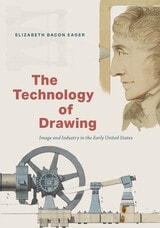
The Technology of Drawing
Image and Industry in the Early United StatesElizabeth Bacon Eager
University of Chicago Press, 2026
A richly illustrated study of how technical drawing shaped culture in the early United States.
With The Technology of Drawing, Elizabeth Bacon Eager explores the importance of manual skill and graphic literacy in the emergence of American industry, offering readers a new lens through which to view the visual culture of the early United States. Focused on questions of materiality and process, the book traces the development of drawing as a technology and argues for it as an embodied way of thinking and knowing, revealing the significance of such knowledge in the construction of both scientific and social authority. Through close analysis of materials, including construction drawings, mechanical treatises, cartographic surveys, and patent drawings, many of which have never been published before, Eager presents a history of American art focused on materiality and process through the view of the mechanic rather than the fine artist.
Reaching beyond the traditional boundaries of art historical study to engage objects rarely considered as art, The Technology of Drawing treats the technical image as a site of extraordinary creativity, in which eighteenth- and nineteenth-century Americans across the social spectrum negotiated critical concepts of identity, invention, and authorship with a remarkable degree of material intelligence and visual sophistication.
The Tennessee Campaign of 1864
Edited by Steven E. Woodworth and Charles D. Grear
Southern Illinois University Press, 2016
Contributors explore the campaign’s battlefield action, including how Major General Andrew J. Smith’s three aggressive divisions of the Army of Tennessee became the most successful Federal unit at Nashville, how vastly outnumbered Union troops held the Allatoona Pass, why Hood failed at Spring Hill and how the event has been perceived, and why so many of the Army of Tennessee’s officer corps died at the Battle of Franklin, where the Confederacy suffered a disastrous blow. An exciting inclusion is the diary of Confederate major general Patrick R. Cleburne, which covers the first phase of the campaign. Essays on the strained relationship between Ulysses S. Grant and George H. Thomas and on Thomas’s approach to warfare reveal much about the personalities involved, and chapters about civilians in the campaign’s path and those miles away show how the war affected people not involved in the fighting. An innovative case study of the fighting at Franklin investigates the emotional and psychological impact of killing on the battlefield, and other implications of the campaign include how the courageous actions of the U.S. Colored Troops at Nashville made a lasting impact on the African American community and how preservation efforts met with differing results at Franklin and Nashville.
Canvassing both military and social history, this well-researched volume offers new, illuminating perspectives while furthering long-running debates on more familiar topics. These in-depth essays provide an expert appraisal of one of the most brutal and notorious campaigns in Civil War history.

The Tenth Muse
Victorian Philology and the Genesis of the Poetic Language of Gerard Manley HopkinsBy Cary H. Plotkin
Southern Illinois University Press, 1989
With authority and sensitivity Plotkin traces the close relationship between Hopkins’s poetry and the theories of language suggested in his Journals and expounded by Victorian philologists such as Max Müller and George Marsh.
Plotkin seeks to determine what changed Hopkins’s perception of language between the writing of such early poems as "The Habit of Perfection" and "Nondum" (1866) and his creation of The Wreck of the Deutschland (1875–76). Did the language of the ode, and of Hopkins’s mature poetry generally, arise as spontaneously as it appears to have done, or does it have a traceable genesis in the ways in which language as a whole was conceived and studied in mid-century England? In answer, Plotkin fixes the development of Hopkins’s singular poetic language in the philological context of his time.
If one is to understand Hopkins’s writings and poetic language in the context in which they developed rather than in the terms of a present-day theory of history or textuality, then that movement in all of its complexity must be considered. Hopkins "translates" into the language of poetry patterns and categories common to Victorian language study.
The Terrible Fitzball
The Melodramatist of the MacabreLarry Stephen Clifton
University of Wisconsin Press, 1993
The Thousand Dollar Dinner
America's First Great Cookery ChallengeBecky Libourel Diamond
Westholme Publishing, 2015
In 1851, fifteen wealthy New Yorkers wanted to show a group of Philadelphia friends just how impressive a meal could be and took them to Delmonico’s, New York’s finest restaurant. They asked Lorenzo Delmonico to “astonish our Quaker City friends with the sumptuousness of our feast,” and assured him that money was no object, as the honor of New York was at stake. They were treated to a magnificent banquet, enjoyed by all. However, not to be outdone, the Philadelphia men invited the New Yorkers to a meal prepared by James W. Parkinson in their city. In what became known as the “Thousand Dollar Dinner,” Parkinson successfully rose to the challenge, creating a seventeen-course extravaganza featuring fresh salmon, baked rockfish, braised pigeon, turtle steaks, spring lamb, out-of-season fruits and vegetables, and desserts, all paired with rare wines and liquors. Midway through the twelve-hour meal, the New Yorkers declared Philadelphia the winner of their competition, and at several times stood in ovation to acknowledge the chef ’s mastery. In The Thousand Dollar Dinner: America’s First Great Cookery Challenge, research historian Becky Libourel Diamond presents the entire seventeen-course meal, course by course, explaining each dish and its history. A gastronomic turning point, Parkinson’s luxurious meal helped launch the era of grand banquets of the gilded age and established a new level of American culinary arts to rival those of Europe.
The Times Were Strange and Stirring
Methodist Preachers and the Crisis of EmancipationReginald F. Hildebrand
Duke University Press, 1995
Hildebrand explores the ideas and ideals of missionaries from several branches of Methodism—the African Methodist Episcopal Church, the Colored Methodist Episcopal Church, and the northern-based Methodist Episcopal Church—and the significant and highly charged battle waged between them over the challenge and meaning of freedom. He traces the various strategies and goals pursued by these competing visions and develops a typology of some of the ways in which emancipation was approached and understood.
Focusing on individual church leaders such as Lucius H. Holsey, Richard Harvey Cain, and Gilbert Haven, and with the benefit of extensive research in church archives and newspapers, Hildebrand tells the dramatic and sometimes moving story of how missionaries labored to organize their denominations in the black South, and of how they were overwhelmed at times by the struggles of freedom.
The Toledo War
The First Michigan-Ohio RivalryDon Faber
University of Michigan Press, 2008
Most are familiar with the Michigan-Ohio football rivalry, an intense but usually good-natured contest that stretches back over one hundred years. Yet far fewer may know that in the early nineteenth century Michigan and Ohio were locked in a different kind of battle---one that began before Michigan became a state.
The conflict started with a long-simmering dispute over a narrow wedge of land called the Toledo Strip. Early maps were famously imprecise, adding to the uncertainty of the true boundary between the states. When Ohio claimed to the mouth of the Maumee River, land that according to the Northwest Ordinance of 1787 fell in the territory of Michigan, the "Toledo War" began.
Today the fight may bring a smile to Michiganians and Ohioans because both states benefited: Ohioans won the war and Michigan got the Upper Peninsula. But back then passions about rightful ownership ran high, and it would take many years---and colorful personalities all the way up to presidents---to settle the dispute. The Toledo War: The First Michigan-Ohio Rivalry gives a well-researched and fascinating account of the famous war.
The Tolerant Populists, Second Edition
Kansas Populism and NativismWalter Nugent
University of Chicago Press, 2013
Historians wrote approvingly of the Populists up into the 1950s. But with time and new voices, led by historian Richard Hofstadter, the Populists were denigrated, depicted as demagogic, conspiratorial, and even anti-Semitic.
In a landmark study, Walter Nugent set out to uncover the truth of populism, focusing on the most prominent Populist state, Kansas. He focused on primary sources, looking at the small towns and farmers that were the foundation of the movement. The result, The Tolerant Populists, was the first book-length, source-based analysis of the Populists. Nugent’s work sparked a movement to undo the historical revisionism and ultimately found itself at the center of a controversy that has been called “one of the bloodiest episodes in American historiography.”
This timely re-release of The Tolerant Populists comes as the term finds new currency—and new scorn—in modern politics. A definitive work on populism, it serves as a vivid example of the potential that political movements and popular opinion can have to change history and affect our future.
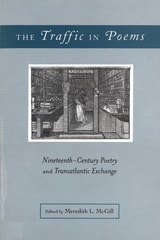
The Traffic In Poems
Nineteenth-Century Poetry and Transatlantic ExchangeMcGill, Meredith L
Rutgers University Press, 2008
Drawing on examples such as Felicia Hemans's elaboration of the foundational American myth of Plymouth Rock, Emma Lazarus's ambivalent welcome of Europe's cast-off populations, black abolitionist Mary Webb's European performances of Hiawatha, and American reprints of Robert Browning and George Meredith, the eleven essays in this book focus on poetic depictions of exile, slavery, immigration, and citizenship and explore the often asymmetrical traffic between British and American poetic cultures.
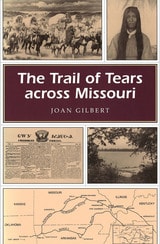
The Trail of Tears across Missouri
Joan Gilbert
University of Missouri Press, 1996
As settlers moved beyond the eastern seaboard during the early nineteenth century, the government forced thousands of American Indians from their ancestral lands. The Cherokees, the largest and most important tribe in the Southeast, fought exile with a combination of passive resistance and national publicity for their plight. Because they had successfully resisted the government's efforts to move them from their homeland, their removal was particularly brutal when it finally came. The Trail of Tears across Missouri is a moving account of the 1837-1838 removal of the Cherokees from the southeastern United States to Indian Territory (now Oklahoma).
After providing an overview of the Cherokees' life in the Southeast and of the events leading up to their exile, Joan Gilbert traces the mass exodus state by state from Tennessee to Arkansas. Successive chapters highlight the experiences and the hardships endured by those forced to travel with inadequate supplies of food, clothing, and transportation. It is estimated that four thousand Cherokees, nearly a quarter of the tribe, died.
In bringing the grim realities of the forced march to life, Gilbert draws from such primary sources as letters, newspaper stories, and the writings of missionaries, guides, and doctors who accompanied them. She focuses on the Cherokees' experiences as they passed through Missouri, using the journals of Dr. W. I. I. Morrow and guide B. B. Cannon.
In addition to chronicling the removal of the Cherokees, Gilbert also brings the story up to date by describing how the nation lives today and how the Trail of Tears has been commemorated.
The Transatlantic Materials of American Literature
Publishing US Writing in Britain, 1830–1860Katie McGettigan
University of Massachusetts Press, 2023
Winner, Transatlantic Studies Association and Cambridge University Press Book Prize, 2023
During the antebellum period, British publishers increasingly brought out their own authorized and unauthorized editions of American literary works as the popularity of print exploded and literacy rates grew. Playing a formative role in the shaping of American literature, the industry championed the work of US-based writers, highlighted the cultural value of American literary works, and intervened in debates about the future of American literature, authorship, and print culture.
The Transatlantic Materials of American Literature examines the British editions of American fiction, poetry, essays, and autobiographies from writers like Edgar Allan Poe, Harriet Beecher Stowe, Frederick Douglass, and Hannah Flagg Gould. Putting these publications into historical context, Katie McGettigan considers key issues of the day, including developments in copyright law, changing print technologies, and the financial considerations at play for authors and publishers. This innovative study also uncovers how the transatlantic circulation of these works exposed the racial violence and cultural nationalism at the heart of the American experiment, producing overlapping and competing visions of American nationhood in the process.
The Triumph of Human Empire
Verne, Morris, and Stevenson at the End of the WorldRosalind Williams
University of Chicago Press, 2013
The Troubled Union
Expansionist Imperatives in Post-Reconstruction American NovelsJohn Morán González
The Ohio State University Press, 2010
The Tunnel under the Lake
The Engineering Marvel That Saved ChicagoBenjamin Sells
Northwestern University Press, 2017
Despite Chicago's location beside the world’s largest source of fresh water, its low elevation at the end of Lake Michigan provided no natural method of carrying away waste. As a result, within a few years of its founding, Chicago began to choke on its own sewage collecting near the shore. The befouled environment, giving rise to outbreaks of sickness and cholera, became so acute that even the ravages and costs of the U.S. Civil War did not distract city leaders from taking action.
Chesbrough's solution was an unprecedented tunnel five feet in diameter lined with brick and dug sixty feet beneath Lake Michigan. Construction began from the shore as well as the tunnel’s terminus in the lake. With workers laboring in shifts and with clay carted away by donkeys, the lake and shore teams met under the lake three years later, just inches out of alignment. When it opened in March 1867, observers, city planners, and grateful citizens hailed the tunnel as the "wonder of America and of the world."
Benjamin Sells narrates in vivid detail the exceptional skill and imagination it took to save this storied city from itself. A wealth of fascinating appendixes round out Sells’s account, which will delight those interested in Chicago history, water resources, and the history of technology and engineering.

The Tutor'd Mind
Indian Missionary-Writers in Antebellum AmericaBernd C. Peyer
University of Massachusetts Press, 1997
In the view of the English colonists and their descendants, Indian converts to Christianity were expected to repudiate native traditions and affirm the superiority of European civilization, to serve as role models, and to spread the gospel far into the wilderness. Yet as Bernd C. Peyer shows, Indian missionaries did not always fulfill the expectations of those who trained them. Once the Indians recognized that conversion alone did not guarantee protection from discrimination, they devised a variety of strategies, theological as well as practical, to resist assimilation into the dominant white culture. Making effective use of their literacy and education, they called attention to the discrepancy between the Protestant ideals they had been taught and the Anglo-American practices to which native people were subjected.
By uncovering this subtext of dissent and resistance, Peyer at once alters and enriches our understanding of the evolution of the American Indian literary tradition.

The Ukrainian Question
Russian Empire and Nationalism in the 19th CenturyAlexei Miller
Central European University Press, 2003
The Unbounded Community
Neighborhood Life and Social Structure in New York City, 1830–1875Kenneth A. Scherzer
Duke University Press, 1992
After a critical examination of recent historical renderings of neighborhood life, Scherzer focuses on the ecological, symbolic, and social aspects of nineteenth-century community life in New York City. Employing a wide array of sources, from census reports and church records to police blotters and brothel guides, he documents the complex composition of neighborhoods that defy simple categorization by class or ethnicity. From his account, the New York City neighborhood emerges as a community in flux, born out of the chaos of May Day, the traditional moving day. The fluid geography and heterogeneity of these neighborhoods kept most city residents from developing strong local attachments. Scherzer shows how such weak spatial consciousness, along with the fast pace of residential change, diminished the community function of the neighborhood. New Yorkers, he suggests, relied instead upon the "unbounded community," a collection of friends and social relations that extended throughout the city.
With pointed argument and weighty evidence, The Unbounded Community replaces the neighborhood of nostalgia with a broader, multifaceted conception of community life. Depicting the neighborhood in its full scope and diversity, the book will enhance future forays into urban history.
The Unhappy Medium
Spiritualism and the Life of Margaret FoxBy Earl Wesley Fornell; Drawings by Lowell Collins
University of Texas Press, 1964
“Here, Mr. Split-Foot, do as I do!” exclaimed the child, and the spirits obeyed her command. Thus, in 1848, thirteen-year-old Margaret Fox inaugurated the age of spiritualism. Those early spirit manifestations in a humble New York farmhouse were “but the beginning of a grand seance which for the next half century was to see persons returned from the dead walking upon the earth, mingling freely with mortal Americans. Ceremonies were performed which united in wedlock the living and the dead; ghostly schoolboys returned from the land of the spirits to revisit their old schoolhouses, upsetting the dignity of earthly classrooms . . . Drivers of owl horsecars . . . were intrigued by beautiful female spirits who rode their cars at night and promptly vanished if approached for a fare.”
The colorful career of Margaret Fox, the most famous medium of the era and the “fountainhead” of the cult of spiritualism, attracted the attention of the most prominent public figures of the day. For P. T. Barnum, this phenomenon was another novelty to present to the American public. Horace Greeley took a personal interest in Margaret and her sister; he gave the movement extensive publicity. Lincoln often invited Margaret Fox and other mediums to the White House for seances, during which attempts were made to invoke the spirit of the Lincolns’ dead son. Members of Congress, judges, and intellectuals of the day were well acquainted with her and with the spiritualist movement.
The course of this spirit invasion and the many and varied means by which men communicated with dwellers of the other world are the subjects of this volume. With Margaret Fox the spirits spoke by rapping on floor and furniture. With others they communicated by writing on slates, by touching with ghostly hands, by moving furniture (one medium was so popular that his furniture followed him about like a pack of dogs). Some spirits spoke directly through the mouths of entranced mediums. And some were so bold—or so talented—that they were able to materialize in the flesh before properly receptive groups of people—and happy indeed was the devotee who received a warm embrace from a lovely young spirit lady or a handsome ghostly gentleman during such a materialization.
The spirits who thus displayed their interest in this mortal world soon came to have a considerable influence over whole segments of the American population. For some, spiritualism was a comforting means of maintaining contact with loved ones now departed. For others it was a religion, a blessed aid on the road to salvation. For still others it provided practical assistance with more earthly problems. Many found in it intriguing puzzles for scientific investigation. And for the whole country it provided a constant source of excitement, interest, and entertainment.
Written in spritely prose and permeated with a grave humor, this account of nineteenth-century spiritualism will be equally satisfying to the casual reader interested in a good story, and to the scholar seeking serious social history.
The Union on Trial
The Political Journals of Judge William Barclay Napton, 1829-1883Edited by Christopher Phillips & Jason L. Pendleton. Introduction by Christopher Phillips
University of Missouri Press, 2005
The Universal Jew
Masculinity, Modernity, and the Zionist MomentMikhal Dekel
Northwestern University Press, 2010
Such prototypical characters transform the symbol of the Jew from a racially or religiously defined minority subject to a "post-Jewish," particularuniversal, and fundamentally liberal majority subject. The Universal Jew situates the "Zionist moment" horizontally, within the various intellectual currents that make up the turn of the twentieth century: the discourse on modernity, the crisis in liberalism, Nietzsche’s critique of the Enlightenment, psychoanalysis, early feminism, and fin de siècle interrogation of sexual identities. The book examines the symbolic roles that Jews are assigned within these discourses and traces the ways in which Jewish literary citizens are shaped, both out of and in response to them. Beginning with an analysis of George Eliot’s construction of the character Deronda and its reception in Zionist circles, the Universal Jew ends with the self-fashioning of male citizens in fin de siècle and post-statehood Hebrew works, through the aesthetics oftragedy. Throughout her readings, Dekel analyzes the political meaning of these nascent images of citizens, uncovering in particular the gendered arrangements out of which they are born.
The University and the People
Envisioning American Higher Education in an Era of Populist ProtestScott M. Gelber
University of Wisconsin Press, 2011
The University and the People chronicles the influence of Populism—a powerful agrarian movement—on public higher education in the late nineteenth century. Revisiting this pivotal era in the history of the American state university, Scott Gelber demonstrates that Populists expressed a surprising degree of enthusiasm for institutions of higher learning. More fundamentally, he argues that the mission of the state university, as we understand it today, evolved from a fractious but productive relationship between public demands and academic authority.
Populists attacked a variety of elites—professionals, executives, scholars—and seemed to confirm academia’s fear of anti-intellectual public oversight. The movement’s vision of the state university highlighted deep tensions in American attitudes toward meritocracy and expertise. Yet Populists also promoted state-supported higher education, with the aims of educating the sons (and sometimes daughters) of ordinary citizens, blurring status distinctions, and promoting civic engagement. Accessibility, utilitarianism, and public service were the bywords of Populist journalists, legislators, trustees, and sympathetic professors. These “academic populists” encouraged state universities to reckon with egalitarian perspectives on admissions, financial aid, curricula, and research. And despite their critiques of college “ivory towers,” Populists supported the humanities and social sciences, tolerated a degree of ideological dissent, and lobbied for record-breaking appropriations for state institutions.
The Unknown Travels and Dubious Pursuits of William Clark
Jo Ann Trogdon
University of Missouri Press, 2023
In this vivid history, Jo Ann Trogdon reveals William Clark’s highly questionable activities during the years before his famous journey west of the Mississippi. Delving into the details of Clark’s diary and ledger entries, Trogdon investigates evidence linking Clark to a series of plots—often called the Spanish Conspiracy—in which corrupt officials sought to line their pockets with Spanish money and to separate Kentucky from the United States. The Unknown Travels and Dubious Pursuits of William Clark gives readers a more complex portrait of the American icon than has been previously written.
The Untried Life
The Twenty-Ninth Ohio Volunteer Infantry in the Civil WarJames T. Fritsch
Ohio University Press, 2012
Told in unflinching detail, this is the story of the Twenty-Ninth Ohio Volunteer Infantry, also known as the Giddings Regiment or the Abolition Regiment, after its founder, radical abolitionist Congressman J. R. Giddings. The men who enlisted in the Twenty-Ninth OVI were, according to its lore, handpicked to ensure each was as pure in his antislavery beliefs as its founder. Whether these soldiers would fight harder than other soldiers, and whether the people of their hometowns would remain devoted to the ideals of the regiment, were questions that could only be tested by the experiment of war.
The Untried Life is the story of these men from their very first regimental formation in a county fairground to the devastation of Gettysburg and the march to Atlanta and back again, enduring disease and Confederate prisons. It brings to vivid life the comradeship and loneliness that pervaded their days on the march. Dozens of unforgettable characters emerge, animated by their own letters and diaries: Corporal Nathan Parmenter, whose modest upbringing belies the eloquence of his writings; Colonel Lewis Buckley, one of the Twenty-Ninth’s most charismatic officers; and Chaplain Lyman Ames, whose care of the sick and wounded challenged his spiritual beliefs.
The Untried Life shows how the common soldier lived—his entertainments, methods of cooking, medical treatment, and struggle to maintain family connections—and separates the facts from the mythology created in the decades after the war.
The Unwritten War
American Writers and the Civil WarDaniel Aaron
University of Alabama Press, 2003
In The Unwritten War, Daniel Aaron examines the literary output of American writers—major and minor—who treated the Civil War in their works. He seeks to understand why this devastating and defining military conflict has failed to produce more literature of a notably high and lasting order, why there is still no "masterpiece" of Civil War fiction.
In his portraits and analyses of 19th- and some 20th-century writers, Aaron distinguishes between those who dealt with the war only marginally—Henry Adams, Henry James, William Dean Howells, Mark Twain-and those few who sounded the war's tragic import—Herman Melville, Walt Whitman, and William Faulkner. He explores the extent to which the war changed the direction of American literature and how deeply it entered the consciousness of American writers. Aaron also considers how writers, especially those from the South, discerned the war's moral and historical implications.
The Unwritten War was originally published by Alfred A. Knopf in 1973. The New Republic declared, [This book's] major contribution will no doubt be to American literary history. In this respect it resembles Edmund Wilson's Patriotic Gore and is certain to become an indispensable guide for anyone who wants to explore the letters, diaries, journals, essays, novels, short stories, poems-but apparently no plays-which constitute Civil War literature. The mass of material is presented in a systematic, luminous, and useful way.
The Urbanization of Japanese Labor, 1868-1955
Wilkinson, O. T.
University of Massachusetts Press, 1965
This book examines the transition from peasant agriculturalism to urban industrialism in Japan was in the hands of a merchant class wholly oriented toward an internal economic system when she entered the modern international world. Consequently, Japanese political administration assumed a large portion of foreign commercial and industrial activity, in its initial stages. Thus, her modern economic and industrial development served political purposes of those concerned with Japan’s international political standing. In this sense, Japan’s early modernization was a “planned” transition. The industries sponsored by subsidy and outright government ownership therefore experienced rapid technological change and expansion, while those industries devoted to consumer goods were left to traditional means of production. The demographic characteristics of Japan’s urban population clearly reflect this background. The organization of a manufacturing group along the lines of family structure was modified, but not destroyed, by the transition to urban industrialism. Thus, in marked contrast to Europe, where the family is primarily a consumer unit, in Japan is a productive unit as well. While the experience of Japan does not provide a blueprint for nations that are now undertaking industrialization, the unique evolution of her urban-industrial complexes has great abstract value, in corroborating the theoretical contention that there is a wide range of alternatives to the pattern of industrialization that prevails in the West. All those concerned with preserving the best of their existing culture, while moving into the inevitable world-wide urban-industrial future, will benefit and be encouraged by the example of Japan.
The Urbanization of Opera
Music Theater in Paris in the Nineteenth CenturyAnselm Gerhard
University of Chicago Press, 1998
"An invaluable look at this fascinating genre."—George W. Loomis, Opera News

The Vampire in Nineteenth Century English Literature
Carol A. Senf
University of Wisconsin Press, 1988
The Vanguard of the Atlantic World
Creating Modernity, Nation, and Democracy in Nineteenth-Century Latin AmericaJames E. Sanders
Duke University Press, 2014
The Vast and Terrible Drama
American Literary Naturalism in the Late Nineteenth CenturyEric Carl Link
University of Alabama Press, 2004
A broad treatment of the cultural, social, political, and literary under-pinnings of an entire period and movement in American letters
The Vast and Terrible Drama is a critical study of the context in which authors such as Oliver Wendell Holmes, Stephen Crane, Frank Norris, Theodore Dreiser, and Jack London created their most significant work. In 1896 Frank Norris wrote: "Terrible things must happen to the characters of the naturalistic tale. They must be twisted from the ordinary . . . and flung into the throes of a vast and terrible drama." There could be "no teacup tragedies here." This volume broadens our understanding of literary naturalism as a response to these and other aesthetic concerns of the 19th century.
Themes addressed include the traditionally close connection between French naturalism and American literary naturalism; relationships between the movement and the romance tradition in American literature, as well as with utopian fictions of the 19th century; narrative strategies employed by the key writers; the dominant naturalist theme of determinism; and textual readings that provide broad examples of the role of the reader. By examining these and other aspects of American literary naturalism, Link counters a century of criticism that has perhaps viewed literary naturalism too narrowly, as a subset of realism, bound by the conventions of realistic narration.
The Verdi-Boito Correspondence
Giuseppe Verdi and Arrigo Boito
University of Chicago Press, 1994
This new edition of the landmark Carteggio Verdi/Boito is at once a valuable resource for all students, teachers, and scholars of opera and a fascinating glimpse of the daily life of European art and artists during the fertile last decades of the 19th century.
Embarking on a 20-year collaboration, Verdi and Boito produced a successful revision of Simon Boccanegra, and two new operas, Otello and Falstaff. They created what many consider to be Verdi's greatest operas, thanks both to Boito's poetry and to his handling of the composer. Here are the day-to-day tasks of creation: poet and composer debating problems of dramatic structure, words, phrases, and meters; altering dialogue as, at the same time, they converse about the wider worlds of art and music. The give and take of artistic creation is rendered fascinatingly.
This edition features a new introduction by Marcello Conati, improvements and updatings to the original edition, and an appendix of undated correspondence. William Weaver's translation is characteristically pitch-perfect; he also provides a short closing sketch of Boito's life after the death of his beloved maestro. Explanatory "linking texts" between the letters create a narrative.
The Very Worst Road
Travellers' Accounts of Crossing Alabama's Old Creek Indian Territory, 1820-1847Jeffrey C. Benton
University of Alabama Press, 2009
The Vicksburg Assaults, May 19-22, 1863
Edited by Steven E. Woodworth and Charles D. Grear
Southern Illinois University Press, 2019
But due to difficult terrain, strong defenses, and uncoordinated movements, the quick triumph Grant desired was unattainable. On the afternoon of May 19, with little rest, preparation, or reconnaissance, Union forces charged the Confederate lines only to be repulsed. A respite between the assaults allowed both sides to reinforce their positions. Early on May 22 the Union artillery sought to soften the stronghold’s defenses before the general attack, but despite the Union forces’ preparation, the fighting proved even more disorganized and vicious. Again Grant failed to move Pemberton. Not wanting to risk more soldiers in a third attack, Grant conceded to the necessity of laying siege. Confederate morale climbed as the Southerners realized they had held their ground against an overwhelming force.
Editors Steven E. Woodworth and Charles D. Grear have assembled five captivating essays that examine Grant’s unsuccessful assaults against Confederate defensive lines around Vicksburg. Ranging from military to social history, the essays further historical debates on prominent topics, such as the reactions of Midwesterners to the first failures of Grant’s Vicksburg campaign. Two essays from opposing sides analyze the controversial decisions surrounding the Railroad Redoubt, the site of the bloodiest fighting on May 22. Another investigates how the tenacity of Texan reinforcements forced Union soldiers to abandon their gains.
Peppered with first-hand observations and bolstered by an impressive depth of research, this anthology is an invitingly written account and comprehensive assessment. By zeroing in on the two assaults, the contributors offer essential clarity and understanding of these important events within the larger scope of the Civil War’s Vicksburg Campaign.
The Vicksburg Campaign, March 29–May 18, 1863
Edited by Steven E. Woodworth and Charles D. Grear
Southern Illinois University Press, 2013
Ulysses S. Grant’s ingenious campaign to capture the last Confederate stronghold on the Mississippi River was one of the most decisive events of the Civil War and one of the most storied military expeditions in American history. The ultimate victory at Vicksburg effectively cut the Confederacy in two, gave control of the river to Union forces, and delivered a devastating blow from which the South never fully recovered. Editors Steven E. Woodworth and Charles D. Grear have assembled essays by prominent and emerging scholars, who contribute astute analysis of this famous campaign’s most crucial elements and colorful personalities.
Encompassed in this first of five planned volumes on the Vicksburg campaign are examinations of the pivotal events that comprised the campaign’s maneuver stage, from March to May of 1863. The collection sheds new light on Grant’s formidable intelligence network of former slaves, Mississippi loyalists, and Union spies; his now legendary operations to deceive and confuse his Confederate counterparts; and his maneuvers from the perspective of classic warfare. Also presented are insightful accounts of Grant’s contentious relationship with John A. McClernand during the campaign; interactions between hostile Confederate civilians and Union army troops; and the planning behind such battles as Grierson’s Raid, Port Gibson, Raymond, Jackson, Champion Hill, and Big Black River Bridge.

The Victoria History of Essex
Harwich, Dovercourt and Parkeston in the 19th CenturyAndrew Senter Andrew Morrell
University of London Press, 2019
The Victorian Eye
A Political History of Light and Vision in Britain, 1800-1910Chris Otter
University of Chicago Press, 2008
The Victorian Eye’s innovative interdisciplinary approach—and generous illustrations—will captivate a range of readers interested in the history of modern Britain, visual culture, technology, and urbanization.
The Victorian Marionette Theatre
John Mccormick
University of Iowa Press, 2004
The Victorian Novel of Adulthood
Plot and Purgatory in Fictions of MaturityRebecca Rainof
Ohio University Press, 2015
In The Victorian Novel of Adulthood, Rebecca Rainof confronts the conventional deference accorded the bildungsroman as the ultimate plot model and quintessential expression of Victorian nation building. The novel of maturity, she contends, is no less important to our understanding of narrative, Victorian culture, and the possibilities of fiction.
Reading works by Charles Dickens, George Eliot, Henry James, John Henry Newman, and Virginia Woolf, Rainof exposes the little-discussed theological underpinnings of plot and situates the novel of maturity in intellectual and religious history, notably the Oxford Movement. Purgatory, a subject hotly debated in the period, becomes a guiding metaphor for midlife adventure in secular fiction. Rainof discusses theological models of gradual maturation, thus directing readers’ attention away from evolutionary theory and geology, and offers a new historical framework for understanding Victorian interest in slow and deliberate change.
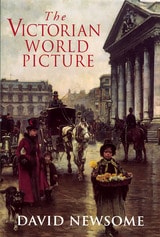
The Victorian World Picture
Newsome, David
Rutgers University Press, 1997
When did the Victorians come to regard themselves as "Victorians" and to use that term to describe the period in which they were living? David Newsome's monumental history takes a good, long look at the Victorian age and what distinguishes it so prominently in the history of both England and the world. The Victorian World Picture presents a vivid canvas of the Victorians as they saw themselves and as the rest of the world saw them.
The Victorian era was a time of unprecedented population growth and massive industrialization. Darwinian theory shook people's religious beliefs and foreign competition threatened industry and agriculture. The transformation of this nineteenth-century world was overhwelming, pervading the social, cultural, intellectual, economic, and political spheres. By the time of the Great Exhibition in 1851, the British were calling themselves Victorians and Prince Albert was able to proclaim, "We are living at a period of most wonderful transition." David Newsome weaves all these strands of Victorian life into a compelling evocation of the spirit of a fascinating time that laid the foundation for the modern age.
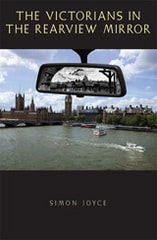
The Victorians in the Rearview Mirror
Simon Joyce
Ohio University Press, 2007
When Margaret Thatcher called in 1979 for a return to Victorian values such as hard work, self-reliance, thrift, and national pride, Labour Party leader Neil Kinnock responded that “Victorian values” also included “cruelty, misery, drudgery, squalor, and ignorance.”
The Victorians in the Rearview Mirror is an in-depth look at the ways that the twentieth century reacted to and reimagined its predecessor. It considers how the Victorian inheritance has been represented in literature, politics, film, and visual culture; the ways in which modernists and progressives have sought to differentiate themselves from an image of the Victorian; and how conservatives (and some liberals) have sought to revive elements of nineteenth-century life. Nostalgic and critical impulses combine to fix an understanding of the Victorians in the popular imagination.
Simon Joyce examines heritage culture, contemporary politics, and the “neo-Dickensian” novel to offer a more affirmative assessment of the Victorian legacy, one that lets us imagine a model of social interconnection and interdependence that has come under threat in today’s politics and culture.
Although more than one hundred years have passed since the death of Queen Victoria, the impact of her time is still fresh. The Victorians in the Rearview Mirror speaks to diverse audiences in literary and cultural studies, in addition to those interested in visual culture and contemporary politics, and situates detailed close readings of literary and cinematic texts in the context of a larger argument about the legacies of an era not as distant as we might like to think.
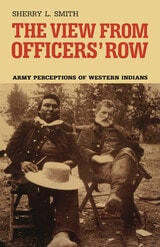
The View from Officers' Row
Army Perceptions of Western IndiansSherry L. Smith
University of Arizona Press, 1990
Capturing military men in contemplation rather than combat, Sherry L. Smith reveals American army officers' views about the Indians against whom they fought in the last half of the nineteenth century. She demonstrates that these officers—and their wives—did not share a monolithic, negative view of their enemies, but instead often developed a great respect for Indians and their cultures. Some officers even came to question Indian policy, expressed misgivings about their personal involvement in the Indian Wars, and openly sympathized with their foe.
The book reviews the period 1848–1890—from the acquisition of the Mexican Cession to the Battle of Wounded Knee—and encompasses the entire trans-Mississippi West. Resting primarily on personal documents drawn from a representative sample of the officer corps at all levels, the study seeks to juxtapose the opinions of high-ranking officers with those of officers of lesser prominence, who were perhaps less inclined to express personal opinions in official reports.
No educated segment of American society had more prolonged contact with Indians than did army officers and their wives, yet not until now has such an overview of their attitudes been presented. Smith's work demolishes the stereotype of the Indian-hating officer and broadens our understanding of the role of the army in the American West.

The Village Enlightenment in America
Popular Religion and Science in the Nineteenth CenturyCraig James Hazen
University of Illinois Press, 2000
A theologian, writer, and apologist for the nascent Mormon movement, as well as an amateur scientist, Orson Pratt wrote Key to the Universe, or a New Theory of Its Mechanism, to establish a scientific base for the Church of Jesus Christ of Latter-day Saints. Robert Hare, an inventor and ardent convert to spiritualism, used his scientific expertise to lend credence to the spiritualist movement. Phineas Parkhurst Quimby, generally considered the initiator of the American mind-cure movement, developed an overtly religious concept of science and used it to justify his system of theology.
Pratt, Hare, and Quimby all employed a potent combination of popular science and Baconianism to legitimate their new religious ideas. Using the same terms--matter, ether, magnetic force--to account for the behavior of particles, planetary rotation, and the influence of the Holy Ghost, these agents of the Enlightenment constructed complex systems intended to demonstrate a fundamental harmony between the physical and the metaphysical.
Through the lives and work of these three influential men, The Village Enlightenment in America opens a window to a time when science and religion, instead of seeming fundamentally at odds with each other, appeared entirely reconcilable.

The Virgin and the Dynamo
Public Murals in American Architecture, 1893–1917Bailey Van Hook
Ohio University Press, 2003
The beaux-arts mural movement in America was fueled by energetic young artists and architects returning from training abroad. They were determined to transform American art and architecture to make them more thematically cosmopolitan and technically fluid and accomplished. The movement slowly coalesced around the decoration of mansions of the Gilded Age elite, mostly in New York, and of public buildings and institutions across the breadth of the country.
The Virgin and the Dynamo: Public Murals in American Architecture, 1893-1917 is the first book in almost a century to concentrate exclusively on the beaux-arts mural movement in the United States. Beginning with a short history of the movement from its inception in Boston during the American Renaissance, Bailey Van Hook focuses on the movement’s public manifestations in the period between the World’s Columbian Exposition in Chicago in 1893 and the First World War.
Professor Van Hook explores different aspects of the mural movement, the concept and meaning of “decoration,” the claim that murals are inherently democratic, the shift in preference from allegory to history, the gendered concept of modernity, the ideologies behind the iconography, and, finally, the decline of the movement when it began to be seen as old fashioned and anachronistic.
The Virgin and the Dynamo raises our understanding of the beaux-arts movement to a new level. For the general reader, this illustrated history will explain many familiar representations of local and national values.
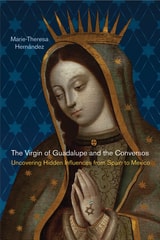
The Virgin of Guadalupe and the Conversos
Uncovering Hidden Influences from Spain to MexicoHernández, Marie-Theresa
Rutgers University Press, 2014
The terms converso and judaizante are often used for descendants of Spanish Jews (the Sephardi, or Sefarditas as they are sometimes called), who converted under duress to Christianity in the fourteenth and fifteenth centuries. There are few, if any, archival documents that prove the existence of judaizantes after the Spanish expulsion of the Jews in 1492 and the Portuguese expulsion in 1497, as it is unlikely that a secret Jew in sixteenth-century Spain would have documented his allegiance to the Law of Moses, thereby providing evidence for the Inquisition.
On a Da Vinci Code – style quest, Hernández persisted in hunting for a trove of forgotten manuscripts at the New York Public Library. These documents, once unearthed, describe the Jewish/Christian religious beliefs of an early nineteenth-century Catholic priest in Mexico City, focusing on the relationship between the Virgin of Guadalupe and Judaism. With this discovery in hand, the author traces the cult of Guadalupe backwards to its fourteenth-century Spanish origins. The trail from that point forward can then be followed to its interface with early modern conversos and their descendants at the highest levels of the Church and the monarchy in Spain and Colonial Mexico. She describes key players who were somehow immune to the dangers of the Inquisition and who were allowed the freedom to display, albeit in a camouflaged manner, vestiges of their family's Jewish identity.
By exploring the narratives produced by these individuals, Hernández reveals the existence of those conversos and judaizantes who did not return to the “covenantal bond of rabbinic law,” who did not publicly identify themselves as Jews, and who continued to exhibit in their influential writings a covert allegiance and longing for a Jewish past. This is a spellbinding and controversial story that offers a fresh perspective on the origins and history of conversos.
The Virginal Mother in German Culture
From Sophie von La Roche and Goethe to MetropolisLauren Nossett
Northwestern University Press, 2019
Examining the virginal mother in the first novel by a German woman (Sophie von La Roche), canonical texts by Goethe, nineteenth-century popular fiction, autobiographical works, and Thea von Harbou’s novel Metropolis and Fritz Lang’s film by the same name, this book highlights the virginal mother at pivotal moments in German history and cultural development: the entrance of women into the literary market, the Goethezeit, the foundation of the German Empire, and the volatile Weimar Republic. The Virginal Mother in German Culture will be of interest to students and scholars of German literature, history, cultural and social studies, and women’s studies.