Results by title
3258 books match the query 'Performing Arts' and 658 start with t
Trying to Get Over
African American Directors after Blaxploitation, 1977-1986By Keith Corson
University of Texas Press, 2016
From 1972 to 1976, Hollywood made an unprecedented number of films targeted at black audiences. But following this era known as “blaxploitation,” the momentum suddenly reversed for black filmmakers, and a large void separates the end of blaxploitation from the black film explosion that followed the arrival of Spike Lee’s She's Gotta Have It in 1986. Illuminating an overlooked era in African American film history, Trying to Get Over is the first in-depth study of black directors working during the decade between 1977 and 1986.
Keith Corson provides a fresh definition of blaxploitation, lays out a concrete reason for its end, and explains the major gap in African American representation during the years that followed. He focuses primarily on the work of eight directors—Michael Schultz, Sidney Poitier, Jamaa Fanaka, Fred Williamson, Gilbert Moses, Stan Lathan, Richard Pryor, and Prince—who were the only black directors making commercially distributed films in the decade following the blaxploitation cycle. Using the careers of each director and the twenty-four films they produced during this time to tell a larger story about Hollywood and the shifting dialogue about race, power, and access, Corson shows how these directors are a key part of the continuum of African American cinema and how they have shaped popular culture over the past quarter century.
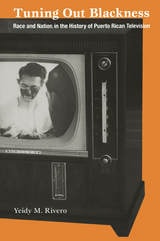
Tuning Out Blackness
Race and Nation in the History of Puerto Rican TelevisionYeidy M. Rivero
Duke University Press, 2005
Drawing on interviews, participant observation, archival research, and textual analysis, Rivero considers representations of race in Puerto Rico, taking into account how they are intertwined with the island’s status as a U.S. commonwealth, its national culture, its relationship with Cuba before the Cuban Revolution in 1959, and the massive influx of Cuban migrants after 1960. She focuses on locally produced radio and television shows, particular television events, and characters that became popular media icons—from the performer Ramón Rivero’s use of blackface and “black” voice in the 1940s and 1950s, to the battle between black actors and television industry officials over racism in the 1970s, to the creation, in the 1990s, of the first Puerto Rican situation comedy featuring a black family. As the twentieth century drew to a close, multinational corporations had purchased all Puerto Rican stations and threatened to wipe out locally produced programs. Tuning Out Blackness brings to the forefront the marginalization of nonwhite citizens in Puerto Rico’s media culture and raises important questions about the significance of local sites of television production.
Turning the Page
Storytelling as Activism in Queer Film and MediaCoon, David R
Rutgers University Press, 2018
Surprisingly, Hollywood is still clumsily grappling with its representation of sexual minorities, and LGBTQ filmmakers struggle to find a place in the mainstream movie industry. However, organizations outside the mainstream are making a difference, helping to produce and distribute authentic stories that are both by and for LGBTQ people.
Turning the Page introduces readers to three nonprofit organizations that, in very different ways, have each positively transformed the queer media landscape. David R. Coon takes readers inside In the Life Media, whose groundbreaking documentaries on the LGBTQ experience aired for over twenty years on public television stations nationwide. Coon reveals the successes of POWER UP, a nonprofit production company dedicated to mentoring filmmakers who can turn queer stories into fully realized features and short films. Finally, he turns to Three Dollar Bill Cinema, an organization whose film festivals help queer media find an audience and whose filmmaking camps for LGBTQ youth are nurturing the next generation of queer cinema.
Combining a close analysis of specific films and video programs with extensive interviews of industry professionals, Turning the Page demonstrates how queer storytelling in visual media has the potential to empower individuals, strengthen communities, and motivate social justice activism.
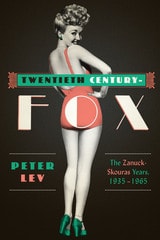
Twentieth Century-Fox
The Zanuck-Skouras Years, 1935–1965By Peter Lev
University of Texas Press, 2013
When the Fox Film Corporation merged with Twentieth Century Pictures in 1935, the company posed little threat to industry juggernauts such as Paramount and MGM. In the years that followed however, guided by executives Darryl F. Zanuck and Spyros Skouras, it soon emerged as one of the most important studios. Though working from separate offices in New York and Los Angeles and often of two different minds, the two men navigated Twentieth Century-Fox through the trials of the World War II boom, the birth of television, the Hollywood Blacklist, and more to an era of exceptional success, which included what was then the highest grossing movie of all time, The Sound of Music.
Twentieth Century-Fox is a comprehensive examination of the studio’s transformation during the Zanuck-Skouras era. Instead of limiting his scope to the Hollywood production studio, Lev also delves into the corporate strategies, distribution models, government relations, and technological innovations that were the responsibilities of the New York headquarters. Moving chronologically, he examines the corporate history before analyzing individual films produced by Twentieth Century-Fox during that period. Drawn largely from original archival research, Twentieth Century-Fox offers not only enlightening analyses and new insights into the films and the history of the company, but also affords the reader a unique perspective from which to view the evolution of the entire film industry.
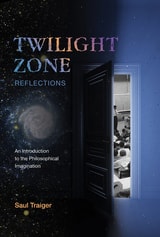
Twilight Zone Reflections
An Introduction to the Philosophical ImaginationSaul Traiger
Lever Press, 2024
Each short chapter dives into a single episode and concludes with helpful cross-references to other episodes that explore similar philosophical problems and subjects. For example, a reader may be interested in questions about the nature of the mind and whether machines can think. By referencing this book, they could easily discover the thematic connections between episodes like “I Sing the Body Electric” or “The Lateness of the Hour,” and learn how both episodes introduce the viewer to possible worlds that challenge us to consider whether our idea of the mind, and even our very personhood, extends beyond the human to robots and other artificial intelligences. Each chapter introduces fundamental philosophical questions such as these through the lens of The Twilight Zone and inspires additional exploration. Further readings are suggested for all episodes, making this volume indispensable to academics, students, and fans of the show. Each chapter is short and accessible, ensuring that this book is the perfect resource to accompany a complete series re-watch.
The Twilight Zone considered questions that strike at the heart of philosophical inquiry, such as the nature of self, the existence of god, the possibility of an afterlife, the relationship between knowledge and mental illness, the nature of possibility, even the nature of imagination itself, and so much more. Traiger argues that each episode can serve as an entry point for philosophical reflection. Twilight Zone Reflections is a valuable reference for anyone interested in exploring a well-known slice of popular culture history that doubles as a vast store of philosophical ideas.
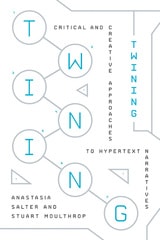
Twining
Critical and Creative Approaches to Hypertext NarrativesAnastasia Salter
Amherst College Press, 2021
"While there have certainly been attempts to study Twine historically and theoretically... no single publication has provided such a detailed account of it. And no publication has even attempted to situate Twine amongst its many different conversations and traditions, something this book does masterfully." —James Brown, Rutgers University, Camden
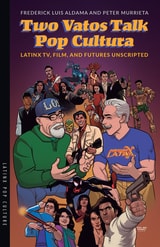
Two Vatos Talk Pop Cultura
Latinx TV, Film, and Futures UnscriptedFrederick Luis Aldama and Peter Murrieta
University of Arizona Press, 2026
Two Vatos Talk Pop Cultura brings a leading Latinx media studies scholar, Frederick Luis Aldama, together with an award-winning television writer and producer, Peter Murrieta, to examine how Latinx representation has evolved—and stagnated—across seven decades of American TV, film, and pop culture.
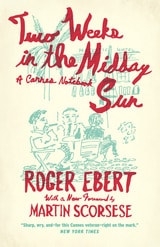
Two Weeks in the Midday Sun
A Cannes NotebookRoger Ebert
University of Chicago Press, 2016
More about people than movies, this book is an intimate, quirky, and witty account of the parade of personalities attending the 1987 festival—Ebert’s twelfth, and the fortieth anniversary of the event. A wonderful raconteur with an excellent sense of pacing, Ebert presents lighthearted ruminations on his daily routine and computer troubles alongside more serious reflection on directors such as Fellini and Coppola, screenwriters like Charles Bukowski, actors such as Isabella Rossellini and John Malkovich, the very American press agent and social maverick Billy “Silver Dollar” Baxter, and the stylishly plunging necklines of yore. He also comments on the trajectory of the festival itself and the “enormous happiness” of sitting, anonymous and quiet, in an ordinary French café. And, of course, he talks movies.
Illustrated with Ebert’s charming sketches of the festival and featuring both a new foreword by Martin Scorsese and a new postscript by Ebert about an eventful 1997 dinner with Scorsese at Cannes, Two Weeks in the Midday Sun is a small treasure, a window onto the mind of this connoisseur of criticism and satire, a man always so funny, so un-phony, so completely, unabashedly himself.