Results by title
4038 books match the query 'Social aspects' and 711 start with t

Troubling Gender
Youth and Cumbia in Argentina's Music SceneAuthored by Pablo Vila and Pablo Semán, contributions by Eloísa Martín and María Julia Carozzi
Temple University Press, 2011
Cumbia villera—literally, cumbia from the shantytowns— is a musical genre quite popular with Argentine youth who frequent urban dance halls. Its songs are known for having highly sexualized lyrics— about girls dancing provocatively or experiencing erotic pleasure. The songs exhibit the tensions at play in the different ways people relate to this musical genre.
In Troubling Gender, noted sociologists Pablo Vila and Pablo Semán scrutinize the music's lyrics and the singers' and dancers' performances. At the same time, the authors conduct in-depth interviews to examine the ways males construct and appropriate cumbia's lyrics, and how females identify, appropriate, and playfully and critically manipulate the same misogynistic songs.
Addressing the relationship between this form of music and the wider social, political, and economic changes that influence the lives of urban youth, Troubling Gender argues that the music both reflects and influences the ways in which women's and men's roles are changing in Argentine society.
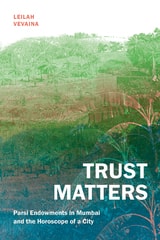
Trust Matters
Parsi Endowments in Mumbai and the Horoscope of a CityLeilah Vevaina
Duke University Press, 2023
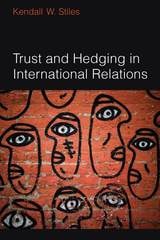
Trust and Hedging in International Relations
Kendall W. Stiles
University of Michigan Press, 2018
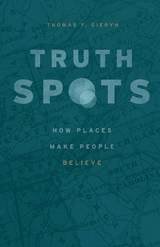
Truth-Spots
How Places Make People BelieveThomas F. Gieryn
University of Chicago Press, 2018
In Truth-Spots, Gieryn gives readers an elegant, rigorous rendering of the provenance of ideas, uncovering the geographic location where they are found or made, a spot built up with material stuff and endowed with cultural meaning and value. These kinds of places—including botanical gardens, naturalists’ field-sites, Henry Ford’s open-air historical museum, and churches and chapels along the pilgrimage way to Santiago de Compostela in Spain—would seem at first to have little in common. But each is a truth-spot, a place that makes people believe. Truth may well be the daughter of time, Gieryn argues, but it is also the son of place.

Tuberculosis Control and Institutional Change in Shanghai, 1911–2011
Rachel S. Core
Hong Kong University Press, 2023
Tuberculosis Control and Institutional Change in Shanghai, 1911–2011 is the first book on the most widespread and deadly infectious disease in China, both historically and today. Weaving together interviews with data from periodicals and local archives in Shanghai, Rachel Core examines the rise and fall of tuberculosis control in China from the 1950s to the 1990s. Under the socialist work unit system, the vast majority of people had guaranteed employment, a host of benefits tied to their workplace, and there was little mobility—factors that made the delivery of medical and public health services possible in both urban and rural areas. The dismantling of work units amid wider market reforms in the 1980s and 1990s led to the rise of temporary and casual employment and a huge migrant worker population, with little access to health care, creating new challenges in TB control. This study of Shanghai will provide valuable lessons for historians, social scientists, public health specialists, and many others working on public health infrastructure on both the national and global levels.

Tween Pop
Children's Music and Public CultureTyler Bickford
Duke University Press, 2020

Twin Cities Sports
Games for All SeasonsSheldon Anderson
University of Arkansas Press, 2020

Twins Talk
What Twins Tell Us about Person, Self, and SocietyDona Lee Davis
Ohio University Press, 2015
Twins Talk is an ethnographic study of identical twins in the United States, a study unique in that it considers what twins have to say about themselves, instead of what researchers have written about them. It presents, in the first person, the grounded and practical experiences of twins as they engage, both individually and together, the “who am I” and “who are we” questions of life. Here, the twins themselves are the stars.
Dona Lee Davis conducted conversational interviews with twenty-two sets of identical twins attending the Twins Days Festival in Twinsburg, Ohio, the largest such gathering in the world. Lively and often opinionated, each twin comes through as a whole person who at the same time maintains a special bond that the vast majority of people will never experience.
The study provides a distinctive and enlightening insider’s challenge to the nature/nurture debates that dominate contemporary research on twins. The author, herself an identical twin, draws on aspects of her own life to inform her analysis of the data throughout the text. Each chapter addresses a different theme from multiple viewpoints, including those of popular science writers, scientific researchers, and singletons, as well as those of the twins themselves.

Two Bits
The Cultural Significance of Free SoftwareChristopher M. Kelty
Duke University Press, 2008
Drawing on ethnographic research that took him from an Internet healthcare start-up company in Boston to media labs in Berlin to young entrepreneurs in Bangalore, Kelty describes the technologies and the moral vision that bind together hackers, geeks, lawyers, and other Free Software advocates. In each case, he shows how their practices and way of life include not only the sharing of software source code but also ways of conceptualizing openness, writing copyright licenses, coordinating collaboration, and proselytizing. By exploring in detail how these practices came together as the Free Software movement from the 1970s to the 1990s, Kelty also considers how it is possible to understand the new movements emerging from Free Software: projects such as Creative Commons, a nonprofit organization that creates copyright licenses, and Connexions, a project to create an online scholarly textbook commons.

Two Dreams in One Bed
Empire, Social Life, and the Origins of the North Korean Revolution in ManchuriaHyun Ok Park
Duke University Press, 2005
Drawing on a rich archive of Korean, Japanese, and Chinese sources, Park describes how Koreans negotiated the contradictory demands of national and colonial powers. She demonstrates that the dynamics of global capitalism led the Chinese and Japanese to pursue capitalist expansion while competing for sovereignty. Decentering the nation-state as the primary analytic rubric, her emphasis on the role of global capitalism is a major innovation for understanding nationalism, colonialism, and their immanent links in social space.
Through a regional and temporal comparison of Manchuria from the late nineteenth century until 1945, Park details how national and colonial powers enacted their claims to sovereignty through the regulation of access to land, work, and loans. She shows that among Korean migrants, the complex connections among Chinese laws, Japanese colonial policies, and Korean social practices gave rise to a form of nationalism in tension with global revolution—a nationalism that laid the foundation for what came to be regarded as North Korea’s isolationist politics.

Tyranny of the Moment
Fast and Slow Time in the Information AgeThomas Hylland Eriksen
Pluto Press, 2001