Results by title
3703 books match the query '19th century' and 853 start with t

The Wright Company
From Invention to IndustryEdward J. Roach
Ohio University Press, 0
But all was not well in Dayton, a city that hummed with industry, producing cash registers, railroad cars, and many other products. The brothers found it hard to transition from running their own bicycle business to being corporate executives responsible for other people’s money. Their dogged pursuit of enforcement of their 1906 patent — especially against Glenn Curtiss and his company — helped hold back the development of the U.S. aviation industry. When Orville Wright sold the company in 1915, more than three years after his brother’s death, he was a comfortable man — but his company had built only 120 airplanes at its Dayton factory and Wright Company products were not in the U.S. arsenal as war continued in Europe.
Edward Roach provides a fascinating window into the legendary Wright Company, its place in Dayton, its management struggles, and its effects on early U.S. aviation.

The Writing of Melancholy
Modes of Opposition in Early French ModernismRoss Chambers
University of Chicago Press, 1993
After the failed revolution of 1848, the sense of disillusion that swept through France deeply affected the literature of the time. Chambers argues that literary melancholy and disorientation constituted a symptom of historical conditions rather than, as many other critics contend, a willful resistance to them.
Enriched by careful readings of works by Flaubert, Nerval, Baudelaire, Gautier, and Hugo, this book is a subtle meditation on the powers of writing and reading and a suggestive contribution to current debates over the historical status of literary texts. Originally published in French, the book has been revised and expanded to include a new chapter on Gérard de Nerval's "Sylvie."
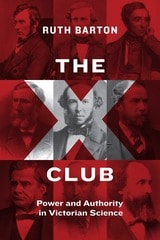
The X Club
Power and Authority in Victorian ScienceRuth Barton
University of Chicago Press, 2018
These six ambitious professionals and three wealthy amateurs—J. D. Hooker, T. H. Huxley, John Tyndall, John Lubbock, William Spottiswoode, Edward Frankland, George Busk, T. A. Hirst, and Herbert Spencer—wanted to guide the development of science and public opinion on issues where science impinged on daily life, religious belief, and politics. They formed a private dining club, which they named the X Club, to discuss and further their plans. As Ruth Barton shows, they had a clear objective: they wanted to promote “scientific habits of mind,” which they sought to do through lectures, journalism, and science education. They devoted enormous effort to the expansion of science education, with real, but mixed, success.
For twenty years, the X Club was the most powerful network in Victorian science—the men succeeded each other in the presidency of the Royal Society for a dozen years. Barton’s group biography traces the roots of their success and the lasting effects of their championing of science against those who attempted to limit or control it, along the way shedding light on the social organization of science, the interactions of science and the state, and the places of science and scientific men in elite culture in the Victorian era.
The Yellow Journalism
The Press and America's Emergence as a World PowerDavid R. Spencer
Northwestern University Press, 2007
Most notable among Hearst's competitors was New York City's The World, owned and managed by a European Jewish immigrant named Joseph Pulitzer. The Yellow Journalism describes how these two papers and others exploited the scandal, corruption, and crime among the city's most influential citizens, and its most desperate inhabitants--a policy that made this "journalism of action" remarkably effective, not just as a commercial force, but also as an advocate for the city's poor and defenseless. Spencer shows how many of the innovations first introduced during this period--from investigative reporting to the use of color, entertainment news, and cartoons in papers--have had a lasting effect on journalism; and how media in our day reflects the Yellow Press's influence, but also its threatened irrelevance within the broader realities of contemporary society.
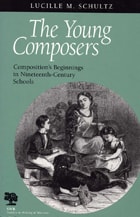
The Young Composers
Composition's Beginnings in Nineteenth-Century SchoolsLucille M. Schultz
Southern Illinois University Press, 1999
Lucille M. Schultz's The Young Composers: Composition's Beginnings in Nineteenth-Century Schools is the first full-length history of school-based writing instruction. Schultz demonstrates that writing instruction in nineteenth-century American schools is much more important in the overall history of writing instruction than we have previously assumed.
Drawing on primary materials that have not been considered in previous histories of writing instruction—little-known textbooks and student writing that includes prize-winning essays, journal entries, letters, and articles written for school newspapers—Schultz shows that in nineteenth-century American schools, the voices of the British rhetoricians that dominated college writing instruction were attenuated by the voice of the Swiss education reformer Johann Heinrich Pestalozzi. Partly through the influence of Pestalozzi's thought, writing instruction for children in schools became child-centered, not just a replica or imitation of writing instruction in the colleges.
It was also in these nineteenth-century American schools that personal or experience-based writing began and where the democratization of writing was institutionalized. These schools prefigured some of our contemporary composition practices: free writing, peer editing, and the use of illustrations as writing prompts. It was in these schools, in fact, where composition instruction as we know it today began, Schultz argues.
This book features a chapter on the agency of textbook iconography, which includes illustrations from nineteenth-century composition books as well as a cultural analysis of those illustrations. Schultz also includes a lengthy bibliography of nineteenth-century composition textbooks and student and school newspapers.
Theater of Capital
Modern Drama and Economic LifeAlisa Zhulina
Northwestern University Press, 2024
Emerging amid the turbulent rise of market finance and wider socioeconomic changes, modern drama enacted vital critiques of art and life under capitalism. Alisa Zhulina shows how fin-de-siècle playwrights such as Henrik Ibsen, August Strindberg, Anton Chekhov, George Bernard Shaw, and Gerhart Hauptmann interrogated the meaning of this newly coined economic concept. Acutely aware of their complicity in the system they sought to challenge, these playwrights staged economic questions as moral and political concerns, using their plays to explore the theories of Adam Smith, Karl Marx and Friedrich Engels, Max Weber, and others within the boundaries of bourgeois theater.
Theater of Capital: Modern Drama and Economic Life reveals the prescient and unsettling visions of life in a new financial and societal reality in now-canonical plays such as A Doll’s House, Miss Julie, and The Cherry Orchard, as well as in lesser-known and long-overlooked works. This wide-ranging study prompts us to reevaluate modern drama and its legacy for the urgent economic and political questions that haunt our present moment.
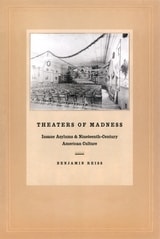
Theaters of Madness
Insane Asylums and Nineteenth-Century American CultureBenjamin Reiss
University of Chicago Press, 2008
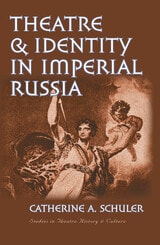
Theatre and Identity in Imperial Russia
Catherine A. Schuler
University of Iowa Press, 2009
Schuler draws upon contemporary journals written and published by the educated nobility and the intelligentsia—who represented the intellectual, aesthetic, and cultural groups of the day—as well as upon the laws of the Russian empire and upon theatrical memoirs. With fascinating detail, she spotlights the ideologically charged binaries ascribed to prominent actors—authentic/performed, primitive/civilized, Russian/Western—that mirrored the volatility of national identity from the Napoleonic Wars through the reign of Alexander II.
If the path traveled by Russian artists and audiences from the turn of the nineteenth century to the era of the Great Reforms reveals anything about Russian culture and society, it may be that there is nothing more difficult than being Russian in Russia. By exploring the ways in which theatrical administrators, playwrights, and actors responded to three tsars, two wars, and a major revolt, this carefully crafted book demonstrates the battle for the hearts and minds of the Russian people.
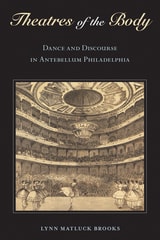
Theatres of the Body
Dance and Discourse in Antebellum PhiladelphiaLynn Matluck Brooks
Temple University Press, 2025
Reviewing print culture in the 1840s, Brooks shows how newspapers, magazines, and popular fiction provided documentation of dancing in Philadelphia as well as the responses of dance commentators, practitioners, and moralists. Theatres of the Body also considers the interplay of science with dance in the 1850s, which impacted both dance practices and reception.
Providing an expansive historiography of these significant contributions to dance in the United States, Brooks deepens our understanding of antebellum culture and history.
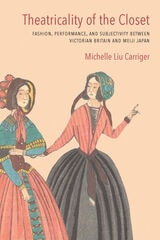
Theatricality of the Closet
Fashion, Performance, and Subjectivity between Victorian Britain and Meiji JapanMichelle Liu Carriger
Northwestern University Press, 2023
Clothing matters. This basic axiom is both common sense and, in another way, radical. It is from this starting point that Michelle Liu Carriger elucidates the interconnected ways in which gender, sexuality, class, and race are created by the everyday act of getting dressed. Theatricality of the Closet: Fashion, Performance, and Subjectivity between Victorian Britain and Meiji Japan examines fashion and clothing controversies of the nineteenth century, drawing on performance theory to reveal how the apparently superficial or frivolous deeply affects the creation of identity.
By interrogating a set of seemingly disparate examples from the same period but widely distant settings—Victorian Britain and Meiji-era Japan—Carriger disentangles how small, local, ordinary practices became enmeshed in a global fabric of cultural and material surfaces following the opening of trade between these nations in 1850. This richly illustrated book presents an array of media, from conservative newspapers and tabloids to ukiyo-e and early photography, that locate dress as a site where the individual and the social are interwoven, whether in the 1860s and 1870s or the twenty-first century.
Their Determination to Remain
A Cherokee Community's Resistance to the Trail of Tears in North CarolinaLance Greene
University of Alabama Press, 2023
The remarkable story of a North Carolina Cherokee community who avoided forced removal on the Trail of Tears
During the 1838 forced Cherokee removal by the US government, a number of close-knit Cherokee communities in the Southern Appalachian Mountains refused to relinquish their homelands, towns, and way of life. Using a variety of tactics, hundreds of Cherokees avoided the encroaching US Army and remained in the region.
In his book Their Determination to Remain: A Cherokee Community’s Resistance to the Trail of Tears in North Carolina, Lance Greene explores the lives of wealthy plantation owners Betty and John Welch who lived on the southwestern edge of the Cherokee Nation. John was Cherokee and Betty was White. Although few Cherokees in the region participated in slavery, the Welches held nine African Americans in bondage.
During removal, the Welches assisted roughly 100 Cherokees hiding in the steep mountains. Afterward, they provided land for these Cherokees to rebuild a new community, Welch’s Town. Betty became a wealthy and powerful plantation mistress because her husband could no longer own land. Members of Welch’s Town experienced a transitional period in which they had no formal tribal government or clear citizenship yet felt secure enough to reestablish a townhouse, stickball fields, and dance grounds.
Greene’s innovative study uses an interdisciplinary approach, incorporating historical narrative and archaeological data, to examine how and why the Welches and members of Welch’s Town avoided expulsion and reestablished their ways of life in the midst of a growing White population who resented a continued Cherokee presence. The Welch strategy included Betty’s leadership in demonstrating outwardly their participation in modern Western lifestyles, including enslavement, as John maintained a hidden space—within the boundaries of their land—for the continuation of traditional Cherokee cultural practices. Their Determination to Remain explores the complexities of race and gender in this region of the antebellum South and the real impacts of racism on the community.
Theodore Roosevelt
A Literary LifeThomas Bailey and Katherine Joslin
University Press of New England, 2018

Theory as Practice
A Critical Anthology of Early German Romantic WritingsJochen Schulte-Sasse, Haynes Horne, Elizabeth Mittman, Lisa C. Roetzel, Andreas Michel, Assenka Oksiloff, and Mary R. Strand, EditorsTranslated by Jochen Schulte-Sasse
University of Minnesota Press, 1997
Theory as Practice was first published in 1997. Minnesota Archive Editions uses digital technology to make long-unavailable books once again accessible, and are published unaltered from the original University of Minnesota Press editions.
In light of recent, dramatic revisions in criticism of European-particularly German-Romanticism, this anthology brings together key texts of the movement, especially those written in the last quarter of the eighteenth century by a small, influential circle centered at Jena.
In their introductory essays, the editors locate writings by Fichte, Schelling, Novalis, August Wilhelm Schlegel, and Friedrich Schlegel, among others, in this context. The selections include extensive excerpts from the correspondence of the Jena Romantics, their commentaries on each other's work, their most pertinent essays, fragments, and dialogues as well as diary entries and reviews. These works, together with the editors' articulation and elaboration of their significance, provide a new perspective on the provenance of postmodern thought and literary theory.
Jochen Schulte-Sasse is professor of German and comparative literature at the University of Minnesota and coeditor (with Wlad Godzich) of the Theory and History of Literature series at the University of Minnesota Press. Haynes Horne (University of Alabama), Andreas Michel (Indiana University), Assenka Oksiloff (New York University), Elizabeth Mittman (Michigan State University), Lisa C. Roetzel (University of Rochester), and Mary R. Strand each received a Ph.D. from the University of Minnesota.
There I Grew Up
Remembering Abraham Lincoln's Indiana YouthWilliam E. Bartelt
Indiana Historical Society Press, 2008
There is No Humor in Heaven
Mark Twain and Religious LiberalismDwayne E. Eutsey
University of Missouri Press, 2025
In There is No Humor in Heaven, Dwayne Eutsey challenges the persistent view of Twain as a hostile critic of religion by placing him within the prevailing liberal religious ethos of his time. From Hannibal to the western frontier and from Hartford to the wider world, Eutsey contends Twain’s vocation as a humorist was rooted in his frustrated youthful ambition to become a preacher of the Gospel. Throughout his life, his friendships with several influential liberal ministers, each of them espousing various forms of the era’s diverse progressive theology, informed not only Twain’s evolving religious worldview but his lecture performances and literary output.
There is No Humor in Heaven traces unconventional theological influences on Twain ranging from African-American spirituality, Freemasonry, and frontier Unitarianism to devout Liberal Christianity, radical Free Religion, and esoteric Hinduism. Drawing from Twain’s writings, documents, personal notes, and more, There is No Humor in Heaven offers readers a radical re-examination of the spiritually creative vitality of a controversial literary giant.
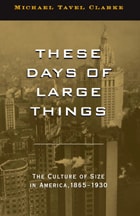
These Days of Large Things
The Culture of Size in America, 1865-1930Michael Tavel Clarke
University of Michigan Press, 2009
The United States at the turn of the twentieth century cultivated a passion for big. It witnessed the emergence of large-scale corporate capitalism; the beginnings of American imperialism on a global stage; record-level immigration; a rapid expansion of cities; and colossal events and structures like world's fairs, amusement parks, department stores, and skyscrapers. Size began to play a key role in American identity. During this period, bigness signaled American progress.
These Days of Large Things explores the centrality of size to American culture and national identity and the preoccupation with physical stature that pervaded American thought. Clarke examines the role that body size played in racial theory and the ways in which economic changes in the nation generated conflicting attitudes toward growth and bigness. Finally, Clarke investigates the relationship between stature and gender.
These Days of Large Things brings together a remarkable range of cultural material including scientific studies, photographs, novels, cartoons, architecture, and film. As a general cultural and intellectual history of the period, this work will be of interest to students and scholars in American studies, U.S. history, American literature, and gender studies.
Michael Tavel Clarke is Assistant Professor of English at the University of Calgary.
Cover photograph: "New York from Its Pinnacles," Alvin Langdon Coburn (1912). Courtesy of the George Eastman House.
"A fascinating study of the American preoccupation with physical size, this book charts new paths in the history of science, culture, and the body. A must-read for anyone puzzling over why Americans today love hulking SUVs, Mcmansions, and outsized masculine bodies."
---Lois Banner, University of Southern California
"From the Gilded Age through the Twenties, Clarke shows a nation-state obsessed with sheer size, ranging from the mammoth labor union to the 'Giant Incorporated Body' of the monopoly trust. These Days of Large Things links the towering Gibson Girl with the skyscraper, the pediatric regimen with stereotypes of the Jew. Spanning anthropology, medicine, architecture, business, and labor history, Clarke provides the full anatomy of imperial America and offers a model of cultural studies at its very best."
---Cecelia Tichi, Vanderbilt University
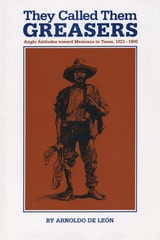
They Called Them Greasers
Anglo Attitudes toward Mexicans in Texas, 1821–1900by Arnoldo De León
University of Texas Press, 1983
Tension between Anglos and Tejanos has existed in the Lone Star State since the earliest settlements. Such antagonism has produced friction between the two peoples, and whites have expressed their hostility toward Mexican Americans unabashedly and at times violently.
This seminal work in the historical literature of race relations in Texas examines the attitudes of whites toward Mexicans in nineteenth-century Texas. For some, it will be disturbing reading. But its unpleasant revelations are based on extensive and thoughtful research into Texas' past. The result is important reading not merely for historians but for all who are concerned with the history of ethnic relations in our state.
They Called Them Greasers argues forcefully that many who have written about Texas's past—including such luminaries as Walter Prescott Webb, Eugene C. Barker, and Rupert N. Richardson—have exhibited, in fact and interpretation, both deficiencies of research and detectable bias when their work has dealt with Anglo-Mexican relations. De León asserts that these historians overlooled an austere Anglo moral code which saw the morality of Tejanos as "defective" and that they described without censure a society that permitted traditional violence to continue because that violence allowed Anglos to keep ethnic minorities "in their place."
De León's approach is psychohistorical. Many Anglos in nineteenth-century Texas saw Tejanos as lazy, lewd, un-American, subhuman. In De León's view, these attitudes were the product of a conviction that dark-skinned people were racially and culturally inferior, of a desire to see in others qualities that Anglos preferred not to see in themselves, and of a need to associate Mexicans with disorder so as to justify their continued subjugation.
They Sought a Land
A Settlement in the Arkansas River Valley, 1840–1870William Oates Ragsdale
University of Arkansas Press, 1997
Pisgah grew and prospered, developing increasingly successful farming practices, landholding patterns, and trading strategies. But the Civil War took a heavy toll, taking workers away from farms, subjecting those left on the home front to deprivation and violence, and creating division in the community. By 1870, the people of Pisgah had dispersed into Arkansas’s larger developing society.
Absorbing to read and rich with colorful detail, They Sought a Land is an important story of the westward expansion of the United States and the settling of the American South during the nineteenth century.
Thinking Outside the Book
Augusta Rohrbach
University of Massachusetts Press, 2014
In Thinking Outside the Book, Augusta Rohrbach works through the increasing convergences between digital humanities and literary studies to explore the meaning and primacy of the book as a literary, material, and cultural artifact. Rohrbach assembles a rather unlikely cohort of nineteenth-century women writers—Jane Johnston Schoolcraft, Sojourner Truth, Hannah Crafts, Augusta Evans, and Mary Chesnut—to consider the publishing culture of their period from the perspective of our current digital age, bringing together scholarly concepts from both print culture and new media studies.
In nineteenth-century America, women from a variety of racial and class affiliations were bombarding the print market with their literary productions, taking advantage of burgeoning rates of literacy and advances in publishing technology. Their work challenged prevailing modes of authorship and continues to do so today. Each chapter of Thinking Outside the Book positions a focal figure as both paradigmatic and problematic within the context of key terms that define the study of the book. In lieu of terms such as literacy, authorship, publication, edition, and editor, Rohrbach develops an alternate typology that includes mediation, memory, history, testimony, and loss. Recognizing that the field spans radio, cinema, television, and the Internet, she draws comparisons to the present day, when Web 2.0 allows writers from varying backgrounds and positions to seek out readers without “gatekeepers” limiting their exposure.
More than a literary history, this book takes up theories of recovery, literacy, authorship, narrative, the book, and new media in connection with race, gender, class, and region.
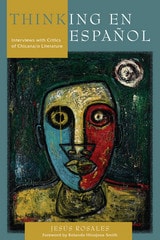
Thinking en español
Interviews with Critics of Chicana/o LiteratureJesús Rosales; Foreword by Rolando Hinojosa-Smith
University of Arizona Press, 2014
The twelve critics interviewed for this project share certain characteristics. For each one, Mexico plays an essential role in his or her personal and academic background, and each is bilingual and bicultural, having received formal literary education in Spanish graduate programs. As products of the working class, each scholar here shares a sense of social consciousness and commitment that lends an urgency to their desire to promote Chicano literature and culture at the local, regional, national, and international levels. They serve as a source of inspiration and commitment for future generations of scholars of Chicano literature and leave a lasting legacy of their own.
Thinking en español legitimizes Chicana/o criticism as an established discipline, and documents the works of some of the most important critics of Chicano literature at the turn of the twentieth and into the twenty-first century. This timely book immortalizes literary historical figures and documents the trajectory of Chicano criticism.
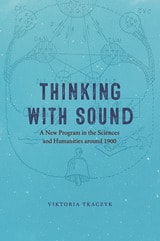
Thinking with Sound
A New Program in the Sciences and Humanities around 1900Viktoria Tkaczyk
University of Chicago Press, 2023
When the outside world is silent, all sorts of sounds often come to mind: inner voices, snippets of past conversations, imaginary debates, beloved and unloved melodies. What should we make of such sonic companions? Thinking with Sound investigates a period when these and other newly perceived aural phenomena prompted a far-reaching debate. Through case studies from Paris, Vienna, and Berlin, Viktoria Tkaczyk shows that the identification of the auditory cortex in late nineteenth-century neuroanatomy affected numerous academic disciplines across the sciences and humanities. “Thinking with sound” allowed scholars and scientists to bridge the gaps between theoretical and practical knowledge, and between academia and the social, aesthetic, and industrial domains. As new recording technologies prompted new scientific questions, new auditory knowledge found application in industry and the broad aesthetic realm. Through these conjunctions, Thinking with Sound offers a deeper understanding of today’s second “acoustic turn” in science and scholarship.
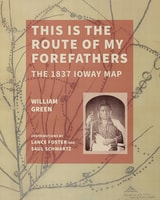
This Is the Route of My Forefathers
The 1837 Ioway MapWilliam Green
University of Iowa Press, 2025
Illustrating nearly 200 years of Ioway history, the 1837 Ioway map provides insights into the tribe’s political and diplomatic strategies, their relationships with neighboring nations, and how they resisted and negotiated in the face of dispossession. This Is the Route of My Forefathers uses an interdisciplinary approach to reveal how group accounts may fade over time, while accounts of origin—legendary histories—remain rich and vibrant.
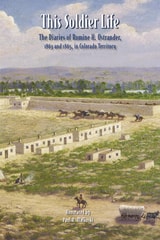
This Soldier Life
The Diaries of Romine H. Ostrander, 1863 and 1865, in Colorado TerritoryPaul A. Malkoski
University Press of Colorado, 2006
Jan. 24, 1865:
"I have had pretty spirited arguments with these third reg't ducks sometimes about the barbarity of indiscriminately murdering defenseless women and children of the Indians at sand creek. Some of them deny that any thing of the kind was done except in the general action when there was no telling the difference; and some acknowledge that there were women and children killed after the general action was over; but argue that it was right because Indians have done the same."
Oct. 17, 1863:
"I know that I have written a great many foolish - yes silly things in this book, and - well, what of it? What if I have? Who's business is it? Who's going to read them? I am!"
Published by the Colorado Historical Society
Thomas De Quincey
British Rhetoric's Romantic TurnLois Peters Agnew
Southern Illinois University Press, 2012
This wide-ranging volume gives proper attention to the views on rhetoric and style set forth by British literary figure Thomas De Quincey (1785–1859), whose contributions to the history of rhetoric are often overlooked. Lois Peters Agnew presents an overview of this theorist’s life and provides cultural context for his time and place, with particular emphasis on the significance of his rhetoric as both an alternative strain of rhetorical history and a previously unrealized example of rhetoric’s transformation in nineteenth-century Britain.
Agnew presents an extensive discussion of De Quincey’s ideas on rhetoric, his theory and practice of conversation, his theory of style and its role in achieving rhetoric’s dialogic potential, and his strategic use of humor and irony in such works as Confessions of an English Opium Eater. Synthesizing previous treatments of De Quincey’s rhetoric and connecting his unusual perspectives on language to the biographical details of his life, Agnew helps readers understand his intellectual development while bringing to light the cultural contexts that prompted radical changes in the ways nineteenth-century British intellectuals conceived of the role of language and the imagination in public and private discourse.
Agnew presents an alternative vision of rhetoric that departs from many common assumptions about rhetoric’s civic purpose and offers insights into the topic of rhetoric and technological change. The result is an accessible and thorough explanation of De Quincey’s complex ideas on rhetoric and the first work to fully show the reach of his ideas across multiple texts written during his lifetime.
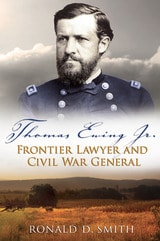
Thomas Ewing Jr.
Frontier Lawyer and Civil War GeneralRonald D. Smith
University of Missouri Press, 2008
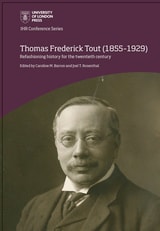
Thomas Frederick Tout (1855–1929)
refashioning history for the twentieth centuryEdited by Joel T. Rosenthal and Caroline M. Barron
University of London Press, 2019
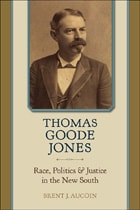
Thomas Goode Jones
Race, Politics, and Justice in the New SouthBrent J. Aucoin
University of Alabama Press, 2016
Thomas Goode Jones of Alabama is the first comprehensive biography of a key Alabama politician and federal jurist whose life and times embody the conflicts and transformations in the Deep South between the Civil War and World War I.
A man who both represented and differed from his class, Thomas Goode Jones offers contemporary readers and scholars an ideal subject of study to understand a period of southern history that still shapes American life today. Often overshadowed by the pharaonic antebellum period, the Civil War, and the luminous heights of the civil rights movement, the deceptively placid decades at the turn of the century were, in fact, a period when southerners fiercely debated the course of the South’s future. In tracing Jones’s career, Brent J. Aucoin offers vivid accounts of the great events and trends of that pivotal period: Reconstruction, the birth of the “Solid South,” the Populist Revolt, and the establishment of racial disenfranchisement and segregation.
Born in 1844, Jones served in the Confederate army and after the war identified as a conservative “Bourbon” Democrat. He served as Alabama's governor from 1890 to 1894 and as a federal judge from 1901 until his death in 1914. As a veteran, politician, and judge, Jones embodied numerous roles in the shifting political landscape of the South.
Jones was not, however, a reflexive conformist and sometimes pursued policies at odds with his party. Jones’s rhetoric and support of African American civil rights were exceptional and earned him truculent criticism from unrepentant racist factions in his party. His support was so fearless that it inspired Booker T. Washington to recommend Jones to Republican president Theodore Roosevelt as a federal judge. On the bench, Jones garnered national attention for his efforts to end peonage and lynching, and yet he also enabled the establishment of legalized segregation in Alabama, confounding attempts easily to categorize him as an odious reactionary or fearless progressive.
Thomas Hardy's Brains
Psychology, Neurology, and Hardy's ImaginationSuzanne Keen
The Ohio State University Press, 2014
This study reveals how Hardy made sense of diverse sources of an affective human psychology, a discipline that expanded significantly during Hardy’s working life. From the 1870s to the turn of the twentieth century, the tools and techniques for studying the structures and function of the nervous system developed rapidly. Simultaneously, Hardy moved steadily toward realizing a more physiologically accurate rendering of brains and nerves.

Thoreau beyond Borders
New International Essays on America's Most Famous Nature WriterFrançois Specq
University of Massachusetts Press, 2020
Henry David Thoreau spent his life as an intellectual vagrant, jumping fences, pushing boundaries, and crossing borders. How, why, and to what end are the questions asked by contributors to this new volume of essays, whose work crosses national and disciplinary borders to think about Thoreau anew.
Deliberately invoking Thoreau's commitment to “living a border life,” a life located between the world of nature and that of the polis, these varied essays explore the writer's thinking and writing as situated not merely against, but across and beyond borders and boundaries—whether geographic, temporal, or spiritual. Arguing that literary texts are governed by mediation and dialogue, lines of force becoming lines of connection that entail complex patterns and interweavings, the contributors draw on methodologies that freely combine literary and philosophical approaches with cultural and political ones—in turn moving us beyond borders.
Contributors include the volume editors as well as Kristen Case, Danielle Follett, Rochelle Johnson, John J. Kucich, Daniel S. Malachuk, Henrik Otterberg, Sandra Harbert Petrulionis, Benjamin Pickford, David M. Robinson, Christa Holm Vogelius, and Michael C. Weisenburg.
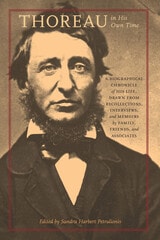
Thoreau in His Own Time
A Biographical Chronicle of His Life, Drawn from Recollections, Interviews, and Memoirs by Family, Friends, and AssociatesSandra Harbert Petrulionis
University of Iowa Press, 2012
The forty-nine recollections gathered in Thoreau in His Own Time demonstrate that it was those who knew him personally, rather than his contemporary literati, who most prized Thoreau’s message, but even those who disparaged him respected his unabashed example of an unconventional life. Included are comments by Ralph Waldo Emerson—friend, mentor, Walden landlord, and progenitor of the spin on Thoreau’s posthumous reputation; Nathaniel Hawthorne, who could not compliment Thoreau without simultaneously denigrating him; and John Weiss, whose extended commentary on Thoreau’s spirituality reflects unusual tolerance. Selections from the correspondence of Caroline Healey Dall, Maria Thoreau, Sophia Hawthorne, Sarah Alden Bradford Ripley, and Amanda Mather amplify our understanding of the ways in which nineteenth-century women viewed Thoreau. An excerpt by John Burroughs, who alternately honored and condemned Thoreau, asserts his view that Thoreau was ever searching for the unattainable.
The dozens of primary sources in this crisply edited collection illustrate the complexity of Thoreau’s iconoclastic singularity in a way that no one biographer could. Each entry is introduced by a headnote that places the selection in historical and cultural context. Petrulionis’s comprehensive introduction and her detailed chronology of personal and literary events in Thoreau’s life provide a lively and informative gateway to the entries themselves. The collaborative biography that Petrulionis creates in Thoreau in His Own Time contextualizes the strikingly divergent views held by his contemporaries and highlights the reasons behind his profound legacy.
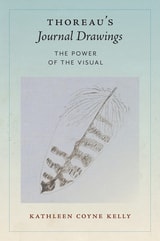
Thoreau's Journal Drawings
The Power of the VisualKathleen Coyne Kelly
University of Massachusetts Press, 2026
Examining journal drawings as an integral—and often delightful—feature of Thoreau’s work
In 1850, Henry David Thoreau began to draw in his Journal—a hedgehog’s quill, a locust’s wing, a goldenrod leaf. The sketches reflect his efforts to train his eye to observe more carefully, to look closely enough that he could see what was in front of him—with intention and attention. As Thoreau worked to combine the vivid language of a writer with the precision of a scientist, his drawings became more vital to the process. For him, writing and drawing were not separate activities; they were part of the same active, hands-on process of learning about the natural world.
Thoreau’s Journal Drawings offers a sustained examination of an understudied aspect of the Journal, emphasizing visual as well as textual analysis. It places Thoreau’s illustrated entries in the broader context of nineteenth-century scientific illustration, nature writing, and visual culture, while also offering close readings of key passages in which text and image work in tandem. The book opens up new possibilities for interpretation—both within the Journal and in the larger project of Thoreau’s thinking.
Ultimately, Thoreau’s illustrated Journal offers a case study in the complexities of representing the natural world through both language and image. His practice raises enduring questions about how we document, interpret, and mediate the more-than-human world across different forms of expression. To read the later volumes of Henry David Thoreau’s Journal without attending to his drawings is to overlook a vital dimension of his practice as both writer and observer.
Thoreau’s Democratic Withdrawal
Alienation, Participation, and ModernityShannon L. Mariotti
University of Wisconsin Press, 2009
Separated by time, space, and context, Thoreau and Adorno share a common belief that critical inquiry is essential to democracy but threatened by modern society. While walking, huckleberrying, and picking wild apples, Thoreau tries to recover the capacities for independent perception and thought that are blunted by “Main Street,” conventional society, and the rapidly industrializing world that surrounded him. Adorno’s thoughts on particularity and the microscopic gaze he employs to work against the alienated experience of modernity help us better understand the value of Thoreau’s excursions into nature. Reading Thoreau with Adorno, we see how periodic withdrawals from public spaces are not necessarily apolitical or apathetic but can revitalize our capacity for the critical thought that truly defines democracy.
In graceful, readable prose, Mariotti reintroduces us to a celebrated American thinker, offers new insights on Adorno, and highlights the striking common ground they share. Their provocative and challenging ideas, she shows, still hold lessons on how we can be responsible citizens in a society that often discourages original, critical analysis of public issues.
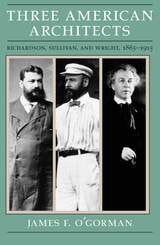
Three American Architects
Richardson, Sullivan, and Wright, 1865-1915James F. O'Gorman
University of Chicago Press, 1991
[A] brilliant analysis . . . a major contribution to our understanding of the beginnings of modern American architecture."—David Hamilton Eddy, Times Higher Education Supplement.

Three Civilizations, Two Cultures, One State
Canada's Political TraditionsDouglas Verney
Duke University Press, 1986
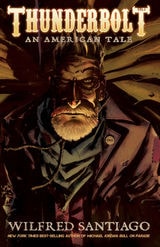
Thunderbolt
An American Tale, Vol. 1Wilfred Santiago
The Ohio State University Press, 2019
As a young boy in nineteenth-century America, Captain John Brown swore to dedicate his life to the struggle against slavery. Years later, he and his sons have joined the fight in Kansas, the epicenter of the national debate over slavery. As the territory nears statehood, abolitionists and proslavery border ruffians clash in increasingly violent conflict across the territory. But John Brown has more in mind than border skirmishes. He aims to eliminate slavery from US soil once and for all—even if that means raiding a government armory in order to arm a national slave revolt. From the Pottawatomie Massacre to the Battle of Black Jack and the Battle of Osawatomie, this first installment in the story of the legendary John Brown traces the rise of the insurrection in stunning detail.
Gritty, gripping, and masterfully illustrated, Wilfred Santiago’s telling of John Brown’s tale pulls no punches as it unflinchingly recounts the epic struggle across pre–Civil War America. And while John Brown’s methods may be questionable, his story is unforgettable. After all, dying is part of the plan.
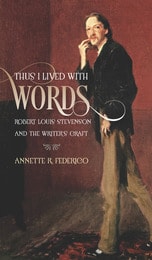
Thus I Lived with Words
Robert Louis Stevenson and the Writer's CraftAnnette R. Federico
University of Iowa Press, 2017
Stevenson belonged to a newly commercial literary world, an era of mass readership, marketing, and celebrity. He had plenty of practical advice for writers who wanted to enter the profession: study the best authors, aim for simplicity, strike a keynote, work on your style. He also held that a writer should adhere to the truth and utter only what seems sincere to his or her heart and experience of the world. Writers have messages to deliver, whether the work is a tale of Highland adventure, a collection of children’s verse, or an essay on umbrellas. Stevenson believed that an author could do no better than to find the appetite for joy, the secret place of delight that is the hidden nucleus of most people’s lives. His remarks on how to write, on style and method, and on pleasure and moral purpose contain everything in literature and life that he cared most about—adventuring, persisting, finding out who you are, and learning to embrace “the romance of destiny.”
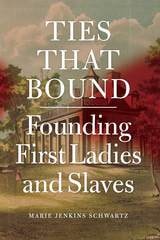
Ties That Bound
Founding First Ladies and SlavesMarie Jenkins Schwartz
University of Chicago Press, 2017
Unlike other histories that treat the stories of the First Ladies’ slaves as separate from the lives of their mistresses, Ties That Bound closely examines the relationships that developed between the First Ladies and their slaves. For elite women and their families, slaves were more than an agricultural workforce; slavery was an entire domestic way of life that reflected and reinforced their status. In many cases slaves were more constant companions to the white women of the household than were their husbands and sons, who often traveled or were at war. By looking closely at the complicated intimacy these women shared, Schwartz is able to reveal how they negotiated their roles, illuminating much about the lives of slaves themselves, as well as class, race, and gender in early America.
By detailing the prevalence and prominence of slaves in the daily lives of women who helped shape the country, Schwartz makes it clear that it is impossible to honestly tell the stories of these women while ignoring their slaves. She asks us to consider anew the embedded power of slavery in the very earliest conception of American politics, society, and everyday domestic routines.
Till the Dark Angel Comes
Abolitionism and the Road to the Second American RevolutionWilliam S. King
Westholme Publishing, 2016
Establishing himself as a fresh and important voice in the history of African American emancipation,William S. King provides a critical introduction to the lead-up to the Civil War. A skilled and judicious chronicler, King seamlessly weaves multiple and seemingly disparate threads, including early nineteenth-century Revivalism, the emergence of the Republic of Texas, the fugitive slave laws—and even the explosion of a cannon aboard the U.S.S. Princeton in 1844—to explain how the opposition to slavery in America changed from producing speeches and pamphlets to embracing the reality that slavery could be eradicated only through armed conflict. By tracing this transformation through the life of John Brown, King provides an entirely new assessment of this enigmatic figure who was characterized as a “mad man” in the wake of his butchering of proslavery settlers in Kansas and the inept raid on Harpers Ferry, Virginia. King puts these actions in context to explain the paradox of Brown’s legacy. On one hand he was vilified as an unstable threat to American democracy or a fanatical sideshow to the history of the Civil War, while on the other he was an inspiration to the oppressed, a man who garnered the indomitable Harriet Tubman’s commitment to the righteousness of his endeavor.
Elegantly written with a command of period sources, Till the Dark Angel Comes: Abolitionism and the Road to the Second American Revolution is the story of interracial opposition to slavery, the important debates among free blacks as to their future in America, and the arguments and compromises at the highest levels of government. Here we encounter many personalities of the time, some well known, such as Frederick Douglass,William Lloyd Garrison, and John C. Calhoun, and others less so, but no less important—Martin Delany, Henry Highland Garnet, and Elijah Lovejoy.
Time Travelers
Victorian Encounters with Time and HistoryEdited by Adelene Buckland and Sadiah Qureshi
University of Chicago Press, 2020
Out of their discoveries, new histories emerged, giving rise to fresh debates, while seemingly well-known histories were thrown into confusion by novel tools and methods of scrutiny. If in the eighteenth century the study of the past had been the province of a handful of elites, new technologies and economic development in the nineteenth century meant that the past, in all its brilliant detail, was for the first time the property of the many, not the few. Time Travelers is a book about the myriad ways in which Victorians approached the past, offering a vivid picture of the Victorian world and its historical obsessions.

To Care for the Sick and Bury the Dead
African American Lodges and Cemeteries in TennesseeLeigh Ann Gardner
Vanderbilt University Press, 2022
These Black cemeteries dot the Tennessee landscape, but few know their history or the societies of care they represent. To Care for the Sick and Bury the Dead is the first book-length look at these cemeteries and the lodges that fostered them.
This book is a must-have for genealogists, historians, and family members of the people buried in these cemeteries.
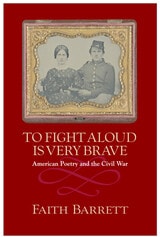
To Fight Aloud Is Very Brave
American Poetry and the Civil WarFaith Barrett
University of Massachusetts Press, 2012
Focusing on literary and popular poets, as well as work by women, African Americans, and soldiers, this book considers how writers used poetry to articulate their relationships to family, community, and nation during the Civil War. Faith Barrett suggests that the nationalist “we” and the personal “I” are not opposed in this era; rather they are related positions on a continuous spectrum of potential stances. For example, while Julia Ward Howe became famous for her “Battle Hymn of the Republic,” in an earlier poem titled “The Lyric I” she struggles to negotiate her relationship to domestic, aesthetic, and political stances.
Barrett makes the case that Americans on both sides of the struggle believed that poetry had an important role to play in defining national identity. She considers how poets created a platform from which they could speak both to their own families and local communities and to the nations of the Confederacy, the Union, and the United States. She argues that the Civil War changed the way American poets addressed their audiences and that Civil War poetry changed the way Americans understood their relationship to the nation.
To Heal the Scourge of Prejudice
The Life and Writings of Hosea EastonHosea Easton
University of Massachusetts Press, 1999
How did racial prejudice originate and why has it been so deeply rooted in American culture? What have been the long-term effects of prejudice on the intellectual, communal, and psychological resources of African Americans? How might the nightmare of racial domination be truly brought to an end? Still pertinent today, these were among the key questions addressed more than a century and a half ago by Hosea Easton (1799–1837), an important yet long neglected activist and intellectual.
A black minister from New England, Easton rose to prominence during the 1820s and 1830s by joining in the struggle of free African Americans to resist southern slavery and secure racial equality. From this experience he developed a deep understanding of the problem of "race" in the United States and became a trenchant critic of white supremacy and its devastating consequences. This volume brings back into print the only extended writings of Easton that have survived into our time: his insightful, almost prescient A Treatise on the Intellectual Character, and the Civil and Political Condition of the Colored People of the U. States, first published in 1837; and his passionate 1828 Thanksgiving Day “Address.” The book also provides a biographical portrait of Easton and his family, drawn from primary documents as well as secondary sources in the areas of biography, genealogy, and social history.
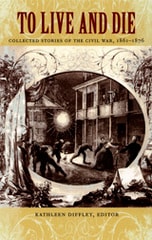
To Live and Die
Collected Stories of the Civil War, 1861–1876Kathleen Diffley, ed.
Duke University Press, 2002
The authors, who include Louisa May Alcott and Mark Twain, depict the horrors of the battlefield, the suffering in prison camps and field hospitals, and the privations of the home front. In these pages, bushwhackers carry the war to out-of-the-way homesteads, spies work households from the inside, journeying paymasters rely on the kindness of border women, and soldiers turn out to be girls. The stories are populated with nurses, officers, speculators, preachers, slaves, and black troops, and they take place in cities, along the frontier, and on battlefields from Shiloh to Gettysburg.
The book opens with a prewar vigilante attack on the Underground Railroad and a Kansas parson in Henry King’s “The Cabin at Pharoah’s Ford” and concludes with an ex-slave recalling the loss of her remaining son in Twain’s “A True Story.” In between are stories written by both women and men that were published in magazines from the South and West as well as the culturally dominant Northeast. Wartime wood engravings highlight the text. Kathleen Diffley’s introduction provides literary and historical background, and her commentary introduces readers to magazine authors as well as the deepening disruptions of a country at war.
Just as they did for nineteenth-century readers, these stories will bring the war home to contemporary readers, giving shape to a crisis that rocked the nation then and continues to haunt it now.
To Make Negro Literature
Writing, Literary Practice, and African American AuthorshipElizabeth McHenry
Duke University Press, 2021
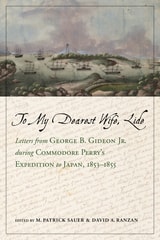
To My Dearest Wife, Lide
Letters from George B. Gideon Jr. during Commodore Perry’s Expedition to Japan, 1853–1855Edited by M. Patrick Sauer and David A. Ranzan
University of Alabama Press, 2019
George B. Gideon Jr. served as second assistant engineer aboard the USS Powhatan from 1852 to 1856. From his position on the steam frigate, Gideon traveled to Singapore, Labuan, Borneo, Hong Kong, and many other Asian lands. During his time at sea, Gideon penned dozens of letters to his wife, Lide, back home in Philadelphia. Recently discovered in the attic of his great-great-grandniece, were fifty-one letters penned by Gideon providing thorough and insightful commentary throughout the voyage.
Through these correspondences, Gideon laboriously documents the details of his daily life on board, from the food they ate to the technical aspects of his work, as well as observations concerning the historical events unfolding around him, such as Chinese piracy, the Taiping Rebellion, the Crimean War, and the devastation of Shimoda. To My Dearest Wife, Lide: Letters from George B. Gideon Jr. during Commodore Perry’s Expedition to Japan, 1853–1855 is a rare first-person account of the landmark American naval expedition to Japan to establish commercial relations between the two countries. Gideon’s letters have been meticulously transcribed and annotated by the editors and are an invaluable primary historical source.
Gideon’s letters are candid and revealing, delving into the rampant dysfunction in the navy of the 1850s—sickness and disease, alcohol abuse, and poor leadership, among other challenges. Gideon also unabashedly shares his own cynical views of the navy’s role in supporting American economic interests in Japan. This firsthand account of the political mission of the Perry expedition is a unique contribution to naval and military history and gives readers a better view of life aboard a navy ship.
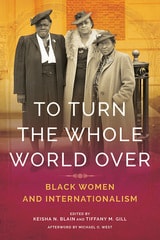
To Turn the Whole World Over
Black Women and InternationalismEdited by Keisha N. Blain and Tiffany M. Gill
University of Illinois Press, 2019
To the Wide Missouri
Traveling in America During the First Decades of Westward ExpansionLouis A. Garavaglia
Westholme Publishing, 2011
The Fascinating History of the Rapid Expansion of Roads, Canals, and Railways in the First Decades of the United States
While the great overland migration routes to America’s far west are well known and documented—the California, Oregon, Mormon, and Santa Fe Trails, the Central Overland and Pony Express—less attention has been given to how Americans in the first decades of the republic traveled across the western frontiers of the original colonies. Following the revolution, Americans began to seek their fortunes to the west in greater numbers. Land grants to veterans inspired others to move, including tradesmen, merchants, and tavern owners. With the Louisiana Purchase in 1803, the country doubled in size, and the rate of migration became extraordinary, with wider and more durable roads built, ferries installed at river crossings, canals cut to move goods, regular stage routes established, and ultimately the first railroad tracks laid down. Entire regions that supported few communities in the 1790s exploded in population, and as a result seven new states were admitted to the Union in the decade following the War of 1812. John Bradbury, who traveled through the United States between 1809 and 1811, wrote that “In passing through the upper parts of Virginia, I observed a great number of farms that had been abandoned, on many of which good houses had been erected, and fine apple and peach orchards had been planted. On enquiring the reason, I was always informed that the owners had gone to the western country.” In Maryland, a newspaper reporter wrote, “The time is close at hand when the region west of the Allegheny mountains will sway the destinies of the nation.” By 1839, the National Road extended more than 700 miles from Washington, DC, to central Illinois, New York’s Erie Canal operated from Albany to Buffalo, and the Baltimore and Ohio Railroad carried passengers briskly west, ultimately to the Ohio River.
Tohopeka
Rethinking the Creek War and the War of 1812Edited by Kathryn E. Holland Braund
University of Alabama Press, 2012
Reexamining the Creek War, the War of 1812, and the Making of the American South.
Tohopeka contains a variety of perspectives and uses a wide array of evidence and approaches, from scrutiny of cultural and religious practices to literary and linguistic analysis, to illuminate this troubled period. Almost two hundred years ago, the territory that would become Alabama was both ancient homeland and new frontier where a complex network of allegiances and agendas was playing out. The fabric of that network stretched and frayed as the Creek Civil War of 1813-14 pitted a faction of the Creek nation known as Red Sticks against those Creeks who supported the Creek National Council. The war began in July 1813, when Red Stick rebels were attacked near Burnt Corn Creek by Mississippi militia and settlers from the Tensaw area in a vain attempt to keep the Red Sticks’ ammunition from reaching the main body of disaffected warriors. A retaliatory strike against a fortified settlement owned by Samuel Mims, now called Fort Mims, was a Red Stick victory. The brutality of the assault, in which 250 people were killed, outraged the American public and “Remember Fort Mims” became a national rallying cry.
During the American-British War of 1812, Americans quickly joined the war against the Red Sticks, turning the civil war into a military campaign designed to destroy Creek power. The battles of the Red Sticks have become part of Alabama and American legend and include the famous Canoe Fight, the Battle of Holy Ground, and most significantly, the Battle of Tohopeka (also known as Horseshoe Bend)—the final great battle of the war. There, an American army crushed Creek resistance and made a national hero of Andrew Jackson.
New attention to material culture and documentary and archaeological records fills in details, adds new information, and helps disabuse the reader of outdated interpretations.
Contributors
Susan M. Abram / Kathryn E. Holland Braund/Robert P. Collins / Gregory Evans Dowd / John E. Grenier / David S. Heidler / Jeanne T. Heidler / Ted Isham / Ove Jensen / Jay Lamar / Tom Kanon / Marianne Mills / James W. Parker / Craig T. Sheldon Jr. / Robert G. Thrower / Gregory A. Waselkov
Tolerable Entertainment
Herman Melville and Professionalism in Antebellum New YorkJohn Evelev
University of Massachusetts Press, 2006
Perhaps more than any other nineteenth-century writer, Melville has been read and understood in the context of his career, embodied in a narrative of the trajectory from immature emergence, through brilliant ascendance, to collapse into neglect. Moving beyond these stereotypes, John Evelev uses Melville's writings to place the concept of "career" within a historical framework, as part of the ideological project of a new middle-class professionalism. He describes a meritocratic ethos of competitive specialization and expertise that distanced itself from both the deskilling of industrialized labor and the older professional arrangement of elite patronage. By exploring the intersections of class and culture in antebellum America, Evelev offers a new perspective on Melville's literary career.
Tolerable Entertainment reads Melville's life and work in relation to such cultural developments as the famous "high/low" theater riots at Astor Place and the rise of the lyceum circuit, a forum for celebrity lecturers to reach the new urban "middlebrow" audience. The book also considers such transformations in antebellum social attitudes as urban workers' protests against industrialization and the growth of the "self-culture" of the new urban middle class, with the emergence of vocational associations and professional specialization.
Evelev's readings run against the grain of modern Melville scholarship by emphasizing not the values of individualism and democracy that have led critics to construe Melville's writings as central to the American canon, but rather the ambivalent cultural and vocational distinctions of the developing middle class to which Melville belonged.
Tolstoy and Dostoevsky in Russian Symbolist Criticism
A ReaderEdited by Lindsay Ceballos, D. Brian Kim, and Chloë Kitzinger
Amherst College Press, 2026
At the turn of the twentieth century, Symbolist writers and thinkers at the forefront of Russian modernism cast Fyodor Dostoevsky and Leo Tolstoy as their chosen ancestors—examples to be exalted, repudiated, and ultimately surpassed. Their writings transformed the way these novelists were read within and beyond the Russian Empire. Many of the Symbolist writings on Tolstoy and Dostoevsky were long unavailable in English or were only available in outdated or unreliable translations. Presenting fresh annotated translations of some of the most influential Symbolist essays, Tolstoy and Dostoevsky in Russian Symbolist Criticism opens this globally influential body of criticism to a new anglophone audience. Readers will discover threads that extend toward writers from Sigmund Freud and J. M. Coetzee to Virginia Woolf and Mikhail Bakhtin. Tolstoy and Dostoevsky in Russian Symbolist Criticism will appeal to students encountering Tolstoy’s and Dostoevsky’s novels for the first time and to scholars of literary history and theory. This volume fills a longstanding gap in the study of Dostoevsky’s and Tolstoy’s novels and provides English-speaking readers with a missing key to the absorbing—and ongoing—story of their reception.