Results by title
8642 books match the query '20th century' and 1764 start with t

The Man Who Would Marry Susan Sontag
And Other Intimate Literary Portraits of the Bohemian EraEdward Field
University of Wisconsin Press, 2007
Long before Stonewall, young Air Force veteran Edward Field, fresh from combat in WWII, threw himself into New York’s literary bohemia, searching for fulfillment as a gay man and poet. In this vivid account of his avant-garde years in Greenwich Village and the bohemian outposts of Paris’s Left Bank and Tangier—where you could write poetry, be radical, and be openly gay—Field opens the closet door to reveal, as never been seen before, some of the most important writers of his time.
Here are young, beautiful Susan Sontag sitting at the feet of her idol Alfred Chester, who shrewdly plotted to marry her; May Swenson and her two loves; Paul and Jane Bowles in their ambiguous marriage; Frank O’Hara in and out of bed; Fritz Peters, the anointed son of Gurdjieff; and James Baldwin, Isabel Miller (Patience and Sarah), Tobias Schneebaum, Robert Friend, and many others. With its intimate portraits, Field’s memoir brings back a forgotten era—postwar bohemia—bawdy, comical, romantic, sad, and heroic.
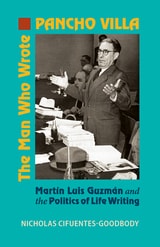
The Man Who Wrote Pancho Villa
Martin Luis Guzman and the Politics of Life WritingNicholas Cifuentes-Goodbody
Vanderbilt University Press, 2016
The Man Who Wrote Pancho Villa places Guzman's work in a biographical context, shedding light on the immediate motivations behind his writing in a given moment and the subsequent ways in which he rewrote or repackaged the material. Despite his efforts to establish a definitive reading of his life and literature, Guzman was unable to control that interpretation as audiences became less tolerant of the glaring omissions in his self-portrait.

The Man Who Wrote the Perfect Novel
John Williams, Stoner, and the Writing LifeBy Charles J. Shields
University of Texas Press, 2018
When Stoner was published in 1965, the novel sold only a couple of thousand copies before disappearing with hardly a trace. Yet John Williams’s quietly powerful tale of a Midwestern college professor, William Stoner, whose life becomes a parable of solitude and anguish eventually found an admiring audience in America and especially in Europe. The New York Times called Stoner “a perfect novel,” and a host of writers and critics, including Colum McCann, Julian Barnes, Bret Easton Ellis, Ian McEwan, Emma Straub, Ruth Rendell, C. P. Snow, and Irving Howe, praised its artistry. The New Yorker deemed it “a masterly portrait of a truly virtuous and dedicated man.”
The Man Who Wrote the Perfect Novel traces the life of Stoner’s author, John Williams. Acclaimed biographer Charles J. Shields follows the whole arc of Williams’s life, which in many ways paralleled that of his titular character, from their shared working-class backgrounds to their undistinguished careers in the halls of academia. Shields vividly recounts Williams’s development as an author, whose other works include the novels Butcher’s Crossing and Augustus (for the latter, Williams shared the 1972 National Book Award). Shields also reveals the astonishing afterlife of Stoner, which garnered new fans with each American reissue, and then became a bestseller all over Europe after Dutch publisher Lebowski brought out a translation in 2013. Since then, Stoner has been published in twenty-one countries and has sold over a million copies.
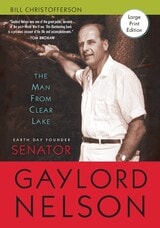
The Man from Clear Lake
Earth Day Founder Senator Gaylord NelsonBill Christofferson
University of Wisconsin Press, 2009
On Earth Day 1970 twenty million Americans displayed their commitment to a clean environment. It was called the largest demonstration in human history, and it permanently changed the nation’s political agenda. By Earth Day 2000 participation had exploded to 500 million people in 167 countries.
The seemingly simple idea—a day set aside to focus on protecting our natural environment—was the brainchild of U.S. Senator Gaylord Nelson of Wisconsin. It accomplished, far beyond his expectations, his lifelong goal of putting the environment onto the nation’s and the world’s political agendas.
A remarkable man, Nelson ranks as one of history’s leading environmentalists. He also played a major role as an early, outspoken opponent of the Vietnam War, and as a senate insider was a key player in civil rights, poverty, civil liberties and consumer protection issues.
The life of Nelson, a small town boy who learned his values and progressive political principles at an early age, is woven through the political history of the twentieth century. Nelson’s story intersects at times with Fighting Bob La Follette, Joe McCarthy, and Bill Proxmire in Wisconsin, and with George McGovern, Lyndon Johnson, Hubert Humphrey, Russell Long, Walter Mondale, John F. Kennedy, and others on the national scene.
Winner, Elizabeth A. Steinberg Prize, University of Wisconsin Press

The Man with the Black Coat
Russia's Literature of the AbsurdDaniil Kharms and Alexander Vvedensky
Northwestern University Press, 1997
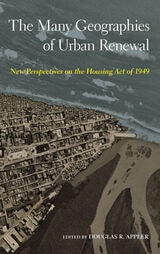
The Many Geographies of Urban Renewal
New Perspectives on the Housing Act of 1949Edited by Douglas R. Appler
Temple University Press, 2023
Taken as a whole, the essays showcase the unexpected diversity of how different communities used the federal urban renewal program. The Many Geographies of Urban Renewal allows us to better understand what was arguably the most significant urban policy of the 20th century, and how that policy shaped the American landscape.
Contributors include Francesca Russello Ammon, Brent Cebul, Robert B. Fairbanks, Leif Fredrickson, Colin Gordon, David Hochfelder, Robert K. Nelson, Benjamin D. Lisle, Stacy Kinlock Sewell and the editor.

The Many Lives of a Jesuit, Freemason, and Philanthropist
The Story of Töhötöm NagyÉva Petrás
Central European University Press, 2024
The life of Töhötöm Nagy (1908–1979), Jesuit, Mason, and secret service agent, offers fascinating insights into interwar Hungary, the Catholic Church and Vatican diplomacy, Freemasonry, and the activities of communist state security service.
As a young Jesuit Nagy was one of the leaders of a successful Catholic youth movement in interwar Hungary. After World War II he played an important role acting as an intermediary between the Vatican, the Red Army, and the Hungarian Catholic Church. After being sent to South America, he was attracted by liberation theology, but left the Society of Jesus, joined the Freemasons, and did social and philanthropic work in the slums of Buenos Aires. However, in the late 1960s he agreed to work for the Hungarian state security service in return for his repatriation. This latter period is reconstructed from the files of the Historical Archives of State Security in Budapest. Éva Petrás writes with empathy but with a sense of distance of the courage and restless energy of her subject. Her discussion of the limits of free choice and Nagy’s intense struggle to live a meaningful life make this biography breathtaking.
The Marcus Garvey and Universal Negro Improvement Association Papers, Volume XI
The Caribbean Diaspora, 1910–1920Marcus Garvey
Duke University Press, 2011
Praise for the Previous Volumes:
“The Marcus Garvey and Universal Negro Improvement Association Papers will take its place among the most important records of the Afro-American experience. . . . ‘The Marcus Garvey Papers’ lays the groundwork for a long overdue reassessment of Marcus Garvey and the legacy of racial pride, nationalism and concern with Africa he bequeathed to today’s black community.”—Eric Foner, the New York Times Book Review
“Until the publication of The Marcus Garvey and Universal Negro Improvement Association Papers, many of the documents necessary for a full assessment of Garvey’s thought or of his movement’s significance have not been easily accessible. Robert A. Hill and his staff . . . have gathered over 30,000 documents from libraries and other sources in many countries. . . . The Garvey papers will reshape our understanding of the history of black nationalism and perhaps increase our understanding of contemporary black politics.”—Clayborne Carson, the Nation
“Now is our chance, through these important volumes, to finally begin to come to terms with the significance of Garvey’s complex, fascinating career and the meaning of the movement he built.”—Lawrence W. Levine, the New Republic
The Marcus Garvey and Universal Negro Improvement Association Papers, Volume XII
The Caribbean Diaspora, 1920-1921Marcus Garvey
Duke University Press, 2014
Volume XII highlights the centrality of the Caribbean people not only to the convention, but also to the movement. The reports to the convention discussed the range of social and economic conditions obtaining in the Caribbean, particularly their impact on racial conditions. The quality of the discussions and debates were impressive. Contained in these reports are some of the earliest and most clearly enunciated statements in defense of social and political freedom in the Caribbean. These documents form an underappreciated and still underutilized record of the political awakening of Caribbean people of African descent.
The Marcus Garvey and Universal Negro Improvement Association Papers, Volume XIII
The Caribbean Diaspora, 1921-1922, Volume 13Marcus Garvey
Duke University Press, 2016
The Mark of Criminality
Rhetoric, Race, and Gangsta Rap in the War-on-Crime EraBryan J. McCann
University of Alabama Press, 2017
In The Mark of Criminality: Rhetoric, Race, and Gangsta Rap in the War-on-Crime Era, Bryan J. McCann argues that gangsta rap should be viewed as more than a damaging reinforcement of an era’s worst racial stereotypes. Rather, he positions the works of key gangsta rap artists, as well as the controversies their work produced, squarely within the law-and-order politics and popular culture of the 1980s and 1990s to reveal a profoundly complex period in American history when the meanings of crime and criminality were incredibly unstable.
At the center of this era—when politicians sought to prove their “tough-on-crime” credentials—was the mark of criminality, a set of discourses that labeled members of predominantly poor, urban, and minority communities as threats to the social order. Through their use of the mark of criminality, public figures implemented extremely harsh penal polices that have helped make the United States the world’s leading jailer of its adult population.
At the same time when politicians like Ronald Reagan, George H. W. Bush, and Bill Clinton and television shows such as COPS and America’s Most Wanted perpetuated images of gang and drug-filled ghettos, gangsta rap burst out of the hip-hop nation, emanating mainly from the predominantly black neighborhoods of South Central Los Angeles. Groups like NWA and solo artists (including Dr. Dre, Snoop Dogg, and Tupac Shakur) became millionaires by marketing the very discourses political and cultural leaders used to justify their war on crime. For these artists, the mark of criminality was a source of power, credibility, and revenue. By understanding gangsta rap as a potent, if deeply imperfect, enactment of the mark of criminality, we can better understand how crime is always a site of struggle over meaning. Furthermore, by underscoring the nimble rhetorical character of criminality, we can learn lessons that may inform efforts to challenge our nation’s failed policies of mass incarceration.
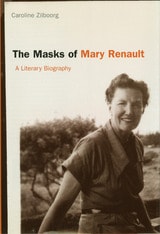
The Masks of Mary Renault
A Literary BiographyCaroline Zilboorg
University of Missouri Press, 2001
Born Eileen Mary Challans in London in 1905, Mary Renault wrote six successful contemporary novels before turning to the historical fiction about ancient Greece for which she is best known. While Renault's novels are still highly regarded, her life and work have never been completely examined. Caroline Zilboorg seeks to remedy this in The Masks of Mary Renault by exploring Renault's identity as a gifted writer and a sexual woman in a society in which neither of these identities was clear or easy.
Although Renault's life was anything but ordinary, this fact has often been obscured by her writing. The daughter of a doctor, she grew up comfortably and attended a boarding school in Bristol. She received a degree in English from St. Hugh's College in Oxford in 1928, but she chose not to pursue an academic career. Instead, she decided to attend the Radcliffe Infirmary in Oxford, where she trained to be a nurse. With the outbreak of the Second World War, she was assigned to the Winford Emergency Hospital in Bristol and briefly worked with Dunkirk evacuees. She went on to work in the Radcliffe Infirmary's brain surgery ward and was there until 1945.
It was during her nurse's training that Renault met Julie Mullard, who became her lifelong companion. This important lesbian relationship both resolved and posed many problems for Renault, not the least of which was how she was to write about issues at once intensely personal and socially challenging. In 1939, Renault published her first novel under a pseudonym in order to mask her identity. It was a time when she was struggling not only with her vocation (nursing and writing), but also with her sexual identity in the social and moral context of English life during the war.
In 1948, Renault left England with Mullard for South Africa and never returned. It was in South Africa that she made the shift from her early contemporary novels of manners to the mature historical novels of Hellenic life. The classical settings allowed Renault to mask material too explosive to deal with directly while simultaneously giving her an "academic" freedom to write about subjects vital to her—among them war, peace, career, women's roles, female and male homosexuality, and bisexuality.
Renault's reception complicates an understanding of her achievement, for she has a special status within the academic community, where she is both widely read and little written about. Her interest in sexuality and specifically in homosexuality and bisexuality, in fluid gender roles and identities, warrants a rereading and reevaluation of her work. Eloquently written and extensively researched, The Masks of Mary Renault will be of special value to anyone interested in women's studies or English literature.
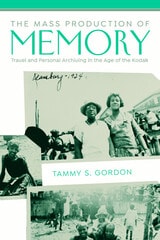
The Mass Production of Memory
Travel and Personal Archiving in the Age of the KodakTammy S. Gordon
University of Massachusetts Press, 2020
In 1888, the Eastman Dry Plate and Film Company offered the first portable camera that allowed users to conveniently take photos, using leisure travel as a primary marketing feature to promote it. The combination of portability, ease of use, and mass advertising fed into a national trend of popular photography that drew on Americans' increasing mobility and leisure time. The Kodak Company and the first generation of tourist photographers established new standards for personal archiving that amplified the individual's role in authoring the national narrative. But not everyone had equal access to travel and tourism, and many members of the African American, Native American, and gay and lesbian communities used the camera to counter the racism, homophobia, and classism that shaped public spaces.
In this groundbreaking history, Tammy S. Gordon tells the story of the camera's emerging centrality in leisure travel across the late nineteenth and early twentieth centuries and its role in “the mass production of memory,” a process in which users crafted a visual archive attesting to their experiences, values, and circumstances, setting the stage for the customizable visual culture of the digital age.
The Master and the Dean
The Literary Criticism of Henry James and William Dean HowellsRob Davidson
University of Missouri Press, 2005

The Math Mafia
How a Persistent Group of Reformers Standardized American EducationEmily T. Hamilton
University of Alabama Press, 2026
How Cold War urgency, academic ambition, and federal power converged to make math the cornerstone of American education policy.
The Math Mafia by Emily T. Hamilton is a historical account of mathematics education reform in twentieth-century America and how that movement played a role in shaping the broader contours of national education policy. Hamilton contends that a cohesive and well-organized community of advocates was instrumental in the rise of standardized testing and curriculum reforms, as well as federal involvement in classrooms, especially during the Cold War. By positioning mathematics as central to national strength and security, these reformers established math education as a key area of federal focus.
The “mafia” at the center of Hamilton’s story includes mathematicians, educators, and researchers from universities, as well as members of government-funded organizations such as the National Science Foundation and various educational psychology circles. Prominent figures such as Edward Begle, who led the School Mathematics Study Group during the “new math” movement, played key roles. Other influential participants include federal education officials, advocates from professional organizations such as the National Council of Teachers of Mathematics, and cognitive scientists, who contributed both research and theoretical frameworks that informed curriculum design and assessment methods.
The Math Mafia offers historians, educators, policymakers, and other interested readers a compelling perspective on the legacy of the math education reforms on federal education policy in the United States and is a welcome contribution to ongoing discourse around “teaching toward the test,” educational equity, school performance, and other hot-button issues in US education today.
The Matter of Black Living
The Aesthetic Experiment of Racial Data, 1880–1930Autumn Womack
University of Chicago Press, 2022
As the nineteenth century came to a close and questions concerning the future of African American life reached a fever pitch, many social scientists and reformers approached post-emancipation Black life as an empirical problem that could be systematically solved with the help of new technologies like the social survey, photography, and film. What ensued was nothing other than a “racial data revolution,” one which rendered African American life an inanimate object of inquiry in the name of social order and racial regulation. At the very same time, African American cultural producers and intellectuals such as W. E. B. Du Bois, Kelly Miller, Sutton Griggs, and Zora Neale Hurston staged their own kind of revolution, un-disciplining racial data in ways that captured the dynamism of Black social life.
The Matter of Black Living excavates the dynamic interplay between racial data and Black aesthetic production that shaped late nineteenth-century social, cultural, and literary atmosphere. Through assembling previously overlooked archives and seemingly familiar texts, Womack shows how these artists and writers recalibrated the relationship between data and Black life. The result is a fresh and nuanced take on the history of documenting Blackness. The Matter of Black Living charts a new genealogy from which we can rethink the political and aesthetic work of racial data, a task that has never been more urgent.
The Mau Mau War in Perspective
Eastern African StudiesFrank Furedi
Ohio University Press, 1989
The book breaks new ground in following the story of the participants of the rural movement during the decade after the defeat of the Mau Mau. New archival sources and interviews provide exciting material on the mechanics of the sociology of decolonization and on the containment of rural radicalism in Kenya. For the first time an account of decolonization in Kenya based on primary sources is offered to the reader.
The Mau Mau was militarily crushed in the mid-fifties, but the struggle for land rights was only contained in the post independence era of Kenya. Kikuyu squatters on European estates who formed the backbone of this movement are the main subject of this book.
Furedi’s account considers how the radicalization of rural protest in the so-called White Highlands led to the Mau Mau explosion and how it was sustained during the subsequent fifteen years.
The book establishes a focus for discussion of these critical events through exploring the relationship between rural resistance and decolonization. The author argues that the main issue facing post-colonial policies in Kenya was to resolve the problems raised by the Mau Mau revolt.
Written from an interdisciplinary perspective, with a special emphasis on historical and political sociology, this book is aimed at students of African politics and political sociologists interested in rural revolution and revolt.
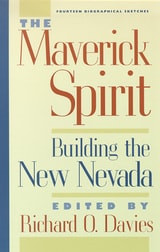
The Maverick Spirit
Building The New NevadaRichard O. Davies
University of Nevada Press, 1998
A collection of biographical essays on fourteen contemporary Nevadans. The subjects of the essays are Maude Frazier; Moe Dalitz; James B. McMillan; William F. Harrah; Hank Greenspun; Alan Bible; Robert Laxalt; Grant Sawyer; Molly Flagg Knudtsen; Paul Laxalt; Steve Wynn; William Raggio; Sue Wagner; and Jerry Tarkanian.
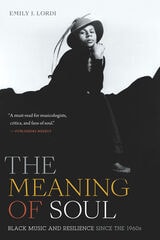
The Meaning of Soul
Black Music and Resilience since the 1960sEmily J. Lordi
Duke University Press, 2020
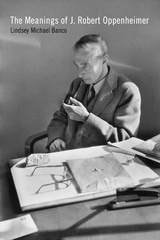
The Meanings of J. Robert Oppenheimer
Lindsey Michael Banco
University of Iowa Press, 2016
The Meanings of J. Robert Oppenheimer examines how he has been represented over the past seven decades in biographies, histories, fiction, comics, photographs, film, television, documentaries, theater, and museums. Lindsey Michael Banco gathers an unprecedented group of cultural texts and seeks to understand the multiple meanings Oppenheimer has held in American popular culture since 1945. He traces the ways these representations of Oppenheimer have influenced public understanding of the atomic bomb, technology, physics, the figure of the scientist, the role of science in war, and even what it means to pursue knowledge of the world around us. Questioning and unpacking both how and why Oppenheimer is depicted as he is across time and genre, this book is broad in scope, profound in detail, and offers unique insights into the rise of nuclear culture and how we think about the relationship between history, imagination, science, and nuclear weapons today.

The Memoir of Ednah Shepard Thomas
Ednah Shepard Thomas
University Press of Colorado, 2017
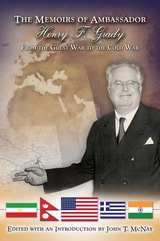
The Memoirs of Ambassador Henry F. Grady
From the Great War to the Cold WarEdited & Intro by John T. McNay
University of Missouri Press, 2009
When Henry Grady died in 1957, one obituary called him “America’s top diplomatic soldier” for a critical period of the Cold War, and over a long career he was deeply involved in events that changed our role in the world. Even so, this self-described “soft” cold warrior has been largely overlooked by historians. His memoirs, left to languish with his other papers, are now published for the first time, offering new insight into the origins and implementation of American trade and development policies—and into the tumult that was the Cold War.
A specialist in international economic policy, Grady helped create the system of reciprocal trade established under FDR during the depression. Progressing in his career through his abilities rather than through political connections, he was sent to India during World War II to spark its production for the war effort, then to Italy to help jump-start its economy once German forces were driven out. After the war, he was the first American ambassador to an independent India, then served as ambassador to Greece and Iran—where he was embroiled in the oil industry crisis that eventually led to the CIA’s overthrow of Prime Minister Mohammad Mossadegh.
Grady’s memoirs are an intriguing and informative account of early Cold War diplomacy in significant and turbulent regions of the Third World, embellished by his thoughts about the changing nature of American economic policies and his role as a representative of that system abroad. It offers new perspectives on the crisis in Iran in the early 1950s, where Grady was especially critical of Secretary of State Dean Acheson’s support for the remnants of British imperialism in Iran—and paid for his criticism with his job. Editor John McNay’s introduction and comments shed light on Grady’s thinking and his role in the policy-making process.
More than a chronicle of a wide-ranging career—one that reflects the emergence of the United States as the world’s leading economic power—Grady’s memoirs are a trenchant critique of U.S. foreign policy in the first half of the twentieth century. They provide modern readers an opportunity to reconsider the conflict between realism and idealism in foreign relations during the Cold War years.
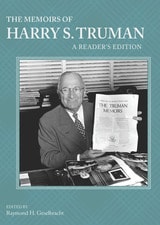
The Memoirs of Harry S. Truman
A Reader's EditionEdited by Raymond H. Geselbracht
University of Missouri Press, 2027
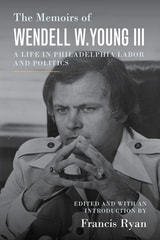
The Memoirs of Wendell W. Young III
A Life in Philadelphia Labor and PoliticsFrancis Ryan
Temple University Press, 2019
Philadelphia native Wendell W. Young III was one of the most important American labor leaders in the last half of the twentieth century. An Acme Markets clerk in the 1950s and ’60s, he was elected top officer of the Retail Clerks Union when he was twenty-four. His social justice unionism sought to advance wages while moving beyond collective bargaining to improve the conditions of the working-class majority, whether in a union or not. Young quickly gained a reputation for his independence, daring at times to publicly criticize the policies of the city’s powerful AFL-CIO leadership and tangle with the city’s political machine.
Editor Francis Ryan, whose introduction provides historical context, interviewed Young about his experiences working in the region’s retail and food industry, measuring the changes over time and the tangible impact that union membership had on workers. Young also describes the impact of Philadelphia’s deindustrialization in the 1970s and ’80s and recounts his activism for civil rights and the anti-war movements as well as on John F. Kennedy’s presidential campaign.
The Memoirs of Wendell W. YoungIII provides the most extensive labor history of late twentieth-century Philadelphia yet written.
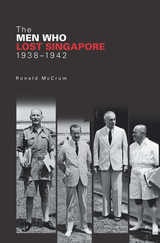
The Men Who Lost Singapore, 1938-1942
Ronald McCrum
National University of Singapore Press, 2017
In The Men Who Lost Singapore, McCrum closely examines the role and responsibilities of the colonial authorities before and during the war. He argues that the poor and occasionally hostile relations that developed between the local government and the British military hierarchy prevented the development and implementation of a strategic and unified plan of defense against the growing threat of the Japanese. Consequently, this indecisive and ineffective leadership led to significant losses and civilian casualties that could have been prevented.
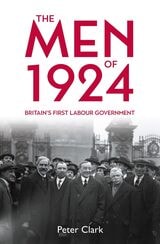
The Men of 1924
Britain’s First Labour GovernmentPeter Clark
Haus Publishing, 2023
In January of 1924, the cabinet of the first Labour government consisted of twenty white, middle-aged men, as it had for generations. But the election also represented a radical departure from government by the ruling class. Most members of the administration had left school by the age of fifteen. Five of them had started work by the time they were twelve years old. Three were working down the mines before they entered their teens. Two were illegitimate, one was abandoned at birth, and three were of Irish immigrant descent. For the first time in Britain’s history, the cabinet could truly be said to represent all of Britain’s social classes. This unheralded revolution in representation is the subject of Peter Clark’s fascinating new book, The Men of 1924. Who were these men? Clark’s vivid portrayal is full of evocative portraits of a new breed of politician, the forerunners of all those who, later in the last century and this one, overcame a system from which they had been excluded for too long.
The Menace of Prosperity
New York City and the Struggle for Economic Development, 1865–1981Daniel Wortel-London
University of Chicago Press, 2025
Many local policymakers make decisions based on a deep-seated belief: what’s good for the rich is good for cities. Convinced that local finances depend on attracting wealthy firms and residents, municipal governments lavish public subsidies on their behalf. Whatever form this strategy takes—tax-exempt apartments, corporate incentives, debt-financed mega projects—its rationale remains consistent and assumed to be true. But this wasn’t always the case. Between the 1870s and the 1970s, a wide range of activists, citizens, and intellectuals in New York City connected local fiscal crises to the greed and waste of the rich. These figures saw other routes to development, possibilities rooted in alternate ideas about what was fiscally viable.
In The Menace of Prosperity, Daniel Wortel-London argues that urban economics and politics are shaped by what he terms the “fiscal imagination” of policymakers, activists, advocates, and other figures. His survey of New York City during a period of explosive growth shows how residents went beyond the limits of redistributive liberalism to imagine how their communities could become economically viable without the largesse of the wealthy. Their strategies—which included cooperatives, public housing, land-value taxation, public utilities, and more—centered the needs and capabilities of ordinary residents as the basis for local economies that were both prosperous and just.
Overturning stale axioms about economic policy, The Menace of Prosperity shows that not all growth is productive for cities. Wortel-London’s ambitious history demonstrates the range of options we’ve abandoned and hints at the economic frameworks we could still realize—and the more democratic cities that might result.
The Menace of Prosperity
New York City and the Struggle for Economic Development, 1865–1981Daniel Wortel-London
University of Chicago Press, 2025
Upends entrenched thinking about cities, demonstrating how urban economies are defined—or constrained—by the fiscal imagination of policymakers, activists, and residents.
Many local policymakers make decisions based on a deep-seated belief: what’s good for the rich is good for cities. Convinced that local finances depend on attracting wealthy firms and residents, municipal governments lavish public subsidies on their behalf. Whatever form this strategy takes—tax-exempt apartments, corporate incentives, debt-financed mega projects—its rationale remains consistent and assumed to be true. But this wasn’t always the case. Between the 1870s and the 1970s, a wide range of activists, citizens, and intellectuals in New York City connected local fiscal crises to the greed and waste of the rich. These figures saw other routes to development, possibilities rooted in alternate ideas about what was fiscally viable.
In The Menace of Prosperity, Daniel Wortel-London argues that urban economics and politics are shaped by what he terms the “fiscal imagination” of policymakers, activists, advocates, and other figures. His survey of New York City during a period of explosive growth shows how residents went beyond the limits of redistributive liberalism to imagine how their communities could become economically viable without the largesse of the wealthy. Their strategies—which included cooperatives, public housing, land-value taxation, public utilities, and more—centered the needs and capabilities of ordinary residents as the basis for local economies that were both prosperous and just.
Overturning stale axioms about economic policy, The Menace of Prosperity shows that not all growth is productive for cities. Wortel-London’s ambitious history demonstrates the range of options we’ve abandoned and hints at the economic frameworks we could still realize—and the more democratic cities that might result.
The Merchant Prince of Black Chicago
Anthony Overton and the Building of a Financial EmpireRobert E. Weems Jr.
University of Illinois Press, 2020
Robert E. Weems Jr. restores Overton to his rightful place in American business history. Dispelling stubborn myths, he traces Overton's rise from mentorship by Booker T. Washington, through early failures, to a fateful move to Chicago in 1911. There, Overton started a popular magazine aimed at African American women that helped him dramatically grow his cosmetics firm. Overton went on to become the first African American to head a major business conglomerate, only to lose significant parts of his businesses—and his public persona as ”the merchant prince of his race”—in the Depression, before rebounding once again in the early 1940s.
Revealing and panoramic, The Merchant Prince of Black Chicago weaves the fascinating life story of an African American trailblazer through the eventful history of his times.
The Merleau-Ponty Aesthetics Reader
Philosophy and PaintingEdited and with an Introduction by Galen A. Johnson; Michael B. Smith, Translation Editor
Northwestern University Press, 1993
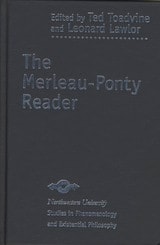
The Merleau-Ponty Reader
Leonard Lawlor and Ted Toadvine
Northwestern University Press, 2007
Arranged chronologically, the essays are grouped in three sections corresponding to the major periods of Merleau-Ponty’s work: First, the years prior to his appointment to the Sorbonne in 1949, the early, existentialist period during which he wrote important works on the phenomenology of perception and the primacy of perception; second, the years of his work as professor of child psychology and pedagogy at the Sorbonne, a period especially concerned with language; and finally, his years as chair of modern philosophy at the Collège de France, a time devoted to the articulation of a new ontology and philosophy of nature. The editors, who provide an interpretive introduction, also include previously unpublished working notes found in Merleau-Ponty’s papers after his death. Translations of all selections have been updated and several appear here in English for the first time.
By contextualizing Merleau-Ponty’s writings on the philosophy of art and politics within the overall development of his thought, this volume allows readers to see both the breadth of his contribution to twentieth-century philosophy and the convergence of the various strands of his reflection.
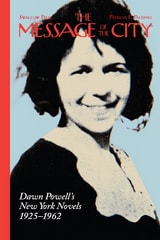
The Message of the City
Dawn Powell’s New York Novels, 1925–1962Patricia E. Palermo
Ohio University Press, 2016
Dawn Powell was a gifted satirist who moved in the same circles as Dorothy Parker, Ernest Hemingway, renowned editor Maxwell Perkins, and other midcentury New York luminaries. Her many novels are typically divided into two groups: those dealing with her native Ohio and those set in New York. “From the moment she left behind her harsh upbringing in Mount Gilead, Ohio, and arrived in Manhattan, in 1918, she dove into city life with an outlander’s anthropological zeal,” reads a recent New Yorker piece about Powell, and it is those New York novels that built her reputation for scouring wit and social observation.
In this critical biography and study of the New York novels, Patricia Palermo reminds us how Powell earned a place in the national literary establishment and East Coast social scene. Though Powell’s prolific output has been out of print for most of the past few decades, a revival is under way: the Library of America, touting her as a “rediscovered American comic genius,” released her collected novels, and in 2015 she was posthumously inducted into the New York State Writer’s Hall of Fame.
Engaging and erudite, The Message of the City fills a major gap in in the story of a long-overlooked literary great. Palermo places Powell in cultural and historical context and, drawing on her diaries, reveals the real-life inspirations for some of her most delicious satire.

The Metal of a Thousand Uses
Mercury Mining in Arkansas, 1930-1946Terry S. Reynolds
University of Arkansas Press, 2026
In 1930, a remote corner of southwest Arkansas witnessed the discovery of cinnabar, the ore from which mercury is extracted. Upon the arrival of “the metal of a thousand uses,” a wave of hope and ambition swept through the foothills of the Ouachita Mountains as mercury mining promised economic revival for the struggling state. Despite the known dangers of the industry, Arkansans greeted the prospect of a mercury boom with unbridled enthusiasm, seeing it as a potential solution to their economic woes amid the Great Depression.
In The Metal of a Thousand Uses: Mercury Mining in Arkansas, 1930–1946, Terry S. Reynolds charts the dramatic rise and fall of the state’s mercury mining district, from the euphoria of discovery to the logistical and financial challenges of industrialization. Drawing on deep archival research, Reynolds explores the experiences of the miners and managers whose fates became bound to the companies that sought to commercialize mercury refining in the Ouachita Mountains. The result is a vivid account of a little-known chapter in American mineral-resource history.
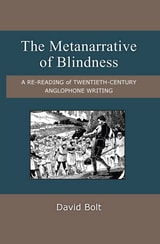
The Metanarrative of Blindness
A Re-reading of Twentieth-Century Anglophone WritingDavid Bolt
University of Michigan Press, 2013
Although the theme of blindness occurs frequently in literature, literary criticism has rarely engaged the experiential knowledge of people with visual impairments. The Metanarrative of Blindness counters this trend by bringing to readings of twentieth-century works in English a perspective appreciative of impairment and disability. Author David Bolt examines representations of blindness in more than forty literary works, including writing by Kipling, Joyce, Synge, Orwell, H. G. Wells, Susan Sontag, and Stephen King, shedding light on the deficiencies of these representations and sometimes revealing an uncomfortable resonance with the Anglo-American science of eugenics.
What connects these seemingly disparate works is what Bolt calls “the metanarrative of blindness,” a narrative steeped in mythology and with deep roots in Western culture. Bolt examines literary representations of blindness using the analytical tools of disability studies in both the humanities and social sciences. His readings are also broadly appreciative of personal, social, and cultural aspects of disability, with the aim of bringing literary scholars to the growing discipline of disability studies, and vice versa. This interdisciplinary monograph is relevant to people working in literary studies, disability studies, psychology, sociology, applied linguistics, life writing, and cultural studies, as well as those with a general interest in education and representations of blindness.

The Metaphysics of Sound in Wallace Stevens
Anca Rosu
University of Alabama Press, 1995
Where sound speaks louder than meaning—Stevens’s poetry as a metaphysical echo.
Wallace Stevens dedicated his poetry to challenging traditional notions about reality, truth, knowledge, and the role of language as a means of representation. Rosu demonstrates that Stevens's experimentation with sound is not only essential to his poetics but also profoundly linked to the pragmatist ideas that informed his way of thinking about language. Her readings of Stevens's poems focus on revealing the dynamic through which meaning emerges in language patterns—a dynamic she calls "images of sound."
Rosu argues that the formal aspects of poetry are deeply ingrained in cultural realities and are, in fact, generated by their context. The sound pattern pervading Stevens's poems at once addresses and violates the reader's assumptions about the functioning of language and, along with them, ideas about reality, knowledge, and subjectivity. Sound is thus the starting point of an argument concerned with Stevens's epistemology and poetics—the way his poems insist on a movement past or through a normal poetic representation of the world to gesture toward a reality that lies outside or beyond systems of representation.
The relationship between sound and meaning isolated and analyzed in The Metaphysics of Sound in Wallace Stevens is firmly situated among critical debates concerning the poet's aesthetic and philosophical convictions. Rosu claims that Stevens's poetry is not ultimately about the powerlessness of language, nor is it a deconstructive enterprise of destabilizing culturally consecrated truths; rather it achieves meaning most frequently through patterns of sound. Sound helps Stevens make a deeply philosophical point in a language unavailable to philosophers.
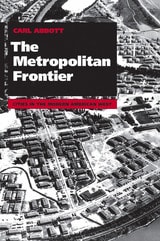
The Metropolitan Frontier
Cities in the Modern American WestCarl Abbott
University of Arizona Press, 1993
The Metropolitan Frontier places this last half-century of Western history in its urban context, making it the first comprehensive overview of urban growth in the region. Integrating the urban experience of all nineteen Western states, Carl Abbott ranges for evidence from Honolulu to Houston and from Fargo to Fairbanks to show how Western cities organize the region's vast spaces and connect them to the even larger sphere of the world economy. His survey moves from economic change to social and political response, examining the initial boom of the 1940s, the process of change in the following decades, and the ultimate impact of Western cities on their environments, on the Western regional character, and on national identity.
Today, a steadily decreasing number of Western workers are engaged in rural industries, but Western cities continue to grow. As ecological and social crises begin to affect those cities, Abbott’s study will prove required reading for historians, geographers, sociologists, urban planners, and all citizens concerned with America’s future.
The Mexican Aristocracy
An Expressive Ethnography, 1910–2000By Hugo G. Nutini
University of Texas Press, 2004
The Mexican aristocracy today is simultaneously an anachronism and a testimony to the persistence of social institutions. Shut out from political power by the democratization movements of the twentieth century, stripped of the basis of its great wealth by land reforms in the 1930s, the aristocracy nonetheless maintains a strong sense of group identity through the deeply held belief that their ancestors were the architects and rulers of Mexico for nearly four hundred years.
This expressive ethnography describes the transformation of the Mexican aristocracy from the onset of the Mexican Revolution of 1910, when the aristocracy was unquestionably Mexico's highest-ranking social class, until the end of the twentieth century, when it had almost ceased to function as a superordinate social group. Drawing on extensive interviews with group members, Nutini maps out the expressive aspects of aristocratic culture in such areas as perceptions of class and race, city and country living, education and professional occupations, political participation, religion, kinship, marriage and divorce, and social ranking. His findings explain why social elites persist even when they have lost their status as ruling and political classes and also illuminate the relationship between the aristocracy and Mexico's new political and economic plutocracy.
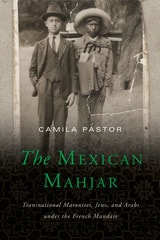
The Mexican Mahjar
Transnational Maronites, Jews, and Arabs under the French MandateBy Camila Pastor
University of Texas Press, 2017
Winner, Khayrallah Migration Studies Prize, Moise Khayrallah Center for Lebanese Diaspora Studies, 2018
Migration from the Middle East brought hundreds of thousands of people to the Americas in the late nineteenth and early twentieth centuries. By the time the Ottoman political system collapsed in 1918, over a third of the population of the Mashriq, i.e. the Levant, had made the transatlantic journey. This intense mobility was interrupted by World War I but resumed in the 1920s and continued through the late 1940s under the French Mandate. Many migrants returned to their homelands, but the rest concentrated in Brazil, Argentina, the United States, Haiti, and Mexico, building transnational lives.
The Mexican Mahjar provides the first global history of Middle Eastern migrations to Mexico. Making unprecedented use of French colonial archives and historical ethnography, Camila Pastor examines how French colonial control over Syria and Lebanon affected the migrants. Tracing issues of class, race, and gender through the decades of increased immigration to Mexico and looking at the narratives created by the Mahjaris (migrants) themselves in both their old and new homes, Pastor sheds new light on the creation of transnational networks at the intersection of Arab, French, and Mexican colonial modernisms. Revealing how migrants experienced mobility as conquest, diaspora, exile, or pilgrimage, The Mexican Mahjar tracks global history on an intimate scale.
The Mexican Petroleum Industry in the Twentieth Century
Edited by Jonathan C. Brown and Alan Knight
University of Texas Press, 1992
Mexico's petroleum industry has come to symbolize the very sovereignty of the nation itself. Politicians criticize Pemex, the national oil company, at their peril, and President Salinas de Gortari has made clear that the free trade negotiations between Mexico and the United States will not affect Pemex's basic status as a public enterprise. How and why did the petroleum industry gain such prominence and, some might say, immunity within Mexico's political economy?
The Mexican Petroleum Industry in the Twentieth Century, edited by Jonathan C. Brown and Alan Knight, seeks to explain the impact of the oil sector on the nation's economic, political, and social development. The book is a multinational effort—one author is Australian, two British, three North American, and five Mexican. Each contributing scholar has researched and written extensively about Mexico and its oil industry.
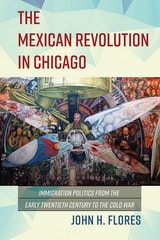
The Mexican Revolution in Chicago
Immigration Politics from the Early Twentieth Century to the Cold WarJohn H Flores
University of Illinois Press, 2018
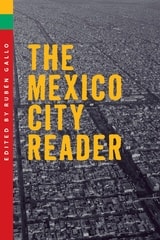
The Mexico City Reader
Edited by Ruben Gallo
University of Wisconsin Press, 2004
Mexico City is one of Latin America’s cultural capitals, and one of the most vibrant urban spaces in the world. The Mexico City Reader is an anthology of "Cronicas"—short, hybrid texts that are part literary essay, part urban reportage—about life in the capital. This is not the "City of Palaces" of yesteryear, but the vibrant, chaotic, anarchic urban space of the1980s and 1990s—the city of garbage mafias, necrophiliac artists, and kitschy millionaires.
Like the visitor wandering through the city streets, the reader will be constantly surprised by the visions encountered in this mosaic of writings—a textual space brimming with life and crowded with flâneurs, flirtatious students, Indian dancers,
food vendors, fortune tellers, political activists, and peasant protesters.
The essays included in this anthology were written by a panoply of writers, from well-known authors like Carlos Monsiváis and Jorge Ibagüengoitia to younger figures like Fabrizio Mejía Madrid and Juieta García González, all of whom are experienced practitioners of the city. The texts collected in this anthology are among the most striking examples of this concomitant "theory and practice" of Mexico City, that most delirious of megalopolises.
“[An] exciting literary journey . . .”—Carolyn Malloy, Multicultural Review

The Michigan Murders
Edward Keyes
University of Michigan Press, 2010
"True crime devotees won't want to miss this one!"
---Publishers Weekly
"Very engrossing . . . in the finest you can't put it down tradition."
---Hartford Courant
"This factual account of each murder, through the conviction of the killer, has all the excitement of a first-rate work of fiction, and is told straight, without the usual sociological jargon. Keyes collaborated with Robin Moore on The French Connection; The Michigan Murders is his first solo effort, and it is a good one."
---Miami Herald
"The Michigan Murders is the ultimate True Crime classic, unfolding like great mystery fiction while still delivering the powerful charge of real life."
---Jamie Agnew, Aunt Agatha's Mystery Bookshop
With a new prologue by Mardi Link and a new epilogue by Laura James
The true story of the savage coed killings---by the boy who could have lived next door!
Southeastern Michigan was rocked in the late 1960s by the terrifying serial murders of young women, whose bodies were dumped in Ann Arbor and Ypsilanti. In each case, few clues were left at the scene, and six separate police agencies were unable to end the horror. Then, almost by accident, a break came. The suspect: John Norman Collins, a young, quiet, all-American boy.
Collins was caught, went to trial, and, on August 19, 1970, was found guilty and sentenced to life imprisonment with no possibility of parole. He is now in his sixties and is serving his sentence in Marquette, Michigan.
Collins was one of the first serial killers exposed in the region, and his crimes had many in the area locking their doors for the first time. Edward Keyes's harrowing The Michigan Murders covers every step of the case. It fell out of print for more than a decade before being revived for this special edition.
Mardi Link, author of the new prologue, is the author of two regionally best-selling true crime books based in northern Michigan, When Evil Came to Good Hart and Isadore's Secret.
Laura James, author of the new epilogue, is a trial lawyer, crime historian, and true crime author who blogs about the true crime genre at her Web site CLEWS (www.laurajames.com).
Edward Keyes, now deceased, spent several years in the early 1970s investigating the Michigan murders. He also authored the works Double Dare and Cocoanut Grove. The Michigan Murders was a finalist for the Edgar Allan Poe Award for Best Fact Crime in 1977.
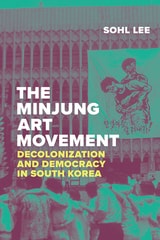
The Minjung Art Movement
Decolonization and Democracy in South KoreaSohl Lee
Duke University Press, 2026
The Mismeasure of Progress
Economic Growth and Its CriticsStephen J. Macekura
University of Chicago Press, 2020
Beginning with the rise of the growth paradigm in the 1940s and 1950s and continuing through the present day, The Mismeasure of Progress is the first book on the myriad thinkers who argued against growth and the conventional way progress had been measured and defined. For growth critics, questioning the meaning and measurement of growth was a necessary first step to creating a more just, equal, and sustainable world. These critics argued that focusing on growth alone would not resolve social, political, and environmental problems, and they put forth alternate methods for defining and measuring human progress.
In today’s global political scene—marked by vast inequalities of power and wealth and made even more fraught by a global climate emergency—the ideas presented by these earlier critics of growth resonate more loudly than ever. Economic growth appealed to many political leaders because it allowed them to avoid addressing political trade-offs and class conflict. It sustained the fiction that humans are somehow separate from nonhuman “nature,” ignoring the intimate and dense connections between the two. In order to create a truly just and equitable society, Macekura argues, we need a clear understanding of our collective needs beyond growth and more holistic definitions of progress that transcend economic metrics like GDP.

The Missouri Home Guard
Protecting the Home Front during the Great WarPetra DeWitt
University of Missouri Press, 2022
The Home Guard also functioned to preserve patriotism and reduce opposition to the war. Service in the Guard was a way to show loyalty to one’s country, particularly for German Americans, who were frequently under suspicion as untrustworthy. Many German Americans in Missouri enthusiastically signed up to dispel any whispers of treason, while others found themselves torn between the motherland and their new homeland. Men too old or exempt from the draft for other reasons found meaning in helping with the war effort through the Home Guard while also garnering respect from the community. For similar reasons, women attempted to join the organization as did African Americans, some of whom formed units of a “Negro Home Guard.” Informed by the dynamics of race, gender, and ethnicity, DeWitt’s consideration of this understudied but important organization examines the fluctuating definition of patriotism and the very real question of who did and who did not have the privilege of citizenship and acceptance in society.
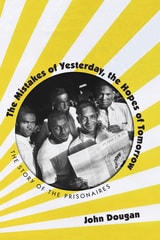
The Mistakes of Yesterday, the Hopes of Tomorrow
The Story of the PrisonairesJohn Dougan
University of Massachusetts Press, 2012
Early in the morning on June 1, 1953, five African American men boarded a van to make the 200-mile trip from Nashville to Memphis for a daylong recording session at the legendary Sun Studios, to be overseen by Sun founder Sam Phillips. One of the two tracks cut that day, “Just Walkin' in the Rain,” would go on to become a regional R&B hit, Sun Records' biggest record of the pre-Elvis era. It would, however, be the group's only hit. They were the Prisonaires, a vocal quintet who had honed their skills while inmates at the Tennessee State Penitentiary in Nashville.
In this book, John Dougan tells the story of the Prisonaires, their hit single, and the afterlife of this one remarkable song. The group and the song itself represent a compelling concept: imprisoned men using music as a means of cultural and personal survival. The song was re-recorded by white singer Johnnie Ray, who made it a huge hit in 1956. Over the years, other singers and groups would move the song further away from its origins, recasting the deep emotions that came from creating music in a hostile, controlled environment.
The story of the Prisonaires, for all of its triumphs, reflects the disappointment of men caught in a paradoxical search for personal independence while fully cognizant of a future consigned to prison. Their brief career and the unusual circumstances under which it flourished sheds light on the harsh realities of race relations in the pre–Civil Rights South. The book also provides a portrait of Nashville just as it was gaining traction as a nationally recognized music center.
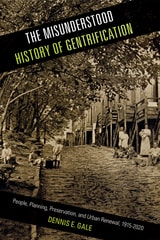
The Misunderstood History of Gentrification
People, Planning, Preservation, and Urban Renewal, 1915-2020Dennis E. Gale
Temple University Press, 2021
The origins of gentrification date back to World War I—only it was sometimes known as “remodeling” then. Dennis Gale’s insightful book, TheMisunderstood History of Gentrification, provides a recontextualization of American gentrification, planning, and policymaking. He argues that gentrification must be understood as an urban phenomenon with historical roots in the very early twentieth century.
Gale uses solid empirical evidence to trace the embryonic revitalization of Georgetown, Greenwich Village, Beacon Hill, and elsewhere back to 1915. He shows how reinvestment and restoration reversed urban decline and revitalized neighborhoods. The Misunderstood History of Gentrification also explains how federal policies such as the Urban Redevelopment Program (later named Urban Renewal), which first emerged in 1949, razed urban slums and created an “urban crisis” that persisted in the 1960s and ‘70s. This situation soon prompted city gentrifiers and historic preservationists to reuse and rehabilitate existing structures.
Within a more expansive historical framework, Gale offers a fresh perspective on and debunks misperceptions about gentrification in America.
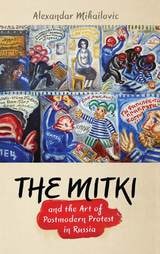
The Mitki and the Art of Postmodern Protest in Russia
Alexandar Mihailovic
University of Wisconsin Press, 2019
More broadly, Alexandar Mihailovic shows, the Mitki pioneered a form of political protest art that has since become a centerpiece of activism in post-Soviet Russia, most visibly today in groups such as Pussy Riot. He draws on extensive interviews with members of the collective and illuminates their critique of the authoritarian state, militarism, and social strictures from the Brezhnev years to the present.
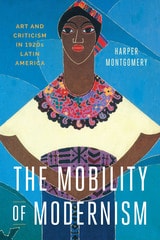
The Mobility of Modernism
Art and Criticism in 1920s Latin AmericaBy Harper Montgomery
University of Texas Press, 2017
Arvey Foundation Book Award, Association for Latin American Art, 2018
Many Latin American artists and critics in the 1920s drew on the values of modernism to question the cultural authority of Europe. Modernism gave them a tool for coping with the mobility of their circumstances, as well as the inspiration for works that questioned the very concepts of the artist and the artwork and opened the realm of art to untrained and self-taught artists, artisans, and women. Writing about the modernist works in newspapers and magazines, critics provided a new vocabulary with which to interpret and assign value to the expanding sets of abstracted forms produced by these artists, whose lives were shaped by mobility.
The Mobility of Modernism examines modernist artworks and criticism that circulated among a network of cities, including Buenos Aires, Mexico City, Havana, and Lima. Harper Montgomery maps the dialogues and relationships among critics who published in avant-gardist magazines such as Amauta and Revista de Avance and artists such as Carlos Mérida, Xul Solar, and Emilio Pettoruti, among others, who championed esoteric forms of abstraction. She makes a convincing case that, for these artists and critics, modernism became an anticolonial stance which raised issues that are still vital today—the tensions between the local and the global, the ability of artists to speak for blighted or unincorporated people, and, above all, how advanced art and its champions can enact a politics of opposition.
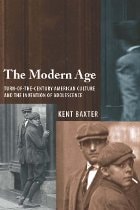
The Modern Age
Turn-of-the-Century American Culture and the Invention of AdolescenceKent Baxter
University of Alabama Press, 2008
The Modern Age examines the discourses that have come to characterize adolescence and argues that commonplace views of adolescents as impulsive, conflicted, and rebellious are constructions inspired by broader cultural anxieties that characterized American society in early-twentieth-century America.
The idea of adolescence, argues Kent Baxter, came into being because it fulfilled specific historical and cultural needs: to define a quickly expanding segment of the population, and to express concerns associated with the movement into a new era. Adolescence—a term that had little currency before 1900 and made a sudden and pronounced appearance in a wide variety of discourses thereafter—is a “modern age” not only because it sprung from changes in American society that are synonymous with modernity, but also because it came to represent all that was threatening about “modern life.”
Baxter provides a preliminary history of adolescence, focusing specifically on changes in the American educational system and the creation of the juvenile justice system that carved out a developmental space between the child and the adult. He looks at the psychological works of G. Stanley Hall and the anthropological works of Margaret Mead and explores what might have inspired their markedly negative descriptions of this new demographic. He examines the rise of the Woodcraft Indian youth movement and its promotion of “red skin” values while also studying the proliferation of off-reservation boarding schools for Native American youth, where educators attempted to eradicate the very “red skin” values promoted by the Woodcraft movement.
Finally Baxter studies reading at the turn of the century, focusing specifically on Horatio Alger (the Ragged Dick series) and Edward Stratemeyer (the Tom Swift, Nancy Drew, and Hardy Boys series) and what those works reveal about the “problem” of adolescence and its solutions in terms of value, both economic and moral.