4531 books match the query 'Cultural & Ethnic Studies' and 804 start with t
cover of Two Studies on Ming History

Two Studies on Ming History

Charles O. Hucker

University of Michigan Press, 1971
In the first study of Two Studies on Ming History, Charles O. Hucker presents an account of a military campaign that provides insight into the nature of civil officials’ authority, decision-making, and relationship with the Ming court. In the spring and summer of 1556, a Chinese renegade named Hsü Hai led an invading group of Japanese and Chinese soldiers on a plundering foray through the northeastern sector of Chekiang province. Opposing them was a military establishment that for years past had been battered by coastal raiders, now under the control of an ambitious and clever official named Hu Tsung-hsien. The campaign was not one of the most consequential in China’s military history, even during the Ming dynasty (1368–1644). But it was famous and well reported in its time, and it illustrates some of the unusual ways in which the Chinese of the imperial age coped with the often unusual military problems they faced.
In the second part of Two Studies, Hucker presents a translation of K’ai-tu ch’uan-hsin, a popular narrative of a spontaneous demonstration in which literati and commoners alike rose up to defend an austere and incorruptible adherent to Confucian morality who had been doomed to die because of his defiance of the ruthless and heterodox clique that had usurped imperial power. In 1626, Chinese political morality was at one of its lowest ebbs. On the throne at Peking was an incompetent twenty-one-year-old emperor who was much too occupied with puttering at carpentry to pay attention to the government. Into the vacuum stepped Wei Chung-hsien, the favorite of the emperor’s governess. Wei used brutal terror to make himself undisputed master of the vast bureaucratic mechanism that administered China. One of Wei’s many victims was Chou Shun-ch’ang, a member of the official class who was said to have hated evil as a personal enemy. Chou became critical of Wei, an order was put out for Chou’s arrest, and a popular uprising occurred in protest.
[more]
cover of Two Twelfth-Century Texts on Chinese Painting

Two Twelfth-Century Texts on Chinese Painting

Robert J. Maeda, Translator

University of Michigan Press, 1970
Two Twelfth-Century Texts on Chinese Painting presents two texts in translation that provide dual insight into the Painting Academy of Emperor Hui-tsung and the literati school of painting.
The Shan-shui ch’un-ch’uan chi is a treatise for beginning landscape painters dated to the Hsüan-ho era. The treatise was written by Han Cho, a reputed member of the Academy, but the text was not specifically directed at Academicians. The treatise collects and orders previous writings on landscape painting; one of Han Cho’s main goals is to list all landscape definitions and their practical application in painting. Yet his view is more detached and analytical than a stereotypical Academy painter, revealing an approach reminiscent of Confucian scholarship and literati painting as well.
The Hua-chi by Teng Ch’un is a history of painting that was written as a sequel to two earlier painting histories. In ten chapters, Teng Ch’un compiles facts and critical evaluations of painters from 1075 to 1167, as well as listings of selected masterpieces. Teng Ch’un provides more specific information about the Academy than Han Cho, discussing its organization and examination system, and noting that “form-likeness” and adherence to rules were leading standards for painting in the Academy. On the other hand, he thinks that painting should transmit “soul,” not just “form.” Thus, Teng Ch’un writes the history of both the establishment values of the Academy and the intellectual tendencies of the literati.
[more]
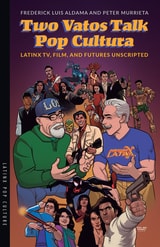
cover of Two Vatos Talk Pop Cultura: Latinx TV, Film, and Futures Unscripted

Two Vatos Talk Pop Cultura

Latinx TV, Film, and Futures Unscripted

Frederick Luis Aldama and Peter Murrieta

University of Arizona Press, 2026

Two Vatos Talk Pop Cultura brings a leading Latinx media studies scholar, Frederick Luis Aldama, together with an award-winning television writer and producer, Peter Murrieta, to examine how Latinx representation has evolved—and stagnated—across seven decades of American TV, film, and pop culture. 
[more]
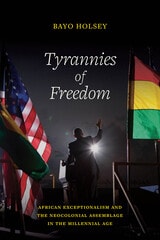
cover of Tyrannies of Freedom: African Exceptionalism and the Neocolonial Assemblage in the Millennial Age

Tyrannies of Freedom

African Exceptionalism and the Neocolonial Assemblage in the Millennial Age

Bayo Holsey

University of Chicago Press, 0

Examines the enduring myth of Ghanaian exceptionalism and neoliberal freedom.

What is the legacy of the African Revolution today? Black Studies scholar and anthropologist Bayo Holsey addresses this question by examining the twenty-first-century relationship between the United States and Ghana, a nation that was once associated with a powerful vision of Black freedom. In Tyrannies of Freedom, she demonstrates that the period that saw the expansion of the US counterterror state also witnessed attempts to discredit this vision of freedom and replace it with another—one that centers the agency of US politicians, media pundits, and development experts.

Analyzing international development discourses, the anti-trafficking regime’s representational economy, and the expansion of Ghana’s branding as a homeland of the African diaspora, Holsey interrogates the operation of a millennial neocolonial assemblage that asserts, in various ways, that the United States is the guarantor of Ghanaian freedom while simultaneously implementing policies of surveillance, endangerment, and exploitation. At the same time, Holsey shows how Ghanaians and other Black subjects have contested these projects. Tracking the transformation of the Ghanaian nation from a beacon of Black freedom and Pan-African possibility to a battleground over the meanings of African sovereignty in a post-9/11 world, this important book addresses pressing questions concerning the operation of US power in Africa and the production and legitimation of a racialized global hierarchy.

[more]