Results by title
4743 books match the query 'Religion' and 1168 start with t
The Sources of Christian Ethics
Servais Pinckaers
Catholic University of America Press, 2013
The Spanish Disquiet
The Biblical Natural Philosophy of Benito Arias MontanoMaría M. Portuondo
University of Chicago Press, 2019
Foremost among them was Benito Arias Montano—Spain’s most prominent biblical scholar and exegete of the sixteenth century. He was also a widely read member of the European intellectual community, and his motivation to reform natural philosophy shows that the Spanish Disquiet was a local manifestation of greater concerns about Aristotelian natural philosophy that were overtaking Europe on the eve of the Scientific Revolution. His approach to the study of nature framed the natural world as unfolding from a series of events described in the Book of Genesis, ultimately resulting in a new metaphysics, cosmology, physics, and even a natural history of the world. By bringing Arias Montano’s intellectual and personal biography into conversation with broader themes that inform histories of science of the era, The Spanish Disquiet ensures an appreciation of the variety and richness of Arias Montano’s thought and his influence on early modern science.
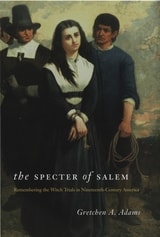
The Specter of Salem
Remembering the Witch Trials in Nineteenth-Century AmericaGretchen A. Adams
University of Chicago Press, 2008
In The Specter of Salem, Gretchen A. Adams reveals the many ways that the Salem witch trials loomed over the American collective memory from the Revolution to the Civil War and beyond. Schoolbooks in the 1790s, for example, evoked the episode to demonstrate the new nation’s progress from a disorderly and brutal past to a rational present, while critics of new religious movements in the 1830s cast them as a return to Salem-era fanaticism, and during the Civil War, southerners evoked witch burning to criticize Union tactics. Shedding new light on the many, varied American invocations of Salem, Adams ultimately illuminates the function of collective memories in the life of a nation.
“Imaginative and thoughtful. . . . Thought-provoking, informative, and convincingly presented, The Specter of Salem is an often spellbinding mix of politics, cultural history, and public historiography.”— New England Quarterly
“This well-researched book, forgoing the usual heft of scholarly studies, is not another interpretation of the Salem trials, but an important major work within the scholarly literature on the witch-hunt, linking the hysteria of the period to the evolving history of the American nation. A required acquisition for academic libraries.”—Choice, Outstanding Academic Title 2009
The Spectral Jew
Conversion and Embodiment in Medieval EuropeSteven F. Kruger
University of Minnesota Press, 2006
Looking closely at how medieval Jewish and Christian identities are distinguished from each other, yet intimately intertwined, Kruger demonstrates how Jews were often corporealized in ways that posited them as inferior to Christians—archaic and incapable of change—even as the two mutually shaped each other. But such attempts to differentiate Jews and Christians were inevitably haunted by the knowledge that Christianity had emerged out of Judaism and was, in its own self-understanding, a community of converts.
Examining the points of contact between Christian and Jewish communities, Kruger discloses the profound paradox of the Jew as different in all ways, yet capable of converting to fully Christian status. He draws from central medieval authors and texts such as Peter Damian, Guibert of Nogent, the Barcelona Disputation, and the Hebrew chronicles of the First Crusade, as well as lesser known writings such as the disputations of Ceuta, Majorca, and Tortosa and the immensely popular Dialogues of Peter Alfonsi.
By putting the conversion narrative at the center of this analysis, Kruger exposes it as a disruption of categories rather than a smooth passage and reveals the prominent role Judaism played in the medieval Christian imagination.
Steven F. Kruger is professor of English and medieval studies at Queens College and the Graduate Center, CUNY. He is author of several books and editor with Glenn Burger of Queering the Middle Ages (Minnesota, 2001).
The Spires Still Point to Heaven
Cincinnati's Religious Landscape, 1788–1873Matthew Smith
Temple University Press, 2023
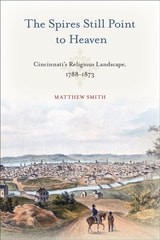
A case study about the formation of American pluralism and religious liberty, The Spires Still Point to Heaven explores why—and more importantly how—the early growth of Cincinnati influenced the changing face of the United States. Matthew Smith deftly chronicles the urban history of this thriving metropolis in the mid-nineteenth century. As Protestants and Catholics competed, building rival domestic missionary enterprises, increased religious reform and expression shaped the city. In addition, the different ethnic and religious beliefs informed debates on race, slavery, and immigration, as well as disease, temperance reform, and education.
Specifically, Smith explores the Ohio Valley’s religious landscape from 1788 through the nineteenth century, examining its appeal to evangelical preachers, abolitionists, social critics, and rabbis. He traces how Cincinnati became a battleground for newly energized social reforms following a cholera epidemic, and how grassroots political organizing was often tied to religious issues. He also illustrates the anti-immigrant sentiments and anti-Catholic nativism pervasive in this era.
The first monograph on Cincinnati’s religious landscape before the Civil War, The Spires Still Point to Heaven highlights Cincinnati’s unique circumstances and how they are key to understanding the cultural and religious development of the nation.
The Spirit and the Letter
On the Interpretation of ScriptureGiorgio Agamben
Seagull Books, 2026
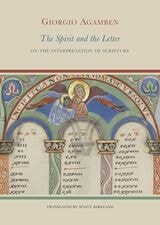
The problem of interpreting Scripture—above all, sacred scripture, but ultimately any form of writing—coincides with the very history of Western culture. It is no surprise, then, that an archaeological inquiry such as the one proposed here—on the problem of interpretation from Origen to Auerbach, from the Talmud to Benjamin—might hold unexpected revelations.
Essential reading for scholars of theology, religious studies, and hermeneutics interested in the history of scriptural interpretation, The Spirit and the Letter highlights how the interpretation of Scripture reveals itself as inseparable from ethics and politics.
The Spirit of God
Short Writings on the Holy SpiritYves Congar
Catholic University of America Press, 2017
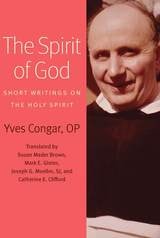
The Spirit of God brings together for the first time eight of Yves Congar’s previously untranslated writings on the Holy Spirit composed after Vatican II (from 1969 to 1985). Two of these selections offer general overviews of Congar’s pneumatology, a pneumatology based upon Scripture and the Tradition of the Church, but articulated in conversation with philosophers, ecumenical partners and non-believers. Other articles make clear the historical context of Vatican II’s pneumatology and the Holy Spirit’s crucial influence upon the unfolding of history and upon the moral life, the efficacy of the sacraments and, especially, upon ecclesial life.
The writings in The Spirit of God have been translated and edited by a team of scholars familiar with the work of the French Dominican theologian. An introduction situates each of the writings historically and highlights its theological significance. A bibliography lists Congar’s publications on the Holy Spirit, the major articles and books written about his pneumatology, and the major scholarly resources to which Congar made reference in the notes that accompanied these writings. An index of biblical references and of personal names is also included.
The Spirit of Religion and the Spirit of Liberty
The Tocqueville Thesis RevisitedEdited by Michael P. Zuckert
University of Chicago Press Journals, 2017
The Spirit of Soul Food
Race, Faith, and Food JusticeChristopher Carter
University of Illinois Press, 2021
Soul food has played a critical role in preserving Black history, community, and culinary genius. It is also a response to--and marker of--centuries of food injustice. Given the harm that our food production system inflicts upon Black people, what should soul food look like today?
Christopher Carter's answer to that question merges a history of Black American foodways with a Christian ethical response to food injustice. Carter reveals how racism and colonialism have long steered the development of US food policy. The very food we grow, distribute, and eat disproportionately harms Black people specifically and people of color among the global poor in general. Carter reflects on how people of color can eat in a way that reflects their cultural identities while remaining true to the principles of compassion, love, justice, and solidarity with the marginalized.
Both a timely mediation and a call to action, The Spirit of Soul Food places today's Black foodways at the crossroads of food justice and Christian practice.
The Spirits and the Law
Vodou and Power in HaitiKate Ramsey
University of Chicago Press, 2011
Vodou has often served as a scapegoat for Haiti’s problems, from political upheavals to natural disasters. This tradition of scapegoating stretches back to the nation’s founding and forms part of a contest over the legitimacy of the religion, both beyond and within Haiti’s borders. The Spirits and the Law examines that vexed history, asking why, from 1835 to 1987, Haiti banned many popular ritual practices.
To find out, Kate Ramsey begins with the Haitian Revolution and its aftermath. Fearful of an independent black nation inspiring similar revolts, the United States, France, and the rest of Europe ostracized Haiti. Successive Haitian governments, seeking to counter the image of Haiti as primitive as well as contain popular organization and leadership, outlawed “spells” and, later, “superstitious practices.” While not often strictly enforced, these laws were at times the basis for attacks on Vodou by the Haitian state, the Catholic Church, and occupying U.S. forces. Beyond such offensives, Ramsey argues that in prohibiting practices considered essential for maintaining relations with the spirits, anti-Vodou laws reinforced the political marginalization, social stigmatization, and economic exploitation of the Haitian majority. At the same time, she examines the ways communities across Haiti evaded, subverted, redirected, and shaped enforcement of the laws. Analyzing the long genealogy of anti-Vodou rhetoric, Ramsey thoroughly dissects claims that the religion has impeded Haiti’s development.
The Spiritual Formation of Seminarians
Learning to Live in Intimate and Unceasing Union with GodJames Keating
Catholic University of America Press, 2025
The Spiritual Journey of Charles Fillmore
Discovering the Power WithinNeal Vahle
Templeton Press, 2008
The Spiritual Journey of Charles Fillmore sheds new light on the life and work of an essential spiritual pioneer. In this landmark new biography, author Neal Vahle uses thorough new research, interviews with those who knew Fillmore, and his intimate familiarity with Fillmore's writings to introduce readers to the intriguing cofounder of the Unity movement. Beyond standard biography, Vahle's comprehensive treatment also extensively details Fillmore's era's philosophical and spiritual landscape. It gives readers an excellent overview of the metaphysical movement's evolution through time.
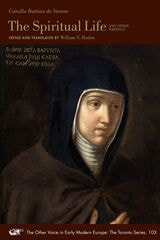
The Spiritual Life and Other Writings
Camilla Battista Da Varano
Iter Press, 2023
Camilla Battista da Varano (1458–1524) was a Franciscan nun and the author of profound spiritual writings in both prose and verse. Raised in the princely household of Camerino in north-central Italy, she put her thorough humanist education to use explaining her own spiritual experience and delivering advice to others. Varano composed ecstatic revelations, prayers, poems, hagiography, spiritual direction, and commentary on convent legislation. She drew on a wide variety of sources, including scripture and Church Fathers, plus popular literature and proverbs. Varano was an erudite woman of considerable complexity, defying many of the commonplace images we associate with religious women of the late fifteenth and early sixteenth centuries.
The Spiritualiity of Martyrdom
Servais Pinckaers
Catholic University of America Press, 2016
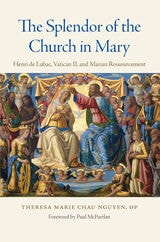
The Splendor of the Church in Mary
Henri de Lubac, Vatican II, and Marian RessourcementTheresa Marie Chau Nguyen
Catholic University of America Press, 2023
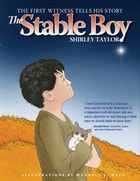
The Stable Boy
The First Witness Tells His StoryShirley A. Taylor
Parkhurst Brothers, Inc., 2012
"Shirley Taylor's story gives readers and hearers insight into the town of Bethlehem at the time of the birth of Christ. Wendell Hall's illustrations help us imagine that scene wonderfully. The young homeless boy touches our hearts and imaginations. Not just for children, this is a read aloud book for all ages." - Lauretta Phillips, Storyteller, Author, Radio & TV Host
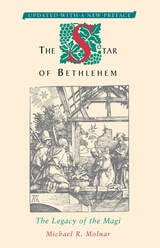
The Star of Bethlehem
The Legacy of the MagiMolnar, Michael R.
Rutgers University Press, 2013
Could the $50 purchase of an ancient coin by a Rutgers astronomer have unlocked the mystery of the Christmas Star? For years, scientists have looked, with little success, to astronomical records for an explanation of the magical star that guided the Magi to Christ’s manger. Intrigued by the image he found on the latest addition to his coin collection, Michael Molnar thought there might be more to learn by looking, instead, at the teachings of ancient astrologers.
Molnar argues in his book that the Star of Bethlehem was not a star at all, but rather a regal portent centering around the planet Jupiter that was eclipsed by the moon. He bases this theory on the actual beliefs of astrologers, such as the Magi, who lived around the time of Christ. Molnar found some intriguing clues to the mystery while researching the meaning of astrological symbols he found an ancient coin, which bore the image of Aries looking back at a star. He found that Aries was a symbol of Judea at the time, and that ancient astrologers believed that a new king would be born when the moon passed in front of Jupiter. Molnar wondered, could the coin have been issued as a response to the Great Messianic Portent, the Star of Bethlehem?
To match the story of the appearance of the Christmas star, Molnar also knew the event had to happen when Jupiter was “in the east.” Using these criteria and a computer program, he was able to chart an eclipse of Jupiter in Aries on April 17, 6 B.C., a day when Jupiter was precisely “in the east,” which confirmed his theory. Moreover, he found that a Roman astrologer described the conditions of that day as fitting the birth of a “divine and immortal” person.
According to Harvard University Professor Owen Gingerich, “this is the most original and important contribution of the entire 20th century” about the Magi’s star. Using clues from astronomy, astrology, and history, Molnar has created a provocative, fascinating theory on the Christmas Star. He weaves together an intriguing scientific detective story which resolves one of the world’s greatest mysteries: The Star of Bethlehem at the birth of Christ.
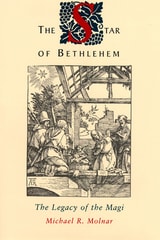
The Star of Bethlehem
The Legacy of the MagiMolnar, Michael R.
Rutgers University Press, 1999
Could the $50 purchase of an ancient coin by a Rutgers astronomer have unlocked the mystery of the Christmas Star? For years, scientists have looked, with little success, to astronomical records for an explanation of the magical star that guided the Magi to Christ’s manger. Intrigued by the image he found on the latest addition to his coin collection, Michael Molnar thought there might be more to learn by looking, instead, at the teachings of ancient astrologers.
Molnar argues in his book that the Star of Bethlehem was not a star at all, but rather a regal portent centering around the planet Jupiter that was eclipsed by the moon. He bases this theory on the actual beliefs of astrologers, such as the Magi, who lived around the time of Christ. Molnar found some intriguing clues to the mystery while researching the meaning of astrological symbols he found an ancient coin, which bore the image of Aries looking back at a star. He found that Aries was a symbol of Judea at the time, and that ancient astrologers believed that a new king would be born when the moon passed in front of Jupiter. Molnar wondered, could the coin have been issued as a response to the Great Messianic Portent, the Star of Bethlehem?
To match the story of the appearance of the Christmas star, Molnar also knew the event had to happen when Jupiter was “in the east.” Using these criteria and a computer program, he was able to chart an eclipse of Jupiter in Aries on April 17, 6 B.C., a day when Jupiter was precisely “in the east,” which confirmed his theory. Moreover, he found that a Roman astrologer described the conditions of that day as fitting the birth of a “divine and immortal” person.
According to Harvard University Professor Owen Gingerich, “this is the most original and important contribution of the entire 20th century” about the Magi’s star. Using clues from astronomy, astrology, and history, Molnar has created a provocative, fascinating theory on the Christmas Star. He weaves together an intriguing scientific detective story which resolves one of the world’s greatest mysteries: The Star of Bethlehem at the birth of Christ.
The Star of Redemption
Franz Rosenzweig; Translated by Barbara E. Galli; Foreword by Michael Oppenheim, introduction by Elliot R. Wolfson
University of Wisconsin Press, 2005
The Star of Redemption is essential reading for anyone interested in understanding religion and philosophy in the twentieth century. Fusing philosophy and theology, the book assigns both Judaism and Christianity distinct but equally important roles in the spiritual structure of the world. Franz Rosenzweig finds in both biblical religions approaches to a comprehension of reality.
The major themes and motifs of The Star—the birth, life, death, and the immortality of the soul; Eastern philosophies and Jewish mysticism; the relationship between God, world and humanity over time; and revelation as the real biblical miracle of faith and path to redemption—resonate meaningfully.
The Stations of Lent
Bruce Fingerhut
St. Augustine's Press, 2015
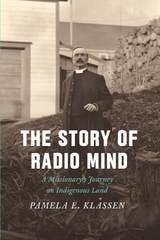
The Story of Radio Mind
A Missionary's Journey on Indigenous LandPamela E. Klassen
University of Chicago Press, 2018
Following Du Vernet’s journey westward from Toronto to Ojibwe territory and across the young nation of Canada, Pamela Klassen examines how contests over the mediation of stories—via photography, maps, printing presses, and radio—lucidly reveal the spiritual work of colonial settlement. A city builder who bargained away Indigenous land to make way for the railroad, Du Vernet knew that he lived on the territory of Ts’msyen, Nisga’a, and Haida nations who had never ceded their land to the onrush of Canadian settlers. He condemned the devastating effects on Indigenous families of the residential schools run by his church while still serving that church. Testifying to the power of radio mind with evidence from the apostle Paul and the philosopher Henri Bergson, Du Vernet found a way to explain the world that he, his church and his country made.
Expanding approaches to religion and media studies to ask how sovereignty is made through stories, Klassen shows how the spiritual invention of colonial nations takes place at the same time that Indigenous peoples—including Indigenous Christians—resist colonial dispossession through stories and spirits of their own.
The Story upon a Hill
The Puritan Myth in Contemporary American FictionChristopher Leise
University of Alabama Press, 2017
The Story upon a Hill: The Puritan Myth in Contemporary American Fiction analyzes the work of several of the most important contemporary writers in the United States as reinterpreting commonplace narratives of the country’s origins with a keen eye on the effects of inclusion and exclusion that Puritan myths promote. In 1989, Ronald Reagan recalled the words of Massachusetts Bay Colony governor John Winthrop, who imagined the colony as a “city upon a hill” for future nations to emulate. In Reagan’s speech, Winthrop’s signature rhetoric became an emblem of American idealism, and for many Americans, the Puritans’ New England was the place where the United States forged its original identity.
But what if Winthrop never gave that speech? What if he did not even write it? Historians cannot definitively answer these questions. In fact, no group that we refer to as American Puritans thought of themselves as Puritans. Rather, they were a group of dissident Christians often better defined by their disagreements than their shared beliefs.
Literary scholars interested in Anglo-American literary production from the seventeenth century through the present, historians, and readers interested in how ideas about Christianity circulate in popular culture will find fascinating the ways in which William Gaddis, Kurt Vonnegut, Thomas Pynchon, and Marilynne Robinson repurpose so-called Puritan forms of expression to forge a new narrative of New England’s Congregationalist legacy in American letters. Works by Colson Whitehead, Paul Auster, Toni Morrison, and others are also considered. The Story upon a Hill raises a provocative question: if the Puritans never existed as we understand them, what might American history look like in that context?
The Straight Mind in Corinth
Queer Readings across 1 Corinthians 11:2-16Gillian Townsley
SBL Press, 2017
A new reading that troubles and transgresses the normal with regard to biblical studies and our understandings of gender and sexuality
Despite its lack of both historical and exegetical clarity, 1 Corinthians 11:2-16 has often been fundamental to understandings of gender and sexuality in many Christian traditions. In particular, a hierarchical model of gender and a heterosexual model of sexuality tend to dominate and are presented as “natural” and “God-ordained.” With the materialist lesbian theory of Monique Wittig providing the theoretical basis for discussion, this book intersects various biblical, theological, and queer lines of inquiry across 1 Corinthians 11:2-16 in order to reveal and challenge these models of gender and sexuality that lie behind both the text itself and its various interpretations.
Features
- Reveals the complex relationship between effeminacy, masculinity and sexual relations in the first century Greco-Roman environment of the New Testament
- Explores the ideologies of sexuality that underlie much of the debate within evangelical circles
- Examines Karl Barth’s theology on the binary pairing of “man and woman” as asymmetrically related to each other and to God through the notion of the imago dei, revealing and challenging the ways in which this reflects androcentric and patriarchal ideologies
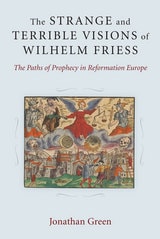
The Strange and Terrible Visions of Wilhelm Friess
The Paths of Prophecy in Reformation EuropeJonathan Green
University of Michigan Press, 2014
Dutch scholars have recognized that Frans Fraet was executed for printing a prognostication by Willem de Vriese, but this prognostication was thought to be lost. A few scholars of sixteenth-century German apocalypticism have briefly noted the prophecies of Wilhelm Friess but have not studied them in depth. The Strange and Terrible Visions of Wilhelm Friess is the first to connect de Vriese and Friess, as well as recognize the prophecy of Wilhelm Friess as an adaptation of a French version of theVademecum of Johannes de Rupescissa, making these pamphlets by far the most widespread source for Rupescissa’s apocalyptic thought in Reformation Germany. The book explains the connection between the first and second prophecies of Wilhelm Friess and discovers the Calvinist context of the second prophecy and its connection to Johann Fischart, one of the most important German writers of the time.
Jonathan Green provides a study of how textual history interacts with print history in early modern pamphlets and proposes a model of how early modern prophecies were created and transmitted. The Strange and Terrible Visions of Wilhelm Friess makes important contributions to the study of early modern German and Dutch literature, apocalypticism and confessionalization during the Reformation, and the history of printing in the sixteenth century.
The Stranger within Your Gates
Converts and Conversion in Rabbinic LiteratureGary G. Porton
University of Chicago Press, 1994
The Stranger within Your Gates analyzes virtually every reference to converts in the full corpus of rabbinic literature. The intellectual dilemma that converts posed for classical Judaism played itself out in discussions of marriage, religious practice, inheritance of property, and much else. Reviewing the rabbinic literature text by text, Porton exposes the rabbis' frequently ambivalent and ambiguous views.
The Stranger within Your Gates is the only examination of conversion in rabbinic literature to draw upon the full scope of contemporary anthropological and sociological studies of conversion. It is also unique in its focus on the opinions of the community into which the convert enters, rather than on the testimony of the convert. By approaching data with new methods, Porton heightens our understanding of conversion and the nature of the People of Israel in rabbinic literature.
The Stranger, the Tears, the Photograph, the Touch
Divine Presence in Spain and Europe since 1500William A. Christian Jr.
Central European University Press, 2017
The Struggle for Inclusion
Muslim Minorities and the Democratic EthosElisabeth Ivarsflaten and Paul M. Sniderman
University of Chicago Press, 2022
Notwithstanding the turbulence and violence of the last decade over issues of immigration and of Muslims in the West, the results of this study demonstrate that the largest number of citizens in contemporary liberal democracies are more open to inclusion of Muslims than has been recognized. Not less important, the book reveals limits on inclusion that follow from the friction between liberal democratic values. This pioneering work thus brings to light both pathways to progress and polarization traps.
The Struggle over Class
Socioeconomic Analysis of Ancient Christian TextsG. Anthony Keddie
SBL Press, 2021
An interdisciplinary discussion engaging classics, archaeology, religious studies, and the social sciences
The Struggle over Class brings together scholars from the fields of New Testament and early Christianity to examine Christian texts in light of the category of class. Historically rigorous and theoretically sophisticated, this collection presents a range of approaches to, and applications of, class in the study of the epistles, the gospels, Acts, apocalyptic texts, and patristic literature. Contributors Alicia J. Batten, Alan H. Cadwallader, Cavan W. Concannon, Zeba Crook, James Crossley, Lorenzo DiTommaso, Philip F. Esler, Michael Flexsenhar III, Steven J. Friesen, Caroline Johnson Hodge, G. Anthony Keddie, Jaclyn Maxwell, Christina Petterson, Jennifer Quigley, Elisabeth Schüssler Fiorenza, Daniëlle Slootjes, and Emma Wasserman challenge both scholars and students to articulate their own positions in the ongoing scholarly struggle over class as an analytical category.
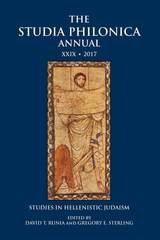
The Studia Philonica Annual XXIX, 2017
Studies in Hellenistic JudaismDavid T. Runia
SBL Press, 2017
The best current research on Philo and Hellenistic Judaism
The Studia Philonica Annual is a scholarly journal devoted to the study of Hellenistic Judaism, particularly the writings and thought of the Hellenistic-Jewish writer Philo of Alexandria (circa 15 BCE to circa 50 CE). This volume includes a soecial section on Philo's De plantatione.
Features:
- Articles on aspects of Hellenistic Judaism written by experts in the field
- Bibliography
- Book reviews
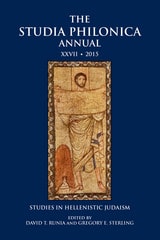
The Studia Philonica Annual XXVII, 2015
Studies in Hellenistic JudaismDavid T. Runia
SBL Press, 2015
The best current research on Philo and Hellenistic Judaism
The Studia Philonica Annual is a scholarly journal devoted to the study of Hellenistic Judaism, particularly the writings and thought of the Hellenistic-Jewish writer Philo of Alexandria (circa 15 BCE to circa 50 CE).
Features:
- Articles on aspects of Hellenistic Judaism written by experts in the field
- Bibliography
- Book reviews
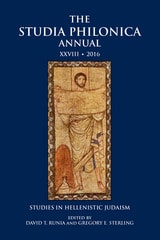
The Studia Philonica Annual XXVIII, 2016
Studies in Hellenistic JudaismDavid T. Runia
SBL Press, 2016
Celebrate the contributions of David T. Runia
The Studia Philonica Annual is a scholarly journal devoted to the study of Hellenistic Judaism, particularly the writings and thought of the Hellenistic-Jewish writer Philo of Alexandria. More than fifteen scholars from around the world offer contributions to this special edition of the Annual in honor of Professor David T. Runia on the occasion of his 65th birthday and retirement from his post as Master of Queens College, University of Melbourne. Professor Runia is internationally recognized as one of the world's foremost experts on Philo of Alexandria. As founder of The Studia Philonica Annual, he has been editor or coeditor for twenty-seven years. He initiated a Philo Bibliography project prior to the Annual and incorporated the bibliography into the Annual from the outset. It serves as the primary bibliography for Philonic studies worldwide.
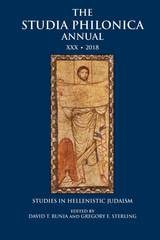
The Studia Philonica Annual XXX, 2018
Studies in Hellenistic JudaismDavid T. Runia
SBL Press, 2018
Studies on Philo and Hellenistic Judaism from experts in the field
The Studia Philonica Annual is a scholarly journal devoted to the study of Hellenistic Judaism, particularly the writings and thought of the Hellenistic-Jewish writer Philo of Alexandria. This volume includes five articles on topics ranging from preserved fragments of Philo to travel in Philo’s works. Nine book reviews cover recent books on Philo, Josephus, and ancient pedagogy.
Features:
- Articles on aspects of Hellenistic Judaism written by scholars from around the world
- Comprehensive bibliography and book reviews
The Studia Philonica Annual XXXI, 2019
Studies in Hellenistic JudaismDavid T. Runia
SBL Press, 2019
Studies on Philo and Hellenistic Judaism from experts in the field
The Studia Philonica Annual is a scholarly journal devoted to the study of Hellenistic Judaism, particularly the writings and thought of the Hellenistic-Jewish writer Philo of Alexandria. This volume includes articles on allegory, Platonic interpretations of the law, rhetoric, and Philo’s thoughts on reincarnation.
Features:
- Articles on aspects of Hellenistic Judaism written by scholars from around the world
- Comprehensive bibliography and book reviews
The Studia Philonica Annual XXXII, 2020
Studies in Hellenistic JudaismDavid T. Runia
SBL Press, 2021
Celebrate the contributions of Gregory E. Sterling
Harold W. Attridge, Ellen Birnbaum, Adela Yarbro Collins, John J. Collins, Michael B. Cover, Jan Willem van Henten, Carl R. Holladay, Andrew McGowan, Karl-Wilhelm Niebuhr, Maren R. Niehoff, James R. Royse, and David T. Runia offer essays honoring Professor Gregory E. Sterling in this special edition of the The Studia Philonica Annual. This volume includes a biography of Sterling’s life by David T. Runia and a bibliography of Sterling’s scholarship by Michael B. Cover. Essays cover a range of topics on Philo, the Bible, and Josephus.
Features:
- Articles on aspects of Hellenistic Judaism written by scholars from around the world
- Comprehensive bibliography of scholarship on Philo
The Studia Philonica Annual XXXIII, 2021
Studies in Hellenistic JudaismDavid T. Runia
SBL Press, 2021
Studies on Philo and Hellenistic Judaism from experts in the field
The Studia Philonica Annual is a scholarly journal devoted to the study of Hellenistic Judaism, particularly the writings and thought of the Hellenistic-Jewish writer Philo of Alexandria (circa 15 BCE to circa 50 CE). Volume 33 includes a special section on the history of editions of Philo, five general articles on Philo’s work, an annotated bibliography, and thirteen book reviews.
The Studia Philonica Annual XXXIV, 2022
Studies in Hellenistic JudaismDavid T. Runia
SBL Press, 2022
The Studia Philonica Annual XXXV, 2023
Studies in Hellenistic JudaismDavid T. Runia
SBL Press, 2023
The Studia Philonica Annual is a scholarly journal devoted to the study of Hellenistic Judaism, particularly the writings and thought of the Hellenistic-Jewish writer Philo of Alexandria (circa 15 BCE to circa 50 CE).
The Studia Philonica Annual XXXVII, 2025
Studies in Hellenistic JudaismDavid T. Runia
SBL Press, 2015
The Studia Philonica Annual is a scholarly journal devoted to the study of Hellenistic Judaism, particularly the writings and thought of the Hellenistic-Jewish writer Philo of Alexandria (circa 15 BCE to circa 50 CE). This volume includes a special section on Philo's De providentia, six additional articles, annotated bibliographies, and a book review section.
The Study of Religion in an Age of Global Dialogue
Leonard Swidler
Temple University Press, 2000
What is religion? As this comprehensive work shows, religion is an explanation of the ultimate meaning of life and how to live accordingly, based on a notion of the Transcendent. Normally it contains the four "C's": Creed, Code, Cult, Community-structure.
This volume looks at the ways we humans have developed to study religion. It also examines the new age in human consciousness that is now drawing. It also examines the new age in human consciousness that is now dawning: The Age of Global Dialogue, a radically new consciousness that shifts the ways we understand everything in life, including religion. This global dialogical way of understanding life does not lead to one global religion, but it does lead toward a consciously acknowledged common set of ethical principles, a Global Ethic. The book looks at these two movements -- the Age of Global Dialogue and inchoative Global Ethic -- in order to help readers understand what is going on around them, so they may make informed, intelligent decisions about the meaning of life and how to live it.
The Subversion of the Apocalypses in the Book of Jubilees
Todd R. Hanneken
SBL Press, 2012
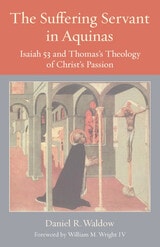
The Suffering Servant in Aquinas
Isaiah 53 and Thomas's Theology of Christ's PassionDaniel R. Waldow
Catholic University of America Press, 2024
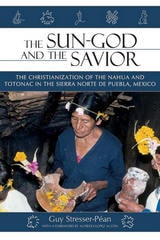
The Sun God and the Savior
The Christianization of the Nahua and Totonac in the Sierra Norte de Puebla, MexicoGuy Stresser-Péan
University Press of Colorado, 2009
The first English translation of Guy Stresser-Péan's tour-de-force presents two decades of fieldwork in the Sierra Norte de Puebla, Mexico, where native pre-Hispanic pagan beliefs blended with traditional Catholic evangelization from the sixteenth century and the more recent intrusion of modernism.
The Indians of the Sierra Norte de Puebla are deeply devoted to Christianity, but their devotion is seamlessly combined with pagan customs, resulting in a hybrid belief system that is not wholly indigenous, yet not wholly Christian. The syncretism practiced here has led the Totonac and Nahua people to identify Christ with the Sun God, a belief expressed symbolically in ritual practices such as the Dance of the Voladores.
Spanning the four centuries from the earliest systematic campaign against Nahua ritual practices - Zumárraga's idolatry trials of 1536-1540 - to the twentieth century, Stresser-Péan contextualizes Nahua and Totonac ritual practices as a series of responses to Christian evangelization and the social reproduction of traditional ritual practices. The Sun God and the Savior is a monumental work on the ethnographic and historical knowledge of the peoples of the Sierra Norte.
The Superhumanities
Historical Precedents, Moral Objections, New RealitiesJeffrey J. Kripal
University of Chicago Press, 2022
What would happen if we reimagined the humanities as the superhumanities? If we acknowledged and celebrated the undercurrent of the fantastic within our humanistic disciplines, entirely new cultural worlds and meanings would become possible. That is Jeffrey J. Kripal’s vision for the future—to revive the suppressed dimension of the superhumanities, which consists of rare but real altered states of knowledge that have driven the creative processes of many of our most revered authors, artists, and activists. In Kripal’s telling, the history of the humanities is filled with precognitive dreams, evolving superhumans, and doubled selves. The basic idea of the superhuman, for Kripal, is at the core of who and what the human species has tried to become over millennia and around the planet.
After diagnosing the basic malaise of the humanities—that the truth must be depressing—Kripal shows how it can all be done differently. He argues that we have to decolonize reality itself if we are going to take human diversity seriously. Toward this pluralist end, he engages psychoanalytic, Black critical, feminist, postcolonial, queer, and ecocritical theory. He works through objections to the superhumanities while also recognizing the new realities represented by the contemporary sciences. In doing so, he tries to move beyond naysaying practices of critique toward a future that can embrace those critiques within a more holistic view—a view that recognizes the human being as both a social-political animal as well as an evolved cosmic species that understands and experiences itself as something super.

The Talmud of the Land of Israel, Volume 10
Orlah and BikkurimJacob Neusner, General Editor
University of Chicago Press, 1991
The Talmud of the Land of Israel, Volume 11
ShabbatJacob Neusner, General Editor
University of Chicago Press, 1991
The Talmud of the Land of Israel, Volume 12
ErubinJacob Neusner, General Editor
University of Chicago Press, 1990
The Talmud of the Land of Israel, Volume 13
Yerushalmi PesahimJacob Neusner, General Editor
University of Chicago Press, 1995
Yerushalmi Pesahim details the specific requirements regarding the preparation for Passover, the Passover sacrifice, and the Seder. Commenting on the many, often contradictory, prescriptions in Exodus, Leviticus, Numbers, and Deuteronomy, this tractate is an important part of a long tradition of interpretation regarding Passover.
The Talmud of the Land of Israel, Volume 14
YomaJacob Neusner, General Editor
University of Chicago Press, 1991
The Talmud of the Land of Israel, Volume 15
SheqalimJacob Neusner, General Editor
University of Chicago Press, 1990
The Talmud of the Land of Israel, Volume 16
Rosh HashanahJacob Neusner, General Editor
University of Chicago Press, 1988