Results by title
379 books match the query 'Botany' and 63 start with t
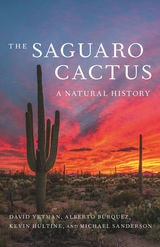
The Saguaro Cactus
A Natural HistoryDavid Yetman, Alberto Búrquez, Kevin Hultine, and Michael Sanderson, with Frank S. Crosswhite
University of Arizona Press, 2020
This book offers a complete natural history of this enduring and iconic desert plant. Gathering everything from the saguaro’s role in Sonoran Desert ecology to its adaptations to the desert climate and its sacred place in Indigenous culture, this book shares precolonial through current scientific findings.
The saguaro is charismatic and readily accessible but also decidedly different from other desert flora. The essays in this book bear witness to our ongoing fascination with the great cactus and the plant’s unusual characteristics, covering the saguaro’s: history of discovery, place in the cactus family, ecology, anatomy and physiology, genetics, and ethnobotany. The Saguaro Cactus offers testimony to the cactus’s prominence as a symbol, the perceptions it inspires, its role in human society, and its importance in desert ecology.
The Social Lives of Forests
Past, Present, and Future of Woodland ResurgenceEdited by Susanna B. Hecht, Kathleen D. Morrison, and Christine Padoch
University of Chicago Press, 2014
Focusing on the history and current use of woodlands from India to the Amazon, The Social Lives of Forests attempts to build a coherent view of forests sited at the nexus of nature, culture, and development. With chapters covering the effects of human activities on succession patterns in now-protected Costa Rican forests; the intersection of gender and knowledge in African shea nut tree markets; and even the unexpectedly rich urban woodlands of Chicago, this book explores forests as places of significant human action, with complex institutions, ecologies, and economies that have transformed these landscapes in the past and continue to shape them today. From rain forests to timber farms, the face of forests—how we define, understand, and maintain them—is changing.
The Vascular Plants of Iowa
An Annotated Checklist and Natural HistoryLawrence J. Eilers
University of Iowa Press, 1994
Anyone who works with the vascular plants of Iowa—researchers, conservationists, teachers, agricultural specialists, horticulturists, gardeners, and so on—and those who are simply interested in knowing more about the state's plants have long felt a need for a comprehensive flora of Iowa. This meticulously researched volume is a giant first step toward such a flora.
This book consists of an extended essay on the natural history of the vascular plants of Iowa, a discussion of their origins, a description of the state's natural regions, and a painstakingly annotated checklist of Iowa vascular plants. The data, which apply to over 150 years, took more than 15 years to collect.
All known vascular plants that grow and persist in Iowa without cultivation are included in the checklist. These are native plants, primarily, but a large number of introduced species have become established throughout the state. Also included are Iowa's major crop plants and some of its common garden plants. The lengthy checklist provides an accurate and up-to-date listing of species names and common names, synonyms, distribution, habitat, abundance, and origin; county names are given for very rare species, and the most complete information has been provided for all rare plants and troublesome species.
The wealth of information is this well-organized, practical volume—which describes more than two thousand species from Adiantum pedatum, the northern maidenhair fern of moist woods and rocky slopes, to Zannichellia palustris, the horned pondweed of shallow marshes and coldwater streams—makes it possible to identify Iowa plants correctly. All midwesterners will want to own a copy of The Vascular Plants of Iowa.
The Vegetation of Wisconsin
An Ordination of Plant CommunitiesJohn T. Curtis
University of Wisconsin Press, 1959

The Wardian Case
How a Simple Box Moved Plants and Changed the WorldLuke Keogh
University of Chicago Press, 2020
Roses, jasmine, fuchsia, chrysanthemums, and rhododendrons bloom in gardens across the world, and yet many of the most common varieties have roots in Asia. How is this global flowering possible? In 1829, surgeon and amateur naturalist Nathaniel Bagshaw Ward placed soil, dried leaves, and the pupa of a sphinx moth into a sealed glass bottle, intending to observe the moth hatch. But when a fern and meadow grass sprouted from the soil, he accidentally discovered that plants enclosed in glass containers could survive for long periods without watering. After four years of experimentation in his London home, Ward created traveling glazed cases that would be able to transport plants around the world. Following a test run from London to Sydney, Ward was proven correct: the Wardian case was born, and the botanical makeup of the world’s flora was forever changed.
In our technologically advanced and globalized contemporary world, it is easy to forget that not long ago it was extremely difficult to transfer plants from place to place, as they often died from mishandling, cold weather, and ocean salt spray. In this first book on the Wardian case, Luke Keogh leads us across centuries and seas to show that Ward’s invention spurred a revolution in the movement of plants—and that many of the repercussions of that revolution are still with us, from new industries to invasive plant species. From the early days of rubber, banana, tea, and cinchona cultivation—the last used in the production of the malaria drug quinine—to the collecting of beautiful and exotic flora like orchids in the first great greenhouses of the United States Botanic Garden in Washington, DC, and England’s Royal Botanic Gardens, Kew, the Wardian case transformed the world’s plant communities, fueled the commercial nursery trade and late nineteenth-century imperialism, and forever altered the global environment.
Three Language List of Botanical Name Components
A. Radcliffe-Smith
Royal Botanic Gardens, Kew, 2000

Tidal Wetlands Primer
An Introduction to Their Ecology, Natural History, Status, and ConservationRalph W. Tiner
University of Massachusetts Press, 2013
Illustrated with maps, photographs, and diagrams, this volume provides a clear account of the factors that make these habitats unique and vulnerable. It discusses their formation, the conditions affecting their plant and animal life, and the diversity of types across North America, as well as their history, use by wildlife and humans, current status, conservation, restoration, and likely future. The emphasis is on vegetated wetlands—marshes and swamps—with additional discussion of eelgrass meadows, rocky shores, beaches, and tidal flats.
Ralph Tiner's previous field guides to coastal wetland plants in the Northeast and Southeast have been widely praised. Tidal Wetlands Primer joins Tiner's earlier publications as an authoritative and user-friendly guide that should appeal to anyone with a serious interest in coastal habitats.
Tree Day
A Story of 24 Hours and 24 Arboreal LivesMeg Lowman
University of Chicago Press, 2025
In this short book, treetop explorer Meg Lowman guides us through a global forest. Each chapter of Tree Day introduces a single tree during a single hour, highlighting twenty-four species from around the world.
In the dark of Yemen’s night, it is too early to see the red sap from which the dragon’s blood tree gets its name. But if we watch closely, we will see nocturnal geckos carry the trees’ pollen in their snouts. Later, in the Pacific Northwest, we climb the world’s tallest species, the coastal redwood. The morning fog is a reminder that redwoods absorb water through their roots and canopies, helping them survive such heights. The sun is already low in the sky on an autumn afternoon. Given the darkness of this New England forest, the sugar maple’s leaves have stopped producing chlorophyll that converts light into energy—and green gives way to vivid crimson foliage. After many hours of boiling, the maple sap makes delicious maple syrup. As the sun sets in Mexico, we observe the origin of another treat, chocolate. The cocoa tree’s flowers sprout along its trunk and branches, allowing easy access for tiny insects like midges that pollinate the tree and start the process of making delicious food for humans, monkeys, bats, and squirrels. By the end of our tree day, we will understand that trees are the silent caretakers of our planet, providing us with medicines, foods, machinery for making fresh water and oxygen, and more.
For each hour, celebrated artist Thibaud Hérem has depicted these trees with gorgeous pen and ink illustrations. Working together to narrate and illustrate these unique moments in time, Lowman and Hérem have created an engaging read that is a perfect way to spend an hour or two—and a true gift for anyone who has ever looked up at a tree in wonder.
Trees and Forests of Tropical Asia
Exploring TapovanPeter Ashton and David Lee
University of Chicago Press, 2022
Trees and Forests of Tropical Asia invites readers on an expedition into the leafy, humid, forested landscapes of tropical Asia—the so-called tapovan, a Sanskrit word for the forest where knowledge is attained through tapasya, or inner struggle. Peter Ashton and David Lee, two of the world’s leading scholars on Asian tropical rain forests, reveal the geology and climate that have produced these unique forests, the diversity of species that inhabit them, the means by which rain forest tree species evolve to achieve unique ecological space, and the role of humans in modifying the landscapes over centuries. Following Peter Ashton’s extensive On the Forests of Tropical Asia, the first book to describe the forests of the entire tropical Asian region from India east to New Guinea, this new book provides a more condensed and updated overview of tropical Asian forests written accessibly for students as well as tropical forest biologists, ecologists, and conservation biologists.
Trees of New Guinea
Edited by Timothy M. A. Utteridge and Laura V. S. Jennings
Royal Botanic Gardens, Kew, 2021
New Guinea is the most floristically diverse island in the world, home to nearly 5,000 tree species alone. Trees of New Guinea details each of the 693 plant genera with arborescent members found in New Guinea, covering the entire region including the West Papua and Papua Provinces of Indonesia, Papua New Guinea, and the surrounding islands such as New Britain, New Ireland, and Bougainville. The book follows contemporary classifications and is richly illustrated with line drawings and color photographs throughout. Each group has a family description and key to the New Guinea tree genera, followed by a description of each genus, with notes on taxonomy, distribution, ecology, and diagnostic characters. Trees of New Guinea—winner of the Council on Botanical and Horticultural Libraries Literature’s 2022 Award for Excellence in Botany—is an essential companion for anyone studying or working in the region, including botanists, conservation workers, ecologists, and zoologists.
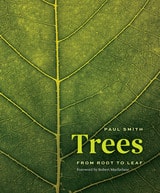
Trees
From Root to LeafPaul Smith
University of Chicago Press, 2022
Trees seen like never before—a world expert presents a stunning compendium, illuminating science, conservation, and art.
Trees provoke deep affection, spirituality, and creativity. They cover about a third of the world’s land and play a crucial role in our environmental systems—influencing the water, carbon, and nutrient cycles and the global climate. This puts trees at the forefront of research into mitigating our climate emergency; we cannot understate their importance in shaping our daily lives and our planet’s future.
In these lavish pages, ecologist Paul Smith celebrates all that trees have inspired across nearly every human culture throughout history. Generously illustrated with over 450 images and organized according to tree life cycle—from seeds and leaves to wood, flowers, and fruit—this book celebrates the great diversity and beauty of the 60,000 tree species that inhabit our planet. Surprising photography and infographics will inspire readers, illustrating intricate bark and leaf patterns, intertwined ecosystems, colorful flower displays, archaic wooden wheels, and timber houses. In this lavishly illustrated book, Smith presents the science, art, and culture of trees. As we discover the fundamental and fragile nature of trees and their interdependence, we more deeply understand the forest without losing sight of the magnificent trees.
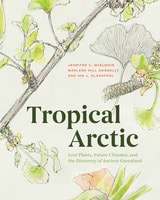
Tropical Arctic
Lost Plants, Future Climates, and the Discovery of Ancient GreenlandJennifer McElwain, Marlene Hill Donnelly, and Ian Glasspool
University of Chicago Press, 2021
While today’s Greenland is largely covered in ice, in the time of the dinosaurs the area was a lushly forested, tropical zone. Tropical Arctic tracks a ten-million-year window of Earth’s history when global temperatures soared and the vegetation of the world responded.
A project over eighteen years in the making, Tropical Arctic is the result of a unique collaboration between two paleobotanists, Jennifer C. McElwain and Ian J. Glasspool, and award-winning scientific illustrator Marlene Hill Donnelly. They began with a simple question: “What was the color of a fossilized leaf?” Tropical Arctic answers that question and more, allowing readers to experience Triassic Greenland through three reconstructed landscapes and an expertly researched catalog of extinct plants. A stunning compilation of paint and pencil art, photos, maps, and engineered fossil models, Tropical Arctic blends art and science to bring a lost world to life. Readers will also enjoy a front-row seat to the scientific adventures of life in the field, with engaging anecdotes about analyzing fossils and learning to ward off polar bear attacks.
Tropical Arctic explains our planet’s story of environmental upheaval, mass extinction, and resilience. By looking at Earth’s past, we see a glimpse of the future of our warming planet—and learn an important lesson for our time of climate change.
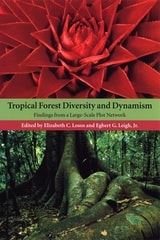
Tropical Forest Diversity and Dynamism
Findings from a Large-Scale Plot NetworkEdited by Elizabeth Losos and Egbert Giles Leigh Jr.
University of Chicago Press, 2004
Written by experts in the field of tropical ecology, Tropical Forest Diversity and Dynamism will appeal to students and professionals with an interest in community ecology and patterns of diversity.