Results by title
383 books match the query 'Globalization' and 78 start with t
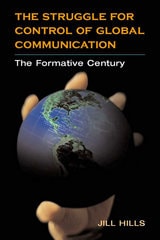
The Struggle for Control of Global Communication
The Formative CenturyJill Hills
University of Illinois Press, 2002
Tracing the development of communication markets and the regulation of international communications from the 1840s through World War I, Jill Hills examines the political, technological, and economic forces at work during the formative century of global communication.
Hills analyzes power relations within the arena of global communications from the inception of the telegraph through the successive technologies of submarine telegraph cables, ship-to-shore wireless, broadcast radio, shortwave wireless, the telephone, and movies with sound. As she shows, global communication began to overtake transportation as an economic, political, and social force after the inception of the telegraph, which shifted communications from national to international. From that point on, information was a commodity and ownership of the communications infrastructure became valuable as the means of distributing information. The struggle for control of that infrastructure occurred in part because British control of communications hindered the growing economic power of the United States.
Hills outlines the technological advancements and regulations that allowed the United States to challenge British hegemony and enter the global communications market. She demonstrates that control of global communication was part of a complex web of relations between and within the government and corporations of Britain and the United States. Detailing the interplay between American federal regulation and economic power, Hills shows how these forces shaped communications technologies and illuminates the contemporary systems of power in global communications.

The Tartar Moment
Crisis and the Globalization of Chinese Knowledge in Early Modern EuropeGianamar Giovannetti-Singh
University of Chicago Press, 0
How seventeenth-century Europeans, following Jesuit missionary Martino Martini, saw their continent as historically, environmentally, and culturally intertwined with China.
The Tartar Moment focuses on understanding how the Manchu conquest of the Ming Empire in 1644 transformed European science, technology, and politics for over a century. Gianamar Giovannetti-Singh argues that seventeenth-century European natural philosophers found the nomadic takeover of a seemingly eternal empire deeply relevant for their own concerns. They began to reevaluate how they thought about the roles of astronomy, history-writing, agriculture, and military technologies in ensuring the long-term survival of a state.
The book’s narrative center is the Jesuit missionary Martino Martini, who first grasped the global significance of the Tartar War and its aftermath. Giovannetti-Singh situates Martini as a broker bridging multiple worlds, each grappling with new forms of turbulence. Martini’s writings reinterpreted Chinese knowledge and culture for diverse European audiences urgently seeking order in an age of uncertainty. China ceased to be imagined as a timeless Other and instead appeared as a civilization that, like Europe, confronted recurring disorder and crafted philosophical solutions to maintain stability. During this period, Europeans selectively appropriated Chinese methods of reading the heavens, cultivating the earth, and governing the state.
By tracing how Martini recognized, theorized, and recounted crises in Ming, Manchu, and European contexts, The Tartar Moment shows that the 1640s and 1650s were not simply years of collapse but of intense creativity in interpreting and responding to disorder.
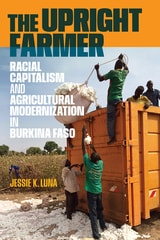
The Upright Farmer
Racial Capitalism and Agricultural Modernization in Burkina FasoJessie K. Luna
Duke University Press, 2026

The View from Prague
The Expectations of World Leaders at the Dawn of the 21st CenturyJirí Musil
Central European University Press, 2007
The Vinyl Ain't Final
Hip Hop and the Globalization of Black Popular CultureDipannita Basu and Sidney Lemelle
Pluto Press, 2006
From the front lines of hip hop culture and music in the USA, Britain, France, Japan, Germany, Hawaii, Tanzania, Cuba, Samoa and South Africa, academics, poets, practitioners, journalists, and political commentators explore hip hop -- both as a culture and as a commodity. From the political economy of the South African music industry to the cultural resistance forged by Afro-Asian hip hop, this potent mix of contributors provides a unique critical insight into the implications of hip hop globally and locally. Indispensable for fans of hip hop culture and music, this book will also appeal to anyone interested in cultural production, cultural politics and the implications of the huge variety of forms hip hop encompasses.
Dipa Basu is and Associate Professor of Sociology and Black Studies at Pitzer College, Claremont, California. Her recent publications include 'Sociology of the Color Line' in Peter Ratcliffe, ed. The Politics of Social Science Research: Race, Ethnicity and Social Change (Palgrave Press, 2001).
Sidney Lemelle is an Associate Professor of Black Studies at Pomona College, Claremont, California. He has co-edited with Robin D.G Kelley, Imagining Home: Class, Culture and Nationalism in the African Diaspora (Verso, 1994).

The Wardian Case
How a Simple Box Moved Plants and Changed the WorldLuke Keogh
University of Chicago Press, 2020
Roses, jasmine, fuchsia, chrysanthemums, and rhododendrons bloom in gardens across the world, and yet many of the most common varieties have roots in Asia. How is this global flowering possible? In 1829, surgeon and amateur naturalist Nathaniel Bagshaw Ward placed soil, dried leaves, and the pupa of a sphinx moth into a sealed glass bottle, intending to observe the moth hatch. But when a fern and meadow grass sprouted from the soil, he accidentally discovered that plants enclosed in glass containers could survive for long periods without watering. After four years of experimentation in his London home, Ward created traveling glazed cases that would be able to transport plants around the world. Following a test run from London to Sydney, Ward was proven correct: the Wardian case was born, and the botanical makeup of the world’s flora was forever changed.
In our technologically advanced and globalized contemporary world, it is easy to forget that not long ago it was extremely difficult to transfer plants from place to place, as they often died from mishandling, cold weather, and ocean salt spray. In this first book on the Wardian case, Luke Keogh leads us across centuries and seas to show that Ward’s invention spurred a revolution in the movement of plants—and that many of the repercussions of that revolution are still with us, from new industries to invasive plant species. From the early days of rubber, banana, tea, and cinchona cultivation—the last used in the production of the malaria drug quinine—to the collecting of beautiful and exotic flora like orchids in the first great greenhouses of the United States Botanic Garden in Washington, DC, and England’s Royal Botanic Gardens, Kew, the Wardian case transformed the world’s plant communities, fueled the commercial nursery trade and late nineteenth-century imperialism, and forever altered the global environment.
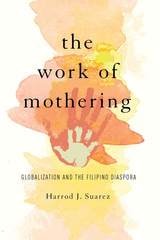
The Work of Mothering
Globalization and the Filipino DiasporaHarrod Suarez
University of Illinois Press, 2017
Harrod J. Suarez's innovative readings of this cultural production explores issues of diaspora, gender, and labor. He details the ways literature and cinema play critical roles in encountering, addressing, and problematizing what we think we know about overseas Filipina workers. Though often seen as compliant subjects, the Filipina mother can also destabilize knowledge production that serves the interests of global empire, capitalism, and Philippine nationalism. Suarez examines canonical writers like Nick Joaquín, Carlos Bulosan, and Jessica Hagedorn to explore this disruption and understand the maternal specificity of the construction of overseas Filipina workers. The result is a series of readings that develop new ways of thinking through diasporic maternal labor that engages with the sociological imaginary.
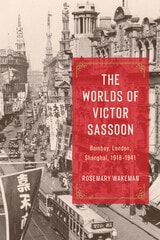
The Worlds of Victor Sassoon
Bombay, London, Shanghai, 1918–1941Rosemary Wakeman
University of Chicago Press, 2024
In this book, historian Rosemary Wakeman brings to life the frenzied, crowded streets, markets, ports, and banks of Bombay, London, and Shanghai. In the early twentieth century, these cities were at the forefront of the sweeping changes taking the world by storm as it entered an era of globalized commerce and the unprecedented circulation of goods, people, and ideas. Wakeman explores these cities and the world they helped transform through the life of Victor Sassoon, who in 1924 gained control of his powerful family’s trading and banking empire. She tracks his movements between these three cities as he grows his family’s fortune and transforms its holdings into a global juggernaut. Using his life as its point of entry, The Worlds of Victor Sassoon paints a broad portrait not just of wealth, cosmopolitanism, and leisure but also of the discrimination, exploitation, and violence wreaked by a world increasingly driven by the demands of capital.
Theatre Symposium, Vol. 25
Cross-Cultural Dialogue on the Global StageEdited by Becky K. Becker
University of Alabama Press, 2017
Globalization may strike many as a phenomenon of our own historical moment, but it is truly as old as civilization: we need only look to the ancient Silk Road linking the Far East to the Mediterranean in order to find some of the earliest recorded impacts of people and goods crossing borders. Yet, in the current cultural moment, tensions are high due to increased migration, economic unpredictability, complicated acts of local and global terror, and heightened political divisions all over the world.
Thus globalization seems new and a threat to our ways of life, to our nations, and to our cultures. In what ways have theatre practitioners, educators, and scholars worked to support cross-cultural dialogue historically? And in what ways might theatre embrace the complexities and contradictions inherent in any meaningful exchange? The essays in Theatre Symposium, Volume 25 reflect on these questions.
Featured in Theatre Symposium, Volume 25
- “Theatre as Cultural Exchange: Stages and Studios of Learning” by Anita Gonzalez
- “Certain Kinds of Dances Used among Them: An Initial Inquiry into Colonial Spanish Encounters with the Areytos of the Taíno in Puerto Rico” by E. Bert Wallace
- “Gertrude Hoffmann’s Lawful Piracy: ‘A Vision of Salome’ and the Russian Season as Transatlantic Production Impersonations” by Sunny Stalter-Pace
- “Greasing the Global: Princess Lotus Blossom and the Fabrication of the ‘Orient’ to Pitch Products in the American Medicine Show” by Chase Bringardner
- “Dismembering Tennessee Williams: The Global Context of Lee Breuer’s A Streetcar Named Desire” by Daniel Ciba
- “Transformative Cross-Cultural Dialogue in Prague: Americans Creating Czech History Plays” by Karen Berman
- “Finding Common Ground: Lessac Training across Cultures” by Erica Tobolski and Deborah A. Kinghorn

Theatre, Globalization and the Heteroglobal Method
Glenn Odom
Intellect Books, 2026
Theatre, Globalization and the Heteroglobal Method offers a groundbreaking framework for rethinking global theatre studies. Drawing on philosophy and scholarship from major theatre traditions—South Africa, the United States, the United Kingdom, China, Japan, and Nigeria—the volume reimagines how performance circulates and transforms in a global context.
Challenging the dominance of Eurocentric models in postcolonial studies, comparative literature, and world theatre, the book introduces the “heteroglobal” method: an adaptable, equitable approach that begins with local theoretical and philosophical frameworks before bringing them into dialogue. These imagined centers, each with its own rich discursive heritage, become sites of knowledge exchange where fresh understandings of art and globalization emerge.
Through a theoretically pluralistic matrix of comparison and interculturalism, Theatre, Globalization and the Heteroglobal Method documents contemporary scholarly and artistic practices across diverse cultural landscapes, offering a new model for teaching, research, and performance in an interconnected world.
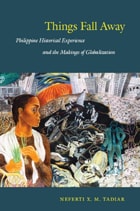
Things Fall Away
Philippine Historical Experience and the Makings of GlobalizationNeferti X. M. Tadiar
Duke University Press, 2009
Tadiar treats the historical experiences articulated in feminist, urban protest, and revolutionary literatures of the 1960s–90s as “cultural software” for the transformation of dominant social relations. She considers feminist literature in relation to the feminization of labor in the 1970s, when between 300,000 and 500,000 prostitutes were working in the areas around U.S. military bases, and in the 1980s and 1990s, when more than five million Filipinas left the country to toil as maids, nannies, nurses, and sex workers. She reads urban protest literature in relation to authoritarian modernization and crony capitalism, and she reevaluates revolutionary literature’s constructions of the heroic revolutionary subject and the messianic masses, probing these social movements’ unexhausted cultural resources for radical change.
Threads
Gender, Labor, and Power in the Global Apparel IndustryJane L. Collins
University of Chicago Press, 2003
To dispel these misunderstandings, Jane L. Collins visited two very different apparel firms and their factories in the United States and Mexico. Moving from corporate headquarters to factory floors, her study traces the diverse ties that link First and Third World workers and managers, producers and consumers. Collins examines how the transnational economics of the apparel industry allow firms to relocate or subcontract their work anywhere in the world, making it much harder for garment workers in the United States or any other country to demand fair pay and humane working conditions.
Putting a human face on globalization, Threads shows not only how international trade affects local communities but also how workers can organize in this new environment to more effectively demand better treatment from their distant corporate employers.

Tight Knit
Global Families and the Social Life of Fast FashionElizabeth L. Krause
University of Chicago Press, 2018
Krause offers a revelatory look into how families involved in the fashion industry are coping with globalization based on longterm research in Prato, the historic hub of textile production in the heart of metropolitan Tuscany. She brings to the fore the tensions—over value, money, beauty, family, care, and belonging—that are reaching a boiling point as the country struggles to deal with the same migration pressures that are triggering backlash all over Europe and North America. Tight Knit tells a fascinating story about the heterogeneity of contemporary capitalism that will interest social scientists, immigration experts, and anyone curious about how globalization is changing the most basic of human conditions—making a living and making a life.
Toward Border Abolition
Migrant Struggles and the LawNicholas De Genova and Daniel I. Morales, editors
Duke University Press, 2026
Toward a Global Idea of Race
Denise Ferreira da Silva
University of Minnesota Press, 2007
In this far-ranging and penetrating work, Denise Ferreira da Silva asks why, after more than five hundred years of violence perpetrated by Europeans against people of color, is there no ethical outrage?
Rejecting the prevailing view that social categories of difference such as race and culture operate solely as principles of exclusion, Silva presents a critique of modern thought that shows how racial knowledge and power produce global space. Looking at the United States and Brazil, she argues that modern subjects are formed in philosophical accounts that presume two ontological moments—historicity and globality—which are refigured in the concepts of the nation and the racial, respectively. By displacing historicity’s ontological prerogative, Silva proposes that the notion of racial difference governs the present global power configuration because it institutes moral regions not covered by the leading post-Enlightenment ethical ideals—namely, universality and self-determination.
By introducing a view of the racial as the signifier of globality,Toward a Global Idea of Race provides a new basis for the investigation of past and present modern social processes and contexts of subjection.
Denise Ferreira da Silva is associate professor of ethnic studies at University of California, San Diego.
Towards a Sustainable Information Society
Deconstructing WSISEdited by Nico Carpentier and Jan Servaes
Intellect Books, 1995
With the two-phased World Summit on the Information Society (WSIS), the United Nations attempted to stimulate the development of such tools.
Simultaneously, the WSIS is a large-scale experiment in multistakeholderism. The objective was to create a more balanced decision-making process that would allow the voices of civil society and business actors to be heard in international politics.
This book aims to evaluate the potentialities of both the Information Society, and the WSIS in supporting and constructing more democratic, just and developed societies. It is the second book arising from the intellectual work of European Consortium for Communications Research members.
Trading Down
Africa, Value Chains, And The Global EconomyPeter Gibbon and Stefano Ponte
Temple University Press, 2005

Traffick
The Illicit Movement of People and ThingsGargi Bhattacharyya
Pluto Press, 2005
Trans-Americanity
Subaltern Modernities, Global Coloniality, and the Cultures of Greater MexicoJosé David Saldívar
Duke University Press, 2012
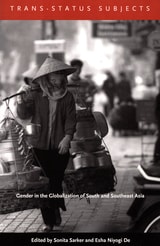
Trans-Status Subjects
Gender in the Globalization of South and Southeast AsiaSonita Sarker and Esha Niyogi De, eds.
Duke University Press, 2002
The contributors—including literary and film theorists, geographers, historians, sociologists, and anthropologists—show how the dominant colonial powers prefigured the ideologies of gender and sexuality that neocolonial nation-states have later refigured; investigate economic and artistic production; and explore labor, capital, and social change. The essays cover a range of locales—including Sri Lanka, Vietnam, Thailand, Singapore, Borneo, Indonesia, and the United States. In investigating issues of power, mobility, memory, and solidarity in recent eras of globalization, the contributors—scholars and activists from South Asia, Southeast Asia, England, Australia, Canada, and the United States—illuminate various facets of the new concept of trans-status subjects.
Trans-Status Subjects carves out a new area of inquiry at the intersection of feminisim and critical geography, as well as globalization, postcolonial, and cultural studies.
Contributors. Anannya Bhattacharjee, Esha Niyogi De, Karen Gaul, Ketu Katrak, Karen Leonard, Philippa Levine, Kathryn McMahon, Andrew McRae, Susan Morgan, Nihal Perera, Sonita Sarker, Jael Silliman, Sylvia Tiwon, Gisele Yasmeen
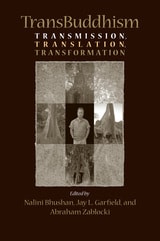
TransBuddhism
Transmission, Translation, and TransformationNalini Bhushan
University of Massachusetts Press, 2009
The chapters in the first section explore the transmission of Buddhism to the West, ranging from the writings of one of its earliest western interpreters, the Wesleyan missionary R. Spence Hardy, to the globalization of Tibetan Buddhist reincarnation, to the development and practice of Buddhism within the American prison system. The concluding chapter of this section presents a case study of a Japanese Buddhist temple in Oregon that ultimately died out—an example of a transmission that failed.
The second section looks at the complex issues that arise in the translation of Buddhist terms, texts, and concepts from one language or cultural milieu to another. Two chapters examine the challenges confronted by those who translate Buddhist texts—one exploring the contemporary translation of Tibetan Buddhism, the second analyzing an exchange of poetry in medieval Japan. The other two chapters describe the translation of Buddhist ideas into new cultural domains in America, specifically film and sports.
The final section presents case studies in the transformation of Buddhism which is resulting from its new global interconnections. Topics include the role of women in transforming Buddhist patriarchy, Buddhist-Freudian dialogue in relationship to mourning, and the interplay between Buddhism and the environmental movement.
The book also includes images created by the noted artist Meridel Rubenstein which frame the individual chapters within a nonverbal exploration of the themes discussed.
In addition to the editors, contributors include Mark Blum, Mario D'Amato, Sue Darlington, Elizabeth Eastman, Connie Kassor, Tom Rohlich, Judith Snodgrass, Jane Stangl, and Karma Lekshe Tsomo.
Translation, Resistance, Activism
Maria Tymoczko
University of Massachusetts Press, 2010
From silence to radical manipulation of texts, translation strategies are instrumental in significant historical interventions and cultural change. Translation plays a pivotal role in ideological dialogue and struggle, including resistance to oppression and cultural straitjackets of all types, from sexual puritanism to military dictatorships. Situated in their own space, time, history, and political contexts, translators promote ideological agendas by creating new cultural narratives, pragmatically adjusting tactics so as to maximize the social and political impact.
The essays in this volume explore ways to read translations as records of cultural contestation and ideological struggle; as means of fighting censorship, physical coercion, cultural repression, and political dominance; and as texts that foster a wide variety of goals from cultural nationalism to armed confrontation. Translations are set in relief as central cultural documents rather than derivative, peripheral, or marginalized productions. They are seen as forms of ethical, political, and ideological activity rather than as mere communicative transactions or creative literary exercises.
The contributors demonstrate that engaged and activist translations are performative acts within broader political and ideological contexts. The essays detail the initiative, resourcefulness, and courage of individual translators, whose willingness to put themselves on the line for social change can sometimes move the world.
In addition to Maria Tymoczko, contributors include Pua'ala'okalani D. Aiu, Brian James Baer, Mona Baker, Paul F. Bandia, Georges L. Bastin, Nitsa Ben-Ari, Ãngela Campo, Antonia Carcelen-Estrada, Ãlvaro Echeverri, Denise Merkle, John Milton, and Else R.P. Vieira.
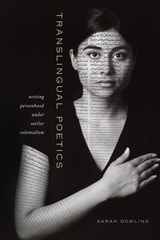
Translingual Poetics
Writing Personhood Under Settler ColonialismSarah Dowling
University of Iowa Press, 2018
Since the 1980s, poets in Canada and the U.S. have increasingly turned away from the use of English, bringing multiple languages into dialogue—and into conflict—in their work. This growing but under-studied body of writing differs from previous forms of multilingual poetry. While modernist poets offered multilingual displays of literary refinement, contemporary translingual poetries speak to and are informed by feminist, anti-racist, immigrant rights, and Indigenous sovereignty movements. Although some translingual poems have entered Chicanx, Latinx, Asian American, and Indigenous literary canons, translingual poetry has not yet been studied as a cohesive body of writing.
The first book-length study on the subject, Translingual Poetics argues for an urgent rethinking of Canada and the U.S.’s multiculturalist myths. Dowling demonstrates that rising multilingualism in both countries is understood as new and as an effect of cultural shifts toward multiculturalism and globalization. This view conceals the continent’s original Indigenous multilingualism and the ongoing violence of its dismantling. It also naturalizes English as traditional, proper, and, ironically, native.
Reading a range of poets whose work contests this “settler monolingualism”—Jordan Abel, Layli Long Soldier, Myung Mi Kim, Guillermo Gómez-Peña, M. NourbeSe Philip, Rachel Zolf, Cecilia Vicuña, and others—Dowling argues that translingual poetry documents the flexible forms of racialization innovated by North American settler colonialisms. Combining deft close readings of poetry with innovative analyses of media, film, and government documents, Dowling shows that translingual poetry’s avoidance of authentic, personal speech reveals the differential forms of personhood and non-personhood imposed upon the settler, the native, and the alien.
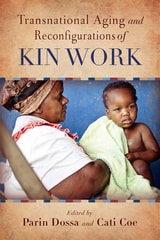
Transnational Aging and Reconfigurations of Kin Work
Dossa, Parin
Rutgers University Press, 2017
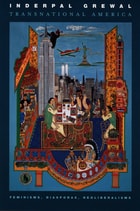
Transnational America
Feminisms, Diasporas, NeoliberalismsInderpal Grewal
Duke University Press, 2005
Grewal combines a postcolonial perspective with social and cultural theory to argue that contemporary notions of gender, race, class, and nationality are linked to earlier histories of colonization. Through an analysis of Mattel’s sales of Barbie dolls in India, she discusses the consumption of American products by middle-class Indian women newly empowered with financial means created by India’s market liberalization. Considering the fate of asylum-seekers, Grewal looks at how a global feminism in which female refugees are figured as human rights victims emerged from a distinctly Western perspective. She reveals in the work of three novelists who emigrated from India to the United States—Bharati Mukherjee, Chitra Banerjee Divakaruni, and Amitav Ghosh—a concept of Americanness linked to cosmopolitanism. In Transnational America Grewal makes a powerful, nuanced case that the United States must be understood—and studied—as a dynamic entity produced and transformed both within and far beyond its territorial boundaries.

Transnational Korean Cinema
Cultural Politics, Film Genres, and Digital TechnologiesDal Yong Jin
Rutgers University Press, 2020
The book emphasizes the economic and industrial aspects of the story, looking at questions on the interaction of politics and economics, including censorship and public funding, and provides a better view of the big picture by laying bare the relationship between film industries, the global market, and government. Jin also sheds light on the operations and globalization strategies of Korean film industries alongside changing cultural policies in tandem with Hollywood’s continuing influences in order to comprehend the power relations within cultural politics, nationally and globally. This is the first book to offer a full overview of the nascent development of Korean cinema.
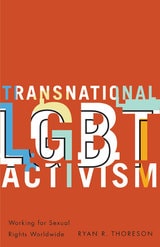
Transnational LGBT Activism
Working for Sexual Rights WorldwideRyan R. Thoreson
University of Minnesota Press, 2014
The International Gay and Lesbian Human Rights Commission (IGLHRC) was founded in 1990 as the first NGO devoted to advancing LGBT human rights worldwide. How, this book asks, is that mission translated into practice? What do transnational LGBT human rights advocates do on a day-to-day basis and for whom? Understanding LGBT human rights claims is impossible, Ryan R. Thoreson contends, without knowing the answers to these questions.
In Transnational LGBT Activism, Thoreson argues that the idea of LGBT human rights is not predetermined but instead is defined by international activists who establish what and who qualifies for protection. He shows how IGLHRC formed and evolved, who is engaged in this work, how they conceptualize LGBT human rights, and how they have institutionalized their views at the United Nations and elsewhere. After a full year of in-depth research in New York City and Cape Town, South Africa, Thoreson is able to reconstruct IGLHRC’s early campaigns and highlight decisive shifts in the organization’s work from its founding to the present day.
Using a number of high-profile campaigns for illustration, he offers insight into why activists have framed particular demands in specific ways and how intergovernmental advocacy shapes the claims that activists ultimately make. The result is a uniquely balanced, empirical response to previous impressionistic and reductive critiques of Western human rights activists—and a clarifying perspective on the nature and practice of global human rights advocacy.
Transnational Political Islam
Religion, Ideology and PowerEdited by Azza Karam
Pluto Press, 2003
Political Islam, to be distinguished from Islam as a culture or a religion, and from Islamic Fundamentalism, is an increasingly important feature of the western political scene. The ideologies of Political Islam reflect the fact that some of their adherents live and work within a Western socio-political context.
Although Political Islam has been widely written about in Muslim countries, very little has been published the West, and this book attempts to redress that imbalance.
With a range of outstanding contributors that includes academics and human rights advocates this book tackles the diversity of Islamist thinking and practice in various Western countries and explores their transnational connections in both East and West.
The book analyses developments in Islamist thinking and activities, and their connections to the latest global political and economic trends, and discusses future evolutions of the ideology and its manifestations.