Results by title
260 books match the query 'Holocaust' and 56 start with t
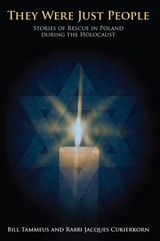
They Were Just People
Stories of Rescue in Poland During the HolocaustBill Tammeus & Rabbi Jacques Cukierkorn
University of Missouri Press, 2009
Hitler’s attempt to murder all of Europe’s Jews almost succeeded. One reason it fell short of its nefarious goal was the work of brave non-Jews who sheltered their fellow citizens. In most countries under German control, those who rescued Jews risked imprisonment and death. In Poland, home to more Jews than any other country at the start of World War II and location of six German-built death camps, the punishment was immediate execution.
This book tells the stories of Polish Holocaust survivors and their rescuers. The authors traveled extensively in the United States and Poland to interview some of the few remaining participants before their generation is gone. Tammeus and Cukierkorn unfold many stories that have never before been made public: gripping narratives of Jews who survived against all odds and courageous non-Jews who risked their own lives to provide shelter.
These are harrowing accounts of survival and bravery. Maria Devinki lived for more than two years under the floors of barns. Felix Zandman sought refuge from Anna Puchalska for a night, but she pledged to hide him for the whole war if necessary—and eventually hid several Jews for seventeen months in a pit dug beneath her house. And when teenage brothers Zygie and Sol Allweiss hid behind hay bales in the Dudzik family’s barn one day when the Germans came, they were alarmed to learn the soldiers weren’t there searching for Jews, but to seize hay. But Zofia Dudzik successfully distracted them, and she and her husband insisted the boys stay despite the danger to their own family.
Through some twenty stories like these, Tammeus and Cukierkorn show that even in an atmosphere of unimaginable malevolence, individuals can decide to act in civilized ways. Some rescuers had antisemitic feelings but acted because they knew and liked individual Jews. In many cases, the rescuers were simply helping friends or business associates. The accounts include the perspectives of men and women, city and rural residents, clergy and laypersons—even children who witnessed their parents’ efforts.
These stories show that assistance from non-Jews was crucial, but also that Jews needed ingenuity, sometimes money, and most often what some survivors called simple good luck. Sixty years later, they invite each of us to ask what we might do today if we were at risk—or were asked to risk our lives to save others.
[more]
Third-Generation Holocaust Representation
Trauma, History, and MemoryVictoria Aarons and Alan L. Berger
Northwestern University Press, 2017
Victoria Aarons and Alan L. Berger show that Holocaust literary representation has continued to flourish well into the twenty-first century—gaining increased momentum even as its perspective shifts, as a third generation adds its voice to the chorus of post-Holocaust writers. In negotiating the complex thematic imperatives and narrative conceits of the literature of third-generation writers, this bold new work examines those structures, tropes, patterns, ironies, disjunctions, and overall tensions that produce a literature that laments unrecoverable loss for a generation removed spatially and temporally from the extended trauma of the Holocaust. Aarons and Berger address evolving notions of “postmemory”; the intergenerational and ongoing transmission of trauma; issues of Jewish cultural identity; inherited memory; the psychological tensions of post-Holocaust Jewish identity; the characteristic tropes of memory and the personalized narrative voice; issues of generational dislocation and anxiety; the recurrent antagonisms of assimilation and historical alienation; the imaginative re-creation and reconstruction of the past; and the future of Holocaust memory and representation.
[more]
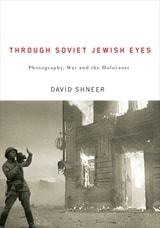
Through Soviet Jewish Eyes
Photography, War, and the HolocaustShneer, David
Rutgers University Press, 2012
Most view the relationship of Jews to the Soviet Union through the lens of repression and silence. Focusing on an elite group of two dozen Soviet-Jewish photographers, including Arkady Shaykhet, Alexander Grinberg, Mark Markov-Grinberg, Evgenii Khaldei, Dmitrii Baltermants, and Max Alpert, Through Soviet Jewish Eyes presents a different picture. These artists participated in a social project they believed in and with which they were emotionally and intellectually invested-they were charged by the Stalinist state to tell the visual story of the unprecedented horror we now call the Holocaust.
These wartime photographers were the first liberators to bear witness with cameras to Nazi atrocities, three years before Americans arrived at Buchenwald and Dachau. In this passionate work, David Shneer tells their stories and highlights their work through their very own images-he has amassed never-before-published photographs from families, collectors, and private archives.
Through Soviet Jewish Eyes helps us understand why so many Jews flocked to Soviet photography; what their lives and work looked like during the rise of Stalinism, during and then after the war; and why Jews were the ones charged with documenting the Soviet experiment and then its near destruction at the hands of the Nazis.
[more]
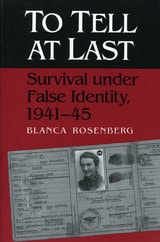
To Tell At Last
Survival under False Identity, 1941-45Blanca Rosenberg
University of Illinois Press, 1993
"Searing. . . . With
an even hand and understated prose, Ms. Rosenberg, now a New York City
psychotherapist, bravely depicts Nazi carnage in chilling detail."
-- Susan Shapiro, New York Times Book Review
"[A] harrowing account
of intrigue and danger with all the elements of a war movie adventure."
-- Miriam Rinn, The Forward
This memoir of how a Jewish
woman survived Nazi Germany by passing as an Aryan was selected as the
best book on Holocaust and Jewish Resistance Literature by the Israeli
committee of the Egit Grants.
[more]
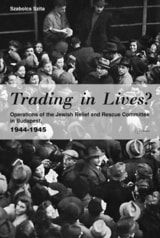
Trading in Lives?
Operations of the Jewish Relief and Rescue Committee in Budapest, 1944-1945Szabolcs Szita
Central European University Press, 2005
Set in the tumultuous moments of 1944–45 Budapest, this work discusses the operations of the Budapest Relief and Rescue Committee. Drawing out the contradictions and complexities of the mass deportations of Hungarian Jews during the final phase of World War II, Szita suggests that in the Hungarian context, a commerce in lives ensued, where prominent Zionists like Dr. Rezso Kasztner negotiated with the higher echelons of the SS, trying to garner the freedom of Hungarian Jews. Szita's portrait of the controversial Kasztner is a more sympathetic rendition of a powerful Zionist leader who was later assassinated in Israel for his dealings with Nazi leaders. Szita reveals a story of interweaving personalities and conflicts during arguably the most tragic moment in European history. The author's extensive research is a tremendous contribution to a field of study that has been much ignored by scholarship-the Hungarian holocaust and the trade in human lives.
[more]
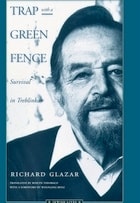
Trap with a Green Fence
Survival in TreblinkaRichard Glazar
Northwestern University Press, 1995
Trap with a Green Fence is Richard Glazar's memoir of deportation, escape, and survival. In economical prose, Glazar weaves a description of Treblinka and its operations into his evocation of himself and his fellow prisoners as denizens of an underworld. Glazar gives us compelling images of these horrors in a tone that remains thoughtful but sober, affecting but simple.
[more]