Results by title
328 books match the query 'Islam' and 61 start with t
The Theology of Louis Massignon
Christian Krokus
Catholic University of America Press, 2017
The Unconverted Self
Jews, Indians, and the Identity of Christian EuropeJonathan Boyarin
University of Chicago Press, 2009
Europe’s formative encounter with its “others” is still widely assumed to have come with its discovery of the peoples of the New World. But, as Jonathan Boyarin argues, long before 1492 Christian Europe imagined itself in distinction to the Jewish difference within. The presence and image of Jews in Europe afforded the Christian majority a foil against which it could refine and maintain its own identity. In fundamental ways this experience, along with the ongoing contest between Christianity and Islam, shaped the rhetoric, attitudes, and policies of Christian colonizers in the New World.
The Unconverted Self proposes that questions of difference inside Christian Europe not only are inseparable from the painful legacy of colonialism but also reveal Christian domination to be a fragile construct. Boyarin compares the Christian efforts aimed toward European Jews and toward indigenous peoples of the New World, bringing into focus the intersection of colonial expansion with the Inquisition and adding significant nuance to the entire question of the colonial encounter.
Revealing the crucial tension between the Jews as “others within” and the Indians as “others without,” The Unconverted Self is a major reassessment of early modern European identity.
The Venture of Islam, Volume 1
The Classical Age of IslamMarshall G. S. Hodgson
University of Chicago Press, 1974
"This is a nonpareil work, not only because of its command of its subject but also because it demonstrates how, ideally, history should be written."—The New Yorker
Volume 1, The Classical Age of Islam, analyzes the world before Islam, Muhammad's challenge, and the early Muslim state between 625 and 692. Hodgson then discusses the classical civilization of the High Caliphate. The volume also contains a general introduction to the complete work and a foreword by Reuben Smith, who, as Hodgson's colleague and friend, finished the Venture of Islam after the author's death and saw it through to publication.
The Venture of Islam, Volume 2
The Expansion of Islam in the Middle PeriodsMarshall G. S. Hodgson
University of Chicago Press, 1977
The Venture of Islam has been honored as a magisterial work of the mind since its publication in early 1975. In this three-volume study, illustrated with charts and maps, Hodgson traces and interprets the historical development of Islamic civilization from before the birth of Muhammad to the middle of the twentieth century. This work grew out of the famous course on Islamic civilization that Hodgson created and taught for many years at the University of Chicago.
In the second work of this three-volume set, Hodgson investigates the establishment of an international Islamic civilization through about 1500. This includes a theoretical discussion of cultural patterning in the Islamic world and the Occident.
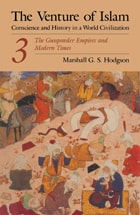
The Venture of Islam, Volume 3
The Gunpowder Empires and Modern TimesMarshall G. S. Hodgson
University of Chicago Press, 1977
In this concluding volume of The Venture of Islam, Hodgson describes the second flowering of Islam: the Safavi, Timuri, and Ottoman empires. The final part of the volume analyzes the widespread Islamic heritage in today's world.
"This is a nonpareil work, not only because of its command of its subject but also because it demonstrates how, ideally, history should be written."—The New Yorker
The Victim and its Masks
An Essay on Sacrifice and Masquerade in the MaghrebAbdellah Hammoudi
University of Chicago Press, 1993
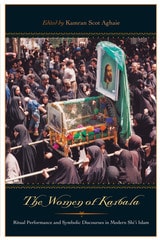
The Women of Karbala
Ritual Performance and Symbolic Discourses in Modern Shi'i IslamEdited by Kamran Scot Aghaie
University of Texas Press, 2005
Commemorating the Battle of Karbala, in which the Prophet Mohammad's grandson Hosayn and seventy-two of his family members and supporters were martyred in 680 CE, is the central religious observance of Shi'i Islam. Though much has been written about the rituals that reenact and venerate Karbala, until now no one has studied women's participation in these observances. This collection of original essays by a multidisciplinary team of scholars analyzes the diverse roles that women have played in the Karbala rituals, as well as the varied ways in which gender-coded symbols have been used within religious and political discourses.
The contributors to this volume consider women as participants in and observers of the Karbala rituals in Iran, Iraq, Lebanon, India, Pakistan, and the United States. They find that women's experiences in the Shi'i rituals vary considerably from one community to another, based on regional customs, personal preferences, religious interpretations, popular culture, and socioeconomic background. The authors also examine the gender symbolism within the rituals, showing how it reinforces distinctions between the genders while it also highlights the centrality of women to the symbolic repertory of Shi'ism. Overall, the authors conclude that while Shi'i rituals and symbols have in some ways been used to restrict women's social roles, in other ways they have served to provide women with a sense of independence and empowerment.
The Word of Islam
Edited by John Alden Williams
University of Texas Press, 1993
Since the 1970s, Islam has been undergoing a tremendous resurgence throughout the world. This resurgence has often been labeled "Islamic fundamentalism" by the media, but it includes believers of every persuasion, from the most conservative to the most liberal.
Given this fact, it is vital for the West to understand the terms in which Islam thinks and to communicate effectively with Muslims. This anthology includes writings central to Islamic thought, some translated earlier but here redone, and others which have never before appeared in any Western language.
The selections include an interpretation of the Qur'an, as well as portions of the Hadith, or sayings and actions of the Prophet; Islamic law; mysticism (Sufism); theology; and sectarian writings. A final essay on Islam today places these writings in their contemporary context and shows the breadth and variety of Islamic belief and practice.
Compiled with the intention of letting Islam describe itself in its own words, the book is an important source for all students of Muslim culture and world religions. This book is similar in scope to Williams' well-known 1961 George Braziller publication, but freshly written and much improved.
Times of History
Universal Topics in Islamic HistoriographyAziz Al-Azmeh
Central European University Press, 2007
Toward an Islamic Theology of Nonviolence
In Dialogue with René GirardAdnane Mokrani
Michigan State University Press, 2022
Two Arabs, a Berber, and a Jew
Entangled Lives in MoroccoLawrence Rosen
University of Chicago Press, 2015
Through the intellectual lives of these four men, this book explores a number of interpretative and theoretical issues that have made Arab culture distinct, especially in relationship to the West: how nothing is ever hard and fast, how everything is relational and always a product of negotiation. It showcases the vitality of the local in a global era, and it contrasts Arab notions of time, equality, and self with those in the West. Likewise, Rosen unveils his own entanglement in their world and the drive to keep the analysis of culture first and foremost, even as his own life enmeshes itself in those of his study. An exploration of faith, politics, history, and memory, this book highlights the world of everyday life in Arab society in ways that challenge common notions and stereotypes.