Results by title
301 books match the query 'Knowledge' and 62 start with t
Thinking in Henry James
Sharon Cameron
University of Chicago Press, 1989
Thomas De Quincey
British Rhetoric's Romantic TurnLois Peters Agnew
Southern Illinois University Press, 2012
This wide-ranging volume gives proper attention to the views on rhetoric and style set forth by British literary figure Thomas De Quincey (1785–1859), whose contributions to the history of rhetoric are often overlooked. Lois Peters Agnew presents an overview of this theorist’s life and provides cultural context for his time and place, with particular emphasis on the significance of his rhetoric as both an alternative strain of rhetorical history and a previously unrealized example of rhetoric’s transformation in nineteenth-century Britain.
Agnew presents an extensive discussion of De Quincey’s ideas on rhetoric, his theory and practice of conversation, his theory of style and its role in achieving rhetoric’s dialogic potential, and his strategic use of humor and irony in such works as Confessions of an English Opium Eater. Synthesizing previous treatments of De Quincey’s rhetoric and connecting his unusual perspectives on language to the biographical details of his life, Agnew helps readers understand his intellectual development while bringing to light the cultural contexts that prompted radical changes in the ways nineteenth-century British intellectuals conceived of the role of language and the imagination in public and private discourse.
Agnew presents an alternative vision of rhetoric that departs from many common assumptions about rhetoric’s civic purpose and offers insights into the topic of rhetoric and technological change. The result is an accessible and thorough explanation of De Quincey’s complex ideas on rhetoric and the first work to fully show the reach of his ideas across multiple texts written during his lifetime.
Thomas Hardy's Brains
Psychology, Neurology, and Hardy's ImaginationSuzanne Keen
The Ohio State University Press, 2014
This study reveals how Hardy made sense of diverse sources of an affective human psychology, a discipline that expanded significantly during Hardy’s working life. From the 1870s to the turn of the twentieth century, the tools and techniques for studying the structures and function of the nervous system developed rapidly. Simultaneously, Hardy moved steadily toward realizing a more physiologically accurate rendering of brains and nerves.
Thoreaus Sense of Place
Essays in American Environmental WritingRichard J. Schneider
University of Iowa Press, 2000
The contributors to this stimulating collection address the ways in which Thoreau and his successors attempt to cope with the basic epistemological split between perceiver and place inherent in writing about nature; related discussions involve the kinds of discourse most effective for writing about place. They focus on the impact on Thoreau and his successors of culturally constructed assumptions deriving from science, politics, race, gender, history, and literary conventions. Finally, they explore the implications surrounding a writer's appropriation or even exploitation of places and objects.
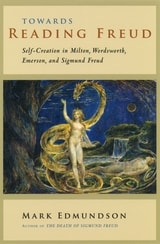
Towards Reading Freud
Self-Creation in Milton, Wordsworth, Emerson, and Sigmund FreudMark Edmundson
University of Chicago Press, 2007
“Marvelous. . . . Edmundson’s book offers an extraordinary challenge both to practicing analysts and to a scholarly community which all too uncomplainingly inhabits and reinforces the Freudian paradigm of interpretation. Edmundson reinvents an adventurous and dissident Freud as an antidote to . . . weary psychoanalytic commonplaces.”—Malcolm Bowie, Raritan
“This book takes a distinguished place in the ongoing effort to recontextualize Freud by stressing the literary, rather than the scientific roots and character of his theory.”—Virginia Quarterly Review
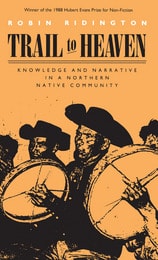
Trail to Heaven
Knowledge and Narrative in a Northern Native CommunityRobin Ridington
University of Iowa Press, 1992

Transcendental Wordplay
America’s Romantic Punsters and the Search for the Language of NatureMichael West
Ohio University Press, 2000
Throughout the first half of the nineteenth century, America was captivated by a muddled notion of “etymology.” New England Transcendentalism was only one outcropping of a nationwide movement in which schoolmasters across small-town America taught students the roots of words in ways that dramatized religious issues and sparked wordplay.
Shaped by this ferment, our major romantic authors shared the sensibility that Friedrich Schlegel linked to punning and christened “romantic irony.” Notable punsters or etymologists all, they gleefully set up as sages, creating jocular masterpieces from their zest for oracular wordplay. Their search for a primal language lurking beneath all natural languages provided them with something like a secret language that encodes their meanings. To fathom their essentially comic masterpieces we must decipher it.
Interpreting Thoreau as an ironic moralist, satirist, and social critic rather than a nature-loving mystic, Transcendental Wordplay suggests that the major American Romantics shared a surprising conservatism. In this award-winning study, Professor West rescues the pun from critical contempt and allows readers to enjoy it as a serious form of American humor.
Travelling Facts
The Social Construction, Distribution, and Accumulation of KnowledgeEdited by Caroline Baillie, Elizabeth Dunn, and Yi Zheng
Campus Verlag, 2004
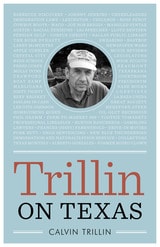
Trillin on Texas
By Calvin Trillin
University of Texas Press, 2011
A remarkably perceptive portrait of the Lone Star State, this collection of pieces from the New Yorker, the Nation, and other publications presents highlights of bestselling author Calvin Trillin’s classic writing on Texas subjects.
"Yes, I do have a Texas connection, but, as we say in the Midwest, where I grew up, not so's you'd know it." So Calvin Trillin introduces this collection of articles and poems about a place that turns up surprisingly often when he's ostensibly writing about something else. Whether reporting on the American scene for the New Yorker, penning comic verse and political commentary for the Nation, or writing his memoirs, Trillin has bumped into Texas again and again. He insists that "this has not been by design . . . there has simply been a lot going on in Texas." Astute readers will note, however, that Trillin's family immigrated to the United States through the port of Galveston, and, after reading this book, many will believe that the Lone Star State has somehow imprinted itself in the family's imagination.
Trillin on Texas gathers some of Trillin's best writing on subjects near to his heart—politics, true crime, food, and rare books, among them—which also have a Texas connection. Indulging his penchant for making "snide and underhanded jokes about respectable public officials," he offers his signature sardonic take on the Bush dynasty and their tendency toward fractured syntax; a faux, but quite believable, LBJ speech; and wry portraits of assorted Texas county judges, small town sheriffs, and Houston immigration lawyers. Trillin takes us on a mouthwatering pilgrimage to the barbecue joint that Texas Monthly proclaimed the best in Texas and describes scouting for books with Larry McMurtry—who rejects all of his "sleepers." He tells the stories of two teenagers who dug up half a million dollars in an ice chest on a South Texas ranch and of rare book dealer Johnny Jenkins, who was found floating in the Colorado River with a bullet wound in the back of his head. And he recounts how redneck movie reviewer "Joe Bob Briggs" fueled a war between Dallas's daily newspapers and pays tribute to two courageous Texas women who spoke truth to power—Molly Ivins and Sissy Farenthold.
Sure to entertain Texans and other folks alike, Trillin on Texas proves once again that Calvin Trillin is one of America's shrewdest observers and wittiest writers.
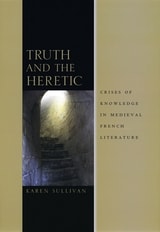
Truth and the Heretic
Crises of Knowledge in Medieval French LiteratureKaren Sullivan
University of Chicago Press, 2005
Exploring the figure of the heretic in Catholic writings of the twelfth and thirteenth centuries as well as the heretic's characterological counterpart in troubadour lyrics, Arthurian romance, and comic tales, Truth and the Heretic seeks to understand why French literature of the period celebrated the very characters who were so persecuted in society at large. Karen Sullivan proposes that such literature allowed medieval culture a means by which to express truths about heretics and the epistemological anxieties they aroused.
The first book-length study of the figure of the heretic in medieval French literature, Truth and the Heretic explores the relation between orthodoxy and deviance, authority and innovation, and will fascinate historians of ideas and literature as well as scholars of religion, critical theory, and philosophy.
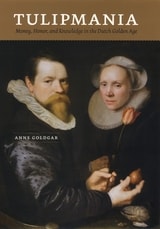
Tulipmania
Money, Honor, and Knowledge in the Dutch Golden AgeAnne Goldgar
University of Chicago Press, 2007
“Goldgar tells us at the start of her excellent debunking book: ‘Most of what we have heard of [tulipmania] is not true.’. . . She tells a new story.”—Simon Kuper, Financial Times
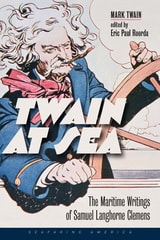
Twain at Sea
The Maritime Writings of Samuel Langhorne ClemensMark Twain
University Press of New England, 2018