Results by title
320 books match the query 'Legal status, laws, etc' and 63 start with t
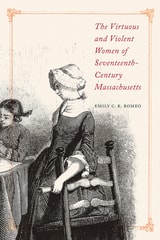
The Virtuous and Violent Women of Seventeenth-Century Massachusetts
Emily C.K. Romeo
University of Massachusetts Press, 2020
Dismantling the image of the peaceful and serene colonial goodwife and countering the assumption that New England was inherently less violent than other regions of colonial America, Emily C. K. Romeo offers a revealing look at acts of violence by Anglo-American women in colonial Massachusetts, from the everyday to the extraordinary. Using Essex County as a case study, Romeo deftly utilizes seventeenth- and eighteenth-century sources to demonstrate that Puritan women, both “virtuous” and otherwise, learned to negotiate the shifting boundaries between acceptable and unacceptable violence in their daily lives and communities.
The Virtuous and Violent Women of Seventeenth-Century Massachusetts shows that more dramatic violence by women—including infanticide, the scalping of captors during the Indian Wars, and even witchcraft accusations—was not necessarily intended to challenge the structures of authority but often sprung from women's desire to protect property, safety, and standing for themselves and their families. The situations in which women chose to flout powerful social conventions and resort to overt violence expose the underlying, often unspoken, priorities and gendered expectations that shaped this society.
The War on Sex
David M. Halperin and Trevor Hoppe, editors
Duke University Press, 2017
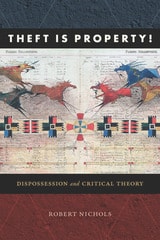
Theft Is Property!
Dispossession and Critical TheoryRobert Nichols
Duke University Press, 2020
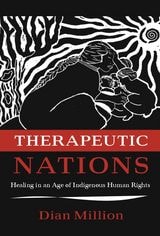
Therapeutic Nations
Healing in an Age of Indigenous Human RightsDian Million
University of Arizona Press, 2013
Million contends that nation-state relations are influenced by a theory of trauma ascendant with the rise of neoliberalism. Such use of trauma theory regarding human rights corresponds to a therapeutic narrative by Western governments negotiating with Indigenous nations as they seek self-determination.
Focusing on Canada and drawing comparisons with the United States and Australia, Million brings a genealogical understanding of trauma against a historical filter. Illustrating how Indigenous people are positioned differently in Canada, Australia, and the United States in their articulation of trauma, the author particularly addresses the violence against women as a language within a greater politic. The book introduces an Indigenous feminist critique of this violence against the medicalized framework of addressing trauma and looks to the larger goals of decolonization. Noting the influence of humanitarian psychiatry, Million goes on to confront the implications of simply dismissing Indigenous healing and storytelling traditions.
Therapeutic Nations is the first book to demonstrate affect and trauma’s wide-ranging historical origins in an Indigenous setting, offering insights into community healing programs. The author’s theoretical sophistication and original research make the book relevant across a range of disciplines as it challenges key concepts of American Indian and Indigenous studies.

Till the Dark Angel Comes
Abolitionism and the Road to the Second American RevolutionWilliam S. King
Westholme Publishing, 2016
Establishing himself as a fresh and important voice in the history of African American emancipation,William S. King provides a critical introduction to the lead-up to the Civil War. A skilled and judicious chronicler, King seamlessly weaves multiple and seemingly disparate threads, including early nineteenth-century Revivalism, the emergence of the Republic of Texas, the fugitive slave laws—and even the explosion of a cannon aboard the U.S.S. Princeton in 1844—to explain how the opposition to slavery in America changed from producing speeches and pamphlets to embracing the reality that slavery could be eradicated only through armed conflict. By tracing this transformation through the life of John Brown, King provides an entirely new assessment of this enigmatic figure who was characterized as a “mad man” in the wake of his butchering of proslavery settlers in Kansas and the inept raid on Harpers Ferry, Virginia. King puts these actions in context to explain the paradox of Brown’s legacy. On one hand he was vilified as an unstable threat to American democracy or a fanatical sideshow to the history of the Civil War, while on the other he was an inspiration to the oppressed, a man who garnered the indomitable Harriet Tubman’s commitment to the righteousness of his endeavor.
Elegantly written with a command of period sources, Till the Dark Angel Comes: Abolitionism and the Road to the Second American Revolution is the story of interracial opposition to slavery, the important debates among free blacks as to their future in America, and the arguments and compromises at the highest levels of government. Here we encounter many personalities of the time, some well known, such as Frederick Douglass,William Lloyd Garrison, and John C. Calhoun, and others less so, but no less important—Martin Delany, Henry Highland Garnet, and Elijah Lovejoy.
Traditional, National, and International Law and Indigenous Communities
Edited by Marianne O. Nielsen and Karen Jarratt-Snider
University of Arizona Press, 2020
While all of these issues are rooted in colonization, Indigenous peoples are using their own solutions to demonstrate the resilience, persistence, and innovation of their communities. With chapters focusing on the use and misuse of law as it pertains to Indigenous peoples in North America, Latin America, Canada, Australia, and New Zealand, this book offers a wide scope of global injustice. Despite proof of oppressive legal practices concerning Indigenous peoples worldwide, this book also provides hope for amelioration of colonial consequences.

Trafficking Women’s Human Rights
Julietta Hua
University of Minnesota Press, 2011
The history of human beings bought and sold, forced into lives of abject servitude or sexual slavery, is a story as old as civilization and yet still of global concern today. How this story is told, Julietta Hua argues, says much about our cultural beliefs. Through a critical inquiry into representations of human trafficking, she reveals the political, social, and cultural strains underlying our current preoccupation with this issue and the difficulty of framing human rights in universal terms.
In Trafficking Women’s Human Rights, Hua maps the ways in which government, media, and scholarship have described sex trafficking for U.S. consumption. As her investigation takes us from laws like the Victims of Trafficking and Violence Protection Act to political speeches and literary and media images, it uncovers dark assumptions about race, difference, and the United States’ place in the world expressed—and often promoted—by such images. The framing itself, exploiting dichotomies of victim/agent, rescued/rescuer, trafficked/smuggled, illustrates the limits of universalism in addressing human rights.
Uniquely broad in scope, this work considers the laws of human trafficking in conjunction with popular culture. In doing so, it constructively draws attention to the ways in which notions of racialized sexualities form our ideas about national belonging, global citizenship, and, ultimately, human rights.
Transgender Rights
Paisley Currah
University of Minnesota Press, 2006
Over the past three decades, the transgender movement has gained visibility and achieved significant victories. Discrimination has been prohibited in several states, dozens of municipalities, and more than two hundred private companies, while hate crime laws in eight states have been amended to include gender identity. Yet prejudice and violence against transgender people remain all too common.
With analysis from legal and policy experts, activists and advocates, Transgender Rights assesses the movement’s achievements, challenges, and opportunities for future action. Examining crucial topics like family law, employment policies, public health, economics, and grassroots organizing, this groundbreaking book is an indispensable resource in the fight for the freedom and equality of those who cross gender boundaries. Moving beyond media representations to grapple with the real lives and issues of transgender people, Transgender Rights will launch a new moment for human rights activism in America.
Contributors: Kylar W. Broadus, Judith Butler, Mauro Cabral, Dallas Denny, Taylor Flynn, Phyllis Randolph Frye, Julie A. Greenberg, Morgan Holmes, Bennett H. Klein, Jennifer L. Levi, Ruthann Robson, Nohemy Solórzano-Thompson, Dean Spade, Kendall Thomas, Paula Viturro, Willy Wilkinson.
Paisley Currah is associate professor of political science at Brooklyn College, executive director of the Center for Lesbian and Gay Studies at the CUNY Graduate Center, and a founding board member of the Transgender Law and Policy Institute.
Richard M. Juang cochairs the advisory board of the National Center for Transgender Equality (NCTE) in Washington, DC. He has taught at Oberlin College and Susquehanna University. He is the lead editor of NCTE's Responding to Hate Crimes: A Community Resource Manual and coeditor of Transgender Justice, which explores models of activism.
Shannon Price Minter is legal director of the National Center for Lesbian Rights and a founding board member of the Transgender Law and Policy Institute.
Transgender Rights and Politics
Groups, Issue Framing, and Policy AdoptionJami K. Taylor and Donald P. Haider-Markel, Editors
University of Michigan Press, 2015
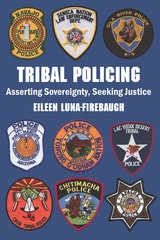
Tribal Policing
Asserting Sovereignty, Seeking JusticeEileen Luna-Firebaugh
University of Arizona Press, 2007
Author Eileen Luna-Firebaugh answers these and other questions in this well-documented text about tribal government and law enforcement in America. Based on extensive research with tribal police departments conducted over a period of eight years, Tribal Policing reveals the complicated role of police officials in Indian country and the innovative methods they are developing to address crime within their borders and to advance tribal sovereignty in the United States.
Tribal police departments face many challenges, such as heightened crime rates, a lack of resources (working patrol vehicles, 911 systems, access to police radios), and vast patrol areas. Luna-Firebaugh demonstrates that tribal officers see themselves as members of the tribal community and that tribal law enforcement is a complex balance of tribal position and authority within the community. Among other topics, Luna-Firebaugh analyzes the structure of tribal law enforcement and the ways it differs from mainstream policing; the role of women, tribal members, and others who comprise tribal law enforcement personnel; tribal jails and corrections; police training; and the legal, political, cultural, and historical issues that affect American Indian tribal policing.
This informative text addresses the scarcity of published material regarding tribal law enforcement and will be a welcome addition to courses in criminal justice, the administration of justice, law enforcement, and Native American studies.
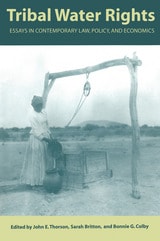
Tribal Water Rights
Essays in Contemporary Law, Policy, and EconomicsEdited by John E. Thorson, Sarah Britton, and Bonnie G. Colby
University of Arizona Press, 2006
Tribes, Treaties, and Constitutional Tribulations
By Vine Deloria, Jr., and David E. Wilkins
University of Texas Press, 2000
"Federal Indian law . . . is a loosely related collection of past and present acts of Congress, treaties and agreements, executive orders, administrative rulings, and judicial opinions, connected only by the fact that law in some form has been applied haphazardly to American Indians over the course of several centuries. . . . Indians in their tribal relation and Indian tribes in their relation to the federal government hang suspended in a legal wonderland."
In this book, two prominent scholars of American Indian law and politics undertake a full historical examination of the relationship between Indians and the United States Constitution that explains the present state of confusion and inconsistent application in U.S. Indian law. The authors examine all sections of the Constitution that explicitly and implicitly apply to Indians and discuss how they have been interpreted and applied from the early republic up to the present. They convincingly argue that the Constitution does not provide any legal rights for American Indians and that the treaty-making process should govern relations between Indian nations and the federal government.
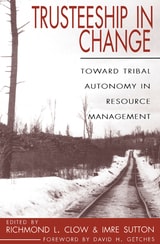
Trusteeship in Change
Toward Tribal Autonomy in Resource ManagementRichmond L. Clow
University Press of Colorado, 2001
This book also includes case studies focused on wildlife management, forest preservation, tribal hunting laws, and other specific concerns in management, preservation and utilization of Native American land. An excellent source for scholars in the fields of Native American and environmental studies, Trusteeship in Change is sure to spark debate and to be an important reference book for years to come.