Results by title
1228 books match the query 'Library & Information Science' and 234 start with t

The Busy Librarians Guide To Information Literacy In
Jeanne Davidson
Assoc of College & Research Libraries, 2012
The Busy Librarian’s Guide to Information Literacy in Science and Engineering
Katherine O'Clair
Assoc of College & Research Libraries, 2012

The Challenge of Library Management
Leading with Emotional EngagementPixey Anne Mosley
American Library Association, 2011
The Changing Academic Library
Operations, Culture, EnvironmentsJohn Budd
Assoc of College & Research Libraries, 2018
The Collection All Around
Sharing Our Cities, Towns, and Natural PlacesJeffrey T. Davis
American Library Association, 2017
The College Student's Research Companion
Finding, Evaluating, and Citing the Resources You Need to SucceedArlene Rodda Quaratiello
American Library Association, 2010
The Community College Library
AssessmentJanet Pinkley
American Library Association, 2022
Community college librarians are engaged in meaningful work designing and delivering library programs and services that meet the needs of their diverse populations and support student learning. The Community College Library series is meant to lift the voices of community college librarians and highlight their creativity, tenacity, and commitment to students.
The Community College Library: Assessment explores the research, comprehensive plans, and new approaches to assessment being created by community college librarians around the U.S. Chapters include sample activities and materials and cover topics including assessing student learning while shifting from Standards to Framework; investigating and communicating library instruction’s relationship to student retention; and building librarian assessment confidence through communities of research practice.
This book demonstrates the innovative and replicable ways community college librarians are measuring, evaluating, and reflecting on the services they provide, and how to use these assessments to demonstrate the value and impact of library services and advocate for resources.
The Community College Library
Collections and Technical ServicesJanet Pinkley
Assoc of College & Research Libraries, 2025
The Community College Library: Collections and Technical Services highlights the various approaches to collection development and the technical services work being done by community college librarians around the U.S. You’ll find strategies for developing equity-centered collections, data-driven acquisitions, cataloging, systems migrations, zero textbook cost degrees, and more. These programs can serve as a model, providing new and innovative ways to approach this work at your own institutions.
Community college librarians are engaged in meaningful work designing and delivering library programs and services that meet the needs of their diverse populations and support student learning. ACRL’s “The Community College Library” series is meant to lift the voices of community college librarians and highlight their creativity, tenacity, and commitment to students.
The Community College Library
Reference and InstructionJanet Pinkley
American Library Association, 2022
Community college librarians are engaged in meaningful work designing and delivering library programs and services that meet the needs of their diverse populations and support student learning. The Community College Library series is meant to lift the voices of community college librarians and highlight their creativity, tenacity, and commitment to students.
The Community College Library: Reference and Instruction collects research, programs, and new approaches to reference and instruction implemented by community college librarians around the U.S. Chapters include sample activities and materials and cover topics including using race-centered and trauma-informed practices in the reference interview; incorporating online workshops into an existing information literacy program; and using student-driven pedagogy to navigate the early stages of research.
This book demonstrates the innovative and replicable ways community college librarians are meeting the information and research needs of their college population both in person and remotely, all while providing a safe, inclusive space for students to explore and learn.
The Comparative Guide to WordPress in Libraries
A LITA GuideAmanda L. American Library Association
American Library Association, 2014
The Complete Collections Assessment Manual
A Holistic ApproachMadeline M. Kelly
American Library Association, 2020
Assessment is increasingly integral to building, managing, and justifying library collections. Unfortunately, assessment can also be a daunting undertaking. And though every institution is unique, as this manual demonstrates, there’s no need to reinvent the wheel. Spanning both concept and practice, Kelly offers a holistic assessment framework suitable to a variety of collections and contexts. With a structure that makes it applicable as both a training tool for practicing librarians and a useful course text for library students, this manual
- introduces foundational assessment methodologies then provides concrete guidance on how to contextualize those methodologies within a holistic collections assessment program;
- covers topics such as assessment goals, assessment stakeholders, selecting data and methodologies, working through project constraints, and project planning;
- includes sample assessment program structures and other useful templates;
- provides step-by-step instructions for more than a dozen specific methodologies, describing which aspect of the collection is being measured, what goals the methodology can address, technological requirements, recommended visualizations, and other helpful pointers; and
- shares best practices for communicating effectively with internal and external stakeholders about assessment projects, with sample communication plans that can be easily adapted.
The Complete Guide to Institutional Repositories
Stephen Craig Finlay
American Library Association, 2021
The Institutional Repository (IR) has become standard to the academic library in the past decade. In fact, some 5,000 are listed in open access directories. However, IR operations are anything but standard. You are not alone in your challenges, whether it’s discovery of born-digital content or policies for deposit and withdrawal. This resource gathers expertise to offer a comprehensive guide on contemporary institutional repository management. Readers will sharpen their understanding of such key IR topics as
- managing complexity task-by-task using a detailed breakdown of IR projects;
- six crucial elements every deposit policy should address;
- using the SHERPA RoMEO database to quickly locate publisher policies;
- policy development, community outreach, and open source software testing, illuminated through case studies;
- metadata basics for the non-cataloger;
- authority control for electronic theses, dissertations, and grey literature;
- workflow suggestions for small and mid-sized institutions;
- showcasing undergraduates’ work with student peer-reviewed journals, photography, or theater performances;
- promoting faculty engagement with awards and recognition; and
- copyright fundamentals all staff who interact with the IR should know.
The Complete Guide to Personal Digital Archiving
Brianna H. Marshall
American Library Association, 2017
The Complete Library Trustee Handbook
Jillian Kalonick
American Library Association, 2010
The Craft Of Librarian Instruct Tion
Using Acting TechniquesJulie Artman
Assoc of College & Research Libraries, 2016
The Craft of Library Instruction
Using Acting Techniques to Create Your Teaching PresenceJulie Artman
Assoc of College & Research Libraries, 2016
The Critical Librarianship and Pedagogy Symposium
Reflections, Revisions, and New WorksYvonne Mery
Assoc of College & Research Libraries, 2023
The Critical Librarianship and Pedagogy Symposium: Reflections, Revisions, and New Works collects expanded and updated presentations given at the Critical Librarianship and Pedagogy Symposium (CLAPS) held biennially at the University of Arizona Libraries. This anthology provides a toolkit for critical library pedagogy that recognizes how knowledge is created within historical and deeply politicized contexts. Authors working in library or disciplinary teaching fields explore intersections between information literacy and critical pedagogy and provide current thinking, assessment, and reflection on their practices of teaching students how to recognize and critique the oppressive power structures inherent in educational systems. The work done by librarians is analyzed to reveal the socioeconomic frameworks that drive the costs of our labor.
Divided into five parts—Critical Pedagogies in the Classroom, Feminist Library Practices, The Labor of Librarianship, Practices of Care, and Community Archives—chapters include explorations of the advent of neoliberalism in higher education, social justice, white fragility, supporting neurodivergence in education, and disability-rights activism. They use lenses such as queer, intersectional, feminist, and critical race theory to examine subjects, and include practices for sustainable teaching, facilitating dialogue in the classroom, and using tools such as user experience or empathic design. The Critical Librarianship and Pedagogy Symposium offers ways to incorporate critical pedagogy theory into your own practices as educators, both within the library and in higher education in general.
The Critical Thinking About Sources Cookbook
Sarah E. Morris
Assoc of College & Research Libraries, 2020
The Culture of Digital Scholarship in Academic Libraries
Robin Chin Roemer
American Library Association, 2019
At the heart of digital scholarship are universal questions, lessons, and principles relating both to the mission of higher education and the shared values that make an academic library culture. But while global in aspirations, digital scholarship starts with local culture drawn from the community. Editors Chin Roemer and Kern invite you into their institutional workspace, the University of Washington, gathering voices from a range of positions that speak to the facets of digital scholarship. This mosaic of perspectives reveals the challenges, questions, and personalities that sit at the nexus of academic libraries and digital scholarship culture. Reflecting on UW’s approach, you’ll gain insights for your own institution on topics such as
- ways to create awareness of digital services through training;
- supporting students as creators of content;
- blending existing analog collections with ongoing digital initiatives using a media lab;
- creating a campus-wide, discipline agnostic, data repository service;
- how a popular digital storytelling workshop spawned digital scholarship across campus;
- digital scholarship consultations, viewed from an instructional technologist’s approach;
- the place of digital scholarship in the fabric of a revitalized urban community;
- four strategies for teaching research skills within an online-only bachelor’s degree program; and
- assessment findings from focus groups, surveys, digital pedagogy projects, and Omeka case studies.
By thoroughly exploring a single institution, this unique volume elucidates the many ways in which digital scholarship can express the values, priorities, opportunities, and challenges of the community’s intellectual and technical environment.
The Data Literacy Cookbook
Kelly Getz
Assoc of College & Research Libraries, 2022
The Data Literacy Cookbook includes a variety of approaches to and lesson plans for teaching data literacy, from simple activities to self-paced learning modules to for-credit and discipline-specific courses. Sixty-five recipes are organized into nine sections based on learning outcomes:
- Interpreting Polls and Surveys
- Finding and Evaluating Data
- Data Manipulation and Transformation
- Data Visualization
- Data Management and Sharing
- Geospatial Data
- Data in the Disciplines
- Data Literacy Outreach and Engagement
- Data Literacy Programs and Curricula
The Data Wrangler's Handbook
Simple Tools for Powerful ResultsKyle Banerjee
American Library Association, 2019
Data manipulation and analysis are far easier than you might imagine—in fact, using tools that come standard with your desktop computer, you can learn how to extract, manipulate, and analyze data (and metadata) of any size and complexity. In this handbook, data wizard Banerjee will familiarize you with easily digestible but powerful concepts that will enable you to feel confident working with data. With his expert guidance, you’ll learn how to
- use a single-word command to sort files of any size by any criteria, identify duplicates, and perform numerous other common library tasks;
- understand data formats, delimited text and CSV files, XML, JSON, scripting, and other key components of data;
- undertake more sophisticated tasks such as comparing files, converting data from one format to another, reformatting values, combining data from multiple files, and communicating with APIs (Application Programming Interfaces);
- save time and stress through simple techniques for transforming text, recognizing symbols that perform important tasks, a Regular Expression cheat sheet, a glossary, and other tools.
Library technologists and those involved in maintaining and analyzing data and metadata will find Banerjee’s resource essential.
The Disaster Planning Handbook for Libraries
Mary Grace Flaherty
American Library Association, 2021
Your library is a vital information hub and resource provider every single day, and that’s doubly true when calamity strikes. In fact, your library’s role as an “essential community function” during disasters is now encoded in U.S. law. Engaging as a partner in planning and preparedness will build much-needed community support should disaster strike, and even a basic plan will also save you time and stress later on. No matter where your library is in the disaster planning cycle, this handbook will make the process clearer and less daunting. You’ll get tools, activities, easy-to-adapt templates, and hands-on guidance on such topics as
- the six phases of disaster response;
- 15 first-hand accounts of library disaster planning or responses, helping you identify the library services most needed during a disaster;
- three essential factors that will shape the form of your disaster plan;
- preparing for hurricanes, tornadoes, fires, floods, and earthquakes;
- ideas for connecting with your community’s emergency response teams;
- federal government planning resources;
- pointers on working with state and local governments;
- a sample Memorandum of Understanding to outline mutual support for a speedier recovery;
- recommended courses and training, many of which are free;
- targeted advice for archives and special collections;
- sample building inspection checklists; and
- recommended games to help children and families prepare.
The Dysfunctional Library
Challenges and Solutions to Workplace RelationshipsJo Henry
American Library Association, 2017
The Electronic Resources Troubleshooting Guide
Holly Talbott
American Library Association, 2020
A library user can’t access an article. Your log in credentials won’t work. In the realm of electronic resources everything runs smoothly—until suddenly, without warning, it doesn’t. Invariably, systems will break down, but a trial and error approach to finding out what’s wrong is highly inefficient. This hands-on guide from two expert ERM librarians walks you through the essentials of troubleshooting. It outlines a methodical process that will help you identify the source of a problem even when it’s not obvious and take steps to reach a resolution. With the goal of developing a library-wide workflow in mind, this guide will teach you how to
- familiarize yourself with the components of electronic resources, using flowchart diagrams of common access chains such as discovery services, knowledge bases, research guides, and library services platforms;
- navigate the complete triage and troubleshooting workflow, illustrated through 14 in-depth examples;
- recognize the symptoms of common access disruptions;
- conduct efficient troubleshooting interviews;
- manage help tickets and design problem reports that capture key information without overburdening the user;
- create publicly available help pages for problems originating with users’ devices or computers;
- communicate with vendors and IT personnel for speedy resolutions, providing dozens of clear definitions of library and technology terms that will help you minimize confusion; and
- customize your own troubleshooting workflow chart for common use across departments and staff hierarchies.
The Essential Lapsit Guide
A Multimedia How-To-Do-It Manual and Programming Guide for Stimulating Literacy Development from 12 to 24 MonthsLinda L. Ernst
American Library Association, 2015
Not just a sourcebook or a reference, but a complete multimedia guide, this innovative, comprehensive resource will help you stimulate the minds of your youngest patrons with rhymes, songs, fingerplays, books, and other creative activities. The engaging materials and methods in this book are equally useful for experienced children's librarians looking for new ideas and new librarians starting to build their own program for the very young. Through researching the latest in early learner and developmental theories, Ernst
- Carefully details the physical, mental, emotional, and social development of children 12 to 24 months
- Guides you through using Lapsit programming to perform effective outreach to all segments of your community
- Shows how to build and maintain effective partnerships with caregivers, child-care providers, early childhood educators, and others
- Offers tips for seeking funding for early childhood services
The Expert Library
Staffing, Sustaining, And Advancing TheScott Walter
Assoc of College & Research Libraries, 2011
The Expert Library
Staffing, Sustaining, and Advancing the Academic Library in the 21st CenturyScott Walter
Assoc of College & Research Libraries, 2011
The First-Year Experience Cookbook
Raymond Pun
Assoc of College & Research Libraries, 2017
The First-year Experience Cookbook
Raymond Pun
Assoc of College & Research Libraries, 2017
The Frugal Librarian
Carol American Library Association
American Library Association, 2011
The Fun Of Motivation
Crossing The Threshold Concepts-Pub#71Mary Francis
American Library Association, 2017
The Future Academic Librarians Toolkit
FindingMegan Hodge
Assoc of College & Research Libraries, 2019
The Future of Memory
A History of Lossless Format Standards in the Moving Image ArchiveJimi Jones and Marek Jancovic
University of Illinois Press, 2025
Drawing on interviews with archivists and developers, Jones and Jancovic reveal the archive as a dynamic space where deeply entrenched social practices produce disagreements but also resourceful collaborations. They contrast the unprecedented rise of archivist-driven standardization and controversies around non-standard technology with the historical dominance of the film and broadcast industries. Throughout, the authors clarify the role of tech companies, software developers, film pirates, hackers, and other players with poorly understood roles in the process.
A timely look at the state of audiovisual preservation, The Future of Memory provides a history of recent innovations alongside a snapshot of a field in the midst of profound technological change.
The Good, the Great, and the Unfriendly
A Librarian's Guide to Working with Friends GroupsSally Gardner Reed
American Library Association, 2017
The Greening of America’s Libraries
LEEDing the WayMary M. Carr
Assoc of College & Research Libraries, 2013
The Greening of America’s Libraries
LEEDing the WayMary M. Carr
Assoc of College & Research Libraries, 2013
The Grounded Instruction Librarian
Participating in The Scholarship of Teaching and LearningMelissa Mallon
Assoc of College & Research Libraries, 2019
The Handbook for Storytellers
Judy Freeman
American Library Association, 2015
The Handbook for Storytime Programs
Judy Freeman
American Library Association, 2015
The Heart of Librarianship
Attentive, Positive, and Purposeful ChangeMichael Stephens
American Library Association, 2016
The High-Impact Digital Library
Innovative Approaches for Outreach and InstructionAnna Neatrour, Jeremy Myntti, Rachel Jane Wittmann, Rebekah Cummings, Jane Monson, and Megan Myres McMillan, in collaboration with Core Publishing
American Library Association, 2025
- discusses the results of a unique survey that provides new and structured information on digital library outreach and instruction;
- presents outreach case studies illustrating uses of social media promotion, integration of digital collections into teaching and instruction activities, partnerships with external campus units or community organizations, and other activities;
- explores many types of instruction, from drop-in class sessions and training to course-integrated instruction and ways that digital library practitioners can contribute to the Open Educational Resources (OER) and open pedagogy movements;
- details the digital humanities and digital scholarship programs developed at the University of Utah by many of the authors through cross-departmental collaboration;
- describes the ways in which the pandemic spurred many institutions to use rapid response collecting to practice community engagement; and
- speculates on future directions for outreach and instruction for digital libraries.
The Hipster Librarian's Guide to Teen Craft Projects
Tina Coleman
American Library Association, 2009
The Holiday Handbook
700+ Storytime Activities from Arbor Day to Yom Kippur…from Diwali to Kwanzaa to RamadanBarbara A. Scott
American Library Association, 2012
The Indispensable Academic Librarian
Teaching and Collaborating for ChangeMichelle Reale
American Library Association, 2018
The Kovacs Guide to Electronic Library Collection Development
Essential Core Subject Collections, Selection Criteria, and GuidelinesAmerican Library Association, 2009
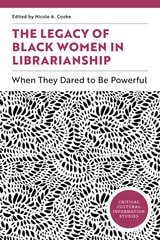
The Legacy of Black Women in Librarianship
When They Dared to Be PowerfulEdited by Nicole A. Cooke
American Library Association, 2025
- span the entire 20th Century, stretching from rural South Carolina and Florida to urban centers like New York and Los Angeles;
- profile better known figures such as Augusta Baker and Eliza Atkins Gleason as well as many who have yet to receive their due;
- grapple with the toxic legacy of segregation in library education, universities, public libraries, schools, and other institutions, showing how these persevering Black women dared to strive and work towards more equitable futures;
- include an inspiring Afterword by Dr. Aisha Johnson-Jones, an educator and revelator of Southern intellectual history;
- will encourage LIS students and newer librarians of all backgrounds to see themselves reflected in the profession’s long and rich heritage; and
- shed light on how librarianship can become ever more diverse and community centered.
The Librarian Stereotype
Deconstructing Perceptions AndMiriam Rigby
Assoc of College & Research Libraries, 2014
The Librarian Stereotype
Deconstructing Perceptions and Presentations of Information WorkNicole Pagowsky
Assoc of College & Research Libraries, 2014
The Librarian as Information Consultant
Sarah Anne Murphy
American Library Association, 2011
The Librarian's Book of Lists
A Librarian's Guide to Helping Job SeekersGeorge M. Eberhart
American Library Association, 2010