Results by title
322 books match the query 'Social Policy' and 59 start with t
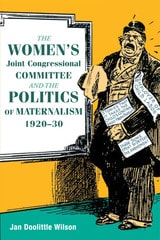
The Women's Joint Congressional Committee and the Politics of Maternalism, 1920-30
Jan Doolittle Wilson
University of Illinois Press, 2006
Jan Doolittle Wilson offers the first comprehensive history of the umbrella organization founded by former suffrage leaders in order to coordinate activities around women's reform. Encompassing nearly every major national women's organization of its time, the Women's Joint Congressional Committee (WJCC) evolved into a powerful lobbying force for the legislative agendas of more than twelve million women. Critics and supporters alike came to recognize it as "the most powerful lobby in Washington."
Examining the WJCC's most consequential and contentious campaigns, Wilson traces how the group's strategies, rhetoric, and success generated congressional and grassroots support for their far-reaching, progressive reforms. But the committee's early achievements sparked a reaction by big business that challenged and ultimately limited the programs these women envisioned. Using the WJCC as a lens, Wilson analyzes women's political culture during the 1920s. She also sheds new light on the initially successful ways women lobbied for social legislation, the limitations of that process for pursuing class-based reforms, and the enormous difficulties the women soon faced in trying to expand public responsibility for social welfare.
A volume in the series Women in American History, edited by Anne Firor Scott, Susan Armitage, Susan K. Cahn, and Deborah Gray White
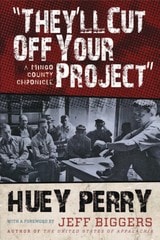
They'll Cut Off Your Project
A Mingo County ChronicleHuey Perry, with a foreword by Jeff Biggers
West Virginia University Press, 2010
In old England, if a king didn’t like you, he would cut off your head. Now, if they don’t like you, they’ll cut off your project!
As the Johnson Administration initiated its war on poverty in the 1960s, the Mingo County Economic Opportunity Commission project was established in southern West Virginia. Huey Perry, a young, local history teacher was named the director of this program and soon he began to promote self-sufficiency among low-income and vulnerable populations. As the poor of Mingo County worked together to improve conditions, the local political infrastructure felt threatened by a shift in power. Bloody Mingo County, known for its violent labor movements, corrupt government, and the infamous Hatfield-McCoy rivalry, met Perry’s revolution with opposition and resistance.
In They’ll Cut Off Your Project, Huey Perry reveals his efforts to help the poor of an Appalachian community challenge a local regime. He describes this community’s attempts to improve school programs and conditions, establish cooperative grocery stores to bypass inflated prices, and expose electoral fraud. Along the way, Perry unfolds the local authority’s hostile backlash to such change and the extreme measures that led to an eventual investigation by the FBI. They’ll Cut Off Your Project chronicles the triumphs and failures of the war on poverty, illustrating why and how a local government that purports to work for the public’s welfare cuts off a project for social reform.
Thick Moralities, Thin Politics
Social Integration Across Communities of BeliefBenjamin Gregg
Duke University Press, 2003
Thick Moralities, Thin Politics grapples with the work of theorists from both sides of the Atlantic, including Jürgen Habermas, Anthony Giddens, and Niklas Luhmann, as well as George Herbert Mead, Erving Goffman, and Harold Garfinkel. Gregg develops a model of validity for arguments made in the public sphere, for understanding among competing worldviews, and for adjudicating disputes generated by normative differences. He applies his theory of politics to specific issues of contemporary social life, including those relating to the place of women, minorities, and multiculturalism in American and European society today. He also addresses the scientific study of religion, issues of legal interpretation, and the critique of ideology, in each case illuminating how different epistemic systems, as well as competing value systems, can achieve some understanding of one another. Gregg demonstrates, ultimately, that thin politics actually further, rather than reduce, citizens' engagement in the political process.

Time Matters
On Theory and MethodAndrew Abbott
University of Chicago Press, 2001
Time Matters focuses particularly on questions of time, events, and causality. Abbott grounds each essay in straightforward examinations of actual social scientific analyses. Throughout, he demonstrates the crucial assumptions we make about causes and events, about actors and interaction and about time and meaning every time we employ methods of social analysis, whether in academic disciplines, market research, public opinion polling, or even evaluation research. Turning current assumptions on their heads, Abbott not only outlines the theoretical orthodoxies of empirical social science, he sketches new alternatives, laying down foundations for a new body of social theory.
Trade-Offs
An Introduction to Economic ReasoningHarold Winter
University of Chicago Press, 2023
The highly engaging introduction to thinking like an economist, updated for a new generation of readers.
When economists wrestle with any social issue—be it unemployment, inflation, healthcare, or crime and punishment—they do so impersonally. The big question for them is: what are the costs and benefits, or trade-offs, of the solutions to such matters? These trade-offs constitute the core of how economists see the world—and make the policies that govern it.
Trade-Offs is an introduction to the economic approach of analyzing controversial policy issues. A useful introduction to the various factors that inform public opinion and policymaking, Trade-Offs is composed of case studies on topics drawn from across contemporary law and society.
Intellectually stimulating yet accessible and entertaining, Trade-Offs will be appreciated by students of economics, public policy, health administration, political science, and law, as well as by anyone following current social policy debates.
Trade-Offs
An Introduction to Economic Reasoning and Social IssuesHarold Winter
University of Chicago Press, 2005
Harold Winter provides readers with the analytical tools needed to identify and understand the trade-offs associated with these topics. By considering both the costs and benefits of potential policy solutions, Winter stresses that real-world policy decision making is best served by an explicit recognition of as many trade-offs as possible.
Intellectually stimulating yet accessible and entertaining, Trade-Offs will be appreciated by students of economics, public policy, health administration, political science, and law, as well as by anyone who follows current social policy debates.

Trade-Offs
An Introduction to Economic Reasoning and Social Issues, Second EditionHarold Winter
University of Chicago Press, 2013
Transgender Rights and Politics
Groups, Issue Framing, and Policy AdoptionJami K. Taylor and Donald P. Haider-Markel, Editors
University of Michigan Press, 2015
Trapped in America's Safety Net
One Family's StruggleAndrea Louise Campbell
University of Chicago Press, 2014
As a social policy scholar, Campbell thought she knew a lot about means-tested assistance programs. What she quickly learned was that missing from most government manuals and scholarly analyses was an understanding of how these programs actually affect the lives of the people who depend on them. Using Marcella and Dave’s situation as a case in point, she reveals their many shortcomings in Trapped in America’s Safety Net. Because American safety net programs are designed for the poor, Marcella and Dave first had to spend down their assets and drop their income to near-poverty level before qualifying for help. What’s more, to remain eligible, they will have to stay under these strictures for the rest of their lives, meaning they are barred from doing many of the things middle-class families are encouraged to do: Save for retirement. Develop an emergency fund. Take advantage of tax-free college savings. And, while Marcella and Dave’s story is tragic, the financial precariousness they endured even before the accident is all too common in America, where the prevalence of low-income work and unequal access to education have generated vast—and growing—economic inequality. The implementation of Obamacare has cut the number of uninsured and underinsured and reduced some of the disparities in coverage, but it continues to leave too many people open to tremendous risk.
Behind the statistics and beyond the ideological battles are human beings whose lives are stunted by policies that purport to help them. In showing how and why this happens, Trapped in America’s Safety Net offers a way to change it.