Results by title
303 books match the query 'Time' and 103 start with t
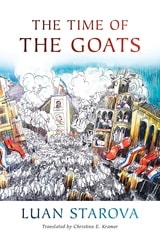
The Time of the Goats
Luan Starova; Translated by Christina E. Kramer
University of Wisconsin Press, 2012
The Time of the Goats is the second novel in Luan Starova’s acclaimed multivolume Balkan saga. It follows the main characters from My Father’s Books and the tragicomic events of their lives in Skopje as the narrator’s intellectual father and the head goatherd become friends. As local officials clumsily carry out absurd policies, Starova conveys the bonds of understanding and mutual support that form in Skopje’s poorest neighborhoods. At once historical and allegorical, folkloric and fantastic, The Time of the Goats draws lyrically on Starova’s own childhood.
The Time
NightLudmilla Petrushevskaya
Northwestern University Press, 2000
The Train Was on Time
Heinrich Boll
Northwestern University Press, 1994
The Trinity
Eternity and TimeThomas G. Weinandy
Sapientia Press of Ave Maria University, 2022

The Universe in Thirteen Graphs
Charting Cosmic Discoveries Across Space and TimeChris Lintott, Jeffrey Grube, and Daina Bouquin
University of Chicago Press, 2027
See the Universe as astronomers do: These thirteen graphs distill the cutting-edge discoveries of the cosmos—from planets and stars to galaxies, to ripples in spacetime itself.
From the front page of newspapers to your favorite t-shirt, the visual language of the cosmos is pervasive. Yet while you may have seen stunning images of planets, nebulae, and even the shadow of a black hole, pretty pictures alone cannot reveal the universe. Whether you’re looking for planets outside our solar system, searching for dark matter, listening for ripples in spacetime, or looking back to very early times, to truly understand the cosmos you need graphs.
In this fully illustrated and engaging book, astronomers Chris Lintott and Jeffrey Grube and data scientist Daina Bouquin focus on thirteen graphs to offer a tour of the major astronomical discoveries of the last century. Meet the HR diagram, which tells us about stellar lives; marvel at the Hubble diagram’s evidence for the expansion of the Universe; understand special relativity through Minkowski spacetime; and turn back time to the earliest visible light of the cosmic microwave background. With fascinating stories of discovery and accessible science for understanding ongoing debates, this book proves that while a picture may be worth a thousand words, a graph can show you the universe.

The Weekly War
Newsmagazines and VietnamJames Landers
University of Missouri Press, 2004
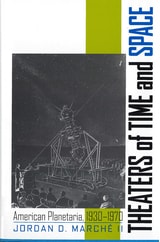
Theaters of Time and Space
American Planetaria, 1930-1970Marche, Jordan
Rutgers University Press, 2005
Every year, millions of Americans visit planetariums and are captivated by their strikingly realistic portrayal of the night sky. Today, it is indeed difficult to imagine astronomy education without these magnificent celestial theaters. But projection planetariums, first developed in Germany, have been a part of American museum pedagogy only since the early twentieth century and were not widespread until the 1960s.
In this unique social history,former planetarium director and historian of science Jordan D. Marché II offers the first complete account of the community of individuals and institutions that, during the period between 1930 and 1970, made planetariums the popular teaching aids they are today. Marché addresses issues such as the role of gender and social developments within the planetarium community, institutional patronage, and the popularization of science. He reveals how, at different times, various groups, including financial donors, amateur scientists, and government officials, viewed the planetarium as an instrument through which they could shape public understanding and perceptions of astronomy and space science.
Offering an insightful, wide-ranging look into the origins of an institution that has fascinated millions, Theaters of Timeand Space brings new perspectives to how one educational community changed the cultural complexion of science, helped shape public attitudes toward the U.S. space program, and even contributed to policy decisions regarding allocations for future space research.

Theatre, Time and Temporality
Melting Clocks and Snapped ElasticsDavid Ian Rabey
Intellect Books, 2016
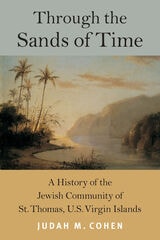
Through the Sands of Time
A History of the Jewish Community of St. Thomas, U.S. Virgin IslandsJudah M. Cohen
Brandeis University Press, 2012
Time & Eternity
The Question of Time in Church, Science and TheologyAntje Jackelen
Templeton Press, 2005
What is time? Is there a link between objective knowledge about time and subjective experience of time? And what is eternity? Does religion have the answer? Does science?
•Theological approaches to time and eternity, as well as a look at Trinitarian theology and its relation to time
•The discussion of scientific theories of time, including Newtonian, relativistic, quantum, and chaos theories
•The formulation of a "theology of time," a theological-mathematical model incorporating relational thinking oriented toward the future, the doctrine of trinity, and the notion of eschatology
Time Binds
Queer Temporalities, Queer HistoriesElizabeth Freeman
Duke University Press, 2010
Time Driven
Metapsychology and the Splitting of the DriveAdrian Johnston
Northwestern University Press, 2005
Johnston draws on Jacques Lacan's oeuvre in conjunction with certain philosophical resources-elements from transcendental philosophy, structuralism, and phenomenology-to rectify the inconsistencies within the Freudian metapsychological model of drive. In doing so, he helps to answer a question haunting Freud at the end of his career: Why is humanity plagued by a perpetual margin of discontent, despite technological and cultural progress?
In Time Driven, Johnston is able to make sense of Freud's metapsychology both as a whole and in its historical development of Lacan's reinterpretation of Freud, and of the place of both Freud and Lacan in modern philosophy.
Time Maps
Collective Memory and the Social Shape of the PastEviatar Zerubavel
University of Chicago Press, 2003
Who were the first people to inhabit North America? Does the West Bank belong to the Arabs or the Jews? Why are racists so obsessed with origins? Is a seventh cousin still a cousin? Why do some societies name their children after dead ancestors?
As Eviatar Zerubavel demonstrates in Time Maps, we cannot answer burning questions such as these without a deeper understanding of how we envision the past. In a pioneering attempt to map the structure of our collective memory, Zerubavel considers the cognitive patterns we use to organize the past in our minds and the mental strategies that help us string together unrelated events into coherent and meaningful narratives, as well as the social grammar of battles over conflicting interpretations of history. Drawing on fascinating examples that range from Hiroshima to the Holocaust, from Columbus to Lucy, and from ancient Egypt to the former Yugoslavia, Zerubavel shows how we construct historical origins; how we tie discontinuous events together into stories; how we link families and entire nations through genealogies; and how we separate distinct historical periods from one another through watersheds, such as the invention of fire or the fall of the Berlin Wall.
Most people think the Roman Empire ended in 476, even though it lasted another 977 years in Byzantium. Challenging such conventional wisdom, Time Maps will be must reading for anyone interested in how the history of our world takes shape.
Time Matters
On Theory and MethodAndrew Abbott
University of Chicago Press, 2001
Time Matters focuses particularly on questions of time, events, and causality. Abbott grounds each essay in straightforward examinations of actual social scientific analyses. Throughout, he demonstrates the crucial assumptions we make about causes and events, about actors and interaction and about time and meaning every time we employ methods of social analysis, whether in academic disciplines, market research, public opinion polling, or even evaluation research. Turning current assumptions on their heads, Abbott not only outlines the theoretical orthodoxies of empirical social science, he sketches new alternatives, laying down foundations for a new body of social theory.
Time To Care
Redesigning Child Care To Promote Education,Joan Lombardi
Temple University Press, 2002
Time Travels
Feminism, Nature, PowerElizabeth Grosz
Duke University Press, 2005
Grosz’s reflections on how rethinking time might generate new understandings of nature, culture, subjectivity, and politics are wide ranging. She moves from a compelling argument that Charles Darwin’s notion of biological and cultural evolution can potentially benefit feminist, queer, and antiracist agendas to an exploration of modern jurisprudence’s reliance on the notion that justice is only immanent in the future and thus is always beyond reach. She examines Henri Bergson’s philosophy of duration in light of the writings of Gilles Deleuze, Maurice Merleau-Ponty, and William James, and she discusses issues of sexual difference, identity, pleasure, and desire in relation to the thought of Deleuze, Friedrich Nietzsche, Michel Foucault, and Luce Irigaray. Together these essays demonstrate the broad scope and applicability of Grosz’s thinking about time as an undertheorized but uniquely productive force.
Time and Chance
Gerald Ford's Appointment with HistoryJames Cannon
University of Michigan Press, 1998
"James Cannon, formerly national affairs editor at Newsweek and Ford's domestic policy advisor, has written a superbly provocative and arresting biography that traces Ford's life from his July 4, 1913, birth in Omaha, Nebraska, to his September 8,1974, decision to pardon Nixon of the Watergate conspiracy." --Washington Post Book World
James M. Cannon is a journalist and was Domestic Policy Adviser to President Ford and Chief of Staff to Senate Majority Leader Howard Baker.

Time and Change
150 Years of The Ohio State UniversityTamar Chute with a Letter by President Michael V. Drake and an Afterword by Provost Bruce A. McPheron
The Ohio State University Press, 2019
Gain a visually stunning new perspective on iconic landmarks such as Mirror Lake, the Oval, Ohio Stadium, and the neighborhoods surrounding the Columbus and regional campuses. From beloved teams, symbols, and traditions to scenes from academic and campus life, reflect on time and change and rediscover the extraordinary connection that unites generations of Buckeyes.
Time and Decision
Economic and Psychological Perspectives of Intertemporal ChoiceGeorge Loewenstein
Russell Sage Foundation, 2003
Time and Experience
Peter K. McInerney
Temple University Press, 1992
This book is the only contemporary, systematic study of the relationship of time and conscious experience. Peter K. Mclnerney examines three tightly interconnected issues: how we are able to be conscious of time and temporal entities, whether time exists independently of conscious experience, and whether the conscious experiencer exists in time in the same way that ordinary natural objects are thought to exist in time. Insight is drawn from the views of major phenomenological and existential thinkers on these issues.
Building on a detailed explication and critique of the views of Kant, Husserl, Heidegger, and Sartre, Mclnerney develops and defends his own positions. He argues that a revised version of Husserl’s three-feature theory of time-consciousness provides the best explanation of our awareness of temporal features, but that an independently real time is necessary to explain our experience of temporal passage. He also shows that human existence has some special temporal features in addition to those it shares with other entities. Time-consciousness, the conscious exercise of powers, and personal identity through time require that any temporal part of human existence be defined by and "reach across" to earlier and later parts.
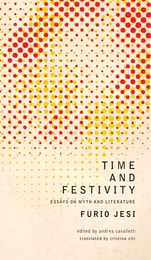
Time and Festivity
Furio Jesi
Seagull Books, 2018
In Time and Festivity, Andrea Cavalletti collects Jesi’s finest essays, ranging from his groundbreaking work on myth and politics to his reflections on time, festivity, and revolt. He explores the significance of texts by Rimbaud, Rilke, Lukács, and Pavese and the mythological language of the biblical story of Susanna. Carefully annotated and referenced, and enriched by a first-person account of Jesi’s intellectual biography, Time and Festivity provides a precious guide to the methodology and approach at the core of Jesi’s thought, displaying how his personal, vitally intense via negativa might in fact originate from his early statement: “All I have ever written is poetry.”
Time and Freedom
Christophe Bouton
Northwestern University Press, 2014
Time and Imagination
Chronotopes in Western Narrative CultureBart Keunen
Northwestern University Press, 2011
After constructing an archeology of the chronotope, Keunen proposes a remarkably original description of the various types of chronotopes. Chronotypes that emphasize conflict are using Greek mythological names to explain equilibrium, or reconciliation, and conflict chronotopes. He then develops a plot typology that covers the whole history of Western narrative culture. With examples and resonances both ancient and modern, Keunen’s Time and Imagination will equip theorists in a wide range of fields with powerful tools for years to come.
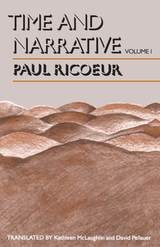
Time and Narrative, Volume 1
Paul Ricoeur
University of Chicago Press, 1990
Ricoeur finds a "healthy circle" between time and narrative: time is humanized to the extent that it portrays temporal experience. Ricoeur proposes a theoretical model of this circle using Augustine's theory of time and Aristotle's theory of plot and, further, develops an original thesis of the mimetic function of narrative. He concludes with a comprehensive survey and critique of modern discussions of historical knowledge, understanding, and writing from Aron and Mandelbaum in the late 1930s to the work of the Annales school and that of Anglophone philosophers of history of the 1960s and 1970s.
"This work, in my view, puts the whole problem of narrative, not to mention philosophy of history, on a new and higher plane of discussion."—Hayden White, History and Theory
"Superb. . . . A fine point of entrance into the work of one of the eminent thinkers of the present intellectual age."—Joseph R. Gusfield, Contemporary Sociology
Time and Narrative, Volume 2
Paul Ricoeur
University of Chicago Press, 1990
Ricoeur treats the question of just how far the Aristotelian concept of "plot" in narrative fiction can be expanded and whether there is a point at which narrative fiction as a literary form not only blurs at the edges but ceases to exist at all. Though some semiotic theorists have proposed all fiction can be reduced to an atemporal structure, Ricoeur argues that fiction depends on the reader's understanding of narrative traditions, which do evolve but necessarily include a temporal dimension. He looks at how time is actually expressed in narrative fiction, particularly through use of tenses, point of view, and voice. He applies this approach to three books that are, in a sense, tales about time: Virgina Woolf's Mrs. Dalloway; Thomas Mann's Magic Mountain; and Marcel Proust's Remembrance of Things Past.
"Ricoeur writes the best kind of philosophy—critical, economical, and clear."—Eugen Weber, New York Times Book Review
"A major work of literary theory and criticism under the aegis of philosophical hermenutics. I believe that . . . it will come to have an impact greater than that of Gadamer's Truth and Method—a work it both supplements and transcends in its contribution to our understanding of the meaning of texts and their relationship to the world."—Robert Detweiler, Religion and Literature
"One cannot fail to be impressed by Ricoeur's encyclopedic knowledge of the subject under consideration. . . . To students of rhetoric, the importance of Time and Narrative . . . is all too evident to require extensive elaboration."—Dilip Parameshwar Gaonkar, Quarterly Journal of Speech
Time and Narrative, Volume 3
Paul Ricoeur
University of Chicago Press, 1990
Ricoeur's aim here is to explicate as fully as possible the hypothesis that has governed his inquiry, namely, that the effort of thinking at work in every narrative configuration is completed in a refiguration of temporal experience. To this end, he sets himself the central task of determing how far a poetics of narrative can be said to resolve the "aporias"—the doubtful or problematic elements—of time. Chief among these aporias are the conflicts between the phenomenological sense of time (that experienced or lived by the individual) and the cosmological sense (that described by history and physics) on the one hand and the oneness or unitary nature of time on the other. In conclusion, Ricoeur reflects upon the inscrutability of time itself and attempts to discern the limits of his own examination of narrative discourse.
"As in his previous works, Ricoeur labors as an imcomparable mediator of often estranged philosophical approaches, always in a manner that compromises neither rigor nor creativity."—Mark Kline Taylor, Christian Century
"In the midst of two opposing contemporary options—either to flee into ever more precious readings . . . or to retreat into ever more safe readings . . . —Ricoeur's work offers an alternative option that is critical, wide-ranging, and conducive to new applications."—Mary Gerhart, Journal of Religion
Time and the Digital
Connecting Technology, Aesthetics, and a Process Philosophy of TimeTimothy Scott Barker
Dartmouth College Press, 2012
Time and the Erotic in Horace's Odes
Ronnie Ancona
Duke University Press, 1994
Drawing on contemporary theory, including recent work in feminist criticism, Ancona provides close readings of fourteen odes, which are presented in English translation as well as in Latin. Through a discussion of the poet’s use of various temporal devices—the temporal adverb, seasonal imagery, and the lover or beloved’s own temporality—she shows how Horace makes time dominate the erotic context and, further, how the version of love that appears in his poems is characterized by the lover’s desire to control the beloved. The romantic ideal of a timeless love, apparently rejected by the poet, emerges here instead as an underlying element of the poet’s portrayal of the erotic. In a critique of the predominant modes of recent Horatian scholarship on the love odes, Ancona offers an alternative view that takes into account the male gender of the lover and its effect on the structure of desire in the poems. By doing so, she advances a broader project in recent classical studies that aims to include discussion of features of classical literature, such as sexuality and gender, which have previously escaped critical attention.
Addressing aspects of Horace as a love poet—especially the dynamics of gender relations—that critics have tended to ignore, this book articulates his version of love as something not to be championed or condemned but rather to be seen as challengingly problematic. Of primary interest to classicists, it will also engage the attention of scholars and teachers in the humanities with specializations in gender, sexuality, lyric poetry, or feminist theory.
Time and the Shared World
Heidegger on Social RelationsIrene McMullin
Northwestern University Press, 2013
In doing so, McMullin argues that Heidegger’s work on the social nature of the self must be located within a philosophical continuum that builds on Kant and Husserl’s work regarding the nature of the a priori and the fundamental structures of human temporality, while also pointing forward to developments of these themes to be found in Heidegger’s later work and in such thinkers as Sartre and Levinas. By developing unrecognized resources in Heidegger’s work, Time and the Shared World is able to provide a Heidegger-inspired account of respect and the intersubjective origins of normativity.

Time and the Town
A Provincetown ChronicleAdele Heller
Rutgers University Press, 1991
Time and the Town was the last of Mary Heaton Vorse's books. It is about many things —a town and its people, the author, a certain kind of idyllic life. As much as anything else, it is the biography of the house Vorse bought in 1907 and lived in, off and on, for the next thirty-six years. The moods of the house mirrored her own. "Our houses," she wrote, "are our biographies, the stories of our defeats and victories."
Tinged with nostalgia and disenchantment, the book describes a Provincetown that has changed, a place on the verge of modernity. It is no longer a major fishing port. It has become a place whose business is tourism. Contrasting the old and the new, Vorse celebrates the enduring character of the town itself. She tells stories that are engaging and charming, droll and fabulous. The wrinkled Mrs. Mary Mooncusser who, though drunk and stark naked, conducts herself with great decorum when Vorse pays her a call, might have stepped out of the pages of Sherwood Anderson or Eudora Welty. In another anecdote, the townspeople scour the beaches for cases of booze dumped into the sea by rumrunners and are briefly inflated with the spirit of ancestral smugglers and buccaneers.
Vorse herself remained something of an outsider in Provincetown, despite her evident affection for the place and its inhabitants. They surely regarded her as simply another of those artist-intellectuals--many of whom appear in the pages of this book. The "off-Cape" outsiders put the town in the national limelight but took no interest in local matters. Vorse here ponders local matters exclusively, almost, one suspects, as a way of forgetting the more complex matters that occupied her--her agonies of parental guilt, her resentment of domestic obligations, her third marriage, her depressions and breakdowns. The town is in that sense beyond time.
Time in Archaeology
Time Perspectivism RevisitedSimon Holdaway
University of Utah Press, 2011
The point of departure for this volume lies in the post-tumultuous times of processual archaeology, in the 1970s and 1980s, when Geoff Bailey, Lewis Binford, David Clarke, Robert Dunnell, Robert Foley, and Michael Schiffer, among others, initiated a deconstruction of time as used in archaeology. Here, the authors further this deconstruction.
Time in Archaeology was originally convened as an electronic symposium held at the Society of American Archaeology meetings in 2003. The result is a tightly focused group of papers that provide both a historical background to the development of the ideas of time perspectivism as well as a range of case studies that illustrate where scholars have taken the ideas. This book demonstrates the importance of concepts of time with excellent discussions and perspectives from twelve scholars working in vastly different arenas. It is a rigorous examination of the assumptions we make and the impacts of those assumptions. After reading this you may never think about time in quite the same way.
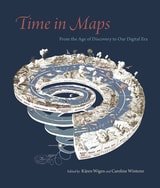
Time in Maps
From the Age of Discovery to Our Digital EraEdited by Kären Wigen and Caroline Winterer
University of Chicago Press, 2020
Focusing on maps created in Spanish America, Europe, the United States, and Asia, these essays take us from the Aztecs documenting the founding of Tenochtitlan, to early modern Japanese reconstructing nostalgic landscapes before Western encroachments, to nineteenth-century Americans grappling with the new concept of deep time. The book also features a defense of traditional paper maps by digital mapmaker William Rankin. With more than one hundred color maps and illustrations, Time in Maps will draw the attention of anyone interested in cartographic history.
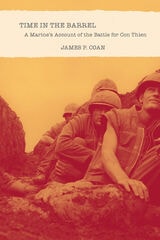
Time in the Barrel
A Marine's Account of the Battle for Con ThienJames P. Coan
University of Alabama Press, 2019
A Marine’s highly personal memoir reliving the hellish days of a pivotal conflict of the Vietnam War.
Con Thien, located only two miles from the demilitarized zone dividing North and South Vietnam, was a United States Marine Corps firebase that was the scene of fierce combat for months on end during 1967. Staving off attacks and ambushes while suffering from ineffectual leadership from Washington as well as media onslaughts, courageous American Marines protected this crucial piece of land at all costs. They would hold Con Thien, but many paid the ultimate price. By the end of the war, more than 1,400 Marines had died and more than 9,000 sustained injuries defending the “Hill of Angels.”
For eight months, James P. Coan’s five-tank platoon was assigned to Con Thien while attached to various Marine infantry battalions. A novice second lieutenant at the time, the author kept a diary recording the thoughts, fears, and frustrations that accompanied his life on “The Hill.” Time in the Barrel: A Marine’s Account of the Battle for Con Thien offers an authentic firsthand account of the daily nightmare that was Con Thien. An enticing and fascinating read featuring authentic depictions of combat, it allows readers to fully grasp the enormity of the fierce struggle for Con Thien.
The defenders of Con Thien were bombarded with hundreds of rounds of incoming rockets, mortars, and artillery that pounded the beleaguered outpost daily. Monsoon downpours turned the red laterite clay soil into a morass of oozing mud, flooded bunkers and trenches, and made Con Thien a living hell. .Being at Con Thien came to be ruefully referred to by the Marines stationed there as "time in the barrel” because they were targets as easy as fish in a barrel.
More than a retelling of military movements, Coan’s engrossing narratives focus on the sheer sacrifice and misery of one Marine’s experience in Vietnam. Through his eyes, we experience the abysmal conditions the Marines endured, from monsoon rainstorms to the constant threat of impending attack. Climatic moments in history are captured through the rare, personal perspective of one particularly astute and observant participant.
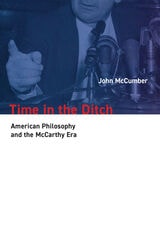
Time in the Ditch
American Philosophy and the McCarthy EraJohn McCumber
Northwestern University Press, 2023
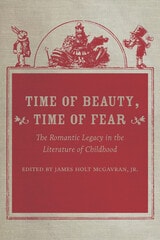
Time of Beauty, Time of Fear
The Romantic Legacy in the Literature of ChildhoodJames Holt McGavran, Jr.
University of Iowa Press, 2012
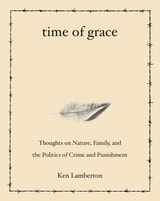
Time of Grace
Thoughts on Nature, Family, and the Politics of Crime and PunishmentKen Lamberton
University of Arizona Press, 2007
Time of Grace is a remarkable book, written with great eloquence by a former science teacher who was incarcerated for twelve years for his sexual liaison with a teenage student. Far more than a “prison memoir,” it is an intimate and revealing look at relationships—with fellow humans and with the surprising wildlife of the Sonoran Desert, both inside and beyond prison walls. Throughout, Ken Lamberton reflects on human relations as they mimic and defy those of the natural world, whose rhythms calibrate Lamberton’s days and years behind bars. He writes with candor about his life, while observing desert flora and fauna with the insight and enthusiasm of a professional naturalist.
While he studies a tarantula digging her way out of the packed earth and observes Mexican freetail bats sailing into the evening sky, Lamberton ruminates on his crime and on the wrenching effects it has had on his wife and three daughters. He writes of his connections with his fellow inmates—some of whom he teaches in prison classes—and with the guards who control them, sometimes with inexplicable cruelty. And he unflinchingly describes a prison system that has gone horribly wrong—a system entrapped in a self-created web of secrecy, fear, and lies.
This is the final book of Lamberton’s trilogy about the twelve years he spent in prison. Readers of his earlier books will savor this last volume. Those who are only now discovering Lamberton’s distinctive voice—part poet, part scientist, part teacher, and always deeply, achingly human—will feel as if they are making a new friend.
Gripping, sobering, and beautifully written, Lamberton’s memoir is an unforgettable exploration of crime, punishment, and the power of the human spirit.
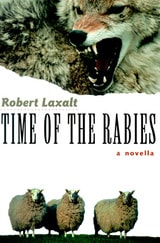
Time of the Rabies
A NovellaRobert Laxalt
University of Nevada Press, 2000
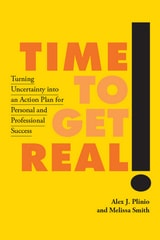
Time to Get Real!
Turning Uncertainty into an Action Plan for Personal and Professional SuccessAlex J. Plinio
Rutgers University Press, 2019
The Life and Career Planning Model in Time to Get Real! has been utilized by individuals in early, mid and later career and life. Too many individuals let life happen to them. Control more of your life through readiness and preparation. We can help you visualize a future that you desire and a road that you can travel to get there.
Written by Alex J. Plinio, and Melissa Smith, acclaimed business leaders and life and career planning specialists, this book is filled with instructive case studies, illuminating stories, interactive exercises, and inspirational quotes enabling you to unlock those things leading to personal satisfaction and success. The Life and Career Planning Model helps you target what matters the most to you in your life while providing the impetus to move you forward in a positive direction. Whether you are 21, 41, or 61, it is now Time to Get Real!
Time, Creation and the Continuum
Theories in Antiquity and the Early Middle AgesRichard Sorabji
University of Chicago Press, 2006
“Splendid. . . . The canvas is vast, the picture animated, the painter nonpareil. . . . Sorabji’s work will encourage more adventurers to follow him to this fascinating new-found land.”—Jonathan Barnes, Times Literary Supplement
“One of the most important works in the history of metaphysics to appear in English for a considerable time. No one concerned with the problems with which it deals either as a historian of ideas or as a philosopher can afford to neglect it.”—Donald MacKinnon, Scottish Journal of Theology
“Unusually readable for such scholarly content, the book provides in rich and cogent terms a lively and well-balanced discussion of matters of concern to a wide academic audience.”—Choice
Time, Duration and Change in Contemporary Art
Beyond the ClockKate Bretkelly-Chalmers
Intellect Books, 2018
This book examines alternative frameworks of time, duration, and change in prominent philosophical, scientific, and technological traditions, including physics, psychology, phenomenology, neuroscience, media theory, and selected environmental sciences. It suggests that art makes a crucial contribution to these discourses not by “visualizing” time, but by entangling viewers in different sensory, material, and imaginary temporalities.
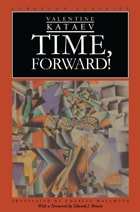
Time, Forward!
Valentin Kataev
Northwestern University Press, 1995
Time, History, and Belief in Aztec and Colonial Mexico
By Ross Hassig
University of Texas Press, 2001
Based on their enormously complex calendars that recorded cycles of many kinds, the Aztecs and other ancient Mesoamerican civilizations are generally believed to have had a cyclical, rather than linear, conception of time and history. This boldly revisionist book challenges that understanding. Ross Hassig offers convincing evidence that for the Aztecs time was predominantly linear, that it was manipulated by the state as a means of controlling a dispersed tribute empire, and that the Conquest cut off state control and severed the unity of the calendar, leaving only the lesser cycles. From these, he asserts, we have inadequately reconstructed the pre-Columbian calendar and so misunderstood the Aztec conception of time and history.
Hassig first presents the traditional explanation of the Aztec calendrical system and its ideological functions and then marshals contrary evidence to argue that the Aztec elite deliberately used calendars and timekeeping to achieve practical political ends. He further traces how the Conquest played out in the temporal realm as Spanish conceptions of time partially displaced the Aztec ones. His findings promise to revolutionize our understanding of how the Aztecs and other Mesoamerican societies conceived of time and history.

Time, Ignorance, and Uncertainty in Economic Models
Donald W. Katzner
University of Michigan Press, 1998
Donald W. Katzner begins with an extensive investigation of the distinction between potential surprise and probability. He presents a modified version of Shackle's model of decision-making in ignorance and examines in considerable detail its "comparative statics" and operationality properties. The meaning of aggregation and simultaneity under these conditions is also explored, and Shackle's model is applied to the construction of models of the consumer, the firm, microeconomics, and macroeconomics. Katzner concludes with discussions of the roles of history, hysteresis, and empirical investigation in economic inquiry.
Time, Ignorance, and Uncertainty in Economic Models will be of interest to economists and others engaged in the study of uncertainty, probability, aggregation, and simultaneity. Those interested in the microeconomics of consumer and firm behavior, general equilibrium, and macroeconomics will also benefit from this book.
Donald W. Katzner is Professor of Economics, University of Massachusetts.
Time, Memory, Institution
Merleau-Ponty's New Ontology of SelfDavid Morris
Ohio University Press, 2015
This collection is the first extended investigation of the relation between time and memory in Maurice Merleau-Ponty’s thought as a whole and the first to explore in depth the significance of his concept of institution. It brings the French phenomenologist’s views on the self and ontology into contemporary focus. Time, Memory, Institution argues that the self is not a self-contained or self-determining identity, as such; it is gathered out of a radical openness to what is not self, and that it gathers itself in a time that is not merely a given dimension, but folds back upon, gathers, and institutes itself.
Access to previously unavailable texts, in particular Merleau-Ponty’s lectures on institution and expression, has presented scholars with new resources for thinking about time, memory, and history. These essays represent the best of this new direction in scholarship; they deepen our understanding of self and world in relation to time and memory; and they give occasion to reexamine Merleau-Ponty’s contribution and relevance to contemporary Continental philosophy.
This volume is essential reading for scholars of phenomenology and French philosophy, as well as for the many readers across the arts, humanities, and social sciences who continue to draw insight and inspiration from Merleau-Ponty.
Contributors: Elizabeth Behnke, Edward Casey, Véronique Fóti, Donald Landes, Kirsten Jacobson, Galen Johnson, Michael Kelly, Scott Marratto, Glen Mazis, Caterina Rea, John Russon, Robert Vallier, and Bernhard Waldenfels
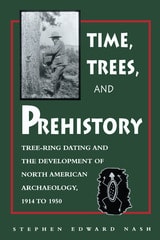
Time, Trees, and Prehistory
Tree Ring dating and the Development of NA Archaeology 1914 to 1950Stephen E Nash
University of Utah Press, 2006
Dendrochronology, the science of assigning precise calendar dates to annual growth rings in trees, provided accurate dates at a time when North American archaeologists had no absolute dating techniques available to guide their analyses. Time, Trees, and Prehistory examines the growth, development, application, and interpretive implications of North American archaeological tree-ring dating from 1914 to 1950.
The development of dendrochronology forced archaeologists to radically revise their understanding of the prehistoric past, compressing by nearly fifty percent the time scale of the archaeological record. Basketmaker sites, for instance, were once thought to be four thousand years old; tree-ring application demonstrated that these sites dated well into the present millennium. Classic sites in Chaco Canyon and Mesa Verde were believed occupied for nearly a thousand years, but tree-ring dates demonstrated that such sites were often built, occupied, and abandoned in just over a century. Other similar changes in temporal scale forced archaeologists to reconsider their interpretations of the rate of prehistoric cultural change, population growth, and the degree of social and political complexity in the Southwest.
Time, Trees, and Prehistory examines archaeological practices of the 1920s, 30s, and 40s and demonstrates that tree-ring dating set the stage that enabled revolutionary developments in archaeological method and theory in succeeding decades.
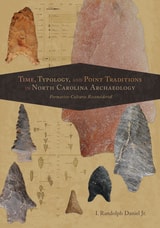
Time, Typology, and Point Traditions in North Carolina Archaeology
Formative Cultures ReconsideredI. Randolph Daniel Jr.
University of Alabama Press, 2021
Revisiting the stone tools that reshaped our understanding of North Carolina's prehistoric past.
In the 1964 landmark publication The Formative Cultures of the Carolina Piedmont, Joffre Coe established a projectile point typology and chronology that, for the first time, allowed archaeologists to identify the relative age of a site or site deposit based on the point types recovered there. Consistent with the cultural-historical paradigm of the day, the “Coe axiom” stipulated that only one point type was produced at one moment in time in a particular location. Moreover, Coe identified periods of “cultural continuity” and “discontinuity” in the chronology based on perceived similarities and differences in point styles through time.
In Time, Typology, and Point Traditions in North Carolina Archaeology: Formative Cultures Reconsidered, I. Randolph Daniel Jr. reevaluates the Coe typology and sequence, analyzing their strengths and weaknesses. Daniel reviews the history of the projectile point type concept in the Southeast and revisits both Coe’s axiom and his notions regarding cultural continuity and change based on point types. In addition, Daniel updates Coe’s typology by clarifying or revising existing types and including types unrecognized in Coe’s monograph. Daniel also adopts a practice-centered approach to interpreting types and organizes them into several technological traditions that trace ancestral-descendent communities of practice that relate to our current understanding of North Carolina prehistory.
Appealing to professional and avocational archaeologists, Daniel provides ample illustrations of points in the book as well as color versions on a dedicated website. Daniel dedicates a final chapter to a discussion of the ethical issues related to professional archaeologists using private artifact collections. He calls for greater collaboration between professional and avocational communities, noting the scientific value of some private collections.
Time, Work, and Culture in the Middle Ages
Jacques Le Goff
University of Chicago Press, 1980

Time, the Familiar Stranger
J. Fraser
University of Massachusetts Press, 1987
Translation Effects
Language, Time, and Community in Medieval EnglandMary Kate Hurley
The Ohio State University Press, 2021
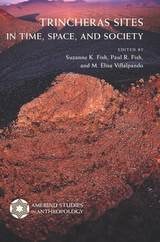
Trincheras Sites in Time, Space, and Society
Edited by Suzanne K. Fish, Paul R. Fish, and M. Elisa Villalpando
University of Arizona Press, 2008
This multi-author volume integrates a remarkable body of new data representing a textbook-like array of current research issues and methodologies in the archaeology of the region. Scholars from the United States and Mexico offer original research on trincheras sites in Chihuahua, Sonora, Arizona, and New Mexico. Scales of focus range from intensive intrasite sampling to the largest contiguous survey in the region. Authors incorporate spatial analyses, artifact studies, environmental and subsistence data, ethnographic analogs, ethnohistorical records, cross-cultural comparisons, archaeology, and archival resources.
The volume’s discussions contribute innovative approaches to worldwide interpretations of landscapes marked by hilltop sites. Contributors present meticulous research arguing that many trincheras sites were primarily used for habitation and ceremonial rites, in addition to previously predominant views of them as defensive refuges. Because trincheras occupations date from the late preceramic era to shortly before Spanish contact, authors relate them to early forms of agriculture, the emergence of village life, the appearance of differentiated settlement systems, and tendencies toward political and ritual centralization.
Detailed maps and figures illustrate the text, and close-up aerial photographs capture the visual essence of the sites, highlighted by a section that includes color photographs and an essay by renowned photographer Adriel Heisey.
Contributors:
Christian E. Downum
Paul R. Fish
Suzanne K. Fish
Robert J. Hard
Adriel Heisey
Stephen A. Kowalewski
Randall H. McGuire
Ben A. Nelson
John R. Roney
Judith Taylor
M. Elisa Villalpando
Joseph Vogel
Henry Wallace
David R. Wilcox
J. Scott Wood