Results by title
22279 books match the query 'Social Science' and 4007 start with t
The Declining Significance of Race
Blacks and Changing American Institutions, Third EditionWilliam Julius Wilson
University of Chicago Press, 2012
When first published in 1980, The Declining Significance of Race immediately sparked controversy with its contentious thesis that race was becoming less of a deciding factor in the life chances of black Americans than class. This new edition of the seminal book includes a new afterword in which William Julius Wilson not only reflects on the debate surrounding the book, but also presents a provocative discussion of race, class, and social policy.
“The intellectual strength of this book lies in his capacity to integrate disparate findings from historical studies, social theory and research on contemporary trends into a complex and original synthesis that challenges widespread assumptions about the cause of black disadvantage and the way to remove it.”—Paul Starr, New York Times Book Review
“This publication is easily one of the most erudite and sober diagnoses of the American black situation. Students of race relations and anybody in a policy-making position cannot afford to bypass this study.”—Ernest Manheim, Sociology
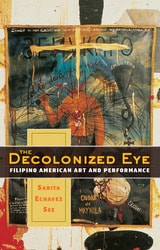
The Decolonized Eye
Filipino American Art and PerformanceSarita Echavez See
University of Minnesota Press, 2009
From the late 1980s to the present, artists of Filipino descent in the United States have produced a challenging and creative movement. In The Decolonized Eye, Sarita Echavez See shows how these artists have engaged with the complex aftermath of U.S. colonialism in the Philippines.
Focusing on artists working in New York and California, See examines the overlapping artistic and aesthetic practices and concerns of filmmaker Angel Shaw, painter Manuel Ocampo, installation artist Paul Pfeiffer, comedian Rex Navarrete, performance artist Nicky Paraiso, and sculptor Reanne Estrada to explain the reasons for their strangely shadowy presence in American culture and scholarship. Offering an interpretation of their creations that accounts for their queer, decolonizing strategies of camp, mimesis, and humor, See reveals the conditions of possibility that constitute this contemporary archive.
By analyzing art, performance, and visual culture, The Decolonized Eye illuminates the unexpected consequences of America's amnesia over its imperial history.
The Deconstruction of Sex
Jean-Luc Nancy and Irving Goh
Duke University Press, 2021
The Deep Blue Memory
Monique Laxalt Urza
University of Nevada Press, 1993
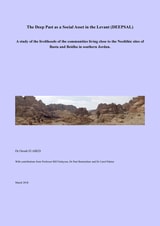
The Deep Past as a Social Asset in the Levant (DEEPSAL)
O. El Abed
Council for British Research in the Levant, 2018
The Deepest Sense
A Cultural History of TouchConstance Victoria Classen
University of Illinois Press, 2012

The Defective Detective in the Pulps
Edited by Gary Hoppenstand and Ray B. Browne
University of Wisconsin Press, 1983
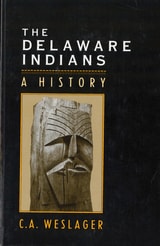
The Delaware Indians
A HistoryWeslager, C. A.
Rutgers University Press, 1990
In the seventeenth century white explorers and settlers encountered a tribe of Indians calling themselves Lenni Lenape along the Delaware River and its tributaries in New Jersey, Delaware, eastern Pennsylvania, and southeastern New York. Today communities of their descendants, known as Delawares, are found in Oklahoma, Kansas, Wisconsin, and Ontario, and individuals of Delaware ancestry are mingled with the white populations in many other states. The Delaware Indians is the first comprehensive account of what happened to the main body of the Delaware Nation over the past three centuries.
C. A. Weslager puts into perspective the important events in United States history in which the Delawares participated and he adds new information about the Delawares. He bridges the gap between history and ethnology by analyzing the reasons why the Delawares were repeatedly victimized by the white man.
The Delinquent Girl
edited by Margaret A. Zahn
Temple University Press, 2009
Over the past decade and a half, girls’ involvement in the juvenile justice system has increased. Yet the topic remains under-studied among criminologists. The Delinquent Girl is a “state-of-the-field” evaluation that identifies and analyzes girls who become delinquent, the kinds of crimes they commit and the reasons they commit them. The distinguished academics and practitioners who contributed to this volume provide an overview of the research on girls’ delinquency, discuss policy implications and point to areas where further research is critically needed.
The Demography of the Semai Senoi
Alan G. Fix
University of Michigan Press, 1977

The Denial of Antiblackness
Multiracial Redemption and Black SufferingJoão H. Costa Vargas
University of Minnesota Press, 2018
An incisive new look at the black diaspora, examining the true roots of antiblackness and its destructive effects on all of society
Thanks to movements like Black Lives Matter, Western society’s chronic discrimination against black individuals has become front-page news. Yet, there is little awareness of the systemic factors that make such a distinct form of dehumanization possible. In both the United States and Brazil—two leading nations of the black diaspora—a very necessary acknowledgment of black suffering is nonetheless undercut by denial of the pervasive antiblackness that still exists throughout these societies.
In The Denial of Antiblackness, João H. Costa Vargas examines how antiblackness affects society as a whole through analyses of recent protests against police killings of black individuals in both the United States and Brazil, as well as the everyday dynamics of incarceration, residential segregation, and poverty. With multisite ethnography ranging from a juvenile prison in Austin, Texas, to grassroots organizing in Los Angeles and Black social movements in Brazil, Vargas finds the common factors that have perpetuated antiblackness, regardless of context. Ultimately, he asks why the denial of antiblackness persists, whom this narrative serves, and what political realities it makes possible.
The Deportation Regime
Sovereignty, Space, and the Freedom of MovementNicholas De Genova and Nathalie Peutz, eds.
Duke University Press, 2010
Whether investigating the power that individual and corporate sponsors have over the fate of foreign laborers in Bahrain, the implications of Germany’s temporary suspension of deportation orders for pregnant and ill migrants, or the significance of the detention camp, the contributors reveal how deportation reflects and reproduces notions about public health, racial purity, and class privilege. They also provide insight into how deportation and deportability are experienced by individuals, including Arabs, South Asians, and Muslims in the United States. One contributor looks at asylum claims in light of an unusual anti-deportation campaign mounted by Algerian refugees in Montreal; others analyze the European Union as an entity specifically dedicated to governing mobility inside and across its official borders. The Deportation Regime addresses urgent issues related to human rights, international migration, and the extensive security measures implemented by nation-states since September 11, 2001.
Contributors: Rutvica Andrijasevic, Aashti Bhartia, Heide Castañeda , Galina Cornelisse , Susan Bibler Coutin, Nicholas De Genova, Andrew M. Gardner, Josiah Heyman, Serhat Karakayali, Sunaina Marr Maira, Guillermina Gina Nuñez, Peter Nyers, Nathalie Peutz, Enrica Rigo, Victor Talavera, William Walters, Hans-Rudolf Wicker, Sarah S. Willen

The Desert Smells Like Rain
A Naturalist in O'odham CountryGary Paul Nabhan
University of Arizona Press, 1982
In this work, Gary Paul Nabhan brings O’odham voices to the page at every turn. He writes elegantly of how they husband scant water supplies, grow crops, and utilize edible wild foods. Woven through his account are coyote tales, O’odham children’s impressions of the desert, and observations of the political problems that come with living on both sides of an international border. Nabhan conveys the everyday life and extraordinary perseverance of these desert people.
This edition includes a new preface written by the author, in which he reflects on his gratitude for the O’odham people who shared their knowledge with him. He writes about his own heritage and connections to the desert, climate change, and the border. He shares his awe and gratitude for O’odham writers and storytellers who have been generous enough to share stories with those of us from other cultural traditions so that we may also respect and appreciate the smell of the desert after a rain.

The Detective as Historian
History and Art in Historical Crime FictionEdited by Ray B. Browne and Lawrence A. Kreiser, Jr.; Preface by Robin W. Winks
University of Wisconsin Press, 2000
Topics include: Ellis Peter’s Brother Cadfael; Umberto Eco’s Name of the Rose; Susanna Gregory’s Doctor Matthew Bartholomew; Peter Heck’s Mark Twain as detective; Anne Perry and her Victorian-era world; Caleb Carr’s works; and Elizabeth Peter’s Egyptologist-adventurer tales.

The Detroit River
Stories of Development and Industrialization, 1874–1912Richard Gebhart
Michigan State University Press, 2027
Covering the period from the first government survey of the treacherous Limekiln Crossing to the completion of the Livingstone Channel, The Detroit River tells the story of the industrial transformation of the city’s most important waterway.

The Development Practitioners' Handbook
Allan Kaplan
Pluto Press, 1996
The Development of Future-Oriented Processes
Edited by Marshall M. Haith, Janette B. Benson, Ralph J. Roberts Jr., and Bruce
University of Chicago Press, 1994
Following Marshall Haith's seminal studies on early infant anticipation, this collection begins with a survey of current knowledge about the early development of expectations. Addressing both the state of neural research in this field and the role of language and social context in the development of future orientation, the authors discuss the nature of planning in action, future orientation in humans and in nonhuman primates, and the development of intermediate and long-term expectations with regard to cognitive skills and scientific activity.
Combining developmental and cognitive perspectives, this volume will interest professionals in developmental psychology, child development, and neuropsychology.
The Development of Linguistic Skill in Twins, Singletons with Siblings, and Only Children from Age Five to Ten Years
Edith Davis
University of Minnesota Press, 1937
The Development of Political Institutions
Power, Legitimacy, DemocracyFederico Ferrara
University of Michigan Press, 2022
While the literature on “new institutionalism” explains the stability of institutional arrangements within countries and the divergence of paths of institutional development between countries, Federico Ferrara takes a “historical institutionalist” approach to theorize dynamic processes of institutional reproduction, institutional decay, and institutional change in explaining the development of political institutions. Ferrara synthesizes “power-based” or “power-distributional” explanations and “ideas-based” “legitimation explanations.” He specifies the psychological “microfoundations” of processes of institutional development, drawing heavily from the findings of experimental psychology to ensure that the explanation is grounded in clear and realistic assumptions regarding human motivation, cognition, and behavior. Aside from being of interest to scholars and graduate students in political science and other social-scientific disciplines whose research concentrates on the genesis of political institutions, their evolution over time, and their impact on the stability of political order and the quality of governance, the book will be required reading in graduate courses and seminars in comparative politics where the study of institutions and their development ranks among the subfield’s most important subjects.
The Devil You Dance With
Film Culture in the New South AfricaEdited and with an Introduction by Audrey McCluskey
University of Illinois Press, 2008
This extraordinary volume presents twenty-five in-depth interviews with established and emerging South African filmmakers, collected and edited by Audrey Thomas McCluskey. The interviews capture the filmmakers’ spirit, energy, and ambition as they attempt to give birth to a film culture that reflects the heart and aspirations of their diverse and emergent nation. The collection includes a biographical profile of each filmmaker, as well an introductory essay by McCluskey, pointing to the themes, as well as creative differences and similarities, among the filmmakers.

The Devil and the Land of the Holy Cross
Witchcraft, Slavery, and Popular Religion in Colonial BrazilBy Laura de Mello e Souza
University of Texas Press, 2004
Originally published in Brazil as O Diabo e a Terra de Santa Cruz, this translation from the Portuguese analyzes the nature of popular religion and the ways it was transferred to the New World in the sixteenth and seventeenth centuries. Using richly detailed transcripts from Inquisition trials, Mello e Souza reconstructs how Iberian, indigenous, and African beliefs fused to create a syncretic and magical religious culture in Brazil.
Focusing on sorcery, the author argues that European traditions of witchcraft combined with practices of Indians and African slaves to form a uniquely Brazilian set of beliefs that became central to the lives of the people in the colony. Her work shows how the Inquisition reinforced the view held in Europe (particularly Portugal) that the colony was a purgatory where those who had sinned were exiled, a place where the Devil had a wide range of opportunities. Her focus on the three centuries of the colonial period, the multiple regions in Brazil, and the Indian, African, and Portuguese traditions of magic, witchcraft, and healing, make the book comprehensive in scope.
Stuart Schwartz of Yale University says, "It is arguably the best book of this genre about Latin America...all in all, a wonderful book." Alida Metcalf of Trinity University, San Antonio, says, "This book is a major contribution to the field of Brazilian history...the first serious study of popular religion in colonial Brazil...Mello e Souza is a wonderful writer."
The Devil's Book of Culture
History, Mushrooms, and Caves in Southern MexicoBy Benjamin Feinberg
University of Texas Press, 2003
Since the 1950s, the Sierra Mazateca of Oaxaca, Mexico, has drawn a strange assortment of visitors and pilgrims—schoolteachers and government workers, North American and European spelunkers exploring the region's vast cave system, and counterculturalists from hippies (John Lennon and other celebrities supposedly among them) to New Age seekers, all chasing a firsthand experience of transcendence and otherness through the ingestion of psychedelic mushrooms "in context" with a Mazatec shaman. Over time, this steady incursion of the outside world has significantly influenced the Mazatec sense of identity, giving rise to an ongoing discourse about what it means to be "us" and "them."
In this highly original ethnography, Benjamin Feinberg investigates how different understandings of Mazatec identity and culture emerge through talk that circulates within and among various groups, including Mazatec-speaking businessmen, curers, peasants, intellectuals, anthropologists, bureaucrats, cavers, and mushroom-seeking tourists. Specifically, he traces how these groups express their sense of culture and identity through narratives about three nearby yet strange discursive "worlds"—the "magic world" of psychedelic mushrooms and shamanic practices, the underground world of caves and its associated folklore of supernatural beings and magical wealth, and the world of the past or the past/present relationship. Feinberg's research refutes the notion of a static Mazatec identity now changed by contact with the outside world, showing instead that identity forms at the intersection of multiple transnational discourses.

The Devil's Fruit
Farmworkers, Health, and Environmental JusticeDvera I. Saxton
Rutgers University Press, 2021

The Devil's Handwriting
Precoloniality and the German Colonial State in Qingdao, Samoa, and Southwest AfricaGeorge Steinmetz
University of Chicago Press, 2007
The Dialectics of Citizenship
Exploring Privilege, Exclusion, and RacializationBernd Reiter
Michigan State University Press, 2013
The Dialectics of Legal Repression
Black Rebels Before the American Criminal CourtsIsaac D. Balbus
Russell Sage Foundation, 2015
The Dialectics of Shopping
Daniel Miller
University of Chicago Press, 2001
Miller's companions are mostly women who confront these contradictions as they shop. They placate their children with items that combine nutrition with taste or usefulness with style. They decide between shopping at the local store or at the impersonal, but less expensive, mall. They tell of their sympathy for environmental concerns but somehow avoid much ethical shopping. They are faced with a selection of shops whose shifts and mergers often reveal extraordinary stories of their own. Filled with entertaining—and thoroughly familiar—stories of shoppers and shops, this book will interest scholars across a broad range of disciplines.

The Dialogic Emergence of Culture
Dennis Tedlock and Bruce Mannheim
University of Illinois Press, 1995
of ethnography. Moving beyond sociolinguistics and performance theory,
and inspired by Bakhtin and by their own field experiences, the contributors
revise notions of where culture actually resides. This pioneering effort
integrates a concern for linguistic processes with interpretive approaches
to culture.
Culture and ethnography are located in social interaction. The collection
contains dialogues that trace the entire course of ethnographic interpretation,
from field research to publication. The authors explore an anthropology
that actively acknowledges the dialogical nature of its own production.
Chapters strike a balance between theory and practice and will also be
of interest in cultural studies, literary criticism, linguistics, and
philosophy.
CONTRIBUTORS: Deborah Tannen, John Attinasi, Paul Friedrich, Billie
Jean Isbell, Allan F. Burns, Jane H. Hill, Ruth Behar, Jean DeBernardi,
R. P. McDermott, Henry Tylbor, Alton L. Becker, Bruce Mannheim, Dennis
Tedlock
The Dialogue of Earth and Sky
Dreams, Souls, Curing, and the Modern Aztec UnderworldTimothy J. Knab
University of Arizona Press, 2004
The Dianshizhai Pictorial
Shanghai Urban Life, 1884–1898Ye Xiaoqing
University of Michigan Press, 2003
The Diasporic Condition
Ethnographic Explorations of the Lebanese in the WorldGhassan Hage
University of Chicago Press, 2021
In The Diasporic Condition, Ghassan Hage engages with the diasporic Lebanese community as a shared lifeworld, defining a common cultural milieu that transcends spatial and temporal distance—a collective mode of being here termed the “diasporic condition.” Encompassing a complicated transnational terrain, Hage’s long-term ethnography takes us from Mehj and Jalleh in Lebanon to Europe, Australia, South America, and North America, analyzing how Lebanese migrants and their families have established themselves in their new homes while remaining socially, economically, and politically related to Lebanon and to each other.
At the heart of The Diasporic Condition lies a critical anthropological question: How does the study of a particular sociocultural phenomenon expand our knowledge of modes of existing in the world? As Hage establishes what he terms the “lenticular condition,” he breaks down the boundaries between “us” and “them,” “here” and “there,” showing that this convergent mode of existence increasingly defines everyone’s everyday life.

The Dictator's Seduction
Politics and the Popular Imagination in the Era of TrujilloLauren Derby
Duke University Press, 2009
Drawing on previously untapped documents in the Trujillo National Archives and interviews with Dominicans who recall life under the dictator, Derby emphasizes the role that public ritual played in Trujillo’s exercise of power. His regime included the people in affairs of state on a massive scale as never before. Derby pays particular attention to how events and projects were received by the public as she analyzes parades and rallies, the rebuilding of Santo Domingo following a major hurricane, and the staging of a year-long celebration marking the twenty-fifth year of Trujillo’s regime. She looks at representations of Trujillo, exploring how claims that he embodied the popular barrio antihero the tíguere (tiger) stoked a fantasy of upward mobility and how a rumor that he had a personal guardian angel suggested he was uniquely protected from his enemies. The Dictator’s Seduction sheds new light on the cultural contrivances of autocratic power.
The Difference Aesthetics Makes
On the Humanities “After Man”Kandice Chuh
Duke University Press, 2019

The Difference That Disability Makes
Rod Michalko
Temple University Press, 2002

The Difference Women Make
The Policy Impact of Women in CongressMichele L. Swers
University of Chicago Press, 2002
Swers combines quantitative analyses of bills with interviews with legislators and their staff to compare legislative activity on women's issues by male and female members of the House of Representatives during the 103rd (1993-94) and 104th (1995-96) Congresses. Tracking representatives' commitment to women's issues throughout the legislative process, from the introduction of bills through committee consideration to final floor votes, Swers examines how the prevailing political context and members' positions within Congress affect whether and how aggressively they pursue women's issues.
Anyone studying congressional behavior, the role of women, or the representation of social identities in Congress will benefit from Swers's balanced and nuanced analysis.
The Digital Black Atlantic
Roopika Risam
University of Minnesota Press, 2021
Exploring the intersections of digital humanities and African diaspora studies
How can scholars use digital tools to better understand the African diaspora across time, space, and disciplines? And how can African diaspora studies inform the practices of digital humanities? These questions are at the heart of this timely collection of essays about the relationship between digital humanities and Black Atlantic studies, offering critical insights into race, migration, media, and scholarly knowledge production.
The Digital Black Atlantic spans the African diaspora’s range—from Africa to North America, Europe, and the Caribbean—while its essayists span academic fields—from history and literary studies to musicology, game studies, and library and information studies. This transnational and interdisciplinary breadth is complemented by essays that focus on specific sites and digital humanities projects throughout the Black Atlantic. Covering key debates, The Digital Black Atlantic asks theoretical and practical questions about the ways that researchers and teachers of the African diaspora negotiate digital methods to explore a broad range of cultural forms including social media, open access libraries, digital music production, and video games. The volume further highlights contributions of African diaspora studies to digital humanities, such as politics and representation, power and authorship, the ephemerality of memory, and the vestiges of colonialist ideologies.
Grounded in contemporary theory and praxis, The Digital Black Atlantic puts the digital humanities into conversation with African diaspora studies in crucial ways that advance both.
Contributors: Alexandrina Agloro, Arizona State U; Abdul Alkalimat; Suzan Alteri, U of Florida; Paul Barrett, U of Guelph; Sayan Bhattacharyya, Singapore U of Technology and Design; Agata Błoch, Institute of History of Polish Academy of Sciences; Michał Bojanowski, Kozminski U; Sonya Donaldson, New Jersey City U; Anne Donlon; Laurent Dubois, Duke U; Amy E. Earhart, Texas A&M U; Schuyler Esprit, U of the West Indies; Demival Vasques Filho, U of Auckland, New Zealand; David Kirkland Garner; Alex Gil, Columbia U; Kaiama L. Glover, Barnard College, Columbia U; D. Fox Harrell, MIT; Hélène Huet, U of Florida; Mary Caton Lingold, Virginia Commonwealth U; Angel David Nieves, San Diego State U; Danielle Olson, MIT; Tunde Opeibi (Ope-Davies), U of Lagos, Nigeria; Jamila Moore Pewu, California State U, Fullerton; Anne Rice, Lehman College, CUNY; Sercan Şengün, Northeastern U; Janneken Smucker, West Chester U; Laurie N.Taylor, U of Florida; Toniesha L. Taylor, Texas Southern U.

The Digital Factory
The Human Labor of AutomationMoritz Altenried
University of Chicago Press, 2022
The workers of today’s digital factory include those in Amazon warehouses, delivery drivers, Chinese gaming workers, Filipino content moderators, and rural American search engine optimizers. Repetitive yet stressful, boring yet often emotionally demanding, these jobs require little formal qualification, but can demand a large degree of skills and knowledge. This work is often hidden behind the supposed magic of algorithms and thought to be automated, but it is in fact highly dependent on human labor.
The workers of today’s digital factory are not as far removed from a typical auto assembly line as we might think. Moritz Altenried takes us inside today’s digital factories, showing that they take very different forms, including gig economy platforms, video games, and Amazon warehouses. As Altenried shows, these digital factories often share surprising similarities with factories from the industrial age. As globalized capitalism and digital technology continue to transform labor around the world, Altenried offers a timely and poignant exploration of how these changes are restructuring the social division of labor and its geographies as well as the stratifications and lines of struggle.

The Digital Factory
The Human Labor of AutomationMoritz Altenried
University of Chicago Press, 2022
This is an auto-narrated audiobook edition of this book.
The Digital Factory reveals the hidden human labor that supports today’s digital capitalism.
The workers of today’s digital factory include those in Amazon warehouses, delivery drivers, Chinese gaming workers, Filipino content moderators, and rural American search engine optimizers. Repetitive yet stressful, boring yet often emotionally demanding, these jobs require little formal qualification, but can demand a large degree of skills and knowledge. This work is often hidden behind the supposed magic of algorithms and thought to be automated, but it is in fact highly dependent on human labor.
The workers of today’s digital factory are not as far removed from a typical auto assembly line as we might think. Moritz Altenried takes us inside today’s digital factories, showing that they take very different forms, including gig economy platforms, video games, and Amazon warehouses. As Altenried shows, these digital factories often share surprising similarities with factories from the industrial age. As globalized capitalism and digital technology continue to transform labor around the world, Altenried offers a timely and poignant exploration of how these changes are restructuring the social division of labor and its geographies as well as the stratifications and lines of struggle.
The Digital Is Kid Stuff
Making Creative Laborers for a Precarious EconomyJosef Nguyen
University of Minnesota Press, 2021
How popular debates about the so-called digital generation mediate anxieties about labor and life in twenty-first-century America
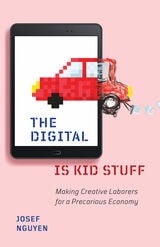
“The children are our future” goes the adage, a proclamation that simultaneously declares both anxiety as well as hope about youth as the next generation. In The Digital Is Kid Stuff, Josef Nguyen interrogates this ambivalence within discussions about today’s “digital generation” and the future of creativity, an ambivalence that toggles between the techno-pessimism that warns against the harm to children of too much screen time and a techno-utopianism that foresees these “digital natives” leading the way to innovation, economic growth, increased democratization, and national prosperity.
Nguyen engages cultural histories of childhood, youth, and creativity through chapters that are each anchored to a particular digital media object or practice. Nguyen narrates the developmental arc of a future creative laborer: from a young kid playing the island fictions of Minecraft, to an older child learning do-it-yourself skills while reading Make magazine, to a teenager posting selfies on Instagram, to a young adult creative laborer imagining technological innovations using design fiction.
Focusing on the constructions and valorizations of creativity, entrepreneurialism, and technological savvy, Nguyen argues that contemporary culture operates to assuage profound anxieties about—and to defuse valid critiques of—both emerging digital technologies and the precarity of employment for “creative laborers” in twenty-first-century neoliberal America.

The Digital NBA
How the World's Savviest League Brings the Court to Our CouchSteven Secular
University of Illinois Press, 2023
A timely look at a dynamic media landscape, The Digital NBA shows how the games we love became content first and sport a distant second.

The Digital Party
Political Organisation and Online DemocracyPaolo Gerbaudo
Pluto Press, 2018
These new political formations tap into the potential of social media to gain consensus, and use online participatory platforms to include the rank-and-file. Paolo Gerbaudo looks at the restructuring of political parties and campaigns in the time of Facebook, Twitter, Instagram, and big data. Drawing on interviews with key political leaders and digital organizers, he argues that the digital party is very different from the class-based “mass party” of the industrial era, and offers promising new solutions to social polarization and the failures of liberal democracy today.

The Digital and Its Discontents
Aden Evens
University of Minnesota Press, 2024
A groundbreaking critique of the digital world that analyzes its universal technological foundations
Whence that nagging sense that something in the digital is amiss—that, as wonderful as our devices are, time spent on smartphones and computers leaves us sour, enervated, alienated? The Digital and Its Discontents uniquely explains that worry and points us toward a more satisfying relationship between our digital lives and our nondigital selves, one that requires a radical change in the way we incorporate technology into our lives.
Aden Evens analyzes universal technological principles—in particular, the binary logic—to show that they encourage certain ways of thinking while making others more challenging or impossible. What is out of reach for any digital machine is contingency, the ontological principle that refuses every rule. As humans engage ourselves and our world ever more through digital machines, we are losing touch with contingency and so banishing from our lives the accidental and unexpected that fuel our most creative and novel possibilities for living.
Taking cues from philosophy rather than cultural or media theory, Evens argues that the consequences of this erosion of contingency are significant yet often overlooked because the same values that make the digital seem so desirable also make contingency seem unimportant—without contingency the digital is confined to what has already been thought, and yet the digital’s ubiquity has allowed it to disguise this inherent sterility. Responsive only to desires that meet the demands of its narrow logic, the digital requires its users to practice those same ideological dictates, instituting a hegemony of thought and value sustained by the pervasive presence of digital mechanisms. Interweaving technical and philosophical concepts, The Digital and Its Discontents advances a powerful and urgent argument about the digital and its impact on our lives.
Retail e-book files for this title are screen-reader friendly.
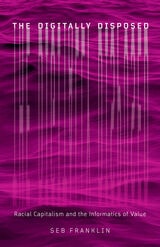
The Digitally Disposed
Racial Capitalism and the Informatics of ValueSeb Franklin
University of Minnesota Press, 2021
Locates the deep history of digitality in the development of racial capitalism
Seb Franklin sets out a media theory of racial capitalism to examine digitality’s racial-capitalist foundations. The Digitally Disposed shows how the promises of boundless connection, flexibility, and prosperity that are often associated with digital technologies are grounded in racialized histories of dispossession and exploitation. Reading archival and published material from the cybernetic sciences alongside nineteenth-century accounts of intellectual labor, twentieth-century sociometric experiments, and a range of literary and visual works, The Digitally Disposed locates the deep history of digitality in the development of racial capitalism.
Franklin makes the groundbreaking argument that capital’s apparently spontaneous synthesis of so-called free individuals into productive circuits represents an “informatics of value.” On the one hand, understanding value as an informatic relation helps to explain why capital was able to graft so seamlessly with digitality at a moment in which it required more granular and distributed control over labor—the moment that is often glossed as the age of logistics. On the other hand, because the informatics of value sort populations into positions of higher and lower capacity, value, and status, understanding their relationship to digitality requires that we see the digital as racialized and gendered in pervasive ways.
Ultimately, The Digitally Disposed questions the universalizing assumptions that are maintained, remade, and intensified by today’s dominant digital technologies. Vital and far-reaching, The Digitally Disposed reshapes such fundamental concepts as cybernetics, informatics, and digitality.

The Dilemma of Dominic Ongwen
From Child Soldier to the International Criminal CourtKjell Anderson
Rutgers University Press, 2027
Dominic Ongwen was abducted by Joseph Kony's Lord's Resistance Army while walking to school at the age of nine. He later rose through its ranks committing, and ultimately being convicted by the International Criminal Court (ICC) of, many of the same crimes of which he was once a victim. The Dilemma of Dominic Ongwen tells this extraordinary story through the voices of those who knew him best: family members, fighters, commanders, “wives,” victims, and trial participants. Their testimonies, gathered in Uganda and The Hague, form the backbone of a narrative that interlaces survivor accounts with legal analysis and vivid excerpts from the ICC trial. The book offers a rare, human-centered lens on international justice, illuminating the dilemmas of prosecuting a former child soldier for mass atrocities. It provides indispensable insights for scholars of international criminal law, transitional justice, political violence, trauma, and human rights.

The Dilemmas of Dissidence in East-Central Europe
Citizen Intellectuals and Philosopher KingsBarbara J. Falk
Central European University Press, 2003

The Dimensions of Tolerance
What Americans Believe About Civil LibertiesHerbert McClosky
Russell Sage Foundation, 1983
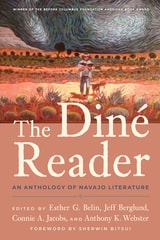
The Diné Reader
An Anthology of Navajo LiteratureEdited by Esther G. Belin, Jeff Berglund, Connie A. Jacobs, and Anthony K. Webster; Foreword by Sherwin Bitsui
University of Arizona Press, 2021
The Diné Reader: An Anthology of Navajo Literature is unprecedented. It showcases the breadth, depth, and diversity of Diné creative artists and their poetry, fiction, and nonfiction prose.This wide-ranging anthology brings together writers who offer perspectives that span generations and perspectives on life and Diné history. The collected works display a rich variety of and creativity in themes: home and history; contemporary concerns about identity, historical trauma, and loss of language; and economic and environmental inequalities.
The Diné Reader developed as a way to demonstrate both the power of Diné literary artistry and the persistence of the Navajo people. The volume opens with a foreword by poet Sherwin Bitsui, who offers insight into the importance of writing to the Navajo people. The editors then introduce the volume by detailing the literary history of the Diné people, establishing the context for the tremendous diversity of the works that follow, which includes free verse, sestinas, limericks, haiku, prose poems, creative nonfiction, mixed genres, and oral traditions reshaped into the written word.
This volume combines an array of literature with illuminating interviews, biographies, and photographs of the featured Diné writers and artists. A valuable resource to educators, literature enthusiasts, and beyond, this anthology is a much-needed showcase of Diné writers and their compelling work. The volume also includes a chronology of important dates in Diné history by Jennifer Nez Denetdale, as well as resources for teachers, students, and general readers by Michael Thompson. The Diné Reader is an exciting convergence of Navajo writers and artists with scholars and educators.

The Disability Rights Movement
From Charity to ConfrontationDoris Fleischer
Temple University Press, 2011
In this updated edition, Doris Zames Fleischer and Frieda Zames expand their encyclopedic history of the struggle for disability rights in the United States, to include the past ten years of disability rights activism.The book includes a new chapter on the evolving impact of the Americans with Disabilities Act, the continuing struggle for cross-disability civil and human rights, and the changing perceptions of disability.
The authors provide a probing analysis of such topics as deinstitutionalization, housing, health care, assisted suicide, employment, education, new technologies, disabled veterans, and disability culture.
Based on interviews with over one hundred activists, The Disability Rights Movement tells a complex and compelling story of an ongoing movement that seeks to create an equitable and diverse society, inclusive of people with disabilities.

The Disabled Child
Memoirs of a Normal FutureAmanda Apgar
University of Michigan Press, 2023
The Disappearing Mestizo
Configuring Difference in the Colonial New Kingdom of GranadaJoanne Rappaport
Duke University Press, 2014