Results by title
8642 books match the query '20th Century' and 1764 start with t

The Salt Lake Papers
From the Years in the Earthscapes of UtahEd Lueders
University of Utah Press, 2018
The Salt Lake Papers is divided into two sections by location and time. Book One reflects the central geophysical presence of the Great Salt Lake, in view from Leuders’s home and the University of Utah campus where he studied and taught. Researched and composed during the 1980s, it is published here for the first time. Book Two begins with his retirement to the “earthscapes” of the Torrey–Capitol Reef area of southern Utah and contemplates the Colorado River system. Hydrology thus provides both the physical and the metaphysical basis for the author’s reflective insights and for the natural flow of his advancing thought.
Beautifully written, The Salt Lake Papers, in varied ways, speaks to the necessity of the humanities in the modern age. At its heart, Lueders’s small book of intellectual musings explores place and the ways landscape shapes what is observant in each of us.
Hear Ed Lueders talk about his book on Utah Conversations with Ted Capener on KUED

The Samuel Gompers Papers, Volume 13
Cumulative IndexSamuel Gompers, Edited by Peter J. Albert and Grace Palladino
University of Illinois Press, 2013
The Sanitation of Brazil
Nation, State, and Public Health, 1889-1930Gilberto Hochman
University of Illinois Press, 2016
The Sarajevo Olympics
A History of the 1984 Winter GamesJason Vuic
University of Massachusetts Press, 2015
To most observers, the 1984 Winter Olympics in Sarajevo, Yugoslavia, were an unmitigated success. That year, the unlikeliest of candidate cities in the unlikeliest of candidate countries did what many had thought impossible: it hosted an international sports competition at the highest level, housing and feeding hundreds of athletes and thousands of tourists while broadcasting a positive image of socialist Yugoslavia to the world.
The first Winter Games held in a communist country, Sarajevo also marked the first Olympic confrontation of Soviet and American athletes since the U.S. boycott of the 1980 Moscow Summer Games. And the competitions themselves were spectacular and memorable. This was the Olympics of British ice dancers Jayne Torvill and Christopher Dean, American skiers “Wild Bill” Johnson and Debbie Armstrong, and East German skaters Katarina Witt and Karin Enke, not to mention a Soviet hockey team that rebounded from its stunning loss to the Americans at Lake Placid four years earlier to win all seven of its matches.
Yet The Sarajevo Olympics is more than just a history of sport. Jason Vuic also retraces the history of the Olympic movement, analyzes the inner workings of the International Olympic Committee during the troubled 1970s and 1980s, and places the 1984 Winter Games in the context of Cold War geopolitics. The book begins and ends by reminding readers that less than a decade after it hosted the Olympics, the Bosnian city of Sarajevo found itself at the vortex of a bloody and brutal civil war that would end with the dissolution of the multiethnic Yugoslavian state.
The Savage Library of Roberto Bolaño
Radical ReadingsBenjamin Loy
Bucknell University Press, 2026
Visionary Chilean writer Roberto Bolaño was known for his darkly poetic prose and postmodern narratives, exemplified in his novel The Savage Detectives. His work is also deeply infused with references to the Western literary canon—from French and Spanish baroque texts to American and German modernism, as well as postmodern literature from Latin America and France. Taking Bolaño’s notion of “savage” reading as a point of departure, this study explores the key authors and literary traditions that underpin his oeuvre. Blending close textual analysis with insights from the history of literature and ideas, Loy offers fresh perspectives on some of Bolaño’s most significant works, including Distant Star, By Night in Chile, and 2666. The intertextual dialogues Loy traces—with figures such as Blaise Pascal, Sor Juana Inés de la Cruz, Charles Baudelaire, William Carlos Williams, Ernst Jünger, Nicanor Parra, and Georges Perec—illuminate the aesthetic universe of an author now regarded as a central figure in twenty-first-century world literature.
Published by Bucknell University Press. Distributed worldwide by Rutgers University Press.
The Saving Lie
Harold Bloom and DeconstructionAgata Bielik-Robson
Northwestern University Press, 2011
Bloom is indeed a party of one, a truly strong poet of his own mode of religious-literary criticism, who, in a typically Emersonian manner, makes his own circumstances and sheds influences by incorporating them into his idiosyncratic theory.In this unprecedented full-length study on Harold Bloom, Agata Bielik-Robson explores the many facets of Bloom’s critical writings and career. In his work, she argues, Bloom draws on a variety of disparate traditions—Judaism, gnosis, Romanticism, American pragmatism, and Freudianism, but also, especially recently, Victorian aestheticism—that comprise a dialectical, difficult whole in a constant quarrel with itself. Yet, this is precisely the image of "life-in-antithesis," which constitutes Bloom’s highest speculative achievement, she observes. The Saving Lie brings all these "Blooms" together and, despite their own tendencies toward dissociation, lets them speak unisono: in one almost harmonious voice that will clearly utter the principles of a new speculative position—Bloom’s antithetical vitalism. This study of Bloom and his contributions will not soon be surpassed.
The Saving Line
Benjamin, Adorno, and the Caesuras of HopeMárton Dornbach
Northwestern University Press, 2021
Walter Benjamin and Theodor Adorno both turned to canonical literary narratives to determine why the Enlightenment project was derailed and how this failure might be remedied. The resultant works, Benjamin’s major essay on Goethe’s Elective Affinities and Adorno’s meditation on the Odyssey in Dialectic of Enlightenment, are centrally concerned with the very act of narration. Márton Dornbach’s groundbreaking book reconstructs a hitherto unnoticed, wide-ranging dialogue between these foundational texts of the Frankfurt School.
At the heart of Dornbach’s argument is a critical model that Benjamin built around the concept of caesura, a model Adorno subsequently reworked. Countering an obscurantism that would become complicit in the rise of fascism, the two theorists aligned moments of arrest in narratives mired in unreason. Although this model responded to a specific historical emergency, it can be adapted to identify utopian impulses in a variety of works.
The Saving Line throws fresh light on the intellectual exchange and disagreements between Benjamin and Adorno, the problematic conjunction of secular reason and negative theology in their thinking, and their appropriations of ancient and modern legacies. It will interest scholars of philosophy and literature, critical theory, German Jewish thought, classical reception studies, and narratology.
The Scandal of Pleasure
Art in an Age of FundamentalismWendy Steiner
University of Chicago Press, 1995
"Stimulating. . . . A splendid rebuttal of those on the left and right who think that the pleasures induced by art are trivial or dangerous. . . . One of the most powerful defenses of the potentiality of art."—Andrew Delbanco, New York Times Book Review
"A concise and . . . readable account of recent contretemps that have galvanized the debate over the role and purposes of art. . . . [Steiner] writes passionately about what she believes in."—Michiko Kakutani, New York Times
"This is one of the few works of cultural criticism that is actually intelligible to the nonspecialist reader. . . . Steiner's perspective is fresh and her perceptions invariably shrewd, far-ranging, and reasonable. A welcome association of sense and sensibility."—Kirkus Reviews, starred review
"Steiner has succeeded so well in [the] task she has undertaken. The Scandal of Pleasure is itself characterized by many of the qualities Steiner demans of art, among them, complexity, tolerance and the pleasures of unfettered thought."—Eleanor Heartly, Art in America
"Steiner . . . provides the best and clearest short presentation of each of [the] debates."—Alexander Nehamas, Boston Book Review
"Steiner has done a fine job as a historian/reporter and as a writer of sophisticated, very clear, cultural criticism. Her reportage alone would be enough to make this a distinguished book."—Mark Edmundson, Lingua Franca
The Scene of Foreplay
Theater, Labor, and Leisure in 1960s New YorkGiulia Palladini
Northwestern University Press, 2017
Matching an original approach to historical materials and theoretical reflection, Palladini addresses the peculiar forms of production, reproduction, and consumption developed in the 1960s as labors of love, creating for artists a condition of “preliminarity” toward professional work and also functioning as a counterforce within productive economy, as a prelude where value is not yet assigned to labor.
The Scene of Foreplay proposes that such labors of love can be considered both as paradigmatic for contemporary forms of precarious labor and also resonating with echoes from marginal histories of the performing arts, in a nonlinear genealogy of queer resistance to ideas of capitalist productivity and professionalism. The book offers much for those interested in performance theory as well asin the history of theater and performance arts in the 1960s.
The Scene of Harlem Cabaret
Race, Sexuality, PerformanceShane Vogel
University of Chicago Press, 2009
Harlem’s nightclubs in the 1920s and ’30s were a crucible for testing society’s racial and sexual limits. Normally tacit divisions were there made spectacularly public in the vibrant, but often fraught, relationship between performer and audience. The cabaret scene, Shane Vogel contends, also played a key role in the Harlem Renaissance by offering an alternative to the politics of sexual respectability and racial uplift that sought to dictate the proper subject matter for black arts and letters. Individually and collectively, luminaries such as Duke Ellington, Lena Horne, Langston Hughes, Claude McKay, Wallace Thurman, and Ethel Waters expanded the possibilities of blackness and sexuality in America, resulting in a queer nightlife that flourished in music, in print, and on stage.
Deftly combining performance theory, literary criticism, historical research, and biographical study, The Scene of Harlem Cabaret brings this rich moment in history to life, while exploring the role of nightlife performance as a definitive touchstone for understanding the racial and sexual politics of the early twentieth century.

The Science of the Swastika
Bernard Mees
Central European University Press, 2008

The Scientific Enterprise in America
Readings from IsisEdited by Ronald L. Numbers and Charles E. Rosenberg
University of Chicago Press, 1996
Contributions include Sally Gregory Kohlstedt, "Parlors, Primers, and Public Schooling: Education for Science in Nineteenth-Century America;" Margaret Rossiter, "'Women's Work' in Science, 1880-1910;" Philip J. Pauly, "The Development of High School Biology: New York City, 1900-1925;" Susan E. Lederer, "Political Animals: The Shaping of Biomedical Research Literature in Twentieth-Century America;" Stanley Goldberg, "Inventing a Climate of Opinion: Vannevar Bush and the Decision to Build the Bomb;" Daniel J. Kevles, "The National Science Foundation and the Debate over Postwar Research Policy, 1942-1945: A Political Interpretation of Science: The Endless Frontier;" David A. Hollinger, "Science as a Weapon in Kulturkämpfe in the United States During and After World War II;" and others.
These essays originally were published in Isis, a publication of the History of Science Society.

The Scientific Life
A Moral History of a Late Modern VocationSteven Shapin
University of Chicago Press, 2008
Conventional wisdom has long held that scientists are neither better nor worse than anyone else, that personal virtue does not necessarily accompany technical expertise, and that scientific practice is profoundly impersonal. Shapin, however, here shows how the uncertainties attending scientific research make the virtues of individual researchers intrinsic to scientific work. From the early twentieth-century origins of corporate research laboratories to the high-flying scientific entrepreneurship of the present, Shapin argues that the radical uncertainties of much contemporary science have made personal virtues more central to its practice than ever before, and he also reveals how radically novel aspects of late modern science have unexpectedly deep historical roots. His elegantly conceived history of the scientific career and character ultimately encourages us to reconsider the very nature of the technical and moral worlds in which we now live.
Building on the insights of Shapin’s last three influential books, featuring an utterly fascinating cast of characters, and brimming with bold and original claims, The Scientific Life is essential reading for anyone wanting to reflect on late modern American culture and how it has been shaped.
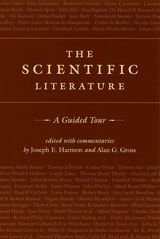
The Scientific Literature
A Guided TourEdited by Joseph E. Harmon and Alan G. Gross
University of Chicago Press, 2007
The scientific article has been a hallmark of the career of every important western scientist since the seventeenth century. Yet its role in the history of science has not been fully explored. Joseph E. Harmon and Alan G. Gross remedy this oversight with The Scientific Literature, a collection of writings—excerpts from scientific articles, letters, memoirs, proceedings, transactions, and magazines—that illustrates the origin of the scientific article in 1665 and its evolution over the next three and a half centuries.
Featuring articles—as well as sixty tables and illustrations, tools vital to scientific communication—that represent the broad sweep of modern science, The Scientific Literature is a historical tour through both the rhetorical strategies that scientists employ to share their discoveries and the methods that scientists use to argue claims of new knowledge. Commentaries that explain each excerpt’s scientific and historical context and analyze its communication strategy accompany each entry.
A unique anthology, The Scientific Literature will allow both the scholar and the general reader to experience first hand the development of modern science.
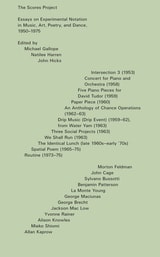
The Scores Project
Essays on Experimental Notation in Music, Art, Poetry, and Dance, 1950–1975Michael Gallope
J. Paul Getty Trust, The, 2025
Individuals working in and across the fields of visual art, music, poetry, theater, and dance in the mid–twentieth century began to use experimental scores in ways that revolutionized artistic practice and opened up new forms of interdisciplinary collaboration. Their experimental methods—associated with the neo-avant-garde, neo-Dadaism, intermedia, Fluxus, and postmodernism—exploded in notoriety during the 1960s in locales from New York to Europe, East Asia, and Latin America, becoming foundational to global trends in contemporary art and performance.
The Scores Project provides an in-depth view of this historical moment. Through expert commentaries from an interdisciplinary team of scholars with accompanying illustrations, this publication examines a series of experimental scores by John Cage, George Brecht, Sylvano Bussotti, Morton Feldman, Allan Kaprow, Alison Knowles, Jackson Mac Low, Benjamin Patterson, Yvonne Rainer, Mieko Shiomi, David Tudor, and La Monte Young. Ambitious, provocative, and playful, The Scores Project is an illuminating resource to scholars and students who seek to understand this innovative and historically complex moment in the history of art.
An expanded edition of this open-access publication is available for free online at www.getty.edu/publications/scores/. It includes more than 2,800 images, audio/video files, and interactive features. Also available are free PDF and EPUB downloads of the book.
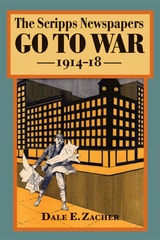
The Scripps Newspapers Go to War, 1914-18
Dale Zacher
University of Illinois Press, 2007
Zacher's account delves into details inside a major newspaper operation during World War I and provides fascinating accounts of its struggles with competition, attending to patriotic duties, and internal editorial dissent. Zacher also looks at war-related issues, considering the newspapers' relationship with President Woodrow Wilson, American neutrality, the move to join the war, and fallout from disillusionment over the actuality of war. As Zacher shows, the progressive spirit and political independence at the Scripps newspapers came under attack and was changed forever during the era.
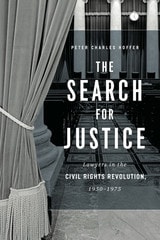
The Search for Justice
Lawyers in the Civil Rights Revolution, 1950–1975Peter Charles Hoffer
University of Chicago Press, 2019
The Search for Justice is a look the role of the lawyers throughout the period, focusing on one of the central issues of the time: school segregation. The most notable participants to address this issue were the public interest lawyers of the NAACP’s Legal Defense Fund, whose counselors brought lawsuits and carried out appeals in state and federal courts over the course of twenty years. But also playing a part in the story were members of the bar who defended Jim Crow laws explicitly or implicitly and, in some cases, also served in state or federal government; lawyers who sat on state and federal benches and heard civil rights cases; and, finally, law professors who analyzed the reasoning of the courts in classrooms and public forums removed from the fray. With rich, copiously researched detail, Hoffer takes readers through the interactions of these groups, setting their activities not only in the context of the civil rights movement but also of their full political and legal legacies, including the growth of corporate private legal practice after World War II and the expansion of the role of law professors in public discourse, particularly with the New Deal. Seeing the civil rights era through the lens of law enables us to understand for the first time the many ways in which lawyers affected the course and outcome of the movement.

The Search for Medieval Music in Africa and Germany, 1891-1961
Scholars, Singers, MissionariesAnna Maria Busse Berger
University of Chicago Press, 2020
The book unfolds in three parts. Busse Berger starts with the origins of comparative musicology circa 1900, when early proponents used ideas from comparative linguistics to test whether parallels could be drawn between nonwestern and medieval European music. She then turns to youth movements of the era—the Wandervogel, Jugendmusikbewegung, and Singbewegung—whose focus on joint music making influenced many musicologists. Finally, she considers case studies of Protestant and Catholic mission societies in what is now Tanzania, where missionaries—many of them musicologists and former youth-group members—extended the discipline via ethnographic research and a focus on local music and communities. In highlighting these long-overlooked transnational connections and the role of global music in early musicology, Busse Berger shapes a fresh conception of music scholarship during a pivotal part of the twentieth century.
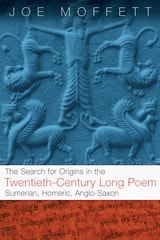
The Search for Origins in the Twentieth-Century Long Poem
Sumerian, Homeric, Anglo-SaxonJOE W. MOFFETT
West Virginia University Press, 2007
In this new, scholarly text—an ambitious study of contemporary poetics—Joe W. Moffett deciphers the twentieth-century long poem, searching for a better understanding of why long-poem writers are preoccupied with a search for origins.
Moffett focuses on issues like postcolonialism, nation, modernism, and postmodernism. He conceptualizes his theories by using what he calls “originiary moments”: historical periods or specific events from which a poet contends our culture descends. These moments enlighten and inspire the modern poet to use origin or “source” as a way to examine present culture and social conditions. The poems also encourage modern readers to question, revise, and repudiate. Moffett organizes his argument by arranging specific examples into three categories of originary moments: Sumerian, Homeric, and Anglo-Saxon.
According to Moffett, the long poem is appealing because it “lacks strict conventions that govern other genres.” Using a wide variety of poems to support his arguments, Moffett asks many stimulating questions and also provides provocative answers.
Questions of when and where It All Began have been off the critical agenda for some time now, embargoed by poststructuralism. Undeterred, Joe Moffett boldly revisits the search for cultural origins, which preoccupied major poets throughout the twentieth century. Capacious in his scope, eclectic in his choices, Moffett rounds up unusual subjects, including long poems by Armand Schwerner, Derek Walcott, Geoffrey Hill, and Judy Grahn, with excursions into Charles Olson, Seamus Heaney, and others. Nowhere will you find clearer, more intelligent, or better-informed readings of these poems than Moffett’s.

The Search for a Socialist El Dorado
Finnish Immigration to Soviet Karelia from the United States and Canada in the 1930sAlexey Golubev and Irina Takala
Michigan State University Press, 2014
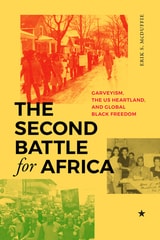
The Second Battle for Africa
Garveyism, the US Heartland, and Global Black FreedomErik S. McDuffie
Duke University Press, 2024

The Second Great Emancipation
The Mechanical Cotton Picker, Black Migration, and How They Shaped the Modern SouthDonald Holley
University of Arkansas Press, 2000
In The Second Great Emancipation, Donald Holley uses statistical and narrative analysis to demonstrate that farm mechanization occurred in the Delta region of Arkansas, Louisiana, and Mississippi after the region’s population of farm laborers moved away for new opportunities. Rather than pushing labor off the land, Holley argues, the mechanical cotton picker enabled the continuation of cotton cultivation in the post-plantation era, opening the door for the civil rights movement, while ushering a period of prosperity into the South.

The Second World War
A Marxist HistoryChris Bambery
Pluto Press, 2014
The Second World War casts a long shadow, portrayed as a necessary and paradigmatic war that defeated fascism. During recent wars in Iraq, Afghanistan and elsewhere, US presidents and British prime ministers have tried to claim they were following in the footsteps of Winston Churchill by standing up to dictators.
In The Second World War Chris Bambery tests this position in a thorough account of the war and tries to understand why it still dominates TV history channels and school history books.
Bambery argues that the conflict ultimately was about a division of the world between the great powers, as well as a rising of ordinary people against fascism. He offers a complex and radical analysis, that is unique when compared to many modern and conventional histories of the war.
The Secret Protocol
The Molotov-Ribbentrop Pact and the Falsification of HistoryAntonella Salomoni, Translated by Antony Shugaar
University of Wisconsin Press, 2025
From the moment of the secret protocol’s inception—and the near-instantaneous rumors of its existence—it generated friction and competing narratives. The document became public during the Nuremberg trials, but the USSR declared it a fabrication evidencing the West’s willingness to falsify history. It continues to be relevant to the reconfiguration of history currently advanced by Vladimir Putin. By centering the rumors, accusations, and propaganda the pact precipitated, Salomoni illuminates how political actors can use and abuse history, how they create and disseminate truths and falsehoods, and how they can blur the boundary between facts and fictions even in the glaring face of black-and-white documentation.

The Secret of M. Dulong
A MemoirColette Inez
University of Wisconsin Press, 2005

The Secret of the Hardy Boys
Leslie McFarlane and the Stratemeyer SyndicateMarilyn S. Greenwald
Ohio University Press, 2004
For generations of readers, the Hardy Boys were the creations of the legendary Franklin W. Dixon—except Dixon never existed. Behind the iconic series stood the Stratemeyer Syndicate, a powerhouse of children’s publishing, and one gifted but largely unrecognized writer: Leslie McFarlane.
In The Secret of the Hardy Boys, acclaimed biographer Marilyn S. Greenwald uncovers the remarkable story of the man who first brought Frank and Joe Hardy to life. A young Canadian journalist with ambitions beyond formula fiction, McFarlane infused the Syndicate’s rigid plots with wit, atmosphere, and narrative vitality—helping to shape one of the most enduring franchises in children’s literature.
Bound by contract and reluctant to claim authorship, McFarlane kept his role a secret for decades, receiving little financial reward for books that sold in the millions. Yet his story is far from one of regret. Drawing on extensive research, Greenwald paints a vivid portrait of a versatile writer who navigated the shifting landscape of twentieth-century media, from pulp magazines to radio and film.
Rich in literary history and human insight, The Secret of the Hardy Boys is both a revealing behind-the-scenes account of a cultural phenomenon and an inspiring testament to creativity, resilience, and the quiet architects of beloved stories.

The Secrets of the Hopewell Box
Stolen Elections, Southern Politics, and a City's Coming of AgeJames D. Squires
Vanderbilt University Press, 1996
—Kirkus Reviews
"His richly textured narrative charts the Nashville machine's rupture with the state's top political boss, Edward Crump of Memphis, and traces the sweeping reforms that shattered rural white control of the state legislature. Squires dramatically reenacts the downfall of Nashville lawyer Tommy Osborn, convicted of jury tampering in 1964 after defending Teamsters boss Jimmy Hoffa. He follows Nashville's transformation into a crucible of the civil rights movement in this stirring chronicle of the South's coming-of-age."
—Publishers Weekly
The Seeds of Triumph
Church and State in Gomulka's PolandHannah Diskin
Central European University Press, 2001
The Roman Catholic Church has played a unique role in the history of Poland in the twentieth century: the people and the Church drew closer and closer together during Nazi rule, the Stalinist period and the somewhat milder, though strongly anti-religious and repressive Gomulka regime (1956-1970). The power struggle between the Church and the communist government did in fact play a role in shaping world politics, the Polish Church having been the force behind the opposition movement in Poland. Against this background, a Polish pope appeared and made a major contribution to the collapse of communism.
The Seeds of Triumph, the most comprehensive recent book on the opposition of Church and State in post-war Poland, compares the characteristics and consequences of this relationship during three different periods: the first and second periods of Gomulka's rule, and the Stalinist era between the two Gomulka periods. It examines the balance of power, studying to what degree the Church and other factors in the political environment influenced governmental policy-making. The author disproves the common stereotype, held at the time, that domestic conditions played only a marginal role. In examining the regime's policies, she covers the legal background, the general policy characteristics, the specific policies implemented during the period, and the role of the individual actors, most notably the pivotal role of the two main protagonists, Cardinal Wyszynski and Wladislaw Gomulka.
In her landmark study, Diskin makes a significant contribution to the study of authoritarian systems and greatly enhances our understanding of the centrality of the Church in recent Polish history.
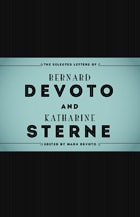
The Selected Letters of Bernard DeVoto and Katharine Sterne
Mark DeVoto
University of Utah Press, 2012
A busy man with a busy life, DeVoto found time to write and answer letters in abundance. In 1933 he received a fan letter from Katharine Sterne, a young woman hospitalized with tuberculosis; his reply touched off an extraordinary eleven-year correspondence. Sterne had graduated with honors from Wellesley College in 1928 and had served as an assistant art critic at the New York Times before her illness. Despite her enforced invalidism she maintained an active intellectual life. Sterne and DeVoto wrote to each other until her death in 1944, sometimes in many pages and as often as twice a week, exchanging opinions about life, literature, art, current events, family news, gossip, and their innermost feelings. DeVoto’s biographer, Wallace Stegner, states that in these letters DeVoto “expressed himself more intimately than in any other writings.” Although their correspondence amounted to more than 868 letters (and is virtually complete on both sides), DeVoto and Sterne never met, both of them doubtless realizing that physical remoteness permitted a psychological proximity that was deeply nourishing.
This volume contains 140 of their letters. They have been selected by DeVoto’s son Mark, who has also provided detailed notes clarifying ambiguities and obscure references. Readers will enjoy these letters for their wit and literary flair, but they will also gain insight into the cultural and historical crosscurrents of the 1930s and ’40s while taking an intimate and engaging look at a friendship forged entirely through words.

The Selected Letters of Ezra Pound to John Quinn
1915–1924Timothy Materer, ed.
Duke University Press, 1991
Pound wrote to John Quinn—a New York lawyer, an expert in business law, and a collector of unusual taste and discrimination—about these artists and many more, urging him to support their journals, collect their manuscripts, and buy and exhibit their paintings and sculptures. Quinn at one time owned manuscripts of Ulysses and The Waste Land, Brancusi’s sculpture Mlle. Pogany, and Picasso’s painting Three Musicians. Yet he was often skeptical about the value of new schools of art, such as Vorticism, and disturbed by the outspokenness of authors such as Joyce. Pound’s letters are unusually tactful when he counters Quinn’s doubts and explains the premises of experimental art. Pound’s letters to Quinn are touched with his characteristic humor and wordplay and are especially notable for their lucidity of expression, engendered by Pound’s deep respect for Quinn.

The Selected Letters of George Oppen
Rachel Blau DuPlessis, ed.
Duke University Press, 1990
These working papers include a rich correspondence, letters which provide access to the sustained, perceptive body of critical and aesthetic thinking of Oppen’s poetic career. Provocative and witty comments on poetry and poetics, especially interesting for the development of an Objectivist aesthetics, and shrewd, deeply felt assessments about the politics of the twentieth century and its moral dilemmas are some of the issues attended to. This edition offers primary documentation about an influential poetics, a little-known movement, and its active figures. Given the aggressive studies of the politics of canon-formation, the interest in describing a historical context for individual literary achievement, and current debates about mainstream poetry, the rethinking of the Objectivist movement, and the collection of documents contributing to its poetics, is an important achievement in literary scholarship.

The Selected Papers of Margaret Sanger, Volume 1
The Woman Rebel, 1900-1928Margaret Sanger, Edited by Esther Katz
University of Illinois Press, 2002

The Selected Papers of Margaret Sanger, Volume 4
Round the World for Birth Control, 1920-1966Margaret Sanger: Edited by Esther Katz: Peter C. Engelman and Cathy Moran Hajo, Associate Editors
University of Illinois Press, 2016
This volume focuses on Sanger from her groundbreaking overseas advocacy during the interwar years through her postwar role in creating the International Planned Parenthood Federation. The documents reconstruct Sanger's dramatic birth control advocacy tours through early 1920s Germany, Japan, and China in the midst of significant government and religious opposition to her ideas. They also trace her tireless efforts to build a global movement through international conferences and tours. Letters, journal entries, writings, and other records reveal Sanger's contentious dealings with other activists, her correspondence with the likes of Albert Einstein and Eleanor Roosevelt, and Sanger's own dramatic evolution from gritty grassroots activist to postwar power broker and diplomat.
A powerful documentary history of a transformative twentieth-century figure, The Selected Papers of Margaret Sanger, Volume 4 is a primer for the debates on individual choice, sex education, and planned parenthood that remain all-too-pertinent in our own time.

The Selected Stories of Ann Scott-Moncrief
Ann Scott-Moncrief
Catholic University of America Press, 2026

The Senses of Nonsense
Alison Rieke
University of Iowa Press, 1992
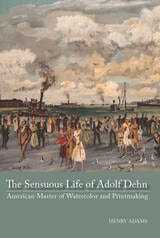
The Sensuous Life of Adolf Dehn
American Master of Watercolor and PrintmakingHenry Adams
University of Missouri Press, 2020
In this wide-ranging biography, Henry Adams explores how a once central figure can come to be forgotten. Noting that Dehn’s watercolor Spring in Central Park has been widely reproduced on calendars, postcards, and other Metropolitan Museum of Art souvenirs, Adams asks why it is that some artists are celebrated as key figures while others, even those who created images that form an integral part of our visual culture, are relatively unknown. With his account of the life of the prolific and influential Dehn, and a look at the circles of artists and writers in which Dehn moved, Adams helps to fill in what he calls the “secret or subterranean history of art.”
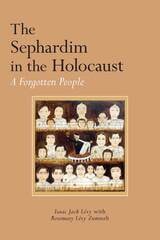
The Sephardim in the Holocaust
A Forgotten PeopleIsaac Jack Lévy with Rosemary Lévy Zumwalt
University of Alabama Press, 2020
A Powerful History of Sephardic Life, Loss, and Resilience During the Holocaust
The Sephardim suffered devastation during the Holocaust, but this facet of history is poorly documented. What literature exists on the Sephardim in the Holocaust focuses on specific countries, such as Yugoslavia and Greece, or on specific cities, such as Salonika, and many of these works are not available in English.
The Sephardim in the Holocaust: A Forgotten People embraces the Sephardim of all the countries shattered by the Holocaust and pays tribute to the memory of the more than 160,000 Sephardim who perished. Isaac Jack Lévy and Rosemary Lévy Zumwalt draw on a wealth of archival sources, family history (Isaac and his family were expelled from Rhodes in 1938), and more than 150 interviews conducted with survivors during research trips to Belgium, Canada, France, Greece, Israel, Mexico, the Netherlands, the former Yugoslavia, and the United States. Lévy follows the Sephardim from Athens, Corfu, Cos, Macedonia, Rhodes, Salonika, and the former Yugoslavia to Auschwitz.
The authors chronicle the interminable cruelty of the camps, from the initial selections to the grisly work of the Sonderkommandos inside the crematoria, detailing the distinctive challenges the Sephardim faced, with their differences in language, physical appearance, and pronunciation of Hebrew, all of which set them apart from the Ashkenazim. They document courageous Sephardic revolts, especially those by Greek Jews, which involved intricate planning, sequestering of gunpowder, and complex coordination and communication between Ashkenazi and Sephardic inmates—all done in the strictest of secrecy. And they follow a number of Sephardic survivors who took refuge in Albania with the benevolent assistance of Muslims and Christians who opened their doors to give sanctuary, and traces the fate of the approximately 430,000 Jews from Morocco, Algiers, Tunisia, and Libya from 1939 through the end of the war.
The author’s intention is to include the Sephardim in the shared tragedy with the Ashkenazim and others. The result is a much needed, accessible, and viscerally moving account of the Sephardim’s unique experience of the Holocaust.
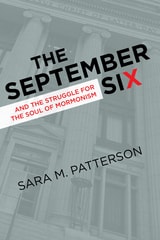
The September Six and the Struggle for the Soul of Mormonism
Patterson, Sara M.
Signature Books, 2023
The September Six and the Struggle for the Soul of Mormonism
Patterson, Sara M.
Signature Books, 2024
The Seventies Now
Culture as SurveillanceStephen Paul Miller
Duke University Press, 1999
The concept of surveillance and its attendant social ramifications have been powerful agents in U.S. culture for many decades, but in describing how during the 1970s Americans learned to “survey” themselves, Miller shines surprising new light on such subjects as the women’s movement, voting rights enforcement, the Ford presidency, and environmental legislation. He illuminates the significance of what he terms “microperiods” and analyzes relevant themes in many of the decade’s major films—such as The Deer Hunter, Network, Jaws, Star Wars, and Apocalypse Now—and in the literature of writers including John Ashbery, Toni Morrison, Adrienne Rich, and Sam Shepard. In discussing the reverberations of the 1969 Stonewall riots, technological innovations, the philosophy of Michel Foucault, and a host of documents and incidents, Miller shows how the 1970s marked an important period of transition, indeed a time of many transitions, to the world we confront at the end of the millennium.
The Seventies Now will interest students and scholars of cultural studies, American history, theories of technology, film and literature, visual arts, and gay and lesbian studies.
The Shadow of Slavery
Peonage in the South, 1901-1969Pete Daniel
University of Illinois Press, 1972
Pete Daniel's book is about this largely ignored form of twentieth-century slavery. It is in part "the record of an American failure, the inability of federal, state, and local law-enforcement officers to end peonage." In a series of case studies and histories, Daniel re-creates the neglected and frightening world of peonage, demanding, "If a form of slavery yet exists in the United States, as so much evidence suggests, then the relevant questions are why, and by whose irresponsibility?"
Peonage grew out of labor settlements following emancipation, when employers forbade croppers to leave plantations because of debt (often less than $30). At the turn of the century the federal government acknowledged that the "labyrinth of local customs and laws" binding men in debt was peonage. They outlawed debt servitude and slowly moved against it, but with no large success. Disappearing witnesses and acquitted employers characterized the cases that did go to court.
Daniel holds that peonage persists for many reasons: the corruption and apathy of law-enforcement, racist traditions in the South, and the impotence of the Justice Department in prosecuting this violation of federal law. He draws extensively on complaints and trial transcripts from the peonage records of the Justice Department.

The Shan Rebellion
Siam’s Colonial Struggle to Secure LannaAndrew Walker
National University of Singapore Press, 2026
A gripping account of how the Shan rebellion influenced the colonial struggle between Siam, Britain, and France to expand their power in northern Thailand.
Moving beyond the familiar story of Siam fending off European colonialism, TheShan Rebellion reveals a new historical subject: Siam as colonizer. As European powers expanded their presence in Southeast Asia at the end of the nineteenth century, Siam launched its own colonial project to assert control over tributary states that lay outside the Siamese heartland. Most important was Lanna (now northern Thailand), a region where Siamese, British, and French colonial ambitions intersected. The outbreak of the Shan Rebellion in 1902 began with the violent dismantling of the Siamese colonial administration in Phrae, one of Lanna’s principal towns. As the rebels began moving towards other centers, they tested the limits of Siamese power in Lanna. With the British having valuable commercial interests to protect and the French itching for an opportunity to expand their reach, Siam’s colonial project faced a dangerous moment. Drawing on rich archival sources from Thailand, Burma, India, France, and England, this outstanding study provides the first detailed account of the rebellion and its impact on competitive colonialism in mainland Southeast Asia.

The Shattered Mirror
Representations of Women in Mexican LiteratureBy María Elena de Valdés
University of Texas Press, 1998
Popular images of women in Mexico—conveyed through literature and, more recently, film and television—were long restricted to either the stereotypically submissive wife and mother or the demonized fallen woman. But new representations of women and their roles in Mexican society have shattered the ideological mirrors that reflected these images. This book explores this major change in the literary representation of women in Mexico.
María Elena de Valdés enters into a selective and hard-hitting examination of literary representation in its social context and a contestatory engagement of both the literary text and its place in the social reality of Mexico. Some of the topics she considers are Carlos Fuentes and the subversion of the social codes for women; the poetic ties between Sor Juana Inés de la Cruz and Octavio Paz; questions of female identity in the writings of Rosario Castellanos, Luisa Josefina Hernández, María Luisa Puga, and Elena Poniatowska; the Chicana writing of Sandra Cisneros; and the postmodern celebration—without reprobation—of being a woman in Laura Esquivel's Like Water for Chocolate.
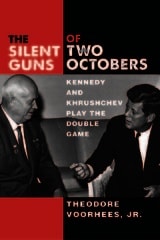
The Silent Guns of Two Octobers
Kennedy and Khrushchev Play the Double GameTheodore Voorhees, Jr.
University of Michigan Press, 2020
The Silent Guns of Two Octobers uses new as well as previously under-appreciated documentary evidence to link the Cuban Missile Crisis to the Checkpoint Charlie tank standoff to achieve the impossible—craft a new, thoughtful, original analysis of a political showdown everyone thought they knew everything about. Ultimately the book concludes that much of the Cold War rhetoric the leaders employed was mere posturing; in reality neither had any intention of starting a nuclear war. Theodore Voorhees reexamines Khrushchev’s and Kennedy’s leadership, decision, and rhetoric in light of the new documentary evidence available. Voorhees examines the impact of John F. Kennedy's domestic political concerns about his upcoming first midterm elections on his handling of the Cuban Missile Crisis through his use of back-channel dealings with Khrushchev during the lead-up to the crisis and in the closing days when the two leaders managed to reach a settlement.

The Silent Guns of Two Octobers
Kennedy and Khrushchev Play the Double GameTheodore Voorhees, Jr.
University of Michigan Press, 2021
The Silent Guns of Two Octobers uses new as well as previously under-appreciated documentary evidence to link the Cuban Missile Crisis to the Checkpoint Charlie tank standoff to achieve the impossible—craft a new, thoughtful, original analysis of a political showdown everyone thought they knew everything about. Ultimately the book concludes that much of the Cold War rhetoric the leaders employed was mere posturing; in reality neither had any intention of starting a nuclear war. Theodore Voorhees reexamines Khrushchev’s and Kennedy’s leadership, decision, and rhetoric in light of the new documentary evidence available. Voorhees examines the impact of John F. Kennedy's domestic political concerns about his upcoming first midterm elections on his handling of the Cuban Missile Crisis through his use of back-channel dealings with Khrushchev during the lead-up to the crisis and in the closing days when the two leaders managed to reach a settlement.
The Silk, the Shears and Marina; or, About Biography
Irena Vrkljan
Northwestern University Press, 1999
These are the first two volumes of the Croatian poet and novelist Irena Vrkljan's lyrical autobiography. Although each novel illuminates the other, they also stand alone as original and independent works of art. In The Silk, the Shears, Vrkljan traces the symbolic and moral significance of her life, and her vision of the fate of women in her mother's time and in her own. Marina continues the intense analysis of the poetic self, using the life of Marina Tsvetaeva to meditate on the processes behind biography.

The Silver Age in Our Home
A Memoir of Russian Literary Life in the 20th CenturySophia Bogatyreva
Central European University Press, 2027
These memoirs read as a significant contribution to scholarship, full of important facts and characterizations. At the same time, they become an original intellectual novel with real-life protagonists seen from the point of view of a child, teenager and young woman. The position of the narrator creates a “defamiliarizing” effect similar to the one about which the Formalists and first and foremost Viktor Shklovsky wrote. However, this powerful effect is “hidden in plain view” – the style of Bogatyreva’s memoirs is strikingly transparent and non-pretentious, which makes her book available even for an unprepared reader.
Mark Lipovetsky, Columbia University
The Sit-Ins
Protest and Legal Change in the Civil Rights EraChristopher W. Schmidt
University of Chicago Press, 2018
The Sit-Ins tells the story of the student lunch counter protests and the national debate they sparked over the meaning of the constitutional right of all Americans to equal protection of the law. Christopher W. Schmidt describes how behind the now-iconic scenes of African American college students sitting in quiet defiance at “whites only” lunch counters lies a series of underappreciated legal dilemmas—about the meaning of the Constitution, the capacity of legal institutions to remedy different forms of injustice, and the relationship between legal reform and social change. The students’ actions initiated a national conversation over whether the Constitution’s equal protection clause extended to the activities of private businesses that served the general public. The courts, the traditional focal point for accounts of constitutional disputes, played an important but ultimately secondary role in this story. The great victory of the sit-in movement came not in the Supreme Court, but in Congress, with the passage of the Civil Rights Act of 1964, landmark legislation that recognized the right African American students had claimed for themselves four years earlier. The Sit-Ins invites a broader understanding of how Americans contest and construct the meaning of their Constitution.
The Six-Minute Memoir
Fifty-Five Short Essays on LifeMary Helen Stefaniak
University of Iowa Press, 2022
What’s more, writing prompts at the end of the book invite readers to search their own lives for such moments—the kind that could be forgotten but instead are turned, by the gift of perspective and perfectly chosen detail, into treasure. The Six-Minute Memoir encourages people to tell their own stories even if they think they don’t have the kind of story that belongs in a memoir.

The Sixties, Center Stage
Mainstream and Popular Performances in a Turbulent DecadeEdited by James M. Harding and Cindy Rosenthal
University of Michigan Press, 2017