Results by title
482 books match the query '17th century' and 121 start with t
The Visions of Sor María de Agreda
Writing Knowledge and PowerClark Colahan
University of Arizona Press, 1994
The Warwolf
A Peasant Chronicle of the Thirty Years WarHermann Lons
Westholme Publishing, 2006
The Thirty Years War, fought between 1618 and 1648, was a ruthless struggle for political and religious control of central Europe. Engulfing most of present-day Germany, the war claimed at least ten million lives. The lengthy conflict was particularly hard on the general population, as thousands of undisciplined mercenaries serving Sweden, Spain, France, the Netherlands, and various German principalities, robbed, murdered, and pillaged communities; disease spread out of control and starvation became commonplace. In The Warwolf, Hermann Löns's acclaimed historical novel, the tragedy and horrors of war in general, and these times in particular are revealed. The Warwolf, based on the author's careful research, traces the life of Harm Wulf, a land-owning peasant farmer of the northern German heath who realizes after witnessing the murder of neighbours and family at the hands of marauding troops that he has a choice between compromising his morals or succumbing to inevitable torture and death. Despite his desire for peace, Wulf decides to band with his fellow farmers and live like "wolves," fiercely protecting their isolated communities from all intruders. Löns's brilliant portrayal of the two sides faced by any person in a moral crisis—in Harm Wulf's case, whether to kill or be killed—continues to resonate. Originally published in 1910 and still in print in Germany, The Warwolf is available for first time in English.
The Whiteness Between Us
Early Modern Playbooks of Racial TriangulationNoémie Ndiaye
University of Chicago Press, 2026
A theorization of the representational juxtapositions, frictions, and connections between Black people and other non-white people in early modern European theatre.
Over the course of the seventeenth century, European drama was an important tool for whiteness to imagine itself at the top of an aspirational structure of power relations. Indeed, that structure could only be aspirational at a time when Europeans were profoundly divided along easily racializable religious and ethnic lines, and when their sovereignty was threatened by the Ottoman empire. It was to strengthen this emerging consciousness of racial whiteness, Noémie Ndiaye argues, that European drama engaged in a form of racial triangulation, fitting Muslim, Jewish, Indigenous, Romani, and Asian characters into a spurious black/white racial binary.
Focusing on English, Spanish, and French drama from 1580 to 1715, The Whiteness Between Us shows how plays became a crucial tool to position not only black people but any non-white community in the new racial architecture that white supremacy sought to build. Ndiaye reveals the stage of this era as a space for wish fulfillment, enabling participants to imagine and work towards a whiter future.
The early modern playbooks of racial triangulation that Ndiaye brings to light can and have been reactivated for white supremacist purposes in our own day and age. Partly in response to the contemporary threat of white nationalism, scholars and students have sought to unearth the early modern roots of racial whiteness and white supremacy. Ndiaye’s book participates in this wave of interest, offering several innovations, including its capacious transnational claims.
The Wit of Seventeenth-Century Poetry
Edited by Claude J. Summers & Ted-Larry Pebworth
University of Missouri Press, 1994
As the twelve original essays collected in this volume demonstrate, to study the wit of seventeenth-century poetry is necessarily to address concerns at the very heart of the period's shifting literary culture. It is a topic that raises persistent questions of thematics and authorial intent, even as it interrogates a wide spectrum of cultural practices. These essays by some of the most renowned scholars in seventeenth-century studies illuminate important authors and engage issues of politics and religion, of secular and sacred love, of literary theory and poetic technique, of gender relations and historical consciousness, of literary history and social change, as well as larger concerns of literary production and smaller ones of local effects. Collectively, they illustrate the vitality of the topic, both in its own right and as a means of understanding the complexity and range of seventeenth-century English poetry.
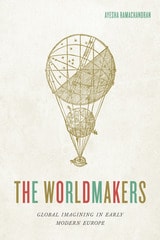
The Worldmakers
Global Imagining in Early Modern EuropeAyesha Ramachandran
University of Chicago Press, 2015
The Worldmakers moves beyond histories of globalization to explore how “the world” itself—variously understood as an object of inquiry, a comprehensive category, and a system of order—was self-consciously shaped by human agents. Gathering an international cast of characters, from Dutch cartographers and French philosophers to Portuguese and English poets, Ramachandran describes a history of firsts: the first world atlas, the first global epic, the first modern attempt to develop a systematic natural philosophy—all part of an effort by early modern thinkers to capture “the world” on the page.
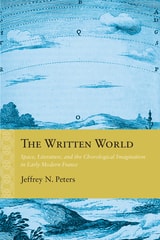
The Written World
Space, Literature, and the Chorological Imagination in Early Modern FranceJeffrey N. Peters
Northwestern University Press, 2018
In analyses of well-known authors such as Corneille, Molière, Racine, and Madame de Lafayette, Peters demonstrates that the apparent absence of physical space in seventeenth-century literary depiction indicates a subtle engagement with, rather than a rejection of, evolving principles of cosmological understanding. Space is not absent in these works so much as transformed in keeping with contemporaneous developments in early modern natural philosophy. The Written World will appeal to philosophers of literature and literary theorists as well as scholars of early modern Europe and historians of science and geography
Theater Enough
American Culture and the Metaphor of the World Stage, 1607–1789Jeffrey H. Richards
Duke University Press, 1991
The rhetoric, or discourse, of early American theater emerged out of the figures of speech that permeated the colonists’ lives and literary productions. Jeffrey H. Richards examines a variety of texts—histories, diaries, letters, journals, poems, sermons, political tracts, trial transcripts, orations, and plays—and looks at the writings of such authors as John Winthrop and Mercy Otis Warren. Richards places the American usage of theatrum mundi—the world depicted as a stage—in the context of classical and Renaissance traditions, but shows how the trope functions in American rhetoric as a register for religious, political, and historical attitudes.
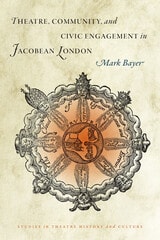
Theatre, Community, and Civic Engagement in Jacobean London
Mark Bayer
University of Iowa Press, 2011
Taking to heart Thomas Heywood’s claim that plays “persuade men to humanity and good life, instruct them in civility and good manners, showing them the fruits of honesty, and the end of villainy,” Mark Bayer’s captivating new study argues that the early modern London theatre was an important community institution whose influence extended far beyond its economic, religious, educational, and entertainment contributions. Bayer concentrates not on the theatres where Shakespeare’s plays were performed but on two important amphitheatres, the Fortune and the Red Bull, that offer a more nuanced picture of the Jacobean playgoing industry. By looking at these playhouses, the plays they staged, their audiences, and the communities they served, he explores the local dimensions of playgoing.
Theology and the Cartesian Doctrine of Freedom
Etienne Gilson
St. Augustine's Press, 2015
Thrifty Science
Making the Most of Materials in the History of ExperimentSimon Werrett
University of Chicago Press, 2018
Thrifty Science explores this distinctive culture of experiment and demonstrates how the values of the household helped to shape an array of experimental inquiries, ranging from esoteric investigations of glowworms and sour beer to famous experiments such as Benjamin Franklin’s use of a kite to show lightning was electrical and Isaac Newton’s investigations of color using prisms. Tracing the diverse ways that men and women put their material possessions into the service of experiment, Werrett offers a history of practices of recycling and repurposing that are often assumed to be more recent in origin. This thriving domestic culture of inquiry was eclipsed by new forms of experimental culture in the nineteenth century, however, culminating in the resource-hungry science of the twentieth. Could thrifty science be making a comeback today, as scientists grapple with the need to make their research more environmentally sustainable?
To Embody the Marvelous
The Making of Illusions in Early Modern SpainEsther Fernández
Vanderbilt University Press, 2021
Winner of the Nancy Staub Award, UNIMA-USA (Union Internationale de la Marionnette), 2023
In its exploration of puppetry and animation as the performative media of choice for mastering the art of illusion, To Embody the Marvelous engages with early modern notions of wonder in religious, artistic, and social contexts.
From jointed, wood-carved figures of Christ, saintly marionettes that performed hagiographical dramas, experimental puppets and automata in Cervantes' Don Quixote, and the mechanical sets around which playwright Calderón de la Barca devised secular magic shows to deconstruct superstitions, these historical and fictional artifacts reenvisioned religious, artistic, and social notions that led early modern society to critically wrestle with enchantment and disenchantment.
The use of animated performance objects in Spanish theatrical contexts during the sixteenth and seventeenth centuries became one of the most effective pedagogical means to engage with civil society. Regardless of social strata, readers and spectators alike were caught up in a paradigm shift wherein belief systems were increasingly governed by reason—even though the discursive primacy of supernatural doxa and Christian wonder remained firmly entrenched. Thanks to their potential for motion, religious and profane puppets, automata, and mechanical stage props deployed a rationalized sense of wonder that illustrates the relationship between faith and reason, reevaluates the boundaries of fiction in art and entertainment cultures, acknowledges the rise of science and technology, and questions normative authority.
To Feast on Us as Their Prey
Cannibalism and the Early Modern AtlanticRachel B. Herrmann
University of Arkansas Press, 2019
Winner, 2020 Association for the Study of Food and Society Book Award, Edited Volume
Long before the founding of the Jamestown, Virginia, colony and its Starving Time of 1609–1610—one of the most famous cannibalism narratives in North American colonial history—cannibalism played an important role in shaping the human relationship to food, hunger, and moral outrage. Why did colonial invaders go out of their way to accuse women of cannibalism? What challenges did Spaniards face in trying to explain Eucharist rites to Native peoples? What roles did preconceived notions about non-Europeans play in inflating accounts of cannibalism in Christopher Columbus’s reports as they moved through Italian merchant circles?
Asking questions such as these and exploring what it meant to accuse someone of eating people as well as how cannibalism rumors facilitated slavery and the rise of empires, To Feast on Us as Their Prey posits that it is impossible to separate histories of cannibalism from the role food and hunger have played in the colonization efforts that shaped our modern world.
Tough Love
Amazon Encounters in the English RenaissanceKathryn Schwarz
Duke University Press, 2000
Despite seeming to function as signs for what is outside the social—the alien, the exotic, the other—Amazons in sixteenth- and seventeenth-century texts were often represented in conventionally domestic roles, as mothers and lovers, wives and queens, Schwarz demonstrates. She traces this pattern in works by Shakespeare, Spenser, Sidney, Raleigh, and Jonson, as well as in such materials as conduct manuals, explorers’ accounts, court spectacles, and political tracts. Through readings of these texts, Schwarz shows that the Amazon myth provided a language both for setting forth and for challenging the terms of social logic. In representations of Amazon encounters, she argues, homosocial bonds became indistinguishable from heterosexual desires, masculine agency attached itself as logically to women as it did to men, and sexual difference was made nearly impossible to sustain or define. Schwarz’s analysis unveils the Amazon as a theoretical term, one that illuminates the tensions and paradoxes through which ideologies of the domestic take shape.
Tough Love contributes to the ongoing discussion of gendered identity and sexual desire in the early modern period. It will interest students of queer theory, cultural studies, early modern history, feminism, and literature.
Toward a Premodern Posthumanism
Anarchic Ontologies of Earthly Life in Early Modern FranceChad Córdova
Northwestern University Press, 2025
Drawing on early modern French thought to free nature and aesthetics from metaphysical humanism
What good is aesthetics in a time of ecological crisis? Toward a Premodern Posthumanism: Anarchic Ontologies of Earthly Life in Early Modern France shows that philosophical aesthetics contains unheeded potentialities for challenging the ontological subjection of nature to the human subject. Drawing on deconstructive, ecological, and biopolitical thought, Chad Córdova uncovers in aesthetics something irreducible to humanist metaphysics: an account of how beings emerge and are interrelated, responsive, and even response-able without reason or why.
This anarchic and atelic ontology, recovered from Kant, becomes the guiding thread for a new, premodern trajectory of posthumanism. Charting a path from Aristotle to Heidegger to today’s plant-thinking, with new readings of Montaigne, Pascal, Diderot, Rousseau, and others along the way, this capacious study reveals the untimely relevance of pre-1800 practices of writing, science, and art. Enacting a multitemporal mode of reading, Córdova offers a defense and illustration of the importance of returning to early modern texts as a way to rethink nature, art, ethics, and politics in a time when these concepts are in flux and more contentious than ever.
Town in the Empire
Government, Politics, and Society in Seventeenth Century PopayánBy Peter Marzahl
University of Texas Press, 1979
During the seventeenth century, many of the fundamental characteristics of Spanish America were established. Peter Marzahl adds significantly to our understanding of this period with this study of Popayán, a town in what was then part of New Granada and is now Colombia. New Granada was something of a backwater of the empire, but very likely Popayán was more typical of everyday colonial life than the major centers that have drawn most attention from historians.
In the first part of his study, Marzahl describes both town and region, depicts economic activities (agriculture, gold mining, trade), and analyzes urban and rural society. Of particular interest is his discussion of the complex interaction among the different ethnic groups: Spaniards, Mestizos, Indians, and Blacks. In the longer second part he presents a detailed account of the makeup and operations of the town councils. His extensive research in primary sources makes possible a thorough examination of Popayán's administration and politics and their relationship to economic and social patterns. He also describes the councils' relations with the provincial governors, the viceregal authorities in Bogotá, and the Church. Because this study treats a neglected period and region and, in so doing, offers fresh materials and insights, it is an important contribution to our knowledge and comprehension of colonial Spanish America.
Towns between Empires
Good Governance and “Police” in Case Studies from Transylvania, Wallachia, and Moldavia, 1500s–1800sMária Pakucs
Central European University Press, 2025
The chapters in the volume capture the widest possible variety of political and administrative systems in the region. Transylvanian towns were structured and governed similarly to other small Central European urban centers, however significant diversity can be discerned following the Reformation. Moldavian and Wallachian towns in the 18th and 19th century are little known to international scholarship, and the chapters in this volume will fill this gap.
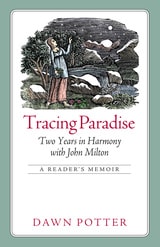
Tracing Paradise
Two Years in Harmony with John MiltonDawn Potter
University of Massachusetts Press, 2009
One winter morning, poet Dawn Potter sat down at her desk in Harmony, Maine, and began copying out the opening lines of John Milton's Paradise Lost. Her intent was to spend half an hour with a poem she had never liked, her goal to transcribe a page or two. Maybe she would begin to appreciate the poet's art, though she had no real expectations that the exercise would change her mind about the poem. Yet what began as a whim turned rapidly into an obsession, and soon Potter was immersed in a strange and unexpected project: she found herself copying out every single word of Milton's immense, convoluted epic.
Tracing Paradise: Two Years in Harmony with John Milton is her memoir of that long task. Over the course of twelve chapters, Potter explores her very personal response to Milton and Paradise Lost, tracing the surprising intersections between a seventeenth-century biblical epic and the routine joys and tragedies of domestic life in contemporary rural Maine. Curious, opinionated, and eager, she engages with the canon on mutable, individual terms. Though she writes perceptively about the details and techniques of Milton's art, always her reactions are linked to her present-tense experiences as a poet, small-time farmer, family member, and citizen of a poor and beleaguered north-country town.
A skilled and entertaining writer, Potter is also a wide-ranging and sophisticated reader. Yet her memoir is not a scholarly treatise: her enthusiasms and misgivings about both Milton and Paradise Lost ebb and flow with the days. Tracing Paradise reminds us that close engagement with another artist's task may itself be a form of creation. Above all, Potter's memoir celebrates one reader's difficult yet transformative love affair with Milton's glorious, irritating, inscrutable masterpiece.
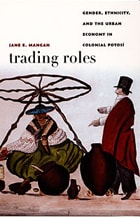
Trading Roles
Gender, Ethnicity, and the Urban Economy in Colonial PotosíJane E. Mangan
Duke University Press, 2005
Drawing on wills and dowries, judicial cases, town council records, and royal decrees, Mangan brings alive the bustle of trade in Potosí. She examines quotidian economic transactions in light of social custom, ethnicity, and gender, illuminating negotiations over vendor locations, kinship ties that sustained urban trade through the course of silver booms and busts, and credit practices that developed to mitigate the pressures of the market economy. Mangan argues that trade exchanges functioned as sites to negotiate identities within this colonial multiethnic society. Throughout the study, she demonstrates how women and indigenous peoples played essential roles in Potosí’s economy through the commercial transactions she describes so vividly.
Tragedy and the Return of the Dead
John D. Lyons
Northwestern University Press, 2018
Early modernity rediscovered tragedy in the dramas and the theoretical writings of the ancient Greeks and Romans. Attempting to make new tragic fictions, writers like Shakespeare, Webster, Hardy, Corneille, and Racine created a dramatic form that would probably have been unrecognizable to the ancient Athenians. Tragedy and the Return of the Dead recovers a model of the tragic that fits ancient tragedies, early modern tragedies, as well as contemporary narratives and films no longer called “tragic” but which perpetuate the same elements.
Authoritative, wide-ranging, and thought provoking, Tragedy and the Return of the Dead uncovers a set of interlocking plots of family violence that stretch from Greek antiquity up to the popular culture of today. Casting aside the elite, idealist view that tragedy manifests the conflict between two equal goods or the human struggle against the divine, John D. Lyons looks closely at tragedy’s staging of gory and painful deaths, ignominious burials, and the haunting return of ghosts. Through this adjusted lens Le Cid, Hamlet, Frankenstein, The Spanish Tragedy, Romeo and Juliet, Phèdre, Macbeth, and other early modern works appear in a striking new light. These works are at the center of a panorama that stretches from Aeschylus’s Agamemnon to Hitchcock’s Psycho and are placed against the background of the Gothic novel, Freud’s “uncanny,” and Burke’s “sublime.”
Lyons demonstrates how tragedy under other names, such as “Gothic fiction” and “thrillers,” is far from dead and continues as a vital part of popular culture.
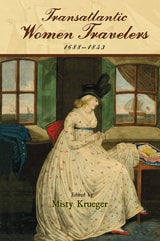
Transatlantic Women Travelers, 1688-1843
Misty Krueger
Bucknell University Press, 2021
Tulipmania
Money, Honor, and Knowledge in the Dutch Golden AgeAnne Goldgar
University of Chicago Press, 2007
“Goldgar tells us at the start of her excellent debunking book: ‘Most of what we have heard of [tulipmania] is not true.’. . . She tells a new story.”—Simon Kuper, Financial Times