Results by title
377 books match the query 'French' and 106 start with t
Tragedy and the Return of the Dead
John D. Lyons
Northwestern University Press, 2018
Early modernity rediscovered tragedy in the dramas and the theoretical writings of the ancient Greeks and Romans. Attempting to make new tragic fictions, writers like Shakespeare, Webster, Hardy, Corneille, and Racine created a dramatic form that would probably have been unrecognizable to the ancient Athenians. Tragedy and the Return of the Dead recovers a model of the tragic that fits ancient tragedies, early modern tragedies, as well as contemporary narratives and films no longer called “tragic” but which perpetuate the same elements.
Authoritative, wide-ranging, and thought provoking, Tragedy and the Return of the Dead uncovers a set of interlocking plots of family violence that stretch from Greek antiquity up to the popular culture of today. Casting aside the elite, idealist view that tragedy manifests the conflict between two equal goods or the human struggle against the divine, John D. Lyons looks closely at tragedy’s staging of gory and painful deaths, ignominious burials, and the haunting return of ghosts. Through this adjusted lens Le Cid, Hamlet, Frankenstein, The Spanish Tragedy, Romeo and Juliet, Phèdre, Macbeth, and other early modern works appear in a striking new light. These works are at the center of a panorama that stretches from Aeschylus’s Agamemnon to Hitchcock’s Psycho and are placed against the background of the Gothic novel, Freud’s “uncanny,” and Burke’s “sublime.”
Lyons demonstrates how tragedy under other names, such as “Gothic fiction” and “thrillers,” is far from dead and continues as a vital part of popular culture.
Transfigurations Of The Maghreb
Feminism, Decolonization, and LiteraturesWinfred Woodhull
University of Minnesota Press, 1993
Through readings of some of the best-known texts in Algerian literature in French, Woodhull both challenges the separation between French and Francophone literatures and cultures in the academy and explores the ways in which "femininity" has been represented in the texts of North African and French writers since the mid-1950s.
Transformations of Memory and Forgetting in Sixteenth-Century France
Marguerite de Navarre, Pierre de Ronsard, Michel de MontaigneNicolas Russell
University of Delaware Press, 2011
This book proposes that in a number of French Renaissance texts, produced in varying contexts and genres, we observe a shift in thinking about memory and forgetting. Focusing on a corpus of texts by Marguerite de Navarre, Pierre de Ronsard, and Michel de Montaigne, it explores several parallel transformations of and challenges to traditional discourses on the human faculty of memory.
Throughout Classical Antiquity and the Middle Ages, a number of influential authors described memory as a powerful tool used to engage important human concerns such as spirituality, knowledge, politics, and ethics. This tradition had great esteem for memory and made great efforts to cultivate it in their pedagogical programs. In the early sixteenth century, this attitude toward memory started to be widely questioned. The invention of the printing press and the early stages of the scientific revolution changed the intellectual landscape in ways that would make memory less important in intellectual endeavors. Sixteenth-century writers began to question the reliability and stability of memory. They became wary of this mental faculty, which they portrayed as stubbornly independent, mysterious, unruly, and uncontrollable–an attitude that became the norm in modern Western thought as is illustrated by the works of Descartes, Locke, Freud, Proust, Foucault, and Nora, for example.
Writing in this new intellectual landscape, Marguerite de Navarre, Ronsard, and Montaigne describe memory not as a powerful tool of the intellect but rather as an uncontrollable mental faculty that mirrored the uncertainty of human life. Their characterization of memory emerges from an engagement with a number of traditional ideas about memory. Notwithstanding the great many differences in concerns of these writers and in the nature of their texts, they react against or transform their classical and medieval models in similar ways. They focus on memory’s unruly side, the ways that memory functions independently of the will. They associate memory with the fluctuations of the body (the organic soul) rather than the stability of the mind (the intellectual soul). In their descriptions of memory, these authors both reflect and contribute to a modern understanding of and attitude towards this mental faculty.
Published by University of Delaware Press. Distributed worldwide by Rutgers University Press.
Traveling in Place
A History of Armchair TravelBernd Stiegler
University of Chicago Press, 2013
Organized into twenty-one “legs”—or short chapters—Traveling in Place begins with a consideration of Xavier de Maistre’s 1794 Voyage autour de ma chambre, an account of the forty-two-day “journey around his room” Maistre undertook as a way to entertain himself while under house arrest. Stiegler is fascinated by the notion of exploring the familiar as though it were completely new and strange. He engages writers as diverse as Roussel, Beckett, Perec, Robbe-Grillet, Cortázar, Kierkegaard, and Borges, all of whom show how the everyday can be brilliantly transformed. Like the best guidebooks, Traveling in Place is more interested in the idea of travel as a state of mind than as a physical activity, and Stiegler reflects on the different ways that traveling at home have manifested themselves in the modern era, from literature and film to the virtual possibilities of the Internet, blogs, and contemporary art.
Reminiscent of the pictorial meditations of Sebald, but possessed of the intellectual playfulness of Calvino, Traveling in Place offers an entertaining and creative Baedeker to journeying at home.

Travels in the Americas
Notes and Impressions of a New WorldAlbert Camus
University of Chicago Press, 2023
In March 1946, the young Albert Camus crossed from Le Havre to New York. Though he was virtually unknown to American audiences at the time, all that was about to change—The Stranger, his first book translated into English, would soon make him a literary star. By 1949, when he set out on a tour of South America, Camus was an international celebrity. Camus’s journals offer an intimate glimpse into his daily life during these eventful years and showcase his thinking at its most personal—a form of observational writing that the French call choses vues (things seen).
Camus’s journals from these travels record his impressions, frustrations, joys, and longings. Here are his unguarded first impressions of his surroundings and his encounters with publishers, critics, and members of the New York intelligentsia. Long unavailable in English, the journals have now been expertly retranslated by Ryan Bloom, with a new introduction by Alice Kaplan. Bloom’s translation captures the informal, sketch-like quality of Camus’s observations—by turns ironic, bitter, cutting, and melancholy—and the quick notes he must have taken after exhausting days of travel and lecturing. Bloom and Kaplan’s notes and annotations allow readers to walk beside the existentialist thinker as he experiences changes in his own life and the world around him, all in his inimitable style.
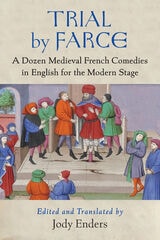
Trial by Farce
A Dozen Medieval French Comedies in English for the Modern StageEdited and Translated by Jody Enders
University of Michigan Press, 2023
Was there more to comedy than Chaucer, the Second Shepherds’ Play, or Shakespeare? Of course! But, for a real taste of medieval and Renaissance humor and in-your-face slapstick, one must cross the Channel to France, where over two hundred extant farces regularly dazzled crowds with blistering satires. Dwarfing all other contemporaneous theatrical repertoires, the boisterous French corpus is populated by lawyers, lawyers everywhere. No surprise there. The lion’s share of mostly anonymous farces was written by barristers, law students, and legal apprentices. Famous for skewering unjust judges and irreligious ecclesiastics, they belonged to a 10,000-member legal society known as the Basoche, which flourished between 1450 and 1550. What is more, their dramatic send-ups of real and fictional court cases were still going strong on the eve of Molière, resilient against those who sought to censor and repress them. The suspenseful wait to see justice done has always made for high drama or, in this case, low drama. But, for centuries, the scripts for these outrageous shows were available only in French editions gathered from scattered print and manuscript sources.
In Trial by Farce, prize-winning theater historian Jody Enders brings twelve of the funniest legal farces to English-speaking audiences in a refreshingly uncensored but philologically faithful vernacular. Newly conceived as much for scholars as for students and theater practitioners, this repertoire and its familiar stock characters come vividly to life as they struggle to negotiate the limits of power, politics, class, gender, and, above all, justice. Through the distinctive blend of wit, social critique, and breathless boisterousness that is farce, we gain a new understanding of comedy itself as form of political correction. In ways presciently modern and even postmodern, farce paints a different cultural picture of the notoriously authoritarian Middle Ages with its own vision of liberty and justice for all. Theater eternally offers ways for new generations to raise their voices and act.