Results by title
645 books match the query 'Judaism' and 172 start with t
The Studia Philonica Annual XXVII, 2015
Studies in Hellenistic JudaismDavid T. Runia
SBL Press, 2015
The best current research on Philo and Hellenistic Judaism
The Studia Philonica Annual is a scholarly journal devoted to the study of Hellenistic Judaism, particularly the writings and thought of the Hellenistic-Jewish writer Philo of Alexandria (circa 15 BCE to circa 50 CE).
Features:
- Articles on aspects of Hellenistic Judaism written by experts in the field
- Bibliography
- Book reviews
The Studia Philonica Annual XXVIII, 2016
Studies in Hellenistic JudaismDavid T. Runia
SBL Press, 2016
Celebrate the contributions of David T. Runia
The Studia Philonica Annual is a scholarly journal devoted to the study of Hellenistic Judaism, particularly the writings and thought of the Hellenistic-Jewish writer Philo of Alexandria. More than fifteen scholars from around the world offer contributions to this special edition of the Annual in honor of Professor David T. Runia on the occasion of his 65th birthday and retirement from his post as Master of Queens College, University of Melbourne. Professor Runia is internationally recognized as one of the world's foremost experts on Philo of Alexandria. As founder of The Studia Philonica Annual, he has been editor or coeditor for twenty-seven years. He initiated a Philo Bibliography project prior to the Annual and incorporated the bibliography into the Annual from the outset. It serves as the primary bibliography for Philonic studies worldwide.
The Studia Philonica Annual XXX, 2018
Studies in Hellenistic JudaismDavid T. Runia
SBL Press, 2018
Studies on Philo and Hellenistic Judaism from experts in the field
The Studia Philonica Annual is a scholarly journal devoted to the study of Hellenistic Judaism, particularly the writings and thought of the Hellenistic-Jewish writer Philo of Alexandria. This volume includes five articles on topics ranging from preserved fragments of Philo to travel in Philo’s works. Nine book reviews cover recent books on Philo, Josephus, and ancient pedagogy.
Features:
- Articles on aspects of Hellenistic Judaism written by scholars from around the world
- Comprehensive bibliography and book reviews
The Studia Philonica Annual XXXI, 2019
Studies in Hellenistic JudaismDavid T. Runia
SBL Press, 2019
Studies on Philo and Hellenistic Judaism from experts in the field
The Studia Philonica Annual is a scholarly journal devoted to the study of Hellenistic Judaism, particularly the writings and thought of the Hellenistic-Jewish writer Philo of Alexandria. This volume includes articles on allegory, Platonic interpretations of the law, rhetoric, and Philo’s thoughts on reincarnation.
Features:
- Articles on aspects of Hellenistic Judaism written by scholars from around the world
- Comprehensive bibliography and book reviews
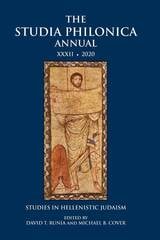
The Studia Philonica Annual XXXII, 2020
Studies in Hellenistic JudaismDavid T. Runia
SBL Press, 2021
Celebrate the contributions of Gregory E. Sterling
Harold W. Attridge, Ellen Birnbaum, Adela Yarbro Collins, John J. Collins, Michael B. Cover, Jan Willem van Henten, Carl R. Holladay, Andrew McGowan, Karl-Wilhelm Niebuhr, Maren R. Niehoff, James R. Royse, and David T. Runia offer essays honoring Professor Gregory E. Sterling in this special edition of the The Studia Philonica Annual. This volume includes a biography of Sterling’s life by David T. Runia and a bibliography of Sterling’s scholarship by Michael B. Cover. Essays cover a range of topics on Philo, the Bible, and Josephus.
Features:
- Articles on aspects of Hellenistic Judaism written by scholars from around the world
- Comprehensive bibliography of scholarship on Philo
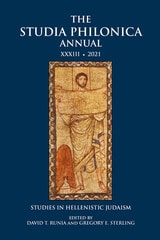
The Studia Philonica Annual XXXIII, 2021
Studies in Hellenistic JudaismDavid T. Runia
SBL Press, 2021
Studies on Philo and Hellenistic Judaism from experts in the field
The Studia Philonica Annual is a scholarly journal devoted to the study of Hellenistic Judaism, particularly the writings and thought of the Hellenistic-Jewish writer Philo of Alexandria (circa 15 BCE to circa 50 CE). Volume 33 includes a special section on the history of editions of Philo, five general articles on Philo’s work, an annotated bibliography, and thirteen book reviews.
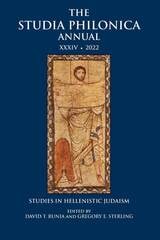
The Studia Philonica Annual XXXIV, 2022
Studies in Hellenistic JudaismDavid T. Runia
SBL Press, 2022
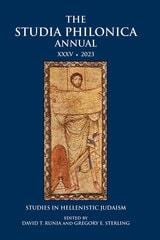
The Studia Philonica Annual XXXV, 2023
Studies in Hellenistic JudaismDavid T. Runia
SBL Press, 2023
The Studia Philonica Annual is a scholarly journal devoted to the study of Hellenistic Judaism, particularly the writings and thought of the Hellenistic-Jewish writer Philo of Alexandria (circa 15 BCE to circa 50 CE).
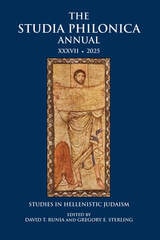
The Studia Philonica Annual XXXVII, 2025
Studies in Hellenistic JudaismDavid T. Runia
SBL Press, 2015
The Studia Philonica Annual is a scholarly journal devoted to the study of Hellenistic Judaism, particularly the writings and thought of the Hellenistic-Jewish writer Philo of Alexandria (circa 15 BCE to circa 50 CE). This volume includes a special section on Philo's De providentia, six additional articles, annotated bibliographies, and a book review section.
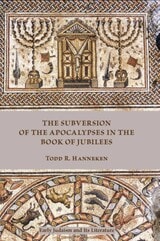
The Subversion of the Apocalypses in the Book of Jubilees
Todd R. Hanneken
SBL Press, 2012

The Talmud of the Land of Israel, Volume 10
Orlah and BikkurimJacob Neusner, General Editor
University of Chicago Press, 1991
The Talmud of the Land of Israel, Volume 11
ShabbatJacob Neusner, General Editor
University of Chicago Press, 1991
The Talmud of the Land of Israel, Volume 12
ErubinJacob Neusner, General Editor
University of Chicago Press, 1990
The Talmud of the Land of Israel, Volume 13
Yerushalmi PesahimJacob Neusner, General Editor
University of Chicago Press, 1995
Yerushalmi Pesahim details the specific requirements regarding the preparation for Passover, the Passover sacrifice, and the Seder. Commenting on the many, often contradictory, prescriptions in Exodus, Leviticus, Numbers, and Deuteronomy, this tractate is an important part of a long tradition of interpretation regarding Passover.
The Talmud of the Land of Israel, Volume 14
YomaJacob Neusner, General Editor
University of Chicago Press, 1991
The Talmud of the Land of Israel, Volume 15
SheqalimJacob Neusner, General Editor
University of Chicago Press, 1990
The Talmud of the Land of Israel, Volume 16
Rosh HashanahJacob Neusner, General Editor
University of Chicago Press, 1988
The Talmud of the Land of Israel, Volume 17
SukkahJacob Neusner, General Editor
University of Chicago Press, 1988
The Talmud of the Land of Israel, Volume 18
Besah and TaanitJacob Neusner, General Editor
University of Chicago Press, 1987
The Talmud of the Land of Israel, Volume 19
MegillahJacob Neusner, General Editor
University of Chicago Press, 1987
The Talmud of the Land of Israel, Volume 1
BerakhotJacob Neusner, General Editor
University of Chicago Press, 1989
The Talmud of the Land of Israel, Volume 20
Hagigah and Moed QatanJacob Neusner, General Editor
University of Chicago Press, 1986
The Talmud of the Land of Israel, Volume 21
YebamotJacob Neusner, General Editor
University of Chicago Press, 1987
The Talmud of the Land of Israel, Volume 22
KetubotJacob Neusner, General Editor
University of Chicago Press, 1985
The Talmud of the Land of Israel, Volume 23
NedarimJacob Neusner, General Editor
University of Chicago Press, 1985
The Talmud of the Land of Israel, Volume 24
NazirJacob Neusner, General Editor
University of Chicago Press, 1985
The Talmud of the Land of Israel, Volume 25
GittinJacob Neusner, General Editor
University of Chicago Press, 1985
The Talmud of the Land of Israel, Volume 26
QiddushinJacob Neusner, General Editor
University of Chicago Press, 1984
The Talmud of the Land of Israel, Volume 27
SotahJacob Neusner, General Editor
University of Chicago Press, 1984
The Talmud of the Land of Israel, Volume 28
Baba QammaJacob Neusner, General Editor
University of Chicago Press, 1984
The Talmud of the Land of Israel, Volume 29
Baba MesiaJacob Neusner, General Editor
University of Chicago Press, 1984
The Talmud of the Land of Israel, Volume 2
Yerushalmi PeahJacob Neusner, General Editor
University of Chicago Press, 1990
The Talmud of the Land of Israel, Volume 30
Baba BatraJacob Neusner, General Editor
University of Chicago Press, 1984
The Talmud of the Land of Israel, Volume 31
Sanhedrin and MakkotJacob Neusner, General Editor
University of Chicago Press, 1984
The Talmud of the Land of Israel, Volume 33
Abodah ZarahJacob Neusner, General Editor
University of Chicago Press, 1982
The Talmud of the Land of Israel, Volume 34
Horayat and NiddahJacob Neusner, General Editor
University of Chicago Press, 1982
The Talmud of the Land of Israel, Volume 35
Introduction. TaxonomyJacob Neusner, General Editor
University of Chicago Press, 1984
The Talmud of the Land of Israel, Volume 3
DemaiJacob Neusner, General Editor
University of Chicago Press, 1993
The Talmud of the Land of Israel, Volume 4
KilayimJacob Neusner, General Editor
University of Chicago Press, 1991
The Talmud of the Land of Israel, Volume 5
ShebiitJacob Neusner, General Editor
University of Chicago Press, 1991
The Talmud of the Land of Israel, Volume 6
TerumotJacob Neusner, General Editor
University of Chicago Press, 1987
The Talmud of the Land of Israel, Volume 7
MaaserotJacob Neusner, General Editor
University of Chicago Press, 1987
The Talmud of the Land of Israel, Volume 8
Maaser SheniJacob Neusner, General Editor
University of Chicago Press, 1993
The Talmud of the Land of Israel, Volume 9
HallahJacob Neusner, General Editor
University of Chicago Press, 1991
The Trace of Judaism
Dostoevsky, Babel, Mandelstam, LevinasVal Vinokur
Northwestern University Press, 2009
The defining quality of Russian literature, for most critics, is its ethical seriousness expressed through formal originality. The Trace of Judaism addresses this characteristic through the thought of the Lithuanian-born Franco-Jewish philosopher Emmanuel Levinas. Steeped in the Russian classics from an early age, Levinas drew significantly from Dostoevsky in his ethical thought. One can profitably read Russian literature through Levinas, and vice versa.
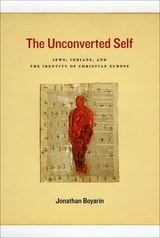
The Unconverted Self
Jews, Indians, and the Identity of Christian EuropeJonathan Boyarin
University of Chicago Press, 2009
Europe’s formative encounter with its “others” is still widely assumed to have come with its discovery of the peoples of the New World. But, as Jonathan Boyarin argues, long before 1492 Christian Europe imagined itself in distinction to the Jewish difference within. The presence and image of Jews in Europe afforded the Christian majority a foil against which it could refine and maintain its own identity. In fundamental ways this experience, along with the ongoing contest between Christianity and Islam, shaped the rhetoric, attitudes, and policies of Christian colonizers in the New World.
The Unconverted Self proposes that questions of difference inside Christian Europe not only are inseparable from the painful legacy of colonialism but also reveal Christian domination to be a fragile construct. Boyarin compares the Christian efforts aimed toward European Jews and toward indigenous peoples of the New World, bringing into focus the intersection of colonial expansion with the Inquisition and adding significant nuance to the entire question of the colonial encounter.
Revealing the crucial tension between the Jews as “others within” and the Indians as “others without,” The Unconverted Self is a major reassessment of early modern European identity.
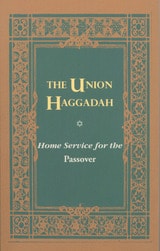
The Union Haggadah
Home Service for the PassoverCentral Conference of American Rabbis
Central Conference of American Rabbis, 1923
A reprint of the historic Reform Haggadah originally published in 1923. In addition to the complete Passover home service, this edition includes an extensive section of essays on Passover in history, literature, and art. An important document of American Reform Jewish history. Illustrated.
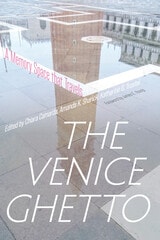
The Venice Ghetto
A Memory Space that TravelsEdited by Chiara Camarda, Amanda K. Sharick, and Katharine G. Trostel
University of Massachusetts Press, 2022
This interdisciplinary collection engages with questions about the history, conditions, and lived experience of the Venice Ghetto, including its legacy as a compulsory, segregated, and enclosed space. Contributors also consider the ghetto's influence on the figure of the Renaissance moneylender, the material culture of the ghetto archive, the urban form of North Africa's mellah and hara, and the ghetto's impact on the writings of Primo Levi and Marjorie Agosín.
In addition to the volume editors, The Venice Ghetto features a foreword from James E. Young and contributions from Shaul Bassi, Murray Baumgarten, Margaux Fitoussi, Dario Miccoli, Andrea Yaakov Lattes, Federica Ruspio, Michael Shapiro, Clive Sinclair, and Emanuela Trevisan Semi.
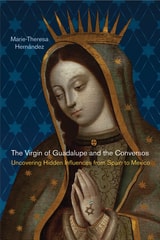
The Virgin of Guadalupe and the Conversos
Uncovering Hidden Influences from Spain to MexicoHernández, Marie-Theresa
Rutgers University Press, 2014
The terms converso and judaizante are often used for descendants of Spanish Jews (the Sephardi, or Sefarditas as they are sometimes called), who converted under duress to Christianity in the fourteenth and fifteenth centuries. There are few, if any, archival documents that prove the existence of judaizantes after the Spanish expulsion of the Jews in 1492 and the Portuguese expulsion in 1497, as it is unlikely that a secret Jew in sixteenth-century Spain would have documented his allegiance to the Law of Moses, thereby providing evidence for the Inquisition.
On a Da Vinci Code – style quest, Hernández persisted in hunting for a trove of forgotten manuscripts at the New York Public Library. These documents, once unearthed, describe the Jewish/Christian religious beliefs of an early nineteenth-century Catholic priest in Mexico City, focusing on the relationship between the Virgin of Guadalupe and Judaism. With this discovery in hand, the author traces the cult of Guadalupe backwards to its fourteenth-century Spanish origins. The trail from that point forward can then be followed to its interface with early modern conversos and their descendants at the highest levels of the Church and the monarchy in Spain and Colonial Mexico. She describes key players who were somehow immune to the dangers of the Inquisition and who were allowed the freedom to display, albeit in a camouflaged manner, vestiges of their family's Jewish identity.
By exploring the narratives produced by these individuals, Hernández reveals the existence of those conversos and judaizantes who did not return to the “covenantal bond of rabbinic law,” who did not publicly identify themselves as Jews, and who continued to exhibit in their influential writings a covert allegiance and longing for a Jewish past. This is a spellbinding and controversial story that offers a fresh perspective on the origins and history of conversos.
The Vision of the Priestly Narrative
Its Genre and Hermeneutics of TimeSuzanne Boorer
SBL Press, 2016
A fresh look at the Priestly narrative that places less weight on linguistic criteria alone in favor of narrative coherence
Boorer explores the theology of an originally independent Priestly narrative (Pg), extending through Genesis–Numbers, as a whole. In this book she describes the structure of the Priestly narrative, in particular its coherent sequential and parallel patterns. Boorer argues that at every point in the narrative’s sequential and parallel structure, it reshapes past traditions, synthesizing these with contemporary and unique elements into future visions, in a way that is akin to the timelessness of liturgical texts. The book sheds new light on what this material might have sought to accomplish as a whole, and how it might have functioned for, its original audience.
- Solid arguments based on genre and themes, with regard to a once separate Priestly narrative (Pg) that concludes in Numbers 27*
- Thorough discussion of the overall interpretation of the Priestly narrative (Pg), by bringing together consideration of its structure and genre
- Clear illustration of how understanding the genre of the material and its hermeneutics of time is vital for interpreting Pg as a whole