642 books match the query 'Linguistics' and 113 start with t
cover of Tokens of Meaning: Papers in Honor of Lauri Karttunen

Tokens of Meaning

Papers in Honor of Lauri Karttunen

Edited by Cleo Condoravdi and Tracy Holloway King

CSLI, 2019
Lauri Karttunen has done groundbreaking work in theoretical and computational linguistics. The papers in this volume present new, state-of-the-art work building on his numerous contributions. The first part includes papers on formal semantics, the focus of Karttunen's early career to which he has returned in recent years. The second part provides a natural extension of his semantic work: the formal analysis of meaning and reasoning and the integration of the lexical and ontological components to enable reasoning by computational systems. The third part focuses on syntactic analyses, including the structure of non-finite clauses and sentence embedding predicates and factivity. The final part of the volume deals with finite state methods and grammars, reflecting Karttunen's extensive contributions to finite state theory and technology and its application to natural language.
[more]
cover of Tondi Songway Kiini: Reference Grammar and TSK-English-French Dictionary

Tondi Songway Kiini

Reference Grammar and TSK-English-French Dictionary

Jeffrey Heath

CSLI, 2005

Only recently discovered by linguistic scholars, Tondi Songway Kiini (TSK) is a tonal language spoken in the small country of Mali in western Africa. Unlike other Songhay languages, TSK preserves the lexical and grammatical tones of its proto-language and also exhibits unique systems for the expression of focalization and relativization. Tondi Songway Kiini is a valuable overview of the grammar of an African language with a tone system quite different from that of the more familiar Bantu system. It is also an irreplaceable guide to the grammar and meanings of this unusual African language.
[more]
cover of Total Speech: An Integrational Linguistic Approach to Language

Total Speech

An Integrational Linguistic Approach to Language

Michael Toolan

Duke University Press, 1996

Units, rules, codes, systems: this is how most linguists study language. Integrationalists such as Michael Toolan, however, focus instead on how language functions in seamless tandem with the rest of human activity. In Total Speech, Toolan provides a clear and comprehensive account of integrationalism, a major new theory of language that declines to accept that text and context, language and world, are distinct and stable categories. At the same time, Toolan extends the integrationalist argument and calls for a radical change in contemporary theorizing about language and communication.
In every foundational area of linguistics—from literal meaning and metaphor to the nature of repetition to the status of linguistic rules—Toolan advances fascinating and provocative criticisms of received linguistic assumptions. Drawing inspiration from the writings of language theorist Roy Harris, Toolan brings the integrationalist perspective to bear on legal cases, the reception of Salman Rushdie, poetry, and the language of children. Toolan demonstrates that the embeddedness of language and the situation-sensitive mutability of meaning reveal language as a tool for re-fashioning and renewal.
Total Speech breaks free of standard linguistics’ fascinated attraction with “cognitive blueprints” and quasi-algorithmic processing to characterize language anew. Toolan’s reflections on the essence of language, including his important discussion of intention, have strong implications for students and scholars of discourse analysis, literature, the law, anthropology, philosophy of language, communication theory, and cognitive science, as well as linguistics.

[more]
cover of Toward a Deaf Translation Norm

Toward a Deaf Translation Norm

Christopher A. Stone

Gallaudet University Press, 2009

As access to deaf people grows around the world, a new profession has begun to emerge as well, that of Deaf translators and interpreters (T/Is). In his new study Toward a Deaf Translation Norm, Christopher Stone explores this innovation, including its antecedents and how it is manifested in public places. Most importantly, Stone investigates whether or not a translation norm has evolved for Deaf T/Is as increasing numbers of them work in the mainstream translating for websites, public services, government literature, and television media.

For his study, the sixth volume in the Studies in Interpretation series, Stone concentrated his research in the United Kingdom. Specifically, he examined the rendering of English broadcast television news into British Sign Language (BSL) by both Deaf and hearing T/Is. Segments of the data feature simultaneous Deaf and hearing in-vision T/I broadcasts. Recording these broadcasts produced a controlled product that enabled direct comparison of the Deaf and hearing T/Is. Close analysis of these examples revealed to Stone that Deaf T/s not only employ a Deaf translation norm, they take labors to shape their BSL text into a stand-alone product rather than a translation. Ultimately, Toward a Deaf Translation Norm opens up engrossing new vistas on current deliberation about neutrality in translation and interpretation.
[more]
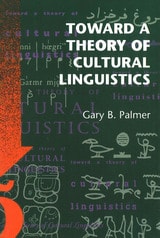
cover of Toward a Theory of Cultural Linguistics

Toward a Theory of Cultural Linguistics

By Gary B. Palmer

University of Texas Press, 1996

Imagery, broadly defined as all that people may construe in cognitive models pertaining to vision, hearing, touch, taste, smell, and feeling states, precedes and shapes human language. In this pathfinding book, Gary B. Palmer restores imagery to a central place in studies of language and culture by bringing together the insights of cognitive linguistics and anthropology to form a new theory of cultural linguistics.

Palmer begins by showing how cognitive grammar complements the traditional anthropological approaches of Boasian linguistics, ethnosemantics, and the ethnography of speaking. He then applies his cultural theory to a wealth of case studies, including Bedouin lamentations, spatial organization in Coeur d'Alene place names and anatomical terms, Kuna narrative sequence, honorifics in Japanese sales language, the domain of ancestral spirits in Proto-Bantu noun-classifiers, Chinese counterfactuals, the non-arbitrariness of Spanish verb forms, and perspective schemas in English discourse.

This pioneering approach suggests innovative solutions to old problems in anthropology and new directions for research. It will be important reading for everyone interested in anthropology, linguistics, cognitive science, and philosophy.
[more]
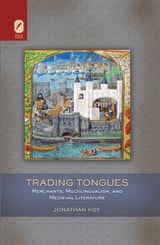
cover of Trading Tongues: Merchants, Multilingualism, and Medieval Literature

Trading Tongues

Merchants, Multilingualism, and Medieval Literature

Jonathan Hsy

The Ohio State University Press, 2013

Trading Tongues offers fresh approaches to the multilingualism of major early English authors like Geoffrey Chaucer, John Gower, Margery Kempe, and William Caxton, and lesser-known figures like French lyricist Charles d’Orléans. Juxtaposing literary works with contemporaneous Latin and French civic records, mixed-language merchant miscellanies, and bilingual phrasebooks, Jonathan Hsy illustrates how languages commingled in late medieval and early modern cities. Chaucer, a customs official for the Port of London, infused English poetry with French and Latin merchant jargon, and London merchants incorporated Latin and vernacular verse forms into trilingual account books.
 
Hsy examines how writers working in English, Latin, and French (and combinations thereof) theorized the rich contours of polyglot identity. In a range of genres—from multilingual lyrics, poems about urban life, and autobiographical narratives—writers found venues to consider their own linguistic capacities and to develop new modes of conceiving language contact and exchange. Interweaving close readings of medieval texts with insights from sociolinguistics and postcolonial theory, Trading Tongues not only illuminates how multilingual identities were expressed in the past; it generates new ways of thinking about cultural contact and language crossings in our own time.
[more]
cover of Transcendental Wordplay: America’s Romantic Punsters and the Search for the Language of Nature

Transcendental Wordplay

America’s Romantic Punsters and the Search for the Language of Nature

Michael West

Ohio University Press, 2000

Throughout the first half of the nineteenth century, America was captivated by a muddled notion of “etymology.” New England Transcendentalism was only one outcropping of a nationwide movement in which schoolmasters across small-town America taught students the roots of words in ways that dramatized religious issues and sparked wordplay.

Shaped by this ferment, our major romantic authors shared the sensibility that Friedrich Schlegel linked to punning and christened “romantic irony.” Notable punsters or etymologists all, they gleefully set up as sages, creating jocular masterpieces from their zest for oracular wordplay. Their search for a primal language lurking beneath all natural languages provided them with something like a secret language that encodes their meanings. To fathom their essentially comic masterpieces we must decipher it.

Interpreting Thoreau as an ironic moralist, satirist, and social critic rather than a nature-loving mystic, Transcendental Wordplay suggests that the major American Romantics shared a surprising conservatism. In this award-winning study, Professor West rescues the pun from critical contempt and allows readers to enjoy it as a serious form of American humor.
[more]
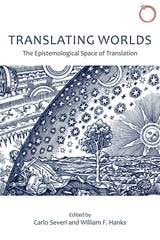
cover of Translating Worlds: The Epistemological Space of Translation

Translating Worlds

The Epistemological Space of Translation

Edited by Carlo Severi and William F. Hanks

HAU, 2015

Set against the backdrop of anthropology’s recent focus on various “turns” (whether ontological, ethical, or otherwise), this pathbreaking volume returns to the question of knowledge and the role of translation as a theoretical and ethnographic guide for twenty-first century anthropology, gathering together contributions from leading thinkers in the field.

Since Ferdinand de Saussure and Franz Boas, languages have been seen as systems whose differences make precise translation nearly impossible. And still others have viewed translation between languages as principally indeterminate. The contributors here argue that the challenge posed by the constant confrontation between incommensurable worlds and systems may be the most fertile ground for state-of-the-art ethnographic theory and practice. Ranging from tourism in New Guinea to shamanism in the Amazon to the globally ubiquitous restaurant menu, the contributors mix philosophy and ethnography to redefine translation not only as a key technique for understanding ethnography but as a larger principle in epistemology.  

[more]
cover of Traslados/Translations: Essays on Latin America in Honour of Jason Wilson

Traslados/Translations

Essays on Latin America in Honour of Jason Wilson

Edited by Claire Lindsay

University of London Press, 2012
This volume is an investigation of some of the enduring preoccupations of one of the UK's foremost Latin Americanists. The essays, by a distinguished group of scholars including former students, colleagues, and intellectual interlocutors, reflect a number of Jason Wilson's many research interests. They continue conversations with Wilson and develop lines of enquiry fostered by his work in areas as diverse as travel, translation, cultural and intellectual history, and literary and visual culture.At the same time, the essays address a wide selection of important topics in Latin American studies and contribute to our understanding of the region's culture and history (for example, by engaging with recent historical re-evaluations of Alexander von Humboldt, amplifying the emerging scholarship on post conflict visual representations of Argentina, and enriching our knowledge of the works of writers such as Jorge Luis Borges and Alejandra Pizarnik.)
[more]
cover of Tree Adjoining Grammars: Formalisms, Linguistic Analysis and Processing

Tree Adjoining Grammars

Formalisms, Linguistic Analysis and Processing

Edited by Anne Abeillé and Owen Rambow

CSLI, 2000

Past research conducted on natural language syntax has occasionally employed the well-known mathematical formalism Context-Free Grammar, defined by Noam Chomsky in 1957. But recent studies have indicated that this approach may not always be ideal in analyzing all types of natural languages. Researchers in theoretical linguistics, psycholinguistics, cognitive science, and in natural language processing have recently converged on a collective insight: formalizing the syntax of words is central to describing, understanding, and analyzing language. This insight has sparked considerable interest in Tree Adjoining Grammar (TAG). Unlike traditional approaches for analyzing natural language syntax, TAG is a lexically-oriented mathematical formalism that can precisely capture the syntactic properties of natural languages such as English, French, and Korean. Tree Adjoining Grammars is the first ever collection of works that discusses the use of the TAG framework in natural language research. The volume begins with an introductory chapter that provides an overview of TAG and key research projects that have utilized the TAG framework in the past. Contributors discuss the formalism itself, its use in analyzing linguistic phenomena, and its use in building natural language processing systems. A glossary and extensive bibliography is included, allowing the volume to be accessible to a broad audience. The selection of works in this volume were presented at the Third International Workshop in Tree Adjoining Grammars and Related Formalisms held in Paris in 1994.
[more]
cover of Trinidad Yoruba: From Mother-Tongue to Memory

Trinidad Yoruba

From Mother-Tongue to Memory

Maureen Warner-Lewis

University of Alabama Press, 2009

A deeply informed Afrocentric view of language and cultural retention under slavery.

Maureen Warner-Lewis offers a comprehensive description of the West African language of Yoruba as it has been used on the island of Trinidad in the southern Caribbean. The study breaks new ground in addressing the experience of Africans in one locale of the Africa Diaspora and examines the nature of their social and linguistic heritage as it was successively retained, modified, and discarded in a European-dominated island community.
[more]
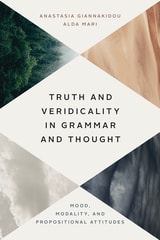
cover of Truth and Veridicality in Grammar and Thought: Mood, Modality, and Propositional Attitudes

Truth and Veridicality in Grammar and Thought

Mood, Modality, and Propositional Attitudes

Anastasia Giannakidou and Alda Mari

University of Chicago Press, 2021

Can language directly access what is true, or is the truth judgment affected by the subjective, perhaps even solipsistic, constructs of reality built by the speakers of that language? The construction of such subjective representations is known as veridicality, and in this book Anastasia Giannakidou and Alda Mari deftly address the interaction between truth and veridicality in the grammatical phenomena of mood choice: the indicative and subjunctive choice in the complements of modal expressions and propositional attitude verbs.

Combining several strands of analysis—formal linguistic semantics, syntactic theory, modal logic, and philosophy of language—Giannakidou and Mari’s theory not only enriches the analysis of linguistic modality, but also offers a unified perspective of modals and propositional attitudes. Their synthesis covers mood, modality, and attitude verbs in Greek and Romance languages, while also offering broader applications for languages lacking systematic mood distinction, such as English. Truth and Veridicality in Grammar and Thought promises to shape longstanding conversations in formal semantics, pragmatics, and philosophy of language, among other areas of linguistics.
[more]
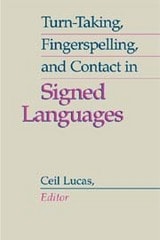
cover of Turn-Taking, Fingerspelling, and Contact in Signed Languages

Turn-Taking, Fingerspelling, and Contact in Signed Languages

Ceil Lucas

Gallaudet University Press, 2002

From Reviewer's Bookwatch, a publication of The Midwest Book Review Compiled and edited by Ceil Lucas, Turn-Taking, Fingerspelling, and Contact in Signed Languages is the eighth volume in the outstanding Gallaudet University Press "Sociolinguistics in Deaf Communities series." The ten contributors bring to their work an expertise in their subject matter and an ability to present their material with a careful balance of scholarship and accessibility. The essays include Kristin J. Mulrooney's "Variation in ASL Fingerspelling"; Bruce A. Sofinski's "So, Why Do I Call This English?"; Paul Dudis' "Grounded Blend Maintenance as a Discourse Strategy"; Mieke Van Herreweghe's "Turn-Taking Mechanisms and Active Participation in Meetings with Deaf and Hearing Participants in Flanders." The final article, "Deaf People in Bilingual Speaking Communities: The Case of Deaf People in Bareclona," is the impressive and collaborative work of Esperanza Morales-Lopez, Delfina Agliaga-Emetrio, Jesus Amador Alonso-Rodriguez, Rosa Maria Boldu-Menasanch, Julia Garrusta-Ribes, and Victoria Gras Ferrer. Turn-Taking, Fingerspelling, and Contact in Signed Languages is a welcome and strongly recommended addition to Signing and Sign Language academic reference collections and supplemental reading lists. Ceil Lucas is Professor of Linguistics in the Department of Linguistics and Interpretation at Gallaudet University.
[more]