Results by title
479 books match the query 'Methodology' and 116 start with t
Thinking About History
Sarah Maza
University of Chicago Press, 2017
Designed for the classroom, Thinking About History is organized around big questions: Whose history do we write, and how does that affect what stories get told and how they are told? How did we come to view the nation as the inevitable context for history, and what happens when we move outside those boundaries? What is the relation among popular, academic, and public history, and how should we evaluate sources? What is the difference between description and interpretation, and how do we balance them? Maza provides choice examples in place of definitive answers, and the result is a book that will spark classroom discussion and offer students a view of history as a vibrant, ever-changing field of inquiry that is thoroughly relevant to our daily lives.
Thinking Like a Political Scientist
A Practical Guide to Research MethodsChristopher Howard
University of Chicago Press, 2017
With wit and practical wisdom, Christopher Howard draws on more than a decade of experience teaching research methods to transform a typically dreary subject and teach budding political scientists the critical skills they need to read published research more effectively and produce better research of their own. The first part of the book is devoted to asking three fundamental questions in political science: What happened? Why? Who cares? In the second section, Howard demonstrates how to answer these questions by choosing an appropriate research design, selecting cases, and working with numbers and written documents as evidence. Drawing on examples from American and comparative politics, international relations, and public policy, Thinking Like a Political Scientist highlights the most common challenges that political scientists routinely face, and each chapter concludes with exercises so that students can practice dealing with those challenges.
Thinking Through Methods
A Social Science PrimerJohn Levi Martin
University of Chicago Press, 2017
This is a user’s guide to sociological research, designed to be used at both the undergraduate and graduate level. Rather than offer mechanical rules and applications, Martin chooses instead to team up with the reader to think through and with methods. He acknowledges that we are human beings—and thus prone to the same cognitive limitations and distortions found in subjects—and proposes ways to compensate for these limitations. Martin also forcefully argues for principled symmetry, contending that bad ethics makes for bad research, and vice versa. Thinking Through Methods is a landmark work—one that students will turn to again and again throughout the course of their sociological research.
Thinking Through Statistics
John Levi Martin
University of Chicago Press, 2018
Martin argues that the task of social statistics isn't to estimate parameters, but to reject false theory. He illustrates common pitfalls that can keep researchers from doing just that using a combination of visualizations, re-analyses, and simulations. Thinking Through Statistics gives social science practitioners accessible insight into troves of wisdom that would normally have to be earned through arduous trial and error, and it does so with a lighthearted approach that ensures this field guide is anything but stodgy.
Thinking the US South
Contemporary Philosophy from Southern PerspectivesEdited by Shannon Sullivan
Northwestern University Press, 2021
Knowledge emerges from contexts, which are shaped by people’s experiences. The varied essays in Thinking the US South: Contemporary Philosophy from Southern Perspectives demonstrate that Southern identities, borders, and practices play an important but unacknowledged role in ethical, political, emotional, and global issues connected to knowledge production. Not merely one geographical region among others, the US South is sometimes a fantasy and other times a nightmare, but it is always a prominent component of the American national imaginary. In connection with the Global North and Global South, the US South provides a valuable perspective from which to explore race, class, gender, and other inter- and intra-American differences. The result is a fresh look at how identity is constituted; the role of place, ancestors, and belonging in identity formation; the impact of regional differences on what counts as political resistance; the ways that affect and emotional labor circulate; practices of boundary policing, deportation, and mourning; issues of disability and slowness; racial and other forms of suffering; and above all, the question of whether and how doing philosophy changes when done from Southern standpoints. Examining racist tropes, Indigenous land claims, Black Southern philosophical perspectives, migrant labor, and more, this incisive anthology makes clear that roots matter.
This Wide and Universal Theater
Shakespeare in Performance, Then and NowDavid Bevington
University of Chicago Press, 2007
Many readers first encounter Shakespeare’s plays in a book rather than a theater. Yet Shakespeare was through and through a man of the stage. So what do we lose when we leave Shakespeare the practitioner behind, and what do we learn when we think about his plays as dramas to be performed?
David Bevington answers these questions with This Wide and Universal Theater, which explores how Shakespeare’s plays were produced both in his own time and in succeeding centuries. Making use of historical documents and the play scripts themselves, Bevington brings Shakespeare’s original stagings to life. He explains how the Elizabethan playhouse conveyed a sense of place using minimal scenery, from the Forest of Arden in As You Like It to the tavern in Henry IV, Part I. Moving beyond Shakespeare’s lifetime, Bevington shows the prodigious lengths to which eighteenth- and nineteenth-century companies went to produce spectacular effects, from flying witches in Macbeth to terrifying storms punctuating King Lear. To bring the book into the present, Bevington considers recent productions on both stage and screen, when character and language have taken precedence over spectacle. This volume brings a lifetime of study to bear on a remarkably underappreciated aspect of Shakespeare’s art.
“An eminent Shakespeare scholar and author, Bevington offers a concise, lucid, and unique overview of the history of Shakespeare in various modes of performance, from stage to film to television.”—Choice
“Even veteran Shakespeareans will profit from the varied reminders of how important performance and staging have always been to the interpretation of the plays.”—Renaissance Quarterly
Thomas Aquinas' Trinitarian Theology
A Study in Theological MethodTimothy L Smith
Catholic University of America Press, 2003
Time Matters
On Theory and MethodAndrew Abbott
University of Chicago Press, 2001
Time Matters focuses particularly on questions of time, events, and causality. Abbott grounds each essay in straightforward examinations of actual social scientific analyses. Throughout, he demonstrates the crucial assumptions we make about causes and events, about actors and interaction and about time and meaning every time we employ methods of social analysis, whether in academic disciplines, market research, public opinion polling, or even evaluation research. Turning current assumptions on their heads, Abbott not only outlines the theoretical orthodoxies of empirical social science, he sketches new alternatives, laying down foundations for a new body of social theory.
Time in Archaeology
Time Perspectivism RevisitedSimon Holdaway
University of Utah Press, 2011
The point of departure for this volume lies in the post-tumultuous times of processual archaeology, in the 1970s and 1980s, when Geoff Bailey, Lewis Binford, David Clarke, Robert Dunnell, Robert Foley, and Michael Schiffer, among others, initiated a deconstruction of time as used in archaeology. Here, the authors further this deconstruction.
Time in Archaeology was originally convened as an electronic symposium held at the Society of American Archaeology meetings in 2003. The result is a tightly focused group of papers that provide both a historical background to the development of the ideas of time perspectivism as well as a range of case studies that illustrate where scholars have taken the ideas. This book demonstrates the importance of concepts of time with excellent discussions and perspectives from twelve scholars working in vastly different arenas. It is a rigorous examination of the assumptions we make and the impacts of those assumptions. After reading this you may never think about time in quite the same way.
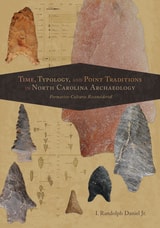
Time, Typology, and Point Traditions in North Carolina Archaeology
Formative Cultures ReconsideredI. Randolph Daniel Jr.
University of Alabama Press, 2021
Revisiting the stone tools that reshaped our understanding of North Carolina's prehistoric past.
In the 1964 landmark publication The Formative Cultures of the Carolina Piedmont, Joffre Coe established a projectile point typology and chronology that, for the first time, allowed archaeologists to identify the relative age of a site or site deposit based on the point types recovered there. Consistent with the cultural-historical paradigm of the day, the “Coe axiom” stipulated that only one point type was produced at one moment in time in a particular location. Moreover, Coe identified periods of “cultural continuity” and “discontinuity” in the chronology based on perceived similarities and differences in point styles through time.
In Time, Typology, and Point Traditions in North Carolina Archaeology: Formative Cultures Reconsidered, I. Randolph Daniel Jr. reevaluates the Coe typology and sequence, analyzing their strengths and weaknesses. Daniel reviews the history of the projectile point type concept in the Southeast and revisits both Coe’s axiom and his notions regarding cultural continuity and change based on point types. In addition, Daniel updates Coe’s typology by clarifying or revising existing types and including types unrecognized in Coe’s monograph. Daniel also adopts a practice-centered approach to interpreting types and organizes them into several technological traditions that trace ancestral-descendent communities of practice that relate to our current understanding of North Carolina prehistory.
Appealing to professional and avocational archaeologists, Daniel provides ample illustrations of points in the book as well as color versions on a dedicated website. Daniel dedicates a final chapter to a discussion of the ethical issues related to professional archaeologists using private artifact collections. He calls for greater collaboration between professional and avocational communities, noting the scientific value of some private collections.
Toward Social Reporting
Next StepsOtis Dudley Duncan
Russell Sage Foundation, 1969
Tradition and Authenticity in the Search for Ecumenic Wisdom
Thomas Langan
University of Missouri Press, 1992
Our emerging world system is bringing the great traditions and cultures it has spawned into ever more intimate and dangerous contact. Langan argues that we must struggle toward a unity of discourse respectful of genuine experiences of varying civilizations if we are to live peacefully on one planet.
Transforming Knowledge 2Nd Edition
Elizabeth Kamarck Minnich
Temple University Press, 2004
* Updated to consider recent scholarship in Gender, Multicultural, Postcolonial, Disability, Native American, and Queer Studies, among other fields of study
* Revised to include an extended analysis of the conceptual errors that legitimate domination, including the construction of kinds ("genders") of human beings
* Revised to include new materials from a variety of cultures and times, and engages with today's contemporary debates about affirmative action, postmodernism, and religion
Translation and Ethnography
The Anthropological Challenge of Intercultural UnderstandingTullio Maranhão
University of Arizona Press, 2003
Translation and Ethnography focuses on issues that arise when we attempt to make significant thematic or symbolic elements of one culture meaningful in terms of another. Its chapters cover a wide range of topics, all stressing the interpretive practices that enable the approximation of meaning: the role of differential power, of language and so-called world view, and of translation itself as a metaphor of many contemporary cross-cultural processes.
The topics covered here represent a global sample of translation, ranging from Papua New Guinea to South America to Europe. Some of the issues addressed include postcolonial translation/transculturation from the perspective of colonized languages, as in the Mexican Zapatista movement; mis-translations of Amerindian conceptions and practices in the Amazon, illustrating the subversive potential of anthropology as a science of translation; Ethiopian oracles translating divine messages for the interpretation of believers; and dreams and clowns as translation media among the Gamk of Sudan.
Anthropologists have long been accustomed to handling translation chains; in this book they open their diaries and show the steps they take toward knowledge. Translation and Ethnography raises issues that will shake up the most obdurate, objectivist translators and stimulate scholars in sociolinguistics, communication, ethnography, and other fields who face the challenges of conveying meaning across human boundaries.
Transparency in Population Forecasting
Methods for Fitting and Projecting Fertility, Mortality and MigrationJoop de Beer
Amsterdam University Press, 2011
Try This
Research Methods for Writersedited by Jennifer Clary-Lemon, Derek Mueller, and Kate Pantelides
University Press of Colorado, 2022
This book is also available as an open access ebook through the WAC Clearinghouse.