Results by title
618 books match the query 'Motion pictures' and 104 start with t

Tropical Multiculturalism
A Comparative History of Race in Brazilian Cinema and CultureRobert Stam
Duke University Press, 1997
Stam examines the broad historical and cultural links that connect Brazil and the United States before considering multicultural imagery in Brazilian film as it has changed from the silent era to the present. His analysis moves through the comic chanchadas of the 1930s and 1940s, to the Hollywood-style films from Sao Paulo in the 1950s, and the diverse phases of Cinema Novo beginning in the 1960s. He explores a wealth of subjects, including the submerged "blackness" of Carmen Miranda, the anti-racist agenda of Orson Welles’s never-released Brazilian film It’s All True, the international background behind Black Orpheus, the career of Grande Otelo (Brazil’s greatest black film star), the allegorical "cannibalistic" films like How Tasty Was My Frenchman, and "indigenous media"—the attempt by Brazilian "indians" to use camcorders and VCRs for their own cultural and political purposes. Tropical Multiculturalism is simultaneously a history of Brazilian cinema from the standpoint of race, a history of Brazil itself through its cinematic representations, a comparative study of racial formations in Brazil and the United States, and a theorized analysis of racialized representations.

Trying to Get Over
African American Directors after Blaxploitation, 1977-1986By Keith Corson
University of Texas Press, 2016
From 1972 to 1976, Hollywood made an unprecedented number of films targeted at black audiences. But following this era known as “blaxploitation,” the momentum suddenly reversed for black filmmakers, and a large void separates the end of blaxploitation from the black film explosion that followed the arrival of Spike Lee’s She's Gotta Have It in 1986. Illuminating an overlooked era in African American film history, Trying to Get Over is the first in-depth study of black directors working during the decade between 1977 and 1986.
Keith Corson provides a fresh definition of blaxploitation, lays out a concrete reason for its end, and explains the major gap in African American representation during the years that followed. He focuses primarily on the work of eight directors—Michael Schultz, Sidney Poitier, Jamaa Fanaka, Fred Williamson, Gilbert Moses, Stan Lathan, Richard Pryor, and Prince—who were the only black directors making commercially distributed films in the decade following the blaxploitation cycle. Using the careers of each director and the twenty-four films they produced during this time to tell a larger story about Hollywood and the shifting dialogue about race, power, and access, Corson shows how these directors are a key part of the continuum of African American cinema and how they have shaped popular culture over the past quarter century.
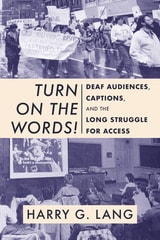
Turn on the Words!
Deaf Audiences, Captions, and the Long Struggle for AccessHarry G. Lang
Gallaudet University Press, 2021
Lang describes the legislation, programs, and people who contributed great ingenuity and passion over decades to realize widespread access to captions, one breakthrough at a time. He also chronicles the resistance to captioned films from Hollywood studios and others, and the Deaf and hearing activists who championed the right to access. Deaf, hard of hearing, disabled, and English-as-a-second-language audiences now experience improved access to the educational, occupational, and cultural benefits of film and television programming. The struggle continues as deaf audiences advocate for equal access in a variety of settings such as movie theaters and online video-sharing platforms. This is a history of technological innovation, as well as a testament to the contributions of the Deaf community to the benefit of society as a whole.
This book has been made possible in part by the National Endowment for the Humanities: Exploring the human endeavor. Any views, findings, conclusions, or recommendations expressed in this book do not necessarily represent those of the National Endowment for the Humanities.
Twelve Films about Love and Heaven
Pete Fraser
St. Augustine's Press, 2023