Results by title
1427 books match the query 'Politics' and 382 start with t
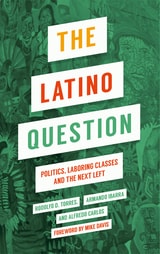
The Latino Question
Politics, Laboring Classes and the Next LeftRodolfo D. Torres
Pluto Press, 2018
In a radical alternative to the dominant orthodoxy in Latino political studies, Rodolfo D. Torres, Armando Ibarra, and Alfredo Carlos emphasize the importance of political economy for understanding Latino politics, culture, and social issues. Written in an accessible style, the authors draw from extensive original research and several critical traditions—including Karl Marx, Antonio Gramsci, and Michel Foucault—to make crucial links between socio-economic and culture-based approaches for understanding the politics of race and ethnicity in capitalist society. Notably, they present front-line evidence of how some Mexican communities across America are not only resisting, but also reinventing and transforming the predominant economic ideas. The Latino Question will be essential for anyone hoping to understand the changes in Latino communities in America today.
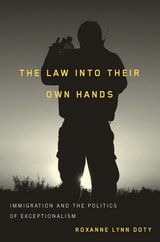
The Law Into Their Own Hands
Immigration and the Politics of ExceptionalismRoxanne Lynn Doty
University of Arizona Press, 2009
Doty examines the social and political contexts that have enabled these civilian groups to flourish and gain legitimacy amongst policy makers and the public. The sentiments underlying the vigilante movement both draw upon and are channeled through a diverse range of organizations whose messages are often reinforced by the media. Taking action when they believe official policy is lacking, groups ranging from elements of the religious right to anti-immigrant groups to white supremacists have created a social movement.
Doty seeks to alert us to the consequences related to this growing movement and to the restructuring of our society. She maintains that with immigrants being considered as enemies and denied basic human rights, it is irresponsible of both citizens and policy makers to treat this complicated issue as a simple black or white reality.
In this solid and theoretically grounded look at contemporary, post-9/11 border vigilantism, the author observes the dangerous and unproductive manner in which private citizens seek to draw firm and uncompromising lines between who is worthy of inclusion in our society and who is not.
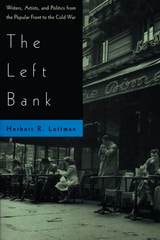
The Left Bank
Writers, Artists, and Politics from the Popular Front to the Cold WarHerbert Lottman
University of Chicago Press, 1998
"Surprisingly fresh and intense. . . . A retrospective travelogue of the Left Bank in the days when it was the setting for almost all French intellectual activity. . . . Absorbing."—Naomi Bliven, New Yorker
"As an introduction to a period in French history already legendary, The Left Bank is superb."—Michael Dirda, Washington Post Book World
"An intellectual history. A history of the interaction between politics and letters. And a rumination on the limitless credulity of intellectuals."—Christopher Hitchens, New Statesman

The Less Responsive Chamber?
Politics and Development in the Early US SenateJoel Sievert
University of Michigan Press, 2027
Who did members of the early US Senate represent? Many scholarly and popular political accounts of the Antebellum era assume that senators were exclusively representatives of the state governments because pre-reform senators were chosen by state legislatures. However, The Less Responsive Chamber? examines senators’ relationships with three potential targets of representation—the state governments, the state legislature, and the electorate of the state.
Through both empirical analyses and detailed case studies, the book demonstrates that senators cared about the public and did not strictly view their representational role as one of being faithful agents to state governments. While senators’ floor speeches, circulars, and correspondences frequently referenced the state electorate as their primary constituency, they were often directed to represent a variety of interests. Further, senators were aware of and responded to public opinion as well as intrastate political dynamics. By documenting how the interests of political parties, states, and the public influenced the Senate’s behavior during the early years of the United States, this book offers insight into a period whose fraught politics continue to impact our lives today.
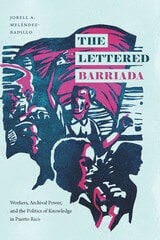
The Lettered Barriada
Workers, Archival Power, and the Politics of Knowledge in Puerto RicoJorell A. Meléndez-Badillo
Duke University Press, 2021
Duke University Press Scholars of Color First Book Award recipient
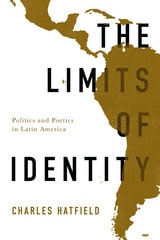
The Limits of Identity
Politics and Poetics in Latin AmericaBy Charles Hatfield
University of Texas Press, 2015
The Limits of Identity is a polemical critique of the repudiation of universalism and the theoretical commitment to identity and difference embedded in Latin American literary and cultural studies. Through original readings of foundational Latin American thinkers (such as José Martí and José Enrique Rodó) and contemporary theorists (such as John Beverley and Doris Sommer), Charles Hatfield reveals and challenges the anti-universalism that informs seemingly disparate theoretical projects.
The Limits of Identity offers a critical reexamination of widely held conceptions of culture, ideology, interpretation, and history. The repudiation of universalism, Hatfield argues, creates a set of problems that are both theoretical and political. Even though the recognition of identity and difference is normally thought to be a form of resistance, The Limits of Identity claims that, in fact, the opposite is true.
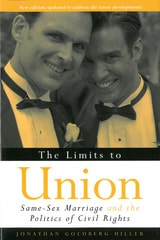
The Limits to Union
Same-Sex Marriage and the Politics of Civil RightsJonathan Goldberg-Hiller
University of Michigan Press, 2004
"The Limits to Union is a superb book about the complexities of recent political struggles over same-sex marriage. Goldberg-Hiller offers a sophisticated account of egalitarian rights advocacy and the reaction it has generated from established majorities animated by a 'new common sense' of exclusionary sovereign authority. The author's analysis is multidimensional and nuanced, but the core argument is bold, important, and well-supported. I recommend it very highly to everyone interested in understanding the character, possibilities, and constraints of civil rights amid our contemporary culture wars."
-Michael McCann, author of Rights at Work: Pay Equity Reform and the Politics of Legal Mobilization
"In this excellent book, Goldberg-Hiller uses Hawaii's experience to examine the interaction between courts and the political system. . . . Relying on briefs, legislative statements, and interviews with activists from both sides of the question, he views this familiar debate . . . through the unfamiliar prism of gay marriage, which allows him to gauge the viability and the pliability of the American civil rights ideal, and how gay and lesbian issues fit (or don't fit) within that ideal."
-Willian Heinzen, New York Law Journal
"Goldberg-Hiller presents the history of the same-sex marriage question since it first sparked debate in Hawaii. He follows the shifting debate through court cases, state propositions, and state and federal legislatures, considering questions about the constitutionality of the Defense of Marriage Act and the concept of equal protection under the law for gays and lesbians. This detailed treatment of the legal issues surrounding same-sex marriages is highly recommended."
-R. L. Abbott, University of Evansville
"[A] valuable contribution to the field, situating the gay marriage debate in broader contexts of theory, law and practice. [S]ame-sex marriage is an important issue...that finds itself caught in the friction points of much larger debates over the nature of rights, the limits of sovereignty and the proper role of courts and law in a democratic society. The Limits to Union should therefore be of interest even to those who do not think of themselves as interested in gay and lesbian rights issues."
-Evan Gerstmann, Loyola Marymount University, Law and Politics Book Review
The Limits to Union
Same-Sex Marriage and the Politics of Civil RightsJonathan Goldberg-Hiller
University of Michigan Press, 2002
"The Limits to Union is a superb book about the complexities of recent political struggles over same-sex marriage. Goldberg-Hiller offers a sophisticated account of egalitarian rights advocacy and the reaction it has generated from established majorities animated by a 'new common sense' of exclusionary sovereign authority. The author's analysis is multidimensional and nuanced, but the core argument is bold, important, and well-supported. I recommend it very highly to everyone interested in understanding the character, possibilities, and constraints of civil rights amid our contemporary culture wars."
-Michael McCann, author of Rights at Work: Pay Equity Reform and the Politics of Legal Mobilization
"In this excellent book, Goldberg-Hiller uses Hawaii's experience to examine the interaction between courts and the political system. . . . Relying on briefs, legislative statements, and interviews with activists from both sides of the question, he views this familiar debate . . . through the unfamiliar prism of gay marriage, which allows him to gauge the viability and the pliability of the American civil rights ideal, and how gay and lesbian issues fit (or don't fit) within that ideal."
-Willian Heinzen, New York Law Journal
"Goldberg-Hiller presents the history of the same-sex marriage question since it first sparked debate in Hawaii. He follows the shifting debate through court cases, state propositions, and state and federal legislatures, considering questions about the constitutionality of the Defense of Marriage Act and the concept of equal protection under the law for gays and lesbians. This detailed treatment of the legal issues surrounding same-sex marriages is highly recommended."
-R. L. Abbott, University of Evansville
"[A] valuable contribution to the field, situating the gay marriage debate in broader contexts of theory, law and practice. [S]ame-sex marriage is an important issue...that finds itself caught in the friction points of much larger debates over the nature of rights, the limits of sovereignty and the proper role of courts and law in a democratic society. The Limits to Union should therefore be of interest even to those who do not think of themselves as interested in gay and lesbian rights issues."
-Evan Gerstmann, Loyola Marymount University, Law and Politics Book Review

The Linguistic Turn in Contemporary Japanese Literary Studies
Politics, Language, TextualityEdited and with an Introduction by Michael K. Bourdaghs
University of Michigan Press, 2010
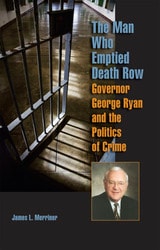
The Man Who Emptied Death Row
Governor George Ryan and the Politics of CrimeJames L. Merriner
Southern Illinois University Press, 2008
George H. Ryan, Illinois governor from 1999 to 2003, became nationally known for two significant and very different reasons. The first governor in the United States to clear out his state’s death row and put a moratorium on the death penalty, he was also convicted and sent to prison on corruption charges. The Man Who Emptied Death Row: Governor George Ryan and the Politics of Crime details the career of a man who both enhanced and tarnished the image of the highest office in Illinois and examines the political history and culture that shaped him.
Author James L. Merriner explores the two very different stories of George Ryan: the brave crusader against the death penalty and the petty crook. An extensive analysis of the official record, exclusive interviews, and previously undisclosed incidents in Ryan’s career expose why the governor pardoned or commuted the sentences of all 171 prisoners on Illinois’s death row before leaving office and how he later was convicted of eighteen counts of official corruption.
This biography traces Ryan’s family history and the Illinois political climate that influenced his development as a politician. Although Ryan championed “good-government” initiatives—organ donations, tougher drunken-driving and lobbyist disclosure laws—he never overcame a reputation as a wheeler-dealer, notes Merriner.
Merriner goes beyond Ryan’s life and career to explore the politics of crime, highlighting the successes and failures of the criminal justice system and suggesting how both white-collar fraud and violent crime shape politics. A fascinating story that reveals much about the way Illinois politics works, The Man Who Emptied Death Row will help determine how history will judge Illinois governor George Ryan.
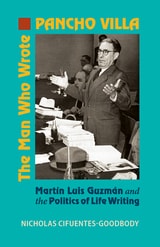
The Man Who Wrote Pancho Villa
Martin Luis Guzman and the Politics of Life WritingNicholas Cifuentes-Goodbody
Vanderbilt University Press, 2016
The Man Who Wrote Pancho Villa places Guzman's work in a biographical context, shedding light on the immediate motivations behind his writing in a given moment and the subsequent ways in which he rewrote or repackaged the material. Despite his efforts to establish a definitive reading of his life and literature, Guzman was unable to control that interpretation as audiences became less tolerant of the glaring omissions in his self-portrait.
The Many Faces of Political Islam, Second Edition
Religion and Politics in Muslim SocietiesMohammed Ayoob and Danielle N. Lussier
University of Michigan Press, 2020
Analysts and pundits from across the American political spectrum describe Islamic fundamentalism as one of the greatest threats to modern, Western-style democracy. Yet very few non-Muslims would be able to venture an accurate definition of political Islam. Fully revised and updated, The Many Faces of Political Islam thoroughly analyzes the many facets of this political ideology and shows its impact on global relations.
The Many Faces of Political Islam
Religion and Politics in the Muslim WorldMohammed Ayoob
University of Michigan Press, 2009
---Peter J. Katzenstein, Walter S. Carpenter, Jr. Professor of International Studies and Stephen H. Weiss Presidential Teaching Fellow, Cornell University
---Fawaz A. Gerges, Carnegie Scholar, and holds the Christian A. Johnson Chair in International Affairs and Middle Eastern Studies, Sarah Lawrence College
---François Burgat, Director, French National Centre for Scientific Research (CNRS) and the Institute for Research and Study on the Arab and Muslim World (IREMAM), Aix-en-Provence, France
---Shibley Telhami, Anwar Sadat Professor for Peace and Development, University of Maryland, and Senior Fellow, Brookings Institution
The Media Swirl
Politics, Audiovisuality, and AestheticsCarol Vernallis
Duke University Press, 2023
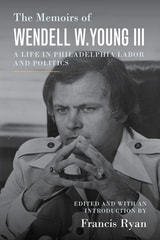
The Memoirs of Wendell W. Young III
A Life in Philadelphia Labor and PoliticsFrancis Ryan
Temple University Press, 2019
Philadelphia native Wendell W. Young III was one of the most important American labor leaders in the last half of the twentieth century. An Acme Markets clerk in the 1950s and ’60s, he was elected top officer of the Retail Clerks Union when he was twenty-four. His social justice unionism sought to advance wages while moving beyond collective bargaining to improve the conditions of the working-class majority, whether in a union or not. Young quickly gained a reputation for his independence, daring at times to publicly criticize the policies of the city’s powerful AFL-CIO leadership and tangle with the city’s political machine.
Editor Francis Ryan, whose introduction provides historical context, interviewed Young about his experiences working in the region’s retail and food industry, measuring the changes over time and the tangible impact that union membership had on workers. Young also describes the impact of Philadelphia’s deindustrialization in the 1970s and ’80s and recounts his activism for civil rights and the anti-war movements as well as on John F. Kennedy’s presidential campaign.
The Memoirs of Wendell W. YoungIII provides the most extensive labor history of late twentieth-century Philadelphia yet written.
The Metaphysics of Knowledge and Politics in Thomas Aquinas
Rocco Buttiglione
St. Augustine's Press, 2020
In addition to its primary audience of philosophers, theologians, and political theorists, the book surprisingly enjoyed a wide general readership in Italy at the time of its publication. It represented an exciting attempt to harmonize medieval philosophy and the insights of personalism that had already had a deep impact on European intellectual life. Buttiglione was able to describe this attempt in a way accessible to a general readership, and in a way that confronted the political challenges Italy had been confronting for the last forty years.
Now, thirty-five years after the book’s initial publication, the conclusions Buttiglione draws from reading Thomas Aquinas’s commentary on Aristotle’s Politics––and the connections he makes between philosophy, theology, and political theory––are more relevant than ever. He argues that the traditional definition of “person” as rationalis naturae individua substantia––an individual substance or substrate (hypokeimenon) of a rational nature––“lacks that certain element that makes Augustine’s approach to personhood so appealing.” Hence Aquinas’s definition “is left wanting since it fails to elaborate on the crucial aspect of interpersonal relationship.”
The ingenuous way in which Buttiglione enlivens Thomistic political thinking with personalist philosophy helps to explain not only why free societies are more stable, tolerant, and respectful of human rights than totalitarian states, but theocratic ones as well. Only by raising the interpersonal aspects of political society to an ontological level—indeed, only by affirming and esteeming the self-transcendence of the human person as evidenced through ontological analysis—do the personal relationships that root and enliven the human person also lead to a realistic, dynamic, and convincing vision of the person’s real existence.
Buttiglione was startlingly prescient of the problems we confront at the beginning of the third millennium. This book will spark new discussions as it explains the importance of both the medieval tradition and twentieth-century personalism. The book also draws on a wide range of secondary sources unavailable to English readers that I and will have the unique ability to introduce readers to the “Italian” way of relating speculative and political philosophy in a relatively slim volume.
The Migrant Image
The Art and Politics of Documentary during Global CrisisT. J. Demos
Duke University Press, 2013
The Military and Politics in Postauthoritarian Chile
Gregory Weeks
University of Alabama Press, 2003
"The Military and Politics in Post-Authoritarian Chile should be read by everyone concerned with the relation between democracy and the armed forces. It is a well-researched, well-written volume that should prove both interesting and useful to scholars and students alike." —Perspectives on Politics
Why have political leaders of developing and authoritarian nations run into so many obstacles as they attempt to establish civilian supremacy over armed forces in the democratization of their countries? This is the question Gregory Weeks poses in his study of Chile from 1990 onward. He explains how the Chilean military has maintained a high level of political influence in the tumultuous aftermath of dictatorial rule by Army General Augusto Pinochet, thus confounding a smooth transition to civilian authority.
Even after the reins of power were officially handed over in 1990, Pinochet continued as commander in chief of the army until 1998, when he took a lifetime seat in the Senate and led the military’s efforts to retain its legal and constitutional prerogatives while limiting civilian oversight of military affairs. This assertion of guardianship by the military has produced a political tug-of-war between it and civilian authorities the two contenders for political primacy in Chile. In addition to recounting the historical background of this situation, Weeks’s study examines where conflict between these two contenders has been most productive and accord has been highest. His findings suggest that formal contacts, conducted through formal institutions, have been the most conducive to civil supremacy and, therefore, the consolidation of democracy.
Based on interviews, government documents, military journals, newspapers, and other archival sources, The Military and Politics in Postauthoritarian Chile describes how presidents, military officers, members of Congress, and judges have interacted since the end of the military regime. With implications for conflict resolution studies, this book will be valuable for Chileanists and policymakers and analysts of Latin American regimes, as well as academic libraries, military historians, social scientists, and students and scholars of Latin American history and politics.
The Mouth That Begs
Hunger, Cannibalism, and the Politics of Eating in Modern ChinaGang Yue
Duke University Press, 1999
Yue’s discussion begins with a brief look at ancient Chinese alimentary writing and then moves on to its main concern: the exploration and textual analysis of themes of eating in modern Chinese literature from the May Fourth period through the post-Tiananmen era. The broad historical scope of this volume illustrates how widely applicable eating-related metaphors can be. For instance, Yue shows how cannibalism symbolizes old China under European colonization in the writing of Lu Xun. In Mo Yan’s 1992 novel Liquorland, however, cannibalism becomes the symbol of overindulgent consumerism. Yue considers other writers as well, such as Shen Congwen, Wang Ruowang, Lu Wenfu, Zhang Zianliang, Ah Cheng, Zheng Yi, and Liu Zhenyun. A special section devoted to women writers includes a chapter on Xiao Hong, Wang Anyi, and Li Ang, and another on the Chinese-American women writers Jade Snow Wong, Maxine Hong Kingston, and Amy Tan. Throughout, the author compares and contrasts the work of these writers with similarly themed Western literature, weaving a personal and political semiotics of eating.
The Mouth That Begs will interest sinologists, literary critics, anthropologists, cultural studies scholars, and everyone curious about the semiotics of food.
The Museum on the Roof of the World
Art, Politics, and the Representation of TibetClare E. Harris
University of Chicago Press, 2012
The National Joker
Abraham Lincoln and the Politics of SatireTodd Nathan Thompson
Southern Illinois University Press, 2015
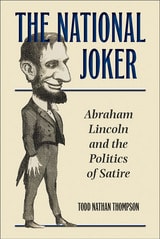
In his speeches, writings, and public persona, Lincoln combined modesty and attack, engaging in strategic self-deprecation while denouncing his opponents, their policies, and their arguments, thus refiguring satiric discourse as political discourse and vice versa. At the same time, he astutely deflected his opponents’ criticisms of him by embracing and sometimes preemptively initiating those criticisms. Thompson traces Lincoln’s comic sources and explains how, in reapplying others’ jokes and stories to political circumstances, he transformed humor into satire. Time and time again, Thompson shows, Lincoln engaged in self-mockery, turning negative assumptions or depictions of him—as ugly, cowardly, jocular, inexperienced—into positive traits that identified him as an everyman while attacking his opponents’ claims to greatness, heroism, and experience as aristocratic or demagogic. Thompson also considers how Lincoln took advantage of political cartoons and other media to help proliferate the particular Lincoln image of the “self-made man”; underscores exceptions to Lincoln’s ability to mitigate negative, satiric depictions of him; and closely examines political cartoons from both the 1860 and 1864 elections. Throughout, Thompson’s deft analysis brings to life Lincoln’s popular humor.
The Nature of Politics
State Building and the Conservation Estate in Postcolonial BotswanaAnnette A. LaRocco
Ohio University Press, 2024
The Nazi Olympics
Sport, Politics, and Appeasement in the 1930sEdited by Arnd Krüger and William Murray
University of Illinois Press, 2003
The 1936 Olympic Games played a key role in the development of both Hitler’s Third Reich and international sporting competition. The Nazi Olympics gathers essays by modern scholars from prominent participating countries and lays out the issues--sporting as well as political--surrounding the involvement of individual nations.
The volume opens with an analysis of Germany’s preparations for the Games and the attempts by the Nazi regime to allay the international concerns about Hitler’s racist ideals and expansionist ambitions. Essays follow on the United States, Great Britain, and France--top-tier Olympian nations with misgivings about participation--as well as Germany's future Axis partners Italy and Japan. Other contributions examine the issues involved for Finland, Sweden, Norway, Denmark, and the Netherlands. Throughout, the authors reveal the high political stakes surrounding the Games and how the Nazi Olympics distilled critical geopolitical issues of the time into a spectacle of sport.
The Nazi Perpetrator
Postwar German Art and the Politics of the RightPaul B. Jaskot
University of Minnesota Press, 2012
Who was responsible for the crimes of the Nazis? Party leaders and members? Rank-and-file soldiers and bureaucrats? Ordinary Germans? This question looms over German disputes about the past like few others. It also looms over the art and architecture of postwar Germany in ways that have been surprisingly neglected. In The Nazi Perpetrator, Paul B. Jaskot fundamentally reevaluates pivotal developments in postwar German art and architecture against the backdrop of contentious contemporary debates over the Nazi past and the difficulty of determining who was or was not a Nazi perpetrator.
Like their fellow Germans, postwar artists and architects grappled with the Nazi past and the problem of defining the Nazi perpetrator—a problem that was thoroughly entangled with contemporary conservative politics and the explosive issue of former Nazis living in postwar Germany. Beginning with the formative connection between Nazi politics and art during the 1930s, The Nazi Perpetrator traces the dilemma of identifying the perpetrator across the entire postwar period. Jaskot examines key works and episodes from West Germany and, after 1989, reunified Germany, showing how the changing perception of the perpetrator deeply impacted art and architecture, even in cases where artworks and buildings seem to have no obvious relation to the Nazi past. The book also reinterprets important periods in the careers of such major figures as Gerhard Richter, Anselm Kiefer, and Daniel Libeskind.
Combining political history with a close analysis of specific works, The Nazi Perpetrator powerfully demonstrates that the ongoing influence of Nazi Germany after 1945 is much more central to understanding a wide range of modern German art and architecture than cultural historians have previously recognized.

The Nazi Symbiosis
Human Genetics and Politics in the Third ReichSheila Faith Weiss
University of Chicago Press, 2010
The Faustian bargain—in which an individual or group collaborates with an evil entity in order to obtain knowledge, power, or material gain—is perhaps best exemplified by the alliance between world-renowned human geneticists and the Nazi state. Under the swastika, German scientists descended into the moral abyss, perpetrating heinous medical crimes at Auschwitz and at euthanasia hospitals. But why did biomedical researchers accept such a bargain?
The Nazi Symbiosis offers a nuanced account of the myriad ways human heredity and Nazi politics reinforced each other before and during the Third Reich. Exploring the ethical and professional consequences for the scientists involved as well as the political ramifications for Nazi racial policies, Sheila Faith Weiss places genetics and eugenics in their larger international context. In questioning whether the motives that propelled German geneticists were different from the compromises that researchers from other countries and eras face, Weiss extends her argument into our modern moment, as we confront the promises and perils of genomic medicine today.
The Necessity of Politics
Reclaiming American Public LifeChristopher Beem
University of Chicago Press, 1999
In response to this bleak assessment, advocates of "civil society" argue that rejuvenating our neighborhoods, churches, and community associations will lead to a more moral, civic-minded polity. Christopher Beem argues that while the movement's goals are laudable, simply restoring local institutions will not solve the problem; a civil society also needs politics and government to provide a sense of shared values and ideas. Tracing the concept back to Tocqueville and Hegel, Beem shows that both thinkers faced similar problems and both rejected civil society as the sole solution. He then shows how, in the case of the Civil Rights movement, both political groups and the federal government were necessary to effect a new consensus on race.
Taking up the arguments of Robert Putnam, Michael Sandel, and others, this timely book calls for a more developed sense of what the state is for and what our politics ought to be about.
"This book is bound to incite controversy and to contribute to our ongoing grappling with where our own democratic political culture is going. . . . Beem helps us to get things right by offering a corrective to any and all visions of civil society sanitized from politics."—Jean Bethke Elshtain, from the Foreword
"[Beem] makes an impressive case. At the end of the day, there really is no substitute for governmental authority in fostering the moral identity of the body politic."—Robert P. George, Times Literary Supplement
The New Decentralists
The Back-to-the-Land Movement and the Politics of Localism in Appalachia, 1968-2000Jinny A Turman
West Virginia University Press, 2026
How some “back-to-the-landers” fled alienating urban, bureaucratic places for rural Appalachia in pursuit of self-reliance, liberation, and community, only to later find themselves vulnerable to a rising tide of national conservatism that minted new political elites on the state and local level at odds with their progressive social ideas and environmental values.
The New Science of Politics
An IntroductionEric Voegelin
University of Chicago Press, 1987
What Eric Voegelin attempts in The New Science of Politics is nothing less ambitious than a complete theory of humanity, society, and history. To build his theory, Voegelin draws on a breathtaking range of subjects from throughout history, including the Mongol Orders of Submission, the Behistun Inscription, and a controversy over an alter to the goddess Victoria in the Roman Forum. Addressing the access to truth afforded by myth, revelation, and philosophy, Voegelin then carefully contrasts each with gnosticism. The resulting book is a heady exploration of the development of European politics through the Western tradition and the ongoing importance of the inner quest for transcendent reality. =
The New Science of Politics
An IntroductionEric Voegelin
University of Chicago Press, 1987
"Thirty-five years ago few could have predicted that The New Science of Politics would be a best-seller by political theory standards. Compressed within the Draconian economy of the six Walgreen lectures is a complete theory of man, society, and history, presented at the most profound and intellectual level. . . . Voegelin's [work] stands out in bold relief from much of what has passed under the name of political science in recent decades. . . . The New Science is aptly titled, for Voegelin makes clear at the outset that a 'return to the specific content' of premodern political theory is out of the question. . . . The subtitle of the book, An Introduction, clearly indicates that The New Science of Politics is an invitation to join the search for the recovery of our full humanity."—From the new Foreword by Dante Germino
"This book must be considered one of the most enlightening essays on the character of European politics that has appeared in half a century. . . . This is a book powerful and vivid enough to make agreement or disagreement with even its main thesis relatively unimportant."—Times Literary Supplement
"Voegelin . . . is one of the most distinguished interpreters to Americans of the non-liberal streams of European thought. . . . He brings a remarkable breadth of knowledge, and a historical imagination that ranges frequently into brilliant insights and generalizations."—Francis G. Wilson, American Political Science Review
"This book is beautifully constructed . . . his erudition constantly brings a startling illumination."—Martin Wright, International Affairs
"A ledestar to thinking men who seek a restoration of political science on the classic and Christian basis . . . a significant accomplishment in the retheorization of our age."—Anthony Harrigan, Christian Century
The Nick of Time
Politics, Evolution, and the UntimelyElizabeth Grosz
Duke University Press, 2004
Grosz develops her argument by juxtaposing the work of three major figures in Western thought: Charles Darwin, Friedrich Nietzsche, and Henri Bergson. She reveals that in theorizing time as an active, positive phenomenon with its own characteristics and specific effects, each of these thinkers had a profound effect on contemporary understandings of the body in relation to time. She shows how their allied concepts of life, evolution, and becoming are manifest in the work of Gilles Deleuze and Luce Irigaray. Throughout The Nick of Time, Grosz emphasizes the political and cultural imperative to fundamentally rethink time: the more clearly we understand our temporal location as beings straddling the past and the future without the security of a stable and abiding present, the more transformation becomes conceivable.
The Nonconformists
Culture, Politics, and Nationalism in a Serbian Intellectual Circle, 1944-1991Nick Miller
Central European University Press, 2007
The Olympics at the Millennium
Power, Politics, and the GamesEdited by Kay Schaffer
Rutgers University Press, 2000
The Olympics thrill the world with spectacle and drama. They also carry a cultural and social significance that goes beyond the stadium, athletes, and fans. The Games are arenas in which individual and team athletic achievement intersect with the politics of national identity in a global context.
The Olympics at the Millennium offers groundbreaking essays that explore the cultural politics of the Games. The contributors investigate such topics as the emergence of women athletes as cultural commodities, the orchestrated spectacles of the opening and closing ceremonies, and the alternative sport culture offered via the Gay Games. Unforgettable events and decisions are discussed: Native American athlete Jim Thorpe winning—and losing—his two gold medals in 1912. Why America was one of the few countries to actually send Jewish athletes to the “Nazi Olympics.” The disqualification of champion Ewa Klobukowska from competing as a woman, due to chromosomal testing in 1967.
With the 2000 Sydney Games imminent, several essays address concerns with which every host country must contend, such as the threat of terrorism. Highlighting the difficult issues of racism and nationalism, another article explores the efforts of this country’s aboriginal people to define a role for themselves in the 2000 Games, as they struggle with ongoing discrimination. And with the world watching, Sydney faces profound pressure to implement a successful Olympics, as a matter of national pride.
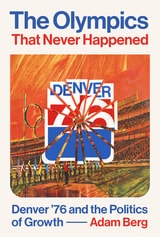
The Olympics that Never Happened
Denver '76 and the Politics of GrowthAdam Berg
University of Texas Press, 2023
A look back at how powerful politicians, business leaders, and a diverse cast of activists used a thwarted Olympics to shape the state of Colorado and the city of Denver.
If you don’t recall the 1976 Denver Olympic Games, it’s because they never happened. The Mile-High City won the right to host the winter games and then was forced by Colorado citizens to back away from its successful Olympic bid through a statewide ballot initiative. Adam Berg details the powerful Colorado regime that gained the games for Denver and the grassroots activism that brought down its Olympic dreams, and he explores the legacy of this milestone moment for the games and politics in the United States.
The ink was hardly dry on Denver’s host agreement when Mexican American and African American urbanites, white middle-class environmentalists, and fiscally concerned local politicians realized opposition to the Olympics provided them new political openings. The Olympics quickly became a platform for taking stands on a range of issues, from conservation to urban livability to the very idea of growth, which for decades had been unquestioned in Colorado. The Olympics That Never Happened argues that hostility to the Olympics galvanized and empowered diverse citizens in a major US city, with long-term ramifications for Colorado and political activism elsewhere. The Olympics themselves were changed forever, compelling organizers to take seriously competing interests from subgroups within their communities.
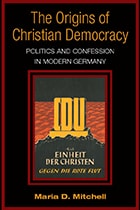
The Origins of Christian Democracy
Politics and Confession in Modern GermanyMaria D. Mitchell
University of Michigan Press, 2012
This book is a pioneering contribution to the history of the founding of the West German political system after the Second World War. The political cooperation between Catholics and Protestants that resulted in the formation of the Christian Democratic Union (CDU) in occupied and early West Germany represented a significant change from a long history of hostility in confessional relations. Given that the CDU went on to dominate politics in West Germany well into the 1960s, Maria D. Mitchell argues that an understanding of what made this interconfessional party possible is crucial to an exploration of German history in the postwar period. She examines the political history of party formation as well as the religious beliefs and motivations that shaped the party's philosophy and positions. She provides an authoritative guide to the complex processes of maneuvering and negotiation that produced the CDU during 1945-46. The full range of political possibilities is discussed, including the suppressed alternatives to the Adenauer/Erhard axis that eventually defined the party's trajectory during the 1950s and the abortive Christian Socialism associated with Jacob Kaiser.
The Other Garment Industry
Politics, Marketplaces the Informal Production of Fashion in Latin AmericaEdited by Matías Dewey
University College London, 2026
The first comprehensive study of Latin America's overlooked garment economy, drawing on cutting-edge fieldwork in sweatshops, informal marketplaces, and cross-border trade routes.
The Other Garment Industry presents an economic, social, and political phenomenon in Latin America, overlooked in social sciences literature, by introducing a new perspective in the discussion about garment production and distribution. It focuses on three pillars of this economy: downstream entrepreneurs, informal garment-oriented marketplaces, and extended routes of national and regional trade.

The Other Public Lands
Preservation, Extraction, and Politics on the Fifty States' Natural Resource LandsSteven Davis
Temple University Press, 2025
The Other Public Lands looks at both differences and common patterns in state land management, including the structure of natural resource agencies. Davis examines the privatization and commercialization of state parks, and the tensions between recreation, revenue and the preservation of biodiversity and natural landscapes. He also raises issues about equity, access, appropriate development, and ecological health. Chapters review state forests, state wildlife management areas, and school trust lands. In addition, the roles of interest groups, the courts, and agency culture and behavior are compared and analyzed both between states and the federal government and between states with differing approaches to specific issues.
As there has been a demand to transfer at least some federal lands to the states, The Other Public Lands concludes with an appraisal of whether states could handle this transfer and goes on to suggest ways to ensure adequate access in an era of increased demand.

The Paddy Camps
The Irish of Lowell, 1821-61Brian C. Mitchell
University of Illinois Press, 1988
The dramatic story of the fights and compromises that shaped an Irish community
Disdained by many Yankee residents as Catholic lowlifes, the growing Irish population of the Lowell, Massachusetts, “paddy camps” in the nineteenth century proved a tempting source of cheap labor for local mill owners, who took advantage of the immigrants’ proximity to exploit them to the fullest. Displaced by their cheaper labor, other workers blamed the Irish for job losses and added to their plight through repression and segregation.
Now in paperback and featuring a new preface, Brian C. Mitchell’s The Paddy Camps demonstrates how the Irish community in Lowell overcame adversity to develop strong religious institutions, an increased political presence, and a sense of common traditions.
The Patchwork City
Class, Space, and Politics in Metro ManilaMarco Z. Garrido
University of Chicago Press, 2019
The Patchwork City illuminates how segregation, class relations, and democracy are all intensely connected. It makes clear, ultimately, that class as a social structure is as indispensable to the study of Manila—and of many other cities of the Global South—as race is to the study of American cities.
The Performance of Power
Theatrical Discourse and PoliticsSue-Ellen Case
University of Iowa Press, 1991
Recently in the field of theatre studies there has been an increasing amount of debate and dissonance regarding the borders of its territory, its methodologies, subject matter, and scholarly perspectives. The nature of this debate could be termed "political" and, in fact, concerns "the performance of power"—the struggle over power relations embedded in texts, methodologies, and the academy itself.
This striking new collection of nineteen divergent essays represents this performance of power and the way in which the recent convergence of new critical theories with historical studies has politicized the study of the theatre. Neither play text, performance, nor scholarship and teaching can safely reside any longer in the "free," politically neutral, self-signifying realm of the aesthetic. Politicizing theatrical discourse means that both the hermeneutics and the histories of theatre reveal the role of ideology and power dynamics.
New strategies and concepts—and a vital new phase of awareness—appear in these illuminating essays. A variety of historical periods, from the Renaissance through the Victorian and up to the most contemporary work of the Wooster group, illustrate the ways in which contemporary strategies do not require contemporary texts and performances but can combine with historical methods and subjects to produce new theatrical discourse.
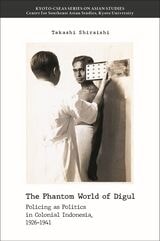
The Phantom World of Digul
Policing as Politics in Colonial Indonesia, 1926–1941Takashi Shiraishi
National University of Singapore Press, 2020
How did the government deploy political policing to achieve its policy objectives? What were the consequences and challenges for Indonesian activists? How was the government able to fashion its policing apparatus as the most potent instrument to achieve peace and order when the Great Depression hit the Indies, nationalist and communist forces were gaining strength in other places of the world, and war was coming both in Europe and Asia? This book answers those questions and more, breaking new ground for our understanding of the history of the Dutch Indies state in the early part of the twentieth century.
The Philosophy Scare
The Politics of Reason in the Early Cold WarJohn McCumber
University of Chicago Press, 2016
McCumber begins with the story of Max Otto, whose appointment to the UCLA Philosophy Department in 1947 was met with widespread protest charging him as an atheist. Drawing on Otto’s case, McCumber details the hugely successful conservative efforts that, by 1960, had all but banished the existentialist and pragmatist paradigms—not to mention Marxism—from philosophy departments all across the country, replacing them with an approach that valorized scientific objectivity and free markets and which downplayed the anti-theistic implications of modern thought. As he shows, while there have since been many instances of definitive and even explosive rejection of this conservative trend, its effects can still be seen at American universities today.

The Place of the Symbolic
Essays on Art and PoliticsReiner Schürmann
Diaphanes, 2021
The Place of the Symbolic gathers Reiner Schürmann’s essays on the nexus of art and politics. In keeping with his translation of the destruction of metaphysics into an an-archic philosophy of practice, Schürmann develops a radical theory of the place of symbols, irreducible either to idealist theories of symbols or structuralist accounts of the symbolic. Symbols, Schürmann argues, may provide a bridge between ontological difference and politics. They resist being grasped metaphysically, in terms of representation. Instead, their understanding requires a specific way of existence: attending to the coming-to-presence of phenomena. As such, the understanding of symbols discloses a form of praxis that abandons ultimate grounds and opens onto the manifold.
Alongside Schürmann’s theory of symbols, the collection includes essays on the relation between metaphysics, tragedy, and technology; on the “there is” in poetry; as well as on judgment. Throughout these characteristically lucid interventions, Schürmann’s most urgent concern remains a consideration of singular and finite practices that enact a release from universal principles. Art and politics appear here as the unworking of ultimate grounds; that is, as practices attuned to a truly groundless form of life.

The Poetics and Politics of the Veil in Iran
An Archival and Photographic AdventureAzadeh Fatehrad
Intellect Books, 2019
The Poetics and Politics of the Veil in Iran features Fatehrad’s own photographs in addition to work by artists Hengameh Golestan, Shirin Neshat, Shadi Ghadirian, Abbas Kiarostami, Mohsen Makhmalbaf, Adolf Loos, Gaëtan Gatian de Clérambault, and Alison Watt. In exploring women’s lives in post-revolutionary Iran, Fatehrad considers the role of the found image and the relationship between the archive and the present, resulting in an illuminating history of feminism in Iran in the twentieth and twenty-first centuries.
The Political Integration of Women
Roles, Socialization, and PoliticsVirginia Sapiro
University of Illinois Press, 1983
The Political Life of Medicare
Jonathan Oberlander
University of Chicago Press, 2003
The Political Poe
Michael Blouin
University of Iowa Press, 2026
The Politics
Aristotle
University of Chicago Press, 1984
This new translation of one of the fundamental texts of Western political thought combines strict fidelity to Aristotle's Greek with a contemporary English prose style. Lord's intention throughout is to retain Aristotle's distinctive style.
The accompanying notes provide literary and historical references, call attention to textual problems, and supply other essential information and interpretation. A glossary supplies working definitions of key terms in Aristotle's philosophical-political vocabulary as well as a guide to linguistic relationships that are not always reflected in equivalent English terms. Lord's extensive Introduction presents a detailed account of Aristotle's life in relation to the political situation and events of his time and then discusses the problematic character and history of Aristotle's writings in general and of the Politics in particular. Lord also outlines Aristotle's conception of political science, tracing its relation to theoretical science on the one hand and to ethics on the other. In conclusion, he briefly traces the subsequent history and influence of the Politics up to modern times.
"Lord's translation is clearly the best available."—Claremont Review

The Politics Of Life
edited by Velina Hasu Houston
Temple University Press, 1993
This anthology of work by three Asian American women playwrights—Wakako Yamauchi, Genny Lim, and Velina Hasu Houston—features pioneering contemporary writers who have made their mark in regional and ethnic theatres throughout the United States. In her introduction, Houston observes that the Asian American woman playwright is compelled "to mine her soul" and express the angst, fear, and rage that oppression has wrought while maintaining her relationship with America as a good citizen.
The plays are rich with cultural and political substance and have a feminist concern about women's spirit, intellect, and lives. They portray Asian and Asian American women who challenge the cultural and sexual stereotypes of the Asian female. Yamauchi's two plays deal with how easily a country can dishonor its citizens. In "12-1-A," a Japanese American family is incarcerated during World War II in an Arizona camp where Yamauchi herself was interned. "The Chairman's Wife" dramatizes the life of Madame Mao Tse Tung through the lens of events at Tien An Men Square in 1989. Lim's "Bitter Cane" is about the exploitation of Chinese laborers who were recruited to work the Hawaiian sugar cane plantations. In "Asa Ga Kimashita" ("Morning Has Broken"), Houston explores a Japanese woman's interracial romance in postwar Japan and the influence of traditional patriarchy on the lives of Japanese women.
These plays will entertain and enlighten, enrage and profoundly move audiences. With honesty, imagination and courage, each grapples with the politics of life.
In the series Asian American History and Culture, edited by Sucheng Chan, David Palumbo-Liu, Michael Omi, K. Scott Wong, and Linda Trinh Võ.

The Politics and Challenges of Achieving Health Equity
Alan B. Cohen, Colleen M. Grogan, and Jedediah Horwitt, special issue editors
Duke University Press, 2017
Articles in this issue address the historical, legal, and political contexts of health equity in the United States. Contributors examine the role of the courts in shaping health equity; document the importance of political discourse in framing health equity and establishing agendas for action; look closely at particular policies to reveal current challenges and the potential to achieve health equity in the future; and examine policies in both health and nonhealth domains, including state Medicaid programs, the use of mobile technology, and education and immigration policies. The issue concludes with a commentary on the future of health equity under the Trump administration and an analysis of how an ACA repeal would impact health equity.
Contributors. Alan B. Cohen, Keon L. Gilbert, Daniel Q. Gillion, Colleen M. Grogan, Mark A. Hall, Jedediah N. Horwitt, Tiffany D. Joseph, Alana M.W. LeBron, Julia F. Lynch, Jamila D. Michener, Vanessa Cruz Nichols, Francisco Pedraza, Isabel M. Perera, Rashawn Ray, Jennifer D. Roberts, Sara Rosenbaum, Sara Schmucker, Abigail A. Sewell, Deborah Stone, Keith Wailoo
The Politics of American Jews
Herbert F. Weisberg
University of Michigan Press, 2019
Jewish voting is distinctive and paradoxical. Stereotypes about the voting habits of American Jews include that they vote at unusually high levels, that they’re liberal, that they vote for Democratic candidates without regard to their self-interest, and that Israel is their most important issue. Not only are all of those claims wrong, but they obscure aspects of Jews’ voting behavior that are much more interesting.
The Politics of American Jews uncovers new perspectives on Jews’ political choices by analyzing the unprecedented amount of survey data that is now available, including surveys that permit contrasting the voting of Jews with that of comparable non-Jews. The data suggest several mysteries about Jewish voting. While more Jews are Democrats than are liberals, there has not been a previous exploration of why more politically conservative Jews are not Republicans.
A fresh picture of Jews’ political behaviors shows that Jews are no longer politically monolithic. They vote on the basis of their self-interest and their values, but not all Jews share the same self-interest or the same values. While most Jews have incorporated being Democratic and liberal into their political DNA, growing divisions in their ranks suggest a mutation could occur.