597 books match the query 'Psychological aspects' and 113 start with t
cover of To Know a Starry Night

To Know a Starry Night

Paul Bogard

University of Nevada Press, 2021
Combining the lyrical writing from Paul Bogard with night-sky photography from Beau Rogers, To Know A Starry Night explores the powerful experience of being outside under a natural starry sky.
[more]
cover of Totalled: Salvaging the Future from the Wreckage of Capitalism

Totalled

Salvaging the Future from the Wreckage of Capitalism

Colin Cremin

Pluto Press, 2015

Have you ever felt totaled? In this book, Colin Cremin tackles the overbearing truth that capitalism encompasses the totality of our social relations, having woven itself deeply into the fabric of what it means to be human. He shows how the capitalist system totalizes everything in its path, as evidenced in industrialized warfare, modern surveillance, commodification, and political control. With ever deepening social crises and ecological catastrophes this system threatens civilization as we know it. But among the wreckage of capitalism, Cremin argues, we can still find functioning parts, machines to be salvaged. To do so, it is imperative that we be able to both imagine and realize a future other than the apocalypticism forewarned by scientists, prescribed by economists, accommodated by politicians, and made into spectacle by the entertainment industry.
            Totalled maps the deteriorating socio-economic, political, and ecological conditions in which we live. Yet Cremin asks how a utopian possibility discernable in the power of human creation can be realized even though as a society we are bound up materially, ideologically, libidinally—totally—to the capitalist machine of destruction. Totalled concludes with a politically and economically grounded set of propositions on how we might begin to imagine such a possibility.
[more]
cover of Touching Encounters: Sex, Work, and Male-for-Male Internet Escorting

Touching Encounters

Sex, Work, and Male-for-Male Internet Escorting

Kevin Walby

University of Chicago Press, 2012
Often depicted as deviant or pathological by public health researchers, psychoanalysts, and sexologists, male-with-male sex and sex work is, in fact, an increasingly mainstream pursuit. Based on a qualitative investigation of the practices involved in male-with-male—or m4m—Internet escorting, Touching Encounters is the first book to explicitly address how masculinity and sexuality shape male commercial sex in this era of Internet communications.
 
By looking closely at the sex and work of male escorts, Kevin Walby tries to reconcile the two extremes of m4m sex—the stereotypical idea of a quick cash transaction and the tendency toward friendship and mutuality. In doing so, Walby draws on the work of Foucault to make visible the play of power in these physical and commercial relations between men. At once a revelation to the sociology of work and a much-needed critical engagement with queer theory, Touching Encounters responds to calls from across the social sciences to connect Foucault with sociologies of sex, sexuality, and intimacy. Walby does this and more, retying this sexual practice back to society at large.
[more]
cover of Touching Photographs

Touching Photographs

Margaret Olin

University of Chicago Press, 2012

Photography does more than simply represent the world. It acts in the world, connecting people to form relationships and shaping relationships to create communities. In this beautiful book, Margaret Olin explores photography’s ability to “touch” us through a series of essays that shed new light on photography’s role in the world.
Olin investigates the publication of photographs in mass media and literature, the hanging of exhibitions, the posting of photocopied photographs of lost loved ones in public spaces, and the intense photographic activity of tourists at their destinations. She moves from intimate relationships between viewers and photographs to interactions around larger communities, analyzing how photography affects the way people handle cataclysmic events like 9/11. Along the way, she shows us James VanDerZee’s Harlem funeral portraits, dusts off Roland Barthes’s family album, takes us into Walker Evans and James Agee’s photo-text Let Us Now Praise Famous Men, and logs onto online photo albums. With over one hundred illustrations, Touching Photographs is an insightful contribution to the theory of photography, visual studies, and art history.
[more]
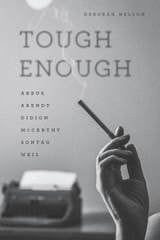
cover of Tough Enough: Arbus, Arendt, Didion, McCarthy, Sontag, Weil

Tough Enough

Arbus, Arendt, Didion, McCarthy, Sontag, Weil

Deborah Nelson

University of Chicago Press, 2017

This book focuses on six brilliant women who are often seen as particularly tough-minded: Simone Weil, Hannah Arendt, Mary McCarthy, Susan Sontag, Diane Arbus, and Joan Didion. Aligned with no single tradition, they escape straightforward categories. Yet their work evinces an affinity of style and philosophical viewpoint that derives from a shared attitude toward suffering. What Mary McCarthy called a “cold eye” was not merely a personal aversion to displays of emotion: it was an unsentimental mode of attention that dictated both ethical positions and aesthetic approaches.

Tough Enough traces the careers of these women and their challenges to the pre-eminence of empathy as the ethical posture from which to examine pain. Their writing and art reveal an adamant belief that the hurts of the world must be treated concretely, directly, and realistically, without recourse to either melodrama or callousness. As Deborah Nelson shows, this stance offers an important counter-tradition to the familiar postwar poles of emotional expressivity on the one hand and cool irony on the other. Ultimately, in its insistence on facing reality without consolation or compensation, this austere “school of the unsentimental” offers new ways to approach suffering in both its spectacular forms and all of its ordinariness.
[more]
cover of Toward a Cognitive Theory of Narrative Acts

Toward a Cognitive Theory of Narrative Acts

Edited by Frederick Luis Aldama

University of Texas Press, 2010

Toward a Cognitive Theory of Narrative Acts brings together in one volume cutting-edge research that turns to recent findings in cognitive and neurobiological sciences, psychology, linguistics, philosophy, and evolutionary biology, among other disciplines, to explore and understand more deeply various cultural phenomena, including art, music, literature, and film. The essays fulfilling this task for the general reader as well as the specialist are written by renowned authors H. Porter Abbott, Patrick Colm Hogan, Suzanne Keen, Herbert Lindenberger, Lisa Zunshine, Katja Mellman, Lalita Pandit Hogan, Klarina Priborkin, Javier Gutiérrez-Rexach, Ellen Spolsky, and Richard Walsh. Among the works analyzed are plays by Samuel Beckett, novels by Maxine Hong Kingston, music compositions by Igor Stravinsky, art by Jean-Baptiste-Simeon Chardin, and films by Michael Haneke. Each of the essays shows in a systematic, clear, and precise way how music, art, literature, and film work in and of themselves and also how they are interconnected. Finally, while each of the essays is unique in style and methodological approach, together they show the way toward a unified knowledge of artistic creativity.
[more]
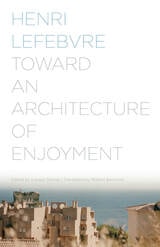
cover of Toward an Architecture of Enjoyment

Toward an Architecture of Enjoyment

Henri Lefebvre

University of Minnesota Press, 2014

Toward an Architecture of Enjoyment is the first publication in any language of the only book devoted to architecture by Henri Lefebvre. Written in 1973 but only recently discovered in a private archive, this work extends Lefebvre’s influential theory of urban space to the question of architecture. Taking the practices and perspective of habitation as his starting place, Lefebvre redefines architecture as a mode of imagination rather than a specialized process or a collection of monuments. He calls for an architecture of jouissance—of pleasure or enjoyment—centered on the body and its rhythms and based on the possibilities of the senses.

Examining architectural examples from the Renaissance to the postwar period, Lefebvre investigates the bodily pleasures of moving in and around buildings and monuments, urban spaces, and gardens and landscapes. He argues that areas dedicated to enjoyment, sensuality, and desire are important sites for a society passing beyond industrial modernization.

Lefebvre’s theories on space and urbanization fundamentally reshaped the way we understand cities. Toward an Architecture of Enjoyment promises a similar impact on how we think about, and live within, architecture.
[more]
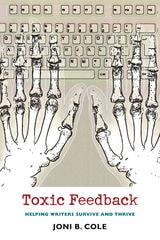
cover of Toxic Feedback: Helping Writers Survive and Thrive

Toxic Feedback

Helping Writers Survive and Thrive

Joni Cole

University Press of New England, 2006

All writers have stories of how some teacher, workshop participant, friend, or spouse gave them commentary that undermined their confidence and their writing. This “toxic feedback” has tainted feedback's reputation as a whole, causing too many writers to avoid or mismanage this valuable resource. In the first book to focus on this vital but delicate dynamic, Joni B. Cole applies first-person experience, real-life teaching examples, and her own unique ability to entertain while reaffirming the many merits of feedback. Cole shows writers how to use feedback to energize and inform their writing at every stage of the process. For feedback providers, she delivers insights into constructive criticism and the difference between being heard and being obnoxious. Finally, she offers advice to workshops and critique groups on how to thrive in this collective experience. In addition, established writers ranging from Julia Alvarez and Khaled Hosseini to Gregory Maguire and Jodi Picoult share their own feedback stories -- from useful to inspiring to deranged -- underscoring Cole's message that feedback plays a critical role in every writer's success. Through a mixture of instruction, anecdotes, and moral support, Cole manages to detoxify the feedback process with humor and without laying blame, inspiring both sides of the interaction to make the most of this powerful resource.
[more]
cover of Translating Modernism: Fitzgerald and Hemingway

Translating Modernism

Fitzgerald and Hemingway

Ronald Berman

University of Alabama Press, 2009

In Translating Modernism Ronald Berman continues his career-long study of the ways that intellectual and philosophical ideas informed and transformed the work of America’s major modernist writers.
Here Berman shows how Fitzgerald and Hemingway wrestled with very specific intellectual, artistic, and psychological influences, influences particular to each writer, particular to the time in which they wrote, and which left distinctive marks on their entire oeuvres. Specifically, Berman addresses the idea of "translating" or "translation"—for Fitzgerald the translation of ideas from Freud, Dewey, and James, among others; and for Hemingway the translation of visual modernism and composition, via Cézanne.
Though each writer had distinct interests and different intellectual problems to wrestle with, as Berman demonstrates, both had to wrestle with transmuting some outside influence and making it their own.
[more]
cover of Transmen and FTMs: Identities, Bodies, Genders, and Sexualities

Transmen and FTMs

Identities, Bodies, Genders, and Sexualities

Jason Cromwell

University of Illinois Press, 1999

Writing as an insider and an anthropologist, Jason Cromwell presents the first in-depth examination of what it means to be a female-bodied transperson. Through extensive participant observation and open-ended interviews, Transmen and FTMs allows female-to-male transsexuals to speak for themselves and reveal aspects of female gender diversity that do not fit into the ready-made categories of male and female.
 
In clarifying how transmen and FTMs define and validate their lives, as opposed to how society attempts to pigeonhole and belittle them, Cromwell shows how female-to-male transpeople have been made virtually invisible by male-dominated discourses. He considers cross-cultural data on female gender diversity, historical evidence of female-bodied people who have lived as men, and contemporary transmen and FTMs. He also addresses how FTMs and transmen are working to challenge the mental illness model of transness as well as other misconceptions.
 
Transmen and FTMs seeks to reframe the dialogue about gender identity and move away from regarding fixed gender categories as normative. By redefining gender diversity from a manifestation of pathology to a human condition Transmen and FTMs promotes a fuller understanding of these individuals as persons in their own right.
 
[more]
cover of Transplanting Care: Shifting Commitments in Health and Care in the United States

Transplanting Care

Shifting Commitments in Health and Care in the United States

Heinemann, Laura L.

Rutgers University Press, 2016

The sudden call, the race to the hospital, the high-stakes operation—the drama of transplant surgery is well known. But what happens before and after the surgery? In Transplanting Care, Laura L. Heinemann examines the daily lives of midwestern organ transplant patients and those who care for them, from pretransplant preparations through to the long posttransplant recovery.
 
Heinemann points out that as efforts to control healthcare costs gain urgency—and as new surgical techniques, drug therapies, and home medical equipment advance—most of the transplant process now takes place at home, among kin. Indeed, the transplant system effectively depends on unpaid care labor, typically provided by spouses, parents, siblings, and others. Drawing on scores of interviews with patients, relatives, and healthcare professionals, Heinemann follows a variety of patients and loved ones as they undertake this uncertain and strenuous “transplant journey.” She also shows how these home-based caregiving efforts take place within the larger economic and political context of a paucity of resources for patients and caregivers, who ultimately must surmount numerous obstacles. The author concludes that the many snags encountered by transplant patients and loved ones make a clear case for more comprehensive health and social policy that treats care as a necessarily shared public responsibility.  
 
An illuminating look at the long transplant journey, Transplanting Care also offers broader insight into how we handle infirmity in America—and how we might do a better job of doing so. 
 
[more]
cover of Traumatic Encounters in Italian Film: Locating the Cinematic Unconscious

Traumatic Encounters in Italian Film

Locating the Cinematic Unconscious

Fabio Vighi

Intellect Books, 2006

'Traumatic Encounters' addresses the question of the relationship between psychoanalysis and film in a thoroughly original way, bringing together Lacanian theory and Italian cinema as a means to unravel the deepest kernel of repressed knowledge around which film narratives are constructed. The primary theoretical reference of the book is the Real, the most under-represented of the three Lacanian categories (Symbolic, Imaginary and Real), which designates the traumatic dimension of reality that cannot be integrated in the order of language and communication. Exploring the relationship between film and its unconscious underside, the author argues that only by locating the elusive “traces of the cinematic Real” can a given film narrative be reconstructed in its entirety. Like the Lacanian subject, film here appears as fundamentally split between a traumatic dimension beyond signification (the Real), and awareness of its fragile symbolic status.

Always stylistically innovative, thematically defiant and driven by a strong political agenda, Italian cinema lends itself particularly well to a critical investigation aimed at radicalising the impact of psychoanalysis on film. In doing exactly that, the book deliberately avoids the standard cultural and historical approaches to film. Instead, it moves freely amongst some of the most widely celebrated – as well as lesser-known – Italian films of the post-war period, discussing the ways in which they tackle such themes as desire, fantasy, sexuality, violence and the law, to mention but a few. The main focus is on the work of those directors who most effectively engage with the divisive nature of the moving image: Antonioni, Pasolini and Rossellini. In addition, the book provides ample and insightful references to films by Visconti, Bertolucci, Bellocchio, Moretti, Petri, Fellini, Ferreri, and many more.
[more]
cover of True Stories of False Confessions

True Stories of False Confessions

Rob Warden

Northwestern University Press, 2009

Editors Rob Warden and Steven Drizin—leaders in the field of wrongful convictions—have gathered articles about some of the most critical accounts of false confessions in the U.S. justice system from more than forty authors, including Sydney H. Schanberg, Christine Ellen Young, Alex Kotlowitz, and John Grisham. Many of the pieces originally appeared in leading magazines and newspapers, including the New York Times, The Nation, the New Yorker, and the Los Angeles Times.

By grouping the cases into categories—including brainwashing, fabrication, mental fragility, police force, and unrequited innocence—the editors demonstrate similarities between cases, thereby refuting the perception that false confessions represent individual tragedies rather than a systemic flaw in the justice system. These incidents are not isolated; they are, in fact, related, and more shocking for it. But the authors of the articles excerpted, adapted, and reprinted in this collection want more for their subjects than outrage; they want to fuel change in the practices and standards that illicit false confessions in the first place. To this end, Warden and Drizin include an illuminating introduction to each category and recommendations for policy changes that would reduce false confessions. They also include a postscript for each case, providing legal updates and additional information.

[more]