Results by title
598 books match the query 'Religious' and 168 start with t
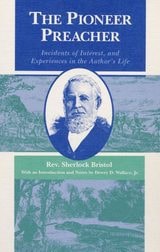
The Pioneer Preacher
Incidents of Interest, and Experiences in the Author's LifeRev. Sherlock Bristol. Introduction and notes by Dewey D. Wallace Jr. Illustrated by Isabelle Blood.
University of Illinois Press, 1989
Originally published in 1887, The Pioneer Preacher is a lively account of a Congregationalist minister's attempts to lead a sin-free existence on the American frontier. Sherlock Bristol (1815-1906) was a California gold miner, wagon train captain, Wisconsin farmer, Idaho rancher, Indian fighter, abolitionist, and Oberlin-trained clergyman. While serving a series of churches in the East, he periodically cured himself of "nervous disorders" by journeying out West. He only broke the Sabbath once---during an Indian attack!
Reflecting in his memoirs the exploits of Daniel Boone and Davy Crockett, Bristol delights in recounting his adventures, ecclesiastical or otherwise. He vividly recalls his redemption in the wilderness where he enjoyed having "little opportunity for reading books or mental exercise, and an abundance of calls for muscular employment." Greatly influenced by the evangelist Charles G. Finney at Oberlin, Bristol tried to teach miners and frontiersmen the principles of revivalism, postmillennialism, and perfectionism. In The Pioneer Preacher he shares his own disputatious views on abolition, American Indians, temperance, and other issues of his day.
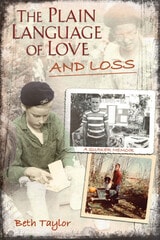
The Plain Language of Love and Loss
A Quaker MemoirBeth Taylor
University of Missouri Press, 2009
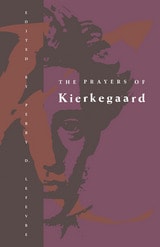
The Prayers of Kierkegaard
Edited by Perry D. LeFevre
University of Chicago Press, 1956
The second part of the volume is a reinterpretation of the life and thought of Kierkegaard. Long regarded as primarily a poet or a philosopher, Kierkegaard is revealed as a fundamentally religious thinker whose central problem was that of becoming a Christian, of realizing personal existence. Perry D. LeFevre's penetrating analysis takes the reader to the religious center of Kierkegaard's world.
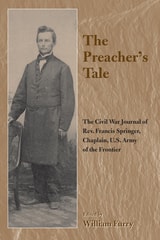
The Preacher's Tale
The Civil War Journal of Rev. Francis Springer, Chaplain, U.S. Army of the FrontierWilliam Furry
University of Arkansas Press, 2001
In the fall of 1861, fifty-one-year-old Rev. Francis Springer enlisted in the Union army. The following spring, Springer, a friend and one-time neighbor to Abraham Lincoln, rode away with the 10th Illinois Cavalry. A witness to the Battle of Prairie Grove (December 1862), Springer was later named post chaplain at Fort Smith, where, in additon to preaching and ministering to the troops, he was placed in charge of refugees—widows, orphans, and contrabands—the displaced victims of virulent guerrilla warfare in Northwest Arkansas. Springer also wrote articles and columns in the Fort Smith New Era under the pseudonym, “Thrifton.” Springer’s honest appraisals of life in the Army of the Frontier make for fascinating reading, and his unique perspective as moralist, educator, and journalist provide new insight into the Civil War and how it was fought in the West. The book includes several never-before published photographs and appendixes which feature accounts of six military executions that Springer participated in as a Union Army chaplain, the hitherto unpublished last letters home of two rebel soldiers condemned and executed at Fort Smith, as well as a eulogy for Abraham Lincoln.
The Preacher’s Tale includes several never before published photographs, and appendixes that contain accounts of six military executions that Springer participated in as a Union Army chaplain, the last letters home of two rebel soldiers condemned and executed at Fort Smith, as well as a eulogy written for Abraham Lincoln.
The Prophetic Law
Essays in Judaism, Girardianism, Literary Studies, and the EthicalSandor Goodhart
Michigan State University Press, 2014
The Quest
History and Meaning in ReligionMircea Eliade
University of Chicago Press, 1969
"Each of these essays contains insights which will be fruitful and challenging for professional students of religion, but at the same time they all retain the kind of cultural relevance and clarity of style which makes them accessible to anyone seriously concerned with man and his religious possibilities."—Joseph M. Kitagawa, Religious Education
The Question of God in Heidegger's Phenomenology
George Kovacs
Northwestern University Press, 1990
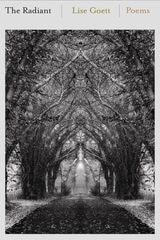
The Radiant
Lise Goett
Tupelo Press, 2024
The Radiant explores the psychological, physical, and spiritual challenges of living in a body and the changes and distortions that arise from the experience of the body’s limitations and inevitable death. The collection takes its title from the term for the point from which all meteors appear to emanate during a shower, luminous bodies in decay that when traced to their origin seem to converge at a single point. “Perhaps you can remember the time called before, the all-you-can-do-is-see-yourself-in-a-split-second where you recognize that everything you’ve ever known is going to be different after,” writes Goett in the collection’s final poem, “The Bookman,” recounting radiant points of no return and transformation that, in spite of their challenge, remain luminous.
The Religion of Existence
Asceticism in Philosophy from Kierkegaard to SartreNoreen Khawaja
University of Chicago Press, 2016
At the heart of existentialism, Noreen Khawaja argues, is a story about secular thought experimenting with the traditions of European Christianity. This book explores how a distinctly Protestant asceticism formed the basis for the chief existentialist ideal, personal authenticity, which is reflected in approaches ranging from Kierkegaard’s religious theory of the self to Heidegger’s phenomenology of everyday life to Sartre’s global mission of atheistic humanism. Through these three philosophers, she argues, we observe how ascetic norms have shaped one of the twentieth century’s most powerful ways of thinking about identity and difference—the idea that the “true” self is not simply given but something that each of us is responsible for producing.
Engaging with many central figures in modern European thought, this book will appeal to philosophers and historians of European philosophy, scholars of modern Christianity, and those working on problems at the intersection of religion and modernity.
The Religious Foundations of Francis Bacon's Thought
Stephen A. McKnight
University of Missouri Press, 2006
The Remembered and Forgotten Jewish World
Jewish Heritage in Europe and the United StatesDaniel J. Walkowitz
Rutgers University Press, 2018
The Remembered and Forgotten Jewish World investigates the politics of heritage tourism and collective memory. In an account that is part travelogue, part social history, and part family saga, acclaimed historian Daniel J. Walkowitz visits key Jewish museums and heritage sites from Berlin to Belgrade, from Krakow to Kiev, and from Warsaw to New York, to discover which stories of the Jewish experience are told and which are silenced. As he travels to thirteen different locations, participates in tours, displays, and public programs, and gleans insight from local historians, he juxtaposes the historical record with the stories presented in heritage tourism. What he finds raises provocative questions about the heritage tourism industry and its role in determining how we perceive Jewish history and identity. This book offers a unique perspective on the importance of collective memory and the dangers of collective forgetting.
The Reredos of All Souls College Oxford
Edited by Peregrine Horden
Paul Holberton Publishing, 2021
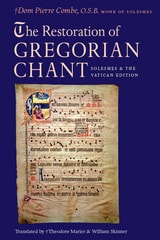
The Restoration of Gregorian Chant
Solesmes and the Vatican EditionDom Pierre Combe, O.S.B.
Catholic University of America Press, 2003
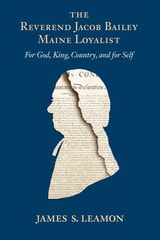
The Reverend Jacob Bailey, Maine Loyalist
For God, King, Country, and for SelfJames S. Leamon
University of Massachusetts Press, 2012
Reverend Bailey's persistence in praying for the king and his refusal to publicize the Declaration of Independence from his Pownalborough pulpit aroused hostilities that drove him and his family to the safety of Nova Scotia. There, in exile, Bailey devoted himself to assisting fellow refugees while defending himself from others. During this time, he wrote almost obsessively: poems, dramas, novels, histories. Though few were ever completed, and even fewer published, in one way or another most of his writings depicted the trauma he underwent as a loyalist.
Leamon's study of the Reverend Jacob Bailey depicts the complex nature and burdens of one person's loyalism while revealing much about eighteenth-century American life and culture.
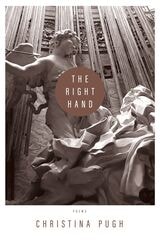
The Right Hand
Christina Pugh
Tupelo Press, 2024
Pain, piercing, and language: with urgent lyricism and lacunae on the page, The Right Hand explores the physical, emotional, and philosophical experiences of chronic pain, bodywork (especially acupuncture), and healing. In the second half of the collection, the poet spends extended time with Bernini's sculpture of St. Teresa in Ecstasy in Rome, finding this famous scene of wounding to be in dialogue with her own experience of pain, as well as her suspension between languages and spiritual isolation. In The Right Hand, the hidden sites of the body speak, and Bernini’s centuries-old arrow pierces us with hurting eloquence.
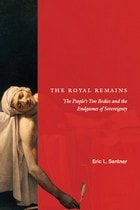
The Royal Remains
The People's Two Bodies and the Endgames of SovereigntyEric L. Santner
University of Chicago Press, 2011
"The king is dead. Long live the king!" In early modern Europe, the king's body was literally sovereign—and the right to rule was immediately transferrable to the next monarch in line upon the king's death. In The Royal Remains, Eric L. Santner argues that the "carnal" dimension of the structures and dynamics of sovereignty hasn't disappeared from politics. Instead, it migrated to a new location—the life of the people—where something royal continues to linger in the way we obsessively track and measure the vicissitudes of our flesh.
Santner demonstrates the ways in which democratic societies have continued many of the rituals and practices associated with kingship in displaced, distorted, and usually, unrecognizable forms. He proposes that those strange mental activities Freud first lumped under the category of the unconscious—which often manifest themselves in peculiar physical ways—are really the uncanny second life of these "royal remains," now animated in the body politic of modern neurotic subjects. Pairing Freud with Kafka, Carl Schmitt with Hugo von Hofmannsthal,and Ernst Kantorowicz with Rainer Maria Rilke, Santner generates brilliant readings of multiple texts and traditions of thought en route to reconsidering the sovereign imaginary. Ultimately, The Royal Remains locates much of modernity—from biopolitical controversies to modernist literary experiments—in this transition from subjecthood to secular citizenship.
This major new work will make a bold and original contribution to discussions of politics, psychoanalysis, and modern art and literature.
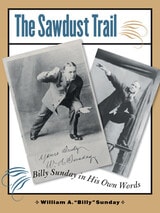
The Sawdust Trail
Billy Sunday in His Own WordsWilliam A. Sunday
University of Iowa Press, 2005
Published serially in the Ladies’ Home Journal in 1932 and 1933 and now in book form for the first time, The Sawdust Trail is the only autobiography that this hugely popular and hugely controversial preacher ever wrote. From his childhood days in Iowa to the early days of his conversion in Illinois, from his baseball career with the National League teams in Chicago, Pittsburgh, and Philadelphia to the challenges of preaching in New York City during his heyday, the sections of Sunday’s autobiography roll out like so many exuberant sermons, yet the sympathetic reader can hear echoes of the loneliness and misery of his early years.
In The Sawdust Trail the sometimes appalling but always appealing Billy Sunday creates a usable past for himself, notable for what he omits as well as for what he includes, which gives us insight not just into his own life and career but also into the peculiar history of evangelism in America.
The Second Coming of Christ
Ancient Doctrine and Present TimesFrançoise Breynaert
St. Augustine's Press, 2022
The great mystery of Christ's second coming is part of the core of Christian faith. And at long last, here is a book that explains what this truly means. And in doing so, we come to know the revealed meaning of history, which has nourished the hope of Christians through the ages.
The Secrets We Keep
Hidden Histories of the Byzantine EmpireRoland Betancourt
J. Paul Getty Trust, The, 2024
Secrecy has played a role throughout human history and continues to capture the popular imagination. Some of the most seductive aspects of the Byzantine Empire—such as the relics of the imperial palace and the military uses of Greek fire—have been shrouded in mystery for centuries. This book provides a brief history of secrecy in Byzantium and examines the role of the art historian in uncovering the truth, demonstrating how visual evidence can not only reveal new findings but also purposely conceal answers.
Art historians face many challenges in their search for hidden knowledge, including accessing accounts preserved in fragmentary glimpses and reconciling how practices of speculation and reconstruction result in different, and sometimes contradictory, understandings. With pressing urgency, this book asks scholars to consider their role in articulating the stories of marginalized people, particularly for queer and trans history.
At the core of these investigations is the quest to discover how clandestine knowledge was transmitted and how relationships were strengthened by collective secret keeping, as well as how concealment is used as a strategy for exercising power. With insights into the religious, imperial, military, and cultural uses of secrecy, this book offers an intriguing look at the ways secrecy manifested itself during the Byzantine Empire and the implications it has for the issues we face today.
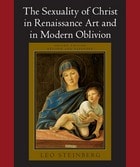
The Sexuality of Christ in Renaissance Art and in Modern Oblivion
Leo Steinberg
University of Chicago Press, 1996
This revised and greatly expanded edition not only adduces new visual evidence, but deepens the theological argument and engages the controversy aroused by the book's first publication.
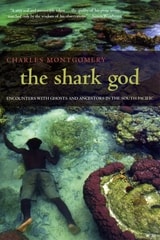
The Shark God
Encounters with Ghosts and Ancestors in the South PacificCharles Montgomery
University of Chicago Press, 2007
In the South Pacific, he discovers a world of sorcery and shark worship, where Christian and pagan rituals coexist and an ordinary day is marked by confrontations with America-worshiping cult leaders and militants alike. A defiantly original blend of history and memoir, anthropology and travel writing, The Shark God is ultimately a tale of personal and political transformation.
“The Shark God, a travel story as dark and twisted as one might ever wish to hear . . . reaches a superb climax with some apocalyptically page-turning scenes.”—Guardian
“A fascinating account of the drama of Melanesian life.”—Times Literary Supplement
“With exquisite writing, Montgomery lovingly captures the beauty and the horrors, the mysteries and the shams of the people and places he visits.”—Publishers Weekly
“A very real and memorable talent. . . . The endurance [Montgomery] displayed on his travels was admirable, the adventures he survived were tremendous, and the quality of his prose seems matched only by the wisdom of his observations.”—Simon Winchester, Globe and Mail (Toronto)
The Sound of Light
A History of Gospel MusicDon Cusic
University of Wisconsin Press, 1990
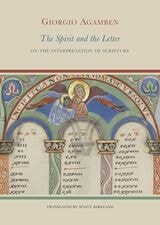
The Spirit and the Letter
On the Interpretation of ScriptureGiorgio Agamben
Seagull Books, 2026
The problem of interpreting Scripture—above all, sacred scripture, but ultimately any form of writing—coincides with the very history of Western culture. It is no surprise, then, that an archaeological inquiry such as the one proposed here—on the problem of interpretation from Origen to Auerbach, from the Talmud to Benjamin—might hold unexpected revelations.
Essential reading for scholars of theology, religious studies, and hermeneutics interested in the history of scriptural interpretation, The Spirit and the Letter highlights how the interpretation of Scripture reveals itself as inseparable from ethics and politics.
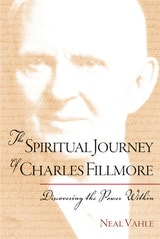
The Spiritual Journey of Charles Fillmore
Discovering the Power WithinNeal Vahle
Templeton Press, 2008
The Spiritual Journey of Charles Fillmore sheds new light on the life and work of an essential spiritual pioneer. In this landmark new biography, author Neal Vahle uses thorough new research, interviews with those who knew Fillmore, and his intimate familiarity with Fillmore's writings to introduce readers to the intriguing cofounder of the Unity movement. Beyond standard biography, Vahle's comprehensive treatment also extensively details Fillmore's era's philosophical and spiritual landscape. It gives readers an excellent overview of the metaphysical movement's evolution through time.
The Star of Redemption
Franz Rosenzweig; Translated by Barbara E. Galli; Foreword by Michael Oppenheim, introduction by Elliot R. Wolfson
University of Wisconsin Press, 2005
The Star of Redemption is essential reading for anyone interested in understanding religion and philosophy in the twentieth century. Fusing philosophy and theology, the book assigns both Judaism and Christianity distinct but equally important roles in the spiritual structure of the world. Franz Rosenzweig finds in both biblical religions approaches to a comprehension of reality.
The major themes and motifs of The Star—the birth, life, death, and the immortality of the soul; Eastern philosophies and Jewish mysticism; the relationship between God, world and humanity over time; and revelation as the real biblical miracle of faith and path to redemption—resonate meaningfully.
The Story of the Sacred Harp, 1844-1944
George Pullen Jackson
Vanderbilt University Press, 1944
The Subversive Simone Weil
A Life in Five IdeasRobert Zaretsky
University of Chicago Press, 2021
Though Weil published little during her life, after her death, thanks largely to the efforts of Albert Camus, hundreds of pages of her manuscripts were published to critical and popular acclaim. While many seekers have been attracted to Weil’s religious thought, Robert Zaretsky gives us a different Weil, exploring her insights into politics and ethics, and showing us a new side of Weil that balances her contradictions—the rigorous rationalist who also had her own brand of Catholic mysticism; the revolutionary with a soft spot for anarchism yet who believed in the hierarchy of labor; and the humanitarian who emphasized human needs and obligations over human rights. Reflecting on the relationship between thought and action in Weil’s life, The Subversive Simone Weil honors the complexity of Weil’s thought and speaks to why it matters and continues to fascinate readers today.
The Temptation to Exist
E. M. Cioran
University of Chicago Press, 1998
"A sort of final philosopher of the Western world. His statements have the compression of poetry and the audacity of cosmic clowning."—Washington Post
"An intellectual bombshell that blasts away at all kinds of cant, sham and conventionality. . . . [Cioran's] language is so erotic, his handling of words so seductive, that the act of reading becomes an encounter in the erogenous zone."—Jonah Raskin, L.A. Weekly
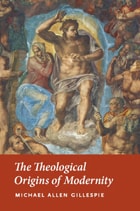
The Theological Origins of Modernity
Michael Allen Gillespie
University of Chicago Press, 2008
Exposing the religious roots of our ostensibly godless age, Michael Allen Gillespie reveals in this landmark study that modernity is much less secular than conventional wisdom suggests. Taking as his starting point the collapse of the medieval world, Gillespie argues that from the very beginning moderns sought not to eliminate religion but to support a new view of religion and its place in human life. He goes on to explore the ideas of such figures as William of Ockham, Petrarch, Erasmus, Luther, Descartes, and Hobbes, showing that modernity is best understood as a series of attempts to formulate a new and coherent metaphysics or theology.
“Bringing the history of political thought up to date and situating it against the backdrop of contemporary events, Gillespie’s analyses provide us a way to begin to have conversations with the Islamic world about what is perhaps the central question within each of the three monotheistic religions: if God is omnipotent, then what is the place of human freedom?”—Joshua Mitchell, Georgetown University
The Time Has Grown Short
René Girard, or the Last LawBenoît Chantre
Michigan State University Press, 2022
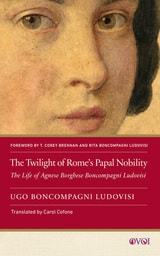
The Twilight of Rome's Papal Nobility
The Life of Agnese Borghese Boncompagni LudovisiUgo Boncompagni Ludovisi (1856–1935)
Rutgers University Press, 2025
First privately published in 1921, The Twilight of Rome's Papal Nobility provides an intimate look at a family who grew up accustomed to almost unimaginable wealth, power, and glamour. A descendant of two popes, Ugo Boncompagni Ludovisi recounts the life story of his mother Agnese, who was raised in a palace full of priceless artwork, including pieces by Caravaggio and Michelangelo. We get a window into Agnese's private life—her girlhood, marriage, and raising of several children—as her public life becomes increasingly tumultuous amid the family’s struggles to retain its property. A tender elegy to a bygone era, Boncompagni Ludovisi's story provides a unique perspective on Italian history and Rome’s urban redevelopment.
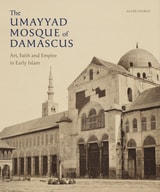
The Umayyad Mosque of Damascus
Art, Faith and Empire in Early IslamAlain George
Gingko, 2020
The Umayyad Mosque of Damascus is one of the oldest continuously used religious sites in the world. The mosque we see today was built in 705 CE by the Umayyad caliph al-Walid on top of a fourth-century Christian church that had been erected over a temple of Jupiter. Incredibly, despite the recent war, the mosque has remained almost unscathed, but over the centuries has been continuously rebuilt after damage from earthquakes and fires. In this comprehensive biography of the Umayyad Mosque, Alain George explores a wide range of sources to excavate the dense layers of the mosque’s history, also uncovering what the structure looked like when it was first built with its impressive marble and mosaic-clad walls. George incorporates a range of sources, including new information he found in three previously untranslated poems written at the time the mosque was built, as well as in descriptions left by medieval scholars. He also looks carefully at the many photographs and paintings made by nineteenth-century European travelers, particularly those who recorded the building before the catastrophic fire of 1893.
The Unchanging Truth of God? Crucial Philosophical Issues for Theology
Thomas G. Guarino
Catholic University of America Press, 2021
The Unhappy Medium
Spiritualism and the Life of Margaret FoxBy Earl Wesley Fornell; Drawings by Lowell Collins
University of Texas Press, 1964
“Here, Mr. Split-Foot, do as I do!” exclaimed the child, and the spirits obeyed her command. Thus, in 1848, thirteen-year-old Margaret Fox inaugurated the age of spiritualism. Those early spirit manifestations in a humble New York farmhouse were “but the beginning of a grand seance which for the next half century was to see persons returned from the dead walking upon the earth, mingling freely with mortal Americans. Ceremonies were performed which united in wedlock the living and the dead; ghostly schoolboys returned from the land of the spirits to revisit their old schoolhouses, upsetting the dignity of earthly classrooms . . . Drivers of owl horsecars . . . were intrigued by beautiful female spirits who rode their cars at night and promptly vanished if approached for a fare.”
The colorful career of Margaret Fox, the most famous medium of the era and the “fountainhead” of the cult of spiritualism, attracted the attention of the most prominent public figures of the day. For P. T. Barnum, this phenomenon was another novelty to present to the American public. Horace Greeley took a personal interest in Margaret and her sister; he gave the movement extensive publicity. Lincoln often invited Margaret Fox and other mediums to the White House for seances, during which attempts were made to invoke the spirit of the Lincolns’ dead son. Members of Congress, judges, and intellectuals of the day were well acquainted with her and with the spiritualist movement.
The course of this spirit invasion and the many and varied means by which men communicated with dwellers of the other world are the subjects of this volume. With Margaret Fox the spirits spoke by rapping on floor and furniture. With others they communicated by writing on slates, by touching with ghostly hands, by moving furniture (one medium was so popular that his furniture followed him about like a pack of dogs). Some spirits spoke directly through the mouths of entranced mediums. And some were so bold—or so talented—that they were able to materialize in the flesh before properly receptive groups of people—and happy indeed was the devotee who received a warm embrace from a lovely young spirit lady or a handsome ghostly gentleman during such a materialization.
The spirits who thus displayed their interest in this mortal world soon came to have a considerable influence over whole segments of the American population. For some, spiritualism was a comforting means of maintaining contact with loved ones now departed. For others it was a religion, a blessed aid on the road to salvation. For still others it provided practical assistance with more earthly problems. Many found in it intriguing puzzles for scientific investigation. And for the whole country it provided a constant source of excitement, interest, and entertainment.
Written in spritely prose and permeated with a grave humor, this account of nineteenth-century spiritualism will be equally satisfying to the casual reader interested in a good story, and to the scholar seeking serious social history.
The Universe We Think In
James V. Schall
Catholic University of America Press, 2018
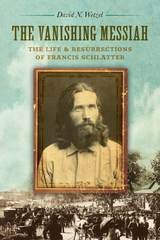
The Vanishing Messiah
The Life and Resurrections of Francis SchlatterDavid N. Wetzel
University of Iowa Press, 2016
Or did it?
Within hours of the announcement of Schlatter’s found remains, a long-haired man emerged in Cleveland to say that he was Francis Schlatter, and the next twenty-five years, several others claimed to be Denver’s great healer. In The Vanishing Messiah, a modern researcher painstakingly pieces together evidence from letters, newspaper reports, hospital records, mug shots, and published reminiscences of the healer to find out what really happened to Francis Schlatter after he left Denver in the middle of the night in November 1895. In doing so, David N. Wetzel uncovers a historical puzzle of lies, deception, and betrayal, and offers a tantalizing look into a nineteenth-century messiah and his twentieth-century reincarnations—one of whom may have been the healer himself.
The Virtual Point of Freedom
Essays on Politics, Aesthetics, and ReligionLorenzo Chiesa
Northwestern University Press, 2016
The Vision of the Soul
James Matthew Wilson
Catholic University of America Press, 2017
Story-telling is foundational to the forms of the fine arts, but it is no less foundational to human reason. Human life in turn constitutes a specific kind of form—a story form. The ancient conception of human life as a pilgrimage to beauty itself is one that we can fully embrace only if we see the essential correlation between reason and story and the essential convertibility of truth, goodness and beauty in beauty. By turns a study in fundamental ontology, aesthetics, and political philosophy, Wilson’s book invites its readers to a renewal of the West’s intellectual tradition.
The Visions of Sor María de Agreda
Writing Knowledge and PowerClark Colahan
University of Arizona Press, 1994
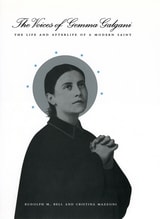
The Voices of Gemma Galgani
The Life and Afterlife of a Modern SaintRudolph M. Bell and Cristina Mazzoni
University of Chicago Press, 2002
Gemma Galgani was the first person who lived in the twentieth century to become a saint. Born in Lucca to a pharmacist and his wife, Gemma died of tuberculosis at the young age of twenty-five after a life of intense personal spirituality. Jesus caressed her as lovers do; the Virgin Mary was her affectionate Mom; Brother Gabriel playfully teased her about whether she preferred his visits to those of Jesus; and she even received all of Christ's wounds in her hands, feet, and side. At the same time, she was mocked by her family and labeled a hysteric by doctors and the local bishop. Her trials and the intimate details of her supernatural encounters—the voices of Gemma Galgani—are revealed here in this marvelous book by Rudolph M. Bell and Cristina Mazzoni.
Bell and Mazzoni have chosen and translated the most important of Gemma's words: her autobiographical account of her childhood, her diary, and key selections from her "ecstasies" and letters. Gemma emerges as a very modern saint indeed: confident, grandiose, manipulative, childish, admired, and with this book, no longer forgotten. Following Gemma's own voice, Bell carefully contextualizes her life and passion and explores her afterlife, specifically the complicated process of her canonization. Mazzoni closes the book with a "Saint's Alphabet" that finds, through Gemma's voice, spiritual meaning for women in the twenty-first century.
Far more than the reinvigoration of a neglected historical figure, The Voices of Gemma Galgani is a portrait of a complex girl-woman caught between the medieval and the modern and a potent reminder of spirituality in a supposedly secular age.
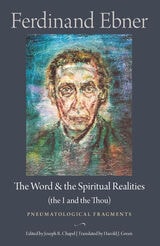
The Word and the Spiritual Realities (the I and the Thou)
Ferdinand Ebner
Catholic University of America Press, 2021
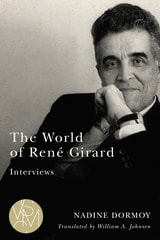
The World of René Girard
InterviewsNadine Dormoy
Michigan State University Press, 2024
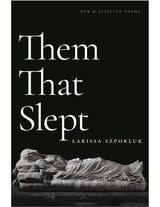
Them That Slept
New & Selected PoemsLarissa Szporluk
Tupelo Press, 2026
A selection of poems that form a narrative about psychological and spiritual somnambulance in our current age and the ever-urgent need to wake up.
In Them That Slept, Larissa Szporluk gathers three decades of work into a single incandescent arc—poems that braid feminist theology, eros, and myth into a lyric of fierce awakening. Borrowing its title from First Corinthians—“the firstfruits of them that slept”—this collection asks what it means to rise, not into certainty, but into desire, voice, and embodiment. Here, virgins become saints and saints become women of appetite. Daughters speak back to fathers. The sea mothers and devours. Joan of Arc lingers in her cell. Venus tweets. The body is never merely symbolic—it is radiant, wounded, knowing. Szporluk’s women are not passive figures in inherited narratives; they are theologians of touch, architects of longing, midwives of their own transformations.
Across selections from six previous books and a powerful suite of new poems, Szporluk reimagines sacred language as intimate speech. Biblical cadences shimmer against domestic interiors, fields, bedrooms, and storm skies. Eros is not an ornament but a form of knowledge; faith is not obedience but risk. These are poems that refuse to sleep through history. They burn toward revelation— sensual, subversive, and alive.
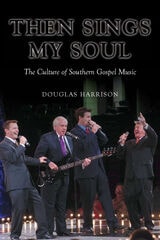
Then Sings My Soul
The Culture of Southern Gospel MusicDouglas Harrison
University of Illinois Press, 2012

Therapon
Bruce Bond and Dan Beacy-Quick
Tupelo Press, 2023
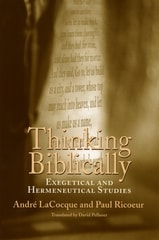
Thinking Biblically
Exegetical and Hermeneutical StudiesAndré LaCocque and Paul Ricoeur
University of Chicago Press, 1998
LaCocque's commentaries employ a historical-critical method that takes into account archaeological, philological, and historical research. LaCocque includes in his essays historical information about the dynamic tradition of reading scripture, opening his exegesis to developments and enrichments subsequent to the production of the original literary text. Ricoeur also takes into account the relation between the texts and the historical communities that read and interpreted them, but he broadens his scope to include philosophical speculation. His commentaries highlight the metaphorical structure of the passages and how they have served as catalysts for philosophical thinking from the Greeks to the modern age.
This extraordinary literary and historical venture reads the Bible through two different but complementary lenses, revealing the familiar texts as vibrant, philosophically consequential, and unceasingly absorbing.

Thomas Aquinas Today
Still the Common Doctor?Andrew Hofer
Catholic University of America Press, 2026
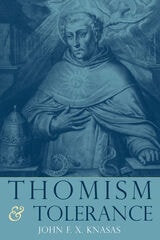
Thomism and Tolerance
John F. X. Knasas
University of Scranton Press, 2010
In this incisive study, John F. X. Knasas grounds the ideal of tolerance in Aquinas’s natural law ethics and connects the virtue of civic tolerance to the concept of being. If God is the source of being, argues Knasas, then we are the articulation of being, and it is in this capacity that we recognize our bond with other people and thus acknowledge our duty to be tolerant of one another. An important contribution to practical metaphysics and the philosophical foundations of political theory, Thomism and Tolerance will appeal to philosophy scholars and students at the undergraduate and graduate level.
Thomistic Considerations
Themes in Aquinas, Aristotle, Augustine, Dante and EliotKevin White
Catholic University of America Press, 2026
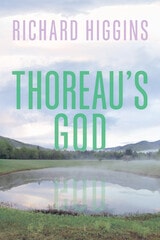
Thoreau's God
Richard Higgins
University of Chicago Press, 2024
Henry David Thoreau’s spiritual life is a riddle. Thoreau’s passionate critique of formal religion is matched only by his rapturous descriptions of encounters with the divine in nature. He fled the church only to pursue a deeper communion with a presence he felt at the heart of the universe. He called this illimitable presence many names, but he often called it God.
In Thoreau’s God, Richard Higgins invites seekers—religious or otherwise—to walk with the great Transcendentalist through a series of meditations on his spiritual life. Thoreau offers us no creed, but his writings encourage reflection on how to live, what to notice, and what to love. Though his quest was deeply personal, Thoreau devoted his life to communicating his experience of an infinite, wild, life-giving God. By recovering this vital thread in Thoreau’s life and work, Thoreau’s God opens the door to a new understanding of an original voice in American religion that speaks to spiritual seekers today.