Results by title
991 books match the query 'Writing' and 165 start with t
The Organization of Journalism
Market Models and Practice in a Fraying ProfessionPatrick Ferrucci
University of Illinois Press, 2024
Using rich interviews and participant observation, Patrick Ferrucci examines institutions with funding mechanisms that range from traditional mogul ownership and online-only nonprofits to staff-owned cooperatives and hedge fund control. The variations in market models have frayed the tenets of professionalization, with unique work cultures emerging from each organization’s focus on its mission and the implantation of its own processes and ethical guidelines. As a result, the field of American journalism no longer shares uniform newsgathering practices and a common identity, a break with the past that affects what information we consume today and what the press will become tomorrow.
An inside look at a fracturing profession, The Organization of Journalism illuminates the institution’s expanding impact on newsgathering and the people who practice it.
The Pink Guitar
Writing as Feminist PracticeRachel Blau DuPlessis
University of Alabama Press, 2006
The Power of Writing
Dartmouth '66 in the Twenty-First CenturyEdited by Christiane Donahue and Kelly Blewett
Dartmouth College Press, 2015
The Rag-Picker's Guide to Poetry
Poems, Poets, ProcessEleanor Wilner and Maurice Manning, editors
University of Michigan Press, 2013
The venture of this inviting collection is to look, from the many vantages that the 35 poets in this eclectic anthology chose to look, at what it was—knowing that a poem can’t be conceived in advance of its creation—that helped their poems to emerge or connected them over time. The Rag-Picker's Guide to Poetry permits an inside view of how poets outwit internal censors and habits of thought, showing how the meticulous and the spontaneous come together in the process of discovery. Within are contained the work and thoughts of:
- Betty Adcock
- Joan Aleshire
- Debra Allbery
- Elizabeth Arnold
- David Baker
- Rick Barot
- Marianne Boruch
- Karen Brennan
- Gabrielle Calvocoressi
- Michael Collier
- Carl Dennis
- Stuart Dischell
- Roger Fanning
- Chris Forhan
- Reginald Gibbons
- Linda Gregerson
- Jennifer Grotz
- Brooks Haxton
- Tony Hoagland
- Mark Jarman
- A. Van Jordan
- Laura Kasischke
- Mary Leader
- Dana Levin
- James Longenbach
- Thomas Lux
- Maurice Manning
- Heather McHugh
- Martha Rhodes
- Alan Shapiro
- Daniel Tobin
- Ellen Bryant Voigt
- Alan Williamson
- Eleanor Wilner
- C. Dale Young

The Reading-Writing Connection
Edited by Nancy Nelson and Robert C. Calfee
University of Chicago Press, 1998
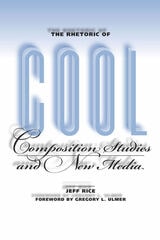
The Rhetoric of Cool
Composition Studies and New MediaJeff Rice
Southern Illinois University Press, 2007
The Rhetoric of Cool addresses the disciplinary claim that composition studies underwent a rebirth in 1963. At that time, three writers reviewed technology, cultural studies, and visual writing outside composition studies and independently used the word cool to describe each position. Starting from these three positions, Rice focuses on chora, appropriation, commutation, juxtaposition, nonlinearity, and imagery—rhetorical gestures conducive to new media work-- to construct the rhetoric of cool.
An innovative work that approaches computers and writing issues from historical, critical, theoretical, and practical perspectives, The Rhetoric of Cool challenges current understandings of writing and new media and proposes a rhetorical rather than an instrumental response for teaching writing in new media contexts.
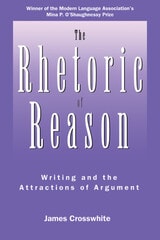
The Rhetoric of Reason
Writing and the Attractions of ArgumentJames Crosswhite
University of Wisconsin Press, 1996
To those who have lost faith in the abilities of people to reach reasoned mutual agreements, and to others who have attacked the right-or-wrong model of formal logic, this book offers the reminder that the rhetorical tradition has always viewed argumentation as a dialogue, a response to changing situations, an exchange of persuading, listening, and understanding. Crosswhite’s aim is to give new purpose to writing instruction and to students’ writing, to reinvest both with the deep ethical interests of the rhetorical tradition. In laying out the elements of argumentation, for example, he shows that claiming, questioning, and giving reasons are not simple elements of formal logic, but communicative acts with complicated ethical features. Students must learn not only how to construct an argument, but the purposes, responsibilities, and consequences of engaging in one.
Crosswhite supports his aims through a rhetorical reconstruction of reason, offering new interpretations of Plato and Aristotle and of the concepts of reflection and dialogue from early modernity through Hegel to Gadamer. And, in his conclusion, he ties these theoretical and historical underpinnings to current problems of higher education, the definition of the liberal arts, and, especially, the teaching of written communication.
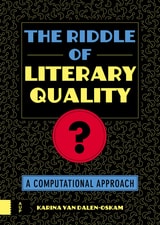
The Riddle of Literary Quality
A Computational ApproachKarina van Dalen-Oskam
Amsterdam University Press, 2023
Using evidence from almost 14,000 readers and building on more textual data than ever before, Van Dalen-Oskam and her team uncovered unconscious biases that shed new light on prejudices many people assumed no longer existed. This monograph explains in an accessible way how the project unfolded, which methods were used, and how the results may change the future of Literary Studies.
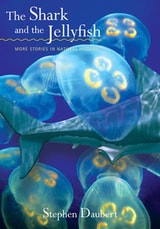
The Shark and the Jellyfish
More Stories in Natural HistoryStephen Daubert
Vanderbilt University Press, 2009
Praise for the first collection of stories:
Stephen Daubert's Threads from the Web of Life is written in the tradition of Aldo Leopold and Bernd Heinrich. It teaches by drawing you into the drama, excitement, and beauty of nature.
--Don Glass, host of the NPR-syndicated program "A Moment of Science"
Threads from the Web of Life is a uniquely wide-ranging combination of scientific research and literary imagination that takes the reader on journeys through time and space that even the most elaborate television programs still can't provide. Stephen Daubert's grasp of a variety of botanical, zoological, geological, and climatological disciplines is impressive, and he presents them and their interactions with grace and authority.
--David Rains Wallace, author of The Klamath Knot, The Monkey's Bridge, and Beasts of Eden
Each of these happenings is a thread in the intricate web of life, and Daubert, a molecular scientist at the University of California, Davis, demonstrates that these threads are easily broken by humans. ... Instructive and entertaining.
--Publishers Weekly
Threads from the Web of Life takes readers on a journey around the globe as the author describes unique and unusual ecological processes. It is ideal for casual reading as well as a source of selections to read aloud (!) or to link literature with the study of natural history.
--NSTA Recommends, National Science Teachers Association
Highly recommended. ... The stories are as much enjoyable as they are informative.
--Science Books& Films
In these sixteen stories of the interplay of organisms, weather, and geophysics, many a being succumbs to predation, and many another endures. Evolution happens as species learn the hard way. There is often a tragic element in these fascinating tales. . . . These vivid, poetic tales . . . afford good teaching. Threads from the Web of Life will appeal to any reader whose heart is in the living world.
-- ForeWord
The Small Book of Hip Checks
On Queer Gender, Race, and WritingErica Rand
Duke University Press, 2021
The Story Is True
The Art and Meaning of Telling StoriesBruce Jackson
Temple University Press, 2008
Making and experiencing stories, remembering and retelling them is something we all do. We tell stories over meals, at the water cooler, and to both friends and strangers. But how do stories work? What is it about telling and listening to stories that unites us? And, more importantly, how do we change them-and how do they change us?
In The Story Is True, author, filmmaker, and photographer Bruce Jackson explores the ways we use the stories that become a central part of our public and private lives. He examines, as no one before has, how stories narrate and bring meaning to our lives, by describing and explaining how stories are made and used. The perspectives shared in this engaging book come from the tellers, writers, filmmakers, listeners, and watchers who create and consume stories.
Jackson writes about his family and friends, acquaintances and experiences, focusing on more than a dozen personal stories. From oral histories, such as conversations the author had with poet Steven Spender, to public stories, such as what happened when Bob Dylan "went electric" at the 1965 Newport Folk Festival. Jackson also investigates how "words can kill" showing how diction can be an administrator of death, as in Nazi extermination camps. And finally, he considers the way lies come to resemble truth, showing how the stories we tell, whether true or not, resemble truth to the teller.
Ultimately, The Story Is True is about the place of stories-fiction or real-and the impact they have on the lives of each one of us.

The Story of All Things
Writing the Self in English Renaissance Narrative PoetryMarshall Grossman
Duke University Press, 1998
Relating subjectivity to the nature of language, Grossman uses the theories of Lacan to analyze the concept of the self as it encounters a transforming environment. He shows how ideological tensions arose from the reorganization and "modernization" of social life in revolutionary England and how the major poets of the time represented the division of the self in writings that are suspended between lyric and narrative genres. Beginning with the portrayals of the self inherited from Augustine, Dante, and Petrarch, he describes the influence of historic developments such as innovations in agricultural technology, civil war and regicide, and the emergence of republican state institutions on the changing representation of characters in the works of Spenser, Donne, Marvell, and Milton. Furthering this psychoanalytic critique of literary history, Grossman probes the linguistic effects of social and personal factors such as Augustine’s strained relationship with his mother and the marital disharmony of Milton and Mary Powell. With its focus on these and other "literary historical events," The Story of All Things not only proposes a new structural theory of narrative but constitutes a significant challenge to New Historicist conceptions of the self.
The Straight Line
Writing on Poetry and PoetsRon Padgett
University of Michigan Press, 2000
But along with the playful wit comes Padgett's serious fascination with how words work. Essays discuss such subjects as the otherness of languages; French poets and their relationship to Cubist painters; an afternoon with the poet Edwin Denby; a tribute to Ted Berrigan; twentieth-century modernism; and suggestions for using the computer to write poetry.
The book concludes with pieces that Padgett has written during his thirty years as a teacher of poetry. Essays explore the unexpected relationships between poetry and dance; the practical value of using "gimmicks" to inspire poetry writing; and some radical and entertaining ideas for innovative ways to read creatively.
Ron Padgett is Publications Director, Teachers and Writers Collaborative. His books include Albanian Diary, Creative Reading, and Old Faithful: 18 Writers Present Their Favorite Writing Assignments.
The Stuff of Fiction
Advice on CraftDouglas Bauer
University of Michigan Press, 2010
Bauer’s focus is on the building blocks of successful fiction: dialogue (the intimate relationship between characters talking and the eavesdropping reader), characters (the virtues of creating fictional characters that are both splendidly flawed and sympathetic), and dramatic events (ways to create moments that produce an emotional and psychological impact). There are also chapters on crafting effective openings and memorable closings of stories and on the vital presence of sentiment in fiction versus the ruinous effect of sentimentality. By assuming the point of view of someone at the task, engaged with the work, inside the effort to bring an invented world to life, The Stuff of Fiction speaks to writers of all ages in a pleasurable yet practical voice.
The Syntax of Sports, Class 1
The Words Under the WordsPatrick Barry
Michigan Publishing Services, 2019
The beginning of a multi-volume series, this initial book recreates the first day of class as it was taught to undergraduates at the University of Michigan. The examples are compelling. The dialogue is fast moving. The stories are ones you’ll want to return to and retell over and over again. There is a reason the actual students who took The Syntax of Sports said the following things about it:
“Every class I learned something new that I know I’ll actually use in my writing for years to come. Couldn’t be happier that I took a chance on Syntax of Sports.”
“Prof. Barry has structured the course so that it’s almost impossible not to learn something valuable to take with you to future classes and future career possibilities.”
“I have learned a ton of techniques for being a better writer in this class. I have also learned many life lessons that will undoubtedly guide how I act in the future.”
“I absolutely loved this course because the teacher was so awesome. I enjoyed sitting through class listening to Professor Barry and falling in love with his brain.”
The Syntax of Sports, Class 2
The Power of the ParticularPatrick Barry
Michigan Publishing Services, 2020
What can we learn from baseball great Ted Williams about how to improve our writing? What can we learn we from the iconic ESPN show SportsCenter about how to manage information? And are you sure you really know what the word “peruse” means?
Explore these and other questions in the second volume of The Syntax of Sports, a series designed to recreate a popular course at the University of Michigan. Here are a few things students have said about the experience of taking it.
-
“Patrick Barry is the best teacher I have ever had. I have never learned so much in a class. I hated English my whole life until I took this course.”
-
“I feel like this is and always will be the most valuable class I've ever taken here.”
-
“I genuinely wanted to show up to this class due to the amount I knew I would learn.”
-
“I'm going to severely SEVERELY miss this course.”
-
“Every student should try to take one of Prof. Barry’s classes if he or she wants to become a better writer.”
-
“My writing is now 113x better.”
The Talk and Texts of Teacher Development
Values, the Practicum, and Programmatic Change in Writing StudiesAdrienne Jankens
Utah State University Press, 2026
Through her multi-site analysis, Jankens examines the ways values are reflected in syllabi, committee meetings, and classroom practices. She demonstrates how values that are often unstated or assumed can be made explicit and linked to programmatic action, thus supporting development and aligning instructional goals with broader institutional objectives. Offering a nuanced framework on practicum courses, Jankens also highlights the importance of local contexts and distinguishes among tacit, implicit, explicit, emergent, and articulated values. This layered understanding helps reveal the often hidden mechanisms by which writing program values are enacted in day-to-day teaching practices.
Teacher development is a crucial site for enacting and understanding programmatic values, and making these values explicit can guide meaningful programmatic change. Providing an institutional ethnography of Jankens’s own writing program and situating those findings within broader conversations in writing studies, The Talk and Texts of Teacher Development adds to scholarship exploring the focus of the practicum course, the positionality and experience of graduate teaching assistants in writing programs, and the perennial work of the field to identify its core values and disciplinary identity.
The Violence of the Letter
Toward a Theory of WritingMelanie McMahon
University of Michigan Press, 2023
Co-Winner of the 2024 ACLA Renè Wellek Prize for Monograph
The emergence of the alphabet in ancient Greece, usually heralded as the first step in the inexorable march toward reason and progress, in fact signaled the introduction of a chance technology that hijacked the future, with devastating consequences for humanity. By investigating an array of cultural artifacts, ranging from Kubrick's 2001: A Space Odyssey to the Oracle at Delphi to Luther's challenge to the Church, this book demonstrates how the apparently benign emergence of writing made possible far-ranging systems of organized domination and unprecedented levels of violence. The Violence of the Letter considers how a twenty-six-letter code changed the face of the world, and not always for the better.
The Voice of the Masters
Writing and Authority in Modern Latin American LiteratureBy Roberto González Echevarría
University of Texas Press, 1985
By one of the most original and learned critical voices in Hispanic studies— a timely and ambitious study of authority as theme and authority as authorial strategy in modern Latin American literature.
An ideology is implicit in modern Latin American literature, argues Roberto González Echevarría, through which both the literature itself and criticism of it define what Latin American literature is and how it ought to be read. In the works themselves this ideology is constantly subjected to a radical critique, and that critique renders the ideology productive and in a sense is what constitutes the work. In literary criticism, however, too frequently the ideology merely serves as support for an authoritative discourse that seriously misrepresents Latin American literature.
In The Voice of the Masters, González Echevarría attempts to uncover the workings of modern Latin American literature by creating a dialogue of texts, a dynamic whole whose parts are seven illuminating essays on seminal texts in the tradition. As he says, "To have written a sustained, expository book ... would have led me to make the same kind of critical error that I attribute to most criticism of Latin American literature.... I would have naively assumed an authoritative voice while attempting a critique of precisely that critical gesture."
Instead, major works by Barnet, Cabrera Infante, Carpentier, Cortázar, Fuentes, Gallegos, García Márquez, Roa Bastos, and Rodó are the object of a set of independent deconstructive (and reconstructive) readings. Writing in the tradition of Derrida and de Man, González Echevarría brings to these readings both the penetrative brilliance of the French master and a profound understanding of historical and cultural context. His insightful annotation of Cabrera Infante's "Meta-End," the full text of which is presented at the close of the study, clearly demonstrates these qualities and exemplifies his particular approach to the text.
The Wandering Life
Followed by "Another Era of Writing"Yves Bonnefoy
Seagull Books, 2023
The Wandering Life is a poetic culmination of Yves Bonnefoy’s wanderings and characterizes the final twenty-five years of his work. Bonnefoy was an ardent traveler throughout his life, and his journeys in foreign countries left a profound imprint on his work. The time he spent in Italy, translating Shakespeare’s work in England, in universities in the United States, in India with Octavio Paz, and more, affected his poetry in discernible ways and inspired The Wandering Life. Interweaving verse and prose—vignettes that range from a few lines in length to several pages—this volume is a fitting capstone to Bonnefoy’s oeuvre and appears in English translation for the first time to mark the centenary of Yves Bonnefoy’s birth.
The Wounded Heart
Writing on Cherríe MoragaBy Yvonne Yarbro-Bejarano
University of Texas Press, 2001
In her work as poet, essayist, editor, dramatist, and public intellectual, Chicana lesbian writer Cherríe Moraga has been extremely influential in current debates on culture and identity as an ongoing, open-ended process. Analyzing the "in-between" spaces in Moraga's writing where race, gender, class, and sexuality intermingle, this first book-length study of Moraga's work focuses on her writing of the body and related material practices of sex, desire, and pleasure.
Yvonne Yarbro-Bejarano divides the book into three sections, which analyze Moraga's writing of the body, her dramaturgy in the context of both dominant and alternative Western theatrical traditions, and her writing of identities and racialized desire. Through close textual readings of Loving in the War Years, Giving Up the Ghost, Shadow of a Man, Heroes and Saints, The Last Generation, and Waiting in the Wings, Yarbro-Bejarano contributes to the development of a language to talk about sexuality as potentially empowering, the place of desire within politics, and the intricate workings of racialized desire.
The Writer in the Well
On Misreading and Rewriting LiteratureGary Weissman
The Ohio State University Press, 2016
Rethinking the methods and goals of literary analysis, Weissman’s study redefines the nature of authorial intention and reconceives literary interpretation as a writing-based practice. By integrating writing pedagogy with older and newer schools of thought—from psychoanalytic, reader-response, and poststructuralist theories to rhetorical narrative theory and cognitive literary studies—and bridging the fields of literary studies, composition and rhetoric, and creative writing, The Writer in the Well argues that the richest understanding of a literary work lies in probing how it has been misinterpreted and reconceived and offers a new “writer-response theory.”
This highly accessible and thought-provoking book, which includes the full text of Sher’s “The Man in the Well,” is designed to engage scholars, teachers, students, and avid readers of literature.
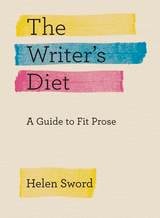
The Writer's Diet
A Guide to Fit ProseHelen Sword
University of Chicago Press, 2016
Helen Sword dispenses with excessive explanations and overwrought analysis. Instead, she offers an easy-to-follow set of writing principles: use active verbs whenever possible; favor concrete language over vague abstractions; avoid long strings of prepositional phrases; employ adjectives and adverbs only when they contribute something new to the meaning of a sentence; and reduce your dependence on four pernicious “waste words”: it, this, that, and there.
Sword then shows the rules in action through examples from William Shakespeare, Emily Dickinson, Martin Luther King Jr., John McPhee, A. S. Byatt, Richard Dawkins, Alison Gopnik, and many more. A writing fitness test encourages you to assess your own writing and get immediate advice on addressing problem areas. While The Writer’s Diet is as sleek and concise as the writing ideals contained within, this slim volume packs a powerful punch.
With Sword’s coaching writers of all levels can strengthen and tone their sentences with the stroke of a pen or the click of a mouse. As with any fitness routine, adhering to the rules requires energy and vigilance. The results, however, will speak for themselves.
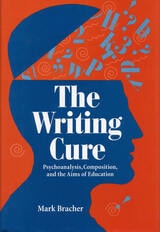
The Writing Cure
Psychoanalysis, Composition, and the Aims of EducationMark Bracher
Southern Illinois University Press, 1999
Psychoanalysis and writing instruction have much to offer each other, asserts Mark Bracher. In this book, Bracher examines the intersection between these two fields and proposes pedagogical uses of psychoanalytic technique for writing instruction.
Psychoanalysis reveals that the writing process is profoundly affected by factors that current theories have largely neglected—forces such as enjoyment, desire, fantasy, and anxiety, which, moreover, are often unconscious. Articulating an approach based on the work of Jacques Lacan, Bracher shows how a psychoanalytic perspective can offer useful insights into the nature of the writing process, the sources of writing problems, and the dynamics of writing instruction. He further demonstrates that writing instruction constitutes the most favorable venue outside of individual psychoanalytic treatment for pursuing psychoanalytic research and practice. Like psychoanalytic treatment proper, writing instruction can function as a way of reducing psychological conflict and as a means of pursuing psychoanalytic research into the workings of the mind. Empirical studies and personal testimonies have demonstrated the psychological (and even the physical) benefits of writing about personal conflict in an academic setting; such benefits promise to be enhanced and consolidated through the application of psychoanalytic principles to the teaching of writing.
The Writing Habit
David Huddle
Brandeis University Press, 1994
The Writing Life
The Hopwood Lectures, Fifth SeriesNicholas Delbanco
University of Michigan Press, 2000
The Writing Studio Sampler
Stories about ChangeMark Sutton
University Press of Colorado, 2018
The Writing of Elena Poniatowska
Engaging DialoguesBy Beth E. Jörgensen
University of Texas Press, 1994
Elena Poniatowska is one of Latin America's most distinguished and innovative living writers. Advocacy of women and the poor in their struggle for social and economic justice, denunciation of the repression of that struggle, and a tendency to blur the boundaries between conventional literary forms characterize her writing practice.
Asserting that Poniatowska's writing has been uniquely shaped by her experience as a journalist and interviewer, Beth Jörgensen addresses four important texts: Palabras cruzadas (interviews), Hasta no verte Jesús mío (testimonial novel), La noche de Tlatelolco (oral history), and La "Flor de Lis" (novel of development). She also treats related pieces, including Lilus Kikus (short fiction), De noche vienes (short stories), Fuerte es el silencio (chronicles), and several of Poniatowska's essays. Her readings incorporate a variety of critical approaches within a feminist framework.
The Writing of Melancholy
Modes of Opposition in Early French ModernismRoss Chambers
University of Chicago Press, 1993
After the failed revolution of 1848, the sense of disillusion that swept through France deeply affected the literature of the time. Chambers argues that literary melancholy and disorientation constituted a symptom of historical conditions rather than, as many other critics contend, a willful resistance to them.
Enriched by careful readings of works by Flaubert, Nerval, Baudelaire, Gautier, and Hugo, this book is a subtle meditation on the powers of writing and reading and a suggestive contribution to current debates over the historical status of literary texts. Originally published in French, the book has been revised and expanded to include a new chapter on Gérard de Nerval's "Sylvie."
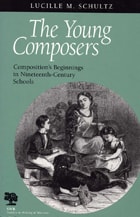
The Young Composers
Composition's Beginnings in Nineteenth-Century SchoolsLucille M. Schultz
Southern Illinois University Press, 1999
Lucille M. Schultz's The Young Composers: Composition's Beginnings in Nineteenth-Century Schools is the first full-length history of school-based writing instruction. Schultz demonstrates that writing instruction in nineteenth-century American schools is much more important in the overall history of writing instruction than we have previously assumed.
Drawing on primary materials that have not been considered in previous histories of writing instruction—little-known textbooks and student writing that includes prize-winning essays, journal entries, letters, and articles written for school newspapers—Schultz shows that in nineteenth-century American schools, the voices of the British rhetoricians that dominated college writing instruction were attenuated by the voice of the Swiss education reformer Johann Heinrich Pestalozzi. Partly through the influence of Pestalozzi's thought, writing instruction for children in schools became child-centered, not just a replica or imitation of writing instruction in the colleges.
It was also in these nineteenth-century American schools that personal or experience-based writing began and where the democratization of writing was institutionalized. These schools prefigured some of our contemporary composition practices: free writing, peer editing, and the use of illustrations as writing prompts. It was in these schools, in fact, where composition instruction as we know it today began, Schultz argues.
This book features a chapter on the agency of textbook iconography, which includes illustrations from nineteenth-century composition books as well as a cultural analysis of those illustrations. Schultz also includes a lengthy bibliography of nineteenth-century composition textbooks and student and school newspapers.
There Is No Making It Out
Stories-So-Far and the Possibilities of New StoriesRomeo García
Utah State University Press, 2025
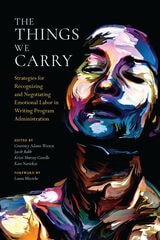
Things We Carry
Strategies for Recognizing and Negotiating Emotional Labor in Writing Program AdministrationCourtney Adams Wooten
Utah State University Press, 2020
The book is broken into three sections: one emphasizing the WPA’s own work identity, one on fostering community in writing programs, and one on balancing the professional and personal. Chapters written by a diverse range of authors in different institutional and WPA contexts examine the roles of WPAs in traumatic events, such as mass shootings and natural disasters, as well as the emotional labor WPAs perform on a daily basis, such as working with students who have been sexually assaulted or endured racist, sexist, homophobic, and otherwise disenfranchising interactions on campus. The central thread in this collection focuses on “preserving” by acknowledging that emotions are neither good nor bad and that they must be continually reflected upon as WPAs consider what to do with emotional labor and how to respond. Ultimately, this book argues for more visibility of the emotional labor WPAs perform and for WPAs to care for themselves even as they care for others.
The Things We Carry extends conversations about WPA emotional labor and offers concrete and useful strategies for administrators working in both a large range of traumatic events as well as daily situations that require tactical work to preserve their sense of self and balance. It will be invaluable to writing program administrators specifically and of interest to other types of administrators as well as scholars in rhetoric and composition who are interested in emotion more broadly.
Things, Thoughts, Words, and Actions
The Problem of Language in Late Eighteenth-Century British Rhetorical TheoryH. Lewis Ulman
Southern Illinois University Press, 1994
H. Lewis Ulman here examines the roles of language theory in eighteenth-century British rhetorics, linking those roles to philosophical issues informing twentieth-century rhetorical theory. In doing so, Ulman develops a general model of the "problem of language" for rhetorical theory, a model that transcends the impasse between realism and skepticism that marks both eighteenth- and twentieth-century rhetorical theory.
The nature of language was never more central to rhetorical theory than in the second half of the eighteenth century. Yet, until now, the articulation of theories of language and the arts of rhetoric in eighteenth-century Britain has received little attention. Ulman examines the role of grammar and theories of language in the formation of eighteenth-century rhetorical theory, investigating the significance of language theory for such key concerns of eighteenth-century rhetoric as verbal criticism, style, and elocution. His study highlights what he understands as the central motive of late eighteenth-century British rhetoricians—to construct for their particular cultural context philosophically rigorous accounts of verbal communication based on carefully articulated theories of thought and language.
Toward this end, Ulman examines three eighteenth-century British rhetorical treatises: George Campbell’s Philosophy of Rhetoric, Hugh Blair’s Lectures on Rhetoric and Belles Lettres, and Thomas Sheridan’s Course of Lectures on Elocution. He then identifies the continuities and discontinuities between the problem of language for eighteenth- and twentieth-century rhetorical theory and proposes a pluralistic stance toward the problem of language in rhetoric as an alternative to the theoretical standoff that currently characterizes the debate between realist and antirealist rhetorics.
Thinking Critically, Second Edition
World Issues for Reading, Writing, and ResearchMyra Shulman
University of Michigan Press, 2014
Just like its predecessor, Thinking Critically helps students improve reading, writing, and research skills while exploring and analyzing major global issues. Although many of the same topics are explored in this second edition—world hunger, global health, gender equality, regional conflict, cultural heritage, and immigration policies—all 31 authentic readings in the second edition are new. New topics included in this edition are cybersecurity, climate change, education reform, leadership, and human rights.
Each chapter contains two or three readings (from print and online news sources, journals, and blogs) designed to raise rather than provide answers; a vocabulary review and discussion questions for each reading; a reaction writing task; a question on the topic to research; a writing assignment for a specific academic or business genre (with models in an appendix); speaking activities (oral presentation, debate, or role-play); and a Thinking about It task. The Thinking about It task calls on students’ ability to evaluate a complex issue with objectivity and to propose a realistic approach, making this textbook good preparation for academic courses that require critical-thinking skills to express opinions both orally and in writing.
Several new academic/business written genres (abstract, fact sheet, briefing paper, report on a survey) have also been added.
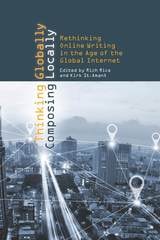
Thinking Globally, Composing Locally
Rethinking Online Writing in the Age of the Global InternetRich Rice
Utah State University Press, 2018
Thinking Globally, Composing Locally explores how writing and its pedagogy should adapt to the ever-expanding environment of international online communication. Communication to a global audience presents a number of new challenges; writers seeking to connect with individuals from many different cultures must rethink their concept of audience. They must also prepare to address friction that may arise from cross-cultural rhetorical situations, variation in available technology and in access between interlocutors, and disparate legal environments.
The volume offers a pedagogical framework that addresses three interconnected and overarching objectives: using online media to contact audiences from other cultures to share ideas; presenting ideas in a manner that invites audiences from other cultures to recognize, understand, and convey or act upon them; and composing ideas to connect with global audiences to engage in ongoing and meaningful exchanges via online media. Chapters explore a diverse range of pedagogical techniques, including digital notebooks designed to create a space for active dialogic and multicultural inquiry, experience mapping to identify communication disruption points in international customer service, and online forums used in global distance education.
Thinking Globally, Composing Locally will prove an invaluable resource for instructors seeking to address the many exigencies of online writing situations in global environments.
Contributors: Suzanne Blum Malley, Katherine Bridgman, Maury Elizabeth Brown, Kaitlin Clinnin, Cynthia Davidson, Susan Delagrange, Scott Lloyd Dewitt, Amber Engelson, Kay Halasek, Lavinia Hirsu, Daniel Hocutt, Vassiliki Kourbani, Tika Lamsal, Liz Lane, Ben Lauren, J. C. Lee, Ben McCorkle, Jen Michaels, Minh-Tam Nguyen, Beau S. Pihlaja, Mª Pilar Milagros, Cynthia L. Selfe, Heather Turner, Don Unger, Josephine Walwema
Thinking with Bruno Latour in Rhetoric and Composition
Edited by Paul Lynch and Nathaniel Rivers
Southern Illinois University Press, 2015
Best known for his books We Have Never Been Modern, Laboratory Life, and Science in Action, Bruno Latour has inspired scholarship across many disciplines. In the past few years, the fields of rhetoric and composition have witnessed an explosion of interest in Latour’s work. Editors Paul Lynch and Nathaniel Rivers have assembled leading and emerging scholars in order to focus the debate on what Latour means for the study of persuasion and written communication.
Essays in this volume discern, rearticulate, and occasionally critique rhetoric and composition’s growing interest in Latour. These contributions include work on topics such as agency, argument, rhetorical history, pedagogy, and technology, among others. Contributors explain key terms, identify implications of Latour’s work for rhetoric and composition, and explore how his theories might inform writing pedagogies and be used to build research methodologies.
Thinking with Bruno Latour in Rhetoric and Composition shows how Latour’s groundbreaking theories on technology, agency, and networks might be taken up, enriched, and extended to challenge scholars in rhetorical studies (both English and communications), composition, and writing studies to rethink some of the field’s most basic assumptions. It is set to become the standard introduction that will appeal not only to those scholars already interested in Latour but also those approaching Latour for the first time.
This Vast Book of Nature
Writing the Landscape of New Hampshire’s White Mountains, 1784–1911Pavel Cenkl
University of Iowa Press, 2006
Starting with an exploration of Jeremy Belknap’s 1784 expedition to Mount Washington, which Cenkl links to the origins of tourism in the White Mountains, to the transformation of touristic and residential relationships to landscape, This Vast Book of Nature explores the ways competing visions of the landscape have transformed the White Mountains culturally and physically, through settlement, development, and—most recently—preservation, a process that continues today.
Threshold Conscripts
Rhetoric and Composition Teaching AssistantshipsWilliam J. Macauley
University Press of Colorado, 2023
Throw Yourself Away
Writing and MasochismJulia Jarcho
University of Chicago Press, 2024
In a series of readings that engage American and European works of fiction, drama, and theory from the late nineteenth through the early twenty-first centuries, critic and playwright Julia Jarcho argues that these works conceive writing itself as masochistic, and masochism as sexuality enacted in writing. Throw Yourself Away is distinctive in its sustained focus on masochism as an engine of literary production across multiple authors and genres. In particular, Jarcho shows that theater has played a central role in modern erotic fantasies of the literary.
Jarcho foregrounds writing as a project of distressed subjects: When masochistic writing is examined as a strategy of response to injurious social systems, it yields a surprisingly feminized—and less uniformly white—image of both masochism and authorship. Ultimately, Jarcho argues that a retheorized concept of masochism helps us understand literature itself as a sex act and shows us how writing can tend to our burdened, desirous bodies. With startling insights into such writers as Henry James, Henrik Ibsen, Mary Gaitskill, and Adrienne Kennedy, Throw Yourself Away furnishes a new masochistic theory of literature itself.
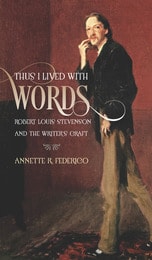
Thus I Lived with Words
Robert Louis Stevenson and the Writer's CraftAnnette R. Federico
University of Iowa Press, 2017
Stevenson belonged to a newly commercial literary world, an era of mass readership, marketing, and celebrity. He had plenty of practical advice for writers who wanted to enter the profession: study the best authors, aim for simplicity, strike a keynote, work on your style. He also held that a writer should adhere to the truth and utter only what seems sincere to his or her heart and experience of the world. Writers have messages to deliver, whether the work is a tale of Highland adventure, a collection of children’s verse, or an essay on umbrellas. Stevenson believed that an author could do no better than to find the appetite for joy, the secret place of delight that is the hidden nucleus of most people’s lives. His remarks on how to write, on style and method, and on pleasure and moral purpose contain everything in literature and life that he cared most about—adventuring, persisting, finding out who you are, and learning to embrace “the romance of destiny.”
To Make Negro Literature
Writing, Literary Practice, and African American AuthorshipElizabeth McHenry
Duke University Press, 2021
Touching the Unreachable
Writing, Skinship, Modern JapanFusako Innami
University of Michigan Press, 2021
Finalist: 2025 British Comparative Literature Association First Book Prize | July 22, 2025
Fusako Innami offers the first comprehensive study of touch and skinship—relationality with the other through the skin—in modern Japanese writing. The concept of the unreachable—that is, the lack of characters’ complete ability to touch what they try to reach for—provides a critical intervention on the issue of intimacy. Touch has been philosophically addressed in France, but literature is an effective—or possibly the most productive—venue for exploring touch in Japan, as literary texts depict what the characters may be concerned with but may not necessarily say out loud. Such a moment of capturing the gap between the felt and the said—the interaction between the body and language—can be effectively analyzed by paying attention to layers of verbalization, or indeed translation, by characters’ utterances, authors’ depictions, and readers’ interpretations. Each of the writers discussed in this book—starting with Nobel prize winner Kawabata Yasunari, Tanizaki Jun’ichirō, Yoshiyuki Junnosuke, and Matsuura Rieko—presents a particular obsession with objects or relationality to the other constructed via the desire for touch.
In Touching the Unreachable, phenomenological and psychoanalytical approaches are cross-culturally interrogated in engaging with literary touch to constantly challenge what may seem like the limit of transferability regarding concepts, words, and practices. The book thereby not only bridges cultural gaps beyond geographic and linguistic constraints, but also aims to decentralize a Eurocentric hegemony in its production and use of theories and brings Japanese cultural and literary analyses into further productive and stimulating intellectual dialogues. Through close readings of the authors’ treatment of touch, Innami develops a theoretical framework with which to examine intersensorial bodies interacting with objects and the environment through touch.
Toward More Sustainable Metaphors of Writing Program Administration
edited by Lydia Wilkes, Lilian W. Mina, and Patti Poblete afterword by Douglas Hesse
Utah State University Press, 2022
This volume presents twelve chapters that reclaim and revise established metaphors; offer new metaphors based on sustainable, relational, or emotional labor practices and phenomena; and reveal the improvisational, artisanal nature of WPA work. Chapters resonate across three sections. The first section focuses on organic relationships captured in phrases like “putting out fires” and "seeing forests for the trees” alongside unexpected comparisons to ground and light. The second describes institutional landscapes featuring generative juxtapositions such as the WPA as a labor activist or a mapper of emotional geography. And the third discusses performance crafts like improv comedy and artisanal making.
Toward More Sustainable Metaphors of Writing Program Administration offers new and revised ways of thinking and acting for WPAs, who are constantly negotiating the paradoxical demands of their work and continually striving to act ethically in conflicted, and even fraught, situations. It will inspire practicing, aspiring, and former WPAs working in a time of transformation by highlighting more sustainable ways of enacting WPA identity.
Contributors: Jacob Babb, John Belk, Katherine Daily O'Meara, Ryan J. Dippre, Douglas Hesse, Andrew Hollinger, Rona Kaufman, Cynthia D. Mwenja, Manny Piña, Scott Rogers, Robyn Tasaka, Alexis Teagarden, Christy I. Wenger, Lydia Wilkes
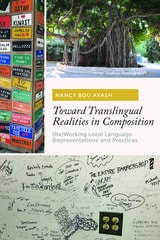
Toward Translingual Realities in Composition
(Re)Working Local Language Representations and PracticesNancy Bou Ayash
Utah State University Press, 2019
Translingualism work has concentrated on critiquing monolingual and multilingual notions of language, but it is only beginning to examine translingual enactments in writing programs and classrooms. Focusing on language representations and practices at both the macro and micro levels, author Nancy Bou Ayash places the study and teaching of university-level writing in the context of the globalization and pluralization of English(es) and other languages. Individual chapters feature various studies that Bou Ayash brings together to address how students act as agents in marshaling their language practices and resources and shows a deliberate translingual intervention that complicates and enriches students’ assumptions about language and writing. Her findings about writing programs, instructors, and students are detailed, multidimensional, and complex.
A substantial contribution to growing translingual scholarship in the field of composition studies, Toward Translingual Realities in Composition offers insights into how writing teacher-scholars and writing program administrators can more productively intervene in local postmonolingual tensions and contradictions at the level of language representations and practices through actively and persistently reworking the design and enactment of their curricula, pedagogies, assessments, teacher training programs, and campus-wide partnerships.
Toward a Grammar of Passages
Richard M. Coe
Southern Illinois University Press, 1988
Richard M. Coe has developed such a “grammar,” one which uses a simple graphic instrument to analyze the meaningful relationships between sentences in a passage and to clarify the function of structure in discourse. Working in the tradition of Christensen’s generative rhetoric, Coe presents a two-dimensional graphic matrix that effectively analyzes the logical relations between statements by mapping coordinate, subordinate, and superordinate relationships.
Coe demonstrates the power of his discourse matrix by applying it to a variety of significant problems, such as how to demonstrate discourse differences between cultures (especially between Chinese and English), how to explain precisely what is “bad” about the structure of passages that do not work, and how best to teach structure. This new view of the structure of passages helps to articulate crucial questions about the relations between form and function, language, thought and culture, cognitive and social processes.
Toward a Phenomenological Rhetoric
Writing, Profession, and AltruismBarbara Couture
Southern Illinois University Press, 1998
Current rhetorical and critical theory for the most part separates writing from consciousness and presumes relative truth to be the only possible expressive goal for rhetoric. These presumptions are reflected in our tradition of persuasive rhetoric, which values writing that successfully argues one person’s belief at the expense of another’s. Barbara Couture presents a case for a phenomenological rhetoric, one that values and respects consciousness and selfhood and that restores to rhetoric the possibility of seeking an all-embracing truth through pacific and cooperative interaction.
Couture discusses the premises on which current interpretive theory has supported relative truth as the philosophical grounding for rhetoric, premises, she argues, that have led to constraints on our notion of truth that divorce it from human experience. She then shows how phenomenological philosophy might guide the theory and practice of rhetoric, reanimating its role in the human enterprise of seeking a shared truth. She proposes profession and altruism as two guiding metaphors for the phenomenological activity of "truth-seeking through interaction."
Among the contemporary rhetoricians and philosophers who influence Couture are Pierre Teilhard de Chardin, Martin Buber, Charles Altieri, Charles Taylor, Alasdair Maclntyre, and Jürgen Habermas.
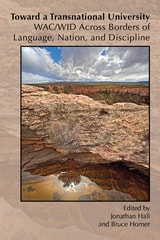
Toward a Transnational University
WAC/WID Across Borders of Language, Nation, and DisciplineJonathan Hall
University Press of Colorado, 2023
Toward an Anti-Capitalist Composition
James Rushing Daniel
Utah State University Press, 2022
Drawing on an array of philosophers, political theorists, and activists, Daniel outlines an anti-capitalist approach informed by the common, a concept theorized by Pierre Dardot and Christian Laval as a solidaristic response to capitalism rooted in inventive political action. Rather than relying upon claims of membership or ownership, the common supports radical, collective acts of remaking that comprehensively reject capitalist logics. Applying this approach to collaborative writing, student debt, working culture, and digital writing, Daniel demonstrates how the writing classroom may be oriented toward capitalist harms and prepare students to critique and resist them. He likewise employs the common to theorize how anti-capitalist interventions beyond the classroom could challenge institutional privatization and oppose the adjunctification of the professoriate.
Arguing that composition scholars have long neglected marketization and corporate power, Toward an Anti-Capitalist Composition extends a case for adopting a resolute anti-capitalist stance in the field and for remaking the university as a site of common work.
Toxic Feedback
Helping Writers Survive and ThriveJoni Cole
University Press of New England, 2006
Tracing the Impact of First-Year Writing
Identity, Process, and Transfer at a Public UniversityLaura Wilder
Utah State University Press, 2024
In contrast to previous longitudinal studies of college writers undertaken at institutions with high prestige and resources, Tracing the Impact of First-Year Writing explores the role of writing at a regional public university and documents how students’ experiences with writing can be highly divergent across the curriculum and unequal across campuses. Additionally, this book includes the voices of students who do not identify as capable writers and have strongly negative emotional reactions to writing and writing instruction and adds empirical support to innovative calls in the field to transform the first-year writing course into one that inspires students to reflectively consider writing itself.