Results by title
8642 books match the query '20th century' and 1764 start with t
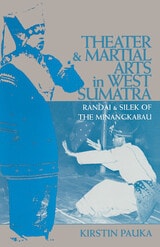
Theater and Martial Arts in West Sumatra
Randai and Silek of the MinangkabauKirstin Pauka
Ohio University Press, 1998
Randai, the popular folk theater tradition of the Minangkabau ethnic group in West Sumatra, has evolved to include influences of martial arts, storytelling, and folk songs. Theater and Martial Arts in West Sumatra describes the origin, development, and cultural background of randai and highlights two recent developments: the emergence of female performers and modern staging techniques.
This book also explores the indigenous martial arts form silek, a vital part of randai today. The strong presence of silek is illustrated in the martial focus of the stories that are told through randai, in its movement repertoire, and even in its costumes and musical accompaniment. As Kirstin Pauka shows, randai, firmly rooted in silek and Minangkabau tradition, is an intriguing mirror of the Minangkabau culture.
Theater of Capital
Modern Drama and Economic LifeAlisa Zhulina
Northwestern University Press, 2024
Emerging amid the turbulent rise of market finance and wider socioeconomic changes, modern drama enacted vital critiques of art and life under capitalism. Alisa Zhulina shows how fin-de-siècle playwrights such as Henrik Ibsen, August Strindberg, Anton Chekhov, George Bernard Shaw, and Gerhart Hauptmann interrogated the meaning of this newly coined economic concept. Acutely aware of their complicity in the system they sought to challenge, these playwrights staged economic questions as moral and political concerns, using their plays to explore the theories of Adam Smith, Karl Marx and Friedrich Engels, Max Weber, and others within the boundaries of bourgeois theater.
Theater of Capital: Modern Drama and Economic Life reveals the prescient and unsettling visions of life in a new financial and societal reality in now-canonical plays such as A Doll’s House, Miss Julie, and The Cherry Orchard, as well as in lesser-known and long-overlooked works. This wide-ranging study prompts us to reevaluate modern drama and its legacy for the urgent economic and political questions that haunt our present moment.
Theater of the Mind
Imagination, Aesthetics, and American Radio DramaNeil Verma
University of Chicago Press, 2012
For generations, fans and critics have characterized classic American radio drama as a “theater of the mind.” This book unpacks that characterization by recasting the radio play as an aesthetic object within its unique historical context. In Theater of the Mind, Neil Verma applies an array of critical methods to more than six thousand recordings to produce a vivid new account of radio drama from the Depression to the Cold War.
In this sweeping exploration of dramatic conventions, Verma investigates legendary dramas by the likes of Norman Corwin, Lucille Fletcher, and Wyllis Cooper on key programs ranging from The Columbia Workshop, The Mercury Theater on the Air, and Cavalcade of America to Lights Out!, Suspense, and Dragnet to reveal how these programs promoted and evolved a series of models of the imagination.
With close readings of individual sound effects and charts of broad trends among formats, Verma not only gives us a new account of the most flourishing form of genre fiction in the mid-twentieth century but also presents a powerful case for the central place of the aesthetics of sound in the history of modern experience.
Theater, War, and Memory in Crisis
Vichy, Algeria, the AftermathJohn Ireland
University of Michigan Press, 2025
Theatermachine
Tadeusz Kantor in ContextEdited by Magda Romanska and Kathleen Cioffi
Northwestern University Press, 2019
Theaters of Time and Space
American Planetaria, 1930-1970Marche, Jordan
Rutgers University Press, 2005
Every year, millions of Americans visit planetariums and are captivated by their strikingly realistic portrayal of the night sky. Today, it is indeed difficult to imagine astronomy education without these magnificent celestial theaters. But projection planetariums, first developed in Germany, have been a part of American museum pedagogy only since the early twentieth century and were not widespread until the 1960s.
In this unique social history,former planetarium director and historian of science Jordan D. Marché II offers the first complete account of the community of individuals and institutions that, during the period between 1930 and 1970, made planetariums the popular teaching aids they are today. Marché addresses issues such as the role of gender and social developments within the planetarium community, institutional patronage, and the popularization of science. He reveals how, at different times, various groups, including financial donors, amateur scientists, and government officials, viewed the planetarium as an instrument through which they could shape public understanding and perceptions of astronomy and space science.
Offering an insightful, wide-ranging look into the origins of an institution that has fascinated millions, Theaters of Timeand Space brings new perspectives to how one educational community changed the cultural complexion of science, helped shape public attitudes toward the U.S. space program, and even contributed to policy decisions regarding allocations for future space research.
Theaters of the Everyday
Aesthetic Democracy on the American StageJacob Gallagher-Ross
Northwestern University Press, 2018
Offering both fresh reappraisals of canonical figures and movements and new examinations of theatrical innovators, Theaters of the Everyday reveals surprising affinities between artists often considered poles apart, such as John Cage and Lee Strasberg, and Thornton Wilder and the New York experimentalist Nature Theater of Oklahoma. Gallagher-Ross persuasively shows how these creators eschew conventional definitions of dramatic action and focus attention on smaller but no less profound dramas of perception, consciousness, and day-to-day life.
Gallagher-Ross traces some of the intellectual roots of the theater of the everyday to American transcendentalism, with its pragmatic process philosophy as well as its sense of ordinary experience as the wellspring of aesthetic awareness.
Theatre Is More Beautiful Than War
German Stage Directing in the Late Twentieth CenturyCarlson, Marvin
University of Iowa Press, 2009
In almost every area of production, German theatre of the past forty years has achieved a level of distinction unique in the international community. This flourishing theatrical culture has encouraged a large number of outstanding actors, directors, and designers as well as video and film artists. The dominant figure throughout these years, however, has remained the director. In this stimulating and informative book, noted theatre historian Marvin Carlson presents an in-depth study of the artistic careers, working methods, and most important productions of ten of the leading directors of this great period of German staging.
Beginning with the leaders of the new generation that emerged in the turbulent late 1960s—Peter Stein, Peter Zadek, and Claus Peymann, all still major figures today—Carlson continues with the generation that appeared in the 1980s, particularly after reunification—Frank Castorf, Anna Viebrock, Andrea Breth, and Christoph Marthaler—and concludes with the leading directors to emerge after the turn of the century, Stefan Pucher, Thomas Ostermeier, and Michael Thalheimer. He also provides information not readily available elsewhere in English on many of the leading actors and dramatists as well as the designers whose work, much of it for productions of these directors, has made this last half century a golden age of German scenic design.
During the late twentieth century, no country produced so many major theatre directors or placed them so high in national cultural esteem as Germany. Drawing on his years of regular visits to the Theatertreffen in Berlin and other German productions, Carlson will captivate students of theatre and modern German history and culture with his provocative, well-illustrated study of the most productive and innovative theatre tradition in Europe.
Theatre of Iraq Under Occupation, 2003-2011
Lamentation, Homeland, IdentityJames Al-Shamma
University of Iowa Press, 2025
However, in 2003, the United States invasion of Iraq propelled Iraqi theatre in an altogether different direction. Global media published photographs documenting the torture of Iraqi detainees by American soldiers and sectarian violence broke out, as Shiʿa and Sunni militias struggled for power. Theatre of Iraq Under Occupation examines the occupation’s impact on Iraqi theatre as eliciting lamentation over loss of homeland and identity, and as an assault on the Iraqi character itself. The first volume in English dedicated solely to theatre in Iraq, James Al-Shamma and Amir Al-Azraki’s insights don’t just offer a significant contribution to cultural studies, they bridge foreign policy and art in real time.
Theatre of the Real
Yeats, Beckett, and SondheimGina Masucci MacKenzie
The Ohio State University Press, 2008
Theatres of Independence
Drama, Theory, and Urban Performance in India since 1947Aparna Bhargava Dharwadker
University of Iowa Press, 2005
The first part of Dharwadker’s study deals with the new dramatic canon that emerged after 1950 and the variety of ways in which plays are written, produced, translated, circulated, and received in a multilingual national culture. The second part traces the formation of significant postcolonial dramatic genres from their origins in myth, history, folk narrative, sociopolitical experience, and the intertextual connections between Indian, European, British, and American drama. The book’s ten appendixes collect extensive documentation of the work of leading playwrights and directors, as well as a record of the contemporary multilingual performance histories of major Indian, Western, and non-Western plays from all periods and genres. Treating drama and theatre as strategically interrelated activities, the study makes post-independence Indian theatre visible as a multifaceted critical subject to scholars of modern drama, comparative theatre, theatre history, and the new national and postcolonial literatures.
Theatrical Consciousness
The Actor’s Mind in Russian ModernismAlisa Ballard Lin
Northwestern University Press, 2025
Investigating late imperial Russian and early Soviet modernism’s reinvention of the actor
In this wide-ranging study, Alisa Ballard Lin argues that Russian theatrical theory and practice contributed to a broad pre- and postrevolutionary discourse about the mind, profoundly reshaping concepts of consciousness, perception, identity, and the constitution of the subject. Theatrical Consciousness: The Actor’s Mind in Russian Modernism examines efforts in Russian theater—from around the turn of the century through the mid-1930s—to stimulate, train, imagine, and ultimately understand the actor’s, as well as the spectator’s, mind. Discussing key figures of the period, including Nikolai Evreinov, Konstantin Stanislavsky, Vsevolod Meyerhold, and Alexander Tairov, Lin identifies an underappreciated dimension of humanism within Russian modernism: a humanism that resisted the pressures of an increasingly technologized, industrialized, and politicized modernity that challenged the place of the human within it.
Themes out of School
Effects and CausesStanley Cavell
University of Chicago Press, 1988
Fantasies of film and television and literature, flashes across the landscape of literary theory, philosophical discourse, and French historiography give Cavell his starting points in these twelve essays. Here is philosophy in and out of "school," understood as a discipline in itself or thought through the works of Shakespeare, Molière, Kierkegaard, Thoreau, Brecht, Makavejev, Bergman, Hitchcock, Astaire, and Keaton.
Theodore Roosevelt in the Field
Michael R. Canfield
University of Chicago Press, 2015
Drawing extensively on Roosevelt’s field notebooks, diaries, and letters, Canfield takes readers into the field on adventures alongside him. From Roosevelt’s early childhood observations of ants to his notes on ornithology as a teenager, Canfield shows how Roosevelt’s quest for knowledge coincided with his interest in the outdoors. We later travel to the Badlands, after the deaths of Roosevelt’s wife and mother, to understand his embrace of the rugged freedom of the ranch lifestyle and the Western wilderness. Finally, Canfield takes us to Africa and South America as we consider Roosevelt’s travels and writings after his presidency. Throughout, we see how the seemingly contradictory aspects of Roosevelt’s biography as a hunter and a naturalist are actually complementary traits of a man eager to directly understand and experience the environment around him.
As our connection to the natural world seems to be more tenuous, Theodore Roosevelt in the Field offers the chance to reinvigorate our enjoyment of nature alongside one of history’s most bold and restlessly curious figures.
Theodore Roosevelt
A Literary LifeThomas Bailey and Katherine Joslin
University Press of New England, 2018

Theory in the Practice of the Nicaraguan Revolution
Bruce E. Wright
Ohio University Press, 1995
Even in the period following the electoral defeat of the Sandinista National Liberation Front (FSLN) in 1990, the revolution of 1979 continues to have a profound effect on the political economy of Nicaragua. Wright’s study, which is based on interviews with people from all walks of life—from government and party officials to academics and campesinos—as well as on the large volume of literature in both English and Spanish, focuses on the FSLN understanding of the relationships between the state, the party, and mass actors, and the nature of social classes. Wright considers the topics of agrarian reform, the development of mass organizations, the role of labor, and other aspects of the Nicaraguan political economy in order to assess their significance in theoretical as well as practical terms.
Therapeutic Revolutions
Medicine, Psychiatry, and American Culture, 1945-1970Halliwell, Martin
Rutgers University Press, 2014
Beginning with a discussion of the profound impact of World War II and the Cold War on mental health, Halliwell moves from the influence of work, family, and growing up in the Eisenhower years to the critique of institutional practice and the search for alternative therapeutic communities during the 1960s. Blending a discussion of such influential postwar thinkers as Erich Fromm, William Menninger, Erving Goffman, Erik Erikson, and Herbert Marcuse with perceptive readings of a range of cultural text that illuminate mental health issues--among them Spellbound, Shock Corridor, Revolutionary Road, and I Never Promised You a Rose Garden--this compelling study argues that the postwar therapeutic revolutions closely interlink contrasting discourses of authority and liberation.
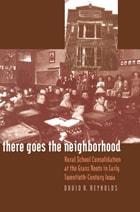
There Goes the Neighborhood
Rural School Consolidation at the Grass Roots in Early Twentieth-Century IowaDavid R. Reynolds
University of Iowa Press, 2002
There Used to Be Order
Life on the Copperbelt after the Privatisation of the Zambia Consolidated Copper MinesPatience Mususa
University of Michigan Press, 2021
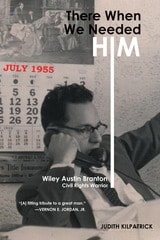
There When We Needed Him
Wiley Austin Branton, Civil Rights WarriorJudith Kilpatrick
University of Arkansas Press, 2007

These Are the Breaks
The Origins of Hip HopEugene Stein
University of Illinois Press, 2027
Stein combines granular detail, oral histories, and analyses from economic geography and Black geographies to reveal the urban environment’s effect on the lives and artistic activities of young people. Himself a Bronx native, Stein grew up in the unpredictable New York City of the 1970s and witnessed a cascade of economic distress, structural racism, city-wide fiscal catastrophe, and the borough’s housing crisis. As he shows, these and other factors primed pioneering rappers, DJs, and other artists to aim at success and outclass rivals by developing new styles. Housing policies and population movements, meanwhile, both tore apart social networks and provided the need and impetus for new and nurturing cultural communities.
Expansive and innovative, These Are the Breaks chronicles how a generation of Black and Latino youth transformed hardship into identity, competition, community, and art.
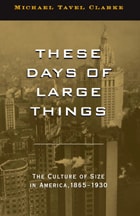
These Days of Large Things
The Culture of Size in America, 1865-1930Michael Tavel Clarke
University of Michigan Press, 2009
The United States at the turn of the twentieth century cultivated a passion for big. It witnessed the emergence of large-scale corporate capitalism; the beginnings of American imperialism on a global stage; record-level immigration; a rapid expansion of cities; and colossal events and structures like world's fairs, amusement parks, department stores, and skyscrapers. Size began to play a key role in American identity. During this period, bigness signaled American progress.
These Days of Large Things explores the centrality of size to American culture and national identity and the preoccupation with physical stature that pervaded American thought. Clarke examines the role that body size played in racial theory and the ways in which economic changes in the nation generated conflicting attitudes toward growth and bigness. Finally, Clarke investigates the relationship between stature and gender.
These Days of Large Things brings together a remarkable range of cultural material including scientific studies, photographs, novels, cartoons, architecture, and film. As a general cultural and intellectual history of the period, this work will be of interest to students and scholars in American studies, U.S. history, American literature, and gender studies.
Michael Tavel Clarke is Assistant Professor of English at the University of Calgary.
Cover photograph: "New York from Its Pinnacles," Alvin Langdon Coburn (1912). Courtesy of the George Eastman House.
"A fascinating study of the American preoccupation with physical size, this book charts new paths in the history of science, culture, and the body. A must-read for anyone puzzling over why Americans today love hulking SUVs, Mcmansions, and outsized masculine bodies."
---Lois Banner, University of Southern California
"From the Gilded Age through the Twenties, Clarke shows a nation-state obsessed with sheer size, ranging from the mammoth labor union to the 'Giant Incorporated Body' of the monopoly trust. These Days of Large Things links the towering Gibson Girl with the skyscraper, the pediatric regimen with stereotypes of the Jew. Spanning anthropology, medicine, architecture, business, and labor history, Clarke provides the full anatomy of imperial America and offers a model of cultural studies at its very best."
---Cecelia Tichi, Vanderbilt University
They All Made Peace—What Is Peace?
The 1923 Lausanne Treaty and the New Imperial OrderEdited by Jonathan Conlin and Ozan Ozavci
Gingko, 2023
The last of the post-World War One peace settlements, the 1923 Treaty of Lausanne departed from methods used in the Treaty of Versailles and took on a new peace-making initiative: a forced population exchange that affected one and a half million people. Like its German and Austro-Hungarian allies, the defeated Ottoman Empire had initially been presented with a dictated peace in 1920. In just two years, however, the Kemalist insurgency enabled Turkey to become the first sovereign state in the Middle East, while the Greeks, Armenians, Arabs, Egyptians, Kurds, and other communities previously under the Ottoman Empire sought their own forms of sovereignty.
Featuring historical analysis from multiple perspectives, They All Made Peace, What Is Peace? considers the Lausanne Treaty and its legacy. Chapters investigate British, Turkish, and Soviet designs in the post-Ottoman world, situate the population exchanges relative to other peacemaking efforts, and discuss the economic factors behind the reallocation of Ottoman debt and the management of refugee flows. Further chapters examine Kurdish, Arab, Iranian, Armenian, and other communities that were refused formal accreditation at Lausanne, but which were still forced to live with the consequences, consequences that are still emerging, one hundred years on.
They Both Reached for the Gun
Beulah Annan, Maurine Watkins, and the Trial That Became ChicagoCharles H. Cosgrove
Southern Illinois University Press, 2024
Honorable Mention, 2025 Society of Midland Authors Award in History!
Examining the case that inspired a pop culture phenomenon
In 1924 Beulah Annan was arrested and incarcerated for killing her lover, Harry Kalsted. Six weeks later, a jury acquitted her of murder. Inspired by the sordid event, trial, and acquittal, Maurine Watkins, a reporter at the time, wrote the play Chicago, a Broadway hit that was adapted several times. Through a fresh retelling of the story of Annan and of Watkins’s play, Charles H. Cosgrove provides the first critical examination of the criminal case, and an initial exploration of the era’s social assumptions that made the message of the play so plausible in its own time. His careful historical research challenges the received portrait of Annan as a killer who got away with murder, and of Watkins as a savvy cub reporter and precocious playwright.
In They Both Reached for the Gun, Charles H. Cosgrove expertly combines inquest and police records, and interviews with Annan’s relatives, to analyze the participants, the trial, and the subsequent play. Although no one will ever know what really happened in the Kenwood apartment on Chicago’s south side one hundred years ago, Cosgrove’s interrogation shows how sensationalized Watkins’s writing was. Her reporting on the Annan case perpetuated falsehoods about Annan’s so-called “confession,” and her play gave an inaccurate portrayal of Chicago’s criminal justice system. Despite Watkins’s insistence that her drama revealed the truth about its subjects without any exaggeration, her play depicted police, prosecutors, and judges as the only “good guys” in the story, ignoring those who lied, misled, and used brutal methods to obtain forced confessions.
They Call You Back
A Lost History, A Search, A MemoirTim Z. Hernandez
University of Arizona Press, 2024
A haunting, an obsession, a calling: Tim Z. Hernandez has been searching for people his whole life. Now, in this highly anticipated memoir, he takes us along on an investigative odyssey through personal and collective history to uncover the surprising conjunctions that bind our stories together.
Hernandez’s mission to find the families of the twenty-eight Mexicans who were killed in the 1948 plane wreck at Los Gatos Canyon formed the basis for his acclaimed documentary novel All They Will Call You, which the San Francisco Chronicle dubbed “a stunning piece of investigative journalism,” and the New York Times hailed as “painstaking detective work by a writer who is the descendant of farmworkers.”
In this riveting new work, Hernandez continues his search for the plane crash victims while also turning the lens on himself and his ancestral past, revealing the tumultuous and deeply intimate experiences that have fueled his investigations—a lifelong journey haunted by memory, addiction, generational trauma, and the spirit world.
They Call You Back is the true chronicle of one man’s obsession to restore dignity to an undignified chapter in America’s past, while at the same time making a case for why we must heal our personal wounds if we are ever to heal our political ones.
They Came to Toil
Newspaper Representations of Mexicans and Immigrants in the Great DepressionBy Melita M. Garza
University of Texas Press, 2018
As the Great Depression gripped the United States in the early 1930s, the Hoover administration sought to preserve jobs for Anglo-Americans by targeting Mexicans, including long-time residents and even US citizens, for deportation. Mexicans comprised more than 46 percent of all people deported between 1930 and 1939, despite being only 1 percent of the US population. In all, about half a million people of Mexican descent were deported to Mexico, a “homeland” many of them had never seen, or returned voluntarily in fear of deportation.
They Came to Toil investigates how the news reporting of this episode in immigration history created frames for representing Mexicans and immigrants that persist to the present. Melita M. Garza sets the story in San Antonio, a city central to the formation of Mexican American identity, and contrasts how the city’s three daily newspapers covered the forced deportations of Mexicans. She shows that the Spanish-language La Prensa not surprisingly provided the fullest and most sympathetic coverage of immigration issues, while the locally owned San Antonio Express and the Hearst chain-owned San Antonio Light varied between supporting Mexican labor and demonizing it. Garza analyzes how these media narratives, particularly in the English-language press, contributed to the racial “othering” of Mexicans and Mexican Americans. Adding an important new chapter to the history of the Long Civil Rights Movement, They Came to Toil brings needed historical context to immigration issues that dominate today’s headlines.
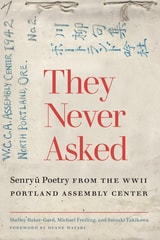
They Never Asked
Senryu Poetry from the WWII Portland Assembly CenterShelley Baker-Gard
Oregon State University Press, 2023
The Japanese American communities in Oregon and southern Washington were relatively small and many of the detainees knew each other; they drew on existing family and community networks to help each other through the long summer, living in inhumane conditions under the constant threat of violence. Several members of Bara Ginsha, a Portland poetry group, decided to continue their work while incarcerated, primarily by writing senryū, a type of Japanese poetry related to haiku.
They Never Asked is a collection of work produced by Bara Ginsha members in the WCCA camp, based on a journal kept by Masaki Kinoshita. The senryū collected here were written by a group of twenty-two poets, who produced hundreds of poems. Individually, the poems reflect the thoughts and feelings the authors experienced while being detained in the Center; collectively, they reflect the resilience and resistance of a community denied freedom. Editors Shelley Baker-Gard, Michael Freiling, and Satsuki Takikawa present translations of the poems alongside the originals, supplemented by historical and literary context and a foreword by Duane Watari, Masaki Kinoshita’s grandson.
They Were Just People
Stories of Rescue in Poland During the HolocaustBill Tammeus & Rabbi Jacques Cukierkorn
University of Missouri Press, 2009
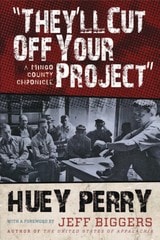
They'll Cut Off Your Project
A Mingo County ChronicleHuey Perry, with a foreword by Jeff Biggers
West Virginia University Press, 2010
In old England, if a king didn’t like you, he would cut off your head. Now, if they don’t like you, they’ll cut off your project!
As the Johnson Administration initiated its war on poverty in the 1960s, the Mingo County Economic Opportunity Commission project was established in southern West Virginia. Huey Perry, a young, local history teacher was named the director of this program and soon he began to promote self-sufficiency among low-income and vulnerable populations. As the poor of Mingo County worked together to improve conditions, the local political infrastructure felt threatened by a shift in power. Bloody Mingo County, known for its violent labor movements, corrupt government, and the infamous Hatfield-McCoy rivalry, met Perry’s revolution with opposition and resistance.
In They’ll Cut Off Your Project, Huey Perry reveals his efforts to help the poor of an Appalachian community challenge a local regime. He describes this community’s attempts to improve school programs and conditions, establish cooperative grocery stores to bypass inflated prices, and expose electoral fraud. Along the way, Perry unfolds the local authority’s hostile backlash to such change and the extreme measures that led to an eventual investigation by the FBI. They’ll Cut Off Your Project chronicles the triumphs and failures of the war on poverty, illustrating why and how a local government that purports to work for the public’s welfare cuts off a project for social reform.
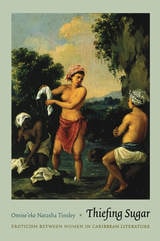
Thiefing Sugar
Eroticism between Women in Caribbean LiteratureOmise eke Natasha Tinsley
Duke University Press, 2010
Things You Need to Hear
Collected Memories of Growing Up in Arkansas, 1890–1980Margaret Jones Bolsterli
University of Arkansas Press, 2016
Think Tanks in America
Thomas Medvetz
University of Chicago Press, 2012
Think to New Worlds
The Cultural History of Charles Fort and His FollowersJoshua Blu Buhs
University of Chicago Press, 2024
Flying saucers. Bigfoot. Frogs raining from the sky. Such phenomena fascinated Charles Fort, the maverick writer who scanned newspapers, journals, and magazines for reports of bizarre occurrences: dogs that talked, vampires, strange visions in the sky, and paranormal activity. His books of anomalies advanced a philosophy that saw science as a small part of a larger system in which truth and falsehood continually transformed into one another. His work found a ragged following of skeptics who questioned not only science but the press, medicine, and politics. Though their worldviews varied, they shared compelling questions about genius, reality, and authority. At the center of this community was adman, writer, and enfant terrible Tiffany Thayer, who founded the Fortean Society and ran it for almost three decades, collecting and reporting on every manner of oddity and conspiracy.
In Think to New Worlds, Joshua Blu Buhs argues that the Fortean effect on modern culture is deeper than you think. Fort’s descendants provided tools to expand the imagination, explore the social order, and demonstrate how power is exercised. Science fiction writers put these ideas to work as they sought to uncover the hidden structures undergirding reality. Avant-garde modernists—including the authors William Gaddis, Henry Miller, and Ezra Pound, as well as Surrealist visual artists—were inspired by Fort’s writing about metaphysical and historical forces. And in the years following World War II, flying saucer enthusiasts convinced of alien life raised questions about who controlled the universe.
Buhs’s meticulous and entertaining book takes a respectful look at a cast of oddballs and eccentrics, plucking them from history’s margins and spotlighting their mark on American modernism. Think to New Worlds is a timely consideration of a group united not only by conspiracies and mistrust of science but by their place in an ever-expanding universe rich with unexplained occurrences and visionary possibilities.

Thinking Across the American Grain
Ideology, Intellect, and the New PragmatismGiles Gunn
University of Chicago Press, 1992
major contribution to the current revival of pragmatism in
America by showing how it provides the most critically
resilient and constructive response to the intellectual
challenges of postmodernism.
Gunn reclaims and refurbishes elements of the pragmatic
tradition that either have been lost or have undergone
important changes and shows how newer critical approaches
have strong roots in the pragmatic tradition. For Gunn,
pragmatism is no longer concerned solely with the nature of
knowledge and the meaning of truth. Because of its
insistence on critical self-awareness, its opposition to
closed systems of thought, and its concern with the ethical,
political, and practical contexts of ideas, pragmatism offers
a blueprint for performing intellectual work in a world
without absolutes. The world Gunn's pragmatism recognizes is
one of multiple truths, unstable interpretations, and
competing interests.
After critically reexamining the nature and scope of the
pragmatic legacy, Gunn explores the way pragmatism
successfully responds to conceptual and methodological
controversies, from the rebirth of ideology, the spread of
interdisciplinarity, and the development of the new
historicism, to the revolt against theory, the erosion of
public discourse, and the problematics of American civil
religion. Drawing throughout on the work of William James,
Henry James, Sr., John Dewey, Kenneth Burke, W. E. B. Du
Bois, Richard Poirier, Stanley Cavell, Clifford Geertz, Frank
Lentricchia, Richard Rorty, Richard J. Bernstein, and
others, Gunn shows that pragmatism, because it offers a way
of thinking across the categories of modern intellectual
specializations, is located at the intersection of these
critical, and often competitive, discourses. The postmodern
challenge for the pragmatist thinker is not only how to
render these different discourses conversible with one
another, but how to turn the salient insights of each into
elements of a new democratic and critical public culture, one
able to counter the twin threats of ideology and solipsism.
Giles Gunn is one of our most acclaimed contemporary critics,
and this broad and ambitious book is certain to become one of
the central works in the current revival of critical
pragmatism and cultural studies.
Thinking Out of Sight
Writings on the Arts of the VisibleJacques Derrida
University of Chicago Press, 2021
The book is divided into three sections. The first demonstrates Derrida’s preoccupation with visibility, image, and space. The second contains interviews and collaborations with artists on topics ranging from the politics of color to the components of painting. Finally, the book delves into Derrida’s writings on photography, video, cinema, and theater, ending with a text published just before his death about his complex relationship to his own image. With many texts appearing for the first time in English, Thinking out of Sight helps us better understand the critique of representation and visibility throughout Derrida’s work, and, most importantly, to assess the significance of his insights about art and its commentary.
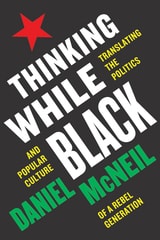
Thinking While Black
Translating the Politics and Popular Culture of a Rebel GenerationDaniel McNeil
Rutgers University Press, 2023
Listen along with this Spotify playlist inspired by the book!
For copyright reasons, this book is available in the U.S.A only.
Thinking With—Jean-Luc Nancy
Edited by Susanna Lindberg, Artemy Magun, and Marita Tatari
Diaphanes, 2023
This book continues passionate conversation that Jean-Luc Nancy (1940–2021) was engaged in throughout his life with philosophers and artists from all over the world. The contributors take up Nancy’s philosophical question of truth as a praxis of a “with”—understanding truth without any given measure or comparison as an articulation of a with. It is a thinking responsible for the world from within the world, a language that seeks to respond to the ongoing mutation of our civilization. Contributors include Jean-Christophe Bailly, Rodolphe Burger, Marcia Sá Calvacante Schuback, Marcus Coelen, Alexander García Düttmann, Juan-Manuel Garrido, Martta Heikkilä, Erich Hörl, Valentin Husson, Sandrine Israel-Jost, Ian James, Apostolos Lampropoulos, Nidesh Lawtoo, Jérôme Lèbre, Susanna Lindberg, Michael Marder, Artemy Magun, Boyan Manchev, Dieter Mersch, Hélène Nancy, Jean-Luc Nancy, Aïcha Liviana Messina, Ginette Michaud, Helen Petrovsky, Jacob Rogozinski, Philipp Stoellger, Peter Szendy, Georgios Tsagdis, Marita Tatari, Gert-Jan van der Heiden, and Aukje van Rooden.
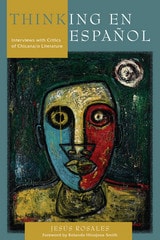
Thinking en español
Interviews with Critics of Chicana/o LiteratureJesús Rosales; Foreword by Rolando Hinojosa-Smith
University of Arizona Press, 2014
The twelve critics interviewed for this project share certain characteristics. For each one, Mexico plays an essential role in his or her personal and academic background, and each is bilingual and bicultural, having received formal literary education in Spanish graduate programs. As products of the working class, each scholar here shares a sense of social consciousness and commitment that lends an urgency to their desire to promote Chicano literature and culture at the local, regional, national, and international levels. They serve as a source of inspiration and commitment for future generations of scholars of Chicano literature and leave a lasting legacy of their own.
Thinking en español legitimizes Chicana/o criticism as an established discipline, and documents the works of some of the most important critics of Chicano literature at the turn of the twentieth and into the twenty-first century. This timely book immortalizes literary historical figures and documents the trajectory of Chicano criticism.
Thinking in Jewish
Jonathan Boyarin
University of Chicago Press, 1996
A fascination with this question prompted Jonathan Boyarin, one of America's most original thinkers in critical theory and Jewish ethnography, to offer the unexpected Jewish perspective on the vexed issue of identity politics presented here. Boyarin's essays explore the ways in which a Jewish—or, more particularly, Yiddish—idiom complicates the question of identity. Ranging from explorations of a Lower East Side synagogue to Fichte's and Derrida's contrasting notions of the relation between the Jews and the idea of Europe, from the Lubavitch Hasidim to accounts of self-making by Judith Butler and Charles Taylor, Thinking in Jewish will be indispensable reading for students of critical theory, cultural studies, and Jewish studies.
Thinking with Sound
A New Program in the Sciences and Humanities around 1900Viktoria Tkaczyk
University of Chicago Press, 2023
When the outside world is silent, all sorts of sounds often come to mind: inner voices, snippets of past conversations, imaginary debates, beloved and unloved melodies. What should we make of such sonic companions? Thinking with Sound investigates a period when these and other newly perceived aural phenomena prompted a far-reaching debate. Through case studies from Paris, Vienna, and Berlin, Viktoria Tkaczyk shows that the identification of the auditory cortex in late nineteenth-century neuroanatomy affected numerous academic disciplines across the sciences and humanities. “Thinking with sound” allowed scholars and scientists to bridge the gaps between theoretical and practical knowledge, and between academia and the social, aesthetic, and industrial domains. As new recording technologies prompted new scientific questions, new auditory knowledge found application in industry and the broad aesthetic realm. Through these conjunctions, Thinking with Sound offers a deeper understanding of today’s second “acoustic turn” in science and scholarship.
Third Wave
The New Russian PoetryKent Johnson and Stephen M. Ashby, Editors. Introduction by Alexei Parshchikov and Andrew Wachtel. Afterword by Mikhail Epstein
University of Michigan Press, 1992
Third-Generation Holocaust Representation
Trauma, History, and MemoryVictoria Aarons and Alan L. Berger
Northwestern University Press, 2017
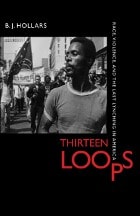
Thirteen Loops
Race, Violence, and the Last Lynching in AmericaB. J. Hollars
University of Alabama Press, 2011
A powerful investigation into the last lynching in America and the long shadow of racial violence in the South.
Thirteen Loops: Race, Violence, and the Last Lynching in America recounts the story of three innocent victims, all of whom suffered violent deaths through no fault of their own: Vaudine Maddox in 1933 in Tuscaloosa, Sergeant Gene Ballard in 1979 in Birmingham, and Michael Donald in 1981 in Mobile.
The death of Vaudine Maddox—and the lynchings that followed—serves as a cautionary tale about the violence that occurred in the same region nearly fifty-years later, highlighting the cowardice, ignorance, and happenstance that sustained a culture of racial intolerance far into the future.Nearly half a century later, after a black bank robber was acquitted for the murder of police Sergeant Gene Ballard, two Klansmen took it upon themselves to exact revenge on an innocent victim--nineteen-year-old African American Michael Donald. Donald's murder--deemed the last lynching in America--reignited the race debate in America and culminated in a courtroom drama in which the United Klans of America were at long last put on trial.
While tracing the relationships among these murders, B. J. Hollars's research led him deep into the heart of Alabama’s racial, political, and legal landscapes. A work of literary journalism, Thirteen Loops draws upon rarely examined primary sources, court documents, newspaper reports, and first-hand accounts in an effort to unravel the twisted tale of a pair of interconnected murders that forever altered United States' race relations.
Thirteen Sisters
The 1979 Boston Murders and the Resistance They InspiredAndrew S. Baer
University of Chicago Press, 2027
The murder of thirteen women and girls in 1979 and the social movement they launched.
In four terrifying months in 1979, thirteen women and girls—twelve Black, one white—were murdered in Boston. All were found in or near Roxbury, a predominantly Black neighborhood in a city famously beset by racial strife and division. Fears of a serial killer spread within Black communities. But the authorities wouldn’t hear of it: these were just ordinary, everyday murders of unimportant people, killed by men they knew. The police said Black residents had nothing to fear—and the media implied that white people could safely ignore the carnage.
Yet Black feminists refused to accept the murders of Black women and girls. The real serial killers, they argued, were chronic racism, sexism, poverty, and domestic violence, including violence committed by Black men. Something had to be done.
Thirteen Sisters tells the gripping stories of the women who died—their lives, their brutal deaths, the attempts to solve them—and the renowned Combahee River Collective, whose activism in the wake of the murders brought national attention to the overlapping oppressions that made Black women and girls so vulnerable to violence. Historian Andrew S. Baer interviews family members and activists to introduce readers to the victims as complete people and investigate the events surrounding their deaths, unspooling a fast-paced and urgent narrative about crime, race, and marginalization. Baer also pays tribute to the Black feminists who saw the social roots of this violence and called for radical change, demands that remain all too relevant today.
Riveting, enraging, and humane, Thirteen Sisters is an indictment of the neglectful institutions that have failed Black women and a testament to the activists who transformed how we understand systemic oppression.
Thirteen Ways of Looking at Latino Art
Ilan Stavans, Jorge J. E. Gracia
Duke University Press, 2014
Thirty Years of Radical History
The Long March, Volume 2001Van Gosse, ed.
Duke University Press, 0
Recognizing the creative power of pluralism, the RHR editors have marshalled a diverse troop of historical scholars in this issue. In “Forum on Radical History,” sixteen historians discuss how the notion of radicalism has affected the way they write, teach, and live, and in "A Conversation about the Radical History Review," past and present members of the editorial board zero in on the journal itself and the political and academic context in which it was born. Offering a more personal perspective, Mike Wallace, Pulitzer Prize winner and radical history founder, shares his thoughts on RHR and the movement. Other articles in this special issue tackle the state of radicalism today, analyzing the academic labor movement, the significance of physical space in Pinochet’s reign of terror, and the enduring symbolism of a particular statue in Prague.
This retrospective issue celebrates the journal’s past, but it also reflects on the present and looks forward to a future in which radicalism will continue to shape the landscape of historical and political discourse.
Contributors. Tani E. Barlow, Dan Bender, Paul Buhle, Gabriela Cano, Anna Clark, Martin Duberman, Ellen Carol DuBois, Ian Christopher Fletcher, Rob Gregg, Harry D. Harootunian, Winston James, Nikki R. Keddie, Dave Kinkela, Staughton Lynd, Teresa Meade, Joanne Pope Melish, Ellen Noonan, Enrique C. Ochoa, Gary Y. Okihiro, Cynthia Paces, Max Page, Vijay Prashad, David Price, David Roediger, Andor Skotnes, Mike Wallace
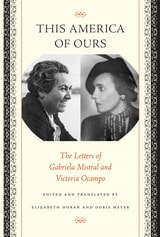
This America of Ours
The Letters of Gabriela Mistral and Victoria OcampoBy Gabriela Mistral and Victoria Ocampo
University of Texas Press, 2003
2005 — Best Book Translation Prize – New England Council of Latin American Studies
Gabriela Mistral and Victoria Ocampo were the two most influential and respected women writers of twentieth-century Latin America. Mistral, a plain, self-educated Chilean woman of the mountains who was a poet, journalist, and educator, became Latin America's first Nobel Laureate in 1945. Ocampo, a stunning Argentine woman of wealth, wrote hundreds of essays and founded the first-rate literary journal Sur. Though of very different backgrounds, their deep commitment to what they felt was "their" America forged a unique intellectual and emotional bond between them.
This collection of the previously unpublished correspondence between Mistral and Ocampo reveals the private side of two very public women. In these letters (as well as in essays that are included in an appendix), we see what Mistral and Ocampo thought about each other and about the intellectual and political atmosphere of their time (including the Spanish Civil War, World War II, and the dictatorships of Latin America) and particularly how they negotiated the complex issues of identity, nationality, and gender within their wide-ranging cultural connections to both the Americas and Europe.
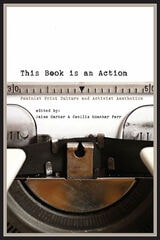
This Book Is an Action
Feminist Print Culture and Activist AestheticsEdited by Jaime Harker and Cecilia Konchar Farr
University of Illinois Press, 2016
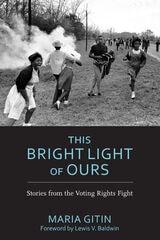
This Bright Light of Ours
Stories from the Voting Rights FightMaria Gitin
University of Alabama Press, 2014
Combining memoir with oral history, creates a vivid and searing portrait of the Freedom Summer of 1965.
This Bright Light of Ours offers a tightly focused insider’s view of the community-based activism that was the heart of the civil rights movement. A celebration of grassroots heroes, this book details through first-person accounts the contributions of ordinary people who formed the nonviolent army that won the fight for voting rights.
Combining memoir and oral history, Maria Gitin fills a vital gap in civil rights history by focusing on the neglected Freedom Summer of 1965 when hundreds of college students joined forces with local black leaders to register thousands of new black voters in the rural South. Gitin was an idealistic nineteen-year-old college freshman from a small farming community north of San Francisco who felt called to action when she saw televised images of brutal attacks on peaceful demonstrators during Bloody Sunday, in Selma, Alabama.
Atypical among white civil rights volunteers, Gitin came from a rural low-income family. She raised funds to attend an intensive orientation in Atlanta featuring now-legendary civil rights leaders. Her detailed letters include the first narrative account of this orientation and the only in-depth field report from a teenage Summer Community Organization and Political Education (SCOPE) project participant.
Gitin details the dangerous life of civil rights activists in Wilcox County, Alabama, where she was assigned. She tells of threats and arrests, but also of forming deep friendships and of falling in love. More than four decades later, Gitin returned to Wilcox County to revisit the people and places that she could never forget and to discover their views of the “outside agitators” who had come to their community. Through conversational interviews with more than fifty Wilcox County residents and former civil rights workers, she has created a channel for the voices of these unheralded heroes who formed the backbone of the civil rights movement.
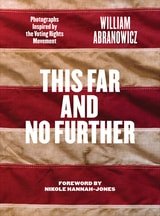
This Far and No Further
Photographs Inspired by the Voting Rights MovementBy William Abranowicz; foreword by Nikole Hannah-Jones
University of Texas Press, 2021
Standing on the Edmund Pettus Bridge in Selma, Alabama, in 2017, photographer William Abranowicz was struck by the weight of historical memory at this hallowed site of one of the civil rights movement's defining episodes: 1965's “Bloody Sunday,” when Alabama police officers attacked peaceful marchers. To Abranowicz’s eye, Selma seemed relatively unchanged from its apperance in the photographs Walker Evans made there in the 1930s. That, coupled with an awareness of renewed voter suppression efforts at state and federal levels, inspired Abranowicz to explore the living legacy of the civil and voting rights movement through photographing locations, landscapes, and individuals associated with the struggle, from Rosa Parks and Harry Belafonte to the barn where Emmett Till was murdered.
The result is This Far and No Further, a collection of photographs from Abranowicz's journey through the American South. Through symbolism, metaphor, and history, he unearths extraordinary stories of brutality, heroism, sacrifice, and redemption hidden within ordinary American landscapes, underscoring the crucial necessity of defending—and exercising—our right to vote at this tenuous moment for American democracy.