Results by title
8642 books match the query '20th Century' and 1764 start with t
To Care for the Sick and Bury the Dead
African American Lodges and Cemeteries in TennesseeLeigh Ann Gardner
Vanderbilt University Press, 2022
These Black cemeteries dot the Tennessee landscape, but few know their history or the societies of care they represent. To Care for the Sick and Bury the Dead is the first book-length look at these cemeteries and the lodges that fostered them.
This book is a must-have for genealogists, historians, and family members of the people buried in these cemeteries.
To Do Justice
The Civil Rights Ministry of Reverend Robert E. HughesRandall C. Jimerson
University of Alabama Press, 2022
A minister’s call to justice in the struggle for civil rights.
A native Alabamian, Reverend Robert E. Hughes worked full-time in the civil rights movement as executive director of the Alabama Council of Human Relations, where he developed a close relationship with Dr. Martin Luther King Jr. After facing backlash from the Ku Klux Klan, spending four days in jail for refusing to disclose ACHR membership lists, and ultimately being forced to leave the state of Alabama, he served as a Methodist missionary in Southern Rhodesia (now part of Zimbabwe). After two years of organizing Black liberation groups, he was banned as a “prohibited immigrant” by the Ian Smith government. His lifelong commitment to social justice, racial equality, and peaceful resolution of conflicts marks a fascinating career richly documented in this comprehensive biography.
To Do Justice: The Civil Rights Ministry of Reverend Robert E. Hughes traces the life and career of an admirable and lesser-known civil rights figure who fought injustice on two continents. This account presents valuable new evidence about the civil rights movement in the United States as well as human rights and liberation issues in colonial Southern Rhodesia in the years leading up to independence and self-rule. It provides an intimate portrait of a courageous individual who worked outside of the public spotlight but provided essential support and informational resources to public activists and news reporters
Randall C. Jimerson explores the interwoven threads of race relations and religious beliefs on two continents, focusing on the dual themes of the American civil rights movement and the African struggles for decolonization and majority rule. The life and career of Robert Hughes provide insight into the international dimensions of racial prejudice and discrimination that can be viewed in comparative context to similar oppressions in other colonial lands.
To Go Into the Words
Norman Finkelstein
University of Michigan Press, 2023
To Go Into the Words is the latest book of critical prose from renowned poet and scholar of Jewish literature Norman Finkelstein. Through a rigorous examination of poets such as William Bronk, Helen Adam, and Nathaniel Mackey, the book engages the contemporary poetic fascination with transcendence through the radical delight with language. By opening up a given poem, Finkelstein seeks the “gnosis” or insight of what it contains so that other readers can understand and appreciate the works even more.
Pulling from Finkelstein’s experience of writing thirteen books of poetry and six books of literary criticism, To Go Into the Words consistently rewards the reader with insights as transformative as they are well-considered and deftly mapped out. This volume opens the world of poetry to poets, scholars, and readers by showcasing “the gnosis that is to be found in modern poetry.”
To Keep the Ball Rolling
The Memoirs of Anthony PowellAnthony Powell
University of Chicago Press, 2001
Powell did eventually reveal himself in four volumes of memoirs, published between 1976 and 1982. This edition of Anthony Powell's Memoirs is an abridged and revised version of those volumes, a version that has never before been published in this form in the United States. The result is not only a fascinating view of Powell as a man and an author but also a unique history of British literary society and the social elite Powell lampooned and moved within from the twenties through the eighties. From Eton and Oxford to his life as a novelist and critic, Powell observes all—the obscenity trial sparked by Lady Chatterley's Lover; Shirley Temple's libel suit after Graham Greene reviewed Wee Willie Winkie "with even more than his usual verve"—and paints vivid portraits of Kingsley Amis, V.S. Naipaul, T.S. Eliot, Virginia Woolf, and countless others. Most importantly, Powell's lively memoirs banish all thought of the man as a relic of the British gentry. He was a modernist, a Tory, and more than a little interested in genealogy and peerage, but a man who, according to Ferdinand Mount, "miraculously knew what life was like."
To Live Here, You Have to Fight
How Women Led Appalachian Movements for Social JusticeJessica Wilkerson
University of Illinois Press, 2019
Jessica Wilkerson tells their stories within the larger drama of efforts to enact change in the 1960s and 1970s. She shows white Appalachian women acting as leaders and soldiers in a grassroots war on poverty--shaping and sustaining programs, engaging in ideological debates, offering fresh visions of democratic participation, and facing personal political struggles. Their insistence that caregiving was valuable labor clashed with entrenched attitudes and rising criticisms of welfare. Their persistence, meanwhile, brought them into unlikely coalitions with black women, disabled miners, and others to fight for causes that ranged from poor people's rights to community health to unionization.
Inspiring yet sobering, To Live Here, You Have to Fight reveals Appalachian women as the indomitable caregivers of a region--and overlooked actors in the movements that defined their time.

To Live Peaceably Together
The American Friends Service Committee's Campaign for Open HousingTracy E. K'Meyer
University of Chicago Press, 2022
The bitterly tangled webs of race and housing in the postwar United States hardly suffer from a lack of scholarly attention. But Tracy K’Meyer’s To Live Peaceably Together delivers something truly new to the field: a lively examination of a predominantly white faith-based group—the Quaker-aligned American Friends Service Committee (AFSC)—that took a unique and ultimately influential approach to cultivating wider acceptance of residential integration. Built upon detailed stories of AFSC activists and the obstacles they encountered in their work in Chicago, Philadelphia, and Richmond, California, To Live Peaceably Together is an engaging and timely account of how the organization allied itself to a cause that demanded constant learning, reassessment, and self-critique. K’Meyer details the spiritual and humanist motivations behind the AFSC, its members’ shifting strategies as they came to better understand structural inequality, and how those strategies were eventually adopted by a variety of other groups. Her fine-grained investigation of the cultural ramifications of housing struggles provides a fresh look at the last seventy years of racial activism.

To Live Peaceably Together
The American Friends Service Committee's Campaign for Open HousingTracy E. K'Meyer
University of Chicago Press, 2022
This is an auto-narrated audiobook edition of this book.
A groundbreaking look at how a predominantly white faith-based group reset the terms of the fight to integrate US cities.
The bitterly tangled webs of race and housing in the postwar United States hardly suffer from a lack of scholarly attention. But Tracy K’Meyer’s To Live Peaceably Together delivers something truly new to the field: a lively examination of a predominantly white faith-based group—the Quaker-aligned American Friends Service Committee (AFSC)—that took a unique and ultimately influential approach to cultivating wider acceptance of residential integration. Built upon detailed stories of AFSC activists and the obstacles they encountered in their work in Chicago, Philadelphia, and Richmond, California, To Live Peaceably Together is an engaging and timely account of how the organization allied itself to a cause that demanded constant learning, reassessment, and self-critique. K’Meyer details the spiritual and humanist motivations behind the AFSC, its members’ shifting strategies as they came to better understand structural inequality, and how those strategies were eventually adopted by a variety of other groups. Her fine-grained investigation of the cultural ramifications of housing struggles provides a fresh look at the last seventy years of racial activism.
To Make a Prairie
Essays on Poets, Poetry, and Country LivingMaxine Kumin
University of Michigan Press, 1980
To Offer Compassion
A History of the Clergy Consultation Service on AbortionDoris Andrea Dirks and Patricia A. Relf
University of Wisconsin Press, 2019
As religious leaders spoke out on issues of civil rights, peace, or poverty, CCS members were also called to action by the suffering of women who had approached them for help. Overwhelmingly male, white, affluent, and middle-aged, these mainline Protestant and Jewish clergy were nonetheless outspoken advocates for the rights of women, particularly poor women. To Offer Compassion is a detailed history of this unique and largely forgotten movement, drawing on extensive interviews with original participants and on primary documents from the CCS's operations.
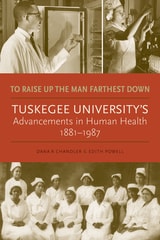
To Raise Up the Man Farthest Down
Tuskegee University’s Advancements in Human Health, 1881–1987Dana R. Chandler and Edith Powell
University of Alabama Press, 2018
An important historical account of Tuskegee University’s significant advances in health care, which affected millions of lives worldwide.
Alabama’s celebrated, historically black Tuskegee University is most commonly associated with its founding president, Booker T. Washington, the scientific innovator George Washington Carver, or the renowned Tuskegee Airmen. Although the university’s accomplishments and devotion to social issues are well known, its work in medical research and health care has received little acknowledgment. Tuskegee has been fulfilling Washington’s vision of “healthy minds and bodies” since its inception in 1881. In To Raise Up the Man Farthest Down, Dana R. Chandler and Edith Powell document Tuskegee University’s medical and public health history with rich archival data and never-before-published photographs. Chandler and Powell especially highlight the important but largely unsung role that Tuskegee University researchers played in the eradication of polio, and they add new dimension and context to the fascinating story of the HeLa cell line that has been brought to the public’s attention by popular media.
Tuskegee University was on the forefront in providing local farmers the benefits of agrarian research. The university helped create the massive Agricultural Extension System managed today by land grant universities throughout the United States. Tuskegee established the first baccalaureate nursing program in the state and was also home to Alabama’s first hospital for African Americans. Washington hired Alabama’s first female licensed physician as a resident physician at Tuskegee. Most notably, Tuskegee was the site of a remarkable development in American biochemistry history: its microbiology laboratory was the only one relied upon by the National Foundation for Infantile Paralysis (the organization known today as the March of Dimes) to produce the HeLa cell cultures employed in the national field trials for the Salk and Sabin polio vaccines. Chandler and Powell are also interested in correcting a long-held but false historical perception that Tuskegee University was the location for the shameful and infamous US Public Health Service study of untreated syphilis.
Meticulously researched, this book is filled with previously undocumented information taken directly from the vast Tuskegee University archives. Readers will gain a new appreciation for how Tuskegee’s people and institutions have influenced community health, food science, and national medical life throughout the twentieth century.
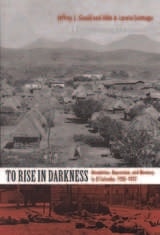
To Rise in Darkness
Revolution, Repression, and Memory in El Salvador, 1920–1932Jeffrey L. Gould, Aldo A. Lauria-Santiago
Duke University Press, 2008
Gould conducted more than two hundred interviews with survivors of la Matanza and their descendants. He and Lauria-Santiago combine individual accounts with documentary sources from archives in El Salvador, Guatemala, Washington, London, and Moscow. They describe the political, economic, and cultural landscape of El Salvador during the 1920s and early 1930s, and offer a detailed narrative of the uprising and massacre. The authors challenge the prevailing idea that the Communist organizers of the uprising and the rural Indians who participated in it were two distinct groups. Gould and Lauria-Santiago demonstrate that many Communist militants were themselves rural Indians, some of whom had been union activists on the coffee plantations for several years prior to the rebellion. Moreover, by meticulously documenting local variations in class relations, ethnic identity, and political commitment, the authors show that those groups considered “Indian” in western El Salvador were far from homogeneous. The united revolutionary movement of January 1932 emerged out of significant cultural difference and conflict.
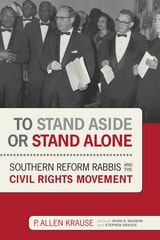
To Stand Aside or Stand Alone
Southern Reform Rabbis and the Civil Rights MovementP. Allen Krause, Edited by Mark K. Bauman with Stephen Krause
University of Alabama Press, 2016
In 1966, a young rabbinical student named P. Allen Krause conducted interviews with twelve Reform rabbis from southern congregations concerning their thoughts, principles, and activities as they related to the civil rights movement. Perhaps because he was a young seminary student or more likely because the interviewees were promised an embargo of twenty-five years before the interviews would be released to the public, the rabbis were extremely candid about their opinions on and their own involvement with what was still an incendiary subject. Now, in To Stand Aside or Stand Alone: Southern Reform Rabbis and the Civil Rights Movement, their stories help elucidate a pivotal moment in time.
After a distinguished rabbinical career, Krause wrote introductions to and annotated the interviews. When Krause succumbed to cancer in 2012, Mark K. Bauman edited the manuscripts further and wrote additional introductions with the assistance of Stephen Krause, the rabbi’s son. The result is a unique volume offering insights into these rabbis’ perceptions and roles in their own words and with more depth and nuance than hitherto available. This exploration into the lives of these teachers and civic leaders is supported by important contextual information on the local communities and other rabbis, with such background information forming the basis of a demographic profile of the Reform rabbis working in the South.
The twelve rabbis whom Krause interviewed served in Alabama, Georgia, Louisiana, Mississippi, Tennessee, and Virginia, and the substance and scope of their discussions cover some of the most crucial periods in the civil rights movement. Although some have provided accounts that appeared elsewhere or have written about their experiences themselves, several new voices appear here, suggesting that more southern rabbis were active than previously thought. These men functioned within a harsh environment: rabbis’ homes, synagogues, and Jewish community centers were bombed; one rabbi, who had been beaten and threatened, carried a pistol to protect himself and his family. The views and actions of these men followed a spectrum from gradualism to activism; while several of the rabbis opposed the evils of the separate and unequal system, others made peace with it or found reasons to justify inaction. Additionally, their approaches differed from their activist colleagues in the North even more than from each other.
Within these pages, readers learn about the attitudes of the rabbis toward each other, toward their congregants, toward national Jewish organizations, and toward local leaders of black and white and Protestant and Catholic groups. Theirs are dramatic stories of frustration, cooperation, and conflict.
To Swim with Crocodiles
Land, Violence, and Belonging in South Africa, 1800-1996Jill E Kelly
Michigan State University Press, 2018
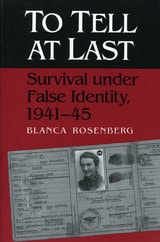
To Tell At Last
Survival under False Identity, 1941-45Blanca Rosenberg
University of Illinois Press, 1993
an even hand and understated prose, Ms. Rosenberg, now a New York City
psychotherapist, bravely depicts Nazi carnage in chilling detail."
-- Susan Shapiro, New York Times Book Review
"[A] harrowing account
of intrigue and danger with all the elements of a war movie adventure."
-- Miriam Rinn, The Forward
This memoir of how a Jewish
woman survived Nazi Germany by passing as an Aryan was selected as the
best book on Holocaust and Jewish Resistance Literature by the Israeli
committee of the Egit Grants.
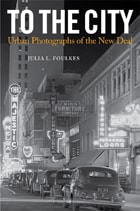
To The City
Urban Photographs of the New DealAuthored by Julia L. Foulkes
Temple University Press, 2011
In the 1930s and 1940s, as the United States moved from a rural to an urban nation, the pull of the city was irrepressible. It was so strong that even a photographic mission designed to record the essence of rural America could not help but capture the energy of urbanization too. To the City showcases over 100 photographs from the Farm Security Administration (FSA) project along with extracts from the Works Progress Administration (WPA) guidebooks and oral histories, to convey the detail and dimensions of that transformation.
This artfully grouped collection of photographs includes magnificent images by notable photographers Dorothea Lange, Walker Evans and Gordon Parks, among many others. Foulkes organizes this history of Americana into five themes: Intersection; Traffic; High Life and Low Life; The City in the Country; and Citizens to illuminate the changes in habits, landscapes, and aspirations that the march to cities encompassed.
As the rural past holds symbolic sway and the suburb presents demographic force, the urban portion of our history—why and how cities have been a destination for hope—recedes from view. To the City is a thoughtful, engaging reminder.
To Tilt at Windmills
A Memoir of the Spanish Civil WarFred A. Thomas
Michigan State University Press, 1996
To Tilt at Windmills is the memoir of Briton Fred Thomas who served with the International Brigades in the Spanish Civil War (July 1936-March 1939).
Inspired by a memorable return to Iberian battlefields forty years later, and based on diaries kept during the many months Thomas spent as a gunner with the British Anti-Tank Battery, the narrative moves eloquently along a journey into the war zone, through the several campaigns in which he fought and where he was twice wounded, and finally to the withdrawal of the Brigades from the conflict. What distinguishes Thomas' account is the remarkable detail provided by the diaries and the measured tone of his reminiscence, There is, as well, the poignant inquiry of the veteran into the shape and meaning of experience as a young soldier. The historian Paul Preston has cited the "warmth, directness and deep humanity" of To Tilt at Windmills, "an important contribution to the collective memory of the war.
To Turn the Whole World Over
Black Women and InternationalismEdited by Keisha N. Blain and Tiffany M. Gill
University of Illinois Press, 2019
To Your Posts!
Fort Meigs in the War of 1812 through the Voices of Those Who Fought ThereLarry L. Nelson
Michigan State University Press, 2025
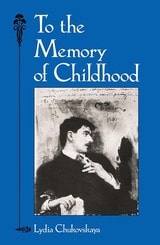
To the Memory of Childhood
Lydia Chukovskaya
Northwestern University Press, 1988
Her father is a household name in Russia because of his tales in verse for children. But his literary accomplishments ranged far beyond bedtime stories. As a critic he wrote controversial articles and lively profiles of cultural figures; as a translator he introduced Whitman, Twain, Kipling, and Wilde to Russian readers. When his children's literature was attacked in the 1920s and 1930s, he turned to editing, scholarship, and articles on translation. A man of boundless energy, he played a vital role in his country's cultural life until his death in 1969. "I am not writing Kornei Ivanovich's biography," Chukovskaya says, "but he was the author of my childhood."

Today the Struggle
Literature and Politics in England during the Spanish Civil WarBy Katharine Bail Hoskins
University of Texas Press, 1969
Many writers, from Aristophanes to Joseph Heller, have written about politics. But at certain periods in history, often at times of conflict and turmoil, writers have consciously used their literary talents to support or oppose a specific cause. The 1930s, a decade of widespread social and political breakdown, was such a period.
Today the Struggle examines the political involvement of those leading British writers who dedicated their talents to the defense of Nationalists or Loyalists during the Spanish Civil War and who saw that war as symbolic of their own Right-Left dialogue.
Conservatives like William Butler Yeats and T. S. Eliot and Roman Catholics like Evelyn Waugh were passionately anti-Communist. They viewed fascism as a bulwark against communism but were unwilling to support the Franco cause actively. Other pro-Nationalists were not so hesitant: Roy Campbell and Wyndham Lewis were ardent participants in the fight against the British left wing.
Pro-Loyalists, united only in their antifascism, ranged from conservative to anarchist in political commitment. Their literary contributions included fine poems by W. H. Auden and Stephen Spender, experimental drama by Auden and Christopher Isherwood, and impassioned prose by Rex Warner, George Orwell, and Aldous Huxley.
Katharine Hoskins’s principal interest in Today the Struggle is to discover how and why certain writers supported specific political actions, to ascertain the effectiveness of their efforts, and to evaluate the influence of these efforts on their work.
Together Still
Yves Bonnefoy
Seagull Books, 2017
The international community of letters mourned the recent death of Yves Bonnefoy, universally acclaimed as one of France’s greatest poets of the last half-century. A prolific author, he was often considered a candidate for the Nobel Prize and published a dozen major collections of poetry in verse and prose, several books of dream-like tales, and numerous studies of literature and art. His oeuvre has been translated into scores of languages, and he himself was a celebrated translator of Shakespeare, Yeats, Keats, and Leopardi.
Together Still is his final poetic work, composed just months before his death. The book is nothing short of a literary testament, addressed to his wife, his daughter, his friends, and his readers throughout the world. In these pages, he ruminates on his legacy to future generations, his insistence on living in the present, his belief in the triumphant lessons of beauty, and, above all, his courageous identification of poetry with hope.
Together, Alone
A Memoir of Marriage and PlaceBy Susan Wittig Albert
University of Texas Press, 2009
What does it mean to belong to a place, to be truly rooted and grounded in the place you call home? How do you commit to a marriage, to a full partnership with another person, and still maintain your own separate identity? These questions have been central to Susan Wittig Albert's life, and in this beautifully written memoir, she movingly describes how she has experienced place, marriage, and aloneness while creating a home in the Texas Hill Country with her husband and writing partner, Bill Albert.
Together, Alone opens in 1985, as Albert leaves a successful, if rootless, career as a university administrator and begins a new life as a freelance writer, wife, and homesteader on a patch of rural land northwest of Austin. She vividly describes the work of creating a home at Meadow Knoll, a place in which she and Bill raised their own food and animals, while working together and separately on writing projects. Once her sense of home and partnership was firmly established, Albert recalls how she had to find its counterbalance—a place where she could be alone and explore those parts of the self that only emerge in solitude. For her, this place was Lebh Shomea, a silent monastic retreat. In writing about her time at Lebh Shomea, Albert reveals the deep satisfaction she finds in belonging to a community of people who have chosen to be apart and experience silence and solitude.

Tokyo Boogie-woogie and D.T. Suzuki
Shoji Yamada
University of Michigan Press, 2022
Against this famous figure, however, is a largely unknown or forgotten shape: Suzuki Alan Masaru. Alan was D.T. Suzuki’s adopted son and, though he remained within his father’s shadow, is mostly known as the lyricist of the iconic pop hit “Tokyo Boogie-woogie.” Perhaps due to his frequent scandals and the fraught nature of the relationship, Alan remains unmentioned and unstudied by scholars and historians. Yet by exploring the nature of the relationship between these two, Shoji Yamada digs into the conflicting memories and experiences of these generations in Japan.
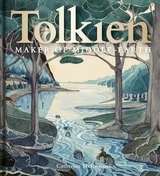
Tolkien
Maker of Middle-earthEdited by Catherine McIlwaine
Bodleian Library Publishing, 2018
Tolkien: Maker of Middle-earth explores the huge creative endeavor behind Tolkien’s enduring popularity. Lavishly illustrated with three hundred images of his manuscripts, drawings, maps, and letters, the book traces the creative process behind his most famous literary works—The Hobbit, The Lord of the Rings, and The Silmarillion—and reproduces personal photographs and private papers, many of which have never been seen before in print.
Six essays introduce the reader to the person of J. R. R. Tolkien and to main themes in his life and work, including the influence of northern languages and legends on the creation of his own legendarium; his concept of “Faërie” as an enchanted literary realm; the central importance of his invented languages in his fantasy writing; his visual imagination and its emergence in his artwork; and the encouragement he derived from his close friend C. S. Lewis and their literary group the Inklings.
The book brings together the largest collection of original Tolkien material ever assembled in a single volume. Drawing on the extensive archives of the Tolkien collections at the Bodleian Libraries, Oxford, which stretch to more than five hundred boxes, and Marquette University, Milwaukee, as well as private collections, this hugely ambitious and exquisitely produced book draws together the worlds of J. R. R. Tolkien – scholarly, literary, creative, and domestic—offering a rich and detailed understanding and appreciation of this extraordinary author.
This landmark publication, produced on the occasion of a major exhibition at the Bodleian Libraries in Oxford in 2018 and at the Morgan Library in New York in 2019, is set to become a standard work in the literature on J. R. R. Tolkien.
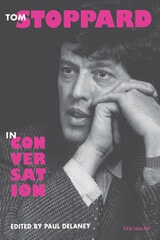
Tom Stoppard in Conversation
Paul Delaney, Editor
University of Michigan Press, 1994
This collection of interviews with British playwright Tom Stoppard, author of such well-known comedies as Travesties, Jumpers, and Rosencrantz and Guildenstern Are Dead, brings together for the first time Stoppard's most significant assessments of his own work.
A wide range of discussions are featured, from extensive conversations with the editors of Theatre Quarterly and Gambit to important interviews in lesser-known periodicals. The interviews include the playwright's unguarded comments to the daily press, from those of a dazzled young Stoppard the morning after the triumphant opening of Rosencrantz and Guildenstern to those of a veteran playwright still smarting from caustic reviews 36 hours after the opening of Hapgood. The interviews cover the full range of Stoppard's work, from his adaptations for the stage to his increasing involvement in film, and this volume makes many of them available for the first time. Also appearing for the first time in print are transcripts of radio interviews and an informal lecture by Stoppard called "The Event and the Text."
Tom Stoppard's conversations about his work shed light on questions of authorial intent and the creative process. Debates over interpretations of the plays will be enhanced by this record of Stoppard's own perceptions and insights. The collection also includes the most extensive bibliography and discography ever compiled of Stoppard's print interviews, broadcast interviews, and lectures.
Witty, illuminating, and informative, Tom Stoppard in Conversation will be of interest to scholars, students, directors, actors, and fans of Stoppard's work.
Tomboys
A Literary and Cultural HistoryMichelle Ann Abate
Temple University Press, 2008
Starting with the figure of the bold, boisterous girl in the mid-19th century and ending with the “girl power” movement of the 1990’s, Tomboys is the first full-length critical study of this gender-bending code of female conduct. Michelle Abate uncovers the origins, charts the trajectory, and traces the literary and cultural transformations that the concept of “tomboy” has undergone in the United States.
Abate focuses on literature including Louisa May Alcott's Little Women and Carson McCullers's The Member of the Wedding and films such as Peter Bogdanovich's Paper Moon and Jon Avnet's Fried Green Tomatoes. She also draws onlesser-known texts like E.D.E.N. Southworth's once wildly popular 1859 novel The Hidden Hand, Cold War lesbian pulp fiction, and New Queer Cinema from the 1990s.
Tomboys also explores the gender and sexual dynamics of tomboyism, and offers intriguing discussions of race and ethnicity's role in the construction of the enduring cultural archetype. Abate’s insightful analysis provides useful, thought-provoking connections between different literary works and eras. The result demystifies this cultural phenomenon and challenges readers to consider tomboys in a whole new light.
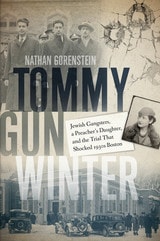
Tommy Gun Winter
Jewish Gangsters, a Preacher's Daughter, and the Trial That Shocked 1930s BostonNathan Gorenstein
University Press of New England, 2015
Tomorrow Is the Question
New Directions in Experimental Music StudiesEdited by Benjamin Piekut
University of Michigan Press, 2014
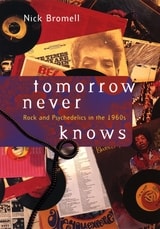
Tomorrow Never Knows
Rock and Psychedelics in the 1960sNick Bromell
University of Chicago Press, 2000
Tonality as Drama
Closure and Interruption in Four Twentieth-Century American OperasEdward D. Latham
University of North Texas Press, 2008
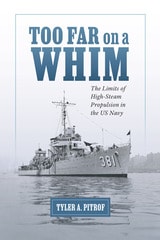
Too Far on a Whim
The Limits of High-Steam Propulsion in the US NavyTyler A. Pitrof
University of Alabama Press, 2024
WINNER OF THE LYMAN BOOK AWARD FOR MARITIME AND NAVAL SCIENCE, TECHNOLOGY, AND ENVIRONMENT
Argues that the US Navy’s commitment to high-steam propulsion for its World War II fleet was a tactical, technological, and bureaucratic failure
In Too Far on a Whim, Tyler A. Pitrof presents a high-spirited revision of the US Navy’s commitment to high-steam propulsion systems, the mainstay of its World War II fleets. Pitrof’s research persuasively demonstrates that in its war against the Imperial Japanese Navy, the US Navy succeeded despite its high-steam propulsion systems rather than because of them.
War with an aggressive Japan and a resurgent Germany loomed in the dark days of the late 1930s. Rear Admiral Harold G. Bowen Sr., head of the US Navy’s Bureau of Engineering, advanced a radical vision: a new fleet based on high-steam propulsion, a novel technology that promised high speeds with smaller engines and better fuel efficiency. High-steam engines had drawbacks—smaller operational ranges and maintenance issues. Nevertheless, trusting its engineers to resolve these issues, the US Navy put high-steam propulsion at the heart of its warship design from 1938 to 1945.
The official record of high-steam technology’s subsequent performance has relied heavily on Bowen’s own memoir, in which he painted high-steam innovation in heroic colors. Pitrof’s empirical review of primary sources such as ship’s maintenance records, however, illuminates the opposite—that the heroism lay in the ability of American seamen to improvise solutions to keep these difficult engines running.
Pitrof artfully explains engineering concepts in layman’s terms and provides an account that extends far beyond technology and into matters of naval hierarchies and bureaucracy, strategic theory, and ego. He offers a cautionary tale—as relevant to any endeavor as it is to military undertakings—about how failures arise when technical experts lack managers who understand their work. Admiral Bowen wielded excessive power because no one else in the US Navy knew enough to countermand him.
Compulsively readable, Too Far on a Whim is a landmark for those interested in naval history and technology but also for readers interested in the interplay between innovation, decision-making, and engineering.
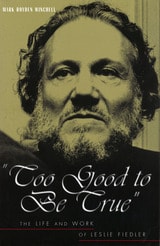
Too Good to Be True
The Life and Work of Leslie FiedlerMark Royden Winchell
University of Missouri Press, 2002
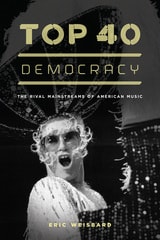
Top 40 Democracy
The Rival Mainstreams of American MusicEric Weisbard
University of Chicago Press, 2014
In Top 40 Democracy, Eric Weisbard studies the evolution of this multicentered pop landscape, along the way telling the stories of the Isley Brothers, Dolly Parton, A&M Records, and Elton John, among others. He sheds new light on the upheavals in the music industry over the past fifteen years and their implications for the audiences the industry has shaped. Weisbard focuses in particular on formats—constructed mainstreams designed to appeal to distinct populations—showing how taste became intertwined with class, race, gender, and region. While many historians and music critics have criticized the segmentation of pop radio, Weisbard finds that the creation of multiple formats allowed different subgroups to attain a kind of separate majority status—for example, even in its most mainstream form, the R&B of the Isley Brothers helped to create a sphere where black identity was nourished. Music formats became the one reliable place where different groups of Americans could listen to modern life unfold from their distinct perspectives. The centers of pop, it turns out, were as complicated, diverse, and surprising as the cultural margins. Weisbard’s stimulating book is a tour de force, shaking up our ideas about the mainstream music industry in order to tease out the cultural importance of all performers and songs.
Topographies of Class
Modern Architecture and Mass Society in Weimar BerlinSabine Hake
University of Michigan Press, 2010
In Topographies of Class, Sabine Hake explores why Weimar Berlin has had such a powerful hold on the urban imagination. Approaching Weimar architectural culture from the perspective of mass discourse and class analysis, Hake examines the way in which architectural projects; debates; and representations in literature, photography, and film played a key role in establishing the terms under which contemporaries made sense of the rise of white-collar society.
Focusing on the so-called stabilization period, Topographies of Class maps out complex relationships between modern architecture and mass society, from Martin Wagner's planning initiatives and Erich Mendelsohn's functionalist buildings, to the most famous Berlin texts of the period, Alfred Döblin's city novel Berlin Alexanderplatz (1929) and Walter Ruttmann's city film Berlin, Symphony of the Big City (1927). Hake draws on critical, philosophical, literary, photographic, and filmic texts to reconstruct the urban imagination at a key point in the history of German modernity, making this the first study---in English or German---to take an interdisciplinary approach to the rich architectural culture of Weimar Berlin.
Sabine Hake is Professor and Texas Chair of German Literature and Culture at the University of Texas at Austin. She is the author of numerous books, including German National Cinema and Popular Cinema of the Third Reich.
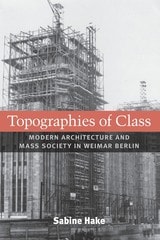
Cover art: Construction of the Karstadt Department Store at Hermannplatz, Berlin-Neukölln. Courtesy Bildarchiv Preeussischer Kulturbesitz / Art Resource, NY
Torn in Two
The Sinking of the Daniel J. Morrell and One Man's Survival on the Open SeaMichael Schumacher
University of Minnesota Press, 2018
Dennis Hale reached the dock just in time to see the Daniel J. Morrell heading out to open waters, a 600-foot freighter that had plied the waters for sixty years, carrying ore from Minnesota’s Iron Range to steel firms around the Great Lakes. The twenty-six-year-old watchman had, quite literally, missed the boat—which meant scrambling to rejoin the Morrell at its next stop or forfeiting a good chunk of his pay package. Seventy-two hours later, Hale would find himself clinging to a life raft alongside the frozen bodies of his crewmates in the violent waves of Lake Huron. The boat would not be reported missing for another twenty-seven hours and by the time the life raft was found, Dennis Hale would remain as the sole survivor of the wreck of the Daniel J. Morrell.
This is life-and-death drama on the inland sea as only Michael Schumacher can tell it. In Torn in Two the great Lakes historian recreates the circumstances surrounding the terrible storm of November 29, 1966, that broke the mighty freighter in half, sending twenty-five of the Morrell’s twenty-nine-man crew to their deaths and consigning the surviving four to the freezing raft where all but Hale would perish. At the heart of Torn in Two are the terrible hours spent by Hale on the life raft with his crewmen, clinging to life for thirty-eight hours in freezing temperatures and wearing only a peacoat, life jacket, and boxer shorts. The fight to save Hale and find the others, the Coast Guard hearings into what happened, the discovery of the wreckage—Schumacher’s vivid narrative captures every harrowing detail and curious fact of the Morrell’s demise, finally doing justice to this epic shipwreck fifty years past.
Torn
Asian/white Life and the Intimacy of ViolenceAnna M. Moncada Storti
Duke University Press, 2026
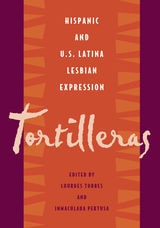
Tortilleras
Hispanic & U.S. Latina Lesbian ExpressionLourdes Torres
Temple University Press, 2003
Torture in the National Security Imagination
Stephanie Athey
University of Minnesota Press, 2023
Reassessing the role of torture in the context of police violence, mass incarceration, and racial capitalism
At the midpoint of a century of imperial expansion, marked on one end by the Philippine–American War of 1899–1902 and on the other by post–9/11 debates over waterboarding, the United States embraced a vision of “national security torture,” one contrived to cut ties with domestic torture and mass racial terror and to promote torture instead as a minimalist interrogation tool. Torture in the National Security Imagination argues that dispelling this vision requires a new set of questions about the everyday work that torture does for U.S. society.
Stephanie Athey describes the role of torture in the proliferation of a U.S. national security stance and imagination: as U.S. domestic tortures were refined in the Philippines at the turn of the twentieth century, then in mid-century counterinsurgency theory and the networks that brought it home in the form of law-and-order policing and mass incarceration.
Drawing on examples from news to military reports, legal writing, and activist media, Athey shows that torture must be seen as a colonial legacy with a corporate future, highlighting the centrality of torture to the American empire—including its role in colonial settlement, American Indian boarding schools, and police violence. She brings to the fore the spectators and commentators, the communal energy of violence, and the teams and target groups necessary to a mass undertaking (equipment suppliers, contractors, bureaucrats, university researchers, and profiteers) to demonstrate that, at base, torture is propelled by local social functions, conducted by networked professional collaborations, and publicly supported by a durable social imaginary.
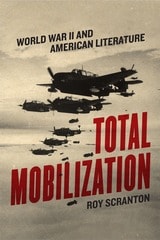
Total Mobilization
World War II and American LiteratureRoy Scranton
University of Chicago Press, 2019
Since World War II, the story of the trauma hero—the noble white man psychologically wounded by his encounter with violence—has become omnipresent in America’s narratives of war, an imaginary solution to the contradictions of American political hegemony. In Total Mobilization, Roy Scranton cuts through the fog of trauma that obscures World War II, uncovering a lost history and reframing the way we talk about war today.
Considering often overlooked works by James Jones, Wallace Stevens, Martha Gellhorn, and others, alongside cartoons and films, Scranton investigates the role of the hero in industrial wartime, showing how such writers struggled to make sense of problems that continue to plague us today: the limits of American power, the dangers of political polarization, and the conflicts between nationalism and liberalism. By turning our attention to the ways we make war meaningful—and by excavating the politics implicit within the myth of the traumatized hero—Total Mobilization revises the way we understand not only World War II, but all of postwar American culture.
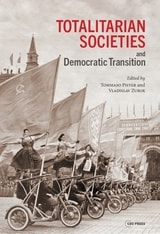
Totalitarian Societies and Democratic Transition
Essays in Memory of Victor ZaslavskyRiccardo James Vargiu
Central European University Press, 2017
Touched Bodies
The Performative Turn in Latin American ArtMara Polgovsky Ezcurra
Rutgers University Press, 2019
Winner of the 2019 Art Journal Prize from the College Art Association
What is the role of pleasure and pain in the politics of art? In Touched Bodies, Mara Polgovsky Ezcurra approaches this question as she examines the flourishing of live and intermedial performance in Latin America during times of authoritarianism and its significance during transitions to democracy. Based on original documents and innovative readings, her book brings politics and ethics to the discussion of artistic developments during the “long 1980s”. She describes the rise of performance art in the context of feminism, HIV-activism, and human right movements, taking a close look at the work of Diamela Eltit and Raúl Zurita from Chile, León Ferrari and Liliana Maresca from Argentina, and Marcos Kurtycz, the No Grupo art collective, and Proceso Pentágono from Mexico. The comparative study of the work of these artists attests to a performative turn in Latin American art during the 1980s that, like photography and film before, recast the artistic field as a whole, changing the ways in which we perceive art and understand its role in society.
Touching Base
Professional Baseball and American Culture in the Progressive EraSteven A. Riess
University of Illinois Press, 1999
Touching Home
Baseball and the Liberal-Republican Tradition in AmericaMary Craig
University of Missouri Press, 2025
2026 Society for American Baseball Research Seymour Medal finalist
Baseball’s relationship to American ideals has long been an object of study across disciplines. In Touching Home, Mary Craig contributes to this ongoing study by relating issues of class, race, and gender to America’s theoretical tradition of liberalism and republicanism established during the nation’s founding era. Specifically, Touching Home traces theories of individualism and civic virtue from the founding era through baseball’s place in American society at the end of the twentieth century.
The work also examines the mythologizing of baseball’s pastoralism, racial equality, and inculcation of manliness as a civic virtue. These myths became ingrained in baseball in significant ways, including, for example, the Supreme Court’s granting of an antitrust exemption to Major League Baseball; MLB’s promotion of Jackie Robinson’s career as proof of its leadership in and commitment to desegregation; and the short-lived All-American Girls Professional Baseball League (1943-1954) and subsequent relegation of women to softball.
Through the exploration of these and other societal issues, Craig’s work highlights baseball’s development from accessible hobby to multi-billion-dollar corporation, exploring the ways in which the sport has helped shape how individual Americans engage with politics. Indeed, in the pages of Touching Home readers will find a demythologizing of baseball that helps them better understand the results of their efforts to form community through engaging with teams at both the local and national levels. Scholars of American politics, particularly American political thought, will be intrigued to find baseball used as a case study of the effectiveness of the founders’ project of crafting a jointly liberal-republican framework capable of directing Americans toward responsible citizenship.
In all of these ways, Touching Home upholds the value of studying popular culture, presenting baseball as a unique and highly interesting lens through which to help us appreciate how individual Americans relate to politics and parties in their respective communities and nationally.
Touching the Unreachable
Writing, Skinship, Modern JapanFusako Innami
University of Michigan Press, 2021
Finalist: 2025 British Comparative Literature Association First Book Prize | July 22, 2025
Fusako Innami offers the first comprehensive study of touch and skinship—relationality with the other through the skin—in modern Japanese writing. The concept of the unreachable—that is, the lack of characters’ complete ability to touch what they try to reach for—provides a critical intervention on the issue of intimacy. Touch has been philosophically addressed in France, but literature is an effective—or possibly the most productive—venue for exploring touch in Japan, as literary texts depict what the characters may be concerned with but may not necessarily say out loud. Such a moment of capturing the gap between the felt and the said—the interaction between the body and language—can be effectively analyzed by paying attention to layers of verbalization, or indeed translation, by characters’ utterances, authors’ depictions, and readers’ interpretations. Each of the writers discussed in this book—starting with Nobel prize winner Kawabata Yasunari, Tanizaki Jun’ichirō, Yoshiyuki Junnosuke, and Matsuura Rieko—presents a particular obsession with objects or relationality to the other constructed via the desire for touch.
In Touching the Unreachable, phenomenological and psychoanalytical approaches are cross-culturally interrogated in engaging with literary touch to constantly challenge what may seem like the limit of transferability regarding concepts, words, and practices. The book thereby not only bridges cultural gaps beyond geographic and linguistic constraints, but also aims to decentralize a Eurocentric hegemony in its production and use of theories and brings Japanese cultural and literary analyses into further productive and stimulating intellectual dialogues. Through close readings of the authors’ treatment of touch, Innami develops a theoretical framework with which to examine intersensorial bodies interacting with objects and the environment through touch.
Tough Enough
Arbus, Arendt, Didion, McCarthy, Sontag, WeilDeborah Nelson
University of Chicago Press, 2017
Tough Enough traces the careers of these women and their challenges to the pre-eminence of empathy as the ethical posture from which to examine pain. Their writing and art reveal an adamant belief that the hurts of the world must be treated concretely, directly, and realistically, without recourse to either melodrama or callousness. As Deborah Nelson shows, this stance offers an important counter-tradition to the familiar postwar poles of emotional expressivity on the one hand and cool irony on the other. Ultimately, in its insistence on facing reality without consolation or compensation, this austere “school of the unsentimental” offers new ways to approach suffering in both its spectacular forms and all of its ordinariness.

Touring the Screen
Tourism and New Zealand Film GeographiesAlfio Leotta
Intellect Books, 2011
Following the success of prominent feature films shot on location, including Tolkien’s wildly popular The Lord of the Rings, New Zealand boasts an impressive film tourism industry. This book examines the relationship between New Zealand’s cinematic representation—as both a vast expanse of natural beauty and a magical world of fantasy on screen—and its tourism imagery, including the ways in which savvy local tourism boards have in recent decades used the country’s film representations to sell New Zealand as a premiere travel destination. Focusing on the films that have had a strong impact on marketing strategies by local tourist boards, Touring the Screen will be of interest to all those working and studying in the fields of cinema, postcolonial history, and tourism studies.
Tourists with Typewriters
Critical Reflections on Contemporary Travel WritingPatrick Holland and Graham Huggan
University of Michigan Press, 2000
The book maps new terrain in a growing area of critical study. Although critical of travel writing's complacency and its often unacknowledged ethnocentrism, the book recognizes its importance as both a literary and cultural form. While travel writing at its worst emerges as a crude expression of economic advantage, at its best it becomes a subtle instrument of cultural self-perception, a barometer for changing views of "other" (i.e., foreign, non-Western) cultures, and a trigger for the information circuits that tap us into the wider world.
Tourists with Typewriters gauges both the best and worst in contemporary travel writing, capturing the excitement of this most volatile--and at times infuriating--of literary genres. The book will appeal to general readers interested in a closer examination of travel writing and to academic readers in disciplines such as literary/cultural studies, geography, history, anthropology, and tourism studies.
"An eminently readable and informative study. It breathes tolerance and intelligence. It is critically perceptive and very au courant. It raises issues (coloniality, postmodernity, gender. . . ) and discusses books that readers of many different stripes will want to find out about." --Ross Chambers, University of Michigan
Patrick Holland, Associate Professor of English, University of Guelph, was born in New Zealand and educated in England, Australia, and Canada. Graham Huggan, Professor of English, University of Munich, was born in Hong Kong and educated in England and in British Columbia.
Tours of Vietnam
War, Travel Guides, and MemoryScott Laderman
Duke University Press, 2009
Tracing a history of ideological assertions embedded in travel discourse, Laderman analyzes the use of tourism in the Republic of Vietnam as a form of Cold War cultural diplomacy by a fledgling state that, according to one pamphlet published by the Vietnamese tourism authorities, was joining the “family of free nations.” He chronicles the evolution of the Defense Department pocket guides to Vietnam, the first of which, published in 1963, promoted military service in Southeast Asia by touting the exciting opportunities offered by Vietnam to sightsee, swim, hunt, and water-ski. Laderman points out that, despite historians’ ongoing and well-documented uncertainty about the facts of the 1968 “Hue Massacre” during the National Liberation Front’s occupation of the former imperial capital, the incident often appears in English-language guidebooks as a settled narrative of revolutionary Vietnamese atrocity. And turning to the War Remnants Museum in Ho Chi Minh City, he notes that, while most contemporary accounts concede that the United States perpetrated gruesome acts of violence in Vietnam, many tourists and travel writers still dismiss the museum’s display of that record as little more than “propaganda.”
Tove Jansson
Life, Art, WordsBoel Westin
University of Minnesota Press, 2024
An in-depth, perceptive account of the unconventional life of the Moomins’ beloved creator, now available in the United States
Tove Jansson achieved fame as the creator of the Moomins, beloved by generations of readers around the world. Remarkably, the Moomins were only part of the prodigious creative output of this Finnish-Swedish writer and artist. Jansson’s work also includes short stories and five novels for adults, as well as paintings, murals, and book illustrations. In this acclaimed biography, Boel Westin relies on numerous conversations with Jansson and unprecedented access to her journals, letters, and personal archives to present an engrossing and comprehensive review of the life and world of Scandinavia’s best-loved author.
As Westin’s meticulous research makes clear, Jansson’s artistic and literary works reflected what was most important to her: the love of family and nature and the desire to pursue her art. Guided by her personal motto, “Love and work,” Jansson seized both with uncompromising joy. And while her romantic relationships with men proved unfulfilling, she found those with women—especially with her longtime partner, the artist Tuulikki Pietilä—both grounding and inspiring.
Westin weaves together the many threads of Jansson’s rich, complex life: an education interrupted to help her family; the bleak war years and her emergence as a painter; the decades of Moominmania across books, newspaper comic strips, merchandise, and adaptations; her later fictions, including her popular The Summer Book; and her time with Pietilä on the solitary island of Klovharu. Tove Jansson: Life, Art, Words offers fans and admirers around the world the most complete portrait of the writer Philip Pullman described as “a genius, a woman of profound wisdom and great artistry.”