Results by title
8642 books match the query '20th Century' and 1764 start with t
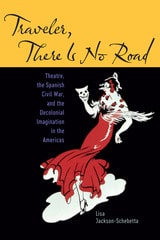
Traveler, There Is No Road
Theatre, the Spanish Civil War, and the Decolonial Imagination in the AmericasLisa Jackson-Schebetta
University of Iowa Press, 2017
This book offers a unique perspective on 1930s theatre and performance, encompassing the theatrical work of the Cuban, Puerto Rican, and Spanish diasporas in the United States, as well as the better-known Anglophone communities. Jackson-Schebetta situates well-known figures, such as Langston Hughes and Clifford Odets, alongside lesser-known ones, such as Erasmo Vando, Franca de Armiño, and Manuel Aparicio. The milicianas, female soldiers of the Spanish Republic, stride on stage alongside the male fighters of the Lincoln Brigade. They and many others used the multiple visions of Spain forged during the civil war to foment decolonial practices across the pasts, presents, and futures of the Americas. Traveler conclusively demonstrates that theatre and performance scholars must position US performances within the Americas writ broadly, and in doing so they must recognize the centrality of the hemisphere’s longest-lived colonial power, Spain.
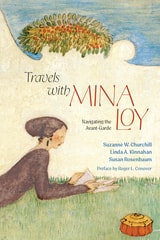
Travels with Mina Loy
Navigating the Avant-GardeSuzanne W. Churchill, Linda A. Kinnahan, and Susan Rosenbaum
Lever Press, 2026
Artist and writer Mina Loy (1882-1966) traversed continents, participated in Futurism, Dada, and Surrealism, and depicted poetic and painterly vistas ranging from lunar landscapes to the gritty streets of the Bowery. Travels with Mina Loy: Navigating the Avant-Garde, a companion text to the award-winning, multi-authored web resource Mina Loy: Navigating the Avant-Garde, offers an illustrated tour of Mina Loy’s long and varied career, contextualized with in-depth explorations of key places that shaped her life and work. Shedding new light on Loy's poetic responses to Italy, her theatrical explorations in New York City, and her forays into the museums of Paris and New York, the book brings in newly discovered and critically overlooked Loy works, as well as fresh timelines and surveys of the critical corpus on her creative output. This essential guidebook to Mina Loy charts her migrations across geography, movements among artistic circles and people, and transit across arts to illuminate her evolving aesthetics, politics, and artistic commitments.
Travels with My Royal
A Memoir of the Writing LifeRobert Laxalt
University of Nevada Press, 2001
The book opens with a series of vignettes about his youth in Carson City as the second son of an immigrant Basque family and his later experiences as a student at the University of Nevada in Reno.
The second part of the book tells of Laxalt's career as a writer—his early days as a reporter when his assignments included interviews with gangsters and obligatory attendance at executions; his later adventures as a contract writer for National Geographic, and his two stays in the Basque Country. He also recounts his days as director of the University of Nevada's news service and his role in the founding of the University of Nevada Press.
The third section discusses the writing of several of his major books—where the ideas came from, what he tried to accomplish in each book, the challenges he faced, and the ways he chose to resolve them. Foreword by Cheryll Glotfelty.
Traversing the Imaginary
Richard Kearney and the Postmodern ChallengeEdited by Peter Gratton and John Panteleimon Manoussakis; Foreword by Richard Kearney
Northwestern University Press, 2007
The book opens with Kearney's own "prelude" in which he traces his intellectual itinerary as it traverses the three imaginaries explored in the volume: the dialogical, the political, and the narrative. The interviews that follow the first section allow readers to listen in on conversations between Kearney and some of the most interesting and respected thinkers of our time—Noam Chomsky, Charles Taylor, Jacques Derrida, Paul Ricouer, and Martha Nussbaum—as they reveal new and unexpected aspects of their thought on stories and mourning, ethics and narrative, terror and religion, intellectuals and ideology. The next section, on the political imaginary, looks at Kearney's distinctive contribution to the political situation in Ireland and in Europe more generally; and in the last, on narrative, writers including David Wood, Terry Eagleton, and Mark Dooley focus on Kearney's novels as instances of narrative theory put into literary practice. Concluding with Kearney's postscript, an essay on "Traversals and Epiphanies in Joyce and Proust," the volume comes full circle, encompassing the full extent of Richard Kearney's engagement and offerings as a philosopher,
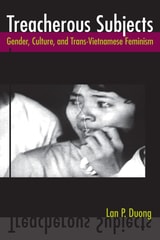
Treacherous Subjects
Gender, Culture, and Trans-Vietnamese FeminismLan P Duong
Temple University Press, 2012
Treacherous Subjects is a provocative and thoughtful examination of Vietnamese films and literature viewed through a feminist lens. Lan Duong investigates the postwar cultural productions of writers and filmmakers, including Tony Bui, Trinh T. Minh-ha, and Tran Anh Hung.
Taking her cue from the double meaning of "collaborator," Duong shows how history has shaped the loyalties and shifting alliances of the Vietnamese, many of whom are caught between opposing/constricting forces of nationalism, patriarchy, and communism. Working at home and in France and the United States, the artists profiled in Treacherous Subjects have grappled with the political and historic meanings of collaboration. These themes, which probe into controversial issues of family and betrayal, figure heavily in fictions such as the films The Scent of Green Papaya and Surname Viet Given Name Nam.
As writers and filmmakers collaborate, Duong suggests that they lay the groundwork for both transnational feminist politics and queer critiques of patriarchy.
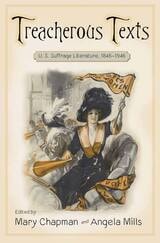
Treacherous Texts
An Anthology of U.S. Suffrage Literature, 1846-1946Chapman, Mary
Rutgers University Press, 2011
Uncovering startling affinities between popular literature and propaganda, Treacherous Texts samples a rich, decades-long tradition of suffrage literature created by writers from diverse racial, class, and regional backgrounds. Beginning with sentimental fiction and polemic, progressing through modernist and middlebrow experiments, and concluding with post-ratification memoirs and tributes, this anthology showcases lost and neglected fiction, poetry, drama, literary journalism, and autobiography; it also samples innovative print cultural forms devised for the campaign, such as valentines, banners, and cartoons. Featured writers include canonical figures as well as writers popular in their day but, until now, lost to ours.
Includes writings by:
• Sojourner Truth
• Elizabeth Cady Stanton
• Frederick Douglass
• Fanny Fern
• Harriet Beecher Stowe
• Djuna Barnes
• Charlotte Perkins Gilman
• Marianne Moore
• Sui Sin Far
• Edna St. Vincent Millay
• Gertrude Stein
And many others.
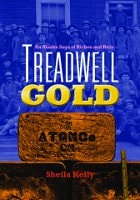
Treadwell Gold
An Alaska Saga of Riches and RuinSheila Kelly
University of Alaska Press, 2010
A century ago, Treadwell, Alaska, was a featured stop on steamship cruises, a rich, up-to-date town that was the most prominent and proud in all Alaska. Its wealth, however, was founded on the remarkably productive gold mines on Douglas Island, and when those caved in and flooded in the early decades of the twentieth century, Treadwell sank into relative obscurity.
Treadwell Gold presents first-person accounts from the sons and daughters of the miners, machinists, hoist operators, and superintendents who together dug and blasted the gold that made Treadwell rich. Alongside these stories are vintage photos that capture both the industrial vigor of the mines and the daily lives that made up Treadwell society. The book will fascinate anyone interested in Alaskan history or the romance of gold mining’s past.
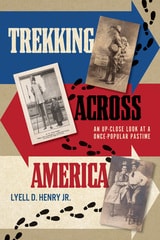
Trekking across America
An Up-Close Look at a Once-Popular PastimeLyell D. Jr. Henry
University of Iowa Press, 2024
As competitive walking faded, a new kind of spectacle walking, which had also begun in the late 1860s, came to full flower. Between 1890 and 1930, hundreds of men, women, even children and entire families were on the nation’s roads and railroad tracks trekking between widely separated points, sometimes moving in unusual ways such as on roller skates or by walking barefooted, backward, on stilts, or while rolling a hoop. To finance their attention-seeking journeys, many sold souvenir postcards. The public usually found these performers entertaining, but public officials and newspaper editors often denounced them as nuisances or frauds. Tapping vintage postcards and old newspaper articles, this is the first book to bring back to view this once-familiar feature of American life.

Tripartite minehunter Haarlem
Bob Roetering
Amsterdam University Press, 2023
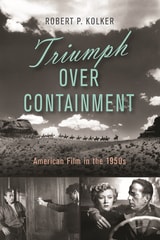
Triumph over Containment
American Film in the 1950sRobert P. Kolker
Rutgers University Press, 2022
Triumph Over Containment offers an uncompromising look at some of the era’s greatest films and directors, from household names like Alfred Hitchcock and Stanley Kubrick to lesser-known iconoclasts like Samuel Fuller and Ida Lupino. Taking in everything from The Thing from Another World (1951) to Dr. Strangelove or: How I Learned to Stop Worrying and Love the Bomb (1964), acclaimed film scholar Robert P. Kolker scours a variety of different genres to find pockets of resistance to the repressive and oppressive norms of Cold War culture. He devotes special attention to two quintessential 1950s genres—the melodrama and the science fiction film—that might seem like polar opposites, but each offered pointed responses to containment culture.
This book takes a fresh look at such directors as Nicholas Ray, John Ford, and Orson Welles, while giving readers a new appreciation for the depth and artistry of 1950s Hollywood films.
Tropes, Parables, and Performatives
J. Hillis Miller
Duke University Press, 1991
Throughout these essays Miller is fascinated with the tropological dimension of literary language, with the way figures of speech turn aside the telling of a story or the presentation of a literary theme. The exploration of this turning leads to the recognition that all works of literature are parabolic, “thrown beside” their real meaning. They tell one story but call forth something else.
Miller further agrees that all parables are fundamentally performative. They do not merely name something or give knowledge, but rather use words to make something happen, to get the reader from here to there. Each essay here attempts to formulate what, in a given case, the reader perfomatively enters by way of parabolic trope.
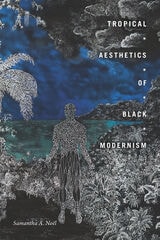
Tropical Aesthetics of Black Modernism
Samantha A. Noël
Duke University Press, 2021
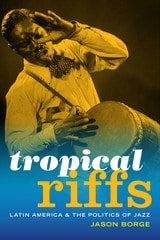
Tropical Riffs
Latin America and the Politics of JazzJason Borge
Duke University Press, 2018
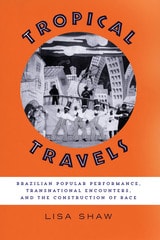
Tropical Travels
Brazilian Popular Performance, Transnational Encounters, and the Construction of RaceBy Lisa Shaw
University of Texas Press, 2018
Brazilian popular culture, including music, dance, theater, and film, played a key role in transnational performance circuits—inter-American and transatlantic—from the latter nineteenth century to the middle of the twentieth century. Brazilian performers both drew inspiration from and provided models for cultural production in France, Portugal, Argentina, the United States, and elsewhere. These transnational exchanges also helped construct new ideas about, and representations of, “racial” identity in Brazil. Tropical Travels fruitfully examines how perceptions of “race” were negotiated within popular performance in Rio de Janeiro and how these issues engaged with wider transnational trends during the period.
Lisa Shaw analyzes how local cultural forms were shaped by contact with imported performance traditions and transnational vogues in Brazil, as well as by the movement of Brazilian performers overseas. She focuses specifically on samba and the maxixe in Paris between 1910 and 1922, teatro de revista (the Brazilian equivalent of vaudeville) in Rio in the long 1920s, and a popular Brazilian female archetype, the baiana, who moved to and fro across national borders and oceans. Shaw demonstrates that these transnational encounters generated redefinitions of Brazilian identity through the performance of “race” and ethnicity in popular culture. Shifting the traditional focus of Atlantic studies from the northern to the southern hemisphere, Tropical Travels also contributes to a fuller understanding of inter-hemispheric cultural influences within the Americas.

Troubadours, Trumpeters, Troubled Makers
Lyricism, Nationalism, and Hybridity in China and Its OthersGregory B. Lee
Duke University Press, 1996
Lee’s broad definition of lyric includes the work of poets, amateur versifiers, and all manner of popular songwriters, and his inclusive sense of nation refers to all Chinese communities regardless of geographic location. Whether examining the globalized consumption of satellite-broadcast pop music or the heroic efforts of little-known poets on the margins of the Chinese diaspora, he finds a questioning and contesting of both the Orientalist construction of a mythic monolithic China invented by the West and the Chinese obsession with ideas of authenticity and purity of nationhood. Lee explores the lyrical transgression of these ideological boundaries in China, in the Chinese communities of America and Britain, and in other marginalized communities, before using the examples of Hong Kong and other non-nationalistic sites to discuss the creative possibilities of hybrid cultures and societies.
Trouble the Water
Melvin Dixon
University of Alabama Press, 1989
A haunting and poetic journey of memory, identity, and reconciliation in the heart of the Black South.
Winner of the Excellence in Minority Fiction Award
Trouble the Water moves among finely woven layers of time and place as it takes on a new and controversial theme in contemporary black writing, the search for family reconciliation. Twenty years after running away from home in Pee Dee, North Carolina, Jordan Henry believed he had found success, as a young college professor of history, a married man, and a resident of New England, whose colonial past he knew so well. When Jordan finds his career stymied by local prejudices, his world crumbles. Word of his grandmother's death reaches him, and he returns home to claim the ambiguous legacy of her farmland and face the consequences of his long absence.
Jordan's estranged father also returns to Pee Dee on a quest of his own restoring his good name in a community which blames him for Chloe Henry's death in childbirth. Chloe was Jordan's mother and his grandmother's only child. Unresolved hostility in the family and in the community breaks out, making Jordan the unsuspecting pawn in a plot of revenge against his father. Jordan may be the only one who can free his family from the past and the equally troubled present.
Trouble the Water gains resonance from its unflinching confrontation with dualities common in the Afro-American experience: reality and myth, folklore and sophistication, North and South, rural and cosmopolitan. While sacrificing none of its complexities for the sake of simplicity, it has the relentless movement of a fairy tale that reaches deep into the unconscious roots of behavior. It is intensely lyrical and dense in realism. Trouble the Water is magical in the way it reveals the Afro-American psyche and symbolizes fundamental truths about American life.
Troubled Ground
A Tale of Murder, Lynching, and Reckoning in the New SouthClaude A. Clegg III
University of Illinois Press, 2010
Troubled Times
The Boston Courthouse Bombing of 1976Kevin Galvin
Brandeis University Press, 2026
Interweaves the stories of a revolutionary and a bombing victim to explore the roots and unintended consequences of political violence.
1976. The Vietnam War had ended, but radical political groups still operated clandestinely throughout the United States. Nowhere was the threat of civil unrest greater than in Boston. Racial tensions had been building since a federal judge ordered the desegregation of the Boston Public Schools, and civic leaders were counting on the pageantry of the nation’s Bicentennial to boost both tourism and investment. In April, the Sam Melville-Jonathan Jackson Unit, prison reformers schooled in Marxism and angered by US interventions abroad, bombed the Suffolk County Courthouse, injuring twenty-two people. The site of the blast marked the spot where the lives of two men intersected: a mill town kid who’d been radicalized in Vietnam and prison, and an immigrant waiting in line because he needed to renew a cab license.
Fifty years after the bombing shook the city, Troubled Times tells the story of lives changed by political violence at a time when the American experiment is again in crisis.
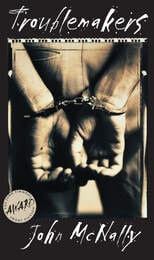
Troublemakers
John McNally
University of Iowa Press, 2000
Troublemakers is an often hilarious, sometimes frightening, occasionally off-the-wall collection of stories about men living on the edge. From the streets of Chicago's southwest side to the rural roads of Nebraska to the small towns of southern Illinois, these men tread a very fine line between right and wrong, love and hate, humor and horror.
Each story is a Pandora's box waiting to be opened: a high school boy with a new driver's license picks his brother up from jail; a UPS driver suspects his wife of having an affair but cannot find any tangible evidence of her indiscretion; an unemployed man's life begins to unravel after he discovers a dead man in a tree in his own backyard; two boys spend Halloween with an older thug; a young college teacher's patience is tested by both his annoying colleagues and the criminals who haunt his neighborhood. In story after story, McNally's troublemakers lead readers to a place no less thrilling or dangerous than the human heart itself.
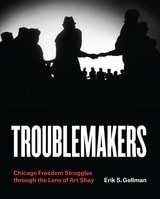
Troublemakers
Chicago Freedom Struggles through the Lens of Art ShayErik S. Gellman
University of Chicago Press, 2019
Troublemakers fuses photography and history to demonstrate how racial and economic inequality gave rise to a decades-long struggle for justice in one American city.
In dialogue with 275 of Art Shay’s photographs, Erik S. Gellman takes a new look at major developments in postwar US history: the Second Great Migration, “white flight,” and neighborhood and street conflicts, as well as shifting party politics and the growth of the carceral state. The result is a visual and written history that complicates—and even upends—the morality tales and popular memory of postwar freedom struggles.
Shay himself was a “troublemaker,” seeking to unsettle society by illuminating truths that many middle-class, white, media, political, and businesspeople pretended did not exist. Shay served as a navigator in the US Army Air Forces during World War II, then took a position as a writer for Life Magazine. But soon after his 1948 move to Chicago, he decided to become a freelance photographer. Shay wandered the city photographing whatever caught his eye—and much did. His lens captured everything from private moments of rebellion to era-defining public movements, as he sought to understand the creative and destructive energies that propelled freedom struggles in the Windy City.
Shay illuminated the pain and ecstasy that sprung up from the streets of Chicago, while Gellman reveals their collective impact on the urban fabric and on our national narrative. This collaboration offers a fresh and timely look at how social conflict can shape a city—and may even inspire us to make trouble today.
Troublemakers
Power, Representation, and the Fiction of the Mass WorkerScott, William
Rutgers University Press, 2012
William Scott’s Troublemakers explores how a major change in the nature and forms of working-class power affected novels about U.S. industrial workers in the first half of the twentieth century. With the rise of mechanization and assembly-line labor from the 1890s to the 1930s, these laborers found that they had been transformed into a class of “mass” workers who, since that time, have been seen alternately as powerless, degraded victims or heroic, empowered icons who could rise above their oppression only through the help of representative organizations located outside the workplace.
Analyzing portrayals of workers in such novels as Upton Sinclair’s The Jungle, Ruth McKenney's Industrial Valley, and Jack London’s The Iron Heel, William Scott moves beyond narrow depictions of these laborers to show their ability to resist exploitation through their direct actions—sit-down strikes, sabotage, and other spontaneous acts of rank-and-file “troublemaking” on the job—often carried out independently of union leadership. The novel of the mass industrial worker invites us to rethink our understanding of modern forms of representation through its attempts to imagine and depict workers’ agency in an environment where it appears to be completely suppressed.
True Grit
American Prints from 1900 to 1950Stephanie Schrader
J. Paul Getty Trust, The, 2019
In the first half of the twentieth century, a group of American artists influenced by the painter and teacher Robert Henri aimed to reject the pretenses of academic fine art and polite society. Embracing the democratic inclusiveness of the Progressive movement, these artists turned to making prints, which were relatively inexpensive to produce and easy to distribute. For their subject matter, the artists mined the bustling activity and stark realities of the urban centers in which they lived and worked. Their prints feature sublime towering skyscrapers and stifling city streets, jazzy dance halls and bleak tenement interiors—intimate and anonymous everyday scenes that addressed modern life in America.
True Grit examines a rich selection of prints by well-known figures like George Bellows, Edward Hopper, Joseph Pennell, and John Sloan as well as lesser-known artists such as Ida Abelman, Peggy Bacon, Miguel Covarrubias, and Mabel Dwight. Written by three scholars of printmaking and American art, the essays present nuanced discussions of gender, class, literature, and politics, contextualizing the prints in the rapidly changing milieu of the first decades of twentieth-century America.
This volume is published to accompany an exhibition on view at the J. Paul Getty Museum at the Getty Center October 15, 2019, to January 19, 2020.
True Songs of Freedom
Uncle Tom’s Cabin in Russian Culture and SocietyJohn MacKay
University of Wisconsin Press, 2013
True Stories
A Century of Literary JournalismNorman Sims
Northwestern University Press, 2007
Truman Capote's Southern Years, 25th Anniversary Edition
Stories from a Monroeville CousinMarianne M. Moates, Foreword by Ralph F. Voss
University of Alabama Press, 2014
Readers are well acquainted with Truman Capote’s meteoric rise to fame and his metamorphosis from literary enfant terrible to literary genius, celebrity author, and dispenser of venomously comic witticisms. It is also well-known that he spent his formative years in the south Alabama hamlet of Monroeville, and that he was abandoned there by his mother to be cared for and then to care for elderly relatives. Yet details of those years have remained sketchy and vague.
In Monroeville young Capote formed significant bonds and played childhood games with his cousin, Jennings Faulk Carter, and next door neighbor, Nelle Harper Lee, author of "To Kill a Mockingbird" and "Go Set a Watchman." Through the tales told by Carter and spun into a fascinating and revealing narrative by Marianne M. Moates readers discover in Truman Capote's Southern Years the lively imagination and the early tragedies of a brilliant child.
A new foreword by Ralph F. Voss underscores the enduring relevance of Truman Capote’s work and the influence his Alabama childhood had on his work.
Truman and Pendergast
Robert H. Ferrell
University of Missouri Press, 1999
No portion of the political career of Harry S. Truman was more fraught with drama than his relationship with Thomas J. Pendergast. In one of their earliest meetings, the two men were momentarily at odds after Truman, who was then presiding judge of Jackson County, gave a $400,000 road contract to a construction company in South Dakota, and Pendergast, the boss of Kansas City, wasn't very happy about it. He had someone else in mind for the contract. Their association thus had its disagreements, but their common interest in politics was enough to establish a long-lasting relationship.
In 1934, after considering fourteen other men, Pendergast sponsored Truman for the Senate. Although Truman had often cooperated with Pendergast on patronage issues, he had never involved himself in the illegalities that would eventually destroy the Pendergast machine. In fact, Truman had no idea how deeply the Boss had engaged in corruption in his personal affairs, as well as in managing the government of Kansas City. When the Boss was sent to Leavenworth for tax evasion in 1939, Truman was astonished.
Despite Truman's honesty, his relationship with Pendergast almost caused his defeat during the Missouri senatorial primary in August 1940. The main challenger for Truman's Senate seat was the ambitious governor of Missouri, Lloyd C. Stark, who after destroying Truman's sponsor, the Pendergast machine, denounced Truman as "the Pendergast senator." Behind the governor was President Franklin D. Roosevelt, whom Stark turned against Truman. Roosevelt wanted Missouri's electoral votes in his forthcoming bid for a third term, and he believed that Stark could give them to him.
Because of the stigma of Truman's Pendergast connection, the 1940 Democratic primary was the tightest election in his entire political career. He won by fewer than eight thousand votes. In Truman and Pendergast, Robert H. Ferrell masterfully presents Truman's struggle to keep his Senate seat without the aid of Pendergast and despite Stark's enlistment of Roosevelt against him. Ferrell shows that Truman won the election in his typical fashion—going directly to the people, speaking honestly and like one of them.

Truman and the Steel Seizure Case
The Limits of Presidential PowerMaeva Marcus
Duke University Press, 1994
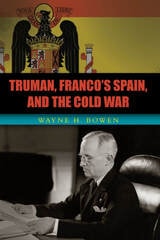
Truman, Franco's Spain, and the Cold War
Wayne H Bowen
University of Missouri Press, 2017
President Harry S. Truman harbored an abiding disdain for Spain and its government. During his presidency (1945–1953), the State Department and the Department of Defense lobbied Truman to form an alliance with Spain to leverage that nation’s geostrategic position, despite Francisco Franco’s authoritarian dictatorship. The eventual alliance between the two countries came only after years of argument for such a shift by nearly the entire U.S. diplomatic and military establishment. This delay increased the financial cost of the 1953 defense agreements with Spain, undermined U.S. planning for the defense of Europe, and caused dysfunction over foreign policy at the height of the Cold War.
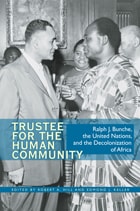
Trustee for the Human Community
Ralph J. Bunche, the United Nations, and the Decolonization of AfricaRobert A. Hill
Ohio University Press, 2010
Ralph J. Bunche (1904–1971), winner of the Nobel Peace Prize in 1950, was a key U.S. diplomat in the planning and creation of the United Nations in 1945. In 1947 he was invited to join the permanent UN Secretariat as director of the new Trusteeship Department. In this position, Bunche played a key role in setting up the trusteeship system that provided important impetus for postwar decolonization ending European control of Africa as well as an international framework for the oversight of the decolonization process after the Second World War.
Trustee for the Human Community is the first volume to examine the totality of Bunche’s unrivalled role in the struggle for African independence both as a key intellectual and an international diplomat and to illuminate it from the broader African American perspective.
These commissioned essays examine the full range of Ralph Bunche’s involvement in Africa. The scholars explore sensitive political issues, such as Bunche’s role in the Congo and his views on the struggle in South Africa. Trustee for the Human Community stands as a monument to the profoundly important role of one of the greatest Americans in one of the greatest political movements in the history of the twentieth century.
Contributors: David Anthony, Ralph A. Austen, Abena P. A. Busia, Neta C. Crawford, Robert R. Edgar, Charles P. Henry, Robert A. Hill, Edmond J. Keller, Martin Kilson, Georges Nzongola-Ntalaja, Jon Olver, Pearl T. Robinson, Elliott P. Skinner, Crawford Young
Trying Biology
The Scopes Trial, Textbooks, and the Antievolution Movement in American SchoolsAdam R. Shapiro
University of Chicago Press, 2013
Trying to Get Over
African American Directors after Blaxploitation, 1977-1986By Keith Corson
University of Texas Press, 2016
From 1972 to 1976, Hollywood made an unprecedented number of films targeted at black audiences. But following this era known as “blaxploitation,” the momentum suddenly reversed for black filmmakers, and a large void separates the end of blaxploitation from the black film explosion that followed the arrival of Spike Lee’s She's Gotta Have It in 1986. Illuminating an overlooked era in African American film history, Trying to Get Over is the first in-depth study of black directors working during the decade between 1977 and 1986.
Keith Corson provides a fresh definition of blaxploitation, lays out a concrete reason for its end, and explains the major gap in African American representation during the years that followed. He focuses primarily on the work of eight directors—Michael Schultz, Sidney Poitier, Jamaa Fanaka, Fred Williamson, Gilbert Moses, Stan Lathan, Richard Pryor, and Prince—who were the only black directors making commercially distributed films in the decade following the blaxploitation cycle. Using the careers of each director and the twenty-four films they produced during this time to tell a larger story about Hollywood and the shifting dialogue about race, power, and access, Corson shows how these directors are a key part of the continuum of African American cinema and how they have shaped popular culture over the past quarter century.
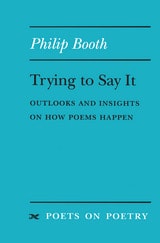
Trying to Say It
Outlooks and Insights on How Poems HappenPhilip Booth
University of Michigan Press, 1996
Gathering together selections from his notebooks, dreamlogs, memoirs, and essays of such poets as Frost, Robert Lowell and George Oppen, Trying to Say It particularly focuses on the ways that the tension between in-formed structures and lineation create poems which--in all senses--move.
Employing the Thoreauvian sense of place for which his poetry is known, Booth probes the nature of poetry itself, as well as the poetry of nature--yielding insights that are rooted in the acute observation that catalyzes imagination. Infused with a restless spirit in search of a moving language commensurate with the complexity of being fully alive, the essays collected in Trying to Say It reveal the pulses of a teacher's mind and a poet's heart.
Philip Booth is the author of nine books of poetry, and has been honored by Guggenheim, Rockefeller, and National Endowment for the Arts fellowships, the National Institute of Arts and Letters, and the Academy of American Poets.
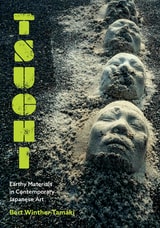
Tsuchi
Earthy Materials in Contemporary Japanese ArtBert Winther-Tamaki
University of Minnesota Press, 2022
An examination of Japanese contemporary art through the lens of ecocriticism and environmental history
Collectively referred to by the word tsuchi, earthy materials such as soil and clay are prolific in Japanese contemporary art. Highlighting works of photography, ceramics, and installation art, Bert Winther-Tamaki explores the many aesthetic manifestations of tsuchi and their connection to the country’s turbulent environmental history, investigating how Japanese artists have continually sought a passionate and redemptive engagement with earth.
In the seven decades following 1955, Japan has experienced severe environmental degradation as a result of natural disasters, industrial pollution, and nuclear irradiation. Artists have responded to these ongoing catastrophes through modes of “mudlarking” and “muckracking,” utilizing raw elements from nature to establish deeper contact with the primal resources of their world and expose its unfettered contamination. Providing a comparative assessment of more than seventy works of art, this study reveals Japanese artists’ engagement with a richly diverse repertoire of earthy materialities, elucidating their aesthetic properties, changing conditions, and cultural significance.
By focusing on the role of tsuchi as a convergence point for a wide range of creative practices, this book offers a critical reassessment of contemporary art in Japan and its intrinsic relationship to the environment. Situating art within the context of ecology and urbanization, Tsuchi shows artists striving to explore and reprocess raw forms of earth beneath the corruptions of human activity.

Tuberculosis Control and Institutional Change in Shanghai, 1911–2011
Rachel S. Core
Hong Kong University Press, 2023
Tuberculosis Control and Institutional Change in Shanghai, 1911–2011 is the first book on the most widespread and deadly infectious disease in China, both historically and today. Weaving together interviews with data from periodicals and local archives in Shanghai, Rachel Core examines the rise and fall of tuberculosis control in China from the 1950s to the 1990s. Under the socialist work unit system, the vast majority of people had guaranteed employment, a host of benefits tied to their workplace, and there was little mobility—factors that made the delivery of medical and public health services possible in both urban and rural areas. The dismantling of work units amid wider market reforms in the 1980s and 1990s led to the rise of temporary and casual employment and a huge migrant worker population, with little access to health care, creating new challenges in TB control. This study of Shanghai will provide valuable lessons for historians, social scientists, public health specialists, and many others working on public health infrastructure on both the national and global levels.

Tuberculosis and the Politics of Exclusion
A History of Public Health and Migration to Los AngelesAbel, Emily K.
Rutgers University Press, 2007
Winner of the 2008 Arthur J. Viseltear Prize from the American Public Health Association and Nominated for the 2008 William H. Welch Medal, AAHM
Though notorious for its polluted air today, the city of Los Angeles once touted itself as a health resort. After the arrival of the transcontinental railroad in 1876, publicists launched a campaign to portray the city as the promised land, circulating countless stories of miraculous cures for the sick and debilitated. As more and more migrants poured in, however, a gap emerged between the city’s glittering image and its dark reality.
Emily K. Abel shows how the association of the disease with “tramps” during the 1880s and 1890s and Dust Bowl refugees during the 1930s provoked exclusionary measures against both groups. In addition, public health officials sought not only to restrict the entry of Mexicans (the majority of immigrants) during the 1920s but also to expel them during the 1930s.
Abel’s revealing account provides a critical lens through which to view both the contemporary debate about immigration and the U.S. response to the emergent global tuberculosis epidemic.
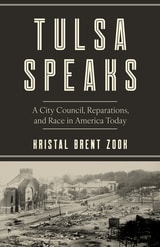
Tulsa Speaks
A City Council, Reparations, and Race in America TodayKristal Brent Zook
Rutgers University Press, 2026
In 2021, the international media descended upon Tulsa, Oklahoma, for the centennial commemoration of the May 31–June 1, 1921, massacre in which a white mob killed more than three hundred African American residents, burned homes and businesses, and decimated a thriving town once referred to as “Black Wall Street.”
Tulsa Speaks is about the ongoing work of the Tulsa City Council, both before the Centennial and afterward, when the cameras were no longer trained on the city. It dives deep into the interpersonal dynamics among the nine councilors, exploring the continuing fight for reparations and racial justice and the long-running efforts of councilor, Vanessa Hall-Harper of District 1, to bring repair to Greenwood.
Tulsa, like many municipal bodies across the country, serves as a hopeful sign of what we might become, as Americans and as a microcosm of race relations in America today.
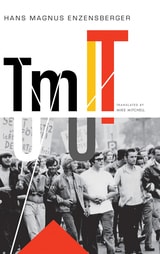
Tumult
Hans Magnus Enzensberger
Seagull Books, 2016
Hans Magnus Enzensberger, widely regarded as Germany’s greatest living poet, was already well known in the 1960s, the tempestuous decade of which Tumult is an autobiographical record. Derived from old papers, notes, jottings, photos, and letters that the poet stumbled upon years later in his attic, the volume is not so much about the man, but rather the many places he visited and people whom he met on his travels through the Soviet Union and Cuba during the 1960s. The book is made up of four long-form pieces written from 1963 to 1970, each episode concluding with a poem and postscript written in 2014. Translated by Mike Mitchell, the book is a lively and deftly written travelogue offering a glimpse into the history of leftist thought. Dedicated to “those who disappeared,” Tumult is a document of that which remains one of humanity’s headiest times.
Tungsten in Peace and War, 1918–1946
Ronald H. Limbaugh
University of Nevada Press, 2011

Tuning the World
The Rise of 440 Hertz in Music, Science, and Politics, 1859–1955Fanny Gribenski
University of Chicago Press, 2023
Tuning the World tells the unknown story of how the musical pitch A 440 became the global norm.
Now commonly accepted as the point of reference for musicians in the Western world, A 440 hertz only became the standard pitch during an international conference held in 1939. The adoption of this norm was the result of decades of negotiations between countries, involving a diverse group of performers, composers, diplomats, physicists, and sound engineers. Although there is widespread awareness of the variability of musical pitches over time, as attested by the use of lower frequencies to perform early music repertoires, no study has fully explained the invention of our current concert pitch. In this book, Fanny Gribenski draws on a rich variety of previously unexplored archival sources and a unique combination of musicological perspectives, transnational history, and science studies to tell the unknown story of how A 440 became the global norm. Tuning the World demonstrates the aesthetic, scientific, industrial, and political contingencies underlying the construction of one of the most “natural” objects of contemporary musical performance and shows how this century-old effort was ultimately determined by the influence of a few powerful nations.
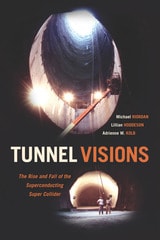
Tunnel Visions
The Rise and Fall of the Superconducting Super ColliderMichael Riordan, Lillian Hoddeson, and Adrienne W. Kolb
University of Chicago Press, 2015
Drawing on extensive archival research, contemporaneous press accounts, and over one hundred interviews with scientists, engineers, government officials, and others involved, Tunnel Visions tells the riveting story of the aborted SSC project. The authors examine the complex, interrelated causes for its demise, including problems of large-project management, continuing cost overruns, and lack of foreign contributions. In doing so, they ask whether Big Science has become too large and expensive, including whether academic scientists and their government overseers can effectively manage such an enormous undertaking.
Turn Out the Lights
Chronicles of Texas during the 80s and 90sBy Gary Cartwright
University of Texas Press, 2000
Whether the subject is Jack Ruby, Willie Nelson, or his own leukemia-stricken son Mark, when it comes to looking at the world through another person's eyes, nobody does it better than Gary Cartwright. For over twenty-five years, readers of Texas Monthly have relied on Cartwright to tell the stories behind the headlines with pull-no-punches honesty and wry humor. His reporting has told us not just what's happened over three decades in Texas, but, more importantly, what we've become as a result.
This book collects seventeen of Cartwright's best Texas Monthly articles from the 1980s and 1990s, along with a new essay, "My Most Unforgettable Year," about the lasting legacy of the Kennedy assassination. He ranges widely in these pieces, from the reasons for his return to Texas after a New Mexican exile to profiles of Kris Kristofferson and Willie Nelson. Along the way, he strolls through San Antonio's historic King William District; attends a Dallas Cowboys old-timers reunion and the Holyfield vs. Foreman fight; visits the front lines of Texas' new range wars; gets inside the heads of murderers, gamblers, and revolutionaries; and debunks Viagra miracles, psychic surgery, and Kennedy conspiracy theories. In Cartwright's words, these pieces all record "the renewal of my Texas-ness, a rediscovery of Texas after returning home."
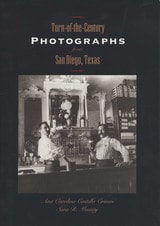
Turn-of-the-Century Photographs from San Diego, Texas
By Ana Carolina Castillo Crimm and Sara R. Massey
University of Texas Press, 2003
Situated in the South Texas borderlands some fifty miles west of Corpus Christi, San Diego was a thriving town already a hundred years old at the turn of the twentieth century. With a population that was 90 percent Mexican or Mexican American and 10 percent Anglo, the bicultural community was the seat of Duval County and a prosperous town of lumberyards, banks, mercantile stores, and cotton gins, which also supplied the needs of area ranchers and farmers. Though Anglos dominated its economic and political life, San Diego was culturally Mexican, and Mexican Americans as well as Anglos built successful businesses and made fortunes.
This collection of nearly one hundred photographs from the estate of amateur photographer William Hoffman captures the cosmopolitan town of San Diego at a vibrant moment in its history between 1898 and 1909. Grouped into the categories women and their jobs, local homes, men and their businesses, children at school and church, families and friends, and entertainment about town, the photos offer an immediate visual understanding of the cultural and economic life of the community, enhanced by detailed captions that identify the subjects and circumstances of the photos. An introductory historical chapter constitutes the first published history of Duval County, which was one of the most important areas of South Texas in the early twentieth century.
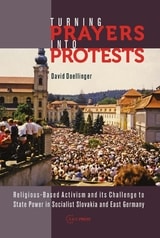
Turning Prayers into Protests
Religious-based Activism and its Challenge to State Power in Socialist Slovakia and East GermanyDavid Doellinger
Central European University Press, 2013
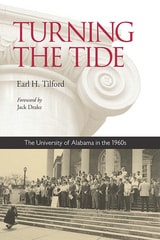
Turning the Tide
The University of Alabama in the 1960sEarl H. Tilford
University of Alabama Press, 2014
Earl H. Tilford details the origins of the student movement from within the Student Government Association, whose leaders included Ralph Knowles and future governor Don Siegelman, among others; the participation of key members of “The Machine,” the political faction made up of the powerful fraternities and sororities on campus; and the efforts of more radical non-Greek students like Jack Drake, Ed Still, and Sondra Nesmith. Tilford also details the political maneuverings that drove the cause of social change through multiple administrations at the university. Turning the Tide highlights the contributions of university presidents Frank A. Rose and David Mathews, as well as administrators like the dean of men John L. Blackburn, who supported the student leaders but also encouraged them to work within the system rather than against it.
Based on archival research, interviews with many of the principal participants, and the author’s personal experiences, Tilford’s Turning the Tide is a compelling portrait of a university in transition during the turbulence surrounding the civil rights and anti-war movements of the 1960s.

Twelve Views from the Distance
Mutsuo Takahashi
University of Minnesota Press, 2012
From one of the foremost poets in contemporary Japan comes this entrancing memoir that traces a boy’s childhood and its intersection with the rise of the Japanese empire and World War II. Originally published in 1970, this translation is the first available in English.
In twelve chapters that visit and revisit critical points in his boyhood, Twelve Views from the Distance presents a vanished time and place through the eyes of an accomplished poet. Recounting memories from his youth, Mutsuo Takahashi captures the full range of his internal life as a boy, shifting between his experiences and descriptions of childhood friendships, games, songs, and school. With great candor, he also discusses the budding awareness of his sexual preference for men, providing a rich exploration of one man’s early queer life in a place where modern, Western-influenced models of gay identity were still unknown.
Growing up poor in rural southwestern Japan, far from the urban life that many of his contemporaries have written about, Takahashi experienced a reality rarely portrayed in literature. In addition to his personal remembrances, the book paints a vivid portrait of rural Japan, full of oral tradition, superstition, and remnants of customs that have quickly disappeared in postwar Japan. With profuse local color and detail, he re-creates the lost world that was the setting for his beginnings as a gay man and poet.
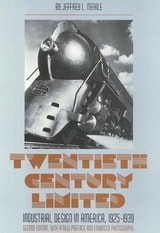
Twentieth Century Limited
Industrial Design In America 1925-1939Jeffrey L. Meikle
Temple University Press, 2001
Commercial artists who answered the call of business -- Walter Dorwin Teague, Norman Bel Geddes, Henry Dreyfuss, and Raymond Loewy the best known among them -- were pioneers who envisioned a coherent machine-age environment in which life would be clean, efficient, and harmonious. Working with new materials -- chrome, stainless steel, Bakelite plastic -- they created a streamlined expressionist style which reflected the desire of the Depression-era public for a frictionless, static society.
Appliances such as Loewy's Coldspot refrigerator "set a new standard" (according to the advertisements), and its usefulness extended to the way it improved the middle-class consumer's taste for sleek new products.
Profusely illustrated with 150 photographs, Twentieth Century Limited pays tribute to the industrial designers and the way they transformed American culture; a generation after its initial publication, this book remains the best introduction to the subject. The new edition will fascinate anyone interested in art, architecture, technology, and American culture of the 1930's.

Twentieth-Century American Literary Naturalism
An InterpretationDonald Pizer
Southern Illinois University Press, 1982
Scorned by critics since birth, decreed dead by many, naturalism, according to Donald Pizer, is “one of the most persistent and vital strains in American fiction, perhaps the only modern literary form in America that has been both popular and significant.”
To define naturalism and explain its tenacious hold throughout the twentieth century on the American creative imagination, Pizer explores six novels: James T. Farrell’s Studs Lonigan, John Dos Passos’s U.S.A., John Steinbeck’s The Grapes of Wrath, Norman Mailer’s The Naked and the Dead, William Styron’s Lie Down in Darkness, and Saul Bellow’s The Adventures of Augie March.
Pizer’s approach to these novels is empirical; he does not wrench each novel awkwardly until it fits his framework of generalizations and principles; rather, he approaches the novels as fiction and arrives at his definition through his close reading of the works.
Establishing the background of naturalism, Pizer explains that it comes under attack because it is “sordid and sensational in subject matter,” it challenges “man’s faith in his innate moral sense and thus his responsibility for his actions,” and it is so full of “social documentation” that it is often dismissed as little more than a photographic record of a life or an era; thus the “aesthetic validity of the naturalistic novel has often been questioned.”
Pizer posits the 1890s, the 1930s,and the late 1940s as the decades when naturalism flourished in America. He concentrates on literary criticism, not on the philosophy ofnaturalism, to show that literary criticism can make a contribution to a particularly muddled area of literary history—a naturalism that is alive and changing, thus resisting the neat definitions reserved for the dead.
Twentieth-Century American Success Rhetoric
How to Construct a Suitable SelfJohn Ramage
Southern Illinois University Press, 2005
Self-help authors like Tom Peters and Stephen Covey, who have dominated best-seller lists over the last two decades, have exercised increasing influence on political, governmental, and educational organizations. By contrast, the topic of American success books— texts that promise to help readers succeed by retrofitting their identity to meet workplace demands—has been ignored by scholars since the 1980s. John Ramage challenges the neglect of this hugely popular literature and revives a once-lively conversation among eminent critics about the social phenomenon represented in the work of Bruce Barton, Dale Carnegie, and Norman Vincent Peale, among others.
Using literary texts from Don Quixote to Catch-22 to gloss the discussion, Ramage utilizes Kenneth Burke’s rhetorical theory to understand symbolic acts and social issues and brings together earlier commentaries within a new critical framework. He considers the problematic and paradoxical nature of success and examines its meaning in terms of its traditional dialectic partner, happiness. A synopsis of seventeenth- to nineteenth-century forerunners prefaces this analysis in which Ramage links literary code heroes with the activities of twentieth-century business leaders to determine whether, in the search for authenticity, the heroic individual or the corporation is ultimately served.
This comprehensive study chronicles the legitimation of the success book genre, enumerates rhetorical strategies used to win over readers, and supplies the historical context that renders each book’s message timely. After considering some of the dangers of crossing disciplinary borders, as exemplified by Deborah Tannen’s work, Ramage critiques Stanley Fish’s theoretical strictures against this practice, finally summoning academic critics to action with a strong call to exert greater influence within the popular marketplace.
Twentieth-Century Russian Poetry
John Glad
University of Iowa Press, 1992
This celebrated anthology, first published in 1978 as Russian Poetry: The Modern Period, provides a much-needed panoramic overview of Russian poetry since the Bolshevik Revolution of 1917.
Major features of this collection include a new and expanded introduction, a substantial new section of glasnost-era poetry, a generous sampling of postrevolutionary poetry in Russia, full representation of poets of the first and second post-World War II generations, and poetry of the successive emigrations, flights, or expulsions from Russia.
Twentieth-Century Russian Poetry makes an important contribution to our continuing understanding of a changing world order. This anthology should be read by all those who wish to know more about the poetry of Russia, those interested in international cultural and literary history, and all Slavicists.
Twentieth-Century Sentimentalism
Narrative Appropriation in American LiteratureWilliamson, Jennifer A.
Rutgers University Press, 2013
Today’s critical establishment assumes that sentimentalism is an eighteenth- and nineteenth-century literary mode that all but disappeared by the twentieth century. In this book, Jennifer Williamson argues that sentimentalism is alive and well in the modern era. By examining working-class literature that adopts the rhetoric of “feeling right” in order to promote a proletarian or humanist ideology as well as neo-slave narratives that wrestle with the legacy of slavery and cultural definitions of African American families, she explores the ways contemporary authors engage with familiar sentimental clichés and ideals.
Williamson covers new ground by examining authors who are not generally read for their sentimental narrative practices, considering the proletarian novels of Grace Lumpkin, Josephine Johnson, and John Steinbeck alongside neo-slave narratives written by Margaret Walker, Octavia Butler, and Toni Morrison. Through careful close readings, Williamson argues that the appropriation of sentimental modes enables both sympathetic thought and systemic action in the proletarian and neo-slave novels under discussion. She contrasts appropriations that facilitate such cultural work with those that do not, including Kathryn Stockett’s novel and film The Help. The book outlines how sentimentalism remains a viable and important means of promoting social justice while simultaneously recognizing and exploring how sentimentality can further white privilege.
Sentimentalism is not only alive in the twentieth century. It is a flourishing rhetorical practice among a range of twentieth-century authors who use sentimental tactics in order to appeal to their readers about a range of social justice issues. This book demonstrates that at stake in their appeals is who is inside and outside of the American family and nation.