Results by title
8642 books match the query '20th century' and 1764 start with t
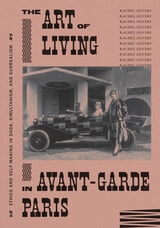
The Art of Living in Avant-Garde Paris
Ethics and Self-Making in Dada, Simultanism, and SurrealismRachel Silveri
University of Chicago Press, 2026
With The Art of Living in Avant-Garde Paris, Rachel Silveri takes a fresh look at the desire to unify art and life, an ambition long regarded as foundational to the European historical avant-gardes. She reveals how many early twentieth-century artists saw their own everyday lives—their bodies, identities, and relationships—as a type of creative material and a central component to their avant-garde practice. These artists abandoned traditional forms of artmaking and venues of art viewing, instead aspiring to integrate art with everyday life, creating an “art of living.”
Considering Tristan Tzara’s performances of Dadaist identity, Sonia Delaunay’s simultaneous fashions and self-branding, and the collective endeavor to open and operate the Surrealist Research Bureau, Silveri offers a new narrative about how the artists of interwar Paris developed experiential life practices that resisted dominant forms of “lifestyle” and normative discourses surrounding gender, ethnicity, and office work. This book argues that ethical questions of “How should I live?” and “How should I relate to others?” were as important to the avant-garde as politics, and that aspirations to change the world played out in daily practices of self-making.
The Art of Poetry
Kenneth Koch
University of Michigan Press, 1996
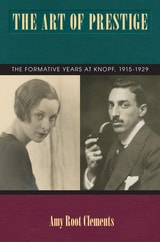
The Art of Prestige
The Formative Years at Knopf, 1915-1929Amy Clements
University of Massachusetts Press, 2014
Capturing the little-known early history of Knopf, The Art of Prestige explores the origins of the company's rise to success during the Jazz Age, when Alfred and Blanche established themselves as literary impresarios on both sides of the Atlantic. Drawing on key archival documents from all phases of the publishing process, Amy Root Clements reconstructs the turning points and rhetorical exchanges that made Knopf's initial books noteworthy, from the acquisitions process to design, consumer marketing, and bookselling.
Lasting cornerstones of the young firm include alliances with pivotal figures in the world of graphic arts and book production and with European publishers who brought numerous Nobel Prize winners to the Borzoi list during the company's first fifteen years. Other featured luminaries include the American authors Willa Cather, Dashiell Hammett, and Langston Hughes. The Art of Prestige also examines Alfred Knopf's ancestry, up-bringing, and formal education at Columbia, as well as his apprenticeships with Frank Nelson Doubleday and Mitchell Kennerley—factors that would influence his business decisions for years to come.
The result is a portrait of innovative branding that seamlessly merged book production with book promotion in a literary landscape that was ripe for transformation.
The Art of Return
The Sixties and Contemporary CultureJames Meyer
University of Chicago Press, 2019
In this innovative work, James Meyer turns to art criticism, theory, memoir, and fiction to examine the fascination with the long sixties and contemporary expressions of these cultural memories across the globe. Meyer draws on a diverse range of cultural objects that reimagine this revolutionary era stretching from the 1950s to the 1970s, including reenactments of civil rights, antiwar, and feminist marches, paintings, sculptures, photographs, novels, and films. Many of these works were created by artists and writers born during the long Sixties who were driven to understand a monumental era that they missed. These cases show us that the past becomes significant only in relation to our present, and our remembered history never perfectly replicates time past. This, Meyer argues, is precisely what makes our contemporary attachment to the past so important: it provides us a critical opportunity to examine our own relationship to history, memory, and nostalgia.
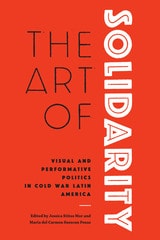
The Art of Solidarity
Visual and Performative Politics in Cold War Latin AmericaEdited by Jessica Stites Mor and Maria del Carmen Suescun Pozas
University of Texas Press, 2018
The Cold War claimed many lives and inflicted tremendous psychological pain throughout the Americas. The extreme polarization that resulted from pitting capitalism against communism held most of the creative and productive energy of the twentieth century captive. Many artists responded to Cold War struggles by engaging in activist art practice, using creative expression to mobilize social change. The Art of Solidarity examines how these creative practices in the arts and culture contributed to transnational solidarity campaigns that connected people across the Americas from the early twentieth century through the Cold War and its immediate aftermath.
This collection of original essays is divided into four chronological sections: cultural and artistic production in the pre–Cold War era that set the stage for transnational solidarity organizing; early artistic responses to the rise of Cold War polarization and state repression; the centrality of cultural and artistic production in social movements of solidarity; and solidarity activism beyond movements. Essay topics range widely across regions and social groups, from the work of lesbian activists in Mexico City in the late 1970s and 1980s, to the exchanges and transmissions of folk-music practices from Cuba to the United States, to the uses of Chilean arpilleras to oppose and protest the military dictatorship. While previous studies have focused on politically engaged artists or examined how artist communities have created solidarity movements, this book is one of the first to merge both perspectives.
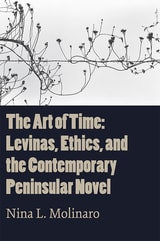
The Art of Time
Levinas, Ethics, and the Contemporary Peninsular NovelNina L. Molinaro
Bucknell University Press, 2019
Academicians and journalists in Spain and abroad have recently fastened on an emerging cluster of peninsular writers who, they argue, pertain to a discernible literary generation, provisionally referred to as Generación X. These writers are distinct from their predecessors; they and their literary texts are closely related to the specific socio-political and historical circumstances in Spain and their novels relate stories of more and less proximity, more and less responsibility, and more and less temporality. In short, they trace the temporal movement of alterity through narrative.
Published by Bucknell University Press. Distributed worldwide by Rutgers University Press.
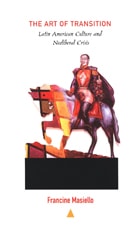
The Art of Transition
Latin American Culture and Neoliberal CrisisFrancine Masiello
Duke University Press, 2001
Masiello views representation as both a political and artistic device, concerned with the tensions between truth and lies, experience and language, and intellectuals and the marginal subjects they study and claim to defend. These often contentious negotiations, she argues, are most provocatively displayed through the spectacle of difference, which constantly crosses the literary stage, the market, and the North/South divide. While forcefully defending the ability of literature and art to advance ethical positions and to foster a critical view of neoliberalism, Masiello especially shows how issues of gender and sexuality function as integrating threads throughout this cultural project. Through discussions of visual art as well as literary work by prominent novelists and poets, Masiello sketches a broad landscape of vivid intellectual debate in the Southern Cone of Latin America.
The Art of Transition will interest Latin Americanists,literary and political theorists, art critics and historians, and those involved with the study of postmodernism and globalization.
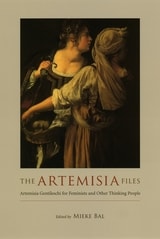
The Artemisia Files
Artemisia Gentileschi for Feminists and Other Thinking PeopleEdited by Mieke Bal
University of Chicago Press, 2005
In The Artemisia Files, Mieke Bal and her coauthors look squarely at this early icon of feminist art history and the question of her status as an artist. Considering the events that shaped her life and reputation—her relationship to her father and her role as the victim in a highly publicized rape case during which she was tortured into giving evidence—the authors make the case that Artemisia's importance is due to more than her role as a poster child in the feminist attack on traditional art history; here, Artemisia emerges more fully as a highly original artist whose work is greater than the sum of the events that have traditionally defined her.
The fresh, engaging discourse in The Artemisia Files will help to both renew the reputation of this artist on the merit of her work and establish her rightful place in the history of art.
The Artistic Censoring of Sexuality
Fantasy and Judgment in the Twentieth Century NovelSusan Mooney
The Ohio State University Press, 2008
Through the twentieth century, from colonial Ireland to the United States, and from Franco's Spain to late Soviet Russia, to include sexuality in a novel signaled social progressiveness and artistic innovation, but also transgression. Certain novelists—such as James Joyce, Vladimir Nabokov, Luis Martín-Santos, and Viktor Erofeev—radicalized the content of the novel by incorporating sexual thoughts, situations, and fantasies and thus portraying repressed areas of social, cultural, political, and mental life.
In The Artistic Censoring of Sexuality: Fantasy and Judgment in the Twentieth-Century Novel, Susan Mooney extensively examines four modernist and postmodernist novels that prompted in their day harsh external censorship because of their sexual content—Ulysses, Lolita, Time of Silence, and Russian Beauty. She shows how motifs of censorship, with all its restrictions, pressures, rules, judgments, and forms of negation, became artistically embedded in the novels' plots, characters, settings, tropes, and themes. These novels contest censorship's status quo and critically explore its processes and power. This study reveals the impact of censorship on literary creation, particularly in relation to the twentieth century's growing interest in sexuality and its discourses.
The Ascent of Affect
Genealogy and CritiqueRuth Leys
University of Chicago Press, 2017
Ruth Leys’s brilliant, much anticipated history, therefore, is a story of controversy and disagreement. The Ascent of Affect focuses on the post–World War II period, when interest in emotions as an object of study began to revive. Leys analyzes the ongoing debate over how to understand emotions, paying particular attention to the continual conflict between camps that argue for the intentionality or meaning of emotions but have trouble explaining their presence in non-human animals and those that argue for the universality of emotions but struggle when the question turns to meaning. Addressing the work of key figures from across the spectrum, considering the potentially misleading appeal of neuroscience for those working in the humanities, and bringing her story fully up to date by taking in the latest debates, Leys presents here the most thorough analysis available of how we have tried to think about how we feel.

The Ashes of Babi Yar
The Massacre of Jews in KyivAntonella Salomoni, Translated by Antony Shugaar
University of Wisconsin Press, 2025
Beginning with an explication of the mass murders and their aftermath, Antonella Salomoni examines the afterlife of a massacre whose physical remains were intentionally hidden. She focuses especially on how the arts—prose, poetry, music, architecture, and painting—shaped a collective narrative that, despite repression, played a crucial role in preserving the history and memory of the genocide.

The Asian American Avant-Garde
Universalist Aspirations in Modernist Literature and ArtAudrey Wu Clark
Temple University Press, 2015
The Asian American Avant-Garde is the first book-length study that conceptualizes a long-neglected canon of early Asian American literature and art. Audrey Wu Clark traces a genealogy of counter-universalism in short fiction, poetry, novels, and art produced by writers and artists of Asian descent who were responding to their contemporary period of Asian exclusion in the United States, between the years 1882 and 1945.
Believing in the promise of an inclusive America, these avant-gardists critiqued racism as well as institutionalized art. Clark examines racial outsiders including Isamu Noguchi, Dong Kingman and Yun Gee to show how they engaged with modernist ideas, particularly cubism. She draws comparisons between writers such as Sui Sin Far and Carlos Bulosan with modernist luminaries like Stein, Eliot, Pound, and Proust.
Acknowledging the anachronism of the term “Asian American” with respect to these avant-gardists, Clark attempts to reconstruct it. The Asian American Avant-Garde explores the ways in which these artists and writers responded to their racialization and the Orientalism that took place in modernist writing.

The Assault on Progress
Technology and Time in American LiteratureJ. Adam Johns
University of Alabama Press, 2008
A belief in progress is a fundamental ethos in American history and culture. The Assault on Progress probes American literary works that challenge the prevailing notion of technology as a manifestation of progress. J. Adam Johns argues that the idea of technology-as-destiny has long been explored—and undercut—in American literary works and that literature remains a crucial site for ongoing debates in this area.
Johns studies the phenomenon by which each generation comes to regard itself as the hinge upon which history turns. He explores several works by historians of technology, focusing in detail on the works of literary critic Lewis Mumford, whose examinations of Herman Melville’s novels provide an early example of critical interest in the abandonment of progress as a value.
He goes on to study the works of William Faulkner and Ralph Ellison, focusing on the convergence of technology and race—machines and slavery, and highlights the ways that these writers have portrayed humans as reduced to machines, evidence that technological “progress” is not always progressive, or liberating to humanity.
The conclusion argues for a shift in our understanding of the relationship between technology and time. According to Johns, writers like Melville, Faulkner, and Ellison help us to think of technology separate from notions of progress, and therefore help us to escape from a perilous ideological bind that forever situates humankind at the end of history.
The Astonishment Tapes
Talks on Poetry and Autobiography with Robin Blaser and FriendsRobin Blaser
University of Alabama Press, 2015
Robin Blaser moved from his native Idaho to attend the University of California, Berkeley, in 1944. While there, he developed as a poet, explored his homosexuality, engaged in a lively arts community, and met fellow travelers and poets Robert Duncan and Jack Spicer. The three men became the founding members of the Berkeley core of what is now known as the San Francisco Renaissance in New American Poetry.
In the company of a small group of friends and writers in 1974, Blaser was asked to narrate his personal story and to comment on the Berkeley poetry scene. In twenty autobiographical audiotapes, Blaser talks about his childhood in Idaho, his time in Berkeley, and his participation in the making of a new kind of poetry. The Astonishment Tapes is the expertly edited transcript of these recordings by Miriam Nichols, Blaser’s editor and biographer.
In The Astonishment Tapes Blaser comments extensively on the poetic principles that he, Duncan, and Spicer worked through, as well as the differences and dissonances between the three of them. Nichols has edited the transcripts only minimally, allowing readers to make their own interpretations of Blaser’s intentions.
Sometimes gossipy, sometimes profound, Blaser offers his version on the inside story of one of the most significant moments in mid-twentieth century American poetry. The Astonishment Tapes is of considerable value and interest, not only to readers of Blaser, Duncan, and Spicer, but also to scholars of the early postmodern and twentieth-century American poetry.
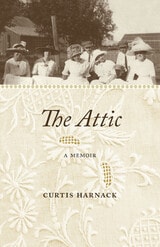
The Attic
A MemoirHarnack, Curtis
University of Iowa Press, 2011
In The Attic, his sequel to the classic We Have All Gone Away, Curtis Harnack returns to his rural Iowa homeplace to sift through an attic full of the trash and treasures left behind by the thirteen children in two generations who grew up in the big farmhouse.
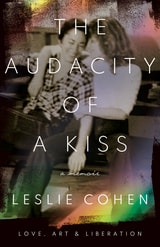
The Audacity of a Kiss
Love, Art, and LiberationLeslie Cohen
Rutgers University Press, 2021
Rendered in bronze, covered in white lacquer, two women sit together on a park bench in Greenwich Village. One of the women touches the thigh of her partner as they gaze into each other’s eyes. The two women are part of George Segal’s iconic sculpture “Gay Liberation,” but these powerful symbols were modeled on real people: Leslie Cohen and her partner (now wife) Beth Suskin.
In this evocative memoir, Cohen tells the story of a love that has lasted for over fifty years. Transporting the reader to the pivotal time when brave gay women and men carved out spaces where they could live and love freely, she recounts both her personal struggles and the accomplishments she achieved as part of New York’s gay and feminist communities. Foremost among these was her 1976 cofounding of the groundbreaking women’s nightclub Sahara, which played host to such luminaries as Betty Friedan, Gloria Steinem, Pat Benatar, Ntozake Shange, Rita Mae Brown, Adrienne Rich, Patti Smith, Bella Abzug, and Jane Fonda. The Audacity of a Kiss is a moving and inspiring tale of how love, art, and solidarity can overcome oppression.

The Author and His Publisher
Lectures Delivered in Mainz and AustinSiegfried Unseld
University of Chicago Press, 1980
Through close examination of four writers, Unseld shows how the author's personality can affect the publisher's dilemma. Hermann Hesse, by virtue of his loyalty and his desire for financial independence, enjoyed an exemplary relationship with his publishers. With Bertolt Brecht it was all confusion; with Rainer Maria Rilke, a one-author-one-publisher lifetime alliance; with Swiss poet Robert Walser, a mire of difficulties ("Each book printed," he once said, was "a grave for its author").

The Author as Hero
Self and Tradition in Bulgakov, Pasternak, and NabokovJustin Weir
Northwestern University Press, 2011
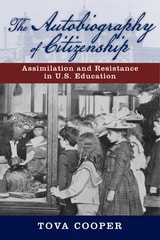
The Autobiography of Citizenship
Assimilation and Resistance in U.S. EducationCooper, Tova
Rutgers University Press, 0

The Avant-Garde and the Popular in Modern China
Tian Han and the Intersection of Performance and PoliticsLiang Luo
University of Michigan Press, 2014
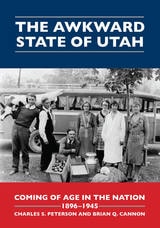
The Awkward State of Utah
Coming of Age in the Nation, 1896-1945Charles Peterson and Brian Cannon
University of Utah Press, 2015
The half century between statehood in 1896 and the end of World War II in 1945 was a period of transformation and transition for Utah. This book interprets those profound changes, revealing sweeping impacts on both institutions and ordinary people. Drawing upon expertise honed over decades of teaching, researching, and writing about Utah’s history, the authors incorporate fresh archival sources, new oral histories, and hundreds of scholarly articles and books as they narrate the little-known story of the crucial formative years when Utah came of age.
During its sometimes awkward years of adolescence and maturation, Utah was gradually incorporated into the American political, social, and economic mainstream. Urban and industrial influences supplanted agrarian traditions, displacing people socially, draining the countryside of population, and galvanizing a critical crisis in values and self-identification. National corporations and mass labor movements took root in the state as commerce expanded. Involvement in world events such as the Spanish-American War, two world wars, and the Great Depression further set the stage for entry into the modern, globalized world as Utahns immersed themselves in national politics and became part of the democratic, corporate culture of twentieth-century America.
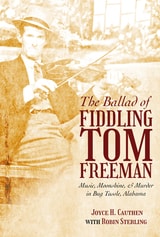
The Ballad of Fiddling Tom Freeman
Music, Moonshine, and Murder in Bug Tussle, AlabamaJoyce H. Cauthen with Robin Sterling
University of Alabama Press, 2026
A raw, firsthand account of feuds, fiddling, moonshining, and survival in a small Alabama town, told by its most colorful chronicler and shaped through careful historical insight.
The Ballad of Fiddling Tom Freeman is a riveting portrait of a forgotten America, drawn from the handwritten memoirs of a bootlegger, fiddler, and chronicler of life in Bug Tussle, Alabama, in the first half of the twentieth century. Today, rural voices are often drowned out by polished narratives, but this book resurrects the unfiltered perspective of a man who lived through—and candidly documented—the chaos and violence in his home place as he shared stories of the large close-knit families who lived there.
Freeman’s storytelling is as wild and tangled as the lives he describes, and author Joyce H. Cauthen, with the assistance of historical researcher Robin Sterling, brings clarity and context to his tales without sanding down their rough edges. The result is a vivid, bottom-up history of a place where lawlessness and loyalty often walked hand in hand.
The Ballad of Fiddling Tom Freeman stands out as a testament to the power of personal narrative. Not just a story about one man, it’s a window into a community shaped by hardship, music, and survival, told in a voice that refuses to be forgotten. This book is essential reading for historians, folklorists, musicians, and anyone drawn to the untamed stories of America’s backroads and backwoods.
The Barren Sacrifice
An Essay on Political ViolencePaul Dumouchel
Michigan State University Press, 2015
The Bars Are Ours
Histories and Cultures of Gay Bars in America,1960 and AfterLucas Hilderbrand
Duke University Press, 2024

The Basque Insurgents
ETA, 1952–1980Robert P. Clark
University of Wisconsin Press, 1984
Blamed, at first, by the Spanish government for the recent Madrid train bombings, ETA (Euzkadi ta Askatasuna), the Basque nationalist organization, has been perhaps the most violent insurgent group on the European continent. Yet little is known about it outside of Spain. This book, now back in print, offers a full analytical study of ETA.

The Battle for Guadalcanal
Samuel B. Griffith II
University of Illinois Press, 1963
Launched on August 7, 1942, to protect Allied control of the strategic South Pacific islands, the Guadalcanal operation was the most costly American offensive of World War II in the history of the U.S. Navy up to that time. Griffith, who fought with Edson's Raiders on Guadalcanal, describes in gritty detail the vicious close-range fighting, the valiant defense of the Henderson Field airstrip, and the dramatic naval engagements that led, in February 1943, to an American victory.
Drawing on American and Japanese sources, Griffith delineates the strategic decisions that shaped the conflict as well as the determination and endurance of combatants on both sides. A breathtaking narrative of military action anchored by a historian's objectivity, The Battle for Guadalcanal is a story of raw courage, desperate measures, and ultimate triumph.
The Battle for the Bs
1950s Hollywood and the Rebirth of Low-Budget CinemaDavis, Blair
Rutgers University Press, 2012
The emergence of the double-bill in the 1930s created a divide between A-pictures and B-pictures as theaters typically screened packages featuring one of each. With the former considered more prestigious because of their larger budgets and more popular actors, the lower-budgeted Bs served largely as a support mechanism to A-films of the major studios—most of which also owned the theater chains in which movies were shown. When a 1948 U.S. Supreme Court antitrust ruling severed ownership of theaters from the studios, the B-movie soon became a different entity in the wake of profound changes to the corporate organization and production methods of the major Hollywood studios.
In The Battle for the Bs, Blair Davis analyzes how B-films were produced, distributed, and exhibited in the 1950s and demonstrates the possibilities that existed for low-budget filmmaking at a time when many in Hollywood had abandoned the Bs. Made by newly formed independent companies, 1950s B-movies took advantage of changing demographic patterns to fashion innovative marketing approaches. They established such genre cycles as science fiction and teen-oriented films (think Destination Moon and I Was a Teenage Werewolf) well before the major studios and also contributed to the emergence of the movement now known as underground cinema. Although frequently proving to be multimillion-dollar box-office draws by the end of the decade, the Bs existed in opposition to the cinematic mainstream in the 1950s and created a legacy that was passed on to independent filmmakers in the decades to come.

The Battle of the Sexes in French Cinema, 1930–1956
Noël Burch and Geneviève Sellier
Duke University Press, 2013
Citing more than 300 films and providing many in-depth interpretations, Burch and Sellier argue that films made in France between 1930 and 1956 created a national imaginary that equated masculinity with French identity. They track the changing representations of masculinity, explaining how the strong patriarch who saved fallen or troubled women from themselves in prewar films gave way to the impotent, unworthy, or incapable father figure of the Occupation. After the Liberation, the patriarch reemerged as protector and provider alongside assertive women who figured as threats not only to themselves but to society as a whole.
The Beats in Mexico
David Stephen Calonne
Rutgers University Press, 2022
The first book-length study of why the Beats were so fascinated by Mexico and how they represented its culture in their work, this volume examines such canonical figures as Kerouac, Burroughs, Ginsberg, Lamantia, McClure, and Ferlinghetti. It also devotes individual chapters to women such as Margaret Randall, Bonnie Bremser, and Joanne Kyger, who each made Mexico a central setting of their work and interrogated the misogyny they encountered in both American and Mexican culture.
The Beats in Mexico not only considers individual Beat writers, but also places them within a larger history of countercultural figures, from D.H. Lawrence to Antonin Artaud to Jim Morrison, who mythologized Mexico as the land of the Aztecs and Maya, where shamanism and psychotropic drugs could take you on a trip far beyond the limits of the American imagination.
The Beautiful Music All Around Us
Field Recordings and the American ExperienceStephen Wade
University of Illinois Press, 2012
The Beautiful Music All Around Us presents the extraordinarily rich backstories of thirteen performances captured on Library of Congress field recordings between 1934 and 1942 in locations reaching from Southern Appalachia to the Mississippi Delta and the Great Plains. Including the children's play song "Shortenin' Bread," the fiddle tune "Bonaparte's Retreat," the blues "Another Man Done Gone," and the spiritual "Ain't No Grave Can Hold My Body Down," these performances were recorded in kitchens and churches, on porches and in prisons, in hotel rooms and school auditoriums. Documented during the golden age of the Library of Congress recordings, they capture not only the words and tunes of traditional songs but also the sounds of life in which the performances were embedded: children laugh, neighbors comment, trucks pass by.
Musician and researcher Stephen Wade sought out the performers on these recordings, their families, fellow musicians, and others who remembered them. He reconstructs the sights and sounds of the recording sessions themselves and how the music worked in all their lives. Some of these performers developed musical reputations beyond these field recordings, but for many, these tracks represent their only appearances on record: prisoners at the Arkansas State Penitentiary jumping on "the Library's recording machine" in a rendering of "Rock Island Line"; Ora Dell Graham being called away from the schoolyard to sing the jump-rope rhyme "Pullin' the Skiff"; Luther Strong shaking off a hungover night in jail and borrowing a fiddle to rip into "Glory in the Meetinghouse."
Alongside loving and expert profiles of these performers and their locales and communities, Wade also untangles the histories of these iconic songs and tunes, tracing them through slave songs and spirituals, British and homegrown ballads, fiddle contests, gospel quartets, and labor laments. By exploring how these singers and instrumentalists exerted their own creativity on inherited forms, "amplifying tradition's gifts," Wade shows how a single artist can make a difference within a democracy.
Reflecting decades of research and detective work, the profiles and abundant photos in The Beautiful Music All Around Us bring to life largely unheralded individuals--domestics, farm laborers, state prisoners, schoolchildren, cowboys, housewives and mothers, loggers and miners--whose music has become part of the wider American musical soundscape. The hardcover edition also includes an accompanying CD that presents these thirteen performances, songs and sounds of America in the 1930s and '40s.
The Bedquilt and Other Stories
By Dorothy Canfield FisherEdited, Intro, & Afterword by Mark J. Madigan
University of Missouri Press, 1997
Dorothy Canfield Fisher, the prolific author of more than forty books, including translations, juveniles, and nonfiction, as well as novels and short-story collections, was one of the most popular and engaging American writers of the first half of the twentieth century. Although her work has been unduly neglected for several decades, it is currently enjoying a revival of critical attention. This colorful collection ranges in subject from New Englanders to the Basques of France to the struggles of African Americans to gain equal rights. Through her stories, many of which received literary awards, Fisher examined the complexities of modern life in the United States and abroad.
In addition to her writing, Fisher had a lifelong involvement in charitable work and social causes--so much so that Eleanor Roosevelt called her one of the most influential women of her time. As one of the earliest and most assertive members of the Book-of-the-Month Club selection committee, Fisher helped define literary taste in America for more than two decades. Mark J. Madigan discusses Fisher's extraordinary life and work in an Introduction and Afterword.
Because of Fisher's rare ability to distinguish enduring concerns from merely topical issues, her work will provide lasting pleasure for generations of readers to come.

The Beginnings of Anti-Jewish Legislation
The 1920 Numerus Clausus Law in HungaryMária M. Kovács
Central European University Press, 2024
The Nazi 1933 Civil Service Law and the 1935 Nuremberg Laws are often considered the first anti-Jewish decrees in interwar Europe. Mária M. Kovács convincingly argues that Hungary’s numerus clausus law of 1920, which introduced a Jewish quota at Hungary’s institutions of higher learning, was, in fact, interwar Europe’s first antisemitic law. By defining—and discriminating against—Jews as a separate “racial” or “national” group, it abrogated the principle of equal rights that had been enshrined into law; as such, it marked an abrupt reversal of Jewish emancipation in Hungary. Moreover, the numerus clausus law set the stage for subsequent “Jewish Laws” (in the late 1930s and early 1940s) that sought to solve Hungary’s “Jewish Question” by means of extraordinary legal measures that targeted Jews alone. This book examines the origins and implementation of the numerus clausus, as well as the attempts to dampen its impact on Hungary’s international reputation, focusing on the debates surrounding it promulgation (1920), its modification (1928) and its eventual application to other areas of Jewish life (1938–45).
The Benderly Boys and American Jewish Education
Jonathan B. Krasner
Brandeis University Press, 2011
The Best I Recall
A MemoirBy Gary Cartwright
University of Texas Press, 2015
Gary Cartwright is one of Texas’s legendary writers. In a career spanning nearly six decades, he has been a newspaper reporter, Senior Editor of Texas Monthly, and author of several acclaimed books, including Blood Will Tell, Confessions of a Washed-up Sportswriter, and Dirty Dealing. Cartwright was a finalist for a National Magazine Award for reporting excellence, and he has won several awards from the Texas Institute of Letters, including its most prestigious—the Lon Tinkle Award for lifetime achievement. His personal life has been as colorful and occasionally outrageous as any story he reported, and in this vivid, often hilarious, and sometimes deeply moving memoir, Cartwright tells the story of his writing career, tangled like a runaway vine with great friendships, love affairs, four marriages, four or five great dogs . . . looking always to explain, at least to himself, how the pattern probably makes a kind of perverted sense.
Cartwright’s career began at the Fort Worth Star-Telegram and Fort Worth Press, among kindred spirits and fellow pranksters Edwin “Bud” Shrake and Dan Jenkins. He describes how the three rookie writers followed their mentor Blackie Sherrod to the Dallas Times Herald and the Dallas Morning News, becoming the “best staff of sportswriters anywhere, ever” and creating a new kind of sportswriting that “swept the country and became standard.” Cartwright recalls his twenty-five years at Texas Monthly, where he covered everything from true crime to notable Texans to Texas’s cultural oddities. Along the way, he tells lively stories about “rebelling against sobriety” in many forms, with friends and co-conspirators that included Willie Nelson, Ann Richards, Dennis Hopper, Willie Morris, Don Meredith, Jack Ruby, and countless others. A remarkable portrait of the writing life and Austin’s counterculture, The Best I Recall may skirt the line between fact and fiction, but it always tells the truth.
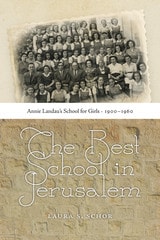
The Best School in Jerusalem
Annie Landau’s School for Girls, 1900–1960Laura S. Schor
Brandeis University Press, 2013
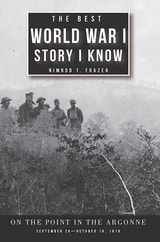
The Best World War I Story I Know
On the Point in the Argonne, September 26–October 16, 1918Nimrod T. Frazer
University of Alabama Press, 2018
The Best World War I Story I Know: On the Point in the Argonne is the breath-taking story of three US Army divisions tasked with capturing the Côte de Châtillon during the Meuse-Argonne offensive in autumn 1918. Readers will first follow in the footsteps of Missouri-Kansas Guard troops who were repulsed in the opening days of the battle; their courage in the face of heavy fire was not enough to overcome poor leadership.
They were replaced by the 1st Division, the “best of the Regular Army.” This fine unit became physically and mentally exhausted after suffering horrendous casualties. Unable to fight on, “The Big Red One” was exchanged at the base of Côte de Châtillon, with the 42nd, the Rainbow Division. It too struggled to gain ground on the heavily-contested hill until General Douglas MacArthur’s determined 84th Brigade of “Alabama cotton pickers and Iowa corn growers” forced their way past the Germans. The Côte was finally in American hands and the war all but over.

The Big Empty
The Great Plains in the Twentieth CenturyR. Douglas Hurt
University of Arizona Press, 2011
Using the voices of women homesteaders, agrarian socialists, Jewish farmers, Mexican meatpackers, New Dealers, and Native Americans, this book creates a sweeping survey of contested race relations, radical politics, and agricultural prosperity and decline during the twentieth century. This narrative shows that even though Great Plains history is fraught with personal and group tensions, violence, and distress, the twentieth century also brought about compelling social, economic, and political change.
The only book of its kind, this account will be of interest to historians studying the region and to anyone inspired by the story of the men and women who found an opportunity for a better life in the Great Plains.

The Big Leagues Go to Washington
Congress and Sports Antitrust, 1951-1989David George Surdam
University of Illinois Press, 2015
In The Big Leagues Go to Washington, David Surdam chronicles the key issues that arose during the hearings and the ways opposing sides used economic data and theory to define what was right, what was feasible, and what was advantageous to one party or another. As Surdam shows, the hearings affected matters as fundamental to the modern game as broadcasting rights, player drafts and unions, league mergers, and the dominance of the New York Yankees. He also charts how lawmakers from the West and South pressed for the relocation of ailing franchises to their states and the ways savvy owners dodged congressional interference when they could and adapted to it when necessary.
The Big Question
David Lehman
University of Michigan Press, 1995
The Big Question leads off with a major essay explaining and exploring the concept of postmodernism. The next sections include pieces about poetry and fiction, lives and letters, and criticism and controversy.
Other "big questions" addressed include political correctness, the genre of literary biography, academic life and deconstruction. There is a humorous piece on poetry "slams" and the whole "downtown" poetry scene, a feisty op-ed column (on the deconstruction of the Gettysburg Address), a pair of wickedly satirical poems, as well as a group of exceptional book reviews.
The subjects covered range from Philip Larkin to Philip Roth- from the greatest poetry hoax of the twentieth century (which took place in Australia during World War II) to Charles Dickens's unfinished last novel- and from nineteenthth-century American poetry to the political career of Martin Heidegger.
David Lehman is a poet and author of Signs of the Times: Deconstruction and the Fall of Paul de Man. He is series editor of the celebrated Best American Poetry anthology.
The Bilingual Muse
Self-Translation among Russian PoetsAdrian Wanner
Northwestern University Press, 2020
The Bilingual Muse analyzes the work of seven Russian poets who translated their own poems into English, French, German, or Italian. Investigating the parallel versions of self-translated poetic texts by Vladimir Nabokov, Joseph Brodsky, Andrey Gritsman, Katia Kapovich, Marina Tsvetaeva, Wassily Kandinsky, and Elizaveta Kul’man, Adrian Wanner considers how verbal creativity functions in different languages, the conundrum of translation, and the vagaries of bilingual identities.
Wanner argues that the perceived marginality of self-translation stems from a romantic privileging of the mother tongue and the original text. The unprecedented recent dispersion of Russian speakers over three continents has led to the emergence of a new generation of diasporic Russians who provide a more receptive milieu for multilingual creativity.
The Birth of Theater from the Spirit of Philosophy
Nietzsche and the Modern DramaDavid Kornhaber
Northwestern University Press, 2016
The Birth of Whiteness
Race and the Emergence of United States CinemaEdited by Daniel Leonard Bernardi
Rutgers University Press, 1996
As indelible components of the history of the United States, race and racism have permeated nearly all aspects of life: cultural, economic, political, and social. In this first anthology on race in early cinema, fourteen scholars examine the origins, dynamics, and ramifications of racism and Eurocentrism and the resistance to both during the early years of American motion pictures. Any discussion of racial themes and practices in any arena inevitably begins with the definition of race. Is race an innate and biologically determined "essence" or is it a culturally constructed category? Is the question irrelevant? Perhaps race exists as an ever-changing historical and social formation that, regardless of any standard definition, involves exploitation, degradation, and struggle. In his introduction, Daniel Bernardi writes that "early cinema has been a clear partner in the hegemonic struggle over the meaning of race" and that it was steadfastly aligned with a Eurocentric world view at the expense of those who didn't count as white.
The contributors to this work tackle these problems and address such subjects as biological determinism, miscegenation, Manifest Destiny, assimilation, and nativism and their impact on early cinema. Analyses of The Birth of a Nation, Romona, Nanook of the North and Madame Butterfly and the directorial styles of D. W. Griffith, Oscar Micheaux, and Edwin Porter are included in the volume.

The Bitterroot and Mr. Brandborg
Clearcutting and the Struggle for Sustainable Forestry in the Northern RockiesFrederick H. Swanson
University of Utah Press, 2011
Winner of the Wallace Stegner Prize in American Environmental or Western History
Fredrick Swanson tells the story of Guy M. Brandborg and his impact on the practices of the U.S. Forest Service. As supervisor of Montana’s Bitterroot National Forest from 1935 to 1955, Brandborg engaged in a management style that promoted not only the well-being of the forest community but also the social and economic welfare of the local people. By relying on selective cutting, his goal was to protect the watersheds and wildlife habitats that are devastated by clear-cutting, and to prevent the job losses that follow such practices. Following his retirement, he became concerned that his agency was deviating from the practice of sustained-yield management of the forest’s timber lands, and led a highly visible public outcry that became known as the Bitterroot controversy. Brandborg’s behind-the-scenes lobbying contributed materially to the passage of the National Forest Management Act of 1976, the single most important law affecting public forestry since the creation of the Forest Service.
Winner of the Western Writers of America Spur Award for Best Western Nonfiction-Contemporary.

The Black Arts Enterprise and the Production of African American Poetry
Howard Rambsy II
University of Michigan Press, 2013
The outpouring of creative expression known as the Black Arts Movement of the 1960s and 1970s spawned a burgeoning number of black-owned cultural outlets, including publishing houses, performance spaces, and galleries. Central to the movement were its poets, who in concert with editors, visual artists, critics, and fellow writers published a wide range of black verse and advanced new theories and critical approaches for understanding African American literary art.
The Black Arts Enterprise and the Production of African American Poetry offers a close examination of the literary culture in which BAM's poets (including Amiri Baraka, Nikki Giovanni, Sonia Sanchez, Larry Neal, Haki Madhubuti, Carolyn Rodgers, and others) operated and of the small presses and literary anthologies that first published the movement's authors. The book also describes the role of the Black Arts Movement in reintroducing readers to poets such as Langston Hughes, Robert Hayden, Margaret Walker, and Phillis Wheatley.
Focusing on the material production of Black Arts poetry, the book combines genetic criticism with cultural history to shed new light on the period, its publishing culture, and the writing and editing practices of its participants. Howard Rambsy II demonstrates how significant circulation and format of black poetic texts—not simply their content—were to the formation of an artistic movement. The book goes on to examine other significant influences on the formation of Black Arts discourse, including such factors as an emerging nationalist ideology and figures such as John Coltrane and Malcolm X.
The Black Butterfly
Brazilian Slavery and the Literary ImaginationMarcus Wood
West Virginia University Press, 2019
The Black Butterfly focuses on the slavery writings of three of Brazil’s literary giants—Machado de Assis, Castro Alves, and Euclides da Cunha. These authors wrote in the late nineteenth and early twentieth centuries, as Brazil moved into and then through the 1888 abolition of slavery. Assis was Brazil’s most experimental novelist; Alves was a Romantic poet with passionate liberationist politics, popularly known as “the poet of the slaves”; and da Cunha is known for the masterpiece Os Sertões (The Backlands), a work of genius that remains strangely neglected in the scholarship of transatlantic slavery.
Wood finds that all three writers responded to the memory of slavery in ways that departed from their counterparts in Europe and North America, where emancipation has typically been depicted as a moment of closure. He ends by setting up a wider literary context for his core authors by introducing a comparative study of their great literary abolitionist predecessors Luís Gonzaga Pinto da Gama and Joaquim Nabuco. The Black Butterfly is a revolutionary text that insists Brazilian culture has always refused a clean break between slavery and its aftermath. Brazilian slavery thus emerges as a living legacy subject to continual renegotiation and reinvention.
The Black Chicago Renaissance
Edited by Darlene Clark Hine and John McCluskey Jr.
University of Illinois Press, 2012
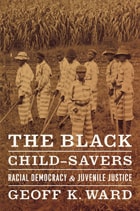
The Black Child-Savers
Racial Democracy and Juvenile JusticeGeoff K. Ward
University of Chicago Press, 2012
At once an inspiring story about the shifting boundaries of race, citizenship, and democracy in America and a crucial look at the nature of racial inequality, The Black Child Savers is a stirring account of the stakes and meaning of social justice.
The Black Intellectual Tradition
African American Thought in the Twentieth CenturyEdited by Derrick P. Alridge, Cornelius L. Bynum, and James B. Stewart
University of Illinois Press, 2021
From 1900 to the present, people of African descent living in the United States have drawn on homegrown and diasporic minds to create a Black intellectual tradition engaged with ideas on race, racial oppression, and the world. This volume presents essays on the diverse thought behind the fight for racial justice as developed by African American artists and intellectuals; performers and protest activists; institutions and organizations; and educators and religious leaders. By including both women’s and men’s perspectives from the U.S. and the Diaspora, the essays explore the full landscape of the Black intellectual tradition. Throughout, contributors engage with important ideas ranging from the consideration of gender within the tradition, to intellectual products generated outside the intelligentsia, to the ongoing relationship between thought and concrete effort in the quest for liberation.
Expansive in scope and interdisciplinary in practice, The Black Intellectual Tradition delves into the ideas that animated a people’s striving for full participation in American life.
Contributors: Derrick P. Alridge, Keisha N. Blain, Cornelius L. Bynum, Jeffrey Lamar Coleman, Pero Gaglo Dagbovie, Stephanie Y. Evans, Aaron David Gresson III, Claudrena N. Harold, Leonard Harris, Maurice J. Hobson, La TaSha B. Levy, Layli Maparyan, Zebulon V. Miletsky, R. Baxter Miller, Edward Onaci, Venetria K. Patton, James B. Stewart, and Nikki M. Taylor
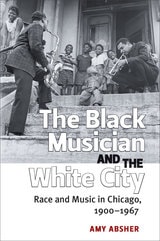
The Black Musician and the White City
Race and Music in Chicago, 1900-1967Amy Absher
University of Michigan Press, 2014
Absher’s work diverges from existing studies in three ways: First, she takes the history beyond the study of jazz and blues by examining the significant role that classically trained black musicians played in building the Chicago South Side community. By acknowledging the presence and importance of classical musicians, Absher argues that black migrants in Chicago had diverse education and economic backgrounds but found common cause in the city’s music community. Second, Absher brings numerous maps to the history, illustrating the relationship between Chicago’s physical lines of segregation and the geography of black music in the city over the years. Third, Absher’s use of archival sources is both extensive and original, drawing on manuscript and oral history collections at the Center for Black Music Research in Chicago, Columbia University, Rutgers’s Institute of Jazz Studies, and Tulane’s Hogan Jazz Archive. By approaching the Chicago black musical community from these previously untapped angles, Absher offers a history that goes beyond the retelling of the achievements of the famous musicians by discussing musicians as a group. In The Black Musician and the White City, black musicians are the leading actors, thinkers, organizers, and critics of their own story.
The Black Pacific Narrative
Geographic Imaginings of Race and Empire between the World WarsEtsuko Taketani
Dartmouth College Press, 2014