Results by title
1272 books match the query 'Asia' and 289 start with t
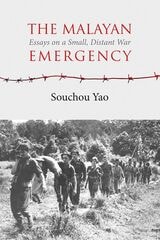
The Malayan Emergency
Essays on a Small, Distant WarSouchou Yao
National University of Singapore Press, 2016

The Man Who Stayed Behind
Sidney Rittenberg and Amanda Bennett
Duke University Press, 2001
Both a memoir and a documentary history of the Chinese revolution from 1949 through the Cultural Revolution, The Man Who Stayed Behind provides a human perspective on China’s efforts to build a new society. Critical of both his own mistakes and those of the Communist leadership, Rittenberg nevertheless gives an even-handed account of a country that is now free of internal war for the first time in a hundred years.
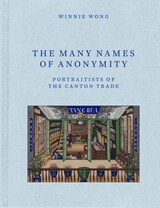
The Many Names of Anonymity
Portraitists of the Canton TradeWinnie Wong
University of Chicago Press, 2025
Challenging contemporary procedures for establishing attribution, chronology, and authenticity in Chinese art, Winnie Wong explores the means, methods, and stakes of recovering the names of an anonymous community of artists. To examine how Western art history has misconstrued and miscategorized names and identities in Chinese art, she looks to conflicting features of modernity: the European attachment of singular names to individuals and their works, and the Chinese use of socially contingent names that often are not attached to material labor and sometimes operate against it. Wong charts the genealogy of this naming problem by bringing to life the artists of the Qing Empire’s trade with Europeans at the port of Guangzhou, centering on a group of portraitists known by names that were recorded in a pidgin language: Chin Qua, Chit Qua, Spoilum, Lam Qua, and Ting Qua.
Many of these paintings survive today, yet scholars have identified only a handful of the painters’ identities. Pushing against Western norms that have shaped our understanding of authorship, Wong reveals that these artists shared names, created works in multiples, and signed their pieces with different names or none at all. This lavishly illustrated volume explores portraiture across media, including unfired clay, reverse painting on glass, watercolor on paper, oil on canvas, and the daguerreotype, to propose new ways of studying anonymity, copying, and the emergence of author names in the Sino-European visual culture of the long eighteenth century.
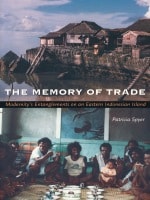
The Memory of Trade
Modernity's Entanglements on an Eastern Indonesian IslandPatricia Spyer
Duke University Press, 2000
Drawing on more than two years of archival and ethnographic research, Spyer examines the dynamics of contact with the Dutch and Europeans, Suharto’s postcolonial regime, and with the competing religions of Islam, Protestantism, and Catholicism in the context of the recent conversion of pagan Aruese. While arguing that Aru identity and community are defined largely in terms of absence, longing, memory, and desire, she also incorporates present-day realities—such as the ecological destruction wrought by the Aru trade in such luxury goods as pearls and shark fins—without overlooking the mystique and ritual surrounding these activities. Imprinted on the one hand by the archipelago’s long engagement with extended networks of commerce and communication and, on the other, by modernity’s characteristic repressions and displacements, Aruese make and manage their lives somewhat precariously within what they often seem to construe as a dangerously expanding—if still enticing—world. By documenting not only the particular expectations and strategies Aruese have developed in dealing with this larger world but also the price they pay for participation therein, The Memory of Trade speaks to problems commonly faced elsewhere in the frontier spaces of modern nation-states.
Balancing particularly astute analysis with classic ethnography, The Memory of Trade will appeal not only to anthropologists and historians but also to students and specialists of Southeast Asia, modernity, and globalization.
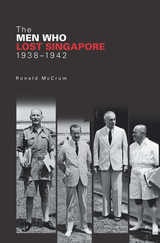
The Men Who Lost Singapore, 1938-1942
Ronald McCrum
National University of Singapore Press, 2017
In The Men Who Lost Singapore, McCrum closely examines the role and responsibilities of the colonial authorities before and during the war. He argues that the poor and occasionally hostile relations that developed between the local government and the British military hierarchy prevented the development and implementation of a strategic and unified plan of defense against the growing threat of the Japanese. Consequently, this indecisive and ineffective leadership led to significant losses and civilian casualties that could have been prevented.
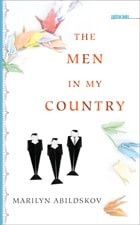
The Men in My Country
Marilyn Abildskov
University of Iowa Press, 2004
The Men in My Country is the story of an American woman living and loving in Japan. Satisfied at first to observe her exotic surroundings, the woman falls in love with the place, with the light, with the curve of a river, with the smell of bonfires during obon, with blue and white porcelain dishes, with pencil boxes, and with small origami birds. Later, struggling for a deeper connection—“I wanted the country under my skin”—Abildskov meets the three men who will be part of her transformation and the one man with whom she will fall deeply in love.
A travel memoir offering an artful depiction of a very real place, The Men in My Country also covers the terrain of a complex emotional journey, tracing a geography of the heart, showing how we move to be moved, how in losing ourselves in a foreign place we can become dangerously—and gloriously—undone.
The Mertiyo Rathors of Merto, Rajasthan
Select Translations Bearing on the History of a Rajput Family, 1462–1660, Volumes 1–2Richard Saran and Norman P. Ziegler, translators and annotators
University of Michigan Press, 2001
The Music of Stones
Sohail Hashmi
Seagull Books, 2025
In The Music of Stones, Sohail Hashmi delves into the intricate history and misconceptions surrounding Islamic architecture and culture. Challenging colonial and orientalist narratives, Hashmi reveals that iconic elements like domes and minarets were not originally part of early Islamic structures but later additions influenced by various cultures, primarily Persian and Turkish. Through engaging anecdotes and thought-provoking theories, Hashmi deconstructs the monolithic view of Islamic culture, emphasizing its rich and diverse heritage shaped by Sufi, Central Asian, and other regional influences. He highlights the importance of historical context and the dangers of oversimplifying complex cultural identities.
The Music of Stones invites readers to reconsider the architectural and cultural legacy of Islam, advocating for a more inclusive and evidence-based understanding that transcends reductive labels and celebrates the richness of its diverse traditions.
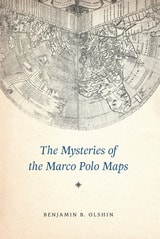
The Mysteries of the Marco Polo Maps
Benjamin B. Olshin
University of Chicago Press, 2014
In The Mysteries of the Marco Polo Maps, historian of cartography Benjamin B. Olshin offers the first credible book-length analysis of these artifacts, charting their course from obscure origins in the private collection of Italian-American immigrant Marcian Rossi in the 1930s; to investigations of their authenticity by the Library of Congress, J. Edgar Hoover, and the FBI; to the work of the late cartographic scholar Leo Bagrow; to Olshin’s own efforts to track down and study the Rossi maps, all but one of which are in the possession of Rossi’s great-grandson Jeffrey Pendergraft. Are the maps forgeries, facsimiles, or modernized copies? Did Marco Polo’s daughters—whose names appear on several of the artifacts—preserve in them geographic information about Asia first recorded by their father? Or did they inherit maps created by him? Did Marco Polo entrust the maps to Admiral Ruggero Sanseverino, who has links to Rossi’s family line? Or, if the maps have no connection to Marco Polo, who made them, when, and why?
Regardless of the maps’ provenance, Olshin’s tale—stretching from the remote reaches of the northern Pacific to early Chinese legends—takes readers on a journey confounding yet fascinating, offering insights into Italian history, the age of exploration, and the wonders of cartography.
The Nation's Tortured Body
Violence, Representation, and the Formation of a Sikh "Diaspora"Brian Keith Axel
Duke University Press, 2001
Based on ethnographic and archival research conducted by Axel at several sites in India, England, and the United States, the text delineates a theoretical trajectory for thinking about the proliferation of diaspora studies and area studies in America and England. After discussing this trajectory in relation to the colonial and postcolonial movement of Sikhs, Axel analyzes the production and circulation of images of Sikhs around the world, beginning with visual representations of Maharaja Duleep Singh, the last Sikh ruler of Punjab, who died in 1893. He argues that imagery of particular male Sikh bodies has situated—at different times and in different ways—points of mediation between various populations of Sikhs around the world. Most crucially, he describes the torture of Sikhs by Indian police between 1983 and the present and discusses the images of tortured Sikh bodies that have been circulating on the Internet since 1996. Finally, he returns to questions of the homeland, reflecting on what the issues discussed in The Nation's Tortured Body might mean for the ongoing fight for Khalistan.
Specialists in anthropology, history, cultural studies, diaspora studies, and Sikh studies will find much of interest in this important work.
The Neighborhood of Gods
The Sacred and the Visible at the Margins of MumbaiWilliam Elison
University of Chicago Press, 2018
The Neighborhood of Gods explores this question, bringing an ethnographic lens to a range of visual and spatial practices: from the shrine construction that encroaches on downtown streets, to the “tribal art” practices of an indigenous group facing displacement, to the work of image production at two Bollywood film studios. A pioneering ethnography, this book offers a creative intervention in debates on postcolonial citizenship, urban geography, and visuality in the religions of India.
The Neighborhood
Space, State, and Daily Life in a Manchurian CityNianshen Song
University of Chicago Press, 2025
What can one neighborhood reveal about the making of a modern nation? The Neighborhood deciphers the unexpected significance of Xita, a half-square-mile quarter in Shenyang, in Northeast China. As the historian Nianshen Song shows, over nearly four centuries, Xita has been shaped and reshaped by empire, war, migration, and urban transformation. Remarkably, the history of this small area mirrors large-scale changes, including and especially China’s metamorphosis from a multiethnic Eurasian empire to a postindustrial society.
Song begins with Xita’s origins as a Qing-era Tibetan Buddhist center, following the lives of Mongol lamas and their imperial patrons. He tracks the neighborhood through the tumultuous twentieth century, when competing Russian and Japanese railway empires fueled its industrial growth, and Japanese colonizers turned it into a showcase for their imperial ambitions. Later, Xita became a vital enclave for Korea’s diaspora before emerging in the post-Mao era as a neon-lit hub of commerce and entertainment.
A thoroughly researched microhistory, The Neighborhood reveals how global forces play out in everyday spaces. By studying the emperors, warlords, merchants, laborers, and migrants who shaped Xita, Song presents a captivating and original perspective for understanding China’s past—not from the top down, but through the streets and people who lived it.
The New Asian City
Three-Dimensional Fictions of Space and Urban FormJini Kim Watson
University of Minnesota Press, 2011
Under Jini Kim Watson’s scrutiny, the Asian Tiger metropolises of Seoul, Taipei, and Singapore reveal a surprising residue of the colonial environment. Drawing on a wide array of literary, filmic, and political works, and juxtaposing close readings of the built environment, Watson demonstrates how processes of migration and construction in the hypergrowth urbanscapes of the Pacific Rim crystallize the psychic and political dramas of their colonized past and globalized present.
Examining how newly constructed spaces—including expressways, high-rises, factory zones, department stores, and government buildings—become figured within fictional and political texts uncovers how massive transformations of citizenries and cities were rationalized, perceived, and fictionalized. Watson shows how literature, film, and poetry have described and challenged contemporary Asian metropolises, especially around the formation of gendered and laboring subjects in these new spaces. She suggests that by embracing the postwar growth-at-any-cost imperative, they have buttressed the nationalist enterprise along neocolonial lines.
The New Asian City provides an innovative approach to how we might better understand the gleaming metropolises of the Pacific Rim. In doing so, it demonstrates how reading cultural production in conjunction with built environments can enrich our knowledge of the lived consequences of rapid economic and urban development.
The New Asian Immigration in Los Angeles and Global Restructuring
Paul Ong
Temple University Press, 1994

The New World of Southeast Asia
Lennox A. Mills
University of Minnesota Press, 1949
The New World of Southeast Asia was first published in 1949. Minnesota Archive Editions uses digital technology to make long-unavailable books once again accessible, and are published unaltered from the original University of Minnesota Press editions.
The News Event
Popular Sovereignty in the Age of Deep MediatizationFrancis Cody
University of Chicago Press, 2023
Not merely the act of representing events with words or images, a “news event” is the reciprocal relationship between the events being reported in the news and the event of the news coverage itself. In The News Event, Francis Cody focuses on how imaginaries of popular sovereignty have been remade through the production and experience of such events. Political sovereignty is thoroughly mediated by the production of news, and subjects invested in the idea of democracy are remarkably reflexive about the role of publicly circulating images and texts in the very constitution of their subjectivity. The law comes to stand as both a limit and positive condition in this process of event making, where acts of legal and extralegal repression of publication can also become the stuff of news about news makers. When the subjects of news inhabit multiple participant roles in the unfolding of public events, when the very technologies of recording and circulating events themselves become news, the act of representing a political event becomes difficult to disentangle from that of participating in it. This, Cody argues, is the crisis of contemporary news making: the news can no longer claim exteriority to the world on which it reports.
The Occupied Clinic
Militarism and Care in KashmirSaiba Varma
Duke University Press, 2020
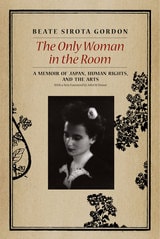
The Only Woman in the Room
A Memoir of Japan, Human Rights, and the ArtsBeate Sirota Gordon
University of Chicago Press, 2014
Sirota was born in Vienna, but in 1929 her family moved to Japan so that her father, a noted pianist, could teach, and she grew up speaking German, English, and Japanese. Russian, French, Italian, Latin, and Hebrew followed, and at fifteen Sirota was sent to complete her education at Mills College in California. The formal declaration of World War II cut Gordon off from her parents, and she supported herself by working for a CBS listening post in San Francisco that would eventually become part of the FCC. Translating was one of Sirota’s many talents, and when the war ended, she was sent to Japan as a language expert to help the American occupation forces. When General MacArthur suddenly created a team that included Sirota to draft the new Japanese Constitution, he gave them just eight days to accomplish the task. Colonel Roest said to Beate Sirota, “You’re a woman, why don’t you write the women’s rights section?”; and she seized the opportunity to write into law guarantees of equality unparalleled in the US Constitution to this day.
But this was only one episode in an extraordinary life, and when Gordon died in December 2012, words of grief and praise poured from artists, humanitarians, and thinkers the world over. Illustrated with forty-seven photographs, The Only Woman in the Room captures two cultures at a critical moment in history and recounts, after a fifty-year silence, a life lived with purpose and courage. This edition contains a new afterword by Nicole A. Gordon and an elegy by Geoffrey Paul Gordon.
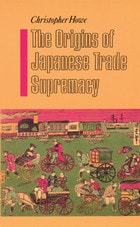
The Origins of Japanese Trade Supremacy
Development and Technology in Asia from 1540 to the Pacific WarChristopher Howe
University of Chicago Press, 1996
"Thoughtful, well-organized, and lucidly written and reflects many years of painstaking research in different literatures."—Business Horizons
"The best analysis yet in English of the role of technology in Japan's emergence as a global economic power."—David J. Jeremy, Technology and Culture
"An important addition to Japanese economic history and the concept of creating relative advantage in trade."—Richard Rice, Journal of Asian Studies
"No other work in English approaches Christopher Howe's combination of a sweeping historical perspective with a comprehensive yet in-depth analysis of factors underlying Japan's pre-1940 economic 'miracle.' . . . [An] illuminating study."—Steven J. Ericson, American Historical Review
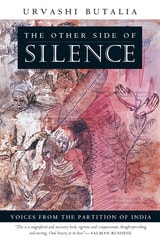
The Other Side of Silence
Voices from the Partition of IndiaUrvashi Butalia
Duke University Press, 2000
Through interviews conducted over a ten-year period and an examination of diaries, letters, memoirs, and parliamentary documents, Butalia asks how people on the margins of history—children, women, ordinary people, the lower castes, the untouchables—have been affected by this upheaval. To understand how and why certain events become shrouded in silence, she traces facets of her own poignant and partition-scarred family history before investigating the stories of other people and their experiences of the effects of this violent disruption. Those whom she interviews reveal that, at least in private, the voices of partition have not been stilled and the bitterness remains. Throughout, Butalia reflects on difficult questions: what did community, caste, and gender have to do with the violence that accompanied partition? What was partition meant to achieve and what did it actually achieve? How, through unspeakable horrors, did the survivors go on? Believing that only by remembering and telling their stories can those affected begin the process of healing and forgetting, Butalia presents a sensitive and moving account of her quest to hear the painful truth behind the silence.
The Patchwork City
Class, Space, and Politics in Metro ManilaMarco Z. Garrido
University of Chicago Press, 2019
The Patchwork City illuminates how segregation, class relations, and democracy are all intensely connected. It makes clear, ultimately, that class as a social structure is as indispensable to the study of Manila—and of many other cities of the Global South—as race is to the study of American cities.
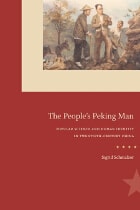
The People's Peking Man
Popular Science and Human Identity in Twentieth-Century ChinaSigrid Schmalzer
University of Chicago Press, 2008
The People’s Peking Man is a skilled social history of twentieth-century Chinese paleoanthropology and a compelling cultural—and at times comparative—history of assumptions and debates about what it means to be human. By focusing on issues that push against the boundaries of science and politics, The People’s Peking Man offers an innovative approach to modern Chinese history and the history of science.
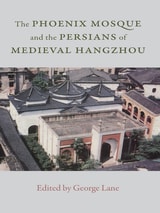
The Phoenix Mosque and the Persians of Medieval Hangzhou
Edited by George Lane
Gingko, 2018

The Pliant Public
Ideology and Public Opinion in ChinaJason Y. Wu
University of Michigan Press, 2027
The Chinese Communist Party has long depended on ideology to set the agenda, communicate its priorities, and legitimize its rule. The Pliant Public argues that for Chinese citizens, however, ideology is in short supply. Surveys show that public opinion is depolarized. Ordinary people have little sense of what ideological labels like “left” and “right” mean, and most of the people who put themselves on the right have the scale backwards. Since a depolarized public is ill-equipped to check the state, China’s leaders can make massive changes to government policy without triggering much backlash.
But depolarization does not always strengthen the state. When citizens lack clear ideological commitments, it is easier for them to set aside their differences. If China’s leaders lost their performance legitimacy, then depolarization could facilitate a broader challenge to party rule.
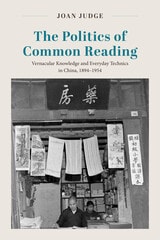
The Politics of Common Reading
Vernacular Knowledge and Everyday Technics in China, 1894–1954Joan Judge
University of Chicago Press, 2025
Examines the transformation of vernacular knowledge during a pivotal period of modern Chinese history, 1894 to 1954.
What did common readers read in the midst of the revolutions that punctuated China’s long Republic (1894–1954)? How did they manage the often-unprecedented challenges of the era? What did they know and how did they know it?
In The Politics of Common Reading, Joan Judge traces the unfolding of a consequential politics of accommodation that engaged commoners as knowers rather than as an unenlightened mass. A response to the institutional failures of the era, this politics was enacted through an informal knowledge infrastructure comprised of low-budget publishers, rustic bookstalls, and a piecemeal national network. As yet unstudied, this infrastructure produced and circulated up to ten times the number of books as official, mainstream channels.
A corpus of some five hundred of these cheap collections of recipes and techniques serves as the basis for this book. Judge focuses on four challenges common readers faced: how to cure an opium addiction, avoid an electric shock, prevent a cholera infection, and graft a plant. She further draws on government, archival, periodical, and fiction materials in devising composites of individual common readers so that we can better know them: details of the crises they faced, the remedies they tried, and the knowledge they relied on as they decocted cures and applied technologies. She argues that the acts of conciliation and assemblage these readers engaged in shaped the broader epistemic terrain from which historical change was actualized in China’s century of revolution.
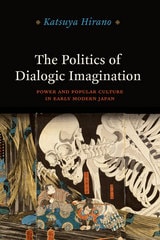
The Politics of Dialogic Imagination
Power and Popular Culture in Early Modern JapanKatsuya Hirano
University of Chicago Press, 2013
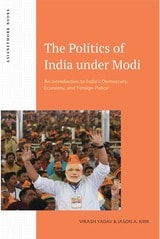
The Politics of India under Modi
An Introduction to India’s Democracy, Economy, and Foreign PolicyVikash Yadav and Jason A. Kirk
Lever Press, 2023
Since the right-wing, Hindu-nationalist government of Narendra Modi’s Bharatiya Janata Party (BJP) came to power at the national level in 2014, and with its consolidation of power in the 2019 general election, India has witnessed a significant realignment of its national politics and a shift toward the right of the political spectrum. The Politics of India under Modi provides a detailed overview of India’s political trends, economic prospects, and international relations in the twenty-first century.
This book is designed as a supplement and update for existing syllabi that trace India’s political economy from the birth of the republic to the quest for economic liberalization and great power status. Undergraduates and scholars interested in India’s foreign policy and political reform will find value in this timely book.
“The subject of this book is extremely compelling and important, as well as timely. BJP rule and the Modi regime, it is now clear, represent some critical turning points in Indian politics, which have yet to be analyzed in depth academically by experts. I see this book as a key first step in this process.”
-Rina Verma Williams, School of Public and International Affairs at the University of Cincinnati
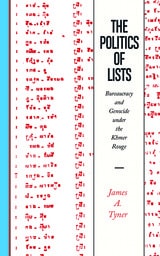
The Politics of Lists
Bureaucracy and Genocide under the Khmer RougeJames A. Tyner
West Virginia University Press, 2018
2019 Julian Minghi Distinguished Book Award winner
Scholars from a number of disciplines have, especially since the advent of the war on terror, developed critical perspectives on a cluster of related topics in contemporary life: militarization, surveillance, policing, biopolitics (the relation between state power and physical bodies), and the like. James A. Tyner, a geographer who has contributed to this literature with several highly regarded books, here turns to the bureaucratic roots of genocide, building on insight from Hannah Arendt, Zygmunt Bauman, and others to better understand the Khmer Rouge and its implications for the broader study of life, death, and power.
The Politics of Lists analyzes thousands of newly available Cambodian documents both as sources of information and as objects worthy of study in and of themselves. How, Tyner asks, is recordkeeping implicated in the creation of political authority? What is the relationship between violence and bureaucracy? How can documents, as an anonymous technology capable of conveying great force, be understood in relation to newer technologies like drones? What does data create and what does it destroy? Through a theoretically informed, empirically grounded study of the Khmer Rouge security apparatus, Tyner shows that lists and telegrams have often proved as deadly as bullet and bombs.
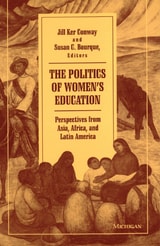
The Politics of Women's Education
Perspectives from Asia, Africa, and Latin AmericaJill Ker Conway and Susan C. Bourque, Editors
University of Michigan Press, 1995
The Politics of the Malayan Communist Party from 1930 to 1948
David Lockwood
National University of Singapore Press, 2024
By 1946, the Malayan Communist Party (MCP) had become one of the most successful communist parties in Asia. From its foundation in 1930, it had built up a membership in the thousands, mainly among Chinese and Indian workers in Malaya. When the Japanese arrived, the MCP organized the Malayan People’s Anti-Japanese Army (MPAJA), the only effective resistance force. After the War, when the British returned, the Party launched a legal campaign for independence, but by 1948, the MCP had surrendered its achievements and taken many members underground to launch a disastrous, failed insurrection against the British.
To understand these momentous turns of history, a fresh view is required of the Malayan Communist Party as a political actor. The Politics of the Malayan Communist Party from 1930 to 1948 gives a political history of the Party and explains why the MCP self-destructed in 1948. In particular, David Lockwood questions assumptions that post-war politics led inevitably to armed struggle and questions the accepted narrative of Party Chairman Lai Tek's treachery. This is a revisionist history of a period, and political force, that has left a lasting mark on the politics of Malaya and Singapore.
The Postdevelopmental State
Dilemmas of Economic Democratization in Contemporary South KoreaJamie Doucette
University of Michigan Press, 2024
Winner of the 2025 Association of Korean Studies in Europe Book Prize
Over the last 25 years, South Korea has witnessed growing inequality due to the proliferation of non-standard employment, ballooning household debt, deepening export-dependency, and the growth of super-conglomerates such as Samsung and Hyundai. Combined with declining rates of economic growth and turbulent political events, these processes mark a departure from Korea’s past recognition as a high growth “developmental state.”
The Postdevelopmental State radically reframes research into the South Korean economy by foregrounding the efforts of pro-democratic reformers and social movements in South Korea to create an alternative economic model—one that can address Korea’s legacy of authoritarian economic development during the Cold War and neoliberal restructuring since the Asian Financial Crisis of the late 1990s. Understanding these attempts offers insight into the types of economic reforms that have been enacted since the late 1990s as well as the continued legacy of dictatorship-era politics within the Korean political and legal system. By examining the dilemmas economic democracy has encountered over the past 25 years, from the IMF Crisis to the aftermath of the Candlelight Revolution, the book reveals the enormous and comprehensive challenges involved in addressing the legacy of authoritarian economic models and their neoliberal transformations.
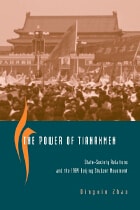
The Power of Tiananmen
State-Society Relations and the 1989 Beijing Student MovementDingxin Zhao
University of Chicago Press, 2001
Dingxin Zhao's award-winning The Power of Tiananmen is the definitive treatment of these historic events. Along with grassroots tales and interviews with the young men and women who launched the demonstrations, Zhao carries out a penetrating analysis of the many parallel changes in China's state-society relations during the 1980s. Such changes prepared an alienated academy, gave rise to ecology-based student mobilization, restricted government policy choices, and shaped student emotions and public opinion, all of which, Zhao argues, account for the tragic events in Tiananmen.
The Present Colonizes the Past
The Future Forsaken?Romila Thapar
Seagull Books, 2026
Short, rigorous intervention on history-writing in public life.
How does the present reshape what a society chooses to remember as its past? Recent interpretations of India's history have replaced careful inquiry with narratives that mirror contemporary anxieties and ambitions, sidelining the evidence, debate, and plurality that once characterized India’s long intellectual tradition. At stake is a shift from understanding history as a method to treating it as a tool of identity and authority. In The Present Colonizes the Past, Romila Thapar asks: How have cultural and religious identities evolved through interaction rather than isolation? How have dissent and accommodation shaped social change? How have education and public discourse influenced what is accepted as knowledge? And, most urgently, how might weakened institutions and selective pasts redefine our heritage and citizenship?
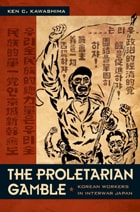
The Proletarian Gamble
Korean Workers in Interwar JapanKen C. Kawashima
Duke University Press, 2009
Kawashima draws on previously unseen archival materials from interwar Japan as he describes how Korean migrants struggled against various recruitment practices, unfair and discriminatory wages, sudden firings, racist housing practices, and excessive bureaucratic red tape. Demonstrating that there was no single Korean “minority,” he reveals how Koreans exploited fellow Koreans and how the stratification of their communities worked to the advantage of state and capital. However, Kawashima also describes how, when migrant workers did organize—as when they became involved in Rōsō (the largest Korean communist labor union in Japan) and in Zenkyō (the Japanese communist labor union)—their diverse struggles were united toward a common goal. In The Proletarian Gamble, his analysis of the Korean migrant workers' experiences opens into a much broader rethinking of the fundamental nature of capitalist commodity economies and the analytical categories of the proletariat, surplus populations, commodification, and state power.
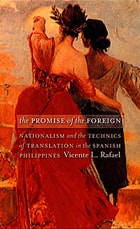
The Promise of the Foreign
Nationalism and the Technics of Translation in the Spanish PhilippinesVicente L. Rafael
Duke University Press, 2005
Through close readings of nationalist newspapers and novels, the vernacular theater, and accounts of the 1896 anticolonial revolution, Rafael traces the deep ambivalence with which elite nationalists and lower-class Filipinos alike regarded Castilian. The widespread belief in the potency of Castilian meant that colonial subjects came in contact with a recurring foreignness within their own language and society. Rafael shows how they sought to tap into this uncanny power, seeing in it both the promise of nationhood and a menace to its realization. Tracing the genesis of this promise and the ramifications of its betrayal, Rafael sheds light on the paradox of nationhood arising from the possibilities and risks of translation. By repeatedly opening borders to the arrival of something other and new, translation compels the nation to host foreign presences to which it invariably finds itself held hostage. While this condition is perhaps common to other nations, Rafael shows how its unfolding in the Philippine colony would come to be claimed by Filipinos, as would the names of the dead and their ghostly emanations.
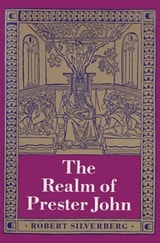
The Realm Of Prester John
Robert Silverberg
Ohio University Press, 1996
In this modern account of the genesis of a great medieval myth, celebrated science fiction author Robert Silverberg’s explores the mysterious origins of Prester John, the astonishing Christian potentate of the East.
Prester John was a legendary figure who cast a powerful spell over Latin Christendom for almost five centuries. Rumors of the warrior-king-prelate’s fabulous realms first reached Europe in the eleventh century and quickly assumed an exalted status alongside such fabled wonders as El Dorado, The Fountain of Youth, and the Holy Grail.
The defeat of a Moslem Turkish tribe by a Buddhist Chinese warlord seems to have been the unlikely historical nugget around which the Prester John myth grew, but contributions to this strange saga have also been traced all around the globe to the Apostle Thomas' apocryphal preaching in India, to the actual existence of small colonies of Nestorian schismatics in central Asia, and even to Genghis Khan.
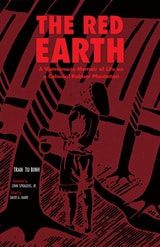
The Red Earth
A Vietnamese Memoir of Life on a Colonial Rubber PlantationBinh Tu Tran
Ohio University Press, 1985
Phu Rieng was one of many French rubber plantations in colonial Vietnam; Tran Tu Binh was one of 17,606 laborers brought to work there in 1927, and his memoir is a straightforward, emotionally searing account of how one Vietnamese youth became involved in revolutionary politics. The connection between this early experience and later activities of the author becomes clear as we learn that Tran Tu Binh survived imprisonment on Con Son island to help engineer the general uprising in Hanoi in 1945.
The Red Earth is the first of dozens of such works by veterans of the 1924–45 struggle in Vietnam to be published in English translation. It is important reading for all those interested in the many-faceted history of modern Vietnam and of communism in the non-Western world.
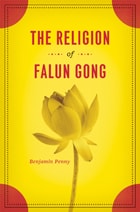
The Religion of Falun Gong
Benjamin Penny
University of Chicago Press, 2012
In July 1999, a mere seven years after the founding of the religious movement known as the Falun Gong, the Chinese government banned it. Falun Gong is still active in other countries, and its suppression has become a primary concern of human rights activists and is regularly discussed in dealings between the Chinese government and its Western counterparts. But while much has been written on Falun Gong’s relation to political issues, no one has analyzed in depth what its practitioners actually believe and do.
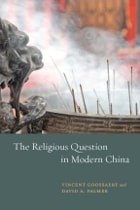
The Religious Question in Modern China
Vincent Goossaert and David A. Palmer
University of Chicago Press, 2011
Recent events—from strife in Tibet and the rapid growth of Christianity in China to the spectacular expansion of Chinese Buddhist organizations around the globe—vividly demonstrate that one cannot understand the modern Chinese world without attending closely to the question of religion. The Religious Question in Modern China highlights parallels and contrasts between historical events, political regimes, and cultural movements to explore how religion has challenged and responded to secular Chinese modernity, from 1898 to the present.
Vincent Goossaert and David A. Palmer piece together the puzzle of religion in China not by looking separately at different religions in different contexts, but by writing a unified story of how religion has shaped, and in turn been shaped by, modern Chinese society. From Chinese medicine and the martial arts to communal temple cults and revivalist redemptive societies, the authors demonstrate that from the nineteenth century onward, as the Chinese state shifted, the religious landscape consistently resurfaced in a bewildering variety of old and new forms. The Religious Question in Modern China integrates historical, anthropological, and sociological perspectives in a comprehensive overview of China’s religious history that is certain to become an indispensible reference for specialists and students alike.
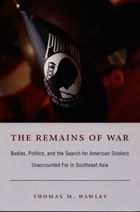
The Remains of War
Bodies, Politics, and the Search for American Soldiers Unaccounted For in Southeast AsiaThomas M. Hawley
Duke University Press, 2005
Hawley combines the theoretical insights of Judith Butler, Michel Foucault, and Emmanuel Levinas with detailed research into the history of the movement to recover the remains of soldiers missing in Vietnam. He examines the practices that constitute the Defense Department’s accounting protocol: the archival research, archaeological excavation, and forensic identification of recovered remains. He considers the role of the American public and the families of missing soldiers in demanding the release of pows and encouraging the recovery of the missing; the place of the body of the Vietnam veteran within the war’s legacy; and the ways that memorials link individual bodies to the body politic. Highlighting the contradictions inherent in the recovery effort, Hawley reflects on the ethical implications of the massive endeavor of the American government and many officials in Vietnam to account for the remains of American soldiers.
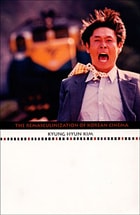
The Remasculinization of Korean Cinema
Kyung Hyun Kim
Duke University Press, 2004
Kim offers in-depth examinations of more than a dozen of the most representative films produced in Korea since 1980. In the process, he draws on the theories of Jacques Lacan, Slavoj Zizek, Gilles Deleuze, Rey Chow, and Kaja Silverman to follow the historical trajectory of screen representations of Korean men from self-loathing beings who desire to be controlled to subjects who are not only self-sufficient but also capable of destroying others. He discusses a range of movies from art-house films including To the Starry Island (1993) and The Day a Pig Fell into the Well (1996) to higher-grossing, popular films like Whale Hunting (1984) and Shiri (1999). He considers the work of several Korean auteurs—Park Kwang-su, Jang Sun-woo, and Hong Sang-su. Kim argues that Korean cinema must begin to imagine gender relations that defy the contradictions of sexual repression in order to move beyond such binary struggles as those between the traditional and the modern, or the traumatic and the post-traumatic.
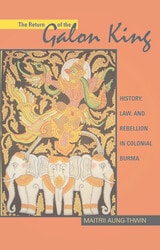
The Return of the Galon King
History, Law, and Rebellion in Colonial BurmaMaitrii Aung-Thwin
Ohio University Press, 2010
In late 1930, on a secluded mountain overlooking the rural paddy fields of British Burma, a peasant leader named Saya San crowned himself King and inaugurated a series of uprisings that would later erupt into one of the largest anti-colonial rebellions in Southeast Asian history. Considered an imposter by the British, a hero by nationalists, and a prophet-king by area-studies specialists, Saya San came to embody traditional Southeast Asia’s encounter with European colonialism in his attempt to resurrect the lost throne of Burma.
The Return of the Galon King analyzes the legal origins of the Saya San story and reconsiders the facts upon which the basic narrative and interpretations of the rebellion are based. Aung-Thwin reveals how counter-insurgency law produced and criminalized Burmese culture, contributing to the way peasant resistance was recorded in the archives and understood by Southeast Asian scholars.
This interdisciplinary study reveals how colonial anthropologists, lawyers, and scholar-administrators produced interpretations of Burmese culture that influenced contemporary notions of Southeast Asian resistance and protest. It provides a fascinating case study of how history is treated by the law, how history emerges in legal decisions, and how the authority of the past is used to validate legal findings.
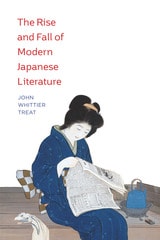
The Rise and Fall of Modern Japanese Literature
John Whittier Treat
University of Chicago Press, 2018
Beginning with journalistic accounts of female criminals in the aftermath of the Meiji civil war, Treat moves on to explore how woman novelist Higuchi Ichiyō’s stories engaged with modern liberal economics, sex work, and marriage; credits Natsume Sōseki’s satire I Am a Cat with the triumph of print over orality in the early twentieth century; and links narcissism in the visual arts with that of the Japanese I-novel on the eve of the country’s turn to militarism in the 1930s. From imperialism to Americanization and the new media of television and manga, from boogie-woogie music to Yoshimoto Banana and Murakami Haruki, Treat traces the stories Japanese audiences expected literature to tell and those they did not. The book concludes with a classic of Japanese science fiction a description of present-day crises writers face in a Japan hobbled by a changing economy and unprecedented natural and manmade catastrophes. The Rise and Fall of Japanese Literature reinterprets the “end of literature”—a phrase heard often in Japan—as a clarion call to understand how literary culture worldwide now teeters on a historic precipice, one at which Japan’s writers may have arrived just a moment before the rest of us.
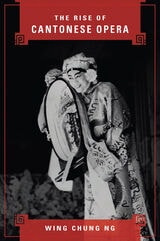
The Rise of Cantonese Opera
Wing Chung Ng
University of Illinois Press, 2015
In the early 1900s, however, Cantonese opera began to capture mass audiences in the commercial theaters of Hong Kong and Guangzhou--a transformation that changed it forever. Wing Chung Ng charts Cantonese opera's confrontations with state power, nationalist discourses, and its challenge to the ascendancy of Peking opera as the country's preeminent "national theatre." Mining vivid oral histories and heretofore untapped archival sources, Ng relates how Cantonese opera evolved from a fundamentally rural tradition into urbanized entertainment distinguished by a reliance on capitalization and celebrity performers. He also expands his analysis to the transnational level, showing how waves of Chinese emigration to Southeast Asia and North America further re-shaped Cantonese opera into a vibrant part of the ethnic Chinese social life and cultural landscape in the many corners of a sprawling diaspora.

The Rise of China and the Demise of the Capitalist World-Economy
Minqi Li
Pluto Press, 2008
Minqi Li examines the future global prospects from the perspectives of Marxism, world-system theories, and ecological limits to growth. He argues that China is likely to exacerbate many of the major contradictions of world capitalism, which could lead to the demise of the existing world-system.
This is an essential text for students of political economy, economics and global politics.
The Rise of the Chinese Empire
Frontier, Immigration, and Empire in Han China, 130 B.C.-A.D.157Chun-shu Chang
University of Michigan Press, 2007
The second and first centuries B.C. were a critical period in Chinese history—they saw the birth and development of the new Chinese empire and its earliest expansion and acquisition of frontier territories.
But for almost two thousand years, because of gaps in the available records, this essential chapter in the history was missing. Fortunately, with the discovery during the last century of about sixty thousand Han-period documents in Central Asia and western China preserved on strips of wood and bamboo, scholars have been able, for the first time, to put together many of the missing pieces.
In this second volume of his monumental history, Chun-shu Chang provides the first systematic reconstruction of the history of the acquisitions and colonization undertaken by the Chinese empire. In never before seen detail, Chang discusses the actions taken by the Chinese empire to develop the Han frontier: the government promoted massive immigration to the newly conquered virgin land; an innovative and complex garrison system was created; and civil institutions and a land system, as well as a regular imperial administration, were established over the region. Chang investigates the long and massive campaigns of the Han territorial expansion movement, considers the impact of early nation-building, and explores the formation and growth of the Chinese empire and its changing national identity. Chang’s comprehensive reconstruction of ancient and early Imperial Chinese history, based on literary, archaeological, and recently discovered ancient texts and classics, reveals the process and mechanics of the Han frontier development through an innovative and complex system of colonization, the core mechanics of the Han empire-building enterprise.
Chun-shu Chang is Professor of History at the University of Michigan and is the author, with Shelley Hsueh-lun Chang, of Crisis and Transformation in Seventeenth-Century China and Redefining History: Ghosts, Spirits, and Human Society in P’u Sung-ling’s World, 1640 – 1715.
"An extraordinary survey of the political and administrative history of early imperial China, which makes available a body of evidence and scholarship otherwise inaccessible to English-readers. The underpinning of research is truly stupendous.”
—Ray Van Dam, Professor, Department of History, University of Michigan
“Powerfully argues from literary and archaeological records that empire, modeled on Han paradigms, has largely defined Chinese civilization ever since.”
—Joanna Waley-Cohen, Professor, Department of History, New York University
The Rise of the Chinese Empire
Nation, State, and Imperialism in Early China, ca. 1600 B.C.-A.D. 8Chun-shu Chang
University of Michigan Press, 2006
The second and first centuries B.C. were a critical period in Chinese history—they saw the birth and development of the new Chinese empire and its earliest expansion and acquisition of frontier territories. But for almost two thousand years, because of gaps in the available records, this essential chapter in the history was missing. Fortunately, with the discovery during the last century of about sixty thousand Han-period documents in Central Asia and western China preserved on strips of wood and bamboo, scholars have been able, for the first time, to put together many of the missing pieces.
In this first volume of his monumental history, Chun-shu Chang uses these newfound documents to analyze the ways in which political, institutional, social, economic, military, religious, and thought systems developed and changed in the critical period from early China to the Han empire (ca. 1600 B.C. – A.D. 220). In addition to exploring the formation and growth of the Chinese empire and its impact on early nation-building and later territorial expansion, Chang also provides insights into the life and character of critical historical figures such as the First Emperor (221– 210 B.C.) of the Ch’in and Wu-ti (141– 87 B.C.) of the Han, who were the principal agents in redefining China and its relationships with other parts of Asia. As never before, Chang’s study enables an understanding of the origins and development of the concepts of state, nation, nationalism, imperialism, ethnicity, and Chineseness in ancient and early Imperial China, offering the first systematic reconstruction of the history of Chinese acquisition and colonization.
Chun-shu Chang is Professor of History at the University of Michigan and is the author, with Shelley Hsueh-lun Chang, of Crisis and Transformation in Seventeenth-Century China and Redefining History: Ghosts, Spirits, and Human Society in P’u Sung-ling’s World, 1640 – 1715.
“An extraordinary survey of the political and administrative history of early imperial China, which makes available a body of evidence and scholarship otherwise inaccessible to English-readers. The underpinning of research is truly stupendous.”
—Ray Van Dam, Professor, Department of History, University of Michigan
“Powerfully argues from literary and archaeological records that empire, modeled on Han paradigms, has largely defined Chinese civilization ever since.”
—Joanna Waley-Cohen, Professor, Department of History, New York University
The Rope of God
James T. Siegel
University of Michigan Press, 2000
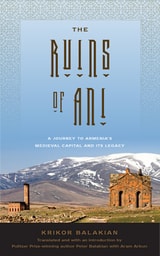
The Ruins of Ani
A Journey to Armenia's Medieval Capital and its LegacyKrikor Balakian
Rutgers University Press, 2019
From the tenth to the thirteenth centuries, the city of Ani was the jewel of the Armenian kingdom, renowned far and wide for its magnificent buildings. Known as the city of 1001 churches, Ani was a center for artistic innovation, and its architecture is a potential missing link between Byzantine and Gothic styles. By the fifteenth century, Ani was virtually abandoned, its stunning buildings left to crumble. Yet its ruins have remained a symbol of cultural accomplishment that looms large in the Armenian imagination.
The Ruins of Ani is a unique combination of history, art criticism, and travel memoir that takes readers on a thousand-year journey in search of past splendors. Today, Ani is a popular tourist site in Turkey, but the city has been falsified in its presentation by the Turkish government in order to erase Armenian history in the wake of the Armenian Genocide. This timely publication also raises questions about the preservation of major historic monuments in the face of post atrocity campaigns of cultural erasure.
Originally written by young priest Krikor Balakian in 1910, just a few years before the Armenian genocide, this book offers a powerful and poignant counterpart to Balakian’s acclaimed genocide memoir Armenian Golgotha. This new translation by the author’s great-nephew, Pulitzer Prize-winning poet Peter Balakian, eloquently renders the book’s vivid descriptions and lyrical prose into English. Including a new introduction that explores Ani’s continued relevance in the twenty-first century, The Ruins of Ani will give readers a new appreciation for this lost city’s status as a pinnacle of both Armenian civilization and human achievement.
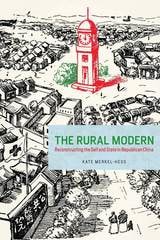
The Rural Modern
Reconstructing the Self and State in Republican ChinaKate Merkel-Hess
University of Chicago Press, 2016
In The Rural Modern, Merkel-Hess shows that Chinese reformers and intellectuals created an idea of modernity that was not simply about what was foreign and new, as in Shanghai and other cities, but instead captured the Chinese people’s desire for social and political change rooted in rural traditions and institutions. She traces efforts to remake village education, economics, and politics, analyzing how these efforts contributed to a new, inclusive vision of rural Chinese life. Merkel-Hess argues that as China sought to redefine itself, such rural reform efforts played a major role, and tensions that emerged between rural and urban ways deeply informed social relations, government policies, and subsequent efforts to create a modern nation during the communist period.