Results by title
1104 books match the query 'Gender Studies' and 189 start with t

These Survivals
Autobiography of an ExtinctionLynne Huffer
Duke University Press, 2025

Thinking Sexuality Transnationally, Volume 5
George and Elizabeth A. Povinelli
Duke University Press, 0
Included in this collection are a study of the construction of male gay identities in China; a consideration of sexual pedagogy, the state, and the “new Brazilian homosexuality”; the format of amnesty applications submitted by lesbians in Guatemala; the roles of gender and sexuality in Taiwanese opera; and a review of transgender literature and language. One of the first comprehensive inquiries into the effects of globalization on sexuality and desire, Thinking Sexuality Transnationally brings together essayists from several disciplines to look at how sexuality and global movement are involved and evolving.
Contributors. Tom Boellstorff, George Chauncey, Peter Jackson, Don Kulick, Patrick Larvie, Heather McClure, Frances Negron-Munter, Elizabeth A. Povinelli, Lisa Rofel, Teri Silvio

This Body That Inhabits Me
Rossana Rossanda
Seagull Books, 2022
Politician, translator, and journalist Rossana Rossanda was the most important female left-wing intellectual in post-war Italy. Central to the Italian Communist Party’s cultural wing during the 1950s and ’60s, she left an indelible mark on the life of the mind. The essays in this volume, however, bring together Rossanda’s reflections on the body—how it ages, how it is gendered, what it means to examine one’s own body. The product of a decades-long dialogue with the Italian women’s movement (above all with Lea Melandri, a vital feminist writer who provides an afterword to the current volume), these essays represent an honest and raw meeting between communist and feminist thought. Ranging from reflections on her own hands through to Chinese cinema, from figures such as the Russian cross-dressing soldier Nadezhda Durova to the Jacobin revolutionary Theroigne de Mericourt, here we see Rossanda’s fierce intellect and extraordinary breadth of knowledge applied to the body as a central question of human experience.
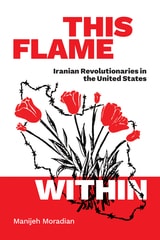
This Flame Within
Iranian Revolutionaries in the United StatesManijeh Moradian
Duke University Press, 2022

Through Our Eyes
African American Men's Experiences of Race, Gender, and ViolenceGarfield, Gail
Rutgers University Press, 2010

Through the Door of Life
A Jewish Journey between GendersJoy Ladin
University of Wisconsin Press, 2012
Professor Jay Ladin made headlines around the world when, after years of teaching literature at Yeshiva University, he returned to the Orthodox Jewish campus as a woman—Joy Ladin. In Through the Door of Life, Joy Ladin takes readers inside her transition as she changed genders and, in the process, created a new self.
With unsparing honesty and surprising humor, Ladin wrestles with both the practical problems of gender transition and the larger moral, spiritual, and philosophical questions that arise. Ladin recounts her struggle to reconcile the pain of her experience living as the “wrong” gender with the pain of her children in losing the father they love. We eavesdrop on her lifelong conversations with the God whom she sees both as the source of her agony and as her hope for transcending it. We look over her shoulder as she learns to walk and talk as a woman after forty-plus years of walking and talking as a man. We stare with her into the mirror as she asks herself how the new self she is creating will ever become real.
Ladin’s poignant memoir takes us from the death of living as the man she knew she wasn’t, to the shattering of family and career that accompanied her transition, to the new self, relationships, and love she finds when she opens the door of life.
2012 Finalist for the National Jewish Book Award for Biography, Autobiography, or Memoir
“Given her high-profile academic position, Ladin’s transition was a major news story in Israel and even internationally. But behind the public story was a private struggle and learning experience, and Ladin pulls no punches in telling that story. She offers a peek into how daunting it was to learn, with little support from others, how to dress as a middle-aged woman, to mu on make-up, to walk and talk like a female. She provides a front-row seat for observing how one person confronted a seemingly impossible situation and how she triumphed, however shakingly, over the many adversities, both societal and psychological, that stood in the way.”—The Gay and Lesbian Review Worldwide
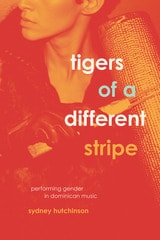
Tigers of a Different Stripe
Performing Gender in Dominican MusicSydney Hutchinson
University of Chicago Press, 2016
Drawing on over a decade of fieldwork in the Dominican Republic and New York among musicians, fans, and patrons of merengue típico—not to mention her own experiences as a female instrumentalist—Hutchinson details a complex nexus of class, race, and artistic tradition that unsettles the typical binary between the masculine and feminine. She sketches the portrait of the classic male figure of the tíguere, a dandified but sexually aggressive and street-smart “tiger,” and she shows how female musicians have developed a feminine counterpart: the tíguera, an assertive, sensual, and respected female figure who looks like a woman but often plays and even sings like a man. Through these musical figures and studies of both straight and queer performers, she unveils rich ambiguities in gender construction in the Dominican Republic and the long history of a unique form of Caribbean feminism.
Times of Mobility
Transnational Literature and Gender in TranslationJasmina Lukic
Central European University Press, 2020

Timing of Affect
Epistemologies of AffectionEdited by Marie-Luise Angerer, Bernd Bösel, and Michaela Ott
Diaphanes, 2014
To Be a Man Is Not a One-Day Job
Masculinity, Money, and Intimacy in NigeriaDaniel Jordan Smith
University of Chicago Press, 2017
Drawing on twenty-five years of experience in southeastern Nigeria, Daniel Jordan Smith takes readers through the principal phases and arenas of men’s lives: the transition to adulthood; searching for work and making a living; courtship, marriage, and fatherhood; fraternal and political relationships; and finally, the attainment of elder status and death. He relates men’s struggles both to fulfill their own aspirations and to meet society’s expectations. He also considers men who behave badly, mistreat their wives and children, or resort to crime and violence. All of these men face similar challenges as they navigate the complex geometry of money and intimacy. Unraveling these connections, Smith argues, provides us with a deeper understanding of both masculinity and society in Nigeria.

Tomboys
A Literary and Cultural HistoryMichelle Ann Abate
Temple University Press, 2008
Starting with the figure of the bold, boisterous girl in the mid-19th century and ending with the “girl power” movement of the 1990’s, Tomboys is the first full-length critical study of this gender-bending code of female conduct. Michelle Abate uncovers the origins, charts the trajectory, and traces the literary and cultural transformations that the concept of “tomboy” has undergone in the United States.
Abate focuses on literature including Louisa May Alcott's Little Women and Carson McCullers's The Member of the Wedding and films such as Peter Bogdanovich's Paper Moon and Jon Avnet's Fried Green Tomatoes. She also draws onlesser-known texts like E.D.E.N. Southworth's once wildly popular 1859 novel The Hidden Hand, Cold War lesbian pulp fiction, and New Queer Cinema from the 1990s.
Tomboys also explores the gender and sexual dynamics of tomboyism, and offers intriguing discussions of race and ethnicity's role in the construction of the enduring cultural archetype. Abate’s insightful analysis provides useful, thought-provoking connections between different literary works and eras. The result demystifies this cultural phenomenon and challenges readers to consider tomboys in a whole new light.
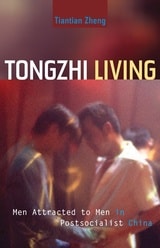
Tongzhi Living
Men Attracted to Men in Postsocialist ChinaTiantian Zheng
University of Minnesota Press, 2015
Tongzhi, which translates into English as “same purpose” or “same will,” was once widely used to mean “comrade.” Since the 1990s, the word has been appropriated by the LGBT community in China and now refers to a broad range of people who do not espouse heteronormativity.
Tongzhi Living, the first study of its kind, offers insights into the community of same-sex-attracted men in the metropolitan city of Dalian in northeast China. Based on ethnographic fieldwork by Tiantian Zheng, the book reveals an array of coping mechanisms developed by tongzhi men in response to rapid social, cultural, and political transformations in postsocialist China. According to Zheng, unlike gay men in the West over the past three decades, tongzhi men in China have adopted the prevailing moral ideal of heterosexuality and pursued membership in the dominant culture at the same time they have endeavored to establish a tongzhi culture. They are, therefore, caught in a constant tension of embracing and contesting normality as they try to create a new and legitimate space for themselves.
Tongzhi men’s attempts to practice both conformity and rebellion paradoxically undercut the goals they aspire to reach, Zheng shows, perpetuating social prejudice against them and thwarting the activism they believe they are advocating.

Tortilleras Negotiating Intimacy
Love, Friendship, and Sex in Queer Mexico CityAnahi Russo Garrido
Rutgers University Press, 2020

Tough Love
Amazon Encounters in the English RenaissanceKathryn Schwarz
Duke University Press, 2000
Despite seeming to function as signs for what is outside the social—the alien, the exotic, the other—Amazons in sixteenth- and seventeenth-century texts were often represented in conventionally domestic roles, as mothers and lovers, wives and queens, Schwarz demonstrates. She traces this pattern in works by Shakespeare, Spenser, Sidney, Raleigh, and Jonson, as well as in such materials as conduct manuals, explorers’ accounts, court spectacles, and political tracts. Through readings of these texts, Schwarz shows that the Amazon myth provided a language both for setting forth and for challenging the terms of social logic. In representations of Amazon encounters, she argues, homosocial bonds became indistinguishable from heterosexual desires, masculine agency attached itself as logically to women as it did to men, and sexual difference was made nearly impossible to sustain or define. Schwarz’s analysis unveils the Amazon as a theoretical term, one that illuminates the tensions and paradoxes through which ideologies of the domestic take shape.
Tough Love contributes to the ongoing discussion of gendered identity and sexual desire in the early modern period. It will interest students of queer theory, cultural studies, early modern history, feminism, and literature.

Toxic Loves, Impossible Futures
Feminist Living as ResistanceIrmgard Emmelhainz
Vanderbilt University Press, 2021
These reflections and dialogues are an urgent attempt to resist the present in the company of the voices of women like bell hooks, Sara Ahmed, Leslie Jamison, Lina Meruane, Leanne Betasamosake Simpson, Chris Kraus, Alaíde Foppa, Lorena Wolffer, Sayak Valencia, Pip Day, Veronica Gonzalez Peña, Eimear McBride, Simone de Beauvoir, Elena Poniatowska, Susan Sontag, Margaret Randall, Simone Weil, Arundhati Roy, Marta Lamas, Paul B. Preciado, Dawn Marie Paley, Raquel Gutiérrez, Sara Eliassen, and Silvia Gruner. Toxic Loves, Impossible Futures continues the discussion on how to undo misogyny and dismantle heteropatriarchy's sublimating and denigrating tricks against women, which are intrinsically linked to colonialism and violence against the Earth.
Traffic in Asian Women
Laura Hyan Yi Kang
Duke University Press, 2020
Trans Exploits
Trans of Color Cultures and Technologies in MovementJian Neo Chen
Duke University Press, 2019
Trans Studies
The Challenge to Hetero/Homo NormativitiesMartínez-San Miguel, Yolanda
Rutgers University Press, 2016
From Caitlyn Jenner to Laverne Cox, transgender people have rapidly gained public visibility, contesting many basic assumptions about what gender and embodiment mean. The vibrant discipline of Trans Studies explores such challenges in depth, building on the insights of queer and feminist theory to raise provocative questions about the relationships among gender, sexuality, and accepted social norms.

Trans Studies
The Challenge to Hetero/Homo NormativitiesMartínez-San Miguel, Yolanda
Rutgers University Press, 2016
From Caitlyn Jenner to Laverne Cox, transgender people have rapidly gained public visibility, contesting many basic assumptions about what gender and embodiment mean. The vibrant discipline of Trans Studies explores such challenges in depth, building on the insights of queer and feminist theory to raise provocative questions about the relationships among gender, sexuality, and accepted social norms.
Trans-Status Subjects
Gender in the Globalization of South and Southeast AsiaSonita Sarker and Esha Niyogi De, eds.
Duke University Press, 2002
The contributors—including literary and film theorists, geographers, historians, sociologists, and anthropologists—show how the dominant colonial powers prefigured the ideologies of gender and sexuality that neocolonial nation-states have later refigured; investigate economic and artistic production; and explore labor, capital, and social change. The essays cover a range of locales—including Sri Lanka, Vietnam, Thailand, Singapore, Borneo, Indonesia, and the United States. In investigating issues of power, mobility, memory, and solidarity in recent eras of globalization, the contributors—scholars and activists from South Asia, Southeast Asia, England, Australia, Canada, and the United States—illuminate various facets of the new concept of trans-status subjects.
Trans-Status Subjects carves out a new area of inquiry at the intersection of feminisim and critical geography, as well as globalization, postcolonial, and cultural studies.
Contributors. Anannya Bhattacharjee, Esha Niyogi De, Karen Gaul, Ketu Katrak, Karen Leonard, Philippa Levine, Kathryn McMahon, Andrew McRae, Susan Morgan, Nihal Perera, Sonita Sarker, Jael Silliman, Sylvia Tiwon, Gisele Yasmeen

Trans/Feminisms
Susan Stryker and Talia M. Bettcher, special issue editors
Duke University Press, 0
This special double issue of TSQ goes beyond the simplistic dichotomy between an exclusionary transphobic feminism and an inclusive trans-affirming feminism. Exploring the ways in which trans issues are addressed within feminist and women’s organizations and social movements around the world, contributors ask how trans, genderqueer, and nonbinary issues are related to feminist movements today, what kind of work is currently undertaken in the name of trans/feminism, what new paradigms and visions are emerging, and what questions still need to be taken up. Central to this special issue is the recognition that trans/feminist politics cannot restrict itself to the domain of gender alone.
This issue features numerous shorter works that represent the diversity of trans/feminist practices and problematics and, in addition to original research articles, includes theory, reports, manifestos, opinion pieces, reviews, and creative/artistic productions, as well as republished key documents of trans/feminist history and international scholarship.
Contributors: Miriam Abelson, Sara Ahmed, Aitzole Araneta, Alexandre Baril, Marie-Hélène/Sam Bourcier, micha cárdenas, Daniel Chávez, Jeanne Córdova, Pedro J. DiPietro, Lucía Egaña, A. Finn Enke, Karine Espineira, Sandra Fernández, Simon D. Fisher, Tania Hammidi, Christoph Hanssmann, Emma Louise Heaney, Hailey Kaas, Cael Keegan, Faris Khan, Yana Kirey-Sitnikova, Terence Kumpf, Riki Lane, Helen Hok-Sze Leung, Claudia Sofia Garriga López, Tommi Avicolli Mecca, L. Leigh Ann van der Merwe, Scott Morgensen, Marcio Jose Ornat, Ruin S. M. Pae, José Quiroga, Naomi Scheman, Joseli Maria Silva, reese simpkins, Miriam Solá, Sandy Stone, Stefania Voli, Rinaldo Walcott, Lori Watson, Cristan Williams, Shana Ye, Asli Zengin
Trans/Portraits
Voices from Transgender CommunitiesJackson Wright Shultz
Dartmouth College Press, 2015

Transatlantic Conversations
Nineteenth-Century American Women’s Encounters with Italy and the Atlantic WorldBeth L. Lueck
University of New Hampshire Press, 2017
This unique interdisciplinary essay collection offers a fresh perspective on the active involvement of American women authors in the nineteenth-century transatlantic world. Internationally diverse contributors explore topics ranging from women's social and political mobility to their authorship and activism. While a number of essays focus on such well-known writers as Margaret Fuller, Catharine Maria Sedgwick, Harriet Beecher Stowe, George Eliot, Louisa May Alcott, and Charlotte Perkins Gilman, other, perhaps lesser-known authors are also included, such as E. D. E. N. Southworth, Elizabeth Stuart Phelps, Elizabeth Peabody, Jeannette Hart, and Laura Richards.
These essays show the spectrum of interests and activities in which nineteenth-century women were involved as they moved, geographically and metaphorically, toward gaining their independence and the right to control their lives. Traveling far and wide—to Italy, France, Great Britain, and the Bahamas—these writers came into contact with realities far different from their own. On topics ranging from homeopathy and literary endeavors to politics and revolution, they conversed with others, reaching and inspiring transnational audiences with their words and deeds, and creating a space for self-expression in the rapidly changing transatlantic world.
Transatlantic Gender Crossings
Anne Emmanuelle Berger and Éric Fassin, special issue editors
Duke University Press, 2016
As much as French feminism influenced the establishment of women’s studies in U.S. universities, so has U.S. gender and queer theory marked the French intellectual and academic landscape. For this reason, gender and sexuality studies have been bound up from the beginning with specific intractable questions of internationalization. Has internationalization contributed to an “Americanization” of the field, or has it allowed for different ways of understanding the connections between the local and the global, the center and the periphery? And how might institutionalization and internationalization affect our thinking about the political and theoretical intersections between gender and sexuality or between sex and race? Contributors from Europe and the United States consider theoretical, political, and institutional questions raised by the transatlantic exchange of feminist theories over four decades.
Contributors
Anne Emmanuelle Berger, Éric Fassin, Delphine Gardey, Clare Hemmings, Ranjana Khanna, Griselda Pollock, Tuija Pulkkinen, Elizabeth Weed
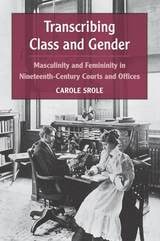
Transcribing Class and Gender
Masculinity and Femininity in Nineteenth-Century Courts and OfficesCarole Srole
University of Michigan Press, 2012
"Drawing upon census data, trade periodicals devoted to stenography and court reporting, the writings of educational reformers, and fiction, Srole allows us to better understand the roles that gender and work played in the formation of middle-class identity. Clearly written and thoroughly researched, her book reminds us of the contradictions that both men and women faced as they navigated changes in the labor market and sought to realize a modern professional identity."
---Thomas Augst, New York University
Transcribing Class and Gender explores the changing meanings of clerical work in nineteenth-century America, focusing on the discourse surrounding that work. At a time when shorthand transcription was the primary method of documenting business and legal communications and transactions, most stenographers were men, but changing technology saw the emergence of women in the once male-dominated field. Carole Srole argues that this shift placed stenographers in a unique position to construct a new image of the professional man and woman and, in doing so, to redefine middle- and working-class identities.
Many male court reporters emphasized their professionalism, portraying themselves as educated language experts as a way to elevate themselves above the growing numbers of female and working-class stenographers and typewriter operators. Meanwhile, women in the courts and offices were confronting the derogatory image of the so-called Typewriter Girl who cared more about her looks, clothing, and marriage prospects than her job. Like males in the field, women responded by fashioning a gendered professional image---one that served to combat this new version of degraded female labor while also maintaining traditional ideals of femininity.The study is unique in the way it reads and analyzes popular fiction, stenography trade magazines, the archives of professional associations, and writings by educational reformers to provide new perspectives on this history. The author challenges the common assumption that men and women clerks had separate work cultures and demonstrates how each had to balance elements of manhood and womanhood in the drive toward professionalism and the construction of a new middle-class image. Transcribing Class and Gender joins the recent scholarship that employs cultural studies approaches to class and gender without abandoning the social history valuation of workers' experiences.
Carole Srole is Professor of History at California State University, Los Angeles.
Photo: A female stenographer working for an actuary in 1897. Courtesy Metlife Archives.
Transfeminist Perspectives in and beyond Transgender and Gender Studies
Finn Enke
Temple University Press, 2012
Lambda Literary Award for Best Book in Transgender Nonfiction, 2013
If feminist studies and transgender studies are so intimately connected, why are they not more deeply integrated? Offering multidisciplinary models for this assimilation, the vibrant essays in Transfeminist Perspectives in and beyond Transgender and Gender Studies suggest timely and necessary changes for institutions of higher learning.
Responding to the more visible presence of transgender persons as well as gender theories, the contributing essayists focus on how gender is practiced in academia, health care, social services, and even national border patrols. Working from the premise that transgender is both material and cultural, the contributors address such aspects of the university as administration, sports, curriculum, pedagogy, and the appropriate location for transgender studies.
Combining feminist theory, transgender studies, and activism centered on social diversity and justice, these essays examine how institutions as lived contexts shape everyday life.
Transformation Now!
Toward a Post-Oppositional Politics of ChangeAnaLouise Keating
University of Illinois Press, 2013

Transforming Masculine Rule
Agriculture and Rural Development in the European UnionElisabeth Prügl
University of Michigan Press, 2011
"The premise of mainstreaming gender is to bring equality concerns into every aspect of policy-making, and this brave book offers a close look at how feminists have taken up the challenge to transform the hidden dynamics of male domination in agricultural policy in Europe. In contrast to the automatic assumption that (neo)liberal policy always works against women’s interests, Prügl demonstrates the potential for feminist ju-jitsu to take advantage of multiple levels of governance to empower women in some circumstances. Although feminists were not always successful, the story of their efforts to remake agricultural policy should encourage activists to look for points of leverage in this and other contested and changing multilevel power systems."
---Myra Marx Ferree, University of Wisconsin
"Information on policy development, conflicts about improving the status of farm women, and using rural development policies to foster gender equality is hard to access in English and extremely useful for researchers concerned with the specifics of gender equality policy in the EU."
---Alison Woodward, Institute for European Studies, Vrije Universiteit Brussel
"This book is a must-read for scholars interested in the gendered process of global restructuring. Elisabeth Prügl succeeds superbly in teasing out the power politics involved in European agricultural policy. Through the lens of a feminist-constructivist approach, she makes visible the multiple mechanisms of gendered power within the state. This very lucid narrative is a milestone in a new generation of feminist theoretical scholarship."
---Brigitte Young, University of Muenster, Germany
Taking West and East Germany as case studies, Elisabeth Prügl shows how European agricultural policy has cemented long-standing gender-based inequalities and how feminists have used liberalization as an opportunity to challenge such inequalities. Through a comparison of the EU’s rural development program known as LEADER as it played out in the Altmark region in the German East and in the Danube/Bavarian Forest region in the West, Prügl provides a close-up view of the power politics involved in government policies and programs.
In identifying mechanisms of power (refusal, co-optation, compromise, normalization, and silencing of difference), Prügl illustrates how these mechanisms operate in arguments over gender relations within the state. Her feminist-constructivist approach to global restructuring as a gendered process brings into view multiple levels of governance and the variety of gender constructions operating in different societies. Ultimately, Prügl offers a new understanding of patriarchy as diverse, contested, and in flux.
Jacket photograph: © iStockphoto.com/Wojtek Kryczka

Transgender Care
Recom Guidelines, Practical InfoGianna Israel
Temple University Press, 2001
By empowering clients to be well-informed medical consumers and by delivering care providers from the straitjacket of inadequate diagnostic standards and stereotypes, this book sets out to transform the nature of transgender care.
In an accessible style, the authors discuss the key mental health issues, with much attention to the vexed relationship between professionals and clients. They propose a new professional role; that of "Gender Specialist."
Chapters 3, 4, and 5 provide definitive information (in the context of consulting health professionals) on hormone administration, aesthetic surgery, and genital reassignment surgery. Chapter 6 takes up the little-examined issue of HIV and AIDS among transgender people. There is also a chapter devoted to issues of transgender people of color, as well as a chapter on transgender adolescents.
The book contains a wealth of practical information and accounts of people's experiences about coming out to one's employer or to one's friends or spouse. Several essays spell out the legal rights of transgender people with regard to insurance, work, marriage, and the use of rest rooms.
The second part of the book consists of thirteen essays on a range of controversial topics. They include three personal stories of transgender life, one essay on the new academic field of Transgender Studies, two essays on legal rights, three essays on medical issues, and two essays on the origins and possible resolution of the conflicts between therapist and client. The authors have also provided useful listings of organizations, centers, and Web sites.
The book has been reviewed by a national committee of professionals and consumers, some of whose members have contributed the essays in the second part of the book.
Transgender Cinema
Rebecca Bell-Metereau
Rutgers University Press, 2019
Transgender Cinema gives readers the big picture of how trans people have been depicted on screen. Beginning with a history of trans tropes in classic Hollywood cinema, from comic drag scenes in Chaplin’s The Masquerader to Garbo’s androgynous Queen Christina, and from psycho killer queers to The Rocky Horror Picture Show’s outrageous queen, it examines a plethora of trans portrayals that subsequently emerged from varied media outlets, including documentary films, television serials, and world cinema. Along the way, it analyzes milestones in trans representation, like The Crying Game, Boys Don’t Cry, Hedwig and the Angry Inch,and A Fantastic Woman.
As it traces the evolution of trans people onscreen, Transgender Cinema also considers the ongoing controversies sparked by these movies and series both within LGBTQ communities and beyond. Ultimately it reveals how film and television have shaped not only how the general public sees trans people, but also how trans people see themselves.
Selected Filmography:
Adventures of Priscilla, Queen of the Desert, All about My Mother, Anak, Austin Unbound, Becoming Chaz, The Blossoming of Maximo Oliveros, Boy I Am, Boy Meets Girl, Boys Don’t Cry, The Brandon Teena Story, A Busy Day, Call Me Malcolm, Carlotta, Change over Time, The Crying Game, Dallas Buyers Club, The Danish Gir, The Devil Is a Woman, Drunktown’s Finest, Facing Mirrors, A Fantastic Woman, 52 Tuesdays, Flesh, Girl Inside, A Girl like Me: The Gwen Araujo Story, Hedwig and the Angry Inch, I Was a Male War Bride,Kate Bornstein Is a Queer and Pleasant Danger, Kumu Hina, La Cage aux Folles, Ma Vie en Rose (My Life in Pink) The Masquerader, Myra Breckinridge, Orlando, Paris Is Burning, Playing with Gender, Psycho, Queen Christina, The Rocky Horror Picture Show, The Saga of Anatahan, She’s a Boy I Knew, Silence of the Lambs, Some Like It Hot, Southern Comfort, Still Black: A Portrait of Black Transmen, Stonewall, The Tenant, Three Generations. Tomboy, Tootsie, Transamerica, Transparent, Trash, Whatever Suits You, A Woman.
Transgender Marxism
Jules Joanne Gleeson
Pluto Press, 2021
Exploring trans lives and movements, the authors delve into the experience of surviving as transgender under capitalism. They explore the pressures, oppression and state persecution faced by trans people living in capitalist societies, their tenuous positions in the workplace and the home, and give a powerful response to right-wing scaremongering against 'gender ideology'.
Reflecting on the relations between gender and labour, these essays reveal the structure of antagonisms faced by gender non-conforming people within society. Looking at the history of transgender movements, Marxist interventions into developmental theory, psychoanalysis and workplace ethnography, the authors conclude that for trans liberation, capitalism must be abolished.
Transgender Rights
Paisley Currah
University of Minnesota Press, 2006
Over the past three decades, the transgender movement has gained visibility and achieved significant victories. Discrimination has been prohibited in several states, dozens of municipalities, and more than two hundred private companies, while hate crime laws in eight states have been amended to include gender identity. Yet prejudice and violence against transgender people remain all too common.
With analysis from legal and policy experts, activists and advocates, Transgender Rights assesses the movement’s achievements, challenges, and opportunities for future action. Examining crucial topics like family law, employment policies, public health, economics, and grassroots organizing, this groundbreaking book is an indispensable resource in the fight for the freedom and equality of those who cross gender boundaries. Moving beyond media representations to grapple with the real lives and issues of transgender people, Transgender Rights will launch a new moment for human rights activism in America.
Contributors: Kylar W. Broadus, Judith Butler, Mauro Cabral, Dallas Denny, Taylor Flynn, Phyllis Randolph Frye, Julie A. Greenberg, Morgan Holmes, Bennett H. Klein, Jennifer L. Levi, Ruthann Robson, Nohemy Solórzano-Thompson, Dean Spade, Kendall Thomas, Paula Viturro, Willy Wilkinson.
Paisley Currah is associate professor of political science at Brooklyn College, executive director of the Center for Lesbian and Gay Studies at the CUNY Graduate Center, and a founding board member of the Transgender Law and Policy Institute.
Richard M. Juang cochairs the advisory board of the National Center for Transgender Equality (NCTE) in Washington, DC. He has taught at Oberlin College and Susquehanna University. He is the lead editor of NCTE's Responding to Hate Crimes: A Community Resource Manual and coeditor of Transgender Justice, which explores models of activism.
Shannon Price Minter is legal director of the National Center for Lesbian Rights and a founding board member of the Transgender Law and Policy Institute.
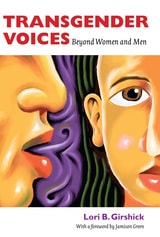
Transgender Voices
Beyond Women and MenLori B. Girshick
University Press of New England, 2009

Transmen and FTMs
Identities, Bodies, Genders, and SexualitiesJason Cromwell
University of Illinois Press, 1999
In clarifying how transmen and FTMs define and validate their lives, as opposed to how society attempts to pigeonhole and belittle them, Cromwell shows how female-to-male transpeople have been made virtually invisible by male-dominated discourses. He considers cross-cultural data on female gender diversity, historical evidence of female-bodied people who have lived as men, and contemporary transmen and FTMs. He also addresses how FTMs and transmen are working to challenge the mental illness model of transness as well as other misconceptions.
Transmen and FTMs seeks to reframe the dialogue about gender identity and move away from regarding fixed gender categories as normative. By redefining gender diversity from a manifestation of pathology to a human condition Transmen and FTMs promotes a fuller understanding of these individuals as persons in their own right.
Transnational Asia Pacific
Gender, Culture, and the Public SphereEdited by Shirley Geok-lin Lim, Larry E. Smith, and Wimal Dissanayake
University of Illinois Press, 1999
The most complete survey to date of the vibrant strands of this music and its colorful practitioners, Mountains of Music delineates a unique culture where music and music making are part of an ancient and treasured heritage. The sly humor, strong faith, clear regional identity, and musical convictions of these performers draw the reader into families and communities bound by music from one generation to another. For devotees as well as newcomers to this infectiously joyous and heartfelt music, Mountains of Music captures the strength of tradition and the spontaneous power of living artistry.
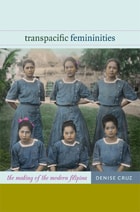
Transpacific Femininities
The Making of the Modern FilipinaDenise Cruz
Duke University Press, 2012
Through a careful study of multiple texts produced by Filipina and Filipino writers in the Philippines and the United States—including novels and short stories, newspaper and magazine articles, conduct manuals, and editorial cartoons—Cruz provides a new archive and fresh perspectives for understanding Philippine literature and culture. She demonstrates that the modern Filipina did not emerge as a simple byproduct of American and Spanish colonial regimes, but rather was the result of political, economic, and cultural interactions among the Philippines, Spain, the United States, and Japan. Cruz shows how the complex interplay of feminism, nationalism, empire, and modernity helped to shape, and were shaped by, conceptions of the transpacific Filipina.
Transpsychoanalytics
Sheila L. Cavanagh, special issue editor
Duke University Press, 2017
Contributors. Sheila L. Cavanagh, Chris Coffman, Elena Dalla Torre, Kate Foord, Patricia Gherovici, Oren Gozlan, Griffin Hansbury, Jordon Osserman, Amy Ray Stewart, Simon van der Weele
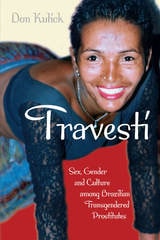
Travesti
Sex, Gender, and Culture among Brazilian Transgendered ProstitutesDon Kulick
University of Chicago Press, 1998
Kulick analyzes the various ways travestis modify their bodies, explores the motivations that lead them to choose this particular gendered identity, and examines the complex relationships that they maintain with one another, their boyfriends, and their families. Kulick also looks at how travestis earn their living through prostitution and discusses the reasons prostitution, for most travestis, is a positive and affirmative experience.
Arguing that transgenderism never occurs in a "natural" or arbitrary form, Kulick shows how it is created in specific social contexts and assumes specific social forms. Furthermore, Kulick suggests that travestis—far from deviating from normative gendered expectations—may in fact distill and perfect the messages that give meaning to gender throughout Brazilian society and possibly throughout much of Latin America.
Through Kulick's engaging voice and sharp analysis, this elegantly rendered account is not only a landmark study in its discipline but also a fascinating read for anyone interested in sexuality and gender.

Troubling Gender
Youth and Cumbia in Argentina's Music SceneAuthored by Pablo Vila and Pablo Semán, contributions by Eloísa Martín and María Julia Carozzi
Temple University Press, 2011
Cumbia villera—literally, cumbia from the shantytowns— is a musical genre quite popular with Argentine youth who frequent urban dance halls. Its songs are known for having highly sexualized lyrics— about girls dancing provocatively or experiencing erotic pleasure. The songs exhibit the tensions at play in the different ways people relate to this musical genre.
In Troubling Gender, noted sociologists Pablo Vila and Pablo Semán scrutinize the music's lyrics and the singers' and dancers' performances. At the same time, the authors conduct in-depth interviews to examine the ways males construct and appropriate cumbia's lyrics, and how females identify, appropriate, and playfully and critically manipulate the same misogynistic songs.
Addressing the relationship between this form of music and the wider social, political, and economic changes that influence the lives of urban youth, Troubling Gender argues that the music both reflects and influences the ways in which women's and men's roles are changing in Argentine society.