Results by title
28164 books match the query 'History' and 6372 start with t
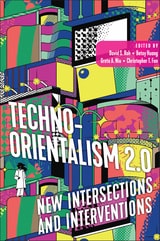
Techno-Orientalism 2.0
New Intersections and InterventionsDavid S. Roh
Rutgers University Press, 2025
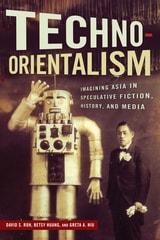
Techno-Orientalism
Imagining Asia in Speculative Fiction, History, and MediaRoh, David S.
Rutgers University Press, 2015
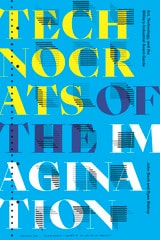
Technocrats of the Imagination
Art, Technology, and the Military-Industrial Avant-GardeJohn Beck and Ryan Bishop
Duke University Press, 2020

Technological Democracy
Bureaucracy and Citizenry in the German Energy DebateCarol J. Hager
University of Michigan Press, 1995
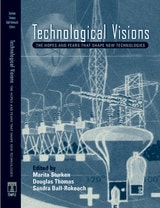
Technological Visions
Hopes And Fears That Shape New TechnologiesMarita Sturken
Temple University Press, 2004
Technologies of Empire
Writing, Imagination, and the Making of Imperial Networks, 1750–1820Dermot Ryan
University of Delaware Press, 2013
Published by University of Delaware Press. Distributed worldwide by Rutgers University Press.
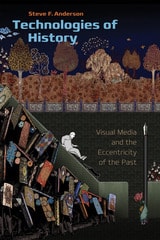
Technologies of History
Visual Media and the Eccentricity of the PastSteve F. Anderson
Dartmouth College Press, 2011
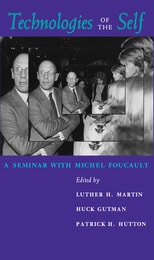
Technologies of the Self
A Seminar with Michel FoucaultLuther H. Martin
University of Massachusetts Press, 1988
Shortly before his death in 1984, Michel Foucault spoke of an idea for a new book on “technologies of the self.” He described it as “composed of different papers about the self. . . . about the role of reading and writing in constituting the self. . . . and so on.” The book Foucault envisioned was based on a faculty seminar on “Technologies of the Self,” originally presented at the University of Vermont in the fall of 1982. This volume is a partial record of that seminar.
In many ways, Foucault's project on the self was the logical conclusion to his historical inquiry over twenty-five years into insanity, deviancy, criminality, and sexuality. Because Foucault died before he completed the revisions of his seminar presentations, this volume includes a careful transcription instead...as a prolegomenon to that unfinished task.
Foucault was a French philosopher, historian of ideas, social theorist, philologist and literary critic.
This volume was edited by Luther H. Martin, Huck Gutman, and Patrick H. Hutton.
Technology and American History
A Historical Anthology from Technology and CultureEdited by Stephen H. Cutcliffe and Terry S. Reynolds
University of Chicago Press, 1997
Emphasizing a societal context for technology, this carefully organized collection demonstrates both the manner in which cultural, political, and economic forces shape innovation, and the ways that technology has influenced society and shaped its values. Individual essays explore the importance of textile manufacturing in American industrialization, the role of the federal government in regulating new modes of transport, the development of interchangeable parts in production, the process of innovation, the notion of technological systems, and the relationship between technological change and work in the factory, on the farm, and in the home.
The essays were selected to be accessible to both the general reader and the undergraduate student.
Technology and Choice
Readings from Technology and CultureEdited by Marcel C. LaFollette and Jeffrey K. Stine
University of Chicago Press, 1991
Through historical accounts that span centuries and national boundaries, exploring the complexity of a nuclear power plant and the apparent simplicity of an electrical plug, the contributors to this volume dramatically illustrate the push and pull between technology and society. General topics addressed include:
- Regulation of private industry
- Social acceptance of commercial innovation
- Negative perceptions of the "Technological Age"
- Cultural and artistic features of technology
These essays were originally published in the journal Technology and Culture
Technology and Place
Sustainable Architecture and the Blueprint FarmBy Steven A. Moore
University of Texas Press, 2001
Developing "sustainable" architectural and agricultural technologies was the intent behind Blueprint Farm, an experimental agricultural project designed to benefit farm workers displaced by the industrialization of agriculture in the Rio Grande Valley of Texas. Yet, despite its promise, the very institutions that created Blueprint Farm terminated the project after just four years (1987-1991).
In this book, Steven Moore demonstrates how the various stakeholders' competing definitions of "sustainability," "technology," and "place" ultimately doomed Blueprint Farm. He reconstructs the conflicting interests and goals of the founders, including Jim Hightower and the Texas Department of Agriculture, Laredo Junior College, and the Center for Maximum Potential Building Systems, and shows how, ironically, they unwittingly suppressed the self-determination of the very farm workers the project sought to benefit. From the instructive failure of Blueprint Farm, Moore extracts eight principles for a regenerative architecture, which he calls his "nonmodern manifesto."
Technology and the Historian
Transformations in the Digital AgeAdam Crymble
University of Illinois Press, 2021
Historians have seen their field transformed by the digital age. Research agendas, teaching and learning, scholarly communication, the nature of the archive—all have undergone a sea change that in and of itself constitutes a fascinating digital history. Yet technology's role in the field's development remains a glaring blind spot among digital scholars.
Adam Crymble mines private and web archives, social media, and oral histories to show how technology and historians have come together. Using case studies, Crymble merges histories and philosophies of the field, separating issues relevant to historians from activities in the broader digital humanities movement. Key themes include the origin myths of digital historical research; a history of mass digitization of sources; how technology influenced changes in the curriculum; a portrait of the self-learning system that trains historians and the problems with that system; how blogs became a part of outreach and academic writing; and a roadmap for the continuing study of history in the digital era.
Technology and the West
A Historical Anthology from Technology and CultureEdited by Terry S. Reynolds and Stephen H. Cutcliffe
University of Chicago Press, 1997
General readers and students will find this collection accessible and engaging.
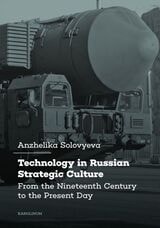
Technology in Russian Strategic Culture
From the Nineteenth Century to the Present DayAnzhelika Solovyeva
Karolinum Press, 2024
This book traces the dynamics of military-technological innovation in Russia over the last hundred and fifty years, particularly focusing on three distinct periods: the introduction of rifled breech-loading weapons in Imperial Russia in the nineteenth century, the invention of nuclear weapons in the Soviet Union in the twentieth century, and the development of precision-guided weapons in post-Soviet Russia in the twenty-first century. The analysis relies extensively on primary data obtained from Russian archives, complemented by a series of expert interviews, and deciphers Russia’s distinct strategic cultural approach to military-technological innovation.
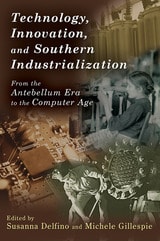
Technology, Innovation, and Southern Industrialization
From the Antebellum Era to the Computer AgeEdited by Susanna Delfino & Michele Gillespie
University of Missouri Press, 2008
Because of its strong agrarian roots, the South has typically been viewed as a region not favorably disposed to innovation and technology. Yet innovation was never absent from industrialization in this part of the United States. From the early nineteenth century onward, southerners were as eager as other Americans to embrace technology as a path to modernity.
This volume features seven essays that range widely across the region and its history, from the antebellum era to the present, to assess the role of innovations presumed lacking by most historians. Offering a challenging interpretation of industrialization in the South, these writings show that the benefits of innovations had to be carefully weighed against the costs to both industry and society.
The essays consider a wide range of innovative technologies. Some examine specific industries in subregions: steamboats in the lower Mississippi valley, textile manufacturing in Georgia and Arkansas, coal mining in Virginia, and sugar planting and processing in Louisiana. Others consider the role of technology in South Carolina textile mills around the turn of the twentieth century, the electrification of the Tennessee valley, and telemedicine in contemporary Arizona—marking the expansion of the region into the southwestern Sunbelt.
Together, these articles show that southerners set significant limitations on what technological innovations they were willing to adopt, particularly in a milieu where slaveholding agriculture had shaped the allocation of resources. They also reveal how scarcity of capital and continued reliance on agriculture influenced that allocation into the twentieth century, relieved eventually by federal spending during the Depression and its aftermath that sparked the Sunbelt South’s economic boom.
Technology, Innovation, and Southern Industrialization clearly demonstrates that the South’s embrace of technological innovation in the modern era doesn’t mark a radical change from the past but rather signals that such pursuits were always part of the region’s economy. It deflates the myth of southern agrarianism while expanding the scope of antebellum American industrialization beyond the Northeast and offers new insights into the relationship of southern economic history to the region’s society and politics.
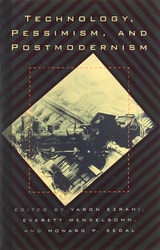
Technology, Pessimism, and Postmodernism
Yaron Ezrahi
University of Massachusetts Press, 1995
This collection of essays from international scholars across various disciplines addresses the compelling theme of technological pessimism—the conviction that technology has simultaneously given humanity the means to achieve unlimited progress while simultaneously providing the tools for self-destruction and the degradation of our most cherished values.
Edited by Yaron Ezrahi, Everett Mendelsohn, and Howard P. Segal, this intellectually rigorous anthology examines the paradoxes and contradictions inherent in contemporary technological society through a postmodern lens. The contributors explore how technology shapes human experience, culture, and social structures in the late twentieth century, questioning the foundational narratives of technological progress and enlightenment that have dominated Western thought.
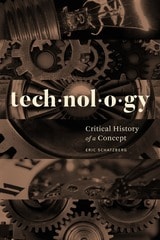
Technology
Critical History of a ConceptEric Schatzberg
University of Chicago Press, 2018
The tension between scholars and technicians continued from Aristotle through Francis Bacon and into the nineteenth century. It was only in the twentieth century that modern meanings of technology arose: technology as the industrial arts, technology as applied science, and technology as technique. Schatzberg traces these three meanings to the present day, when discourse about technology has become pervasive, but confusion among the three principal meanings of technology remains common. He shows that only through a humanistic concept of technology can we understand the complex human choices embedded in our modern world.
Technomodern Poetics
The American Literary Avant-Garde at the Start of the Information AgeTodd F. Tietchen
University of Iowa Press, 2018
After the second World War, the term “technology” came to signify both the anxieties of possible annihilation in a rapidly changing world and the exhilaration of accelerating cultural change. Technomodern Poetics examines how some of the most well-known writers of the era described the tensions between technical, literary, and media cultures at the dawn of the Digital Age. Poets and writers such as Allen Ginsberg, Charles Olson, Jack Kerouac, and Frank O’Hara, among others, anthologized in Donald Allen’s iconic The New American Poetry, 1945–1960, provided a canon of work that has proven increasingly relevant to our technological present. Elaborating on the theories of contemporaneous technologists such as Norbert Wiener, Claude Shannon, J. C. R. Licklider, and a host of noteworthy others, these artists express the anxieties and avant-garde impulses they wrestled with as they came to terms with a complex array of issues raised by the dawning of the nuclear age, computer-based automation, and the expansive reach of electronic media. As author Todd Tietchen reveals, even as these writers were generating novel forms and concerns, they often continued to question whether such technological changes were inherently progressive or destructive.
With an undeniable timeliness, Tietchen’s book is sure to appeal to courses in modern English literature and American studies, as well as among fans of Beat writers and early Cold War culture.
Tecumseh's War
The Epic Conflict for the Heart of AmericaDonald R. Hickey
Westholme Publishing, 2026
The Shawnee leader Tecumseh came to prominence in a war against the United States waged from 1811 to 1815. In 1805, Tecumseh’s younger brother Lalawethika (soon to be known as “the Prophet”) had a vision for an Indian revitalization movement that would restore Native culture and resist American expansion. Tecumseh organized the growing support for this movement, which came from Indigenous peoples across the Old Northwest and parts of the Great Plains, into a loose but powerful military alliance.
In late 1811, while Tecumseh was away on a recruiting mission in the South, General William Henry Harrison led an army to the center of Native resistance at Prophetstown in present-day Indiana. In the early morning hours of November 7, in what came to be known as the Battle of Tippecanoe, Harrison’s men fought off an Indian attack, which marked the beginning of Tecumseh’s War. Seven months later, when the United States declared war on Britain, thus initiating the War of 1812, the British and Tecumseh forged an alliance against the United States. Initially, the Anglo-Indian alliance enjoyed considerable success at Detroit, Chicago, Mackinac, and elsewhere, exposing much of the Old Northwest to border warfare, but the tide turned in 1813 when Harrison invaded Canada. On October 5 the American army defeated a much smaller Anglo-Indian force in the climactic Battle of the Thames. Tecumseh was killed in this battle, and although his confederacy disintegrated, British support ensured that the Indian war would continue for another two years with the Sauk chief Black Hawk now providing the inspiration and leadership. Tecumseh’s War ended only in late 1815 after the British made peace with the United States and abandoned their native allies.
Tecumseh’s War: The Epic Conflict for the Heart of America is the first complete story of this major conflict. Distinguished historian Donald R. Hickey detaches it from the War of 1812, moving Tecumseh’s confederation to center stage to tell the sweeping and engrossing story of this last great Indian War—the last time that Indigenous Peoples had a powerful European ally to oppose United States expansion and thus the lastchance they had of shaping the future of the continent.
Teddy Roosevelt and Leonard Wood
Partners in CommandJohn S. D. Eisenhower
University of Missouri Press, 2013
Theodore Roosevelt was a man of wide interests, strong opinions, and intense ambition for both himself and his country. When he met Leonard Wood in 1897, he recognized a kindred spirit. Moreover, the two men shared a zeal for making the United States an imperial power that would challenge Great Britain as world leader. For the remainder of their lives, their careers would intertwine in ways that shaped the American nation.
When the Spanish American War came, both men seized the opportunity to promote the goals of American empire. Roosevelt resigned as assistant secretary of the navy in William McKinley’s administration to serve as a lieutenant colonel of the Rough Riders, a newly organized volunteer cavalry. Wood, then a captain in the medical corps and physician to McKinley, was promoted to colonel and given charge of the unit.
Roosevelt later took over command of the Rough Riders. In the Battle of San Juan Hill, he led it in a charge up Kettle Hill that would end in victory for the American troops and make their daring commander a household name, a war hero, and, eventually, president of the United States.
At the Treaty of Paris in 1898, Spain ceded Cuba, Puerto Rico, Guam, and the Philippines to the United States. The next year, Wood became military governor of Cuba. He remained in the post until 1902. By that time Roosevelt was president. One of the major accomplishments of his administration was reorganization of the War Department, which the war with Spain had proved disastrously outdated. In 1909, when William Howard Taft needed a strong army chief of staff to enforce the new rules, he appointed Leonard Wood.
Both Wood and Roosevelt were strong proponents of preparedness, and when war broke out in Europe in August 1914, Wood, retired as chief of staff and backed by Roosevelt, established the “Plattsburg camps,” a system of basic training camps. When America entered the Great War, the two men’s foresight was justified, but their earlier push for mobilization had angered Woodrow Wilson, and both were denied the command positions they sought in Europe.
Roosevelt died in 1919 while preparing for another presidential campaign. Wood made a run in his place but was never taken seriously as a candidate. He retired from the army and spent the last seven years of his life as civilian governor of the Philippines.
It was a quiet end for two men who had been giants of their time. While their modernization of the army is widely admired, they were not without their critics. Roosevelt and Wood saw themselves as bold leaders but were regarded by some as ruthless strivers. And while their shared ambitions for the United States were tempered by a strong sense of duty, they could, in their certainty and determination, trample those who stood in their path. Teddy Roosevelt and Leonard Wood: Partners in Command is a revealing and long overdue look at the dynamic partnership of this fascinating pair and will be welcomed by scholars and military history enthusiasts alike.

Teenage Dreams
Girlhood Sexualities in the U.S. Culture WarsCharlie Jeffries
Rutgers University Press, 2022
Teenagers And Teenpics
Juvenilization Of American MoviesThomas Doherty
Temple University Press, 2002
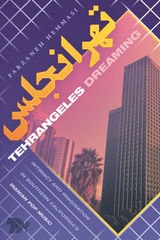
Tehrangeles Dreaming
Intimacy and Imagination in Southern California's Iranian Pop MusicFarzaneh Hemmasi
Duke University Press, 2020
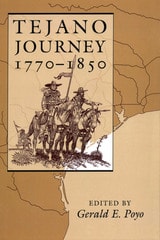
Tejano Journey, 1770-1850
Edited by Gerald E. Poyo
University of Texas Press, 1996
A century before the arrival of Stephen F. Austin's colonists, Spanish settlers from Mexico were putting down roots in Texas. From San Antonio de Bexar and La Bahia (Goliad) northeastward to Los Adaes and later Nacogdoches, they formed communities that evolved their own distinct "Tejano" identity.
In Tejano Journey, 1770-1850, Gerald Poyo and other noted borderlands historians track the changes and continuities within Tejano communities during the years in which Texas passed from Spain to Mexico to the Republic of Texas and finally to the United States. The authors show how a complex process of accommodation and resistance—marked at different periods by Tejano insurrections, efforts to work within the political and legal systems, and isolation from the mainstream—characterized these years of changing sovereignty.
While interest in Spanish and Mexican borderlands history has grown tremendously in recent years, the story has never been fully told from the Tejano perspective. This book complements and continues the history begun in Tejano Origins in Eighteenth-Century San Antonio, which Gerald E. Poyo edited with Gilberto M. Hinojosa.
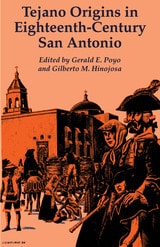
Tejano Origins in Eighteenth-Century San Antonio
Edited by Gerald E. Poyo and Gilberto M. Hinojosa
University of Texas Press, 1991
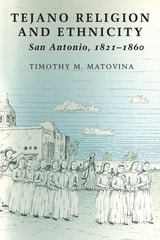
Tejano Religion and Ethnicity
San Antonio, 1821-1860By Timothy M. Matovina
University of Texas Press, 1995
While the flags of Spain, Mexico, the Republic of Texas, and the United States successively flew over San Antonio, its Tejano community (Texans of Spanish or Mexican descent) formed a distinct ethnic identity that persisted despite rapid social and cultural changes. In this pioneering study, Timothy Matovina explores the central role of Tejano Catholicism in forging this unique identity and in binding the community together.
The first book-length treatment of the historical role of religion in a Mexican-origin community in the United States, this study covers three distinct periods in the emergence of Tejano religious and ethnic identity: the Mexican period (1821-1836), the Texas Republic (1836-1845), and the first decade and a half after annexation into the United States (1845-1860). Matovina's research demonstrates how theories of unilateral assimilation are inadequate for understanding the Tejano community, especially in comparison with the experiences of European immigrants to the United States.
As residents of the southwestern United States continue to sort out the legacy of U.S. territorial expansion in the nineteenth century, studies like this one offer crucial understanding of the survival and resilience of Latino cultures in the United States. Tejano Religion and Ethnicity will be of interest to a broad popular and scholarly audience.
Tejano South Texas
A Mexican American Cultural ProvinceBy Daniel D. Arreola
University of Texas Press, 2002
Winner, John Brinckerhoff Jackson Prize, Association of American Geographers
On the plains between the San Antonio River and the Rio Grande lies the heartland of what is perhaps the largest ethnic region in the United States, Tejano South Texas. In this cultural geography, Daniel Arreola charts the many ways in which Texans of Mexican ancestry have established a cultural province in this Texas-Mexico borderland that is unlike any other Mexican American region.
Arreola begins by delineating South Texas as an environmental and cultural region. He then explores who the Tejanos are, where in Mexico they originated, and how and where they settled historically in South Texas. Moving into the present, he examines many factors that make Tejano South Texas distinctive from other Mexican American regions—the physical spaces of ranchos, plazas, barrios, and colonias; the cultural life of the small towns and the cities of San Antonio and Laredo; and the foods, public celebrations, and political attitudes that characterize the region. Arreola's findings thus offer a new appreciation for the great cultural diversity that exists within the Mexican American borderlands.
Telecommunications and Empire
Jill Hills
University of Illinois Press, 2007
Jill Hills picks up from her pathbreaking study The Struggle for Control of Global Communication: The Formative Century to continue her examination of the political, technological, and economic forces at work in the global telecommunications market from World War II to the World Trade Organization agreement of 1997. In the late twentieth century, focus shifted from the creation and development of global communication markets to their intense regulation. The historical framework behind this control--where the market was regulated, by what institution, controlled by what power, and to whose benefit--masterfully complements Hills's analysis of power relations within the global communications arena.
Hills documents attempts by governments to direct, replace, and bypass international telecommunications institutions. As she shows, the results have offered indirect control over foreign domestic markets, government management of private corporations, and government protection of its own domestic communication market. Hills reveals that the motivation behind these powerful, regulatory efforts on person-to-person communication lies in the unmatched importance of communication in the world economy.
As ownership of communications infrastructure becomes more valuable, governments have scrambled to shape international guidelines. Hills provides insight into struggles between U.S. policymakers and the rest of the world, illustrating the conflict between a growing telecommunications empire and sovereign states that are free to implement policy changes. Freshly detailing the interplay between U.S. federal regulation and economic power, Hills fosters a deep understanding of contemporary systems of power in global communications.
Telemodernities
Television and Transforming Lives in AsiaTania Lewis, Fran Martin, and Wanning Sun
Duke University Press, 2016

Telescopes, Tides, and Tactics
A Galilean Dialogue about The Starry Messenger and Systems of the WorldStillman Drake
University of Chicago Press, 1983
Drake has revised his earlier abridged translation of the Starry Messenger, and for the first time the entire work is presented here in modern English. No other edition or translation of this famous work has analyzed Galileo's recorded observations in detail, compared them with modern calculations, or explained the later use he made of them. In the accompanying fictional dialogue, Salviati, Sagredo, and Sarpi reread the Starry Messenger in 1613 and discuss events and issues raised in the three years since its publication. Much of the dialogue is based on archival materials not previously cited in English. Drake has unearthed a wealth of information that will interest the lay reader as well as the historian and the scientist—descriptions of the various and occasionally bizarre critics of Galileo, a reconstruction of Galileo's promised book on the system of the world, his tables of observations and calculations of satellite motions, and evidence for an early tide theory. It was this theory explaining tides by motions of the earth, rather than the influence of Platonic metaphysics, Drake argues that played a major role in Galileo's acceptance of Copernican astronomy.
Telescopes, Tides, and Tactics is a thorough portrait of Galileo as a working astronomer. Offering much more than a commentary on the Starry Messenger, Drake has written a novel and absorbing contribution to the history of physics and astronomy and the study of the Scientific Revolution.
Television Is Where You Find It
A History of Feature Filmmakers in TVCraig S. Simpson
Rutgers University Press, 0
Television Is Where You Find It is a revelatory journey into the overlooked world of feature filmmakers who brought their cinematic vision to the small screen between 1955 and 1990—long before directing for television became trendy in the age of “Prestige TV.” With ten compelling case studies—from legends like Alfred Hitchcock, David Lynch, and Orson Welles to trailblazers like Ida Lupino, Melvin Van Peebles, and Martin Scorsese—author Craig S. Simpson uncovers how these directors reshaped the language of television with style and imagination.
Far from simply dabbling in a “lesser” medium, these filmmakers pushed the boundaries of what TV could do, crafting bold, innovative work that challenges the old notion that television belongs solely to writers and producers. In this fresh, critical study, Television Is Where You Find It makes a case for rediscovering and reevaluating a rich chapter of television history—one in which cinematic artistry quietly flourished, often hidden in plain sight.
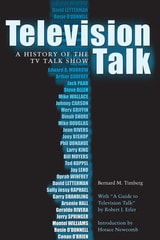
Television Talk
A History of the TV Talk ShowBy Bernard M. Timberg
University of Texas Press, 2002
A CHOICE Outstanding Academic Book
Flip through the channels at any hour of the day or night, and a television talk show is almost certainly on. Whether it offers late-night entertainment with David Letterman, share-your-pain empathy with Oprah Winfrey, trash talk with Jerry Springer, or intellectual give-and-take with Bill Moyers, the talk show is one of television's most popular and enduring formats, with a history as old as the medium itself.
Bernard Timberg here offers a comprehensive history of the first fifty years of television talk, replete with memorable moments from a wide range of classic talk shows, as well as many of today's most popular programs. Dividing the history into five eras, he shows how the evolution of the television talk show is connected to both broad patterns in American culture and the economic, regulatory, technological, and social history of the broadcasting industry. Robert Erler's "A Guide to Television Talk" complements the text with an extensive "who's who" listing of important people and programs in the history of television talk.
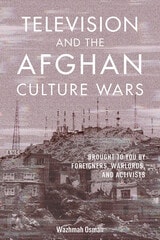
Television and the Afghan Culture Wars
Brought to You by Foreigners, Warlords, and ActivistsWazhmah Osman
University of Illinois Press, 2020
Fieldwork from across Afghanistan allowed Osman to record the voices of many Afghan media producers and people. Afghans offer their own seldom-heard views on the country's cultural progress and belief systems, their understandings of themselves, and the role of international interventions. Osman analyzes the impact of transnational media and foreign funding while keeping the focus on local cultural contestations, productions, and social movements. As a result, she redirects the global dialogue about Afghanistan to Afghans and challenges top-down narratives of humanitarian development.
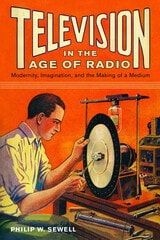
Television in the Age of Radio
Modernity, Imagination, and the Making of a MediumSewell, Philip W
Rutgers University Press, 2014
Television existed for a long time before it became commonplace in American homes. Even as cars, jazz, film, and radio heralded the modern age, television haunted the modern imagination. During the 1920s and 1930s, U.S. television was a topic of conversation and speculation. Was it technically feasible? Could it be commercially viable? What would it look like? How might it serve the public interest? And what was its place in the modern future? These questions were not just asked by the American public, but also posed by the people intimately involved in television’s creation. Their answers may have been self-serving, but they were also statements of aspiration. Idealistic imaginations of the medium and its impact on social relations became a de facto plan for moving beyond film and radio into a new era.
In Television in the Age of Radio, Philip W. Sewell offers a unique account of how television came to be—not just from technical innovations or institutional struggles, but from cultural concerns that were central to the rise of industrial modernity. This book provides sustained investigations of the values of early television amateurs and enthusiasts, the fervors and worries about competing technologies, and the ambitions for programming that together helped mold the medium.
Sewell presents a major revision of the history of television, telling us about the nature of new media and how hopes for the future pull together diverse perspectives that shape technologies, industries, and audiences.

Television, History, and American Culture
Feminist Critical EssaysMary Beth Haralovich and Lauren Rabinovitz, eds.
Duke University Press, 1999
The essays collected here focus on women in front of, behind, and on the TV screen, as producers, viewers, and characters. Using feminist and historical criticism, the contributors investigate how television has shaped our understanding of gender, power, race, ethnicity, and sexuality from the 1950s to the present. The topics range from the role that women broadcasters played in radio and early television to the attempts of Desilu Productions to present acceptable images of Hispanic identity, from the impact of TV talk shows on public discourse and the politics of offering viewers positive images of fat women to the negotiation of civil rights, feminism, and abortion rights on news programs and shows such as I Spy and Peyton Place.
Innovative and accessible, this book will appeal to those interested in women’s studies, American studies, and popular culture and the critical study of television.
Contributors. Julie D’Acci, Mary Desjardins, Jane Feuer, Mary Beth Haralovich, Michele Hilmes, Moya Luckett, Lauren Rabinovitz, Jane M. Shattuc, Mark Williams

Television
An international history of the formative yearsR.W. Burns
The Institution of Engineering and Technology, 1998
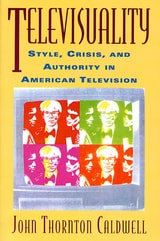
Televisuality
Caldwell, John T
Rutgers University Press, 1995
“Holling is tormented by Koyaanisqatsi dreams until he goes out and does the wild thing with a young stag . . . . ”––Synopsis from production company “Bible,” Northern Exposure, March 30, 1992
The collision of auteurism and rap––couched by primetime producers in the Northern Exposure script––was actually rather commonplace by the early 1990s. Series, and even news broadcasts, regularly engineered their narratives around highly coded aesthetic and cultural fragments, with a kind of ensemble iconography. Televisuality interrogates the nature of such performances as an historical phenomenon, an aesthetic and industrial practice, and as a socially symbolic act. This book suggests that postmodernism does not fully explain television's stylistic exhibitionism and that a reexamination of “high theory” is in order. Caldwell’s unique approach successfully integrates production practice with theory in a way that will enlighten both critical theory and cultural studies.
Televisuality
Style, Crisis, and Authority in American TelevisionJohn T Caldwell
Rutgers University Press, 2020
Tell Me Why My Children Died
Rabies, Indigenous Knowledge, and Communicative JusticeCharles L. Briggs and Clara Mantini-Briggs
Duke University Press, 2016
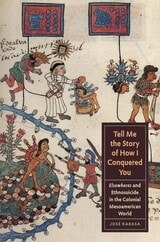
Tell Me the Story of How I Conquered You
Elsewheres and Ethnosuicide in the Colonial Mesoamerican WorldBy José Rabasa
University of Texas Press, 2011
Folio 46r from Codex Telleriano-Remensis was created in the sixteenth century under the supervision of Spanish missionaries in central Mexico. As an artifact of seismic cultural and political shifts, the manuscript painting is a singular document of indigenous response to Spanish conquest. Examining the ways in which the folio's tlacuilo (indigenous painter/writer) creates a pictorial vocabulary, this book embraces the place "outside" history from which this rich document emerged.
Applying contemporary intellectual perspectives, including aspects of gender, modernity, nation, and visual representation itself, José Rabasa reveals new perspectives on colonial order. Folio 46r becomes a metaphor for reading the totality of the codex and for reflecting on the postcolonial theoretical issues now brought to bear on the past. Ambitious and innovative (such as the invention of the concepts of elsewheres and ethnosuicide, and the emphasis on intuition), Tell Me the Story of How I Conquered You embraces the performative force of the native scribe while acknowledging the ineffable traits of 46r—traits that remain untenably foreign to the modern excavator/scholar. Posing provocative questions about the unspoken dialogues between evangelizing friars and their spiritual conquests, this book offers a theoretic-political experiment on the possibility of learning from the tlacuilo ways of seeing the world that dislocate the predominance of the West.
Tell Me, Grandmother
Traditions, Stories, and Cultures of Arapaho PeopleVirginia Sutter
University Press of Colorado, 2004
- Watonga Republican
"Virginia Sutter uses an interesting technique to write the history of her people, the Northern Arapaho Indian Nation. She constructs her work as a series of conversations between herself and her paternal great-grandmother. . . . [T]hrough this device, the history of the Arapaho people is traced from the early nineteenth-century years, when the buffalo ran aplenty and the prairies were boundless, through present-day living conditions in American Indian tribal reservations."
- Moira Richards, www.WomenWriters.net
"Emblematic of the struggle of so many Native Americans of the twentieth century, who seek to reconcile modernity with tradition, and who struggle to recast, reframe, and restore what is Native, even as the majority culture has done its best to uproot, separate, and tell Natives that they can be either modern or Native, but certainly not both."
- Brian Hosmer, Studies in American Indian Literatures (SAIL)
Tell Me, Grandmother is at once the biography of Goes-in-Lodge, a traditional Arapaho woman of the nineteenth century, and the autobiography of her descendant, Virginia Sutter, a modern Arapaho woman with a Ph.D. in public administration. Sutter adeptly weaves her own story with that of Goes-in-Lodge - who, in addition to being Sutter's great-grandmother, was first wife of Sharpnose, the last chief of the Northern Arapaho nation.
Writing in a question-and-answer format between twentieth-century granddaughter and matriarchal ancestor, Sutter discusses four generations of home life, including details about child rearing, education, courtship, marriage, birthing, and burial. Sutter's portrait of Goes-in-Lodge is based on tribal history and interviews with tribal members. Goes-in-Lodge speaks of social and ceremonial gatherings, the Sun Dance, the sweat lodges, and the changes that took place on the Great Plains throughout her lifetime. Sutter details her own life as a child born in a teepee to a white mother and Indian father and the discrimination and injustice she faced struggling to make her way in an increasingly Euro-American world.

Tell Mother I'm in Paradise
Memoirs of a Political Prisoner in El SalvadorAna Margarita Gasteazoro, edited by Judy Blankenship and Andrew Wilson
University of Alabama Press, 2022
The life and times of Ana Margarita Gasteazoro: political activist, clandestine operative, and prisoner of conscience.
Ana Margarita Gasteazoro (1950–1993) was a Salvadoran opposition activist and renowned Amnesty International prisoner of conscience. Tell Mother I’m in Paradise:Memoirs of a Political Prisoner in El Salvador recounts her extraordinary life story. From a privileged Catholic upbringing, with time spent studying and working abroad, Ana Margarita first became a member of the legal political opposition in the late 1970s and later a clandestine operative at work against the brutal military junta.
Gasteazoro recounts her early rebellion against the strictures of conservative upper-class Salvadoran society. She spoke perfect English and discovered a talent for organizing in administrative jobs abroad and at home. As the civil war progressed, she quickly became a valued figure in the National Revolutionary Movement (MNR), a social democratic party, often representing it at international meetings. Against the backdrop of massive social oppression and the “disappearances” of thousands of opposition members, Gasteazoro began a double life as an operative in a faction of the Farabundo Martí National Liberation Front (FMLN). Multitalented and energetic, she organized safe houses for fellow activists, transported weapons and equipment, wrote scripts for an underground radio station, and produced an award-winning documentary film. But the toll on her family life and personal relationships was heavy.
Ana Margarita was disappeared in May 1981 by the infamous National Guard and endured a nightmare 11 days of interrogations, beatings, and abuse. Through international pressure and the connections of her family, her arrest was finally made public, and she was transferred to the women’s prison at Ilopango. There, she and other activists continued the political struggle through the Committee of Political Prisoners of El Salvador (COPPES). During her two years in prison, tested by hunger strikes, violence, and factional divisions, she became one of Amnesty International’s best-known prisoners of conscience. Tell Mother I’m in Paradise is a gripping story of a self-aware activist and a vital young woman’s struggle to find her own way within a deeply conservative society.
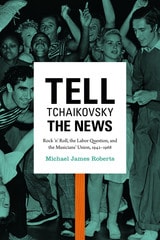
Tell Tchaikovsky the News
Rock 'n' Roll, the Labor Question, and the Musicians' Union, 1942-1968Michael James Roberts
Duke University Press, 2014
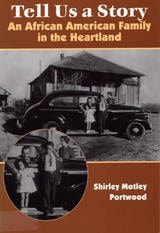
Tell Us a Story
An African American Family in the HeartlandShirley Motley Portwood
Southern Illinois University Press, 2000
Illinois State Historical Society's Certificate of Excellence (2002)
Supplemented by recollections from the present era, Tell Us a Story is a colorful mosaic of African American autobiography and family history set in Springfield, Illinois, and in rural southern Illinois, Missouri, and Arkansas from the 1920s through the 1950s.
Shirley Motley Portwood shares rural, African American family and community history through a collection of vignettes about the Motley family. Initially transcribed accounts of the Motleys’ rich oral history, these stories have been passed among family members for nearly fifty years. In addition to her personal memories, Portwood presents interviews with her father, three brothers, and two sisters plus notes and recollections from their annual family reunions. The result is a composite view of the Motley family.
A historian, Portwood enhances the Motley family story by investigating primary data such as census, marriage, school, and land records, newspaper accounts, city directories, and other sources. The backbone of this saga, however, is oral history gathered from five generations, extending back to Portwood's grandparents, born more than one hundred years ago. Information regarding two earlier generations—her great- grandfather and great-great-grandparents, who were slaves—is based on historical research into state archives, county and local records, plantation records, and manuscript censuses.
A rich source for this material—the Motley family reunions—are week-long retreats where four generations gather at the John Motley house in Burlington, Connecticut, the Portwood home in Godfrey, Illinois, or other locations. Here the Motleys, all natural storytellers, pass on the family traditions. The stories, ranging from humorous to poignant, reveal much about the culture and history of African Americans, especially those from nonurban areas. Like many rural African Americans, the Motleys have a rich and often joyful family history with traditions reaching back to the slave past. They have known the harsh poverty that made even the necessities difficult to obtain and the racial prejudice that divided whites and blacks during the era of Jim Crow segregation and inequality; yet they have kept a tremendous faith in self-improvement through hard work and education.

Tell the Driver
A Biography of Elinor F.E. Black, MDJulie Vandervoort
University of Manitoba Press, 1992
Teller Tales
HistoriesJo Carson
Ohio University Press, 2007
“All my work fits in my mouth,” Jo Carson says. “I write performance material no matter what else the pieces get called, and whether they are for my voice or other characters’ voices … they are first to be spoken aloud.” Following an oral tradition that has strong roots in her native Tennessee, the author of Teller Tales invites the reader to participate in events in a way that no conventional history book can.
Both stories in this book are set in East Tennessee in the mid-eighteenth century and share certain characters. The first narrative, “What Sweet Lips Can Do,” recounts the story of the Overmountain Men and the battle of King’s Mountain, a tide-turning battle in the American Revolution. “Men of Their Time” is an exploration of white-Cherokee relationships from early contact through the time of the Revolution.
Although not well known to the outside world, the stories recounted in Teller Tales are cornerstones in the heritage of the Appalachian region and of American history. In ways that will appeal to young and old alike, Jo Carson’s irreverent telling will broaden the audience and the understanding for the stories of native Americans, settlers, explorers, and revolutionaries of early America.
Telling Complexions
The Nineteenth-Century English Novel and the BlushMary Ann O Farrell
Duke University Press, 1997
Although the blush was used to tell the truth of character and body, O’Farrell shows how it is actually undermined as a stable indicator of character in novels such as Pride and Prejudice, Persuasion, North and South, and David Copperfield. She reveals how these writers then moved on in search of other bodily indicators of mortification and desire, among them the swoon, the scar, and the blunder. Providing unique and creative insights into the constructedness of the body and its semiotic play in literature and in culture, Telling Complexions includes parallel examples of the blush in contemporary culture and describes ways that textualized bodies are sometimes imagined to resist the constraints imposed by such construction.
Telling It Like It Wasn’t
The Counterfactual Imagination in History and FictionCatherine Gallagher
University of Chicago Press, 2018
Gallagher locates the origins of contemporary counterfactual history in eighteenth-century Europe, where the idea of other possible historical worlds first took hold in philosophical disputes about Providence before being repurposed by military theorists as a tool for improving the art of war. In the next century, counterfactualism became a legal device for deciding liability, and lengthy alternate-history fictions appeared, illustrating struggles for historical justice. These early motivations—for philosophical understanding, military improvement, and historical justice—are still evident today in our fondness for counterfactual tales. Alternate histories of the Civil War and WWII abound, but here, Gallagher shows how the counterfactual habit of replaying the recent past often shapes our understanding of the actual events themselves. The counterfactual mode lets us continue to envision our future by reconsidering the range of previous alternatives. Throughout this engaging and eye-opening book, Gallagher encourages readers to ask important questions about our obsession with counterfactual history and the roots of our tendency to ask “What if…?”
Telling It Slant
Avant Garde Poetics of the 1990SMark Wallace
University of Alabama Press, 2001
The finest essays from the newest generation of critics and poet-critics are gathered together in this volume documenting the growth in readership and awareness of avant-garde poetries.
This collection demonstrates the breadth and openness of the field of avant-garde poetry by introducing a wide range of work in poetics, theory, and criticism from emerging writers. Examining the directions innovative poetry has taken since the emergence and success of the Language movement, the essays discuss new forms and the reorientation of older forms of poetry in order to embody present and ongoing involvements. The essays center around four themes: the relation between poetics and contemporary cultural issues; new directions for avant-garde practices; in-depth explorations of current poets and their predecessors; and innovative approaches to the essay form or individual poetics.
Diverging from the traditional, linear argumentative style of academic criticism, many of the essays in this collection instead find critical forms more subtly related to poetry. Viewed as a whole, the essays return to a number of shared issues, namely poetic form and the production of present-day poetry. While focusing on North American poetry, the collection does reference the larger world of contemporary poetics, including potential biases and omissions based on race and ethnicity.
This is cutting-edge criticism at its finest, essential reading for students and scholars of avant-garde poetry, of interest to anyone interested in contemporary American literature and poetry.
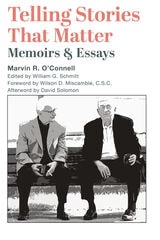
Telling Stories That Matter
Memoirs and EssaysMarvin R. O'Connell
St. Augustine's Press, 2020
In Miscamble’s thorough introduction of O’Connell, he writes that the latter “utilized his striking talents as a historian as an integral part of his fundamental vocation as a priest. [O’Connell] once described the historian as a veritable ‘midwife to our faith,’ who must capture, as best as evidence will allow, the truth of the past.” This position lends itself to the structure of this work. The first part is the sadly incomplete memoirs of Fr. O’Connell, wherein the reader meets the historian and moves with eagerness and confidence into the essays that follow. Highlights of these collected essays include thoughts on Cardinal Newman, Belloc, the Spanish Inquisition, and the historical perspective of evangelization in the United States and modernism at large. What one reads are stories that might have been lost but are here preserved in what can with all moral certainty be called truthfulness. As his friend Ralph McInerny once qualified him, O’Connell combined compassion and judgment such that his histories were always indeed primarily stories and, as the reader well knows, stories have layers and threads and are not told simply for their conclusions.
O’Connell succeeds in showing one how human history is written. Above all, he reveals that history is made by humans, but must also be remembered and deciphered by humans who cannot forego leaving their own marks and prints on everything they encounter (in memory or otherwise). The objectivity we seek can be found in one historical account alone, asserts the priest-storyteller, yet a sharp eye to the past is always consonant with a compassionate desire to understand. Bill Schmitt, Fr. Bill Miscamble and David Solomon do posterity a service by giving us this man and his masterful engagement of history. These friends of O’Connell deem the historian’s passion for truth-in-context to be foundational for shaping stories that matter, including his own.
"This artful combination of memoir and selected essays reawakens our memory of Father O'Connell in all his immense personal charm, intellectual energy, rich erudition, keen wit, and steadfast dedication to his interlocking callings as priest and historian." —J. Philip Gleason, Emeritus Professor, History Department, University of Notre Dame
"The work of a master historian, these memoirs and essays are reliable in recounting what happened, insightful in judging how and why, and eloquent in presenting it all with a flair and wit rarely equaled in historical writing. Moreover, they come forth from a Catholic faith so deep and secure that it need not be imposed on the reader. Rather, they do what good historical writing does, placing the reader into a past that can be seen and felt, recognized and understood. Whether it be his colorful accounts of the tumultuous life and times of Thomas More, or the valiant struggles of Newman and the Oxford Movement, or his own seminary training and teaching in St. Paul, or his fortunes as a graduate student at Notre Dame under the tutelage of the eminent Monsignor Phillip Hughes—whatever the topic, reading O’Connell’s history gives one the gift of being able to say, I remember that happening and I wasn’t even there!"—Michael J. Baxter, Director of Catholic Studies, Regis University in Denver
"O'Connell was a master story teller. He was not, however, just a story teller. He was painstakingly rigorous in what and how he taught. His stories always perfectly illustrated a point, but they were never a substitution for the truth--rather an illustration of it." —Bradley Birzer, Russell Amos Kirk Chair in American Studies, Hillsdale College