Results by title
668 books match the query 'History & Surveys' and 161 start with t
Thomas Kuhn
A Philosophical History for Our TimesSteve Fuller
University of Chicago Press, 2000
Steve Fuller argues that Kuhn actually held a profoundly conservative view of science and how one ought to study its history. Early on, Kuhn came under the influence of Harvard President James Bryant Conant (to whom Structure is dedicated), who had developed an educational program intended to help deflect Cold War unease over science's uncertain future by focusing on its illustrious past. Fuller argues that this rhetoric made its way into Structure, which Fuller sees as preserving and reinforcing the old view that science really is just a steady accumulation of truths about the world (once "paradigm shifts" are resolved).
Fuller suggests that Kuhn, deliberately or not, shared the tendency in Western culture to conceal possible negative effects of new knowledge from the general public. Because it insists on a difference between a history of science for scientists and one suited to historians, Fuller charges that Structure created the awkward divide that has led directly to the "Science Wars" and has stifled much innovative research. In conclusion, Fuller offers a way forward that rejects Kuhn's fixation on paradigms in favor of a conception of science as a social movement designed to empower society's traditionally disenfranchised elements.
Certain to be controversial, Thomas Kuhn must be read by anyone who has adopted, challenged, or otherwise engaged with The Structure of Scientific Revolutions.
"Structure will never look quite the same again after Fuller. In that sense, he has achieved one of the main aims of his ambitious and impressively executed project."—Jon Turney, Times Higher Education Supplement
"Philosophies like Kuhn's narrow the possible futures of inquiry by politically methodizing and taming them. More republican philosophies will leave the future open. Mr. Fuller has amply succeeded in his program of distinguishing the one from the other."—William R. Everdell, Washington Times
Thomistic Considerations
Themes in Aquinas, Aristotle, Augustine, Dante and EliotKevin White
Catholic University of America Press, 2026
Thorstein Veblen and the Enrichment of Evolutionary Naturalism
Rick Tilman
University of Missouri Press, 2007
One of America’s most influential social critics, Thorstein Veblen authored works deeply rooted in evolutionary biology and American philosophical naturalism—both of which help explain his institutional economics and radical sociology. Now, one of today’s preeminent Veblen scholars ranges widely over the man’s writings to show how evolutionary naturalism underlies his social theory and criticism, shapes his satire, and binds his work together.
Rick Tilman’s study focuses on the intersections of social theory and social psychology, political economy and political theory, and modern philosophy and intellectual history in Veblen’s thinking. It links evolutionary naturalism for the first time to Veblen’s aesthetics, secular humanism, sociology of control, sociobiology, and sociology of knowledge, and it makes groundbreaking observations regarding the relationship of Veblen’s own life to his thinking; his place as a cultural lag theorist; and his analysis of sports, gambling, and religion.
Drawing on textual exegesis of Veblen’s work, unpublished correspondence, and selected archives, Tilman argues that only evolutionary naturalism could provide the philosophical foundations of Veblen’s thought. He also emphasizes Veblen’s role in the enhancement and embellishment of the social sciences and cultural studies, as well as his insights into the processes of change in the sociopolitical order.
Veblen’s evolutionary naturalism, with its unflattering evaluation of America’s self-selected special place in the international arena, casts doubt on today’s foreign interventions, and it also provides a much-needed antidote to the resurgence of creationist thought in American culture. Tilman shows that Veblen’s ideas are still valuable to contemporary social scientists—indeed, that his method of analysis and values are sorely needed to help us avoid wasteful consumption, predation, and the persistence of religious superstition. This work offers readers a new appreciation of Veblen and the many issues he addressed, and of Tilman’s own masterful facility in bringing them to light.
Time in the Ditch
American Philosophy and the McCarthy EraJohn McCumber
Northwestern University Press, 2023
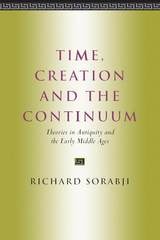
Time, Creation and the Continuum
Theories in Antiquity and the Early Middle AgesRichard Sorabji
University of Chicago Press, 2006
“Splendid. . . . The canvas is vast, the picture animated, the painter nonpareil. . . . Sorabji’s work will encourage more adventurers to follow him to this fascinating new-found land.”—Jonathan Barnes, Times Literary Supplement
“One of the most important works in the history of metaphysics to appear in English for a considerable time. No one concerned with the problems with which it deals either as a historian of ideas or as a philosopher can afford to neglect it.”—Donald MacKinnon, Scottish Journal of Theology
“Unusually readable for such scholarly content, the book provides in rich and cogent terms a lively and well-balanced discussion of matters of concern to a wide academic audience.”—Choice

Tissue of the World
The Nature of Ancient SympathyBrooke Holmes
University of Chicago Press, 0
A multidisciplinary account showing how ancient notions of sympathy changed ways of thinking about interconnectedness.
When we hear the word sympathy today, we tend to imagine the emotional bond between people. But for centuries, sympathy just as commonly brought to mind interdependencies between plants, rocks, and celestial bodies. It explained why magnets attract iron, how the stars influence human destiny, and why one trembles when one is afraid. It implicated human beings in a complex network of loves (sympathies) and hates (antipathies). The ancient notion of sympathy led to ways of thinking about community even beyond the boundaries of the human that continue to influence how we think about life, society, and Nature today.
This book offers the first comprehensive account of ancient sympathy, spanning the fifth century BCE to the third century CE. Tracing connections across works of philosophy, natural history, cosmology, medicine, and literature, Brooke Holmes argues that how people thought about sympathetic communities played a crucial role in shaping the idea of Nature as a webbed, well-ordered whole in the Hellenistic and Roman Imperial Mediterranean. From the scale of the organism to that of the cosmos, this book interrogates the ancient history of a protoecological, antimechanistic conception of Nature, proposing the richly textured thought-world of sympathy as a resource for rethinking and reimagining human and nonhuman communities, the stories we tell about the classical world, and the political and theoretical stakes of vital materialisms.

Tragic Wisdom and Beyond
Gabriel Marcel
Northwestern University Press, 1980
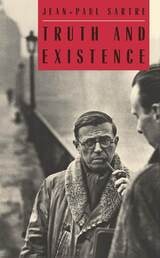
Truth and Existence
Jean-Paul Sartre
University of Chicago Press, 1992
Truth and Existence is introduced by an extended biographical, historical, and analytical essay by Ronald Aronson.
"Truth and Existence is another important element in the recently published links between Sartre's existentialist ontology and his later ethical, political, and literary concerns. . . . The excellent introduction by Aronson will help readers not experienced in reading Sartre."—Choice
"Accompanied by an excellent introduction, this dense, lucidly translated treatise reveals Sartre as a characteristically 20th-century figure."—Publishers Weekly
Jean-Paul Sartre (1906-1980) was offered, but declined, the Nobel Prize for literature in 1964. His many works of fiction, drama, and philosophy include the monumental study of Flaubert, The Family Idiot, and The Freud Scenario, both published in translation by the University of Chicago Press.
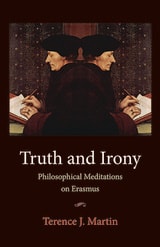
Truth and Irony
Terence J. Martin
Catholic University of America Press, 2016
Truth
Studies of a Robust PresenceKurt Pritzl
Catholic University of America Press, 2010
Turning Traditions Upside Down
Rethinking Giordano Bruno's EnlightenmentAnne Eusterschulte
Central European University Press, 2013