Results by title
598 books match the query 'Religious' and 168 start with t

Thou Shall Not Die
Gabriel Marcel
St. Augustine's Press, 2009
Through the Open Door
A New Look at C.S. LewisDabney Adams Hart
University of Alabama Press, 1984
Unlocking the imagination, language, and vision that shaped C. S. Lewis's enduring legacy.
Through the Open Door: A New Look at C. S. Lewis offers a fresh and illuminating examination of one of the twentieth century's most beloved writers, scholars, and Christian thinkers. In this insightful study, Dabney Adams Hart moves beyond familiar assessments of C. S. Lewis as the creator of The Chronicles of Narnia to explore the intellectual foundations that shaped his work as a literary critic, educator, and defender of the Christian faith. Drawing on Lewis's essays, criticism, fiction, and apologetic writings, Hart reveals the central importance of imagination, language, myth, and meaning in Lewis's understanding of literature and human experience.
Rather than treating Lewis's diverse writings as separate endeavors, Hart demonstrates how they reflect a coherent and unified vision of truth, beauty, and morality. The book shows how Lewis used story and symbolism to address enduring questions about faith, reason, and the search for purpose in a modern world. Accessible to general readers while engaging for scholars, this volume provides valuable insight into the ideas that continue to make Lewis a significant figure in literary and religious studies. An important contribution to Lewis scholarship, Through the Open Door invites readers to discover anew the imagination and intellect behind one of the most influential Christian authors of the modern era.
Thumb to Thumb… and Yet
Peter Coyote
Four Way Books, 2026
If Emmy Award-winner Peter Coyote’s debut collection represents the culmination of a half-century’s devotion to writing poetry, his second functions as a true encore: triumphant and raw. Thumb to Thumb… and Yet presents eighty-plus years of living — the countercultural adventures, the journey from Zen Buddhist discipleship to priesthood, marriage and divorce, a public career in entertainment, and the private work and rewards of parenthood — not as a retrospective but as a perpetual process of becoming. Coyote captures often-elusive wisdom and infuses these pages with the fullness of human experience: weariness that labor never ceases, that we cannot outgrow suffering, that we’re like “Manteaux ducks, immobilized so the fat / of everything can be forced down our gullets,” the glut of gavage neverending and “no option to stop swallowing”; frustration that ambition and ego persist despite the “pre-dawn Zendo chill” and over five decades spent “thumb-to-thumb sitting” in devoted practice; the satisfaction of pleasure, “smiling in the ruined sheets”; gratitude for life consummated and life ongoing and life that will continue long after us, for the opportunity of existence, for the work itself, for the “single nuthatch [that] bows / upside down on the grand oak” and its reminder during meditation that “everything presents itself as a partner.” The titular qualification of that “and yet” is an argument against and a celebration of conclusion; in a masterful encapsulation of the lyrical moment itself, these poems find Coyote returning to the stage only to perform another finale, every end recycled toward beginning. One song cedes to another, and yet the music flows on.
Thunder from the Right
Ezra Taft Benson in Mormonism and PoliticsEdited by Matthew L. Harris
University of Illinois Press, 2019
To Be a Friend of Christ
The Life of Marion D. HanksHanks, Richard D.
Signature Books, 2024
Marion Duff Hanks (1921–2011) was one of the most beloved and influential leaders of the Church of Jesus Christ of Latter-day Saints in the twentieth century, serving as a General Authority (senior leader) for forty years. He was also a leader of national import. As a recognized expert on youth, five US presidents appointed him to their President’s Council on Physical Fitness and Sports. Hanks also served as an executive leader of Rotary International and the Boy Scouts of America.
Author Richard Hanks draws on previously unavailable primary sources—journals, correspondence, notebooks, and recordings—to share this first and only authorized biography of his father. Hanks traces his father’s influence as he advocated for numerous changes in the institutional church, including humanitarian efforts, refugee relief services, missionary community service, a focus on mercy for the sinner, and a churchwide emphasis on “coming unto Christ.” A Renaissance man, Duff Hanks felt comfortable mingling with presidents and world leaders and speaking from pulpits and podiums to huge audiences and on television. But he found his greatest joy in assisting the individual, encouraging each in their personal search for happiness. Once, when asked about his goals, he replied, “My strongest desire is to qualify to be a friend of Christ.”
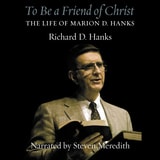
To Be a Friend of Christ
The Life of Marion D. HanksHanks, Richard D.
Signature Books, 2025
Marion Duff Hanks (1921–2011) was one of the most beloved and influential leaders of the Church of Jesus Christ of Latter-day Saints in the twentieth century, serving as a General Authority (senior leader) for forty years. He was also a leader of national import. As a recognized expert on youth, five US presidents appointed him to their President’s Council on Physical Fitness and Sports. Hanks also served as an executive leader of Rotary International and the Boy Scouts of America.
Author Richard Hanks draws on previously unavailable primary sources—journals, correspondence, notebooks, and recordings—to share this first and only authorized biography of his father. Hanks traces his father’s influence as he advocated for numerous changes in the institutional church, including humanitarian efforts, refugee relief services, missionary community service, a focus on mercy for the sinner, and a churchwide emphasis on “coming unto Christ.” A Renaissance man, Duff Hanks felt comfortable mingling with presidents and world leaders and speaking from pulpits and podiums to huge audiences and on television. But he found his greatest joy in assisting the individual, encouraging each in their personal search for happiness. Once, when asked about his goals, he replied, “My strongest desire is to qualify to be a friend of Christ.”
To Flourish or Destruct
A Personalist Theory of Human Goods, Motivations, Failure, and EvilChristian Smith
University of Chicago Press, 2015
In his 2010 book What Is a Person?, Christian Smith argued that sociology had for too long neglected this fundamental question. Prevailing social theories, he wrote, do not adequately “capture our deep subjective experience as persons, crucial dimensions of the richness of our own lived lives, what thinkers in previous ages might have called our ‘souls’ or ‘hearts.’” Building on Smith’s previous work, To Flourish or Destruct examines the motivations intrinsic to this subjective experience: Why do people do what they do? How can we explain the activity that gives rise to all human social life and social structures?
Smith argues that our actions stem from a motivation to realize what he calls natural human goods: ends that are, by nature, constitutionally good for all human beings. He goes on to explore the ways we can and do fail to realize these ends—a failure that can result in varying gradations of evil. Rooted in critical realism and informed by work in philosophy, psychology, and other fields, Smith’s ambitious book situates the idea of personhood at the center of our attempts to understand how we might shape good human lives and societies.
Tolkien, Philosopher of War
Graham McAleer
Catholic University of America Press, 2024
Tongue of a Crow
Peter Coyote
Four Way Books, 2021
Peter Coyote’s first collection of poetry takes us on a whirlwind tour of an eclectic and exciting life as an actor and Zen Buddhist priest, meandering from love affairs to marriage to divorce to the Sixties to psychedelic spirituality and beyond. Written over several decades, these poems read as a collage, each piece distinct and contributing to a cohesive lyric narrative.
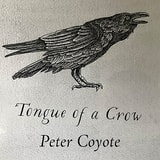
Tongue of a Crow
Peter Coyote
Four Way Books, 2021
Peter Coyote’s first collection of poetry takes us on a whirlwind tour of an eclectic and exciting life as an actor and Zen Buddhist priest, meandering from love affairs to marriage to divorce to the Sixties to psychedelic spirituality and beyond. Written over several decades, these poems read as a collage, each piece distinct and contributing to a cohesive lyric narrative.
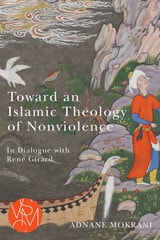
Toward an Islamic Theology of Nonviolence
In Dialogue with René GirardAdnane Mokrani
Michigan State University Press, 2022
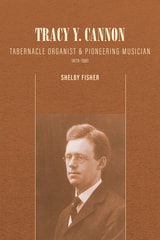
Tracy Y. Cannon
Tabernacle Organist and Pioneering Musician, 1879-1961Fisher, Shelby
Signature Books, 2026
Tracy Y. Cannon guided the musical voice of Mormonism from its provincial roots at the turn of the twentieth century into a state of maturity by the end of his career in 1960. Cannon served as Salt Lake Tabernacle organist from 1905 until 1930, accompanying some of the first radio broadcasts of Music and the Spoken Word. Under his leadership, the McCune School of Music and Art became a cultural hub, offering accredited music degrees as well as community enrichment activities, influencing Utah’s next generation of music educators, composers, leaders, and policymakers. But perhaps his most lasting legacy was his work with the General Music Committee of the Church of Jesus Christ of Latter-day Saints, through which he oversaw the creation of two hymnals, many anthem books, organ anthologies, method books, and an expansive organist and chorister education program.
Cannon’s musical tastes—dignified, refined, reverent, and heavily influenced by Northern European tradition—became the norm for Latter-day Saint congregations for generations. Through his multifaceted career, this brief biography explores the evolution of Latter-day Saint hymnody, “art music,” cultural taste, and music education during the first half of the twentieth century.
Traditions of Natural Law in Medieval Philosophy
Dominic Farrell
Catholic University of America Press, 2022
These various traditions of medieval reflection on natural law, and their interrelation, merit further study, particularly since they touch upon many current philosophical concerns. They grapple with the problem of ethical and religious pluralism. They consider whether universally valid standards of action and social life are accessible to those who rely on reason rather than divine law. In so doing, they develop sophisticated accounts of many central issues in metaethics, action theory, jurisprudence, and the philosophy of religion. However, do they reach a consensus about natural law, or do they end up defending incommensurable ethical frameworks? Do they confirm the value of arguments based on natural law or do they cast doubt on it?
This collection brings together contributions from various expert scholars to explore these issues and the pluralism that exists within medieval reflection on natural law. It is the first one to study the relation between the natural law theories of these various traditions of medieval philosophy: Jewish, Islamic, Byzantine, and Latin.
Each of the first four essays surveys the ‘natural law theory’ of one of the religious traditions of medieval philosophy—Jewish, Islamic, Byzantine, and Latin—and its relation to the others. The next four essays explore some of the alternative accounts of natural law that arise within the Latin tradition. They range over St. Bonaventure, Peter of Tarentaise, Matthew of Aquasparta, John Duns Scotus, and Marsilius of Padua.
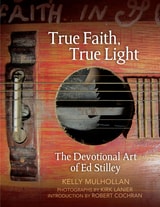
True Faith, True Light
The Devotional Art of Ed StilleyKelly Mulhollan
University of Arkansas Press, 2015
But one day Ed’s life was permanently altered. While plowing his field, he became convinced he was having a heart attack. Ed stopped his work and lay down on the ground. Staring at the sky, he saw himself as a large tortoise struggling to swim across a river. On his back were five small tortoises—his children—clinging to him for survival. And then, as he lay there in the freshly plowed dirt, Ed received a vision from God, telling him that he would be restored to health if he would agree to do one thing: make musical instruments and give them to children.
And so he did. Beginning with a few simple hand tools, Ed worked tirelessly for twenty-five years to create over two hundred instruments, each a crazy quilt of heavy, rough-sawn wood scraps joined with found objects. A rusty door hinge, a steak bone, a stack of dimes, springs, saw blades, pot lids, metal pipes, glass bottles, aerosol cans—Ed used anything he could to build a working guitar, fiddle, or dulcimer. On each instrument Ed inscribed “True Faith, True Light, Have Faith in God.”
True Faith, True Light: The Devotional Art of Ed Stilley documents Ed Stilley’s life and work, giving us a glimpse into a singular life of austere devotion.
Truth on Trial
The Rise and Fall of the Integrated Humanities Program at the University of KansasRobert K. Carlson
Catholic University of America Press, 2026
Twenty Theses on Politics
Enrique Dussel
Duke University Press, 2008
Twenty Theses on Politics is inspired by recent political transformations in Latin America. As Dussel writes in Thesis 15, regarding the liberation praxis of social and political movements, “The winds that arrive from the South—from Nestor Kirchner, Tabaré Vásquez, Luiz Inácio Lula da Silva, Evo Morales, Hugo Chávez, Fidel Castro, and so many others—show us that things can be changed. The people must reclaim sovereignty!” Throughout the twenty theses Dussel engages with Latin American thinkers and activists and with radical political projects such as the World Social Forum. He is also in dialogue with the ideas of Marx, Hegel, Habermas, Rawls, and Negri, offering insights into the applications and limits of their thinking in light of recent Latin American political thought and practice.
Twilight of a Golden Age
Selected Poems of Abraham Ibn EzraWeinberger, Leon J.
University of Alabama Press, 1997