Results by title
923 books match the query 'Urban' and 157 start with t
Toward Camden
Mercy Romero
Duke University Press, 2021
Duke University Press Scholars of Color First Book Award recipient
Toward an Architecture of Enjoyment
Henri Lefebvre
University of Minnesota Press, 2014
Toward an Architecture of Enjoyment is the first publication in any language of the only book devoted to architecture by Henri Lefebvre. Written in 1973 but only recently discovered in a private archive, this work extends Lefebvre’s influential theory of urban space to the question of architecture. Taking the practices and perspective of habitation as his starting place, Lefebvre redefines architecture as a mode of imagination rather than a specialized process or a collection of monuments. He calls for an architecture of jouissance—of pleasure or enjoyment—centered on the body and its rhythms and based on the possibilities of the senses.
Examining architectural examples from the Renaissance to the postwar period, Lefebvre investigates the bodily pleasures of moving in and around buildings and monuments, urban spaces, and gardens and landscapes. He argues that areas dedicated to enjoyment, sensuality, and desire are important sites for a society passing beyond industrial modernization.
Lefebvre’s theories on space and urbanization fundamentally reshaped the way we understand cities. Toward an Architecture of Enjoyment promises a similar impact on how we think about, and live within, architecture.
Toxic Schools
High-Poverty Education in New York and AmsterdamBowen Paulle
University of Chicago Press, 2013
When Bowen Paulle speaks of toxicity, he speaks of educational worlds dominated by intimidation and anxiety, by ambivalence, degradation, and shame. Based on six years of teaching and research in the South Bronx and in Southeast Amsterdam, Toxic Schools is the first fully participatory ethnographic study of its kind and a searing examination of daily life in two radically different settings. What these schools have in common, however, are not the predictable ideas about race and educational achievement but the tragically similar habituated stress responses of students forced to endure the experience of constant vulnerability. From both sides of the Atlantic Ocean, Paulle paints an intimate portrait of how students and teachers actually cope, in real time, with the chronic stress, peer group dynamics, and subtle power politics of urban educational spaces in the perpetual shadow of aggression.

Transformations
Art and the CityEdited by Elizabeth M. Grierson
Intellect Books, 2017
Trust Matters
Parsi Endowments in Mumbai and the Horoscope of a CityLeilah Vevaina
Duke University Press, 2023
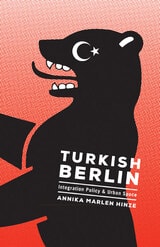
Turkish Berlin
Integration Policy and Urban SpaceAnnika Marlen Hinze
University of Minnesota Press, 2013
The integration of immigrants into a larger society begins at the local level. Turkish Berlin reveals how integration has been experienced by second-generation Turkish immigrant women in two neighborhoods in Berlin, Germany. While the neighborhoods are similar demographically, the lived experience of the residents is surprisingly different.
Informed by first-person interviews with both public officials and immigrants, Annika Marlen Hinze makes clear that local integration policies—often created by officials who have little or no contact with immigrants—have significant effects on the assimilation of outsiders into a community and a society. Focusing on the Turkish neighborhoods of Kreuzberg and Neukölln, Hinze shows how a combination of local policy making and grassroots organizing have contributed to one neighborhood earning a reputation as a hip, multicultural success story and the other as a rougher neighborhood featuring problem schools and high rates of unemployment. Aided by her interviews, she describes how policy makers draw from their imaginations of urban space, immigrants, and integration to develop policies that do not always take social realities into consideration. She offers useful examples of how official policies can actually exacerbate the problems they are trying to help solve and demonstrates that a powerful history of grassroots organizing and resistance can have an equally strong impact on political outcomes.
Employing spatial theory as a tool for understanding the complex processes of integration, Hinze asks two related questions: How do immigrants perceive themselves and their experiences in a new culture? And how are immigrants conceived of by politicians and policy makers? Although her research highlights the German–Turk experience in Berlin, her answers have implications that resonate far beyond the city’s limits.
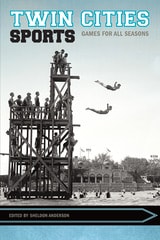
Twin Cities Sports
Games for All SeasonsSheldon Anderson
University of Arkansas Press, 2020