Results by title
2916 books match the query 'Politics and government' and 650 start with t
The Good Road
A K’iche’ Revolutionary TheopoliticsCarlota McAllister
Duke University Press, 2026
The Gospel of Progressivism
Moral Reform and Labor War in Colorado, 1900-1930R. Todd Laugen
University Press of Colorado, 2010
Sharing enemies like the party boss and corporate lobbyist who undermined honest and responsive government, Progressive leaders were determined to root out selfish political action with public exposure. Labor unions defied bosses and rallied for government protection of workers. Women's clubs appealed to other women as mothers, calling for social welfare, economic justice, and government responsiveness. Protestant church congregations formed a core of support for moral reform. Labor relations experts struggled to prevent the outbreak of violence through mediation between corporate employers and organized labor. Persevering through World War I, Colorado reformers faced their greatest challenge in the 1920s, when leaders of the Ku Klux Klan drew upon the rhetoric of Protestant Progressives and manipulated reform tools to strengthen their own political machine. Once in power, Klan legislators turned on Progressive leaders in the state government.
A story of promising alliances never fully realized, zealous crusaders who resisted compromise, and reforms with unexpected consequences, The Gospel of Progressivism will appeal to those interested in Progressive Era reform, Colorado history, labor relations, and women's activism.
The Government-Citizen Disconnect
Suzanne Mettler
Russell Sage Foundation, 2018
Drawing from original survey data which probed Americans’ experiences of 21 federal social policies -- such as food stamps, Social Security, Medicaid, and the home mortgage interest deduction -- Mettler shows that 96 percent of adults have received benefits from at least one of them, and that the average person has utilized five. Overall usage rates transcend social, economic, and political divisions, and most Americans report positive experiences of their policy experiences. However, the fact that they have benefited from these policies has little positive effect on people’s attitudes toward government. Mettler finds that shared identities and group affiliations, as well as ideological forces, are more powerful and consistent influences. In particular, those who oppose welfare tend to extrapolate their unfavorable views of it to government in general. Deep antipathy toward the government has emerged as the result of a conservative movement that has waged a war on social welfare policies for over forty years, even as economic inequality and benefit use have increased.
Mettler finds that voting patterns exacerbate the government-citizen disconnect, as those holding positive views of federal programs and supporting expanded benefits have lower rates of political participation than those holding more hostile views of the government. As a result, the loudest political voice belongs to those who have benefited from policies but who give government little credit for their economic well-being, seeing their success more as a matter of their own deservingness. This contributes to the election of politicians who advocate cutting federal social programs. According to Mettler, the government-citizen disconnect frays the bonds of representative government and democracy.
The Government-Citizen Disconnect illuminates a paradox that increasingly shapes American politics. Mettler's examination of hostility toward government at a time when most Americans will at some point rely on the social benefits it provides helps us better understand the roots of today's fractious political climate.
The Governor and the Colonel
A Dual Biography of William P. Hobby and Oveta Culp HobbyBy Don Carleton
University of Texas Press, 2020
William P. “Will” Hobby Sr. and Oveta Culp Hobby were one of the most influential couples in Texas history. Both were major public figures, with Will serving as governor of Texas and Oveta as the first commander of the Women’s Army Corps and later as the second woman to serve in a presidential cabinet. Together, they built a pioneering media empire centered on the Houston Post and their broadcast properties, and they played a significant role in the transformation of Houston into the fourth largest city in the United States. Don Carleton’s dual biography details their personal and professional relationship—defined by a shared dedication to public service—and the important roles they each played in local, state, and national events throughout the twentieth century.
This deeply researched book not only details this historically significant partnership, but also explores the close relationships between the Hobbys and key figures in twentieth-century history, from Texas legends such as LBJ, Sam Rayburn, and Jesse Jones, to national icons, including the Roosevelts, President Eisenhower, and the Rockefellers. Carleton's chronicle reveals the undeniable impact of the Hobbys on journalistic and political history in the United States.
The Governors of Arkansas
Essays in Political BiographyJr. Gatewood
University of Arkansas Press, 1995
The Governors of New Jersey
Biographical EssaysBirkner, Michael J
Rutgers University Press, 2014
Rogues, aristocrats, and a future U.S. president. These and other governors are portrayed in this revised and updated edition of the classic reference work on the chief executives of New Jersey. Editors Michael J. Birkner, Donald Linky, and Peter Mickulas present new essays on the governors of the last three decades—Brendan T. Byrne, Thomas Kean, James Florio, Christine Todd Whitman, Donald DiFrancesco, James McGreevey, Richard Codey, and Jon Corzine. The essays included in the original edition are amended, edited, and corrected as necessary in light of new and relevant scholarship.
The authors of each governor’s life story represent a roster of such notable scholars as Larry Gerlach, Stanley Katz, Arthur Link, and Clement Price, as well as many other experts on New Jersey history and politics. As a result, this revised edition is a thorough and current reference work on the New Jersey governorship—one of the strongest in the nation.
Also of Interest:
New Jersey Politics and Government
The Suburbs Come of Age
Fourth Edition
Barbara G. Salmore with Stephen A. Salmore
978-0-8135-6139-4 paper $34.95
A volume in the Rivergate Regionals Collection
Me, Governor?
My Life in the Rough-and-Tumble World of New Jersey Politics
Richard J. Codey
978-0-8135-5045-9 cloth $24.95
The Life and Times of Richard J. Hughes
The Politics of Civility
John B. Wefing
978-0-8135-4641-4 cloth $32.50
Governor Tom Kean
From the New Jersey Statehouse to the 911 Commission
Alvin S. Felzenberg
978-0-8135-3799-3 cloth $29.95

The Great Brain Suck
And Other American EpiphaniesEugene Halton
University of Chicago Press, 2008
Luckily Halton, with scalpel-sharp wit in one hand and the balm of wisdom in the other, is here to operate on the declining body politic. His initial diagnosis is bleak: fast food and too much time spent sitting, whether in our cars or on our couches, are ruining our bodies, while our minds are weakened by the proliferation of electronic devices—TVs, computers, cell phones, iPods, video games—and their alienating effects. If we are losing the battle between autonomy and automation, he asks, how can our culture regain self-sufficiency? Halton finds the answer in the inspiring visions—deeply rooted in American culture—of an organic and more spontaneous life at the heart of the work of master craftsman Wharton Esherick, legendary blues singer Muddy Waters, urban critic Lewis Mumford, and artist Maya Lin, among others.
A scathing and original jeremiad against modern materialism, The Great Brain Suck is also a series of epiphanies of a simpler but more profound life.
The Great Broadening
How the Vast Expansion of the Policymaking Agenda Transformed American PoliticsBryan D. Jones, Sean M. Theriault, and Michelle Whyman
University of Chicago Press, 2019
With The Great Broadening, Bryan D. Jones, Sean M. Theriault, and Michelle Whyman examine in detail the causes, internal dynamics, and consequences of this extended burst of activity. They argue that the broadening of government responsibilities into new policy areas such as health care, civil rights, and gender issues and the increasing depth of existing government programs explain many of the changes in America politics since the 1970s. Increasing government attention to particular issues was motivated by activist groups. In turn, the beneficiaries of the government policies that resulted became supporters of the government’s activity, leading to the broad acceptance of its role. This broadening and deepening of government, however, produced a reaction as groups critical of its activities organized to resist and roll back its growth.
The Great Confusion in Indian Affairs
Native Americans and Whites in the Progressive EraBy Tom Holm
University of Texas Press, 2005
The United States government thought it could make Indians "vanish." After the Indian Wars ended in the 1880s, the government gave allotments of land to individual Native Americans in order to turn them into farmers and sent their children to boarding schools for indoctrination into the English language, Christianity, and the ways of white people. Federal officials believed that these policies would assimilate Native Americans into white society within a generation or two. But even after decades of governmental efforts to obliterate Indian culture, Native Americans refused to vanish into the mainstream, and tribal identities remained intact.
This revisionist history reveals how Native Americans' sense of identity and "peoplehood" helped them resist and eventually defeat the U.S. government's attempts to assimilate them into white society during the Progressive Era (1890s-1920s). Tom Holm discusses how Native Americans, though effectively colonial subjects without political power, nonetheless maintained their group identity through their native languages, religious practices, works of art, and sense of homeland and sacred history. He also describes how Euro-Americans became increasingly fascinated by and supportive of Native American culture, spirituality, and environmental consciousness. In the face of such Native resiliency and non-Native advocacy, the government's assimilation policy became irrelevant and inevitably collapsed. The great confusion in Indian affairs during the Progressive Era, Holm concludes, ultimately paved the way for Native American tribes to be recognized as nations with certain sovereign rights.
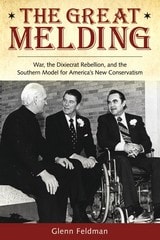
The Great Melding
War, the Dixiecrat Rebellion, and the Southern Model for America's New ConservatismGlenn Feldman
University of Alabama Press, 2015
CHOICE OUTSTANDING ACADEMIC TITLE
Tracing the Southern Origins of Modern American Conservatism.
Audacious in its scope, subtle in its analysis, and persuasive in its arguments, The Great Melding is the second book in Glenn Feldman’s magisterial recounting of the South’s transformation from a Reconstruction-era citadel of Democratic Party inertia to a cauldron of GOP agitation. In this pioneering study, Feldman shows how the transitional years after World War II, the Dixiecrat episode, and the early 1950s formed a pivotal sequence of events that altered America’s political landscape in profound, fundamental, and unexpected ways.
Feldman’s landmark work The Irony of the Solid South dismantled the myth of the New Deal consensus, proving it to be only a fleeting alliance of fissiparous factions; The Great Melding further examines how the South broke away from that consensus. Exploring issues of race and white supremacy, Feldman documents and explains the roles of economics, religion, and emotive appeals to patriotism in southern voting patterns. His probing and original analysis includes a discussion of the limits of southern liberalism and a fresh examination of the Dixiecrat Revolt of 1948.
Feldman convincingly argues that the Dixiecrats—often dismissed as a transitory footnote in American politics—served as a template for the modern conservative movement. Now a predictable Republican stronghold, Alabama at the time was viewed by national political strategists as a battleground and bellwether. Masterfully synthesizing a vast range of sources, Feldman shows that Alabama was then one of the few states where voters made unpredictable choices between the competing ideologies of the Democrats, Republicans, and Dixiecrats.
Writing in his lively and provocative style, Feldman demonstrates that the events he recounts in Alabama between 1942 and Dwight Eisenhower’s 1952 election encapsulate a rare moment of fluidity in American politics, one in which the New Deal consensus shattered and the Democratic and Republican parties fought off a third-party revolt only to find themselves irrevocably altered by their success. The Great Melding will fascinate historians, political scientists, political strategists, and readers of political nonfiction.
The Great Melody
A Thematic Biography of Edmund BurkeConor Cruise O'Brien
University of Chicago Press, 1992
"In bringing Burke to our attention, Mr. O'Brien has brought back a lost treasure. The Great Melody is a brilliant work of narrative sweep and analytical depth. Conor Cruise O'Brien on Edmund Burke is a literary gift to political thought."—John Patrick Diggins, New York Times Book Review
"Serious readers of history are in for a treat: a book by the greatest living Irishman on the greatest Irishman who ever lived. . . . O'Brien's study is not merely a reconstruction of a fascinating man and period. It is also a tract for the times. . . . I cannot remember another time when I finished a book of more than 600 pages wishing it were longer."—Paul Johnson, The Independent
"The Great Melody combines superb biography and fascinating history with a profound understanding of political philosophy."—Former President Richard Nixon
The Great Migration and the Democratic Party
Black Voters and the Realignment of American Politics in the 20th CenturyKeneshia N. Grant
Temple University Press, 2020
Where Black people live has long been an important determinant of their ability to participate in political processes. The Great Migration significantly changed the way Democratic Party elites interacted with Black communities in northern cities, Detroit, New York, and Chicago. Many white Democratic politicians came to believe the growing pool of Black voters could help them reach their electoral goals—and these politicians often changed their campaign strategies and positions to secure Black support. Furthermore, Black migrants were able to participate in politics because there were fewer barriers to Black political participations outside the South.
The Great Migration and the Democratic Party frames the Great Migration as an important economic and social event that also had serious political consequences. Keneshia Grant created one of the first listings of Black elected officials that classifies them based on their status as participants in the Great Migration. She also describes some of the policy/political concerns of the migrants. The Great Migration and the Democratic Party lays the groundwork for ways of thinking about the contemporary impact of Black migration on American politics.
The Great Society and the High Tide of Liberalism
Sidney M. Milkis
University of Massachusetts Press, 2005
In this volume of original essays, a distinguished group of scholars and activists reassess the mixed legacy of this third major reform period of the last century. They examine not only the policies and programs that were part of LBJ's Great Society, but also the underlying ideological and political shifts that changed the nature of liberalism. Some of the essays focus on Lyndon Johnson himself and the institution of the modern presidency, others on specific reform measures, and still others on the impact of these initiatives in the decades that followed. Perspectives, methodologies, and conclusions differ, yet all of the contributors agree that the Great Society represented an important chapter in the story of the American republic and its ongoing struggle to reconcile the power of the state with the rights of individuals—a struggle that has continued into the twenty-first century.
In addition to the editors, contributors include Henry J. Abraham, Brian Balogh, Rosalyn Baxandall, Edward Berkowitz, Eileen Boris, Richard A. Cloward, Hugh Davis Graham, Hugh Heclo, Frederick Hess, William E. Leuchtenburg, Nelson Lichtenstein, Patrick McGuinn, Wilson Carey McWilliams, R. Shep Melnick, Frances Fox Piven, and David M. Shribman.
The Great Upheaval
Women and Nation in Postwar NigeriaJudith A. Byfield
Ohio University Press, 2021

The Grimace of Macho Ratón
Artisans, Identity, and Nation in Late-Twentieth-Century Western NicaraguaLes W. Field
Duke University Press, 1999
Elite appropriations of El Güegüence construe it as an allegory of mestizo national identity in which mestizaje is defined as the production of a national majority of ethnically bounded non-Indians in active collaboration with the state. By contrast, Field interprets the play as a parable of cultural history and not a declaration of cultural identity, a scatological reflection on power and the state, and an evocation of collective loss and humor broadly associated with the national experience of disempowered social groups. By engaging with those most intimately involved in the performance of the play—and by including essays by some of these artisans—Field shows how El Güegüence tells a story about the passing of time, the absurdity of authority, and the contradictions of coping with inheritances of the past. Refusing essentialist notions of what it means to be Indian or artisan, Field explains the reemergence of politicized indigenous identity in western Nicaragua and relates this to the longer history of artisan political organization. Parting ways with many scholars who associate the notion of mestizaje with identity loss and hegemony, Field emphasizes its creative,
productive, and insightful meanings. With an emphasis on the particular struggles of women artisans, he explores the reasons why forms of collective identity have posed various kinds of predicaments for this marginalized class of western Nicaraguans.
This book will appeal to readers beyond the field of Latin American anthropology, including students and scholars of literature, intellectual history, women’s studies, and the politics of ethnicity.

The Guatemala Reader
History, Culture, PoliticsGreg Grandin, Deborah T. Levenson, and Elizabeth Oglesby, eds.
Duke University Press, 2011
The Haiti Reader
History, Culture, PoliticsLaurent Dubois, Kaiama L. Glover, Nadève Ménard, Millery Polyné, and Chantalle F. Verna, editors
Duke University Press, 2020

The Healthiest City
Milwaukee and the Politics of Health ReformJudith W. Leavitt
University of Wisconsin Press, 1996
Between 1850 and 1900, Milwaukee’s rapid population growth also gave rise to high death rates, infectious diseases, crowded housing, filthy streets, inadequate water supplies, and incredible stench. The Healthiest City shows how a coalition of reform groups brought about community education and municipal action to achieve for Milwaukee the title of “the healthiest city” by the 1930s. This highly praised book reminds us that cutting funds and regulations for preserving public health results in inconvenience, illness, and even death.
“A major work. . . . Leavitt focuses on three illustrative issues—smallpox, garbage, and milk, representing the larger areas of infectious disease, sanitation, and food control.”—Norman Gevitz, Journal of the American Medical Association
“Leavitt’s research provides additional evidence . . . that improvements in sanitation, living conditions, and diet contributed more to the overall decline in mortality rates than advances in medical practice. . . . A solid contribution to the history of urban reform politics and public health.”—Jo Ann Carrigan, Journal of American History
The Heroic and the Notorious
U.S. Senators from IllinoisDavid Kenney and Robert E. Hartley
Southern Illinois University Press, 2012
This sweeping survey constitutes the first comprehensive treatment of the men and women who have been chosen to represent Illinois in the United States Senate from 1818 to the present day. David Kenney and Robert E. Hartley underscore nearly two centuries of Illinois history with these biographical and political portraits, compiling an incomparably rich resource for students, scholars, teachers, journalists, historians, politicians, and any Illinoisan interested in the state’s senatorial heritage.
Originally published as An Uncertain Tradition: U.S. Senators From Illinois 1818–2003, this second edition brings readers up to date with new material on Paul Simon, Richard Durbin, and Peter Fitzgerald, as well as completely new sections on Roland Burris, Barack Obama, and Illinois’s newest senator, Mark Kirk. This fresh and careful study of the shifting set of political issues Illinois’s senators encountered over time is illuminated by the lives of participants in the politics of choice and service in the Senate. Kenney and Hartley offer incisive commentary on the quality of Senate service in each case, as well as timeline graphs relating to the succession of individuals in each of the two sequences of service, the geographical distribution of senators within the state, and the variations in party voting for Senate candidates. Rigorously documented and supremely readable, this convenient reference volume is enhanced by portraits of many of the senators.
The Hidden Perspective
The Military Conversations 1906-1914David Owen
Haus Publishing, 2014
Using contemporary historical documents, David Owen, himself a former foreign secretary, shows how the foreign office’s underlying belief in Britain’s moral obligation to send troops to the Continent influenced political decision-making and helped create the impression that war was inevitable. Had Britain’s diplomatic and naval strategy been handled more skillfully during these years, Owen contends, the carnage of World War I might have been prevented altogether.
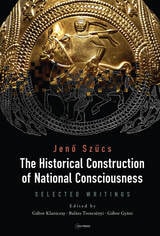
The Historical Construction of National Consciousness
Selected WritingsJeno Szucs
Central European University Press, 2022
A long essay entitled Three Historical Regions of Europe, appearing first in a samizdat volume in Budapest in 1980, instantly put its author into the forefront of the transnational debate on Central Europe, alongside such intellectual luminaries as Milan Kundera and Czesław Miłosz. The present volume offers English-language readers a rich selection of the depth and breadth of the legacy of Jenő Szűcs (1928–1988).
The selection documents Szűcs’s seminal contribution to many contemporary debates in historical anthropology, nationalism studies, and conceptual history. It contains his key texts on the history of national consciousness and patterns of collective identity, as well as medieval and early modern political thought. The works published here, most of them previously unavailable in English, provide a sophisticated analysis of a wide range of subjects from the myths of origins of Hungarians before Christianization to the political and religious ideology of the Dózsa peasant uprising in 1514, the medieval roots of civil society, or the revival of ethnic nationalism during the communist era. The volume, with an introduction by the editors locating Szűcs in a transnational context, offers a unique insight into the complex and sensitive debate on national identity in post-1945 East Central Europe.
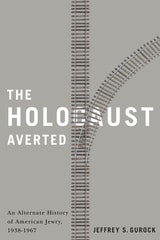
The Holocaust Averted
An Alternate History of American Jewry, 1938-1967Gurock, Jeffrey S
Rutgers University Press, 2015
This alternate history—where, among many scenarios, Hitler is assassinated, Japan does not bomb Pearl Harbor, and Franklin Delano Roosevelt is succeeded after two terms by Robert A. Taft—does cause us to review and better appreciate history. As Gurock tells his tale, he concludes every chapter with a short section that describes what actually happened and, thus, further educates the reader.

The Horn of Africa
Intra-State and Inter-State Conflicts and SecurityEdited by Redie Bereketeab and Cyril Obi
Pluto Press, 2013
The Horn of Africa, comprising Djibouti, Eritrea, Ethiopia, Sudan and Somalia, is the most conflict-ridden region in Africa. This book explores the origins and impact of these conflicts at both an intra-state and inter-state level and the insecurity they create.
The contributors show how regional and international interventions have compounded pre-existing tensions and have been driven by competing national interests linked to the 'War on Terror' and acts of piracy off the coast of Somalia.
The Horn of Africa outlines proposals for multidimensional mechanisms for conflict resolution in the region. Issues of border demarcation, democratic deficit, crises of nation and state building, and the roles of political actors and traditional authorities are all clearly analysed.
The Hot 'Cold War'
The USSR in Southern AfricaVladimir Shubin
Pluto Press, 2008
This book analyses the causes of armed conflicts in Southern Africa during the Cold War. It examines the influence of the various external forces in the region during this period and their relationship to local movements and governments.
The book focuses on states experiencing violent internal conflict and foreign intervention, that is Angola, Mozambique, Namibia , South Africa and Zimbabwe.
The author provides an unique history of the key part that the Soviet Union played in these developments. Spanning 30 years, the book explores how each country struggled for genuine independence against colonialism and apartheid and their place in the wider conflicts encompassed by the Cold War.

The House That Madigan Built
The Record Run of Illinois' Velvet HammerRay Long. Foreword by Charles N. Wheeler III
University of Illinois Press, 2022
Veteran reporter Ray Long draws on four decades of observing state government to provide the definitive political analysis of Michael Madigan. Secretive, intimidating, shrewd, power-hungry--Madigan mesmerized his admirers and often left his opponents too beaten down to oppose him. Long vividly recreates the battles that defined the Madigan era, from stunning James Thompson with a lightning-strike tax increase, to pressing for a pension overhaul that ultimately failed in the courts, to steering the House toward the Rod Blagojevich impeachment. Long also shines a light on the machinery that kept the Speaker in power. Head of a patronage army, Madigan ruthlessly used his influence and fundraising prowess to reward loyalists and aid his daughter’s electoral fortunes. At the same time, he reshaped bills to guarantee he and his Democratic troops shared in the partisan spoils of his legislative victories. Yet Madigan’s position as the state’s seemingly invulnerable power broker could not survive scandals among his close associates and the widespread belief that his time as Speaker had finally reached its end.
Unsparing and authoritative, The House That Madigan Built is the page-turning account of one the most powerful politicians in Illinois history.

The House Will Come To Order
How the Texas Speaker Became a Power in State and National PoliticsBy Patrick L. Cox and Michael Phillips
University of Texas Press, 2010
In a state assumed to have a constitutionally weak governor, the Speaker of the Texas House wields enormous power, with the ability to almost single-handedly dictate the legislative agenda. The House Will Come to Order charts the evolution of the Speaker's role from a relatively obscure office to one of the most powerful in the state. This fascinating account, drawn from the Briscoe Center's oral history project on the former Speakers, is the story of transition, modernization, and power struggles.
Weaving a compelling story of scandal, service, and opportunity, Patrick Cox and Michael Phillips describe the divisions within the traditional Democratic Party, the ascendance of Republicans, and how Texas business, agriculture, and media shaped perceptions of officeholders. While the governor and lieutenant governor wielded their power, the authors show how the modern Texas House Speaker built an office of equal power as the state became more complex and diverse. The authors also explore how race, class, and gender affected this transition as they explain the importance of the office in Texas and the impact the state's Speakers have had on national politics.
At the apex of its power, the Texas House Speaker's role at last receives the critical consideration it deserves.

The House and Senate in the 1790s
Petitioning, Lobbying, and Institutional DevelopmentKenneth R. Bowling
Ohio University Press, 2002
Amid the turbulent swirl of foreign intrigue, external and internal threats to the young nation’s existence, and the domestic partisan wrangling of the 1790s, the United States Congress solidified its role as the national legislature. The ten essays in The House and Senate in the 1790s demonstrate the mechanisms by which this bicameral legislature developed its institutional identity. The first essay sets the scene for the institutional development of Congress by examining its constitutional origins and the efforts of the Founders to empower the new national legislature. The five following essays focus on two related mechanisms—petitioning and lobbying—by which citizens and private interests communicated with national lawmakers.
Although scholars tend to see lobbying as a later nineteenth-century development, the papers presented here clearly demonstrate the existence of lobbyists and lobbying in the 1790s. The final four papers examine other aspects of the institutional development of the House and the Senate, including the evolution of political parties and congressional leadership.
The essays in this collection, the third volume in the series Perspectives on the History of Congress, 1789-1801, originated in a series of conferences held by the United States Capitol Historical Society from 1994 to 2001.

The Humours of Parliament
Harry Furniss's View of Late-Victorian Political CultureEdited and with an Introduction by Gareth Cordery and Joseph S. Meisel
The Ohio State University Press, 2014
Reproducing some 150 images drawn from Furniss’s extensive graphic work, The Humours of Parliament: Harry Furniss’s View of Late-Victorian Political Culture, edited and with an introduction by Gareth Cordery and Joseph S. Meisel, presents Furniss’s unpublished lecture text for the first time. The extensive introduction places the show in its biographical, political, and performative contexts. Cordery and Meisel’s volume therefore both documents a pivotal moment in British political and social history and provides a rare case study of an important yet little studied nineteenth-century performance genre: the illustrated platform lecture.
The Hungarian Patient
Social Opposition to an Illiberal DemocracyJon Van Til
Central European University Press, 2015
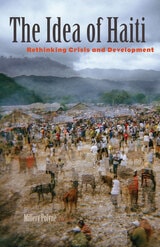
The Idea of Haiti
Rethinking Crisis and DevelopmentMillery Polyné
University of Minnesota Press, 2013
After Haiti was struck by a devastating earthquake on January 12, 2010, aid workers and offers of support poured in from around the world. Tellingly, though, news reports on the catastrophe and relief efforts frequently included a pejorative description of the country that outsiders were determined to rebuild: the troubled island nation, a nation plagued by political violence. There was much talk of inventing a “new” Haiti, which would presumably mimic Western modes of development and thus mitigate political instability and crisis.
As contributors to this wide-ranging book reveal, Haiti has long been marginalized as an embodiment of alterity, as the other, and the idea of a new Haiti is actually nothing new. An investigation of the notion of newness through the lenses of history and literature, urban planning, religion, and governance, The Idea of Haiti illuminates the politics and the narratives of Haiti’s past and present. The essays, which grow from original research and in-depth interviews, examine how race, class, and national development inform the policies that envision re-creating the country.
Together the contributors address important questions: How will the present narratives of deviance affect international relief and rebuilding efforts? What do Haitians themselves think about Haiti, old and new? What are the potential complications and weakness of aid strategies during these trying times? And what do we mean by crisis in Haiti?
Contributors: Yveline Alexis, Rutgers U; Wein Weibert Arthus, State U of Haiti; Greg Beckett, Bowdoin College; Alex Dupuy, Wesleyan U; Harley F. Etienne, U of Michigan; Robert Fatton Jr., U of Virginia; Sibylle Fischer, New York U; Elizabeth McAlister, Wesleyan U; Nick Nesbitt, Princeton U; Karen Richman, U of Notre Dame; Mark Schuller, York College (CUNY); Patrick Sylvain, Brown U; Évelyne Trouillot, State U of Haiti; Tatiana Wah, Columbia U.
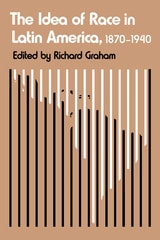
The Idea of Race in Latin America, 1870-1940
Edited and with an introduction by Richard Graham
University of Texas Press, 1990
From the mid-nineteenth century until the 1930s, many Latin American leaders faced a difficult dilemma regarding the idea of race. On the one hand, they aspired to an ever-closer connection to Europe and North America, where, during much of this period, "scientific" thought condemned nonwhite races to an inferior category. Yet, with the heterogeneous racial makeup of their societies clearly before them and a growing sense of national identity impelling consideration of national futures, Latin American leaders hesitated. What to do? Whom to believe?
Latin American political and intellectual leaders' sometimes anguished responses to these dilemmas form the subject of The Idea of Race in Latin America. Thomas Skidmore, Aline Helg, and Alan Knight have each contributed chapters that succinctly explore various aspects of the story in Brazil, Argentina, Cuba, and Mexico. While keenly alert to the social and economic differences that distinguish one Latin American society from another, each author has also addressed common issues that Richard Graham ably draws together in a brief introduction. Written in a style that will make it accessible to the undergraduate, this book will appeal as well to the sophisticated scholar.
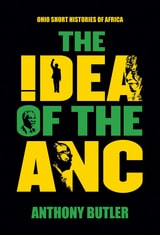
The Idea of the ANC
Anthony Butler
Ohio University Press, 2013
The African National Congress (ANC) is Africa’s most famous liberation movement. It has recently celebrated its centenary, a milestone that has prompted partisans to detail a century of unparalleled achievement in the struggle against colonialism and racial discrimination. Critics paint a less flattering portrait of the historical ANC as a communist puppet, a moribund dinosaur, or an elitist political parasite. For such skeptics, the ANC—now in government for two decades—has betrayed South Africans rather than liberating them.
South Africans endure deep inequality and unemployment, violent community protests, murders of foreign residents, major policy blunders, an AIDS crisis, and deepening corruption. Inside the ANC there are episodes of open rebellion against the leadership, conflicts over the character of a postliberation movement, and debilitating battles for succession to the movement’s presidency. The ANC is nevertheless likely to remain the party of government for the foreseeable future.
This remarkable book explores how ANC intellectuals and leaders interpret the historical project of their movement. It investigates three interlocking ideas: a conception of power, a responsibility for promoting unity, and a commitment to human liberation. Anthony Butler explores how these notions have shaped South African politics in the past and how they will inform ANC leaders’ responses to the challenges of the future.
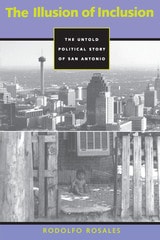
The Illusion of Inclusion
The Untold Political Story of San AntonioBy Rodolfo Rosales
University of Texas Press, 2000
To many observers, the 1981 election of Henry Cisneros as mayor of San Antonio, Texas, represented the culminating victory in the Chicano community's decades-long struggle for inclusion in the city's political life. Yet, nearly twenty years later, inclusion is still largely an illusion for many working-class and poor Chicanas and Chicanos, since business interests continue to set the city's political and economic priorities.
In this book, Rodolfo Rosales offers the first in-depth history of the Chicano community's struggle for inclusion in the political life of San Antonio during the years 1951 to 1991, drawn from interviews with key participants as well as archival research. He focuses on the political and organizational activities of the Chicano middle class in the context of post-World War II municipal reform and how it led ultimately to independent political representation for the Chicano community. Of special interest is his extended discussion of the role of Chicana middle-class women as they gained greater political visibility in the 1980s.
The Impasse of the Latin American Left
Franck Gaudichaud, Massimo Modonesi, and Jeffery R. Webber
Duke University Press, 2022
The Incas
Nigel Davies
University Press of Colorado, 1995
In this classic work, Nigel Davies offers a clear view into Inca political history, economy, governance, religion, art, architecture, and daily life. The Incas has become a classic in its many years in print; readers and scholars interested in ancient American cultures will relish this paperback edition.
The Increasingly United States
How and Why American Political Behavior NationalizedDaniel J. Hopkins
University of Chicago Press, 2018
With The Increasingly United States, Daniel J. Hopkins explores this trend and its implications for the American political system. The change is significant in part because it works against a key rationale of America’s federalist system, which was built on the assumption that citizens would be more strongly attached to their states and localities. It also has profound implications for how voters are represented. If voters are well informed about state politics, for example, the governor has an incentive to deliver what voters—or at least a pivotal segment of them—want. But if voters are likely to back the same party in gubernatorial as in presidential elections irrespective of the governor’s actions in office, governors may instead come to see their ambitions as tethered more closely to their status in the national party.

The Independent Republic of Arequipa
Making Regional Culture in the AndesBy Thomas F. Love
University of Texas Press, 2017
Arequipa, Peru’s second largest city, has the most intense regional culture in the central Andes. Arequipeños fiercely conceive of themselves as exceptional and distinctive, yet also broadly representative of the nation’s overall hybrid nature—a blending of coast (modern, “white”) and sierra (traditional, “indigenous”). The Independent Republic of Arequipa investigates why and how this regional identity developed in a boom of cultural production after the War of the Pacific (1879–1884) through the mid-twentieth century.
Drawing on decades of ethnographic fieldwork, Thomas F. Love offers the first anthropological history of southwestern Peru’s distinctive regional culture. He examines both its pre-Hispanic and colonial altiplano foundations (anchored in continuing pilgrimage to key Marian shrines) and the nature of its mid-nineteenth century “revolutionary” identity in cross-class resistance to Lima’s autocratic control of nation-building in the post-Independence state. Love then examines Arequipa’s early twentieth-century “mestizo” identity (an early and unusual case of “browning” of regional identity) in the context of raging debates about the “national question” and the “Indian problem,” as well as the post-WWII development of extravagant displays of distinctive bull-on-bull fighting that now constitute the very performance of regional identity. Love’s research reveals that Arequipa’s “traditional” local culture, symbolically marked by populist, secular, and rural elements, was in fact a project of urban-based, largely middle-class cultural entrepreneurs, invented to counter continuing Limeño autocratic power, marked by nostalgia, and anxious about the inclusion of the nation’s indigenous majority as full modern citizens.
The Individual in History
Essays in Honor of Jehuda ReinharzEdited by ChaeRan Y. Freeze, Sylvia Fuks Fried, and Eugene R. Sheppard
Brandeis University Press, 2015
The Indonesia Reader
History, Culture, PoliticsTineke Hellwig and Eric Tagliacozzo, eds.
Duke University Press, 2009
Organized chronologically, the volume addresses early Indonesian civilizations; contact with traders from India, China, and the Arab Middle East; and the European colonization of Indonesia, which culminated in centuries of Dutch rule. Selections offer insight into Japan’s occupation (1942–45), the establishment of an independent Indonesia, and the post-independence era, from Sukarno’s presidency (1945–67), through Suharto’s dictatorial regime (1967–98), to the present Reformasi period. Themes of resistance and activism recur: in a book excerpt decrying the exploitation of Java’s natural wealth by the Dutch; in the writing of Raden Ajeng Kartini (1879–1904), a Javanese princess considered the icon of Indonesian feminism; in a 1978 statement from East Timor objecting to annexation by Indonesia; and in an essay by the founder of Indonesia’s first gay activist group. From fifth-century Sanskrit inscriptions in stone to selections related to the 2002 Bali bombings and the 2004 tsunami, The Indonesia Reader conveys the long history and the cultural, ethnic, and ecological diversity of this far-flung archipelago nation.

The Inferno
A Story of Terror and Survival in ChileLuz Arce; Translated by Stacey Alba Skar
University of Wisconsin Press, 2004
As a member of Salvador Allende’s Personal Guards (GAP), Luz Arce worked with leaders of the Socialist Party during the Popular Unity Government from 1971 to1973. In the months following the coup, Arce served as a militant with others from the Left who opposed the military junta led by Augusto Pinochet, which controlled the country from 1973 to1990. Along with thousands of others in Chile, Arce was detained and tortured by Chile’s military intelligence service, the DINA, in their attempt to eliminate alternative voices and ideologies in the country. Arce’s testimonial offers the harrowing story of the abuse she suffered and witnessed as a survivor of detention camps, such as the infamous Villa Grimaldi.
But when faced with threats made to her family, including her young son, and with the possibility that she could be murdered as thousands of others had been, Arce began to collaborate with the Chilean military in their repression of national resistance groups and outlawed political parties. Her testimonial thus also offers a unique perspective from within the repressive structures as she tells of her work as a DINA agent whose identifications even lead to the capture of some of her former friends and compañeros.
During Chile’s return to democracy in the early 1990s, Arce experienced two fundamental changes in her life that led to the writing of her story. The first was a deep spiritual renewal through her contacts with the Catholic Church whose Vicariate of Solidarity had fought for human rights in the country during the dictatorship. The second was her decision to participate within the legal system to identify and bring to justice those members of the military who were responsible for the crimes committed from 1973 to1990. Luz Arce’s book invites readers to rethink the definition of testimonial narrative in Latin America through the unique perspective of a survivor-witness-confessor.

The Information Master
Jean-Baptiste Colbert's Secret State Intelligence SystemJacob Soll
University of Michigan Press, 2011
"Colbert has long been celebrated as Louis XIV's minister of finance, trade, and industry. More recently, he has been viewed as his minister of culture and propaganda. In this lively and persuasive book, Jake Soll has given us a third Colbert, the information manager."
---Peter Burke, University of Cambridge
"Jacob Soll gives us a road map drawn from the French state under Colbert. With a stunning attention to detail Colbert used knowledge in the service of enhancing
royal power. Jacob Soll's scholarship is impeccable and his story long
overdue and compelling."
---Margaret Jacob, University of California, Los Angeles
"Nowadays we all know that information is the key to power, and that the masters of information rule the world. Jacob Soll teaches us that Jean-Baptiste Colbert had grasped this principle three and a half centuries ago, and used it to construct a new kind of state. This imaginative, erudite, and powerfully written book re-creates the history of libraries and archives in early modern Europe, and ties them in a novel and convincing way to the new statecraft of Europe's absolute monarchs."
---Anthony Grafton, Princeton University
"Brilliantly researched, superbly told, and timely, Soll's story is crucial for the history of the modern state."
---Keith Baker, Stanford University
When Louis XIV asked his minister Jean-Baptiste Colbert---the man who was to oversee the building of Versailles and the Royal Academy of Sciences, as well as the navy, the Paris police force, and French industry---to build a large-scale administrative government, Colbert created an unprecedented information system for political power. In The Information Master, Jacob Soll shows how the legacy of Colbert's encyclopedic tradition lies at the very center of the rise of the modern state and was a precursor to industrial intelligence and Internet search engines.
Soll's innovative look at Colbert's rise to power argues that his practice of collecting knowledge originated from techniques of church scholarship and from Renaissance Italy, where merchants recognized the power to be gained from merging scholarship, finance, and library science. With his connection of interdisciplinary approaches---regarding accounting, state administration, archives, libraries, merchant techniques, ecclesiastical culture, policing, and humanist pedagogy---Soll has written an innovative book that will redefine not only the history of the reign of Louis XIV and information science but also the study of political and economic history.
Jacob Soll is Associate Professor of History at Rutgers University and the author of Publishing The Prince: History, Reading, and the Birth of Political Criticism (University of Michigan Press, 2005), and winner of the 2005 Jacques Barzun Prize from the American Philosophical Society and a 2009 Guggenheim Fellowship. Soll edited a special issue of Journal of the History of Ideas titled "The Uses of Historical Evidence in Early Modern Europe"; has cofounded the online journal Republics of Letters; and is editor, along with Anthony Grafton and Ann Blair, of the series Cultures of Knowledge in the Early Modern World.
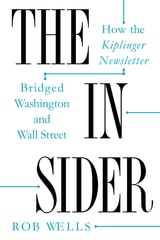
The Insider
How the Kiplinger Newsletter Bridged Washington and Wall StreetRob Wells
University of Massachusetts Press, 2022
When Willard M. Kiplinger launched the groundbreaking Kiplinger Washington Letter in 1923, he left the sidelines of traditional journalism to strike out on his own. With a specialized knowledge of finance and close connections to top Washington officials, Kiplinger was uniquely positioned to tell deeper truths about the intersections between government and business. With careful reporting and insider access, he delivered perceptive analysis and forecasts of business, economic, and political news to busy business executives, and the newsletter’s readership grew exponentially over the coming decades.
More than just a pioneering business journalist, Kiplinger emerged as a quiet but powerful link between the worlds of Presidents Hoover and Roosevelt, and used his Letter to play a little-known but influential role in the New Deal. Part journalism history, part biography, and part democratic chronicle, The Insider offers a well-written and deeply researched portrayal of how Kiplinger not only developed a widely read newsletter that launched a business publishing empire but also how he forged a new role for the journalist as political actor.
The Institutions of France under the Absolute Monarchy, 1598-1789, Volume 1
Society and the StateRoland Mousnier
University of Chicago Press, 1979
In a society divided by hierarchical social groups, conflicts among lineages, communities, and districts became inevitable. Aristocratic disdain, ancestral attachment to privileges, and autonomous powers looked upon as rights, made civil unrest, dislocation, and anarchy endemic. Mousnier examines this contention between classes as they faced each other across the institutional barriers of education, religion, economic resources, technology, means of defense and communication, and territorial and family ties. He shows why a monarchical state was necessary to preserve order within this fragmented society.
Though it was intent on ensuring the survival of French society and the public good, the Absolute Monarchy was unable to maintain security, equilibrium, and cooperation among rival social groups. Discussing the feeble technology at its disposal and its weak means of governing, Mousnier points to the causes that brought the state to the limits of its resources. His comprehensive analysis will greatly interest students of the ancien régime and comparativists in political science and sociology as well.

The Institutions of France under the Absolute Monarchy, 1598-1789, Volume 2
The Origins of State and SocietyRoland Mousnier
University of Chicago Press, 1984
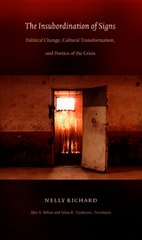
The Insubordination of Signs
Political Change, Cultural Transformation, and Poetics of the CrisisNelly Richard
Duke University Press, 2004
In The Insubordination of Signs Richard theorizes the cultural reactions—particularly within the realms of visual arts, literature, and the social sciences—to the oppression of the Chilean dictatorship. She reflects on the role of memory in the historical shadow of the military regime and on the strategies offered by marginal discourses for critiquing institutional systems of power. She considers the importance of Walter Benjamin for the theoretical self-understanding of the Latin American intellectual left, and she offers revisionary interpretations of the Chilean neo-avantgarde in terms of its relationships with the traditional left and postmodernism. Exploring the gap between Chile’s new left social sciences and its “new scene” aesthetic and critical practices, Richard discusses how, with the return of democracy, the energies that had set in motion the democratizing process seemed to exhaust themselves as cultural debate was attenuated in order to reduce any risk of a return to authoritarianism.
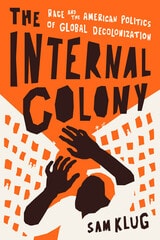
The Internal Colony
Race and the American Politics of Global DecolonizationSam Klug
University of Chicago Press, 2025
In The Internal Colony, Sam Klug reveals the central but underappreciated importance of global decolonization to the divergence between mainstream liberalism and the Black freedom movement in postwar America. Klug reconsiders what has long been seen as a matter of primarily domestic policy in light of a series of debates concerning self-determination, postcolonial economic development, and the meanings of colonialism and decolonization. These debates deeply influenced the discord between Black activists and state policymakers and formed a crucial dividing line in national politics in the 1960s and 1970s.
The result is a history that broadens our understanding of ideological formation—particularly how Americans conceptualized racial power and political economy—by revealing a much wider and more dynamic network of influences. Linking intellectual, political, and social movement history, The Internal Colony illuminates how global decolonization transformed the terms of debate over race and social class in the twentieth-century United States.
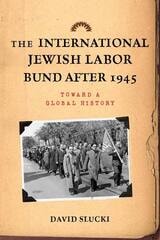
The International Jewish Labor Bund after 1945
Toward a Global HistorySlucki, David
Rutgers University Press, 2012
The Jewish Labor Bund was one of the major political forces in early twentieth-century Eastern Europe. But the decades after the Second World War were years of enormous difficulty for Bundists. Like millions of other European Jews, they faced the challenge of resurrecting their lives, so gravely disrupted by the Holocaust. Not only had the organization lost many members, but its adherents were also scattered across many continents. In this book, David Slucki charts the efforts of the surviving remnants of the movement to salvage something from the wreckage.
Covering both the Bundists who remained in communist Eastern Europe and those who emigrated to the United States, France, Australia, and Israel, the book explores the common challenges they faced—building transnational networks of friends, family, and fellow Holocaust survivors, while rebuilding a once-local movement under a global umbrella. This is a story of resilience and passion—passion for an idea that only barely survived Auschwitz.

The Internationalization of Palace Wars
Lawyers, Economists, and the Contest to Transform Latin American StatesYves Dezalay and Bryant G. Garth
University of Chicago Press, 2002
Based on more than 300 extensive interviews with major players in governments, foundations, law firms, universities, and think tanks, Dezalay and Garth examine both the production of northern exports such as neoliberal economics and international human rights law and the ways they are received south of the United States. They find that the content of what is exported and how it fares are profoundly shaped by domestic struggles for power and influence—"palace wars"—in the nations involved. For instance, challenges to the eastern intellectual establishment influenced the Reagan-era export of University of Chicago-style neoliberal economics to Chile, where it enjoyed a warm reception from Pinochet and his allies because they could use it to discredit the previous regime.
Innovative and sophisticated, The Internationalization of Palace Wars offers much needed concrete information about the transnational processes that shape our world.
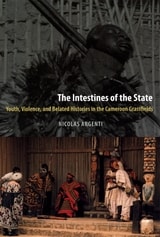
The Intestines of the State
Youth, Violence, and Belated Histories in the Cameroon GrassfieldsNicolas Argenti
University of Chicago Press, 2007
Beginning his study with a political analysis of youth in the Grassfields from the eighteenth century to the present, Argenti pays special attention to the repeated violent revolts staged by young victims of political oppression. He then combines this history with extensive ethnographic fieldwork in the Oku chiefdom, discovering that the specter of past violence lives on in the masked dance performances that have earned intense devotion from today’s youth. Argenti contends that by evoking the imagery of past cataclysmic events, these masquerades allow young Oku men and women to address the inequities they face in their relations with elders and state authorities today.
The Invincible Duff Green
Whig of the WestW. Stephen Belko
University of Missouri Press, 2006