Results by title
18284 books match the query 'United States' and 3764 start with t
The Province of Affliction
Illness and the Making of Early New EnglandBen Mutschler
University of Chicago Press, 2020
The Psychic Hold of Slavery
Legacies in American Expressive CultureSoyica Diggs Colbert, Robert J. Patterson, and Aida Levy-Hussen
Rutgers University Press, 2016
The Public Image
Photography and Civic SpectatorshipRobert Hariman and John Louis Lucaites
University of Chicago Press, 2016
By confronting these conflicted reactions to photography, Robert Hariman and John Louis Lucaites make the case for a fundamental shift in understanding photography and public culture. In place of suspicions about the medium’s capacity for distraction, deception, and manipulation, they suggest how it can provide resources for democratic communication and thoughtful reflection about contemporary social problems.
The key to living well in the image world is to unlock photography from viewing habits that inhibit robust civic spectatorship. Through insightful interpretations of dozens of news images, The Public Image reveals how the artistry of the still image can inform, challenge, and guide reflection regarding endemic violence, environmental degradation, income inequity, and other chronic problems that will define the twenty-first century.
By shifting from conventional suspicions to a renewed encounter with the image, we are challenged to see more deeply on behalf of a richer life for all, and to acknowledge our obligations as spectators who are, crucially, also citizens.

The Public Library Director's Toolkit
Kate Hall and Kathy Parker
American Library Association, 2019
New public library directors quickly learn what seasoned directors already know: running a library means you’ve always got your hands full—balancing the needs of staff, patrons, facilities, library boards, and other stakeholders with professional responsibilities like community interactions, legal and financial requirements, and whole lot else that wasn’t exactly in the job description. Whether you are considering becoming a public library director, are brand new to the role, or have settled in but find yourself thinking “there’s got to be a better way,” authors Hall and Parker are here to help. This book walks you through the core components of getting up to speed and then provides templates, sample documents, checklists, and other resources that will make your job easier. Gleaned from their own decades of experience in library leadership positions, in this toolkit they
- cover such key topics as employees, trustees, finances, legal issues, library policies, emergency planning, and technology;
- discuss strategic planning and share advice on keeping up with trends;
- offer nearly two dozen ready-to-use resources, including a Director’s Report Template, a Social Media Policy, an Employee Exit Questionnaire, a Library Cleaning Checklist, a Vision Statement worksheet, and more; and
- suggest additional learning opportunities in each chapter to help you continue your learning journey.
The Public Life of Privacy in Nineteenth-Century American Literature
Stacey Margolis
Duke University Press, 2005
Margolis provides readings of fiction by Hawthorne and James as well as Susan Warner, Mark Twain, Charles Chesnutt, and Pauline Hopkins. In these writers’ works, she traces a distinctive novelistic tradition that viewed social developments—such as changes in political partisanship and childhood education and the rise of new politico-legal forms like negligence law—as means for understanding how individuals were shaped by their interactions with society. The Public Life of Privacy in Nineteenth-Century American Literature adds a new level of complexity to understandings of nineteenth-century American culture by illuminating a literary tradition full of accidents, mistakes, and unintended consequences—one in which feelings and desires were often overshadowed by all that was external to the self.
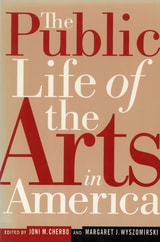
The Public Life of the Arts in America
The Public Life of the Arts in America, Revised EditionCherbo, Joni Maya
Rutgers University Press, 2000
Art and entertainment constitute America’s second-largest export. Most Americans—96%, to be exact—are somehow involved in the arts, whether as audience participants, hobbyists, or via broadcast, recording, video, or the Internet. The contribution of the arts to the U.S. economy is stunning: the nonprofit arts industry alone contributes over 857 billion dollars per year, and America’s fine and performing arts enjoy world-class status.
Despite its size, quality, and economic impact, the arts community is not articulate about how they serve public interests, and few citizens have an appreciation of the myriad of public policies that influence American arts and culture. The contributors to this volume argue that U.S. policy can—and should—support the arts and that the arts, in turn serve a broad rather than an elite public. Indeed, increased support for the arts and culture equals good economic and trade policy; it also contributes to the quality of life and community, and helps sustain the creativity of American artists and organizations.
By encouraging policy-makers to systematically start investigating the crucial role and importance of all of the arts in the United States, The Arts and Public Purpose moves the field forward with fresh ideas, new concepts, and important new data.
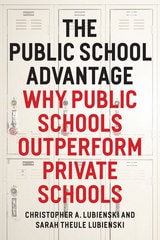
The Public School Advantage
Why Public Schools Outperform Private SchoolsChristopher A. Lubienski and Sarah Theule Lubienski
University of Chicago Press, 2013
For decades research showing that students at private schools perform better than students at public ones has been used to promote the benefits of the private sector in education, including vouchers and charter schools—but much of these data are now nearly half a century old. Drawing on two recent, large-scale, and nationally representative databases, the Lubienskis show that any benefit seen in private school performance now is more than explained by demographics. Private schools have higher scores not because they are better institutions but because their students largely come from more privileged backgrounds that offer greater educational support. After correcting for demographics, the Lubienskis go on to show that gains in student achievement at public schools are at least as great and often greater than those at private ones. Even more surprising, they show that the very mechanism that market-based reformers champion—autonomy—may be the crucial factor that prevents private schools from performing better. Alternatively, those practices that these reformers castigate, such as teacher certification and professional reforms of curriculum and instruction, turn out to have a significant effect on school improvement.
Despite our politics, we all agree on the fundamental fact: education deserves our utmost care. The Public School Advantage offers exactly that. By examining schools within the diversity of populations in which they actually operate, it provides not ideologies but facts. And the facts say it clearly: education is better off when provided for the public by the public.

The Public Trust and the First Americans
Ruthann Knudson
Oregon State University Press, 1995
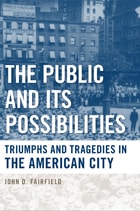
The Public and Its Possibilities
Triumphs and Tragedies in the American CityJohn D. Fairfield
Temple University Press, 2012
In his compelling reinterpretation of American history, The Public and Its Possibilities, John Fairfieldargues that our unrealized civic aspirations provide the essential counterpoint to an excessive focus on private interests. Inspired by the revolutionary generation, nineteenth-century Americans struggled to build an economy and a culture to complement their republican institutions. But over the course of the twentieth century, a corporate economy and consumer culture undercut civic values, conflating consumer and citizen.
Fairfield places the city at the center of American experience, describing how a resilient demand for an urban participatory democracy has bumped up against the fog of war, the allure of the marketplace, and persistent prejudices of race, class, and gender. In chronicling and synthesizing centuries of U.S. history—including the struggles of the antislavery, labor, women’s rights movements—Fairfield explores the ebb and flow of civic participation, activism, and democracy. He revisits what the public has done for civic activism, and the possibility of taking a greater role.
In this age where there has been a move towards greater participation in America's public life from its citizens, Fairfield’s book—written in an accessible, jargon-free style and addressed to general readers—is especially topical.

The Public's Health
A Narrative History Of Health And Disease In ArkansasSam Taggert
Arkansas Times Press, 2013

The Puerto Rican Movement
Voices from the DiasporaAndres Torres
Temple University Press, 1998
To combat these two problems, and drawing n a tradition of patriotism and social responsibility, a number of organizations grew up, including the Young Lords Party (YLP), which later evolved into the Puerto Rican Revolutionary Workers Organization; the Pro Independence Movement (MPI), which evolved into the U.S> branch of the Puerto Rican Socialist Party; El Comite; the Puerto Rican Student Union (PRSU); the Movement for National Liberation (MLN); and the Armed Forces of National Liberation (FALN). THe Puerto Rican Movement looks at all these groups as specific organizations of real people in such places as Boston, Chicago, Hartford, New York, and Philadelphia.
The contributors, almost all of whom were involved with the organizations they describe, provide detailed descriptions and historical analyses of the Puerto Rican Left. Interviews with such key figures as Elizam Escobar, Piri Thomas, and Luis Fuentes, as well as accounts by people active in the gay/lesbian, African American, and white Left movements add a vivid picture of why and how people became radicalized and how their ideals intersected with their group's own dynamics.
These critical assessments highlight each organization's accomplishments and failures and illuminate how different sets of people, in different circumstances, respond to social problems -- in this case, the "national question" and the issues of social justice and movement politics.
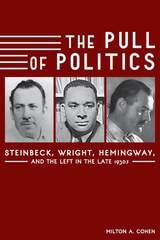
The Pull of Politics
Steinbeck, Wright, Hemingway, and the Left in the Late 1930sMilton A. Cohen
University of Missouri Press, 2018
The Pullman Strike
The Story of a Unique Experiment and of a Great Labor UpheavalAlmont Lindsey
University of Chicago Press, 1964
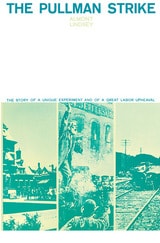
Woven into the narrative is the rise and decline of the extraordinary Pullman experiment. To all outward appearances a philanthropic project conceived by a generous employer for his employees, the "model town" of George Pullman developed into a kind of medieval barony, operated with an iron hand. This experiment is carefully traced in all its varying aspects, with emphasis on its contribution to the origin of the strike.
The Punitive Imagination
Law, Justice, and ResponsibilityAustin Sarat
University of Alabama Press, 2014
From the Gospel of Matthew to numerous US Supreme Court justices, many literary and legal sources have observed that how a society metes out punishment reveals core truths about its character. The Punitive Imagination is a collection of essays that engages and contributes to debates about the purposes and meanings of punishment in the United States.
The Punitive Imagination examines some of the critical assumptions that frame America's approach to punishment. It explores questions such as:
· What is the place of concern for human dignity in our prevailing ideologies of punishment?
· Can we justly punish the socially disadvantaged?
· What assumptions about persons, social institutions, and the ordering of social space provide the basis for American punitiveness?
· Who, if anyone, can be held responsible for excessively punitive criminal sentences?
· How does punishment depend on prevailing views of free will, responsibility, desert, blameworthiness?
· Where/how are those views subject to challenge in our punitive practices?
As Sarat posits in his introduction, the way a society punishes demonstrates its commitment to standards of judgment and justice, its distinctive views of blame and responsibility, its understandings of mercy and forgiveness, and its particular ways of responding to evil. He goes on to discuss the history of punishment in the United States and what it reveals about assumptions made about persons that “undergird” the American system of punishment.
The five additional contributors to The Punitive Imagination seek to illuminate what American practices of punishment tell us about who we are as a nation. Synthesizing cultural, sociological, philosophical, and legal perspectives, they offer a distinctive take on the meaning of punishment in America.
The Puritan Experiment
New England Society from Bradford to EdwardsFrancis J. Bremer
University Press of New England, 1995
The Puritan Experiment
New England Society from Bradford to EdwardsFrancis J. Bremer
Brandeis University Press, 2026
A revised and updated edition of a classic text on the early puritans.
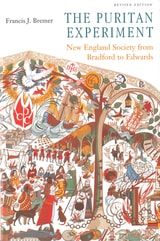
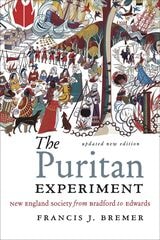
The Puritan Experiment is an accessible, authoritative account of early New England, one with an enduring appeal for students and general readers. This revised and updated edition explains puritanism while incorporating fresh insights from current scholarship.
Tracing the puritans’ journey from the Old World to America, Francis J. Bremer examines the causes and contexts of the puritan movement and analyzes the cultural, political, and economic revolutions wrought by the movement in both Old and New England. A pioneering text in its field, The Puritan Experiment is sweeping in scope. Bremer’s examination begins with the English Act of Supremacy of 1534 which placed King Henry VIII at the head of the Church of England, and it ends with the death of the puritan theologian Jonathan Edwards in 1758. From meeting house architecture to the Salem witch trials, from relations with Native Americans to the founding of the nation’s first colleges, Bremer details with style and grace how “a living system of faith” profoundly influenced the course of history in the New World.
This illustrated edition includes new information about lay empowerment, the role of women, Native society, and the enslavement of Native Americans and Africans.

The Puritan Tradition in America, 1620–1730
Edited by Alden T. Vaughan
University Press of New England, 1997
The Purposeful Graduate
Why Colleges Must Talk to Students about VocationTim Clydesdale
University of Chicago Press, 2015
The key, he argues, is simple: direct, systematic, and creative programs that engage undergraduates on the question of purpose. Backing up his argument with rich data from a Lilly Endowment grant that funded such programs on eighty-eight different campuses, he shows that thoughtful engagement of the notion of vocational calling by students, faculty, and staff can bring rich rewards for all those involved: greater intellectual development, more robust community involvement, and a more proactive approach to lifelong goals. Nearly every institution he examines—from internationally acclaimed research universities to small liberal arts colleges—is a success story, each designing and implementing its own program, that provides students with deep resources that help them to launch flourishing lives.
Flying in the face of the pessimistic forecast of higher education’s emaciated future, Clydesdale offers a profoundly rich alternative, one that can be achieved if we simply muster the courage to talk with students about who they are and what they are meant to do.
The Pursuit of Absolute Integrity
How Corruption Control Makes Government IneffectiveFrank Anechiarico and James B. Jacobs
University of Chicago Press, 1996
The Pursuit of Happiness in the Founding Era
An Intellectual HistoryCarli N. Conklin
University of Missouri Press, 2020
Scholars have long debated the meaning of the pursuit of happiness, yet have tended to define it narrowly, focusing on a single intellectual tradition, and on the use of the term within a single text, the Declaration of Independence. In this insightful volume, Carli Conklin considers the pursuit of happiness across a variety of intellectual traditions, and explores its usage in two key legal texts of the Founding Era, the Declaration and William Blackstone’s Commentaries on the Laws of England.
For Blackstone, the pursuit of happiness was a science of jurisprudence, by which his students could know, and then rightly apply, the first principles of the Common Law. For the founders, the pursuit of happiness was the individual right to pursue a life lived in harmony with the law of nature and a public duty to govern in accordance with that law. Both applications suggest we consider anew how the phrase, and its underlying legal philosophies, were understood in the founding era. With this work, Conklin makes important contributions to the fields of early American intellectual and legal history.
The Pursuit of Happiness
Black Women, Diasporic Dreams, and the Politics of Emotional TransnationalismBianca C. Williams
Duke University Press, 2018
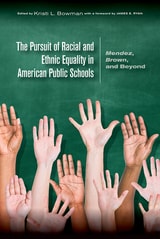
The Pursuit of Racial and Ethnic Equality in American Public Schools
Mendez, Brown, and BeyondKristi L. Bowman
Michigan State University Press, 2015
The Puzzle of Judicial Behavior
Lawrence Baum
University of Michigan Press, 1997
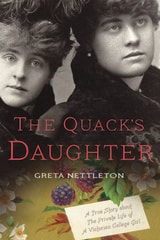
The Quack's Daughter
A True Story about the Private Life of a Victorian College Girl, Revised EditionGreta Nettleton
University of Iowa Press, 2014
This lively, stereotype-shattering story might have been lost, had Cora’s great-granddaughter, Greta Nettleton, not decided to go through some old family trunks instead of discarding most of the contents unexamined. Inside she discovered a rich cache of Cora’s college memorabilia—essential complements to her 1885 diary, which Nettleton had already begun to read. The Quack’s Daughter details Cora’s youthful travails and adventures during a time of great social and economic transformation. From her working-class childhood to her gilded youth and her later married life, Cora experienced triumphs and disappointments as a gifted concert pianist that the reader will recognize as tied to the limited opportunities open to women at the turn of the twentieth century, as well as to the dangerous consequences for those who challenged social norms.
Set in an era of surging wealth torn by political controversy over inequality and women’s rights and widespread panic about domestic terrorists, The Quack’s Daughter is illustrated with over a hundred original images and photographs that illuminate the life of a spirited and charming heroine who ultimately faced a stark life-and-death crisis that would force her to re-examine her doubts about her mother’s medical integrity.
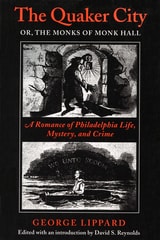
The Quaker City, or The Monks of Monk Hall
A Romance of Philadelphia Life, Mystery, and CrimeGeorge Lippard
University of Massachusetts Press, 1995
The Quality Infrastructure
Measuring, Analyzing, and Improving Library ServicesSarah Anne Murphy
American Library Association, 2013
The Quality Library
A Guide to Self-Improvement, Better Efficiency, and Happier CustomersSara Laughlin
American Library Association, 2008
The Quality of American Life
Perceptions, Evaluations, and SatisfactionsAngus Campbell
Russell Sage Foundation, 1976
The Queen of America Goes to Washington City
Essays on Sex and CitizenshipLauren Berlant
Duke University Press, 1997
As Berlant traces the guiding images of U.S. citizenship through the process of privatization, she discusses the ideas of intimacy that have come to define national culture. From the fantasy of the American dream to the lessons of Forrest Gump, Lisa Simpson to Queer Nation, the reactionary culture of imperilled privilege to the testimony of Anita Hill, Berlant charts the landscape of American politics and culture. She examines the consequences of a shrinking and privatized concept of citizenship on increasing class, racial, sexual, and gender animosity and explores the contradictions of a conservative politics that maintains the sacredness of privacy, the virtue of the free market, and the immorality of state overregulation—except when it comes to issues of intimacy.
Drawing on literature, the law, and popular media, The Queen of America Goes to Washington City is a stunning and major statement about the nation and its citizens in an age of mass mediation. As it opens a critical space for new theory of agency, its narratives and gallery of images will challenge readers to rethink what it means to be American and to seek salvation in its promise.

The Queen's American Rangers
Donald J. Gara
Westholme Publishing, 2015
Prior to the British attack on Long Island in August 1776, French and Indian War hero Robert Rogers organized a regiment to join the fight—but not on the side of his native New Hampshire. Named in honor of Queen Charlotte, the wife of King George III, Rogers’s regiment recruited the bulk of its soldiers from the large number of Loyalist refugees on Staten Island who had fled from New York. Rogers’s command of the unit was short-lived, however, after a humiliating defeat in late October by a surprise attack on his headquarters. Under new leadership, the unit played a decisive role and suffered heavy casualties at the battle of Brandywine that brought them their first favorable attention from the British high command. With this performance, and under the able leadership of John Graves Simcoe, the Queen’s American Rangers—sometimes known as “Simcoe’s Rangers”—were frequently assigned to serve alongside British regular troops in many battles, including Monmouth, Springfield, Charleston, and Yorktown. Receiving frequent high praise from Lieutenant General Sir Henry Clinton, the Commander in Chief of the British Army in America, the unit was placed on the American Establishment of the British Army in May 1779, a status conferred on provincial units that had performed valuable services during the war, and was renamed the 1st American Regiment. Before the end of the war, the rangers were fully incorporated into the British regular army, one of only four Loyalist units to be so honored.
The Queen’s American Rangers by historian Donald J. Gara is the first book-length account of this storied unit. Based on extensive primary source research, the book traces the complete movements, command changes, and battle performances of the rangers, from their first muster to their formal incorporation into the British Army and ultimate emigration to Canada on land grants conferred by a grateful British crown.

The Queer Fantasies of the American Family Sitcom
Pugh, Tison
Rutgers University Press, 2018
The Queer Fantasies of the American Family Sitcom examines the evasive depictions of sexuality in domestic and family-friendly sitcoms. Tison Pugh charts the history of increasing sexual depiction in this genre while also unpacking how sitcoms use sexuality as a source of power, as a kind of camouflage, and as a foundation for family building. The book examines how queerness, at first latent, became a vibrant yet continually conflicted part of the family-sitcom tradition.
Taking into account elements such as the casting of child actors, the use of and experimentation with plot traditions, the contradictory interpretive valences of comedy, and the subtle subversions of moral standards by writers and directors, Pugh points out how innocence and sexuality conflict on television. As older sitcoms often sit on a pedestal of nostalgia as representative of the Golden Age of the American Family, television history reveals a deeper, queerer vision of family bonds.
Download open access ebook here.
The Queerness of Home
Gender, Sexuality, and the Politics of Domesticity after World War IIStephen Vider
University of Chicago Press, 2021
From the Stonewall riots to the protests of ACT UP, histories of queer and trans politics have almost exclusively centered on public activism. In The Queerness of Home, Stephen Vider turns the focus inward, showing that the intimacy of domestic space has been equally crucial to the history of postwar LGBTQ life.
Beginning in the 1940s, LGBTQ activists looked increasingly to the home as a site of connection, care, and cultural inclusion. They struggled against the conventions of marriage, challenged the gendered codes of everyday labor, reimagined domestic architecture, and contested the racial and class boundaries of kinship and belonging. Retelling LGBTQ history from the inside out, Vider reveals the surprising ways that the home became, and remains, a charged space in battles for social and economic justice, making it clear that LGBTQ people not only realized new forms of community and culture for themselves—they remade the possibilities of home life for everyone.

The Quest for Authority and Honor in the American Professions, 1750-1900
Samuel Haber
University of Chicago Press, 1991
Contrary to those who regard the professions as exemplary and up-to-date specimens of social modernization or economic monopoly, Haber argues that they bring both preindustrial and predemocratic ideals and standards into our modern world. He proposes that the values embedded in the professions—authority and honor, fused with duty and responsibility—have their origins in the class position and occupational prescriptions of eighteenth-century English gentlemen. Such an argument has implications for the understanding of American society; it underscores the cumulative and variegated nature of our culture and suggests the drawbacks of trying to describe society as a system. It also accords with Haber's endeavor to write a history that rescues for description and analysis mixed motives, composite conditions, and persons and parties acting upon contradictory explanatory schemes.
Haber traces the cultural evolution of the professions through three stages—establishment (1750-1830), disestablishment (1830-1880), and reestablishment (1880-1900). He shows that when the gentlemanly class declined in the United States, the professions maintained status even in somewhat hostile settings. The professions thus came to be seen as a middle way between the pursuits of laborers and those of capitalists. Massive in scale and ambition, this book will have a formidable impact among scholars newly attuned to the history of American middle-class culture.
The Quest for the Golden Trout
Environmental Loss and America’s Iconic FishDouglas M. Thompson
University Press of New England, 2013
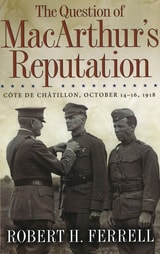
The Question of MacArthur's Reputation
Côte De Châtillon, October 14-16, 1918Robert H. Ferrell
University of Missouri Press, 2008
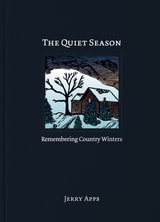
The Quiet Season
Remembering Country WintersJerry Apps
Wisconsin Historical Society Press, 2025
“As I think back to the days of my childhood, the frost-covered windows in my bedroom, the frigid walks to the country school, the excitement of a blizzard, and a hundred other memories, I realize that these experiences left an indelible mark on me and made me who I am today.”—From the Introduction
Jerry Apps recalls winters growing up on a farm in central Wisconsin during the latter years of the Depression and through World War II. Before electricity came to this part of Waushara County, farmers milked cows by hand with the light of a kerosene lantern, woodstoves heated the drafty farm homes, and “making wood” was a major part of every winter’s work. The children in Jerry’s rural community walked to a country school that was heated with a woodstove and had no indoor plumbing. Wisconsin winters then were a time of reflection, of planning for next year, and of families drawing together. Jerry describes how winter influenced farm families and suggests that those of us who grow up with harsh northern winters are profoundly affected in ways we often are not aware.

The Quiet Season
Remembering Country WintersJerry Apps
Wisconsin Historical Society Press, 2025
“As I think back to the days of my childhood, the frost-covered windows in my bedroom, the frigid walks to the country school, the excitement of a blizzard, and a hundred other memories, I realize that these experiences left an indelible mark on me and made me who I am today.”—From the Introduction
Jerry Apps recalls winters growing up on a farm in central Wisconsin during the latter years of the Depression and through World War II. Before electricity came to this part of Waushara County, farmers milked cows by hand with the light of a kerosene lantern, woodstoves heated the drafty farm homes, and “making wood” was a major part of every winter’s work. The children in Jerry’s rural community walked to a country school that was heated with a woodstove and had no indoor plumbing. Wisconsin winters then were a time of reflection, of planning for next year, and of families drawing together. Jerry describes how winter influenced farm families and suggests that those of us who grow up with harsh northern winters are profoundly affected in ways we often are not aware.
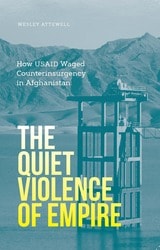
The Quiet Violence of Empire
How USAID Waged Counterinsurgency in AfghanistanWesley Attewell
University of Minnesota Press, 2023
How the U.S. empire-state transformed post-1945 Afghanistan into a key site for reimagining development
Established in 1961 by President Kennedy, the United States Agency for International Development (USAID) is often viewed as an extension of the security state, playing a constant role on the ground in Afghanistan since the early sixties. The Quiet Violence of Empire traces USAID’s long and bloody history of development work in the region, revealing an empirically rich account of the transnational entanglements of imperialism and racial capitalism.
Wesley Attewell carefully analyzes three chronological moments of development as counterinsurgency in action: the Helmand Valley Project, the Soviet–Afghan conflict, and the post-9/11 occupation in Afghanistan. These case studies expose how USAID’s very public commitment to bringing seemingly inclusionary forms of self-help, technical assistance, and market development to Afghanistan has been undergirded by longer-standing infrastructures of race war and racial management. Attewell exposes how one of the net effects of USAID’s development mission to Afghanistan has been to constrain the life chances of Afghan beneficiaries while simultaneously diverting development capital back to U.S. contractors, deftly underscoring the notion of development as a form of slow violence.
The Quiet Violence of Empire asks the critical question: how might we refuse the ruse of USAID and its endlessly deferred promise of development? Thinking relationally across the fields of human geography, global studies, and critical ethnic studies, it uncovers the explicitly racial underpinnings of international development theory and praxis.
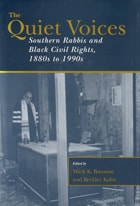
The Quiet Voices
Southern Rabbis and Black Civil Rights, 1880s to 1990sMark K. Bauman
University of Alabama Press, 1997
These wide-ranging essays reveal the various roles played by southern rabbis in the struggle for black civil rights since Reconstruction
The study of black-Jewish relations has become a hotbed of controversy, especially with regard to the role played by Jewish leaders during the Civil Rights movement. Did these leaders play a pivotal role, or did many of them, especially in the South, succumb to societal pressure and strive to be accepted rather than risk being persecuted? If some of these leaders did choose a quieter path, were their reasons valid? And were their methods successful?
Individually, each essay offers a glimpse into both the private and public difficulties these rabbis faced in their struggle to achieve good. Collectively, the essays provide an unparalleled picture of Jewish leadership during the civil rights era.
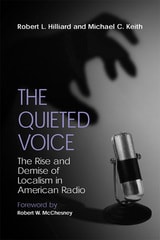
The Quieted Voice
Robert L. Hilliard and Michael C. Keith. Foreword by Robert W. McChesney
Southern Illinois University Press, 2005
How has American radio—once a grassroots, community-based medium—become a generic service that primarily benefits owners and shareholders and prohibits its listeners from receiving diversity of opinions, ideas, and entertainment through local programming? In The Quieted Voice: The Rise and Demise of Localism in American Radio, Robert L. Hilliard and Michael C. Keith blame the government’s continual deregulation of radio and the corporate obsession with the bottom line in the wake of the far-reaching and controversial Telecommunications Act of 1996. Fighting for greater democratization of the airwaves, Hilliard and Keith call for a return to localism to save radio from rampant media conglomeration and ever-narrowing music playlists—and to save Americans from corporate and government control of public information.
The Quieted Voice details radio’s obligation to broadcast in the public’s interest. Hilliard and Keith trace the origins of the public trusteeship behind the medium and argue that local programming is essential to the fulfillment of this responsibility. From historical and critical perspectives, they examine the decline of community-centered programming and outline the efforts of media watchdog and special interest groups that have vigorously opposed the decline of democracy and diversity in American radio. They also evaluate the implications of continuing delocalization of the radio medium and survey the perspectives of leading media scholars and experts.

The Race of Sound
Listening, Timbre, and Vocality in African American MusicNina Sun Eidsheim
Duke University Press, 2018
The Race to 270
The Electoral College and the Campaign Strategies of 2000 and 2004Daron R. Shaw
University of Chicago Press, 2006
The Electoral College has played an important role in presidential politics since our nation’s founding, but surprisingly little information exists about precisely how it affects campaign strategy. Daron R. Shaw, a scholar who also worked as a strategist in both Bush-Cheney campaigns, has written the first book to go inside the past two presidential elections and reveal how the race to 270 was won—and lost.
Shaw’s nonpartisan study lays out how both the Democrats and the Republicans developed strategies to win decisive electoral votes by targeting specific states and media markets. Drawing on his own experience with Republican battle plans, candidate schedules, and advertising purchases—plus key contacts in the Gore and Kerry camps—Shaw goes on to show that both sides used information on weekly shifts in candidate support to reallocate media buys and schedule appearances. Most importantly, he uses strikingly original research to prove that these carefully constructed plans significantly affected voters’ preferences and opinions—not in huge numbers, but enough to shift critical votes in key battlegrounds.
Bridging the gap between those who study campaigns and those who conduct them, The Race to 270 will provide political scientists and practitioners alike with fresh insights about the new strategies that stem from one of our oldest institutions.
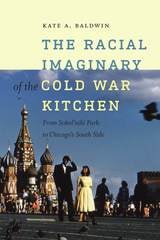
The Racial Imaginary of the Cold War Kitchen
From Sokol’niki Park to Chicago’s South SideKate A. Baldwin
Dartmouth College Press, 2016
The Racial Logic of Politics
Asian Americans and Party CompetitionThomas P. Kim
Temple University Press, 2006

The Racial Order
Mustafa Emirbayer and Matthew Desmond
University of Chicago Press, 2015
In the end, this project is not merely about race; it is a theoretical reconsideration of the fundamental problems of order, agency, power, and social justice. The Racial Order is a challenging work of social theory, institutional and cultural analysis, and normative inquiry.
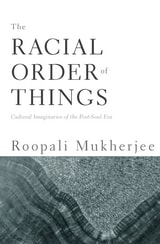
The Racial Order Of Things
Cultural Imaginaries Of The Post-Soul EraRoopali Mukherjee
University of Minnesota Press, 2006

The Rage of John Dos Passos
Christopher Tomlins
University of Chicago Press, 2027
A close look at the emotional and intellectual world of writer John Dos Passos, who was at one time America’s leading modernist, that reveals the political and cultural rhythms of the twentieth century.
John Dos Passos (1896–1970) was a prolific writer—at once compulsive and enigmatic—who became famous in the 1930s as America’s leading literary modernist, only to be eclipsed in the second half of his life because of his own political and aesthetic choices. The Rage of John Dos Passos adopts a psychoanalytic perspective to comprehend the curious career of a man whom Jean-Paul Sartre described in 1938 as “the greatest writer of our time.”
As a young man after World War I, Dos Passos wrote books that won him notoriety as an intemperate critic of American society. His Three Soldiers (1921) was called an insult to the army in which he had been enlisted. His impressionistic novel of New York City, Manhattan Transfer (1925), was dismissed as “spattered filth.” Then in the 1930s, three wildly creative and politically engaged novels written under the collective title U.S.A. truly made his name. Yet Dos Passos then abandoned his youthful radicalism to embrace strident anticommunism and the second Red Scare.
The Rage of John Dos Passos examines the central strands of the author’s life, from infancy until death, and the full range of his writing, including his often-scorned late novels. Christopher Tomlins aims to fuse history, biography, and literary analysis in understanding Dos Passos and his times—and our own.
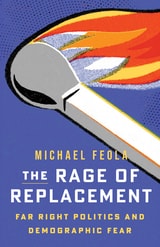
The Rage of Replacement
Far Right Politics and Demographic FearMichael Feola
University of Minnesota Press, 2024
Tracing how the “Great Replacement” narrative has shaped far-right extremism and propelled its dangerous political projects and acts of violence
The “Great Replacement” narrative, which imagines that historic white majorities are being intentionally replaced through immigration policies crafted by global elites, has effectively mobilized racist, nationalist, and nativist movements in the United States and Europe. The Rage of Replacement tracks how this narrative has shaped the politics and worldview of the far right, binding its various camps into a community of rage obsessed with nostalgia for a white-supremacist past.
Showing how the replacement narrative has found significant purchase in recent mainstream discourse through the rise of Trumpism, right-wing media figures like Tucker Carlson, and events such as 2017’s “Unite the Right” rally in Charlottesville, Virginia, Michael Feola diagnoses the dangers this racist theory poses as it shapes the far-right imagination, expands through civil society, and deforms political culture. In particular, he tracks how the replacement narrative has given rise to malignant political strategies designed to “take back” the nation from its perceived enemies—by force if deemed necessary.
Identifying the Great Replacement narrative as a central force behind the rise and expansion of far-right extremism, Feola shows how it has motivated a variety of dangerous political projects in pursuit of illiberal, antidemocratic futures. From calls for the creation of segregated white ethnostates to extremist violence such as the mass shootings in Christchurch, El Paso, and Buffalo, The Rage of Replacement makes clear that replacement theory poses a dire threat to democracy and safety.
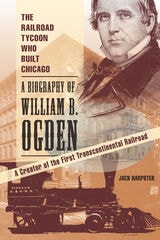
The Railroad Tycoon Who Built Chicago
A Biography of William B. OgdenJack Harpster
Southern Illinois University Press, 2009
William Butler Ogden was a pioneer railroad magnate, one of the earliest founders and developers of the city of Chicago, and an important influence on U.S. westward expansion. His career as a businessman stretched from the streets of Chicago to the wilds of the Wisconsin lumber forests, from the iron mines of Pennsylvania to the financial capitals in New York and beyond. Jack Harpster’s The Railroad Tycoon Who Built Chicago: A Biography of William B. Ogden is the first chronicle of one of the most notable figures in nineteenth-century America.
Harpster traces the life of Ogden from his early experiences as a boy and young businessman in upstate New York to his migration to Chicago, where he invested in land, canal construction, and steamboat companies. He became Chicago’s first mayor, built the city’s first railway system, and suffered through the Great Chicago Fire. His diverse business interests included real estate, land development, city planning, urban transportation, manufacturing, beer brewing, mining, and banking, to name a few. Harpster, however, does not simply focus on Ogden’s role as business mogul; he delves into the heart and soul of the man himself.
The Railroad Tycoon Who Built Chicago is a meticulously researched and nuanced biography set against the backdrop of the historical and societal themes of the nineteenth century. It is a sweeping story about one man’s impact on the birth of commerce in America. Ogden’s private life proves to be as varied and interesting as his public persona, and Harpster weaves the two into a colorful tapestry of a life well and usefully lived.
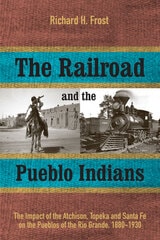
The Railroad and the Pueblo Indians
The Impact of the Atchison, Topeka and Santa Fe on the Pueblos of the Rio Grande, 1880-1930Richard H. Frost
University of Utah Press, 2015
The Pueblo communities responded variously, though mostly conservatively to sustain their traditional communities. This book spotlights two very different responses. Santo Domingo's reaction was hostile, but Laguna chose accommodation. These reactions reveal previously overlooked aspects of these pueblos’ histories that provide compelling reasons behind their varying responses. The book also analyzes the self-contradictory nature of Pueblo constitutional law from 1876 to 1913 and describes conflicted Bureau of Indian Affairs treatment of the Pueblos in the late nineteenth and early twentieth centuries. Each in turn had fateful consequences.