Results by title
2646 books match the query 'History & Criticism' and 549 start with t
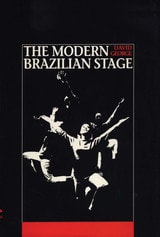
The Modern Brazilian Stage
By David George
University of Texas Press, 1992
Reading a play and watching it performed onstage are quite different experiences. Likewise, studying a country's theatrical tradition with reference only to playtexts overlooks the vital impact of a play's performance on the audience and on the whole artistic community. In this performance-centered approach to Brazilian theatre since the 1940s, David George explores a total theatrical language—the plays, the companies that produced them, and the performances that set a standard for all future stagings.
George structures the discussion around several important companies. He begins with Os Comediantes, whose revolutionary 1943 staging of Nelson Rodrigues' Vestido de Noiva (Bridal Gown) broke with the outmoded comedy-of-manners formula that had dominated the national stage since the nineteenth century. He considers three companies of the 1950s and 1960s—Teatro Brasileiro de Comédia, Teatro de Arena, and Teatro Oficina—along with the 1967 production of O Rei da Vela (The Candle King) by Teatro Oficina.
The 1970s represented a wasteland for Brazilian theatre, George finds, in which a repressive military dictatorship muzzled artistic expression. The Grupo Macunaíma brought theatre alive again in the 1980s, with its productions of Macunaíma and Nelson 2 Rodrigues.
Common to all theatrical companies, George concludes, was the desire to establish a national aesthetic, free from European and United States models. The creative tension this generated and the successes of modern Brazilian theatre make lively reading for all students of Brazilian and world drama.
The Modern British Horror Film
Gerrard, Steven
Rutgers University Press, 2017
Tracking the revitalization of the British horror film industry over the past two decades, media expert Steven Gerrard also investigates why audiences have flocked to these movies. To answer that question, he focuses on three major trends: “hoodie horror” movies responding to fears about Britain’s urban youth culture; “great outdoors” films where Britain’s forests, caves, and coasts comprise a terrifying psychogeography; and psychological horror movies in which the monster already lurks within us.
Offering in-depth analysis of numerous films, including The Descent, Outpost, and The Woman in Black, this book takes readers on a lively tour of the genre’s highlights, while provocatively exploring how these films reflect viewers’ gravest fears about the state of the nation. Whether you are a horror buff, an Anglophile, or an Anglophobe, The Modern British Horror Film is sure to be a thrilling read.
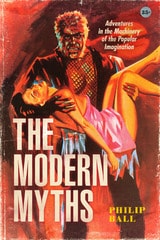
The Modern Myths
Adventures in the Machinery of the Popular ImaginationPhilip Ball
University of Chicago Press, 2021
Myths are usually seen as stories from the depths of time—fun and fantastical, but no longer believed by anyone. Yet, as Philip Ball shows, we are still writing them—and still living them—today. From Robinson Crusoe and Frankenstein to Batman, many stories written in the past few centuries are commonly, perhaps glibly, called “modern myths.” But Ball argues that we should take that idea seriously. Our stories of Dracula, Dr. Jekyll and Mr. Hyde, and Sherlock Holmes are doing the kind of cultural work that the ancient myths once did. Through the medium of narratives that all of us know in their basic outline and which have no clear moral or resolution, these modern myths explore some of our deepest fears, dreams, and anxieties. We keep returning to these tales, reinventing them endlessly for new uses. But what are they really about, and why do we need them? What myths are still taking shape today? And what makes a story become a modern myth?
In The Modern Myths, Ball takes us on a wide-ranging tour of our collective imagination, asking what some of its most popular stories reveal about the nature of being human in the modern age.
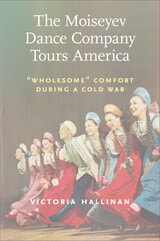
The Moiseyev Dance Company Tours America
"Wholesome" Comfort during a Cold WarVictoria Hallinan
University of Massachusetts Press, 2023
During the Cold War, dancers and musicians from the United States and the USSR were drawn into the battle for hearts and minds, crossing the Iron Curtain to prove their artistic and ideological prowess. After the passage of the Lacy-Zarubin Agreement, direct cultural exchange between the two superpowers opened up, and the Moiseyev Dance Company arrived in the United States in 1958. The first Soviet cultural representatives to tour America, this folk-dance troupe’s repertoire included dances from territories controlled or influenced by the USSR, including Uzbekistan, Crimea, and Poland.
Drawing on contemporary personal and published accounts, Victoria Hallinan explores why the dancers garnered overwhelming acclaim during their multicity tour and Ed Sullivan Show appearance. The “boy-meets-girl” love stories of the dances, and their idealized view of multiple Soviet cultures living together in harmony, presented a comforting image of post–World War II gender norms and race relations for audiences. Americans saw the dancers—their supposed enemies—as humans rather than agents of communist contagion.
The Money Shot
Trash, Class, and the Making of TV Talk ShowsLaura Grindstaff
University of Chicago Press, 2002
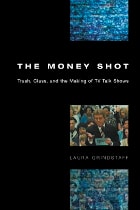
From "classy" shows like Oprah to "trashy" shows like Jerry Springer, the key to a talk show's success is what Laura Grindstaff calls the money shot—moments when guests lose control and express joy, sorrow, rage, or remorse on camera. In this new work, Grindstaff takes us behind the scenes of daytime television talk shows, a genre focused on "real" stories told by "ordinary" people. Drawing on extensive interviews with producers and guests, her own attendance of dozens of live tapings around the country, and more than a year's experience working on two nationally televised shows, Grindstaff shows us how producers elicit dramatic performances from guests, why guests agree to participate, and the supporting roles played by studio audiences and experts.
Grindstaff traces the career of the money shot, examining how producers make stars and experts out of ordinary people, in the process reproducing old forms of cultural hierarchy and class inequality even while seeming to challenge them. She argues that the daytime talk show does give voice to people normally excluded from the media spotlight, but it lets them speak only in certain ways and under certain rules and conditions. Working to understand the genre from the inside rather than pass judgment on it from the outside, Grindstaff asks not just what talk shows can tell us about mass media, but also what they reveal about American culture more generally.
The Mormon Tabernacle Choir
A BiographyMichael Hicks
University of Illinois Press, 2015
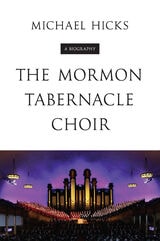
Drawing on decades of work observing and researching the Mormon Tabernacle Choir, Michael Hicks examines the personalities, decisions, and controversies that shaped "America's choir." Here is the miraculous story behind the Tabernacle's world-famous acoustics, the anti-Mormonism that greeted early tours, the clashes with Church leaders over repertoire and presentation, the radio-driven boom in popularity, the competing visions of rival conductors, and the Choir's aspiration to be accepted within classical music even as Mormons sought acceptance within American culture at large. Everything from Billboard hits to TV appearances to White House performances paved the way for Mormonism's crossover triumph. Yet, as Hicks shows, such success raised fundamental concerns regarding the Choir's mission, functions, and image.
The Moses Complex
Freud, Schoenberg, Straub/HuilletUte Holl
Diaphanes, 2016
In The Moses Complex, Ute Holl analyzes these major works in detail and deep historical context, synthesizing the complex models of resistance to explore the relationships among media, migration, and politics. Since Moses descended from Sinai with the tablets inscribed with the Ten Commandments, new media and new laws have often emerged simultaneously. Liberation, in particular, has been negotiated through many different cultural media, with psychoanalysis, music, and cinema all describing exodus and exile as a process of force. Offering a dynamic and comprehensive political and cultural theory of migration and violence, The Moses Complex speaks equally well to psychoanalytic, musical, and cinematic thinking as it does to our tendency toward violence in the treatment of migrants today.
The Most American Thing in America
Circuit Chautauqua as PerformanceCanning, Charlotte M.
University of Iowa Press, 2005
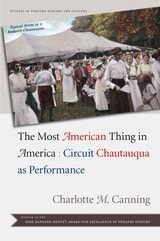
Between 1904 and the Great Depression, Circuit Chautauquas toured the rural United States, reflecting and reinforcing its citizens’ ideas, attitudes, and politics every summer through music (the Jubilee Singers, an African American group, were not always welcome in a time when millions of Americans belonged to the KKK), lectures (“Civic Revivalist” Charles Zueblin speaking on “Militancy and Morals”), elocutionary readers (Lucille Adams reading from Little Lord Fauntleroy), dramas (the Ben Greet Players’ cleaned-up version of She Stoops to Conquer), orations (William Jennings Bryan speaking about the dangers of greed), and special programs for children (parades and mock weddings).
Theatre historians have largely ignored Circuit Chautauquas since they did not meet the conventional conditions of theatrical performance: they were not urban; they produced no innovative performance techniques, stage material, design effects, or dramatic literature. In this beautifully written and illustrated book, Charlotte Canning establishes an analytical framework to reveal the Circuit Chautauquas as unique performances that both created and unified small-town America.
One of the last strongholds of the American traditions of rhetoric and oratory, the Circuits created complex intersections of community, American democracy, and performance. Canning does not celebrate the Circuit Chautauquas wholeheartedly, nor does she describe them with the same cynicism offered by Sinclair Lewis. She acknowledges their goals of community support, informed public thinking, and popular education but also focuses on the reactionary and regressive ideals they sometimes embraced. In the true interdisciplinary spirit of Circuit Chautauquas, she reveals the Circuit platforms as places where Americans performed what it meant to be American.
The Motet Books of Andrea Antico
Edited by Martin Picker
University of Chicago Press, 1987
Andrea Antico was one of the earliest and most important music publishers. Starting in Rome in 1510 and continuing in Venice, Antico produced elegant books of polyphonic music, cut with incredible skill on wood blocks. The repertory he published is central to understanding sixteenth-century music. It includes, for example, many pieces sung regularly in the Sistine Chapel. Since the best-represented composer in Antico's volumes if Jean Mouton, chapel master to the French king, these motet books provide insights into the character of music both at the Vatican and at the French court at the height of the Renaissance.
Martin Picker provides an exemplary edition of the four volumes of motets published by Antico in the early 1520s. His edition includes, in modern notation, all of the contents of these volumes not previously published in the Medici Codex (Monuments of Renaissance Music, Volumes III-V). Picker prefaces his edition with a history of Antico's publishing career and a discussion of each piece and its sources. The list of concordant sources and the discussions of important variants will be of enormous value to Renaissance scholars.
The Movies as a World Force
American Silent Cinema and the Utopian ImaginationFriedman, Ryan J
Rutgers University Press, 2019
The Movies of Racial Childhoods
Screening Self-Sovereignty in Asian/AmericaCeline Parreñas Shimizu
Duke University Press, 2024
The Music between Us
Is Music a Universal Language?Kathleen Marie Higgins
University of Chicago Press, 2012

The Musical Comedy Films of Grigorii Aleksandrov
Laughing MattersRimgaila Salys
Intellect Books, 2009
Grigorii Aleksandrov’s musical comedy films, created with composer Isaak Dunaevskii, were the most popular Russian cinema of the 1930s and ’40s. Drawing on studio documents, press materials, and interviews with surviving film crew members, The Musical Comedy Films of Grigorii Aleksandrov presents the untold production history of the films. Salys explores how Aleksandrov’s cinema preserved the paradigms of the American musical, including its comedic tradition, using both to inscribe the foundation myths of the Stalin era in the national consciousness. As the first major study to situate these films in the cultural context of the era, this book will be essential to courses on Russian cinema and Soviet culture.
The Musician as Philosopher
New York’s Vernacular Avant-Garde, 1958–1978Michael Gallope
University of Chicago Press, 2024
The Musician as Philosopher explores the philosophical thought of avant-garde musicians in postwar New York: David Tudor, Ornette Coleman, the Velvet Underground, Alice Coltrane, Patti Smith, and Richard Hell. It contends that these musicians—all of whom are understudied and none of whom are traditionally taken to be composers—not only challenged the rules by which music is written and practiced but also confounded and reconfigured gendered and racialized expectations for what critics took to be legitimate forms of musical sound. From a broad historical perspective, their arresting music electrified a widely recognized social tendency of the 1960s: a simultaneous affirmation and crisis of the modern self.
The NBC Advisory Council and Radio Programming, 1926-1945
Louise M. Benjamin
Southern Illinois University Press, 2009
In 1926, the new NBC networks established an advisory board of prominent citizens to help it make program decisions as well as to deflect concerns over NBC’s dominance over radio. The council, which advised NBC on program development—especially cultural broadcasts and those aimed at rural audiences—influenced not only NBC’s policies but also decisions other radio organizations made, decisions that resonate in today’s electronic media
The council’s rulings had wide-ranging impact on society and the radio industry, addressing such issues as radio’s operation in the public interest; access of religious groups to the airwaves; personal attacks on individuals, especially the clergy; and coverage of controversial issues of public importance. Principles adopted in these decrees kept undesirable shows off the air, and other networks, stations, and professional broadcast groups used the council’s decisions in establishing their own organizational guidelines.
Benjamin documents how these decrees had influence well after the council’s demise. Beginning in the early 1930s, the council denied use of NBC to birth control advocates. This refusal revealed a pointed clash between traditional and modernistic elements in American society and laid down principles for broadcasting controversial issues. This policy resonated throughout the next five decades with the implementation of the Fairness Doctrine.
The NBC Advisory Council and Radio Programming, 1926–1945 offers the first in-depth examination of the council, which reflected and shaped American society during the interwar period. Author Louise M. Benjamin tracks the council from its inception until it was quietly disbanded in 1945, insightfully critiquing the council’s influence on broadcast policies, analyzing early attempts at using the medium of radio to achieve political goals, and illustrating the council’s role in the development of program genres, including news, sitcoms, crime drama, soap operas, quiz shows, and variety programs.
The Naked Truth
Why Hollywood Doesn't Make X-rated MoviesSandler, Kevin S
Rutgers University Press, 2007
The Names of Minimalism
Authorship, Art Music, and Historiography in DisputePatrick Nickleson
University of Michigan Press, 2023
Expanding the place of Jacques Rancière’s philosophy within musicology, Nickleson draws attention to disciplinary practices of guarding compositional authority against artists who set out to undermine it. The book reimagines the canonic artists and works of minimalism as “(early) minimalism,” to show that art music histories refuse to take seriously challenges to conventional authorship as a means of defending the very category “art music.” Ultimately, Nickleson asks where we end up if we imagine the early minimalist project—artists forming bands to perform their own music, rejecting the score in favor of recording, making extensive use of magnetic type as compositional and archival medium, hosting performances in lofts and art galleries rather than concert halls—not as a utopian moment within a 1960s counterculture doomed to fail, but as the beginning of a process with a long and influential afterlife.

The National Stage
Theatre and Cultural Legitimation in England, France, and AmericaLoren Kruger
University of Chicago Press, 1992
The National Stage answers this question by tracing the relation between theatre institution and public sphere in the discourses of national identity in Britain, France, and the United States. Exploring the boundaries between history and theory, text and performance, this book speaks to theatre and social historians as well as those interested in the theoretical range of cultural studies.
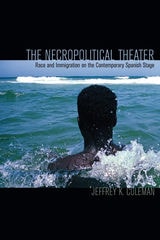
The Necropolitical Theater
Race and Immigration on the Contemporary Spanish StageJeffrey K. Coleman
Northwestern University Press, 2020
Coleman identifies an inherent racial hierarchy informed by the legacies of colonization and religious intolerance.
Drawing on theatrical texts, performances, legal documents, interviews, and critical reviews, this book challenges Spanish theater to develop a new theatrical space. Jeffrey K. Coleman proposes a “convivial theater” that portrays immigrants as contributors to the Spanish state and better represents the multicultural reality of the nation today.

The Needle and the Lens
Pop Goes to the Movies from Rock 'n' Roll to SynthwaveNate Patrin
University of Minnesota Press, 2023
How the creative use of pop music in film—think Saturday Night Fever or Apocalypse Now—has shaped and shifted music history since the 1960s
Quick: What movie do you think of when you hear “The Sounds of Silence”? Better yet, what song comes to mind when you think of The Graduate? The link between film and song endures as more than a memory, Nate Patrin suggests with this wide-ranging and energetic book. It is, in fact, a sort of cultural symbiosis that has mutually influenced movies and pop music, a phenomenon Patrin tracks through the past fifty years, revealing the power of music in movies to move the needle in popular culture.
Rock ’n’ roll, reggae, R&B, jazz, techno, and hip-hop: each had its moment—or many—as music deployed in movies emerged as a form of interpretive commentary, making way for the legitimization of pop and rock music as art forms worthy of serious consideration. These commentaries run the gamut from comedic irony to cheap-thrills excitement to deeply felt drama, all of which Patrin examines in pairings such as American Graffiti and “Do You Want to Dance?”; Saturday Night Fever and “Disco Inferno”; Apocalypse Now and “The End”; Wayne’s World and “Bohemian Rhapsody”; and Jackie Brown and “Didn't I Blow Your Mind This Time?”.
What gives power to these individual moments, and how have they shaped and shifted music history, recasting source material or even stirring wider interest in previously niche pop genres? As Patrin surveys the scene—musical and cinematic—across the decades, expanding into the deeper origins, wider connections, and echoed histories that come into play, The Needle and the Lens offers a new way of seeing, and hearing, these iconic soundtrack moments.
The Neoliberal Self in Bollywood
Cinema, Popular Culture, and IdentityNamrata Rele Sathe
Intellect Books, 2025
The neoliberal self, far from being a stable marker of urban, liberal, millennial Indian identity, is replete with contradictions and oppositions. This study of the unstable neoliberal identity lays bare the sense of precarity and inherent inequality that neoliberal regimes confer upon their subjects.
This analysis draws upon theories of feminist media studies, popular culture analyses, and film studies to critique mainstream Hindi cinema texts produced in the last two decades. Rele Sathe also examines a variety of peripheral subjects and texts, including the film star, the urban space, web series, YouTube videos, and social media content.

The New American Cinema
Jon Lewis, ed.
Duke University Press, 1998
The essays are divided into three sections: "Movies and Money," "Cinema and Culture," and "Independents and Independence." The first section focuses on the economics of the industry and analyzes the connection between the film business and the finished product. Topics include a look at the economic conditions that made the seventies’ auteur renaissance possible, the distribution of studio and independent films, and the recent spate of mergers and acquisitions that have come to characterize the new Hollywood. The second part of The New American Cinema deals with the political and cultural significance of war and Vietnam films (Platoon, Apocalypse Now, Born on the Fourth of July); "male rampage" films (Rambo, Lethal Weapon, Die Hard); women’s psychothrillers (The Silence of the Lambs); special effects pictures (2001: A Space Odyssey, Star Wars); and historical re-presentations (Oliver Stone’s JFK). The final section casts a keen eye on films produced and exhibited outside the commercial mainstream, examining the financial realities of "indie" films; the influence of independent filmmaker John Cassavetes on Coppola, Altman, and Scorsese; the stereotyping of African Americans in mainstream cinema; and the films of independent women filmmakers.

The New American Cinema
For an Intimate WorldJosh Guilford
University of Illinois Press, 2027
Dedicated to shaping a more intimate world, New American Cinema artists created works that emphasized spontaneity, improvisation, and formal experimentation to produce transformative experiences in their viewers. Filmmakers like Jonas Mekas, Lionel Rogosin, Ron Rice, and Shirley Clarke championed cinema’s ability to revive the human soul and foster more liberating social forms. In practice, however, their films often relied on the vitality of marginalized communities and cultural traditions in a manner that lays bare tensions between artistic idealism and cultural extraction. Guilford uses thinkers from inside and outside the world of film to illuminate the political risks and possibilities that come with making intimacy the foundation of social change.
Rigorous and original, The New American Cinema examines an understudied movement and its effort to reshape film culture, challenge conformity, and imagine new ways of living together.
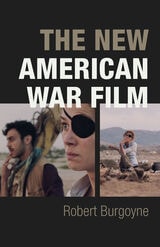
The New American War Film
Robert Burgoyne
University of Minnesota Press, 2023
A look at how post-9/11 cinema captures the new face of war in the twenty-first century
While the war film has carved out a prominent space within the history of cinema, the twenty-first century has seen a significant shift in the characteristics that define it. Serving as a roadmap to the genre’s contemporary modes of expression, The New American War Film explores how, in the wake of 9/11, both the nature of military conflict and the symbolic frameworks that surround it have been dramatically reshaped.
Featuring in-depth analyses of contemporary films like The Hurt Locker, Zero Dark Thirty, Eye in the Sky, American Sniper, and others, The New American War Film details the genre’s turn away from previously foundational themes of heroic sacrifice and national glory, instead emphasizing the procedural violence of advanced military technologies and the haptic damage inflicted on individual bodies. Unfolding amid an atmosphere of profound anxiety and disillusionment, the new American war film demonstrates a breakdown of the prevailing cultural narratives that had come to characterize conflict in the previous century.
With each chapter highlighting a different facet of war’s cinematic representation, The New American War Film charts society’s shifting attitudes toward violent conflict and what is broadly considered to be its acceptable repercussions. Drawing attention to changes in gender dynamics and the focus on war’s lasting psychological effects within these recent films, Robert Burgoyne analyzes how cinema both reflects and reveals the makeup of the national imaginary.
The New Female Antihero
The Disruptive Women of Twenty-First-Century US TelevisionSarah Hagelin and Gillian Silverman
University of Chicago Press, 2022
The last ten years have seen a shift in television storytelling toward increasingly complex storylines and characters. In this study, Sarah Hagelin and Gillian Silverman zoom in on a key figure in this transformation: the archetype of the female antihero. Far from the sunny, sincere, plucky persona once demanded of female characters, the new female antihero is often selfish and deeply unlikeable.
In this entertaining and insightful study, Hagelin and Silverman explore the meanings of this profound change in the role of women characters. In the dramas of the new millennium, they show, the female antihero is ambitious, conniving, even murderous; in comedies, she is self-centered, self-sabotaging, and anti-aspirational. Across genres, these female protagonists eschew the part of good girl or role model. In their rejection of social responsibility, female antiheroes thus represent a more profound threat to the status quo than do their male counterparts. From the devious schemers of Game of Thrones, The Americans, Scandal, and Homeland, to the joyful failures of Girls, Broad City, Insecure, and SMILF, female antiheroes register a deep ambivalence about the promises of liberal feminism. They push back against the myth of the modern-day super-woman—she who “has it all”—and in so doing, they give us new ways of imagining women’s lives in contemporary America.
The New Female Antihero
The Disruptive Women of Twenty-First-Century US TelevisionSarah Hagelin and Gillian Silverman
University of Chicago Press, 2022
The New Female Antihero examines the hard-edged spies, ruthless queens, and entitled slackers of twenty-first-century television.
The last ten years have seen a shift in television storytelling toward increasingly complex storylines and characters. In this study, Sarah Hagelin and Gillian Silverman zoom in on a key figure in this transformation: the archetype of the female antihero. Far from the sunny, sincere, plucky persona once demanded of female characters, the new female antihero is often selfish and deeply unlikeable.
In this entertaining and insightful study, Hagelin and Silverman explore the meanings of this profound change in the role of women characters. In the dramas of the new millennium, they show, the female antihero is ambitious, conniving, even murderous; in comedies, she is self-centered, self-sabotaging, and anti-aspirational. Across genres, these female protagonists eschew the part of good girl or role model. In their rejection of social responsibility, female antiheroes thus represent a more profound threat to the status quo than do their male counterparts. From the devious schemers of Game of Thrones, The Americans, Scandal, and Homeland, to the joyful failures of Girls, Broad City, Insecure, and SMILF, female antiheroes register a deep ambivalence about the promises of liberal feminism. They push back against the myth of the modern-day super-woman—she who “has it all”—and in so doing, they give us new ways of imagining women’s lives in contemporary America.
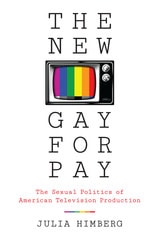
The New Gay for Pay
The Sexual Politics of American Television ProductionBy Julia Himberg
University of Texas Press, 2017
Television conveys powerful messages about sexual identities, and popular shows such as Will & Grace, Ellen, Glee, Modern Family, and The Fosters are often credited with building support for gay rights, including marriage equality. At the same time, however, many dismiss TV’s portrayal of LGBT characters and issues as “gay for pay”—that is, apolitical and exploitative programming created simply for profit. In The New Gay for Pay, Julia Himberg moves beyond both of these positions to investigate the complex and multifaceted ways that television production participates in constructing sexuality, sexual identities and communities, and sexual politics.
Himberg examines the production stories behind explicitly LGBT narratives and characters, studying how industry workers themselves negotiate processes of TV development, production, marketing, and distribution. She interviews workers whose views are rarely heard, including market researchers, public relations experts, media advocacy workers, political campaigners designing strategies for TV messaging, and corporate social responsibility department officers, as well as network executives and producers. Thoroughly analyzing their comments in the light of four key issues—visibility, advocacy, diversity, and equality—Himberg reveals how the practices and belief systems of industry workers generate the conceptions of LGBT sexuality and political change that are portrayed on television. This original approach complicates and broadens our notions about who makes media; how those practitioners operate within media conglomerates; and, perhaps most important, how they contribute to commonsense ideas about sexuality.
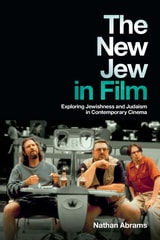
The New Jew in Film
Exploring Jewishness and Judaism in Contemporary CinemaAbrams, Nathan
Rutgers University Press, 2012
The New Jew in Film is grounded in the study of over three hundred films from Hollywood and beyond. Nathan Abrams explores these new and changing depictions of Jews, Jewishness, and Judaism, providing a wider, more representative picture of this transformation. In this compelling, surprising, and provocative book, chapters explore masculinity, femininity, passivity, agency, and religion in addition to a departure into new territory—including bathrooms and food. Abrams’s concern is to reveal how the representation of the Jew is used to convey confidence or anxieties about Jewish identity and history as well as questions of racial, sexual, and gender politics. In doing so, he provides a welcome overview of important Jewish films produced globally over the past twenty years.
The New Latin American Cinema
A Continental ProjectBy Zusana Pick
University of Texas Press, 1993
During the 1967 festival of Latin American Cinema in Viña del Mar, Chile, a group of filmmakers who wanted to use film as an instrument of social awareness and change formed the New Latin American Cinema. Nearly three decades later, the New Cinema has produced an impressive body of films, critical essays, and manifestos that uses social theory to inform filmmaking practices.
This book explores the institutional and aesthetic foundations of the New Latin American Cinema. Zuzana Pick maps out six areas of inquiry—history, authorship, gender, popular cinema, ethnicity, and exile—and explores them through detailed discussions of nearly twenty films and their makers, including Camila (María Luisa Bemberg), The Guns (Ruy Guerra), and Frida (Paul Leduc). These investigations document how the New Latin American Cinema has used film as a tool to change society, to transform national expressions, to support international differences, and to assert regional autonomy.
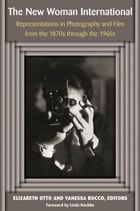
The New Woman International
Representations in Photography and Film from the 1870s through the 1960sElizabeth Otto and Vanessa Rocco, editors
University of Michigan Press, 2012
"In The New Woman International, editors Elizabeth Otto and Vanessa Rocco have gathered a group of intellectually stimulating and provocative essays that present the emergence, both tentative and triumphant, of this new global icon and her increasingly multicultural image. Written largely by historians of art and film, these essays emphasize visual analysis of the photographic and film media that carried the new woman's influential message."
---Norma Broude, American University
"The New Woman International focuses on the New Woman not simply as an image to be analyzed but also as a producer of images and text. This groundbreaking anthology represents a theoretically sophisticated set of essays that thoroughly examine the phenomenon of the New Woman in previously unexplored ways."
---Sarah E. Chinn, Hunter College, CUNY
Images of flappers, garçonnes, Modern Girls, neue Frauen, and trampky---all embodiments of the dashing New Woman---symbolized an expanded public role for women from the suffragist era through the dawn of 1960s feminism. Chronicling nearly a century of global challenges to gender norms, The New Woman International: Representations in Photography and Film from the 1870s through the 1960s is the first book to examine modern femininity's ongoing relationship with the nineteenth and twentieth centuries' most influential new media: photography and film. This volume examines the ways in which novel ideas about women's roles in society and politics were disseminated through these technological media, and it probes the significance of radical changes in female fashion, appearance, and sexual identity. Additionally, these original essays explore the manner in which New Women artists used photography and film to respond creatively to gendered stereotypes and to reconceive of ways of being a woman in a rapidly modernizing world.
The New Woman International brings together different generations of scholars and curators who are experts in gender, photography, literature, mass media, and film to analyze the New Woman from her inception in the later nineteenth century through her full development in the interwar period, and the expansion of her forms in subsequent decades. Arranged both chronologically and thematically, these essays show how controversial female ideals figured in discourses including those on gender norms, race, technology, sexuality, female agency, science, media representation, modernism, commercial culture, internationalism, colonialism, and transnational modernity. In exploring these topics through images that range from montages to newspapers' halftone prints to film stills, this book investigates the terms of gendered representation as a process in which women were as much agents as allegories. Inaugurating a new chapter in the scholarship of representation and New Womanhood and spanning North America, Western and Eastern Europe, Asia, and the colonial contexts of Africa and the Pacific, this volume reveals the ways in which a feminine ideal circled the globe to be translated into numerous visual languages.
With a foreword from the eminent feminist art historian Linda Nochlin, this collection includes contributions by Jan Bardsley, Matthew Biro, Gianna Carotenuto, Melody Davis, Kristine Harris, Karla Huebner, Kristen Lubben, Maria Makela, Elizabeth Otto, Martha H. Patterson, Vanessa Rocco, Clare I. Rogan, Despina Stratigakos, Brett M. Van Hoesen, Kathleen M. Vernon, and Lisa Jaye Young.
DIGITALCULTUREBOOKS: a collaborative imprint of the University of Michigan Press and the University of Michigan Library
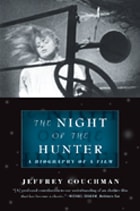
The Night of the Hunter
A Biography of a FilmJeffrey Couchman
Northwestern University Press, 2009
Reaching simultaneously into the realms of film and literature, this detailed exploration of The Night of the Hunter examines the genesis and the eclectic form of each work and the process of transformation by which the novel became a motion picture. It provides the first major study of the long-lost first-draft screenplay by James Agee and confronts a fifty-year controversy about the authorship of the film. This is a story of artistic convergence on many levels--of novelist and director, director and actor, and cinematic form and tastes. The novel, a 1953 debut from Davis Grubb, was a popular and critical success, remaining on the New York Times best-seller list for four months. Hollywood responded to its atmospheric lyricism, and in the hands of first time director Charles Laughton, the book became a film that is equal parts thriller, allegory, and fever dream, filled with slow, inexorable suspense. On the set, Laughton functioned both as an auteur and a collaborator to create his vision of the book, mixing cinematic flourishes both realistic and abstract in sometimes tense situations. The talents that clashed or came together along the road from book to movie make the final film a product of rich stylistic contradiction and rewarding complexity. Through biography, production history, and critical analysis of the novel and film, author Jeffrey Couchman makes the case that this initially overlooked cinematic gem is a prismatic work that continually reveals new aspects of itself.
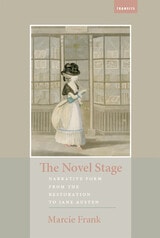
The Novel Stage
Narrative Form from the Restoration to Jane AustenMarcie Frank
Bucknell University Press, 2020
2020 Choice Outstanding Academic Title
Marcie Frank’s study traces the migration of tragicomedy, the comedy of manners, and melodrama from the stage to the novel, offering a dramatic new approach to the history of the English novel that examines how the collaboration of genres contributed to the novel’s narrative form and to the modern organization of literature. Drawing on media theory and focusing on the less-examined narrative contributions of such authors as Aphra Behn, Frances Burney, and Elizabeth Inchbald, alongside those of Samuel Richardson, Henry Fielding, and Jane Austen, The Novel Stage tells the story of the novel as it was shaped by the stage.
Published by Bucknell University Press. Distributed worldwide by Rutgers University Press.
The Only Way Out
The Racial and Sexual Performance of EscapeKatherine Brewer Ball
Duke University Press, 2024
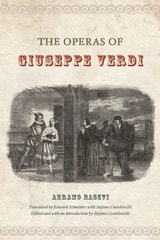
The Operas of Giuseppe Verdi
Abramo Basevi
University of Chicago Press, 2014
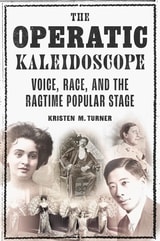
The Operatic Kaleidoscope
Voice, Race, and the Ragtime Popular StageKristen M. Turner
University of Illinois Press, 2026
Turner examines performances ranging from Florenz Ziegfeld’s early Follies to Black vaudeville shows to musical comedies, including everything from celebrity vehicles to obscure productions and overlooked artists. She reveals how opera’s popularity in mass culture illuminates the effects of exclusionary immigration policies, pervasive racial and ethnic inequalities, debates over women’s suffrage, and the imposition of legalized segregation. Performers and creators from many communities—white immigrants, Jewish, Black, and Asian American—strategically deployed operatic allusions and the genre’s characteristic vocal timbre to assert their respectability, challenge stereotypes, and navigate oppressive social structures.
Nuanced and expansive, The Operatic Kaleidoscope explores opera’s role when popular culture grappled with questions of race and citizenship.

The Organ in Manitoba
A History of the Instruments, the Builders, and the PlayersJames B. Hartman
University of Manitoba Press, 1997
The Oriental Obscene
Violence and Racial Fantasies in the Vietnam EraSylvia Shin Huey Chong
Duke University Press, 2011
The Origins of Cool in Postwar America
Joel Dinerstein
University of Chicago Press, 2017
Through eye-opening portraits of iconic figures, Dinerstein illuminates the cultural connections and artistic innovations among Lester Young, Humphrey Bogart, Robert Mitchum, Billie Holiday, Frank Sinatra, Jack Kerouac, Albert Camus, Marlon Brando, and James Dean, among others. We eavesdrop on conversations among Jean-Paul Sartre, Simone de Beauvoir, and Miles Davis, and on a forgotten debate between Lorraine Hansberry and Norman Mailer over the "white Negro" and black cool. We come to understand how the cool worlds of Beat writers and Method actors emerged from the intersections of film noir, jazz, and existentialism. Out of this mix, Dinerstein sketches nuanced definitions of cool that unite concepts from African-American and Euro-American culture: the stylish stoicism of the ethical rebel loner; the relaxed intensity of the improvising jazz musician; the effortless, physical grace of the Method actor. To be cool is not to be hip and to be hot is definitely not to be cool.
This is the first work to trace the history of cool during the Cold War by exploring the intersections of film noir, jazz, existential literature, Method acting, blues, and rock and roll. Dinerstein reveals that they came together to create something completely new—and that something is cool.
The Palestinian Idea
Film, Media, and the Radical ImaginationGreg Burris
Temple University Press, 2019
Is there a link between the colonization of Palestinian lands and the enclosing of Palestinian minds? The Palestinian Idea argues that it is precisely through film and media that hope can occasionally emerge amidst hopelessness, emancipation amidst oppression, freedom amidst apartheid. Greg Burris employs the work of Edward W. Said, Jacques Rancière, and Cedric J. Robinson in order to locate Palestinian utopia in the heart of the Zionist present.
He analyzes the films of prominent directors Annemarie Jacir (Salt of This Sea, When I Saw You) and Hany Abu-Assad (Paradise Now) to investigate the emergence and formation of Palestinian identity. Looking at Mais Darwazah’s documentary My Love Awaits Me By the Sea, Burris considers the counterhistories that make up the Palestinian experience—stories and memories that have otherwise been obscured or denied. He also examines Palestinian (in)visibility in the global media landscape, and how issues of Black-Palestinian transnational solidarity are illustrated through social media, staged news spectacles, and hip hop music.
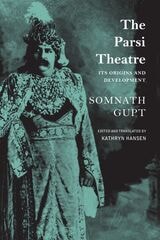
The Parsi Theatre
Its Origins and DevelopmentSomnath Gupt
Seagull Books, 2005
Unrivaled in its long-term impact, Parsi theater remains a crucial component of South Asia’s cultural heritage. Like vaudeville in America, Parsi theater dominated mass entertainment in colonial India in the era before cinema. Drawn by the magic of sight and sound, crowds filled the country’s urban playhouses each night. Marked by extravagant acting, operatic singing, and melodramatic stage effects, this cosmopolitan theater brought an unprecedented level of sophistication to the South Asian stage and transformed commercial drama into a modern industry, paving the way for Indian cinema. This volume presents Somnath Gupt’s classic history of Parsi theater in an English translation enhanced by illustrations, annotations, and appendices, which make it a more comprehensive and accurate reference work.
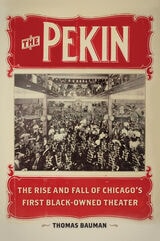
The Pekin
The Rise and Fall of Chicago's First Black-Owned TheaterThomas Bauman
University of Illinois Press, 2014
A missing chapter in African American theatrical history, Bauman's saga presents how Motts used his entrepreneurial acumen to create a successful black-owned enterprise. Concentrating on institutional history, Bauman explores the Pekin's philosophy of hiring only African American staff, its embrace of multi-racial upper class audiences, and its ready assumption of roles as diverse as community center, social club, and fundraising instrument.
The Pekin's prestige and profitability faltered after Motts' death in 1911 as his heirs lacked his savvy, and African American elites turned away from pure entertainment in favor of spiritual uplift. But, as Bauman shows, the theater had already opened the door to a new dynamic of both intra- and inter-racial theater-going and showed the ways a success, like the Pekin, had a positive economic and social impact on the surrounding community.
The Performance Apparatus
On Ideological Production of BehaviorsBranislav Jakovljevic
University of Michigan Press, 2025
Jakovljević suggests that the centrality of behavior in early performance theory is important for the understanding of contemporary society, which is dominated by surveillance capitalism. If ideology is lodged in behaviors, and if surveillance capitalism thrives on the monetization of the behavioral surplus, then performance theory can make significant contributions to our understanding of the moment in which we live and the future we are facing. The Performance Apparatus argues for the importance of continuing attention to the question of ideology in contemporary, neoliberal order.
The Performer-Audience Connection
Emotion to Metaphor in Dance and SocietyBy Judith Lynne Hanna
University of Texas Press, 1983
The Performer-Audience Connection is a pioneering foray into one of the major puzzles of human communication: the communication of emotion in dance. It is the first attempt of its kind systematically to investigate what performers wish to convey and what audiences perceive in the performance of dance.
The centerpiece of this provocative book is an examination of performer intentions and audience response at eight dance performances in Washington, D.C. Part of the Smithsonian Institution Division of Performing Arts Dance Series, these concerts featured a variety of dance genres and cultures: American tap dance, Kathakali dance-drama from Kerala, India, Japanese Kabuki, contemporary avant-garde dance, Philippine folk dance, the Indian classical tradition of Kuchipudi, and modern dance to an AfroAmerican spiritual.
How did dancer and audience interact at the emotional level on these eight occasions? What affected performer-audience rapport? Through interviews of both spectators and dancers, Judith Lynne Hanna explores the performers' ways of imparting emotion through movement and audience members' expectations and responses. In doing so she casts new light on important issues of cultural identity, sex role, historic attitudes toward dance, and even marketing the arts today.
A landmark work not only for performers who wish to reach their audiences more effectively but also for choreographers, anthropologists, specialists in nonverbal communication, behavioral scientists, educators, and all who are fascinated by the arts and the special magic of the "performer-audience connection."
The Persistence of Dance
Choreography as Concept and Material in Contemporary ArtErin Brannigan
University of Michigan Press, 2023
The Persistence of Dance: Choreography as Concept and Material in Contemporary Art clarifies the continuities and differences between the second-wave dance avant-garde in the 1950s‒1970s and the third-wave starting in the 1990s. Through close readings of key artists such as Maria Hassabi, Sarah Michelson, Boris Charmatz, Meg Stuart, Philipp Gehmacher, Adam Linder, Agatha Gothe-Snape, Shelley Lasica and Latai Taumoepeau, The Persistence of Dance traces the relationship between the third-wave and gallery-based work. Looking at these artists highlights how the discussions and practices associated with “conceptual dance” resonate with the categories of conceptual and post-conceptual art as well as with the critical work on the function of visual art categories. Brannigan concludes that within the current post-disciplinary context, there is a persistence of dance and that a model of post-dance exists that encompasses dance as a contemporary art medium.
The Phantom Holocaust
Soviet Cinema and Jewish CatastropheGershenson, Olga
Rutgers University Press, 2013
Focusing on work by both celebrated and unknown Soviet directors and screenwriters, Olga Gershenson has written the first book about all Soviet narrative films dealing with the Holocaust from 1938 to 1991. In addition to studying the completed films, Gershenson analyzes the projects that were banned at various stages of production.
The book draws on archival research and in-depth interviews to tell the sometimes tragic and sometimes triumphant stories of filmmakers who found authentic ways to represent the Holocaust in the face of official silencing. By uncovering little known works, Gershenson makes a significant contribution to the international Holocaust filmography.
The Philosopher's Toothache
Embodied Stoicism in Early Modern English DramaDonovan Sherman
Northwestern University Press, 2022
Informed by work in both classical philosophy and performance studies, Donovan Sherman argues that Stoicism infused the complex theatrical culture of early modern England. Plays written and performed during this period gave life to Stoic exercises that instructed audiences to cultivate their virtue, self-awareness, and creativity. By foregrounding Stoicism’s embodied nature, Sherman recovers a vital dimension too often lost in reductive portrayals of the Stoics by early modern writers and contemporary scholars alike. The Philosopher’s Toothache features readings of dramatic works by William Shakespeare, Cyril Tourneur, and John Marston alongside considerations of early modern adaptations of classical Stoics (Seneca, Epictetus, and Marcus Aurelius) and Neo-Stoics such as Justus Lipsius. These plays model Stoic virtues like unpredictability, indifference, vulnerability, and dependence—attributes often framed as negative but that can also rekindle a sense of responsible public action.
The Philosophical Hitchcock
“Vertigo” and the Anxieties of UnknowingnessRobert B. Pippin
University of Chicago Press, 2017
A bold, brilliant exploration of one of the most admired works of cinema, The Philosophical Hitchcock will lead philosophers and cinephiles alike to a new appreciation of Vertigo and its meanings.

The Plays of David Storey
A Thematic StudyBy William Hutchings
Southern Illinois University Press, 1988
This is the first comprehensive play-by-play analysis of the drama of David Storey, one of the most acclaimed and innovative, sometimes controversial, writers in the British theatre since World War II. Grouping the plays according to theme, Hutchings demonstrates that the central focus in the drama of David Storey is the devaluation of traditional rituals in contemporary life and the disintegration of the family. A playwright attuned to the poetry in the ordinary, to the profundity, subtle eloquence, and dramatic tension in the mundane, Storey explores the ways people cope, or fail to cope, with complexity, with uncertainty, with constant, bewildering flux. He writes about groups—families (In Celebration, The Farm), rugby teams (The Changing Room), and construction crews (The Contractor). In his plays, individuals seek to overcome isolation and integrate themselves into a significant assemblage that transcends the self.
Hutchings notes that Storey frequently deals with working-class parents who cannot "understand their grown children’s anxieties, their discontentedness with life, their unstable marriages, and their inability to enjoy the benefits of the education and advantages they labored so hard for so many years to provide."
Storey understands and sympathizes with parents who have paid to educate their children out of their own spheres. He saw it happen in his own family, knew the disapproval of his father: "What else could my father think when, nearing sixty, he came home each day from the pit exhausted, shattered by fatigue, to find me—a young man ideally physically equipped to do the job which now left him totally prostrated—painting a picture of flowers, or writing a poem about a cloud. There was, and there is, no hope of reconciliation."
Hutchings supplements his thematic analysis of Storey’s plays by interweaving into his text 90 percent of a major interview with the playwright, the only such comprehensive interview in existence. Storey, who believes that readers "ought to be chary of all interviews," discusses alleged literary influences on his work, the current state of British theatre, and his reactions to critics. He also provides insight into various productions and performances in his work.
The Political Force of Musical Beauty
Barry Shank
Duke University Press, 2014
The Political Orchestra
The Vienna and Berlin Philharmonics during the Third ReichFritz Trümpi
University of Chicago Press, 2016
Trümpi looks first at the decades preceding National Socialist rule, when the competing orchestras, whose rivalry mirrored a larger rivalry between Berlin and Vienna, were called on to represent “superior” Austro-German music and were integrated into the administrative and social structures of their respective cities—becoming vulnerable to political manipulation in the process. He then turns to the Nazi period, when the orchestras came to play a major role in cultural policies. As he shows, the philharmonics, in their own unique ways, strengthened National Socialist dominance through their showcasing of Germanic culture in the mass media, performances for troops and the general public, and fictional representations in literature and film. Accompanying these propaganda efforts was an increasing politicization of the orchestras, which ranged from the dismissal of Jewish members to the programming of ideologically appropriate repertory—all in the name of racial and cultural purity.
Richly documented and refreshingly nuanced, The Political Orchestra is a bold exploration of the ties between music and politics under fascism.