Results by title
1488 books match the query 'Media Studies' and 260 start with t
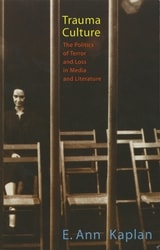
Trauma Culture
The Politics of Terror and Loss in Media and LiteratureKaplan, E. Ann
Rutgers University Press, 2005
In Trauma Culture, E. Ann Kaplan explores the relationship between the impact of trauma on individuals and on entire cultures and nations. Arguing that humans possess a compelling need to draw meaning from personal experience and to communicate what happens to others, she examines the artistic, literary, and cinematic forms that are often used to bridge the individual and collective experience. A number of case studies, including Sigmund Freud's Moses and Monotheism, Marguerite Duras' La Douleur, Sarah Kofman's Rue Ordener, Rue Labat, Alfred Hitchcock's Spellbound, and Tracey Moffatt's Night Cries, reveal how empathy can be fostered without the sensationalistic element that typifies the media.
From World War II to 9/11, this passionate study eloquently navigates the contentious debates surrounding trauma theory and persuasively advocates the responsible sharing and translating of catastrophe.
Travels in Intermediality
ReBlurring the BoundariesEdited by Bernd Herzogenrath
Dartmouth College Press, 2012

Trends in Communication Policy Research
New Theories, Methods and SubjectsEdited by Natascha Just and Manuel Puppis
Intellect Books, 2012
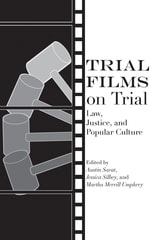
Trial Films on Trial
Law, Justice, and Popular CultureEdited by Austin Sarat, Jessica Silbey, and Martha Merrill Umphrey
University of Alabama Press, 2019
Historically, the emergence of the trial film genre coincided with the development of motion pictures. In fact, one of the very first feature-length films, Falsely Accused!, released in 1908, was a courtroom drama. Since then, this niche genre has produced such critically acclaimed films as Twelve Angry Men, To Kill a Mockingbird, and Anatomy of a Murder. The popularity and success of these films can be attributed to the fundamental similarities of filmic narratives and trial proceedings. Both seek to construct a “reality” through storytelling and representation and in so doing persuade the audience or jury to believe what they see.
Trial Films on Trial: Law, Justice, and Popular Culture is the first book to focus exclusively on the special significance of trial films for both film and legal studies. The contributors to this volume offer a contemporary approach to the trial film genre. Despite the fact that the medium of film is one of the most pervasive means by which many citizens receive come to know the justice system, these trial films are rarely analyzed and critiqued. The chapters cover a variety of topics, such as how and why film audiences adopt the role of the jury, the narrative and visual conventions employed by directors, and the ways mid-to-late-twentieth-century trial films offered insights into the events of that period.
Truth After Post-Truth
Finding a Way ForwardEdited by Anthony Nadler, Molly O’Rourke-Friel, and Doron Taussig
University of Massachusetts Press, 2027
Examining truth, expertise, and authority in the contemporary United States
In an era defined by accusations of “fake news,” declining institutional trust, and deepening political polarization, Truth After Post-Truth reframes the debate about knowledge and democracy in the United States. Rather than treating the so-called post-truth crisis as a failure of public reasoning or the product of bad-faith actors and digital misinformation, this interdisciplinary volume argues that the problem runs deeper and that solutions require renewed democratic deliberation about how public knowledge itself should be produced, evaluated, and shared.
Contributors move beyond familiar diagnoses that blame either misinformed citizens or manipulative media systems. Instead, they interrogate the intellectual and political norms that underwrite claims about truth, expertise, and authority. This book challenges the assumption that restoring democracy depends on returning the public to a fixed set of knowledge practices and calls instead for open debate about which norms and institutions best serve a pluralistic society. Organized around three urgent questions—what relationship a healthy democracy should have to experts, whether a shared and cross-partisan news sphere is necessary or achievable, and whether media reform or media literacy is the more pressing priority—the essays are rigorous, provocative, and often in productive tension with one another. Together, they model the kind of critical engagement needed to rebuild a more resilient democratic information environment.
Timely and forward-looking, Truth After Post-Truth will be essential reading for readers concerned with the future of democratic public life, as well as for scholars and students of media, politics, and communication.
Contributors include the volume editors as well as Mark Andrejevic, Matt Carlson, Vivek Chibber, Belinha de Abreu, John Nerone, Whitney Phillips, Sue Robinson, Michael Schudson, Nik Usher, Andrea Wenzel, and Alex Worsnip.
Truth Be Told
White Nostalgia and Antiracist Queer Resistance in “Post-Truth” AmericaLaura Elliot Tetreault
The Ohio State University Press, 2025
Taking a critical disinformation studies approach, Tetreault analyzes post-truth political messaging in the US after 2016. Using racial rhetorical criticism combined with a queer lens, they focus on how contemporary antiracist, queer, and feminist activists used various forms of cultural production to work against disinformation and its circulation, enacting refusal and insisting on the validity of their own knowledges as a form of community care. Tetreault ultimately argues that it’s not just the truth that academics must advocate for; they must question whose truth and how that truth is mediated and circulated.
Turning On the Mind
French Philosophers on TelevisionTamara Chaplin
University of Chicago Press, 2007
Turning the Page
Storytelling as Activism in Queer Film and MediaCoon, David R
Rutgers University Press, 2018
Surprisingly, Hollywood is still clumsily grappling with its representation of sexual minorities, and LGBTQ filmmakers struggle to find a place in the mainstream movie industry. However, organizations outside the mainstream are making a difference, helping to produce and distribute authentic stories that are both by and for LGBTQ people.
Turning the Page introduces readers to three nonprofit organizations that, in very different ways, have each positively transformed the queer media landscape. David R. Coon takes readers inside In the Life Media, whose groundbreaking documentaries on the LGBTQ experience aired for over twenty years on public television stations nationwide. Coon reveals the successes of POWER UP, a nonprofit production company dedicated to mentoring filmmakers who can turn queer stories into fully realized features and short films. Finally, he turns to Three Dollar Bill Cinema, an organization whose film festivals help queer media find an audience and whose filmmaking camps for LGBTQ youth are nurturing the next generation of queer cinema.
Combining a close analysis of specific films and video programs with extensive interviews of industry professionals, Turning the Page demonstrates how queer storytelling in visual media has the potential to empower individuals, strengthen communities, and motivate social justice activism.

Tweets and the Streets
Social Media and Contemporary ActivismPaolo Gerbaudo
Pluto Press, 2012
Tweets and the Streets analyses the culture of the new protest movements of the 21st century. From the Arab Spring to the 'indignados' protests in Spain and the Occupy movement, Paolo Gerbaudo examines the relationship between the rise of social media and the emergence of new forms of protest.
Gerbaudo argues that activists' use of Twitter and Facebook does not fit with the image of a 'cyberspace' detached from physical reality. Instead, social media is used as part of a project of re-appropriation of public space, which involves the assembling of different groups around 'occupied' places such as Cairo’s Tahrir Square or New York’s Zuccotti Park.
An exciting and invigorating journey through the new politics of dissent, Tweets and the Streets points both to the creative possibilities and to the risks of political evanescence which new media brings to the contemporary protest experience.
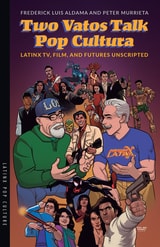
Two Vatos Talk Pop Cultura
Latinx TV, Film, and Futures UnscriptedFrederick Luis Aldama and Peter Murrieta
University of Arizona Press, 2026
Two Vatos Talk Pop Cultura brings a leading Latinx media studies scholar, Frederick Luis Aldama, together with an award-winning television writer and producer, Peter Murrieta, to examine how Latinx representation has evolved—and stagnated—across seven decades of American TV, film, and pop culture.