Results by title
1713 books match the query '21st century' and 315 start with t
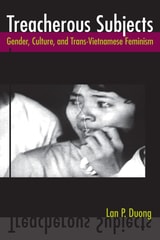
Treacherous Subjects
Gender, Culture, and Trans-Vietnamese FeminismLan P Duong
Temple University Press, 2012
Treacherous Subjects is a provocative and thoughtful examination of Vietnamese films and literature viewed through a feminist lens. Lan Duong investigates the postwar cultural productions of writers and filmmakers, including Tony Bui, Trinh T. Minh-ha, and Tran Anh Hung.
Taking her cue from the double meaning of "collaborator," Duong shows how history has shaped the loyalties and shifting alliances of the Vietnamese, many of whom are caught between opposing/constricting forces of nationalism, patriarchy, and communism. Working at home and in France and the United States, the artists profiled in Treacherous Subjects have grappled with the political and historic meanings of collaboration. These themes, which probe into controversial issues of family and betrayal, figure heavily in fictions such as the films The Scent of Green Papaya and Surname Viet Given Name Nam.
As writers and filmmakers collaborate, Duong suggests that they lay the groundwork for both transnational feminist politics and queer critiques of patriarchy.
Trial Films on Trial
Law, Justice, and Popular CultureEdited by Austin Sarat, Jessica Silbey, and Martha Merrill Umphrey
University of Alabama Press, 2019
Historically, the emergence of the trial film genre coincided with the development of motion pictures. In fact, one of the very first feature-length films, Falsely Accused!, released in 1908, was a courtroom drama. Since then, this niche genre has produced such critically acclaimed films as Twelve Angry Men, To Kill a Mockingbird, and Anatomy of a Murder. The popularity and success of these films can be attributed to the fundamental similarities of filmic narratives and trial proceedings. Both seek to construct a “reality” through storytelling and representation and in so doing persuade the audience or jury to believe what they see.
Trial Films on Trial: Law, Justice, and Popular Culture is the first book to focus exclusively on the special significance of trial films for both film and legal studies. The contributors to this volume offer a contemporary approach to the trial film genre. Despite the fact that the medium of film is one of the most pervasive means by which many citizens receive come to know the justice system, these trial films are rarely analyzed and critiqued. The chapters cover a variety of topics, such as how and why film audiences adopt the role of the jury, the narrative and visual conventions employed by directors, and the ways mid-to-late-twentieth-century trial films offered insights into the events of that period.
Triple Entendre
Furniture Music, Muzak, Muzak-PlusHerve Vanel
University of Illinois Press, 2013
Vanel's discussion culminates in the creative response of the composer John Cage to the pervasiveness and power of background music in contemporary society. Cage neither opposed nor rejected Muzak, but literally answered its challenge by formulating a parallel concept that he called "Muzak-Plus." Forty years after Satie presented his work to general critical puzzlement, Cage saw how background music could be combined with mid-century technology and theories of art and performance to create a participatory soundscape on a scale that Satie could not have envisioned, again reconfiguring the listener's stance to music. By examining the subterranean connections existing between these three formulations of a singular idea, Triple Entendre analyzes and challenges the crucial boundary that separates an artistic concept from its actual implementation in life.
Trouble in Censorville
The Far Right's Assault on Public Education and the Teachers Who are Fighting BackNadine M. Kalin and Rebekah Modrak
Disobedience Press, 2024
Now, for the first time, K-12 educators from across the nation give readers a teacher’s-eye view of the radical right crusade to take down public education, coordinated by well-funded, well-connected far-right political interests. Christian nationalists hell-bent on erasing the line between church and state, white supremacists opposed to a curriculum that teaches the enduring effects of anti-Black racism, political action committees, such as Moms for Liberty, calling for the banning of novels featuring LGBTQ+ people, and profiteers eager to divert taxpayer dollars into private schools are mounting a relentless attack on teachers, the students they serve, and the commitment to public education that is a cornerstone of democracy. “It’s a phenomenal, unprecedented moment that we’re in,” says a librarian, recently retired from her Texas school. “It’s surprising how many people don’t know what’s going on. I talk to reporters who have no idea. And they’re reporters.”
In Trouble in Censorville, public school teachers from states as far-flung as Florida, Texas, Kentucky, New Jersey, Tennessee, Wisconsin, and Washington describe, in their own words, being threatened, stalked, doxxed, ostracized, smeared as “pedophiles" and "Marxists," placed on leave, and fired for teaching historical truth and racial justice, supporting LGBTQ+ students and, in one case, for wearing "insufficiently" feminine attire. Their stories bring readers face-to-face with the human cost of these attacks, which range from social isolation to pent-up anger over institutional betrayal to the terrible toll on teachers’ mental and physical health.
And yet, teachers are fighting back. They’re mobilizing colleagues, parents, and community members who share their faith in the freedom to read, the freedom to think critically, the freedom to challenge small-minded provincialism. Their stories of frontline resistance, collected here, provide a battle plan for confronting censorship, rallying support, and mobilizing a grassroots defense of public schools.
Their gripping testimonials are enhanced by a timeline that situates today’s far-right war on public education in the context of American history, moving briskly from Reconstruction to the anti-left and anti-gay fearmongering of the McCarthy era to the Black Lives Matter movement to the Trump presidency.
Terrifying, infuriating, and inspiring, Trouble in Censorville sounds the alarm for a democracy on fire.
True Stories
A Century of Literary JournalismNorman Sims
Northwestern University Press, 2007
Truth Be Told
White Nostalgia and Antiracist Queer Resistance in “Post-Truth” AmericaLaura Elliot Tetreault
The Ohio State University Press, 2025
Taking a critical disinformation studies approach, Tetreault analyzes post-truth political messaging in the US after 2016. Using racial rhetorical criticism combined with a queer lens, they focus on how contemporary antiracist, queer, and feminist activists used various forms of cultural production to work against disinformation and its circulation, enacting refusal and insisting on the validity of their own knowledges as a form of community care. Tetreault ultimately argues that it’s not just the truth that academics must advocate for; they must question whose truth and how that truth is mediated and circulated.
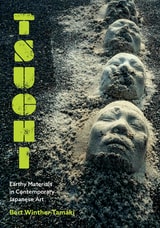
Tsuchi
Earthy Materials in Contemporary Japanese ArtBert Winther-Tamaki
University of Minnesota Press, 2022
An examination of Japanese contemporary art through the lens of ecocriticism and environmental history
Collectively referred to by the word tsuchi, earthy materials such as soil and clay are prolific in Japanese contemporary art. Highlighting works of photography, ceramics, and installation art, Bert Winther-Tamaki explores the many aesthetic manifestations of tsuchi and their connection to the country’s turbulent environmental history, investigating how Japanese artists have continually sought a passionate and redemptive engagement with earth.
In the seven decades following 1955, Japan has experienced severe environmental degradation as a result of natural disasters, industrial pollution, and nuclear irradiation. Artists have responded to these ongoing catastrophes through modes of “mudlarking” and “muckracking,” utilizing raw elements from nature to establish deeper contact with the primal resources of their world and expose its unfettered contamination. Providing a comparative assessment of more than seventy works of art, this study reveals Japanese artists’ engagement with a richly diverse repertoire of earthy materialities, elucidating their aesthetic properties, changing conditions, and cultural significance.
By focusing on the role of tsuchi as a convergence point for a wide range of creative practices, this book offers a critical reassessment of contemporary art in Japan and its intrinsic relationship to the environment. Situating art within the context of ecology and urbanization, Tsuchi shows artists striving to explore and reprocess raw forms of earth beneath the corruptions of human activity.

Tuberculosis Control and Institutional Change in Shanghai, 1911–2011
Rachel S. Core
Hong Kong University Press, 2023
Tuberculosis Control and Institutional Change in Shanghai, 1911–2011 is the first book on the most widespread and deadly infectious disease in China, both historically and today. Weaving together interviews with data from periodicals and local archives in Shanghai, Rachel Core examines the rise and fall of tuberculosis control in China from the 1950s to the 1990s. Under the socialist work unit system, the vast majority of people had guaranteed employment, a host of benefits tied to their workplace, and there was little mobility—factors that made the delivery of medical and public health services possible in both urban and rural areas. The dismantling of work units amid wider market reforms in the 1980s and 1990s led to the rise of temporary and casual employment and a huge migrant worker population, with little access to health care, creating new challenges in TB control. This study of Shanghai will provide valuable lessons for historians, social scientists, public health specialists, and many others working on public health infrastructure on both the national and global levels.

Turkey Reframed
Constituting Neoliberal HegemonyBaris Ozden
Pluto Press, 2013
Turkey Reframed documents the first decade of the 2000s, a period of radical change in Turkish society and politics, which has been marked by the major economic crisis of 2001 and the coming to power of ex-Islamist cadres organised under the Justice and Development Party (AKP).
The contributors analyse this period of radical change, with its continuities and breaks, and its main actor, the AKP, in relation to the creation of a neoliberal hegemony in post-1980 Turkey. They look at the conflictual, turbulent and painful history of neoliberal hegemony and the contested stabilisation strategy of the AKP government.
Turkey Reframed is a cutting-edge guide for students, scholars and other interested readers who want to understand this period in Turkey’s recent history and its social tensions.
Turkey's July 15th Coup
What Happened and WhyEdited by M. Hakan Yavuz and Bayram Balci
University of Utah Press, 2018
Utah Series in Middle East Studies
On July 15, 2016, a faction of the Turkish military attempted to overthrow the government of President Recep Tayyip Erdoğan. The Turkish government blamed the unsuccessful coup attempt on Gülenists, adherents of an Islamist movement led by Fethullah Gülen. They had helped elect Erdoğan and his AK Party, with the goal of bringing an ostensibly “soft” version of Islam into the secular Turkish government. In alliance with the AK Party, Gülenists steadfastly increased their representation in various government institutions, including the military, the police, and the judiciary. This volume focuses on the historical and sociopolitical contexts of the Gülen Movement’s origins and political ascendancy along with its possible role in the failed coup.
Editors Yavuz and Balcı are among the first international scholars to have studied the movement from its nascent stages in Turkey. The volume's contributors include scholars who have researched the movement in Turkey, Central Asia, and the Balkans. The result is a comprehensive, timely assessment of numerous dimensions of Gülenist activities, including its social and political networks and the institutions that supported the movement as it became a major economic and educational force in Turkey and elsewhere. This volume reflects exchanges among scholars who having studied the Gülenists, assembled to discuss how and why the movement became belligerent opponents of Erdoğan’s government, and it addresses questions such as how this major, still continuing disruption in Turkey’s politics will affect not only the future of the movement but also that of Turkey's embattled democracy as well.
Tweets and the Streets
Social Media and Contemporary ActivismPaolo Gerbaudo
Pluto Press, 2012
Tweets and the Streets analyses the culture of the new protest movements of the 21st century. From the Arab Spring to the 'indignados' protests in Spain and the Occupy movement, Paolo Gerbaudo examines the relationship between the rise of social media and the emergence of new forms of protest.
Gerbaudo argues that activists' use of Twitter and Facebook does not fit with the image of a 'cyberspace' detached from physical reality. Instead, social media is used as part of a project of re-appropriation of public space, which involves the assembling of different groups around 'occupied' places such as Cairo’s Tahrir Square or New York’s Zuccotti Park.
An exciting and invigorating journey through the new politics of dissent, Tweets and the Streets points both to the creative possibilities and to the risks of political evanescence which new media brings to the contemporary protest experience.
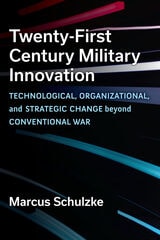
Twenty-First Century Military Innovation
Technological, Organizational, and Strategic Change beyond Conventional WarMarcus Schulzke
University of Michigan Press, 2022
Contemporary war is as much a quest for decisive technological, organizational, and doctrinal superiority before the fighting starts as it is an effort to destroy enemy militaries during battle. Armed forces that are not actively fighting are instead actively reengineering themselves for success in the next fight and imagining what that next fight may look like. Twenty-First Century Military Innovation outlines the most theoretically important themes in contemporary warfare, especially as these appear in distinctive innovations that signal changes in states’ warfighting capacities and their political goals.
Marcus Schulzke examines eight case studies that illustrate the overall direction of military innovation and important underlying themes. He devotes three chapters to new weapons technologies (drones, cyberweapons, and nonlethal weapons), two chapters to changes in the composition of state military forces (private military contractors and special operations forces), and three chapters to strategic and tactical changes (targeted killing, population-centric counterinsurgency, and degradation). Each case study includes an accessible introduction to the topic area, an overview of the ongoing scholarly debates surrounding that topic, and the most important theoretical implications. This book can be read as an overview of the themes that run throughout innovations of varying types or it can be used by readers who are interested in particular topic areas.
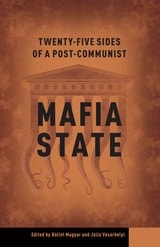
Twenty-Five Sides of a Post-Communist Mafia State
Bálint Magyar
Central European University Press, 2017
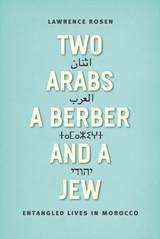
Two Arabs, a Berber, and a Jew
Entangled Lives in MoroccoLawrence Rosen
University of Chicago Press, 2015
Through the intellectual lives of these four men, this book explores a number of interpretative and theoretical issues that have made Arab culture distinct, especially in relationship to the West: how nothing is ever hard and fast, how everything is relational and always a product of negotiation. It showcases the vitality of the local in a global era, and it contrasts Arab notions of time, equality, and self with those in the West. Likewise, Rosen unveils his own entanglement in their world and the drive to keep the analysis of culture first and foremost, even as his own life enmeshes itself in those of his study. An exploration of faith, politics, history, and memory, this book highlights the world of everyday life in Arab society in ways that challenge common notions and stereotypes.
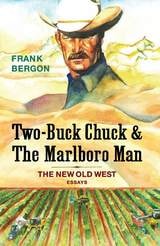
Two-Buck Chuck & The Marlboro Man
The New Old WestFrank Bergon
University of Nevada Press, 2019
Bergon presents a powerful array of rural and small-town Westerners who often see themselves as part of a region and a way of life most Americans aren’t aware of or don’t understand, their voices unheard, their stories untold. In these essays, Westerners from the diverse heritage of the San Joaquin Valley include California’s legendary Fred Franzia, the maker of the world’s best-selling Charles Shaw wines dubbed “Two-Buck Chuck,” and Darrell Winfield, a Dust Bowl migrant and lifelong working cowboy who for more than thirty years reigned as the iconic Marlboro Man. Their voices help us understand the complexities of today’s rural West, where Old West values intersect with New West realities. This is the West (and America today)—a region in conflict with itself.