Results by title
3258 books match the query 'Art' and 634 start with t

The Healing Stage
Black Women, Incarceration, and the Art of TransformationLisa Biggs
The Ohio State University Press, 2022
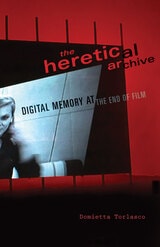
The Heretical Archive
Digital Memory at the End of FilmDomietta Torlasco
University of Minnesota Press, 2013
The Heretical Archive examines the relationship between memory and creation in contemporary artworks that use digital technology while appropriating film materials. Domietta Torlasco argues that these digital films and multimedia installations radically transform our memory of cinema and our understanding of the archive. Indeed, such works define a notion of archiving not as the passive preservation of audiovisual signs but as an intervention and the creative rearticulation of cinema’s perceptual and political textures.
Connecting psychoanalysis, phenomenology, and feminist theory in innovative ways, Torlasco analyzes cutting-edge digital works that engage with the past of European cinema and visual culture, including video installations by Monica Bonvicini (Destroy She Said) and Pierre Huyghe (The Ellipsis), Agnès Varda’s film The Gleaners and I, Marco Poloni’s multimedia installation The Desert Room, and Chris Marker’s CD-ROM Immemory.
Torlasco’s central claim is that if the archives of psychoanalysis and cinema have long privileged the lineage that runs from Oedipus to Freud, the archives of the digital age—what she calls the “heretical archive”—can help us imagine an unruly, porous, multifaceted legacy, one in which marginal figures return to speak of lost life as much as of life that demands to be lived.

The History of Development of Building Construction in Chicago
Frank A. Randall
University of Illinois Press, 1999
Generations have relied on the Randall book as the most authoritative and comprehensive guide to buildings in the Chicago central area. This edition is updated with information about fifty additional buildings from the time frame of the original text, 1830-1949; new data for four hundred buildings from the period 1950-98; and a number of additional plates from the rare Rand McNally Views of Chicago.
The second edition of The History of the Development of Building Construction in Chicago is a tribute to Frank Randall's vision and an indispensable resource to Chicago area architects, engineers, preservation specialists, and other members of the building industry.
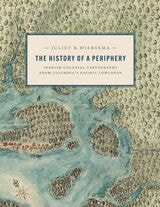
The History of a Periphery
Spanish Colonial Cartography from Colombia's Pacific LowlandsJuliet B. Wiersema
University of Texas Press, 2024
2025 ALAA Book Award, Association for Latin American Art/Arvey Foundation, College Art Association
An exploration of Colombian maps in New Granada.
During the late Spanish colonial period, the Pacific Lowlands, also called the Greater Chocó, was famed for its rich placer deposits. Gold mined here was central to New Granada’s economy yet this Pacific frontier in today’s Colombia was considered the “periphery of the periphery.” Infamous for its fierce, unconquered Indigenous inhabitants and its brutal tropical climate, it was rarely visited by Spanish administrators, engineers, or topographers and seldom appeared in detail on printed maps of the period.
In this lavishly illustrated and meticulously researched volume, Juliet Wiersema uncovers little-known manuscript cartography and makes visible an unexamined corner of the Spanish empire. In concert with thousands of archival documents from Colombia, Spain, and the United States, she reveals how a "periphery" was imagined and projected, largely for political or economic reasons. Along the way, she unearths untold narratives about ephemeral settlements, African adaptation and autonomy, Indigenous strategies of resistance, and tenuous colonialisms on the margins of a beleaguered viceroyalty.
The Hours of Marie de Medici
A FacsimileMarie de Medici
Bodleian Library Publishing, 2016
At the turn of the fifteenth century, private devotionals became a specialty of the renowned Ghent–Bruges illuminators. Wealthy patrons who commissioned work from these artists often spared no expense in the presentation of their personal prayer books, or “books of hours,” from detailed decoration to luxurious bindings and embroidery.
This manuscript owes its name to the French queen, Marie de Medici, widow of King Henri IV. The manuscript was painted by an artist known as the David Master, one of the renowned Flemish illuminators of the sixteenth century. Fine architectural interiors, gorgeous landscapes, and detailed city scenes form the subjects of three full-size illuminations and forty-two full-page miniatures. It is one of the finest examples of medieval illumination in a personal prayer book and the most copiously illustrated work of the David Master to survive.
Together with a scholarly introduction that gives an overview of Flemish illumination and examines each of the illustrations in detail, this full-color facsimile limited edition, bound in linen with a leather quarter binding and beautifully presented in a slipcase, faithfully reproduces all 176 leaves of the original manuscript.
The House of the Singing Winds
The Life and Work of T. C. SteeleRachel Berenson Perry
Indiana Historical Society Press, 2016
The Human Animal in Western Art and Science
Martin Kemp
University of Chicago Press, 2007
From the lazy, fiddling grasshopper to the sneaky Big Bad Wolf, children’s stories and fables enchant us with their portrayals of animals who act like people. But the comparisons run both ways, as metaphors, stories, and images—as well as scientific theories—throughout history remind us that humans often act like animals, and that the line separating them is not as clear as we’d like to pretend.
Here Martin Kemp explores a stunning range of images and ideas to demonstrate just how deeply these underappreciated links between humans and other fauna are embedded in our culture. Tracing those interconnections among art, science, and literature, Kemp leads us on a dazzling tour of Western thought, from Aristotelian physiognomy and its influence on phrenology to the Great Chain of Being and Darwinian evolution. We learn about the racist anthropology underlying a familiar Degas sculpture, see paintings of a remarkably simian Judas, and watch Mowgli, the man-child from Kipling’s The Jungle Book, exhibit the behaviors of the beasts who raised him. Like a kaleidoscope, Kemp uses these stories to refract, reconfigure, and echo the essential truth that the way we think about animals inevitably inflects how we think about people, and vice versa.
Loaded with vivid illustrations and drawing on sources from Hesiod to La Fontaine, Leonardo to P. T. Barnum, The Human Animal in Western Art and Science is a fascinating, eye-opening reminder of our deep affinities with our fellow members of the animal kingdom.
The Human in Bits
Graphical Computers, Black AbstractionsKris Cohen
Duke University Press, 2025

The Humours of Parliament
Harry Furniss's View of Late-Victorian Political CultureEdited and with an Introduction by Gareth Cordery and Joseph S. Meisel
The Ohio State University Press, 2014
Reproducing some 150 images drawn from Furniss’s extensive graphic work, The Humours of Parliament: Harry Furniss’s View of Late-Victorian Political Culture, edited and with an introduction by Gareth Cordery and Joseph S. Meisel, presents Furniss’s unpublished lecture text for the first time. The extensive introduction places the show in its biographical, political, and performative contexts. Cordery and Meisel’s volume therefore both documents a pivotal moment in British political and social history and provides a rare case study of an important yet little studied nineteenth-century performance genre: the illustrated platform lecture.
The Iconic Page in Manuscript, Print, and Digital Culture
George Bornstein and Theresa Tinkle, Editors
University of Michigan Press, 1998
The material features of texts as physical artifacts--their "bibliographic codes" --have over the last decade excited increasing interest in a variety of disciplines. The Iconic Page in Manuscript, Print, and Digital Culture gathers essays by an extraordinarily distinguished group of scholars to offer the most comprehensive examination of these issues yet, drawing on examples from literature, history, the fine arts, and philosophy.
Fittingly, the volume contains over two dozen illustrations that display the iconic features of the works analyzed--from Alfred the Great's Boethius through medieval manuscripts to the philosophy of C. S. Peirce and the dustjackets on works by F. Scott Fitzgerald and William Styron.
The Iconic Page in Manuscript, Print, and Digital Culture will be groundbreaking reading for scholars in a wide range of fields.
George Bornstein is C. A. Patrides Professor of English, University of Michigan. Theresa Tinkle is Associate Professor of English, University of Michigan.

The Idols of ISIS
From Assyria to the InternetAaron Tugendhaft
University of Chicago Press, 2020
Beginning with the Islamic State’s claim that the smashed objects were idols of the “age of ignorance,” Aaron Tugendhaft questions whether there can be any political life without idolatry. He then explores the various roles Mesopotamian sculpture has played in European imperial competition, the development of artistic modernism, and the formation of Iraqi national identity, showing how this history reverberates in the choice of the Mosul Museum as performance stage. Finally, he compares the Islamic State’s production of images to the ways in which images circulated in ancient Assyria and asks how digitization has transformed politics in the age of social media. An elegant and accessibly written introduction to the complexities of such events, The Idols of ISIS is ideal for students and readers seeking a richer cultural perspective than the media usually provides.

The Igor Moiseyev Dance Company
Dancing DiplomatsAnthony Shay
Intellect Books, 2019
The Illuminated Chronicle
Chronicle of the Deeds of the Hungarians from the Fourteenth-Century Illuminated CodexJános M. Bak
Central European University Press, 2018
The Illuminated Chronicle was composed in 1358 in the international artistic style at the royal court of Louis I of Hungary. Its text, presented here in a new edition and translation, is the most complete record of Hungary's medieval historical tradition, going back to the eleventh century and including the mythical past of its people. The pictures in this manuscript—formerly known as the Vienna Chronicle—are not merely occasional illustrations added to some exemplars, but text and image are closely connected and mutually related to each other, to qualify it as a proper “illuminated chronicle”. The artistic value of the miniatures is quite high, and the characters are drawn with detail and with a knowledge of anatomy. Forty-two of the miniatures are included in the present volume. A full color facsimile will be accessible online.
The 147 pictures are an invaluable source of information on late medieval cultural history, costume, and court life. In a historiographical context, The Illuminated Chronicle is an attempt at the popularization of the national history and a systematic appeal to circles beyond the old monastic-clerical audience.
The Illuminated Chronicle (Chronica de gestis Hungarorum e codice picto saec. xiv.) is the ninth volume in the Central European Medieval Texts, a Latin–English bilingual series.
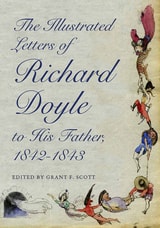
The Illustrated Letters of Richard Doyle to His Father, 1842–1843
Richard Doyle
Ohio University Press, 2015
Before he joined the staff of Punch and designed its iconic front cover, illustrator Richard “Dicky” Doyle was a young man whose father (political caricaturist John Doyle) charged him with sending a weekly letter, even though they lived under the same roof. This volume collects the fifty-three illustrated missives in their entirety for the first time and provides an uncommon peek into the intimate but expansive observations of a precocious social commentator and artist.
In a series of vivid manuscript canvases, Doyle observes Victorian customs and society. He visits operas, plays, and parades. He watches the queen visiting the House of Commons and witnesses the state funeral of the Duke of Sussex. He is caught up in the Chartist riots of August 1842 and is robbed during one of the melees. And he provides countless illustrations of ordinary people strolling in the streets and swarming the parks and picture galleries of the metropolis. The sketches offer a fresh perspective on major social and cultural events of London during the early 1840s by a keen observer not yet twenty years old.
Doyle’s epistles anticipate the modern comic strip and the graphic novel, especially in their experimentation with sequential narrative and their ingenious use of space. The letters are accompanied by a full biographical and critical introduction with new material about Doyle’s life.
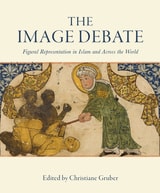
The Image Debate
Figural Representation in Islam and Across the WorldEdited by Christiane Gruber
Gingko, 2019
The Image Debate is a collection of thirteen essays which examine the controversy surrounding the use of images in Islamic and other religious cultures and seek to redress some of the misunderstandings that have arisen. Written by leading academics from the United States, Australia, Turkey, Israel and the United Kingdom, the book has a foreword by Stefano Carboni, Director of the Art Gallery of Western Australia, followed by an introduction by the editor Christiane Gruber, who sets the subject in context with a detailed examination of the debates over idols and the production of figural images in Islamic traditions.
Twelve further articles are divided into three sections: the first deals with pre-modern Islam: Mika Natif looks at tensions between the Hadith prohibition on images and the praxis of image-making under the Umayyad dynasty and argues that the Umayyad rulers used imagery to establish their political and religious authority; Finbarr Barry Flood examines the practice of epigraphic erasure, i.e., the removal of names of rulers and patrons from historical inscriptions from the medieval Islamic world; and Oya Pancaroğlu focuses on the figural conventions of an illustrated manuscript of Varqa and Gulshah, a medieval Persian romance composed in the masnavi (rhyming couplet) form by the 11th-century poet ‘Ayyuqi.
The second section addresses the situation outside Islam: Alicia Walker surveys attitudes toward the production and veneration of religious images in Byzantium from the earliest years of the Christian Roman Empire (early 4th century) to the aftermath of the Iconoclast controversy (late 9th century); Steven Fine explores the history of Jewish engagement with ‘art’ from Roman antiquity through the high middle ages through a detailed exploration of the 3rd-century Dura Europos synagogue and its wall paintings; Michael Shenkar examines evidence for the employment of figural images in the cultic practices of some of the major ancient Iranian cultural and political entities, offering a broad perspective on perceptions of images in ancient Iranian worship; and Robert DeCaroli delves into the question of why no image of the Buddha was made during the first five hundred years of Buddhism.
The third section brings the reader back to Islamic lands with five articles examining aspects of the issue in the modern and contemporary periods: Yousuf Saaed investigates South Asian mass-produced images, especially posters that include illustrations of local Sufi shrines, portraits of saints and Shi‘i iconography; James Bennett explores the visual depiction of Javanese shadow puppets (wayang kulit), including the sage Begawan Abiyasa, whose narratives convey key elements of Sufi mystical philosophy; Allen and Mary Roberts consider images of Cheikh Amadu Bamba, the founding Sufi saint of the Senegalese Mouride order; Rose Issa addresses how the term ‘Islamic’ relates to contemporary art, how artists manage to create work in countries in constant turmoil and to what extent such works reflect their conceptual, aesthetic, and socio-political concerns; and finally Shiva Balaghi traces the use of the figure, along its symbolic shadows and silhouettes, in works by notable Iranian artists living in Iran and in diaspora.
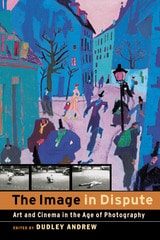
The Image in Dispute
Art and Cinema in the Age of PhotographyEdited by Dudley Andrew
University of Texas Press, 1997
Photography, cinema, and video have irrevocably changed the ways in which we view and interpret images. Indeed, the mechanical reproduction of images was a central preoccupation of twentieth-century philosopher Walter Benjamin, who recognized that film would become a vehicle not only for the entertainment of the masses but also for consumerism and even communism and fascism.
In this volume, experts in film studies and art history take up the debate, begun by Benjamin, about the power and scope of the image in a secular age. Part I aims to bring Benjamin's concerns to life in essays that evoke specific aspects and moments of the visual culture he would have known. Part II focuses on precise instances of friction within the traditional arts brought on by this century's changes in the value and mission of images. Part III goes straight to the image technologies themselves—photography, cinema, and video—to isolate distinctive features of the visual cultures they help constitute.
As we advance into the postmodern era, in which images play an ever more central role in conveying perceptions and information, this anthology provides a crucial context for understanding the apparently irreversible shift from words to images that characterized the modernist period. It will be important reading for everyone in cultural studies, film and media studies, and art history.
The Impossible Nude
François Jullien
University of Chicago Press, 2007
The undraped human form is ubiquitous in Western art and even appears in the art of India and Japan. Only in China, François Jullien argues, is the nude completely absent. In this enthralling extended essay, he explores the different conceptions of the human body that underlie this provocative disparity.
Contrasting nakedness (which implies a diminished state) with nudity (which represents a complete presence), Jullien explores the traditional European vision of the nude as a fixed point of fusion where form joins truth. He then shows that the absence of the nude in Chinese art evinces an understanding of the human body as changeable and transitory. Viewed in light of each other, these differing concepts allow for a new way of thinking about form, the ideal, and beauty, enabling us to delve deeper into the relationship between art and the ideas that lie at its roots. Beautifully illustrated and gracefully translated into English for the first time, The Impossible Nude will fascinate anyone interested in art history, Chinese art, or aesthetics.
The Impossible Reversal
A History of How We PlayPeter D. McDonald
University of Minnesota Press, 2026
Tracing the cultural history of play—from Fluxus to SimCity
Games and gamified activities have become ubiquitous in many adults’ lives, and play is widely valued for fostering creativity, community, growth, and empathy. But how did we come to our current understanding of what it means to play? The Impossible Reversal charts the transformation of notions of playfulness beginning in the second half of the twentieth century, when a legion of artists, academics, and engineers developed new ways of theorizing, structuring, and designing ludic activity.
Through examples ranging from experimental Fluxus games to corporate role-playing exercises and from the Easy Bake Oven to Tetris, The Impossible Reversal presents four styles of playfulness characteristic of the “era of designed play”: the impossible reversal, which puts a player in a seemingly hopeless scenario they must upend with a tiny gesture; expending the secret, which involves silly rules that gain an obscure power and require players to embrace failure; simulated freedom, a satiric criticism of the ordinary world; and oblique repetition, a way of playing that stumbles toward unimaginable outcomes through simple, meaningless, and endlessly iterated acts.
A unique genealogical account of play as both concept and practice, The Impossible Reversal illuminates how playfulness became essential for understanding cultural, technical, and economic production in the United States.
Retail e-book files for this title are screen-reader friendly with images accompanied by short alt text and/or extended descriptions.
The Indecent Screen
Regulating Television in the Twenty-First CenturyChris, Cynthia
Rutgers University Press, 2019

The India Museum Revisited
Arthur MacGregor
University College London, 2023
The museum of the East India Company formed, for a large part of the nineteenth century, one of the sights of London. In recent years, little has been remembered of it beyond its mere existence, while an assumed negative role has been widely attributed to it on the basis of its position at the heart of one of Britain’s arch-colonialist enterprises.
Extensively illustrated, The India Museum Revisited surveys the contents of its multi-faceted collections—with respect to materials, their manufacture, and original functions on the Indian sub-continent—as well as the collectors who gathered them and the manner in which they were mobilized to various ends within the museum.
From this integrated treatment of documentary and material sources, a more accurate, rounded, and nuanced picture emerges of an institution that contributed in major ways, over a period of eighty years, to the representation of India for a European audience, not only in Britain but through the museum’s involvement in the international exposition movement to audiences on the continent and beyond.
The Indian Craze
Primitivism, Modernism, and Transculturation in American Art, 1890–1915Elizabeth Hutchinson
Duke University Press, 2009
Illustrating her argument with images culled from late-nineteenth- and early-twentieth-century publications, Hutchinson revises the standard history of the mainstream interest in Native American material culture as “art.” While many locate the development of this cross-cultural interest in the Southwest after the First World War, Hutchinson reveals that it began earlier and spread across the nation from west to east and from reservation to metropolis. She demonstrates that artists, teachers, and critics associated with the development of American modernism, including Arthur Wesley Dow and Gertrude Käsebier, were inspired by Native art. Native artists were also able to achieve some recognition as modern artists, as Hutchinson shows through her discussion of the Winnebago painter and educator Angel DeCora. By taking a transcultural approach, Hutchinson transforms our understanding of the role of Native Americans in modernist culture.
The Infanticide Controversy
Primatology and the Art of Field ScienceAmanda Rees
University of Chicago Press, 2009
Infanticide in the natural world might be a relatively rare event, but as Amanda Rees shows, it has enormously significant consequences. Identified in the 1960s as a phenomenon worthy of investigation, infanticide had, by the 1970s, become the focus of serious controversy. The suggestion, by Sarah Hrdy, that it might be the outcome of an evolved strategy intended to maximize an individual’s reproductive success sparked furious disputes between scientists, disagreements that have continued down to the present day.
Meticulously tracing the history of the infanticide debates, and drawing on extensive interviews with field scientists, Rees investigates key theoretical and methodological themes that have characterized field studies of apes and monkeys in the twentieth century. As a detailed study of the scientific method and its application to field research, The Infanticide Controversy sheds new light on our understanding of scientific practice, focusing in particular on the challenges of working in “natural” environments, the relationship between objectivity and interpretation in an observational science, and the impact of the public profile of primatology on the development of primatological research. Most importantly, it also considers the wider significance that the study of field science has in a period when the ecological results of uncontrolled human interventions in natural systems are becoming ever more evident.
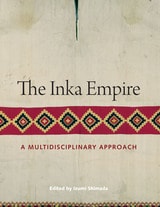
The Inka Empire
A Multidisciplinary ApproachEdited by Izumi Shimada
University of Texas Press, 2015
Massive yet elegantly executed masonry architecture and andenes (agricultural terraces) set against majestic and seemingly boundless Andean landscapes, roads built in defiance of rugged terrains, and fine textiles with orderly geometric designs—all were created within the largest political system in the ancient New World, a system headed, paradoxically, by a single, small minority group without wheeled vehicles, markets, or a writing system, the Inka. For some 130 years (ca. A.D. 1400 to 1533), the Inka ruled over at least eighty-six ethnic groups in an empire that encompassed about 2 million square kilometers, from the northernmost region of the Ecuador–Colombia border to northwest Argentina.
The Inka Empire brings together leading international scholars from many complementary disciplines, including human genetics, linguistics, textile and architectural studies, ethnohistory, and archaeology, to present a state-of-the-art, holistic, and in-depth vision of the Inkas. The contributors provide the latest data and understandings of the political, demographic, and linguistic evolution of the Inkas, from the formative era prior to their political ascendancy to their post-conquest transformation. The scholars also offer an updated vision of the unity, diversity, and essence of the material, organizational, and symbolic-ideological features of the Inka Empire. As a whole, The Inka Empire demonstrates the necessity and value of a multidisciplinary approach that incorporates the insights of fields beyond archaeology and ethnohistory. And with essays by scholars from seven countries, it reflects the cosmopolitanism that has characterized Inka studies ever since its beginnings in the nineteenth century.
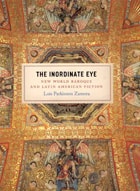
The Inordinate Eye
New World Baroque and Latin American FictionLois Parkinson Zamora
University of Chicago Press, 2006
The New World Baroque combines indigenous, African, and European forms of expression, and, in the early decades of the twentieth century, Latin American writers began to recuperate its visual structures to construct an alternative account of modernity, using its hybrid forms for the purpose of creating a discourse of “counterconquest”—a postcolonial self-definition aimed at disrupting entrenched power structures, perceptual categories, and literary forms.
Zamora engages this process, discussing a wide range of visual forms—Baroque façades and altarpieces, portraits of saints and martyrs (including the self-portraits of Frida Kahlo), murals from indigenous artisans to Diego Rivera—to elucidate works of fiction by Borges, Carpentier, Lezama Lima, Sarduy, Garro, García Márquez, and Galeano, and also to establish a critical perspective external to their work. Because visual media are “other” to the verbal economy of modern fiction, they serve these writers (and their readers) as oblique means by which to position their fiction culturally, politically, and aesthetically.
The first study of its kind in scope and ambition, The Inordinate Eye departs radically from most studies of literature by demonstrating how transcultural conceptions of the visual image have conditioned present ways of seeing and reading in Latin America.
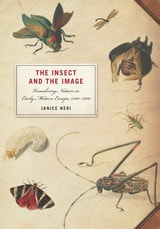
The Insect and the Image
Visualizing Nature in Early Modern Europe, 1500-1700Janice Neri
University of Minnesota Press, 2011
Once considered marginal members of the animal world (at best) or vile and offensive creatures (at worst), insects saw a remarkable uptick in their status during the early Renaissance. This quickened interest was primarily manifested in visual images—in illuminated manuscripts, still life paintings, the decorative arts, embroidery, textile design, and cabinets of curiosity. In The Insect and the Image, Janice Neri explores the ways in which such imagery defined the insect as a proper subject of study for Europeans of the early modern period.
It was not until the sixteenth century that insects began to appear as the sole focus of paintings and drawings—as isolated objects, or specimens, against a blank background. The artists and other image makers Neri discusses deployed this “specimen logic” and so associated themselves with a mode of picturing in which the ability to create a highly detailed image was a sign of artistic talent and a keenly observant eye. The Insect and the Image shows how specimen logic both reflected and advanced a particular understanding of the natural world—an understanding that, in turn, supported the commodification of nature that was central to global trade and commerce during the early modern era.
Revealing how sixteenth- and seventeenth-century artists and image makers shaped ideas of the natural world, Neri’s work enhances our knowledge of the convergence of art, science, and commerce today.
The Intellect Handbook of Documentary
Edited by Kate Nash and Deane Williams
Intellect Books, 2025
The Intellect Handbook of Documentary is an important go-to resource for practitioners, scholars, and students in this burgeoning field. It tackles key topics and debates including the role of documentary in post-truth culture, the rise of streaming giants, and the implications for national documentary cultures, as well as the shifting, increasingly hybrid, practices of documentary activism and the professionalization of impact. Featuring work by key figures in international documentary scholarship and talented emerging scholars, the Handbook is a landmark publication for documentary studies in the twenty-first century.
The Handbook is broad in its scope, incorporating historical, theoretical, empirical, and practical scholarship. It is organized around ten key themes and debates: What and where is documentary (studies); documentary in an age of epistemic uncertainty; documentary histories; documentary and the archive; audio and visualities; documentary relationalities; beyond the Anthropocene; digital and documentary practices; documentary and (new) politics; and a golden age of documentary distribution and funding. Importantly, the Handbook incorporates the voices and practices of practitioners from the Global South, challenging the dominance of Western voices in documentary scholarship.

The Interior Castle
The Art and Life of Jean StaffordHulbert Ann
University of Massachusetts Press, 1993
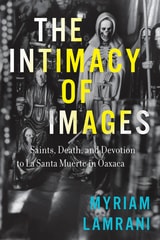
The Intimacy of Images
Saints, Death, and Devotion to La Santa Muerte in OaxacaMyriam Lamrani
University of Texas Press, 2024
2026 Edie Turner First Book Prize in Ethnographic Writing, Society for Humanistic Anthropology
La Santa Muerte becomes a lens for understanding how Oaxacans relate to saints, loved ones, and other “special dead.”
In Oaxaca, images of saints and loved ones, as well as of victims of political or criminal violence, are seemingly everywhere. While Oaxacans relate to all sorts of “special dead,” they are particularly devoted to La Santa Muerte (Saint Death), a female reaper-like figure whose popularity has risen in tandem with violence throughout Mexico.
The Intimacy of Images recontextualizes Oaxacans’ relationships with their “special dead” through the lens of La Santa Muerte, examining how devotees closely interact with what Lamrani terms “intimate images”: not only devotional effigies but also photographs, films, tattoos, and murals, and even dreams and visions. Though Mexicans have a well-known cultural familiarity with death, Lamrani argues that devotion to La Santa Muerte builds upon this intimacy even as it also participates in the production of terror and reflects political and criminal violence. Ultimately, Lamrani finds that these human-image interactions represent more than Catholic devotion; they reveal the secrets of Oaxacan political, religious, and social life, embody changing relationships to mortality and violence, and even offer insight into the practice of anthropology itself.
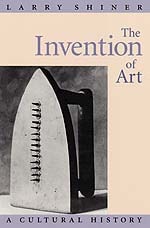
The Invention of Art
A Cultural HistoryLarry Shiner
University of Chicago Press, 2001
With The Invention of Art, Larry Shiner challenges our conventional understandings of art and asks us to reconsider its history entirely, arguing that the category of fine art is a modern invention—that the lines drawn between art and craft resulted from key social transformations in Europe during the long eighteenth century.
The Invisible Dragon
Essays on Beauty, Revised and ExpandedDave Hickey
University of Chicago Press, 2009
The Invisible Dragon made a lot of noise for a little book When it was originally published in 1993 it was championed by artists for its forceful call for a reconsideration of beauty—and savaged by more theoretically oriented critics who dismissed the very concept of beauty as naive, igniting a debate that has shown no sign of flagging.
With this revised and expanded edition, Hickey is back to fan the flames. More manifesto than polite discussion, more call to action than criticism, The Invisible Dragon aims squarely at the hyper-institutionalism that, in Hickey’s view, denies the real pleasures that draw us to art in the first place. Deploying the artworks of Warhol, Raphael, Caravaggio, and Mapplethorpe and the writings of Ruskin, Shakespeare, Deleuze, and Foucault, Hickey takes on museum culture, arid academicism, sclerotic politics, and more—all in the service of making readers rethink the nature of art. A new introduction provides a context for earlier essays—what Hickey calls his "intellectual temper tantrums." A new essay, "American Beauty," concludes the volume with a historical argument that is a rousing paean to the inherently democratic nature of attention to beauty.
Written with a verve that is all too rare in serious criticism, this expanded and refurbished edition of The Invisible Dragon will be sure to captivate a new generation of readers, provoking the passionate reactions that are the hallmark of great criticism.
The Invisible Masterpiece
Hans Belting
University of Chicago Press, 2001
Belting explores and explains how twentieth-century artists, following Duchamp, struggled with their personal dreams of absolute art. It was not until the 1960s that artists, such as Warhol, finally began to reject the idea of the individual, totemic work of art and its permanent exhibition, as well as the related concept of the "masterpiece" and the outmoded art market that fed off it.
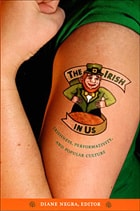
The Irish in Us
Irishness, Performativity, and Popular CultureDiane Negra, ed.
Duke University Press, 2006
Examining how Irishness is performed and commodified in the contemporary transnational environment, the contributors explore topics including Van Morrison’s music, Frank McCourt’s writing, the explosion of Irish-themed merchandising, the practices of heritage seekers, the movie The Crying Game, and the significance of red hair. Whether considering the implications of Garth Brooks’s claim of Irishness and his enormous popularity in Ireland, representations of Irish masculinity in the TV series Buffy the Vampire Slayer and Angel, or Americans’ recourse to a consoling Irishness amid the racial and nationalist tensions triggered by the events of September 11, the contributors delve into complex questions of ethnicity, consumerism, and globalization. Ultimately, they call for an increased awareness of the exclusionary effects of claims of Irishness and for the cultivation of flexible, inclusive ways of affiliating with Ireland and the Irish.
Contributors. Natasha Casey, Maeve Connolly, Catherine M. Eagan, Sean Griffin, Michael Malouf, Mary McGlynn, Gerardine Meaney, Diane Negra, Lauren Onkey, Maria Pramaggiore, Stephanie Rains, Amanda Third
The JAB Anthology
Selections from the Journal of Artists' Books, 1994-2020Johanna Drucker
University of Iowa Press, 2023
The JAB Anthology contains contributions by many renowned figures in the field including: Anne Moeglin-Delcroix, Janet Zweig, Monica Carroll, Adam Dickerson, Alisa Scudamore, Mary Jo Pauly, April Sheridan, Doro Boehme, Gerrit Jan de Rook, Océane Delleaux, Brandon Graham, Jérôme Dupeyrat, Ward Tietz, Paulo Silveira, Philip Cabau, Leszek Brogowski, Lyn Ashby, Tim Mosely, Debra Parr, Pedro Moura, Levi Sherman, Catarina Figueiredo Cardoso, Isabel Baraona, and the editors.
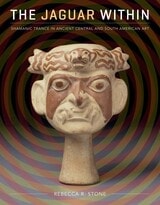
The Jaguar Within
Shamanic Trance in Ancient Central and South American ArtBy Rebecca R. Stone
University of Texas Press, 2011
An important new way of viewing the prehistoric art of the Americas, The Jaguar Within demonstrates that understanding a work of art’s connection with shamanic trance can lead to an appreciation of it as an extremely creative solution to the inherent challenge of giving material form to nonmaterial realities and states of being.
Shamanism—the practice of entering a trance state to experience visions of a reality beyond the ordinary and to gain esoteric knowledge—has been an important part of life for indigenous societies throughout the Americas from prehistoric times until the present. Much has been written about shamanism in both scholarly and popular literature, but few authors have linked it to another significant visual realm—art. In this pioneering study, Rebecca R. Stone considers how deep familiarity with, and profound respect for, the extra-ordinary visionary experiences of shamanism profoundly affected the artistic output of indigenous cultures in Central and South America before the European invasions of the sixteenth century.
Using ethnographic accounts of shamanic trance experiences, Stone defines a core set of trance vision characteristics, including enhanced senses; ego dissolution; bodily distortions; flying, spinning, and undulating sensations; synaesthesia; and physical transformation from the human self into animal and other states of being. Stone then traces these visionary characteristics in ancient artworks from Costa Rica and Peru. She makes a convincing case that these works, especially those of the Moche, depict shamans in a trance state or else convey the perceptual experience of visions by creating deliberately chaotic and distorted conglomerations of partial, inverted, and incoherent images.
The Jewish Decadence
Jews and the Aesthetics of ModernityJonathan Freedman
University of Chicago Press, 2021
The first to tell this sweeping story, Freedman demonstrates the centrality of decadence to the aesthetics of modernity and its inextricability from Jewishness. Freedman recounts a series of diverse and surprising episodes that he insists do not belong solely to the past, but instead reveal that the identification of Jewishness with decadence persists today.
The Judgment of Paris
Hubert Damisch
University of Chicago Press, 1996
The Kingdom of Pylos
Warrior-Princes of Mycenaean GreeceSharon R. Stocker
J. Paul Getty Trust, The, 2025
Ancient Pylos has long captivated travelers, archaeologists, and historians familiar with Homer’s Iliad and Odyssey and his account of King Nestor, the prudent elder counselor in the Trojan War. Excavations begun in 1939 unearthed the storied Palace of Nestor in Messenia, an epicenter of Mycenaean civilization.
The Kingdom of Pylos features spectacular arts and crafts, many recently excavated at sites across Messenia, including goldwork of unparalleled artistry, masterfully carved sealstones, weapons, and wall paintings. Essays by international scholars examine the latest discoveries, including the Linear B tablets—the earliest written form of the Greek language—which document the political, religious, and economic organization of the prosperous Pylian realm. New research and cutting-edge science cast light on the 2015 find of the grave of the Griffin Warrior, an extraordinary, intact burial that held thousands of artifacts, including the celebrated Pylos Combat Agate, perhaps the finest work of art from the prehistoric Aegean. With over 300 illustrations, this is the first major publication in English to reconstruct the society of Pylos and settlements in its orbit during the Late Bronze Age (1700–1070 BCE).
This volume is published to accompany an exhibition on view at the Archaeological Museum of Messenia in Kalamata from February 15 to April 27, 2025, the J. Paul Getty Museum at the Getty Villa from June 25, 2025, to January 12, 2026, and the Hellenic National Archaeological Museum in Athens from March 1 to June 30, 2026.
The Language of Images
W. J. T. Mitchell
University of Chicago Press, 1980
The Later Works of John Dewey, Volume 10, 1925 - 1953
1934, Art as ExperienceJohn Dewey. Edited by Jo Ann Boydston
Southern Illinois University Press, 2008
Art as Experience evolved from John Dewey’s Willam James Lectures, delivered at Harvard University from February to May 1931.
In his Introduction, Abraham Kaplan places Dewey’s philosophy of art within the context of his pragmatism. Kaplan demonstrates in Dewey’s esthetic theory his traditional “movement from a dualism to a monism” and discusses whether Dewey’s viewpoint is that of the artist, the respondent, or the critic.
The Learned Collector
Mythological Statuettes and Classical Taste in Late Antique GaulLea M. Stirling
University of Michigan Press, 2005
The majority of statues in late antique homes were heirlooms and antiques. Mythological statuary, which would be interpreted in varying degrees of complexity, favored themes reflecting aristocratic pastimes such as dining and hunting. The Learned Collector investigates the manufacture of these distinctive statuettes in the later fourth century, the reasons for their popularity, and their modes of display in Gaul and the empire.
Although the destruction of ancient artwork looms large in the common view of late antiquity, statuary of mythological figures continued to be displayed and manufactured into the early fifth century. Stirling surveys the sculptural decor of late antique villas across the empire to reveal the universal and regional trends in the late antique confluence of literary education, mythological references, aristocratic mores, and classicizing taste. Deftly combining art historical, archaeological, and literary evidence, this book will be important to classicists and art historians alike. Stirling's accessible writing style makes this an important work for scholars, students, and anyone with an interest in Roman statues of this era.
Lea M. Stirling is Associate Professor of Classics at the University of Manitoba and holds a Canada Research Council Chair in Roman Archaeology. She co-directs excavations at the ancient city of Leptiminus, Tunisia.
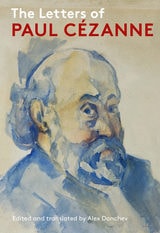
The Letters of Paul Cézanne
Alex Danchev
J. Paul Getty Trust, The, 2013
Revered and misunderstood by his peers and lauded by later generations as the father of modern art, Paul Cézanne (1839-1906) has long been a subject of fascination for artists and art lovers, writers, poets, and philosophers. His life was a ceaseless artistic quest, and he channeled much of his wide-ranging intellect and ferocious wit into his letters. Punctuated by exasperated theorizing and philosophical reflection, outbursts of creative ecstasy and melancholic confession, the artist’s correspondence reveals both the heroic and all-toohuman qualities of a man who is indisputably among the pantheon of all-time greats.
This new translation of Cézanne’s letters includes more than twenty that were previously unpublished and reproduces the sketches and caricatures with which Cézanne occasionally illustrated his words. The letters shed light on some of the key artistic relationships of the modern period—about one third of Cézanne’s more than 250 letters are to his boyhood companion Émile Zola, and he communicated extensively with Camille Pissarro and the dealer Ambroise Vollard. The translation is richly annotated with explanatory notes, and, for the first time, the letters are cross-referenced to the current catalogue raisonné. Numerous inaccuracies and archaisms in the previous English edition of the letters are corrected, and many intriguing passages that were unaccountably omitted have been restored. The result is a publishing landmark that ably conveys Cézanne’s intricacy of expression.
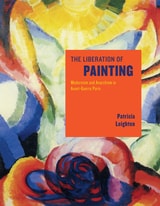
The Liberation of Painting
Modernism and Anarchism in Avant-Guerre ParisPatricia Leighten
University of Chicago Press, 2013
Leighten examines the circle of artists—Pablo Picasso, Juan Gris, František Kupka, Maurice de Vlaminck, Kees Van Dongen, and others—for whom anarchist politics drove the idea of avant-garde art, exploring how their aesthetic choices negotiated the myriad artistic languages operating in the decade before World War I. Whether they worked on large-scale salon paintings, political cartoons, or avant-garde abstractions, these artists, she shows, were preoccupied with social criticism. Each sought an appropriate subject, medium, style, and audience based on different conceptions of how art influences society—and their choices constantly shifted as they responded to the dilemmas posed by contradictory anarchist ideas. According to anarchist theorists, art should expose the follies and iniquities of the present to the masses, but it should also be the untrammeled expression of the emancipated individual and open a path to a new social order. Revealing how these ideas generated some of modernism’s most telling contradictions among the prewar Parisian avant-garde, The Liberation of Painting restores revolutionary activism to the broader history of modern art.
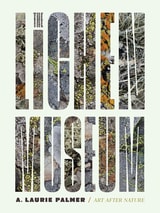
The Lichen Museum
Laurie A. Palmer
University of Minnesota Press, 2023
A radical proposal for how a tiny organism can transform our understanding of human relations
Serving as both a guide and companion publication to the conceptual art project of the same name, The Lichen Museum explores how the physiological characteristics of lichens provide a valuable template for reimagining human relations in an age of ecological and social precarity. Channeling between the personal, the scientific, the philosophical, and the poetic, A. Laurie Palmer employs a cross-disciplinary framework that artfully mirrors the collective relations of lichens, imploring us to envision alternative ways of living based on interdependence rather than individualism and competition.
Lichens are composite organisms made up of a fungus and an alga or cyanobacteria thriving in a mutually beneficial relationship. The Lichen Museum looks to these complex organisms, remarkable for their symbiosis, diversity, longevity, and adaptability, as models for relations rooted in collaboration and nonhierarchical structures. In their resistance to fast-paced growth and commodification, lichens also offer possibilities for humans to reconfigure their relationship to time and attention outside of the accelerated pace of capitalist accumulation.
Drawing together a diverse set of voices, including personal encounters with lichenologists and lichens themselves, Palmer both imagines and embodies a radical new approach to human interconnection. Using this tiny organism as an emblem through which to navigate environmental and social concerns, this work narrows the gap between the human and natural worlds, emphasizing the notion of mutual dependence as a necessary means of survival and prosperity.
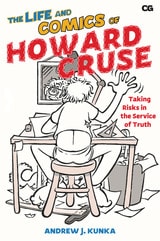
The Life and Comics of Howard Cruse
Taking Risks in the Service of TruthAndrew J. Kunka
Rutgers University Press, 2022
The Life and Comics of Howard Cruse tells the remarkable story of how a self-described “preacher’s kid” from Birmingham, Alabama, became the so-called “Godfather of Gay Comics.” This study showcases a remarkable fifty-year career that included working in the 1970s underground comics scene, becoming founding editor of the groundbreaking anthology series Gay Comix, and publishing the graphic novel Stuck Rubber Baby, partially based on his own experience of coming of age in the Civil Rights era.
Through his exploration of Cruse’s life and work, Andrew J. Kunka also chronicles the dramatic ways that gay culture changed over the course of Cruse’s lifetime, from Cold War-era homophobia to the gay liberation movement to the AIDS crisis to the legalization of gay marriage. Highlighting Cruse’s skills as a trenchant satirist and social commentator, Kunka explores how he cast a queer look at American politics, mainstream comics culture, and the gay community’s own norms.
Lavishly illustrated with a broad selection of comics from Cruse’s career, this study serves as a perfect introduction to this pioneering cartoonist, as well as an insightful read for fans who already love how his work sketched a new vision of gay life.

The Life of Lambert Lombard (1565); and Effigies of Several Famous Painters from the Low Countries (1572)
Dominicus Lampsonius
J. Paul Getty Trust, The, 2022
Dominicus Lampsonius’s The Life of Lambert Lombard (1565) is the earliest published biography of a Netherlandish artist. This neo-Latin account of the life of the painter, architect, and draftsman Lambert Lombard of Liège offers a theoretical exposition on the nature and ideal practice of Netherlandish art, emphasizing Lombard’s intellectual curiosity, interest in antiquity, attentive study of the human body, and exemplary generosity as a teacher.
This volume offers the first English edition of The Life of Lambert Lombard, complemented by a new translation of the inscriptions Lampsonius composed to accompany the Effigies of Several Famous Painters from the Low Countries (1572), a cycle of twenty-three engraved portraits of Netherlandish artists developed in collaboration with the print publisher Hieronymus Cock.
Together, The Life of Lambert Lombard and the Effigies established frameworks for a distinctly Netherlandish history of art. Responding to a growing sense of Netherlandish cultural and political identity on the eve of the Dutch Revolt, these texts proposed a critical alternative to Giorgio Vasari’s Lives of the Artists and its Italian model of art historical development, celebrating local ingenuity and skill. They remain the starting point for any history of the northern Renaissance.
The Light Club
On Paul Scheerbart's "The Light Club of Batavia"Josiah McElheny
University of Chicago Press, 2010
In 1912, Scheerbart published The Light Club of Batavia, a Novelle about the formation of a club dedicated to building a spa for bathing—not in water, but in light—at the bottom of an abandoned mineshaft. Translated here into English for the first time, this rare story serves as a point of departure for Josiah McElheny, who, with an esteemed group of collaborators, offers a fascinating array of responses to this enigmatic work.
The Light Club makes clear that the themes of utopian hope, desire, and madness in Scheerbart’s tale represent a part of modernism’s lost project: a world based on political and spiritual ideals rather than efficiency and logic. In his compelling introduction, McElheny describes Scheerbart’s life as well as his own enchantment with the writer, and he explains the ways in which The Light Club of Batavia inspired him to produce art of uncommon breadth. The Light Club also features inspired writings from Gregg Bordowitz and Ulrike Müller, Andrea Geyer, and Branden W. Joseph, as well as translations of original texts by and about Scheerbart. A unique response by one visionary artist to another, The Light Club is an unforgettable examination of what it might mean to see radical potential in absolute illumination.
The Likeness of the King
A Prehistory of Portraiture in Late Medieval FranceStephen Perkinson
University of Chicago Press, 2009
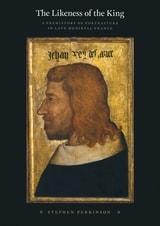
Anyone who has strolled through the halls of a museum knows that portraits occupy a central place in the history of art. But did portraits, as such, exist in the medieval era? Stephen Perkinson’s The Likeness of the King challenges the canonical account of the invention of modern portrait practices, offering a case against the tendency of recent scholarship to identify likenesses of historical personages as “the first modern portraits.”
Unwilling to accept the anachronistic nature of these claims, Perkinson both resists and complicates grand narratives of portraiture art that ignore historical context. Focusing on the Valois court of France, he argues that local practice prompted shifts in the late medieval understanding of how images could represent individuals and prompted artists and patrons to deploy likeness in a variety of ways. Through an examination of well-known images of the fourteenth- and early fifteenth-century kings of France, as well as largely overlooked objects such as wax votive figures and royal seals, Perkinson demonstrates that the changes evident in these images do not constitute a revolutionary break with the past, but instead were continuous with late medieval representational traditions.
The Limits of Auteurism
Case Studies in the Critically Constructed New HollywoodGodfrey, Nicholas
Rutgers University Press, 2018
The book explores the role that contemporary critics played in determining how the movies of this period were understood and how, in turn, strategies of distribution influenced critical responses and dictated the conditions of entry into the rapidly codifying New Hollywood canon. Focusing on a small number of industrially significant films, this new history advances our understanding of this important moment of transition from Classical to contemporary modes of production.
The Literary Work of Art
An Investigation of the Borderlines of Ontology, Logic, and Theory of LanguageRoman Ingarden
Northwestern University Press, 1973
The Literary Word of Art establishes the groundwork for a philosophy of literature, i.e., an ontology in terms of which the basic general structure of all lliterary works can be determined. This "essential anatomy" makes basic tools and concepts available for rigorous and subtle aesthetic analysis.
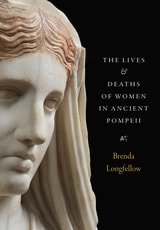
The Lives and Deaths of Women in Ancient Pompeii
Brenda Longfellow
University of Texas Press, 2025
A study of women’s lives in the public sphere of the ancient city of Pompeii.
Pompeii’s well-preserved remains provide a unique opportunity for the close study of ancient lives. Drawing on statues, inscriptions, graffiti, wall paintings, and the architecture of tombs, sanctuaries, houses, and public spaces, The Lives and Deaths of Women in Ancient Pompeii examines the public lives of women in Pompeii. Art historian Brenda Longfellow explores how historical women of all social backgrounds acted in public and exerted agency on behalf of themselves and others, ultimately finding that female initiatives in Pompeii were not only accepted but desired by the community to a greater extent than has previously been recognized.
Longfellow centers her study on a few key women—including the city’s most notable female patron, Eumachia—and uses them to examine female roles in postmortem commemorations, civic patronage and benefactions, commerce, the priesthood, and the home. By following these individuals, Longfellow examines women’s lives in Pompeii in both abstract and concrete ways, allowing readers to better understand their importance to the city and society. The result is a groundbreaking book that foregrounds the agency of women in everyday Pompeii.