Results by title
28250 books match the query 'History' and 6388 start with t
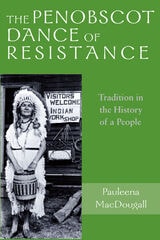
The Penobscot Dance of Resistance
Tradition in the History of a PeoplePauleena MacDougall
University of New Hampshire Press, 2004
Although historians predicted the demise of the Penobscot Indians early in the nineteenth century, the tribe is thriving at the opening of the twenty-first century. Having by the early 1800s been rendered all but invisible to the dominant culture, the Penobscots, by selectively adapting to changing circumstances, won back land and visibility. The vital importance of employing elements of cultural resistance as a survival mechanism has, until now, been underestimated. In a larger context, Dance of Resistance demonstrates how an examination of the history of one Indian nation provides a window on the complex interaction of cultural systems in America.
MacDougall demonstrates that Penobscot legend, linguistics, dance, and oral tradition became foundations of resistance against assimilation into the dominant culture. She thoughtfully and accessibly reconstructs from published, archival, and oral sources the tribe's metaphorical and triumphant Dance of Resistance—founded on spiritual power, reverence for homeland, and commitment to self-determination—from colonial times to the present. A decade of political activism culminated in the precedent-setting 1980 Maine Indian Land Claims settlement. Today the Penobscots run small industries, manage their natural resources, and provide health services, K through 8 education, and social services to the poor and elderly of their community.
The Pensive Image
Art as a Form of ThinkingHanneke Grootenboer
University of Chicago Press, 2020
While the philosophical dimension of painting has long been discussed, a clear case for painting as a form of visual thinking has yet to be made. Traditionally, vanitas still life paintings are considered to raise ontological issues while landscapes direct the mind toward introspection. Grootenboer moves beyond these considerations to focus on what remains unspoken in painting, the implicit and inexpressible that manifests in a quality she calls pensiveness. Different from self-aware or actively desiring images, pensive images are speculative, pointing beyond interpretation. An alternative pictorial category, pensive images stir us away from interpretation and toward a state of suspension where thinking through and with the image can start.
In fluid prose, Grootenboer explores various modalities of visual thinking— as the location where thought should be found, as a refuge enabling reflection, and as an encounter that provokes thought. Through these considerations, she demonstrates that artworks serve as models for thought as much as they act as instruments through which thinking can take place. Starting from the premise that painting is itself a type of thinking, The Pensive Image argues that art is capable of forming thoughts and shaping concepts in visual terms.

The People
Jules Michelet
University of Illinois Press, 1973
The People is a moving picture of France on the eve of 1848. Michelet saw tensions, divisions, and hatreds tearing France apart, and he sought to provide a new faith that would unite the conflicting groups in the love of country.
This book, Michelet wrote, "is the product of my experience rather than of my studies. I have derived it from my observation and my conversations with friends and neighbors." Because of Michelet's countless discussions with people from all ranks of society and his precise observations, his portrait of France is unsurpassed, and representative of general European problems in a time of rapid social and economic change.
The People Are the News
Grant Pick’s Chicago StoriesJohn Pick
Northwestern University Press, 2009
This distinctive collection features writings from Grant Pick’s long, distinguished career in literary journalism. Pick had a uniquely open eye and ear for people who were in difficult situations, doing extraordinary things, or both. Most of his stories focus on interesting but overlooked Chicagoans, like the struggling owner of a laundrymat on the west side or the successful doctor who, as he faced his own death from cancer, strove to enlighten his colleagues in the field of medicine. As only a lifetime Chicagoan could, he described in tender detail the worlds in which people lived or worked, providing a look not just at one city’s citizens but at humanity as a whole.
Pick’s widow and son curate this showcase of some of his most well-remembered work, such as “The Rag Man of Lincoln Park” and “Brother Bill.” In these and all of his other works, Pick wrote from the front lines, speaking to people whom others might encounter everyday but never really see. He faithfully characterized his subjects, never denying them dignity or value and never judging them. In the mirror he held up to his city, Chicago could see the shared humanity of all its citizens.
The People Have Never Stopped Dancing
Native American Modern Dance HistoriesJacqueline Shea Murphy
University of Minnesota Press, 2007
During the past thirty years, Native American dance has emerged as a visible force on concert stages throughout North America. In this first major study of contemporary Native American dance, Jacqueline Shea Murphy shows how these performances are at once diverse and connected by common influences.
Demonstrating the complex relationship between Native and modern dance choreography, Shea Murphy delves first into U.S. and Canadian federal policies toward Native performance from the late nineteenth through the early twentieth centuries, revealing the ways in which government sought to curtail authentic ceremonial dancing while actually encouraging staged spectacles, such as those in Buffalo Bill’s Wild West shows. She then engages the innovative work of Ted Shawn, Lester Horton, and Martha Graham, highlighting the influence of Native American dance on modern dance in the twentieth century. Shea Murphy moves on to discuss contemporary concert dance initiatives, including Canada’s Aboriginal Dance Program and the American Indian Dance Theatre.
Illustrating how Native dance enacts, rather than represents, cultural connections to land, ancestors, and animals, as well as spiritual and political concerns, Shea Murphy challenges stereotypes about American Indian dance and offers new ways of recognizing the agency of bodies on stage.
Jacqueline Shea Murphy is associate professor of dance studies at the University of California, Riverside, and coeditor of Bodies of the Text: Dance as Theory, Literature as Dance.
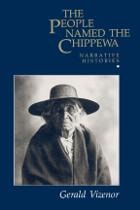
The People Named The Chippewa
Narrative HistoriesGerald Vizenor Vizenor
University of Minnesota Press, 1984
Ranging in time and space from Madeline Island and the reservations of northern Minnesota to the urban reservation of Minneapolis-St. Paul, Vizenor recounts the experiences of the Chippewa and their encounters with the white people who "named" them.
"Through some very funny moments, Vizenor raises serious questions for the pan-Indian movements and 'radical' academics. A teacher and scholar wishing to avoid and to correct the mistakes of twentieth-century scholarship in discussing 'Indians,' 'Native Americans' or 'Amerindians' would do well to begin with these stories; they are the strength of the Anishinaabeg." World Literature Today
The People Shall Judge, Volume I, Part 1
Readings in the Formation of American PolicyEdited by Staff of Social Sciences 1 at The College of the University of Chicago
University of Chicago Press, 1976
These selections have been drawn from systematic philosophies; from opinions expressed in law and judicial decisions; from speeches or pamphlets struck off in the heat of controversy; from political and diplomatic correspondence. They are grouped to focus attention on the perennial issues of liberty, equality, and security in about a dozen significant periods of American history. Volume I, Part 1, begins with a consideration of truth and liberty in the seventeenth century, continues with a study of the issues of the American Revolution, and concludes with a study of the Confederation and the Constitution.
The organization of the readings puts the issues in the context of four fundamental relationships: the citizen and the economy (and, within the economy, the interrelations of major interest groups); the federal union and the states; the United States and the world. The best available texts have been used. Introductions and explanatory notes relate the readings to one another, suggest the circumstances in which they were written, and provide biographical information about the authors.
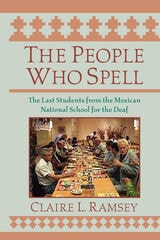
The People Who Spell
The Last Students from the Mexican National School for the DeafClaire L. Ramsey
Gallaudet University Press, 2011
The Escuela Nacional para Sordomudos (ENS), translated as the Mexican National School for the Deaf, opened its doors in the 1860s as part of the republic’s intention to educate its deaf people. The ENS did not use Lengua de Señas Mexicana (LSM), Mexico’s native sign language, for instruction, though they tolerated LSM use by the students. The school was closed permanently in 1972, thus leaving its former students still alive today as the last links to this historic institution. In this compelling social history, Claire L. Ramsey presents these unique Deaf Mexicans from their extraordinary experiences as ENS students and signers to their current personal lives.
One ENS signer, María de los Ángeles Bedolla, inspired the title of the book, The People Who Spell. In her account, she describes herself and her peers as cultured and educated compared to the young deaf people of today. The ENS signers pride themselves on el deletreo, LSM fingerspelling, which they consider key to their sophistication. Ramsey relates each of the signers’ childhoods, marriages, work experiences, and retirements. However, she brings threads of their stories together to reveal a common and abiding disappointment in modern-day Mexico’s failure to educate its deaf citizens according to the promise made more than 100 years ago. The narratives of the ENS signers detail their remarkable lives and heritage but also legitimately question the future of Mexico’s young deaf people.
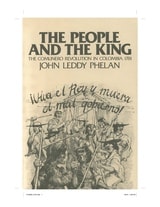
The People and the King
The Comunero Revolution in Colombia, 1781John Leddy Phelan
University of Wisconsin Press, 1978
In The People and the King, John Leddy Phelan reexamines a well-known but long misunderstood event in eighteenth-century Colombia. When the Spanish colonial bureaucratic system of conciliation broke down, indigenous groups resorted to armed revolt to achieve their political ends.
As Phelan demonstrates in these pages, the crisis of 1781 represented a constitutional clash between imperial centralization and colonial decentralization. Phelan argues that the Comunero revolution was not, as it has often been portrayed, a precursor of political independence, nor was it a frustrated social upheaval. The Comunero leaders and their followers did not advocate any basic reordering of society, Phelan concludes, but rather made an appeal for revolutionary reform within a traditionalist framework.
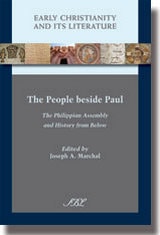
The People beside Paul
The Philippian Assembly and History from BelowJoseph A. Marchal
SBL Press, 2015
Who are the people beside Paul, and what can we know about them?
This volume brings together an international and interdisciplinary group of scholars with a broad range of expertise and a common interest: Philippi in antiquity. Each essay engages one set of contextual particularities for Paul and the ordinary people of the Philippian assembly, while simultaneously placing them in wider settings. This 'people's history' uses both traditional and more cutting-edge methods to reconsider archaeology and architecture, economy and ethnicity, prisons and priestesses, slavery, syncretism, stereotypes of Jews, the colony of Philippi, and a range of communities. The contributors are Valerie Abrahamsen, Richard S. Ascough, Robert L. Brawley, Noelle Damico, Richard A. Horsley, Joseph A. Marchal, Mark D. Nanos, Peter Oakes, Gerardo Reyes Chavez, Angela Standhartinger, Eduard Verhoef, and Antoinette Clark Wire.
Features
- An examination of the social forms and forces that shaped and affected the Philippian church
- Essays offer insight into standard questions about the letter s hymn and audience, Paul's 'opponents,' and the sites of the community and of Paul's imprisonment
- A focused exploration of more marginalized topics and groups, including women, slaves, Jews, and members of localized cults
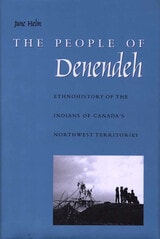
The People of Denendeh
Ethnohistory of the Indians of Canada's Northwest TerritoriesJune Helm
University of Iowa Press, 2000
Helm begins with a broad-ranging, stimulating overview of the social organization of hunter-gatherer peoples of the world, past and present, that provides a background for all she has learned about the Dene. The chapters in part 1 focus on community and daily life among the Mackenzie Dene in the middle of the twentieth century. After two historical overview chapters, Helm moves from the early years of the twentieth century to the earliest contacts between Dene and white culture, ending with a look at the momentous changes in Dene-government relations in the 1970s. Part 3 considers traditional Dene knowledge, meaning, and enjoyments, including a chapter on the Dogrib hand game. Throughout, Helm's encyclopedic knowledge combines with her personal interactions to create a collection that is unique in its breadth and intensity.
The People of Sonora and Yankee Capitalists
Ramón Eduardo Ruiz
University of Arizona Press, 1988
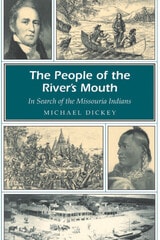
The People of the River's Mouth
In Search of the Missouria IndiansMichael E. Dickey
University of Missouri Press, 2011
The Missouria people were the first American Indians encountered by European explorers venturing up the Pekitanoui River—the waterway we know as the Missouri. This Indian nation called itself the Nyut^achi, which translates to “People of the River Mouth,” and had been a dominant force in the Louisiana Territory of the pre-colonial era. When first described by the Europeans in 1673, they numbered in the thousands. But by 1804, when William Clark referred to them as “once the most powerful nation on the Missouri River,” fewer than 400 Missouria remained. The state and Missouri River are namesakes of these historic Indians, but little of the tribe’s history is known today. Michael Dickey tells the story of these indigenous Americans in The People of the River’s Mouth.
Accessible to general readers, this book recovers the lost history of an important people. The People of the River’s Mouth sheds light on an overlooked aspect of Missouri’s past and pieces together the history of these influential Native Americans in an engaging, readable volume.
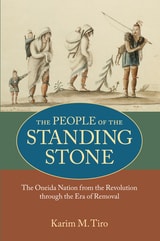
The People of the Standing Stone
The Oneida Nation from the Revolution through the Era of RemovalKarim M. Tiro
University of Massachusetts Press, 2011
The Oneidas' physical, political, and emotional division persists to this day. Even for those who stayed put, their world changed more in cultural, ecological, and demographic terms than at any time before or since. Oneidas of the post-Revolutionary decades were reluctant pioneers, undertaking more of the adaptations to colonized life than any other generation. Amid such wrenching change, maintaining continuity was itself a creative challenge. The story of that extraordinary endurance lies at the heart of this book.

The People's Choice
Congressman Jim Jontz of IndianaRay Boomhower
Indiana Historical Society Press, 2012
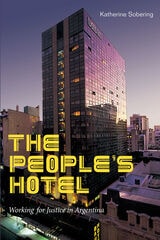
The People's Hotel
Working for Justice in ArgentinaKatherine Sobering
Duke University Press, 2022
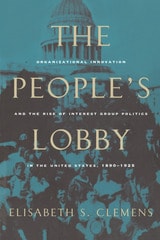
The People's Lobby
Organizational Innovation and the Rise of Interest Group Politics in the United States, 1890-1925Elisabeth S. Clemens
University of Chicago Press, 1997
Clemens sheds new light on how farmers, workers, and women invented strategies to circumvent the parties. Voters learned to monitor legislative processes, to hold their representatives accountable at the polls, and to institutionalize their ongoing participation in shaping policy. Closely analyzing the organizational politics in three states—California, Washington, and Wisconsin—she demonstrates how the political opportunity structure of federalism allowed regional innovations to exert leverage on national political institutions.
An authoritative statement on the changes in American politics during the Progressive Era, this book will interest political scientists, sociologists, and American historians.
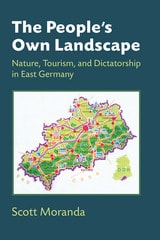
The People's Own Landscape
Nature, Tourism, and Dictatorship in East GermanyScott Moranda
University of Michigan Press, 2014
East Germany’s Socialist Unity Party aimed to placate a public well aware of the higher standards of living enjoyed elsewhere by encouraging them to participate in outdoor activities and take vacations in the countryside. Scott Moranda considers East Germany’s rural landscapes from the perspective of both technical experts (landscape architects, biologists, and physicians) who hoped to dictate how vacationers interacted with nature, and the vacationers themselves, whose outdoor experience shaped their understanding of environmental change. As authorities eliminated traditional tourist and nature conservation organizations, dissident conservationists demanded better protection of natural spaces. At the same time, many East Germans shared their government’s expectations for economic development that had real consequences for the land. By the 1980s, environmentalists saw themselves as outsiders struggling against the state and a public that had embraced mainstream ideas about limitless economic growth and material pleasures.
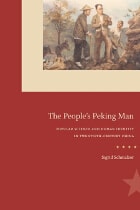
The People's Peking Man
Popular Science and Human Identity in Twentieth-Century ChinaSigrid Schmalzer
University of Chicago Press, 2008
The People’s Peking Man is a skilled social history of twentieth-century Chinese paleoanthropology and a compelling cultural—and at times comparative—history of assumptions and debates about what it means to be human. By focusing on issues that push against the boundaries of science and politics, The People’s Peking Man offers an innovative approach to modern Chinese history and the history of science.

The People's Porn
A History of Handmade Pornography in AmericaLisa Z. Sigel
Reaktion Books, 2020
Critics tend to focus on mass-produced materials and make claims about pornography as plasticized or commodified. In contrast, eminent historian Lisa Z. Sigel looks at what people made, rather than what they bought, revealing how people thought about sexuality for themselves. She also explores periods when these sexual artifacts were pilloried, ransacked, and destroyed, providing a unique document of rare nineteenth- and twentieth-century objects. Whalers and craftsmen, prisoners and activists, African Americans and feminists—all made their own pornography. Ranging across the full sweep of this output, The People’s Porn challenges preconceptions as it tells a new and fascinating story about American sexual history.
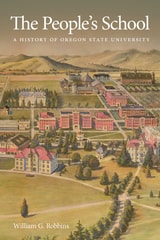
The People's School
A History of Oregon State UniversityWilliam Robbins
Oregon State University Press, 2017
This contextual approach is not to suggest that university presidents are unimportant. Benjamin Arnold (1872-1892), appointed president of Corvallis College by the Methodist Episcopal Church, South, served well beyond the date (1885) when the State of Oregon assumed control of the agricultural college. Robbins uses central administration records and grassroots sources—local and state newspapers, student publications (The Barometer, The Beaver), and multiple and wide-ranging materials published in the university’s digitized ScholarsArchive@OSU, a source for the scholarly work of faculty, students, and materials related to the institution’s mission and research activities. Other voices—extracurricular developments, local and state politics, campus reactions to national crises—provide intriguing and striking addendums to the university’s rich history.
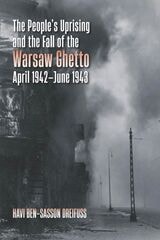
The People's Uprising and the Fall of the Warsaw Ghetto, April 1942–June 1943
Havi Ben-Sasson Dreifuss
Brandeis University Press, 2026
The People’s Uprising and the Fall of the Warsaw Ghetto, April 1942–June 1943 sheds light on the lives, choices, and experiences of the tens of thousands of Jews who were not part of the underground armed resistance but nonetheless supported the famed Warsaw Ghetto Uprising. This riveting and dramatic account focuses on the final year of the Warsaw ghetto, from the Great Deportation in the summer of 1942 through the suppression of the uprising in mid-1943. Drawing on powerful contemporary testimonies, diaries, and documents—many of them previously unexplored—Havi Ben-Sasson Dreifuss
reveals how members of the broader Jewish population struggled to survive, maintain family and community life, and make impossible moral decisions in the face of fear, hunger, and daily violence. Looking beyond the fighters themselves, the book offers a story of devastation, but also of resilience and human dignity.
Published in association with Yad Vashem.
The People's War
Responses to World War II in the Soviet UnionEdited by Robert W. Thurston and Bernd Bonwetsch
University of Illinois Press, 2000
Drawing on a wealth of archival and recently published material, contributors detail the calculated destruction of a Jewish town by the Germans and present a chilling picture of life in occupied Minsk. They look at the cultural developments of the war as well as the wartime experience of intellectuals, for whom the period was a time of relative freedom. They discuss women's myriad roles in combat and other spheres of activity. They also reassess the behavior and morale of ordinary Red Army troops and offer new conclusions about early crushing defeats at the hands of the Germans–-defeats that were officially explained as cowardice on the part of high officers.
A frank investigation of civilian life behind the front lines, The People's War provides a detailed, balanced picture of the Stalinist USSR by describing not only the command structure and repressive power of the state but also how people reacted to them, cooperated with or opposed them, and adapted or ignored central policy in their own ways. By putting the Soviet people back in their war, this volume helps restore the range and complexity of human experience to one of history's most savage periods.

The Peoples Clearance
Highland Emigration to British North America, 1770-1815J.M. Bumsted
University of Manitoba Press, 1982
The Peoples Of Las Vegas
One City, Many FacesJerry L Simich
University of Nevada Press, 2005
Beneath the glitzy surface of the resorts and the seemingly cookie-cutter suburban sprawl of Las Vegas lies a vibrant and diverse ethnic life. People of varied origins make up the population of nearly two million and yet, until now, little mention of the city has been made in studies and discussion of ethnicity or immigration. The Peoples of Las Vegas: One City, Many Faces fills this void by presenting the work of seventeen scholars of history, political science, sociology, anthropology, law, urban studies, cultural studies, literature, social work, and ethnic studies to provide profiles of thirteen of the city’s many ethnic groups. The book’s introduction and opening chapters explore the historical and demographic context of these groups, as well as analyze the economic and social conditions that make Las Vegas so attractive to recent immigrants. Each group is the subject of the subsequent chapters, outlining migration motivations and processes, economic pursuits, cultural institutions and means of transmitting culture, involvement in the broader community, ties to homelands, and recent demographic trends.
The People’s Party in Texas
A Study in Third Party PoliticsBy Roscoe Martin
University of Texas Press, 1970
Roscoe Martin's study of the People's Party in Texas was a pioneering analysis of the state populist movements and long considered one of the best. The People's Party was an influential force in United States politics in the last decade of the nineteenth century, especially in the western and southern states. Martin's study of third-party politics in Texas, as well as being an important work in Texas history, provides much insight into the national radical movement of the 1890s.
The People’s Plaza
Sixty-Two Days of Nonviolent ResistanceJustin Jones
Vanderbilt University Press, 2022
Central to the occupation was Justin Jones, a student of Fisk University and Vanderbilt Divinity School whose place at the forefront of the protests brought him and the occupation to the attention of the Tennessee state troopers, state and US senators, and Governor Bill Lee. The result was two months of solidarity in the face of rampant abuse, community in the face of state-sponsored terror, and standoff after standoff at the doorsteps of the people's house with those who claimed to represent them. In this, his first book, Jones describes those two revolutionary months of nonviolent resistance against a police state that sought to dehumanize its citizens.
The People's Plaza is a rumination on the abuse of power, and a vision of a more just, equitable, anti-racist Nashville—a vision that kept Jones and those with him posted on the plaza through intense heat, unprovoked arrests, vandalism, theft, and violent suppression. It is a first-person account of hope, a statement of intent, and a blueprint for nonviolent resistance in the American South and elsewhere.
The People’s Plaza
Sixty-Two Days of Nonviolent ResistanceJustin Jones
Vanderbilt University Press, 2022
Central to the occupation was Justin Jones, a student of Fisk University and Vanderbilt Divinity School whose place at the forefront of the protests brought him and the occupation to the attention of the Tennessee state troopers, state and US senators, and Governor Bill Lee. The result was two months of solidarity in the face of rampant abuse, community in the face of state-sponsored terror, and standoff after standoff at the doorsteps of the people's house with those who claimed to represent them. In this, his first book, Jones describes those two revolutionary months of nonviolent resistance against a police state that sought to dehumanize its citizens.
The People's Plaza is a rumination on the abuse of power, and a vision of a more just, equitable, anti-racist Nashville—a vision that kept Jones and those with him posted on the plaza through intense heat, unprovoked arrests, vandalism, theft, and violent suppression. It is a first-person account of hope, a statement of intent, and a blueprint for nonviolent resistance in the American South and elsewhere.
The Pequot War
Alfred A. Cave
University of Massachusetts Press, 1996

The Perfect Lion
The Life and Death of Confederate Artillerist John PelhamJerry H. Maxwell
University of Alabama Press, 2011
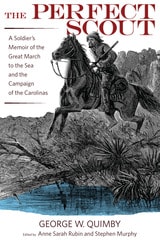
The Perfect Scout
A Soldier’s Memoir of the Great March to the Sea and the Campaign of the CarolinasGeorge W. Quimby, edited by Anne Sarah Rubin and Stephen Murphy
University of Alabama Press, 2018
After his father-in-law passed away, Stephen Murphy found, among the voluminous papers left behind, an ancestral memoir. Murphy quickly became fascinated with the recollections of George W. Quimby (1842–1926), a Union soldier and scout for General William Tecumseh Sherman.
Before Quimby became a part of Sherman’s March, he was held captive by Nathan Bedford Forrest’s troops in western Tennessee. He joined Sherman’s Army in Vicksburg, destroying railroads and bridges across Mississippi and Alabama on the way to Georgia. As the notorious march began, Quimby became a scout and no longer experienced war as his fellow soldiers did. Scouts moved ahead of the troops to anticipate opportunities and dangers. The rank and file were instructed to be seen and feared, while scouts were required to be invisible and stealthy. This memoir offers the rare perspective of a Union soldier who ventured into Confederate territory and sent intelligence to Sherman.
Written around 1901 in the wake of the Spanish American War, Quimby’s memoir shows no desire to settle old scores. He’s a natural storyteller, keeping his audience’s attention with tales of drunken frolics and narrow escapes, providing a memoir that reads more like an adventure novel. He gives a new twist to the familiar stories of Sherman’s March, reminding readers that while the Union soldiers faced few full-scale battles, the campaign was still quite dangerous.
More than a chronicle of day-to-day battles and marches, The Perfect Scout is more episodic and includes such additional elements as the story of how he met his wife and close encounters with the enemy. Offering a full picture of the war, Quimby writes not only about his adventures as one of Sherman’s scouts, but also about the suffering of the civilians caught in the war. He provides personal insight into some of the war’s historic events and paints a vivid picture of the devastation wreaked upon the South that includes destroyed crops and homes and a shattered economy. He also tells of the many acts of kindness he received from Southerners, including women and African Americans, who helped him and his fellow scouts by providing food, shelter, or information.
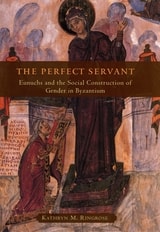
The Perfect Servant
Eunuchs and the Social Construction of Gender in ByzantiumKathryn M. Ringrose
University of Chicago Press, 2003
Accepted for generations as a legitimate and functional part of Byzantine civilization, eunuchs were prominent in both the imperial court and the church. They were distinctive in physical appearance, dress, and manner and were considered uniquely suited for important roles in Byzantine life. Transcending conventional notions of male and female, eunuchs lived outside of normal patterns of procreation and inheritance and were assigned a unique capacity for mediating across social and spiritual boundaries. This allowed them to perform tasks from which prominent men and women were constrained, making them, in essence, perfect servants.
Written with precision and meticulously researched, The Perfect Servant will immediately take its place as a major study on Byzantium and the history of gender.

The Perfect Square
A History of Rittenhouse SquareNancy M. Heinzen
Temple University Press, 2009
One of the five squares William Penn established when he founded the city, the southwest-situated Rittenhouse Square has transformed from a marshy plot surrounded by brickyards and workers’ shanties into the epicenter of Philadelphia high society. A keystone of center city Philadelphia, it was once home to great dynasties, elegant mansions, and grand dames of the Victorian era. Today it is lined with million-dollar high-rise condominiums, where nouveau-riche entrepreneurs and descendants of ethnic immigrants live side-by-side.
Heinzen lovingly chronicles this urban space’s development and growth, illustrating that not only is Rittenhouse Square unique, but so is the combination of human events and relationships that have created and sustained it.
Painstakingly researched and generously illustrated with black-and-white photos from public archives, The Perfect Square will appeal to lay readers interested in history, to professional historians and urban planners, and to the thousands of new residents who have settled on or near Rittenhouse Square since the dawn of the 21st century.
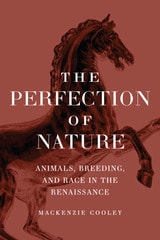
The Perfection of Nature
Animals, Breeding, and Race in the RenaissanceMackenzie Cooley
University of Chicago Press, 2022
The Renaissance is celebrated for the belief that individuals could fashion themselves to greatness, but there is a dark undercurrent to this fêted era of history. The same men and women who offered profound advancements in European understanding of the human condition—and laid the foundations of the Scientific Revolution—were also obsessed with controlling that condition and the wider natural world.
Tracing early modern artisanal practice, Mackenzie Cooley shows how the idea of race and theories of inheritance developed through animal breeding in the shadow of the Spanish Empire. While one strand of the Renaissance celebrated a liberal view of human potential, another limited it by biology, reducing man to beast and prince to stud. “Race,” Cooley explains, first referred to animal stock honed through breeding. To those who invented the concept, race was not inflexible, but the fragile result of reproductive work. As the Spanish empire expanded, the concept of race moved from nonhuman to human animals. Cooley reveals how, as the dangerous idea of controlled reproduction was brought to life again and again, a rich, complex, and ever-shifting language of race and breeding was born.
Adding nuance and historical context to discussions of race and human and animal relations, The Perfection of Nature provides a close reading of undertheorized notions of generation and its discontents in the more-than-human world.
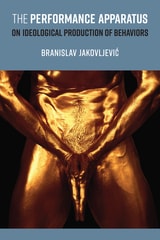
The Performance Apparatus
On Ideological Production of BehaviorsBranislav Jakovljevic
University of Michigan Press, 2025
Jakovljević suggests that the centrality of behavior in early performance theory is important for the understanding of contemporary society, which is dominated by surveillance capitalism. If ideology is lodged in behaviors, and if surveillance capitalism thrives on the monetization of the behavioral surplus, then performance theory can make significant contributions to our understanding of the moment in which we live and the future we are facing. The Performance Apparatus argues for the importance of continuing attention to the question of ideology in contemporary, neoliberal order.
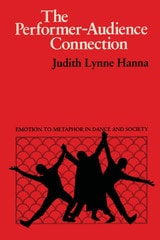
The Performer-Audience Connection
Emotion to Metaphor in Dance and SocietyBy Judith Lynne Hanna
University of Texas Press, 1983
The Performer-Audience Connection is a pioneering foray into one of the major puzzles of human communication: the communication of emotion in dance. It is the first attempt of its kind systematically to investigate what performers wish to convey and what audiences perceive in the performance of dance.
The centerpiece of this provocative book is an examination of performer intentions and audience response at eight dance performances in Washington, D.C. Part of the Smithsonian Institution Division of Performing Arts Dance Series, these concerts featured a variety of dance genres and cultures: American tap dance, Kathakali dance-drama from Kerala, India, Japanese Kabuki, contemporary avant-garde dance, Philippine folk dance, the Indian classical tradition of Kuchipudi, and modern dance to an AfroAmerican spiritual.
How did dancer and audience interact at the emotional level on these eight occasions? What affected performer-audience rapport? Through interviews of both spectators and dancers, Judith Lynne Hanna explores the performers' ways of imparting emotion through movement and audience members' expectations and responses. In doing so she casts new light on important issues of cultural identity, sex role, historic attitudes toward dance, and even marketing the arts today.
A landmark work not only for performers who wish to reach their audiences more effectively but also for choreographers, anthropologists, specialists in nonverbal communication, behavioral scientists, educators, and all who are fascinated by the arts and the special magic of the "performer-audience connection."
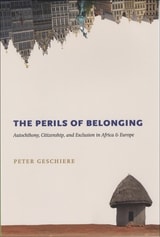
The Perils of Belonging
Autochthony, Citizenship, and Exclusion in Africa and EuropePeter Geschiere
University of Chicago Press, 2009
Despite being told that we now live in a cosmopolitan world, more and more people have begun to assert their identities in ways that are deeply rooted in the local. These claims of autochthony—meaning “born from the soil”—seek to establish an irrefutable, primordial right to belong and are often employed in politically charged attempts to exclude outsiders. In The Perils of Belonging, Peter Geschiere traces the concept of autochthony back to the classical period and incisively explores the idea in two very different contexts: Cameroon and the Netherlands.
In both countries, the momentous economic and political changes following the end of the cold war fostered anxiety over migration. For Cameroonians, the question of who belongs where rises to the fore in political struggles between different tribes, while the Dutch invoke autochthony in fierce debates over the integration of immigrants. This fascinating comparative perspective allows Geschiere to examine the emotional appeal of autochthony—as well as its dubious historical basis—and to shed light on a range of important issues, such as multiculturalism, national citizenship, and migration.
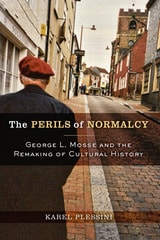
The Perils of Normalcy
George L. Mosse and the Remaking of Cultural HistoryKarel Plessini
University of Wisconsin Press, 2014
In this intellectual biography of George Mosse, Karel Plessini draws on all of Mosse's published and unpublished work to illuminate the origins and development of his groundbreaking methods of historical analysis and the close link between his life and work. He redefined the understanding of modern mass society and politics, masterfully revealing the powerful influence of conformity and political liturgies on twentieth-century history. Mosse warned against the dangers inherent in acquiescence, showing how identity creation and ideological fervor can climax in intolerance and mass murder—a message of continuing relevance.
The Perils of Prosperity, 1914-1932
William E. Leuchtenburg
University of Chicago Press, 1993
Beginning with Woodrow Wilson and U.S. entry into World War I and closing with the Great Depression, The Perils of Prosperity traces the transformation of America from an agrarian, moralistic, isolationist nation into a liberal, industrialized power involved in foreign affairs in spite of itself.
William E. Leuchtenburg's lively yet balanced account of this hotly debated era in American history has been a standard text for many years. This substantial revision gives greater weight to the roles of women and minorities in the great changes of the era and adds new insights into literature, the arts, and technology in daily life. He has also updated the lists of important dates and resources for further reading.
“This book gives us a rare opportunity to enjoy the matured interpretation of an American Historian who has returned to the story and seen how recent decades have added meaning and vividness to this epoch of our history.”—Daniel J. Boorstin, from the Preface
The Perils of Race-Thinking
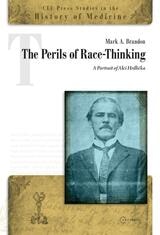
A Portrait of Ales HrdlickaMark A. Brandon
Central European University Press, 2023
Eugenics and scientific racism are experiencing a resurgence, and an understanding of the ideas of Aleš Hrdlička can help combat them. Today, the racial science of the early twentieth century is both untenable and contemptible. This book is about an arch figure of that period: Aleš Hrdlička served as Curator of Physical Anthropology at the prestigious Smithsonian Institution from 1910 to 1941. Although his ideas about race are today considered pseudoscience, the uncomfortable truth is that he was an internationally respected scientist in his own day.
The Perils of Race-Thinking advances a bold new interpretation of modern racial ideology by exploring Hrdlička’s intellectual world. Using previously untapped Czech-language sources, Brandon irrevocably alters the discussion about this important figure by placing Czech nationalism at the center of his racial thinking. Defying disciplinary categories, Perils of Race-Thinking joins critical analysis of this key American anthropologist with an incisive revisionist perspective of interwar Czechoslovakia to unearth transnational racial presumptions lurking behind the worst crimes of the twentieth century.
At the center of Hrdlička’s race beliefs was his commitment to Czech and Slovak unity and independence. From this center, his next level of concern was what he believed to be a millennial racial struggle between Germans and Slavs. On a global scale, he viewed the Slavs, and especially the Soviet Union, as a eugenic bastion of White strength holding off the “rising tide of color.”
Step by step, Perils of Race-Thinking mercilessly dismantles Hrdlička’s racial system and exposes it as mysticism dressed up in the language of science. Convinced that human individuals belonged “naturally” in racial groups, Hrdlička embraced a revolutionary program of reordering the globe according to a harrowing morality of “Darwinist” struggle. Yet despite a lifetime of measuring body parts, even Hrdlička could not decide how many races there were or how to tell them apart.
The Persian Empire
Lindsay Allen
University of Chicago Press, 2005
In her cultural and political history of the development of this power, Lindsay Allen-whose posts in the Ancient Near East departments of the British Museum and the Metropolitan Museum of Art make her one of the leading authorities on Persia-surveys written sources, art objects, warfare, politics, archaeological sites, and daily life during Persian rule. She traces the evolution of the monarchy, showing how it fostered unprecedented international communication and cultural exchange, and describes how the Persian expedition into Greece in the early fifth century BCE became a defining moment that established a European identity apart from an Asian one. Throughout, lavish illustrations bring to life the traditions of this ancient Middle Eastern civilization and finally place Alexander's invasion within a Persian context. As the subject experiences renewed interest, The Persian Empire promises to be the definitive work on one of the most powerful dynasties in ancient history.
The Persistence of Dance
Choreography as Concept and Material in Contemporary ArtErin Brannigan
University of Michigan Press, 2023
The Persistence of Dance: Choreography as Concept and Material in Contemporary Art clarifies the continuities and differences between the second-wave dance avant-garde in the 1950s‒1970s and the third-wave starting in the 1990s. Through close readings of key artists such as Maria Hassabi, Sarah Michelson, Boris Charmatz, Meg Stuart, Philipp Gehmacher, Adam Linder, Agatha Gothe-Snape, Shelley Lasica and Latai Taumoepeau, The Persistence of Dance traces the relationship between the third-wave and gallery-based work. Looking at these artists highlights how the discussions and practices associated with “conceptual dance” resonate with the categories of conceptual and post-conceptual art as well as with the critical work on the function of visual art categories. Brannigan concludes that within the current post-disciplinary context, there is a persistence of dance and that a model of post-dance exists that encompasses dance as a contemporary art medium.
The Persistence of Slavery
An Economic History of Child Trafficking in NigeriaRobin Phylisia Chapdelaine
University of Massachusetts Press, 2021
Despite efforts to abolish slavery throughout Africa in the nineteenth century, the coercive labor systems that constitute “modern slavery” have continued to the present day. To understand why, Robin Phylisia Chapdelaine explores child trafficking, pawning, and marriages in Nigeria's Bight of Biafra, and the ways in which British colonial authorities and Igbo, Ibibio, Efik, and Ijaw populations mobilized children's labor during the early twentieth century. Drawing on a wealth of primary sources that include oral interviews, British and Nigerian archival materials, newspaper holdings, and missionary and anthropological accounts, Chapdelaine argues that slavery's endurance can only be understood when we fully examine “the social economy of a child”—the broader commercial, domestic, and reproductive contexts in which children are economic vehicles.
The Persistence of Slavery provides an invaluable investigation into the origins of modern slavery and early efforts to combat it, locating this practice in the political, social, and economic changes that occurred as a result of British colonialism and its lingering effects, which perpetuate child trafficking in Nigeria today.
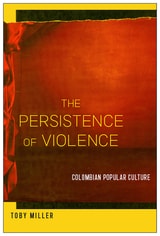
The Persistence of Violence
Colombian Popular CultureToby Miller
Rutgers University Press, 2020
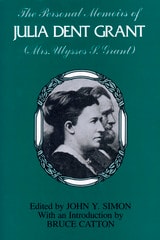
The Personal Memoirs of Julia Dent Grant
(Mrs. Ulysses S. Grant)Edited by John Y. Simon
Southern Illinois University Press, 1975
Written in the early twentieth century for her children and grandchildren and first published in 1975, these eloquent memoirs detail the life of General Ulysses S. Grant’s wife. First Lady Julia Dent Grant wrote her reminiscences with the vivacity and charm she exhibited throughout her life, telling her story in the easy flow of an afternoon conversation with a close friend. She writes fondly of White Haven, a plantation in St. Louis County, Missouri, where she had an idyllic girlhood and later met Ulysses.
In addition to relating the joys she experienced, Grant tells about the difficult and sorrowful times. Her anecdotes give fascinating glimpses into the years of the American Civil War. One recounts the night President Abraham Lincoln was assassinated. Grant insisted she and her husband turn down an invitation to the theater. Her decision saved her husband’s life: like Lincoln, he too had been marked for assassination.
Throughout these memoirs, which she ends with her husband’s death, Grant seeks to introduce her descendants to both her and the man she loved. She also strives to correct misconceptions that were circulated about him. She wanted posterity to share her pride in this man, whom she saw as one of America’s greatest heroes. Her book is a testament to their devoted marriage.
This forty-fifth-anniversary edition includes a new foreword by John F. Marszalek and Frank J. Williams, a new preface by Pamela K. Sanfilippo, the original foreword by Bruce Catton, the original introduction by editor John Y. Simon, recommendations for further reading, and more than twenty photographs of the Grants, their children, and their friends.
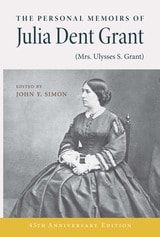
The Personal Memoirs of Julia Dent Grant
(Mrs. Ulysses S. Grant)Edited by John Y. Simon
Southern Illinois University Press, 1975
Written in the early twentieth century for her children and grandchildren and first published in 1975, these eloquent memoirs detail the life of General Ulysses S. Grant’s wife. First Lady Julia Dent Grant wrote her reminiscences with the vivacity and charm she exhibited throughout her life, telling her story in the easy flow of an afternoon conversation with a close friend. She writes fondly of White Haven, a plantation in St. Louis County, Missouri, where she had an idyllic girlhood and later met Ulysses.
In addition to relating the joys she experienced, Grant tells about the difficult and sorrowful times. Her anecdotes give fascinating glimpses into the years of the American Civil War. One recounts the night President Abraham Lincoln was assassinated. Grant insisted she and her husband turn down an invitation to the theater. Her decision saved her husband’s life: like Lincoln, he too had been marked for assassination.
Throughout these memoirs, which she ends with her husband’s death, Grant seeks to introduce her descendants to both her and the man she loved. She also strives to correct misconceptions that were circulated about him. She wanted posterity to share her pride in this man, whom she saw as one of America’s greatest heroes. Her book is a testament to their devoted marriage.
This forty-fifth-anniversary edition includes a new foreword by John F. Marszalek and Frank J. Williams, a new preface by Pamela K. Sanfilippo, the original foreword by Bruce Catton, the original introduction by editor John Y. Simon, recommendations for further reading, and more than twenty photographs of the Grants, their children, and their friends.
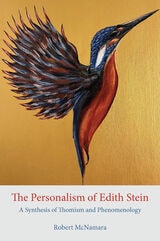
The Personalism of Edith Stein
A Synthesis of Thomism and PhenomenologyRobert McNamara
Catholic University of America Press, 2023
The Personality of Power
A Theory of Fascism for Anti-fascist LifeBrian Massumi
Duke University Press, 2025
The Peru Reader
History, Culture, PoliticsOrin Starn, Carlos Iván Degregori and Robin Kirk, editors
Duke University Press, 2005
Unparalleled in scope, the volume covers Peru’s history from its extraordinary pre-Columbian civilizations to its citizens’ twenty-first-century struggles to achieve dignity and justice in a multicultural nation where Andean, African, Amazonian, Asian, and European traditions meet. The collection presents a vast array of essays, folklore, historical documents, poetry, songs, short stories, autobiographical accounts, and photographs. Works by contemporary Peruvian intellectuals and politicians appear alongside accounts of those whose voices are less often heard—peasants, street vendors, maids, Amazonian Indians, and African-Peruvians. Including some of the most insightful pieces of Western journalism and scholarship about Peru, the selections provide the traveler and specialist alike with a thorough introduction to the country’s astonishing past and challenging present.
The Perversity of Gratitude
An Apartheid EducationFarred, Grant
Temple University Press, 2024
Unsentimental about his education, Farred’s critique recognizes the impact of four exceptional teachers—all engaging pedagogical figures who cultivated a great sense of possibility in how thinking could be learned through a disenfranchised South African education.
The Perversity of Gratitude brings to bear the work of influential philosophers such as Martin Heidegger and Jacques Derrida. The book tackles broad philosophical concepts—transgression, withdrawal, and the dialectic. This leads to the creation of a new concept, “the diaspora-in-place,” which Farred explains, “is having left a place before one physically removes oneself from this place.”
Farred’s apartheid education in South Africa instilled in him a lifelong commitment to learning thinking. “And for that I am grateful,” Farred writes in The Perversity of Gratitude. His autopoiesis is sure to provoke and inspire readers.