Results by title
3703 books match the query '19th Century' and 853 start with t
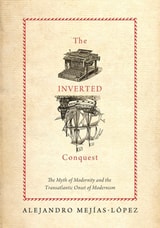
The Inverted Conquest
The Myth of Modernity and the Transatlantic Onset of ModernismAlejandro Mejias-Lopez
Vanderbilt University Press, 2009
Expanding Bourdieu's concepts of cultural field and symbolic capital beyond national boundaries, The Inverted Conquest shows how modernismo originated in Latin America and traveled to Spain, where it provoked a complete renovation of Spanish letters and contributed to a national identity crisis. In the process, described by Latin American writers as a reversal of colonial relations, modernismo wrested literary and cultural authority away from Spain, moving the cultural center of the Hispanic world to the Americas.
Mejias-Lopez further reveals how Spanish American modernistas confronted the racial supremacist claims and homogenizing force of an Anglo-American modernity that defined the Hispanic as un-modern. Constructing a new Hispanic genealogy, modernistas wrote Spain as the birthplace of modernity and themselves as the true bearers of the modern spirit, moved by the pursuit of knowledge, cosmopolitanism, and cultural miscegenation, rather than technology, consumption, and scientific theories of racial purity.
Bound by the intrinsic limits of neocolonial and postcolonial theories, scholarship has been unwilling or unable to explore modernismo's profound implications for our understanding of Western modernities.
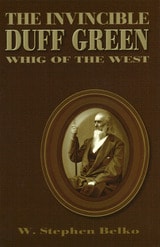
The Invincible Duff Green
Whig of the WestW. Stephen Belko
University of Missouri Press, 2006
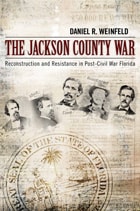
The Jackson County War
Reconstruction and Resistance in Post–Civil War FloridaDaniel R. Weinfeld
University of Alabama Press, 2023
Offers original conclusions explaining why Jackson County became the bloodiest region in Reconstruction Florida
From early 1869 through the end of 1871, citizens of Jackson County, Florida, slaughtered their neighbors by the score. The nearly three year frenzy of bloodshed became known as the Jackson County War. The killings, close to one hundred and by some estimates twice that number, brought Jackson County the notoriety of being the most violent county in Florida during the Reconstruction era. Daniel R. Weinfeld has made a thorough investigation of contemporary accounts. He adds an assessment of recently discovered information, and presents a critical evaluation of the standard secondary sources.
The Jackson County War focuses on the role of the Freedmen’s Bureau, the emergence of white “Regulators,” and the development of African American political consciousness and leadership. It follows the community’s descent after the Civil War into disorder punctuated by furious outbursts of violence until the county settled into uneasy stability seven years later. The Jackson County War emerges as an emblem of all that could and did go wrong in the uneasy years after Appomattox and that left a residue of hatred and fear that endured for generations.
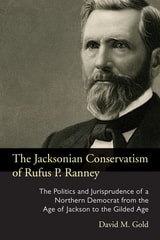
The Jacksonian Conservatism of Rufus P. Ranney
The Politics and Jurisprudence of a Northern Democrat from the Age of Jackson to the Gilded AgeDavid M. Gold
Ohio University Press, 2016
Ohio’s Rufus P. Ranney embodied many of the most intriguing social and political tensions of his time. He was an anticorporate campaigner who became John D. Rockefeller’s favorite lawyer. A student and law partner of abolitionist Benjamin F. Wade, Ranney acquired an antislavery reputation and recruited troops for the Union army; but as a Democratic candidate for governor he denied the power of Congress to restrict slavery in the territories, and during the Civil War and Reconstruction he condemned Republican policies.
Ranney was a key delegate at Ohio’s second constitutional convention and a two-time justice of the Ohio Supreme Court. He advocated equality and limited government as understood by radical Jacksonian Democrats. Scholarly discussions of Jacksonian jurisprudence have primarily focused on a handful of United States Supreme Court cases, but Ranney’s opinions, taken as a whole, outline a broader approach to judicial decision making.
A founder of the Ohio State Bar Association, Ranney was immensely influential but has been understudied until now. He left no private papers, even destroying his own correspondence. In The Jacksonian Conservatism of Rufus P. Ranney, David M. Gold works with the public record to reveal the contours of Ranney’s life and work. The result is a new look at how Jacksonian principles crossed the divide of the Civil War and became part of the fabric of American law and at how radical antebellum Democrats transformed themselves into Gilded Age conservatives.
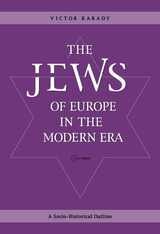
The Jews of Europe in the Modern Era
A Socio-Historical OutlineVictor Karady
Central European University Press, 2003
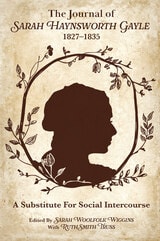
The Journal of Sarah Haynsworth Gayle, 1827–1835
A Substitute for Social IntercourseEdited by Sarah Woolfolk Wiggins with Ruth Smith Truss
University of Alabama Press, 2013
The remarkable journal of the young wife of early Alabama governor John Gayle and a primary source of our knowledge about early Alabama and the antebellum American South
Astonishing, tragic, and remarkable, the journal of Sarah Haynsworth Gayle, wife of early Alabama governor John Gayle, is among the most widely studied and seminal accounts of antebellum life in the American South. This is the first complete edition of the journal in print.
Bereft of the companionship of her often-absent husband, Sarah considered her journal “a substitute for social intercourse” during the period from 1827 to 1835. It became the social and intellectual companion to which she confided stories that reflected her personal life and the world of early Alabama. Sarah speaks directly to us of her loneliness, the challenges of child rearing, her fear of and frustration with the management of slaves, and the difficulty of balancing the responsibilities of a socially prominent woman with her family’s slender finances.
The poor condition of the journal and its transcripts, sometimes disintegrated or reassembled in the wrong order, has led historians to misinterpret Gayle’s words. Gayle’s descendants, Alabama’s famed Gorgases, deliberately obscured or defaced many passages. Using archival techniques to recover the text and restore the correct order, Sarah Wiggins and Ruth Truss reveal the unknown story of Sarah’s economic hardships, the question of her husband’s “temperance,” and her opium use.
The only reliable and unexpurgated edition of Sarah Gayle’s journal, now enhanced with a fascinating introduction and inset notes, The Journal of Sarah Haynsworth Gayle, 1827–1835, is a robust and gripping account and will be of inestimable value to our understanding of antebellum society, religion, intellectual culture, and slavery.
Published in cooperation with the University Libraries, The University of Alabama, with further financial support from the Library Leadership Board, the University Libraries, The University of Alabama.
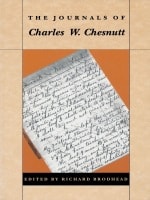
The Journals of Charles W. Chesnutt
Charles W. Chesnutt
Duke University Press, 1993
Though he achieved literary success in his time, Chesnutt has only recently been rediscovered and his contribution to American literature given its due. The only known private diary from a nineteenth-century African American author, these pages offer a fascinating glimpse into Chesnutt's everyday experience as he struggled to win the goods of education in the world of the post-Civil War South. An extraordinary portrait of the self-made man beset by the urgencies and difficulties of self-improvement in a racially discriminatory society, Chesnutt's journals unfold a richly detailed local history of postwar North Carolina. They also show with great force how the world of the postwar South obstructed--and, unexpectedly, assisted--a black man of driving intellectual ambitions.
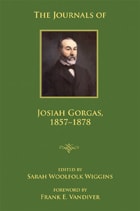
The Journals of Josiah Gorgas, 1857–1878
Josiah Gorgas, edited by Sarah Woolfolk Wiggins, foreword by Frank E. Vandiver
University of Alabama Press, 2009
Josiah Gorgas was best known as the highly regarded Chief of Confederate Ordnance. Born in 1818, he attended West Point, served in the U.S. Army, and later, after marrying Amelia Gayle, daughter of a former Alabama governor, joined the Confederacy. After the Civil War he served as president of The University of Alabama until ill health forced him to resign. His journals, maintained between 1857 and 1878, reflect the family's economic successes and failures, detail the course of the South through the Civil War, and describe the ordeal of Reconstruction. Few journals cover such a sweep of history. An added dimension is the view of Victorian family life as Gorgas explored his feelings about aspects of parental responsibility and transmission of values to children--a rarely documented account from the male perspective. His son, called Willie in the journals, was William Crawford Gorgas (1854-1920), who was noted for his fight to control yellow fever and who became surgeon general of the United States.
In his foreword to the volume, Frank E. Vandiver states: "Wiggins has done much more than present a well-edited version of Gorgas's diaries and journals; she has interpreted them in full Gorgas family context and in perspective of the times they cover. . . . Wiggins informs with the sort of editorial notes expected of a careful scholar, but she enlightens with wide knowledge of American and southern history. . . . Josiah Gorgas [was] an unusually observant, passionate man, a 'galvanized Rebel' who deserves rank among the true geniuses of American logistics."
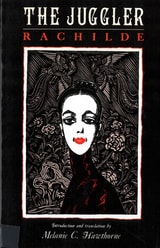
The Juggler
RachildeHawthorne, Melanie C
Rutgers University Press, 1990
The Juggler (La Jongleuse) is a "decadent" novel that was first published in 1900. Its author, Marguerite Vallette-Eymery (1860-1953), who used the pseudonym Rachilde, was a prolific novelist (over sixty works of fiction), playwright, literary critic and reviewer, and a forceful presence in French literary society of her time.
The protagonist of the novel, Eliante Donalger, is in some sense an exaggerated double for her creator--bizarre in appearance, clothing, and interests. Instinctively grasping a medical and psychological truth that the turn-of-the-century scientific world was only beginning to understand, Eliante maintains that there is nothing "natural" about human sexual expression. She claims to be in love with an inanimate (though anthropomorphic and sexually ambiguous) object, a Greek amphora, and the novel traces the rivalry between this faithful partner and an ardent human suitor, a young medical student. It is only through juggling, both literally and metaphorically, that Eliante is able to use her seductive power to maintain desire. The surprise ending challenges the limits of such power in a controversial and surprising twist.
Although Rachilde's work has been neglected in the past, the women's movement and feminist criticism have stimulated renewed interest in her fiction. The Juggler is a major rediscovery.
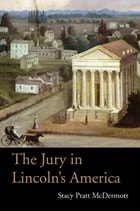
The Jury in Lincoln’s America
Stacy Pratt McDermott
Ohio University Press, 2012
In the antebellum Midwest, Americans looked to the law, and specifically to the jury, to navigate the uncertain terrain of a rapidly changing society. During this formative era of American law, the jury served as the most visible connector between law and society. Through an analysis of the composition of grand and trial juries and an examination of their courtroom experiences, Stacy Pratt McDermott demonstrates how central the law was for people who lived in Abraham Lincoln’s America.
McDermott focuses on the status of the jury as a democratic institution as well as on the status of those who served as jurors. According to the 1860 census, the juries in Springfield and Sangamon County, Illinois, comprised an ethnically and racially diverse population of settlers from northern and southern states, representing both urban and rural mid-nineteenth-century America. It was in these counties that Lincoln developed his law practice, handling more than 5,200 cases in a legal career that spanned nearly twenty-five years.
Drawing from a rich collection of legal records, docket books, county histories, and surviving newspapers, McDermott reveals the enormous power jurors wielded over the litigants and the character of their communities.
The Kimberlins Go to War
A Union Family in Copperhead CountryMichael B. Murphy
Indiana Historical Society Press, 2016
The Kin Who Count
Family and Society in Ottoman Aleppo, 1770-1840By Margaret L. Meriwether
University of Texas Press, 1999
The history of the Middle Eastern family presents as many questions as there are currently answers. Who lived together in the household? Who married whom and for how long? Who got a piece of the patrimonial pie? These are the questions that Margaret Meriwether investigates in this groundbreaking study of family life among the upper classes of the Ottoman Empire in the pre-modern and early modern period.
Meriwether recreates Aleppo family life over time from records kept by the Islamic religious courts that held jurisdiction over all matters of family law and property transactions. From this research, she asserts that the stereotype of the large, patriarchal patrilineal family rarely existed in reality. Instead, Aleppo's notables organized their families in a great diversity of ways, despite the fact that they were all members of the same social class with widely shared cultural values, acting under the same system of family law. She concludes that this had important implications for gender relations and demonstrates that it gave women more authority and greater autonomy than is usually acknowledged.
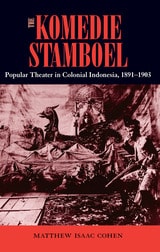
The Komedie Stamboel
Popular Theater in Colonial Indonesia, 1891–1903Matthew Isaac Cohen
Ohio University Press, 2006
Originating in 1891 in the port city of Surabaya, the Komedie Stamboel, or Istanbul-style theater, toured colonial Indonesia, Singapore, and Malaysia by rail and steamship. The company performed musical versions of the Arabian Nights, European fairy tales and operas such as Sleeping Beauty and Aida, as well as Indian and Persian romances, Southeast Asian chronicles, true crime stories, and political allegories. The actors were primarily Eurasians, the original backers were Chinese, and audiences were made up of all races and classes. The Komedie Stamboel explores how this new hybrid theater pointed toward possibilities for the transformation of self in a colonial society and sparked debates on moral behavior and mixed-race politics.
While audiences marveled at spectacles involving white-skinned actors, there were also racial frictions between actors and financiers, sexual scandals, fights among actors and patrons, bankruptcies, imprisonments, and a murder.
Matthew Isaac Cohen's evocative social history situates the Komedie Stamboel in the culture of empire and in late nineteenth-century itinerant entertainment. He shows how the theater was used as a symbol of cross-ethnic integration in postcolonial Indonesia and as an emblem of Eurasian cultural accomplishment by Indische Nederlanders. A pioneering study of nineteenth-century Southeast Asian popular culture, The Komedie Stamboel gives a new picture of the region's arts and culture and explores the interplay of currents in global culture, theatrical innovation, and movement in colonial Indonesia.ABOUT THE AUTHOR---Matthew Isaac Cohen is senior lecturer in Drama and Theatre Studies at Royal Holloway University of London. His articles on Southeast Asian performance have appeared in New Theatre Quarterly, Asian Theatre Journal, Journal of the Royal Asiatic Society, and Archipel. As a practicing shadow puppeteer, he has performed in the United States, Europe, and Asia.
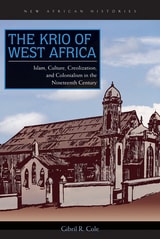
The Krio of West Africa
Islam, Culture, Creolization, and Colonialism in the Nineteenth CenturyGibril R. Cole
Ohio University Press, 2013
Sierra Leone’s unique history, especially in the development and consolidation of British colonialism in West Africa, has made it an important site of historical investigation since the 1950s. Much of the scholarship produced in subsequent decades has focused on the “Krio,” descendants of freed slaves from the West Indies, North America, England, and other areas of West Africa, who settled Freetown, beginning in the late eighteenth century. Two foundational and enduring assumptions have characterized this historiography: the concepts of “Creole” and “Krio” are virtually interchangeable; and the community to which these terms apply was and is largely self-contained, Christian, and English in worldview.
In a bold challenge to the long-standing historiography on Sierra Leone, Gibril Cole carefully disentangles “Krio” from “Creole,” revealing the diversity and permeability of a community that included many who, in fact, were not Christian. In Cole’s persuasive and engaging analysis, Muslim settlers take center stage as critical actors in the dynamic growth of Freetown’s Krio society.
The Krio of West Africa represents the results of some of the first sustained historical research to be undertaken since the end of Sierra Leone’s brutal civil war. It speaks clearly and powerfully not only to those with an interest in the specific history of Sierra Leone, but to histories of Islam in West Africa, the British empire, the Black Atlantic, the Yoruban diaspora, and the slave trade and its aftermath.
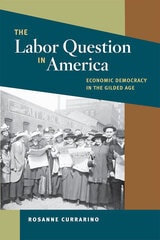
The Labor Question in America
Economic Democracy in the Gilded AgeRoseanne Currarino
University of Illinois Press, 2011
The Land between the Rivers
Thomas Nuttall's Ascent of the Arkansas, 1819Russell M. Lawson
University of Michigan Press, 2004
During the early nineteenth century, Nuttall explored the waters, valleys, plains, and mountains of the Great Lakes, Ohio River, Mississippi River, as well as the Missouri, Arkansas, Red, and Canadian river valleys of the former Louisiana Territory.
In this fascinating account of Nuttall's travels through the wilderness of the middle west, author Russell Lawson-using Nuttall's own journal-captures the sense of excitement of the early wanderer. As much a delight for the mind as the senses, The Land between the Rivers details the unremitting weather and rugged geography of uncharted lands within the Louisiana Territory. A sense of discovery pervades the narrative as Nuttall's odyssey builds to its climax in the prairie wilderness of what is now Oklahoma. Sickened by "ague"-in his case, malaria-Nuttall at times was barely able to go on; yet he continued to search for and catalog plants and animals.
The Land between the Rivers expands our knowledge of the work of one of the country's earliest botanists. We also learn a great deal about the early explorers, the inhabitants of the unsettled land, and about the land and culture of the times.
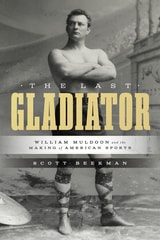
The Last Gladiator
William Muldoon and the Making of American SportsScott Beekman
University of Texas Press, 2025
2026 Honorable Mention in Monographs, North American Society for Sport History (NASSH)
The incredible career of the forgotten but foundational pro wrestler who shaped American sports culture.
William Muldoon was an infamous athlete whose prowess, savvy, and chicanery across his six-decade career led him to wealth, cultural importance, and political power. Muldoon, the child of poor Irish immigrants, began wrestling in the 1870s and quickly became one of the most famous athletes of the post–Civil War era. He started acting and modeling as his popularity grew, making him one of the first sports stars to achieve crossover success. After a triumphant stint rehabilitating fallen boxing heavyweight champion John L. Sullivan in 1889, he retired from the ring and began a new career as a fitness impresario, founding an elite gymnasium and remaking himself as a health authority in the press. He became trainer to the rich, famous, and politically powerful, which led to his appointment as chair of the New York State Athletic Commission in the 1920s. From this position, Muldoon exerted his influence over the rules of boxing and wrestling and weaponized his power to maintain segregation in sport.
The Last Gladiator is a deep, insightful dive into Muldoon’s life and impact, demonstrating the significance of this often-controversial figure in the development of American sports, professional wrestling, and physical and popular culture.
The Last Nostalgia
Poems, 1982–1990Joe Bolton
University of Arkansas Press, 1999
The Last Ottoman Wars
The Human Cost, 1877–1923Jeremy Salt
University of Utah Press, 2019
Jeremy Salt brings to the surface previously ignored facts that disrupt the conventional narrative of an ethno-religious division between Muslim perpetrators and Christian victims of violence. Salt shows instead that all major ethno-religious groups—including Armenians, Turks, Kurds, and Greeks—were guilty of violent acts. The result is a more balanced picture of European involvement in the Ottoman Empire and the Balkans, one that highlights the destructive role of British Prime Minister David Lloyd George and other European leaders grabbing for Ottoman resources up to the end of World War I. The effects of these events are felt to the present day.
This extraordinary story centers not on military campaigns but on ordinary civilians whose lives were disrupted and in many cases destroyed by events over which they had no control. Disease, malnutrition, massacre and inter-communal fighting killed millions of people during the First World War alone. Until now this epic saga of human suffering has remained a story largely untold.

The Last Pioneer
John Taylor, a Mormon ProphetSamuel W. Taylor
Signature Books, 1999
As half the church fell away in Ohio, the Taylors escaped to Missouri with the faithful, just in time for the 1838 Mormon War. John’s role became that of an advocate with Congress—to convince them that it was the non-Mormons who had sacked the county seat and burned their own homes, for instance. As a literary experience, this was good preparation for later editorships of church newspapers in Illinois, New York, and Liverpool.
From his personal letters and speeches, and from the diaries and reminiscences of associates, vivid images of Taylor’s life appear: his children crossing the Missouri River on the backs of oxen “bulls”; one of his ten plural wives packing a piano instead of a cookstove for the trip and then later regretting it; and Native Americans teaching him how to burn a cricket-infested field, gather the roasted insects, and grind the carcasses into flour.
Taylor’s eventual tenure as church president was spent “on the dodge” from federal marshals, and prior to that he often lived out of a suitcase, rotating from one of his sixteen families to the next. Among his greatest achievements was the settlement of as much territory as was colonized by his more famous predecessor, Brigham Young. Taylor was also a visionary man. His personal spirituality led the church through one of its most turbulent times; his revelations later inspired the Mormon fundamentalist schism, as well. This controversy, mingled with the drama of internecine power struggles and interpersonal conflict, makes The Last Pioneer suspenseful and largely unforgettable.
The Legendary Detective
The Private Eye in Fact and FictionJohn Walton
University of Chicago Press, 2015
“I’m in a business where people come to me with troubles. Big troubles, little troubles, but always troubles they don’t want to take to the cops.” That’s Raymond Chandler’s Philip Marlowe, succinctly setting out our image of the private eye. A no-nonsense loner, working on the margins of society, working in the darkness to shine a little light.
The reality is a little different—but no less fascinating. In The Legendary Detective, John Walton offers a sweeping history of the American private detective in reality and myth, from the earliest agencies to the hard-boiled heights of the 1930s and ’40s. Drawing on previously untapped archival accounts of actual detective work, Walton traces both the growth of major private detective agencies like Pinkerton, which became powerful bulwarks against social and labor unrest and the motley, unglamorous work of small-time operatives. He then goes on to show us how writers like Dashiell Hammett and editors of sensational pulp magazines like Black Mask embellished on actual experiences and fashioned an image of the PI as a compelling, even admirable, necessary evil, doing society’s dirty work while adhering to a self-imposed moral code. Scandals, public investigations, and regulations brought the boom years of private agencies to an end in the late 1930s, Walton explains, in the process fully cementing the shift from reality to fantasy.
Today, as the private detective has long since given way to security services and armed guards, the myth of the lone PI remains as potent as ever. No fan of crime fiction or American history will want to miss The Legendary Detective.
The Leopard in the Garden
Animal and Human Lives in Paris at the First Public Zoo of the Modern EraRichard W. Burkhardt, Jr.
University of Chicago Press, 2026
The Paris menagerie at the Paris Museum of Natural History has a special significance in the history of zoos. Founded in 1793–1794 at the height of the French Revolution, it was the model for the other great zoos of the nineteenth century that followed, beginning with London in 1828, Amsterdam in 1838, and Berlin in 1844.
Richard W. Burkhardt Jr. has written the definitive history of the Paris zoo and its early inhabitants, human and nonhuman. The book features narrative or thematic chapters interwoven with chapters focused on particular animals. Combining current scholarship with fresh discoveries gleaned from his immersion in the Paris Zoo’s extensive archive, Burkhardt shares historical treasures that illuminate not only the workings of the menagerie but also various dimensions of the golden age of French zoology (the years of Jean-Baptiste Lamarck, Geoffroy Saint-Hilaire, and Georges Cuvier). His history reconstructs the diverse sources of specimens, the growth of the collection over time, the efforts to make the menagerie scientifically significant, contemporary attitudes toward animals, and the lives of the animals themselves in colonial and diplomatic contexts.
The Letters and the Law
Legal and Literary Culture in Late Imperial RussiaAnna Schur
Northwestern University Press, 2022
Anna Schur combines historical research and literary analysis to argue that the first generations of Russian trial lawyers shaped their professional identity with an eye to the celebrated figure of the writer and that they considered their own activities to be a form of verbal art. A fuller understanding of writers’ antipathy to the law, Schur contends, must take into account this overlooked cultural backdrop. Laced with the better‑known critique of the lawyer’s legalistic proclivities and lack of moral principle are the writer’s reactions to a whole network of explicit and implicit claims of similarity between the two professions’ goals, methods, and missions that were central to the lawyer’s professional ideal. Viewed in this light, writers’ critiques of the law and lawyers emerge as a concerted effort at protecting literature’s exclusive cultural status in the context of modernization and the rapidly expanding public sphere.
The study draws upon a mix of well-known and rarely studied nineteenth-century authors and texts—with particular attention paid to Fyodor Dostoevsky and Mikhail Saltykov-Shchedrin—and on a wide range of nonliterary sources, including courtroom speeches, guides to forensic oratory, legal treatises, and specialized press.
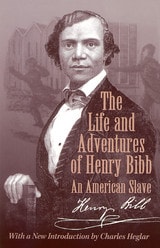
The Life and Adventures of Henry Bibb
An American SlaveHenry Bibb
University of Wisconsin Press, 2001
First published in 1849 and largely unavailable for many years, The Life and Adventures of Henry Bibb is among the most remarkable slave narratives. Born on a Kentucky plantation in 1815, Bibb first attempted to escape from bondage at the age of ten. He was recaptured and escaped several more times before he eventually settled in Detroit, Michigan, and joined the antislavery movement as a lecturer.
Bibb’s story is different in many ways from the widely read Narrative of the Life of Frederick Douglass, An American Slave and Harriet Jacobs’ Incidents in the Life of a Slave Girl. He was owned by a Native American; he is one of the few ex-slave autobiographers who had labored in the Deep South (Louisiana); and he writes about folkways of the slaves, especially how he used conjure to avoid punishment and to win the hearts of women. Most significant, he is unique in exploring the importance of marriage and family to him, recounting his several trips to free his wife and child. This new edition includes an introduction by literary scholar Charles Heglar and a selection of letters and editorials by Bibb.
The Life and Death of Gus Reed
A Story of Race and Justice in Illinois during the Civil War and ReconstructionThomas Bahde
Ohio University Press, 2014
Gus Reed was a freed slave who traveled north as Sherman’s March was sweeping through Georgia in 1864. His journey ended in Springfield, Illinois, a city undergoing fundamental changes as its white citizens struggled to understand the political, legal, and cultural consequences of emancipation and black citizenship. Reed became known as a petty thief, appearing time and again in the records of the state’s courts and prisons. In late 1877, he burglarized the home of a well-known Springfield attorney—and brother of Abraham Lincoln’s former law partner—a crime for which he was convicted and sentenced to the Illinois State Penitentiary.
Reed died at the penitentiary in 1878, shackled to the door of his cell for days with a gag strapped in his mouth. An investigation established that two guards were responsible for the prisoner’s death, but neither they nor the prison warden suffered any penalty. The guards were dismissed, the investigation was closed, and Reed was forgotten.
Gus Reed’s story connects the political and legal cultures of white supremacy, black migration and black communities, the Midwest’s experience with the Civil War and Reconstruction, and the resurgence of nationwide opposition to African American civil rights in the late nineteenth century. These experiences shaped a nation with deep and unresolved misgivings about race, as well as distinctive and conflicting ideas about justice and how to achieve it.
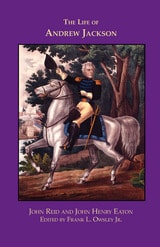
The Life of Andrew Jackson
John Reid
University of Alabama Press, 2007
The frontier fighter who rose to the presidency and reshaped a nation.
Original copies of the first, 1817, edition of this work are so rare that even the Library of Congress does not have an undamaged copy. Consequently scholars and students of Jackson have had to rely on later, incomplete or bowdlerized editions. It is therefore all the more valuable to have Owsley’s critical restoration of the original edition, complete with its useful maps.
The work is a straightforward history of Jackson’s military career, begun by John Reid, Jackson’s military aide throughout the War of 1812 and the ensuing Creek War. Reid wrote the first four chapters, and after his death John Eaton completed the work from Reid’s outline, notes, and papers. Owsley, quondam professor of history at Auburn University, has carefully restored the original edition, noted variants between this and successor editions, and included helpful apparatus, including a memoir of John Reid by Helen Reid Roberts, and indexes to the whole.
This is the first paperback edition of this valuable record.
The Life of Mark Twain
The Early Years, 1835-1871Gary Scharnhorst
University of Missouri Press, 2018
With dozens of Mark Twain biographies available, what is left unsaid? On average, a hundred Clemens letters and a couple of Clemens interviews surface every year. Scharnhorst has located documents relevant to Clemens’s life in Missouri, along the Mississippi River, and in the West, including some which have been presumed lost. Over three volumes, Scharnhorst elucidates the life of arguably the greatest American writer and reveals the alchemy of his gifted imagination.
The Life of Mark Twain
The Final Years, 1891–1910Gary Scharnhorst
University of Missouri Press, 2022
In the final volume of his three-volume biography, Gary Scharnhorst chronicles the life of Samuel Langhorne Clemens from his family’s extended trip to Europe in 1891 to his death in 1910 at age 74. During these years Clemens grapples with bankruptcy, returns to the lecture circuit, and endures the loss of two daughters and his wife. It is also during this time that he writes some of his darkest, most critical works; among these include Pudd’nhead Wilson; Personal Recollections of Joan of Arc; Tom Sawyer Abroad; Tom Sawyer, Detective; Following the Equator; No. 44, the Mysterious Stranger; and portions of his Autobiography.
The Life of Mark Twain
The Middle Years, 1871–1891Gary Scharnhorst
University of Missouri Press, 2019
The second volume of Gary Scharnhorst’s three-volume biography chronicles the life of Samuel Langhorne Clemens between his move with his family from Buffalo to Elmira (and then Hartford) in spring 1871 and their departure from Hartford for Europe in mid-1891.
During this time he wrote and published some of his best-known works, including Roughing It, The Gilded Age, The Adventures of Tom Sawyer, A Tramp Abroad, The Prince and the Pauper, Life on the Mississippi,Adventures of Huckleberry Finn, and A Connecticut Yankee in King Arthur’s Court.
Significant events include his trips to England (1872–73) and Bermuda (1877); the controversy over his Whittier Birthday Speech in December 1877; his 1878–79 Wanderjahr on the continent; his 1882 tour of the Mississippi valley; his 1884–85 reading tour with George Washington Cable; his relationships with his publishers (Elisha Bliss, James R. Osgood, Andrew Chatto, and Charles L. Webster); the death of his son, Langdon, and the births and childhoods of his daughters Susy, Clara, and Jean; as well as the several lawsuits and personal feuds in which he was involved. During these years, too, Clemens expressed his views on racial and gender equality and turned to political mugwumpery; supported the presidential campaigns of Grover Cleveland; advocated for labor rights, international copyright, and revolution in Russia; founded his own publishing firm; and befriended former president Ulysses S. Grant, supervising the publication of Grant’s Memoirs.
The Life of Mark Twain is the first multi-volume biography of Samuel Clemens to appear in more than a century and has already been hailed as the definitive Twain biography.
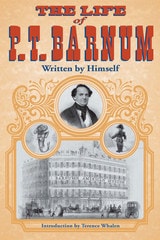
The Life of P. T. Barnum, Written by Himself
Phineas T. BarnumIntroduction by Terence Whalen
University of Illinois Press, 2000
Barnum deliberately cultivated his ambiguous public image through a lifelong advertising campaign, shrewdly exploiting the cultural and technological capabilities of the new publishing industry. While running his numerous shows and exhibitions, Barnum managed to publish newspaper articles, exposés of fraud (not his own), self-help tracts, and a series of best-selling autobiographies, each promising to give "the true history of my many adventures."
Updated editions of The Life of P. T. Barnum appeared regularly, allowing Barnum to keep up with demand and prune the narrative of details that might offend posterity. The present volume is the first modern edition of Barnum's original and outrageous autobiography, published in 1855 and unavailable for more than a century. Brazen, confessional, and immensely entertaining, it immortalizes the showman who hoodwinked customers into paying to hear the reminiscences of a woman presented as George Washington's 161-year-old nurse, the impresario who brought Jenny Lind to America and toured Europe with General Tom Thumb, and the grand entrepreneur of the American Museum of New York. Above all, it ensures that Barnum would be properly remembered . . . exactly as he created himself.
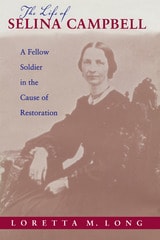
The Life of Selina Campbell
A Fellow Soldier in the Cause of RestorationLoretta M. Long Hunnicutt
University of Alabama Press, 2001
This first biography of Selina Campbell opens a window onto the experience of women in one of the most dynamic religious groups of 19th-century America
Loretta M. Long examines the life and influence of Selina Campbell, one of the most visible women in the 19th-century Disciples of Christ movement. Best known as the wife of Alexander Campbell, founder of the Disciples, Selina Campbell both shaped and exemplified the role of women in this dynamic religious group (also known as the Stone-Campbell movement). Her story demonstrates the importance of faith in the lives of many women during this era and adds a new dimension to the concept of the “separate spheres” of men and women, which women like Campbell interpreted in the context of their religious beliefs.
A household manager, mother, writer, and friend, Campbell held sway primarily in the domestic sphere, but she was not held captive by it. Her relationship with her husband was founded on a deep sense of partnership conditioned by their strong faith in an all-powerful God. Each of them took on complementary roles according to the perceived natural abilities of their genders: Alexander depended on Selina to manage his property and raise the children while he traveled the country preaching. Campbell outlived her husband by 30 years, and during that time published several newspaper articles and supported new causes, such as women in missions.
In the end, as Long amply demonstrates, Selina Campbell was neither her husband’s shadow nor solely a domestic worker. She was, in her husband’s eyes, a full partner and a “fellow soldier” in the cause of Restoration.
The Light of the Home
An Intimate View of the Lives of Women in Victorian AmericaHarvey Green
University of Arkansas Press, 2003
The Lightning Stick
Arrows, Wounds, And Indian LegendsH. Henrietta Stockel
University of Nevada Press, 1995
More than simply a history of the bow and arrow, The Lightening Stick brings together a broad range of significant people and events, spiritual usages, medicinal treatments, and an unusual array of subject matter related to the weapon itself. Henrietta Stockel conveys a host of information derived from primary documents and provides readers with a fascinating book. Her descriptive storytelling—serious, humorous, and even gory at times—takes the reader from modern uses of bows and arrows (including a previously little-known incident in the atomic city of Los Alamos, New Mexico) to an early era of western history, before guns changed the frontier forever.
The Limits of Familiarity
Authorship and Romantic ReadersLindsey Eckert
Bucknell University Press, 2022
What did Wordsworth wear, and where did he walk? Who was Byron’s new mistress, and how did his marriage fare? Answers—sometimes accurate, sometimes not—were tantalizingly at the ready in the Romantic era, when confessional poetry, romans à clef, personal essays, and gossip columns offered readers exceptional access to well-known authors. But at what point did familiarity become overfamiliarity? Widely recognized as a social virtue, familiarity—a feeling of emotional closeness or comforting predictability—could also be dangerous, vulgar, or boring. In The Limits of Familiarity, Eckert persuasively argues that such concerns shaped literary production in the Romantic period. Bringing together reception studies, celebrity studies, and literary history to reveal how anxieties about familiarity shaped both Romanticism and conceptions of authorship, this book encourages us to reflect in our own fraught historical moment on the distinction between telling all and telling all too much.

The Lion and the Cross
Early Christianity in Victorian NovelsRoyal W. Rhodes
The Ohio State University Press, 1900
The Literatures of the U.S.-Mexican War
Narrative, Time, and IdentityBy Jaime Javier Rodríguez
University of Texas Press, 2010
The literary archive of the U.S.-Mexican War (1846–1848) opens to view the conflicts and relationships across one of the most contested borders in the Americas. Most studies of this literature focus on the war's nineteenth-century moment of national expansion. In The Literatures of the U.S.-Mexican War, Jaime Javier Rodríguez brings the discussion forward to our own moment by charting a new path into the legacies of a military conflict embedded in the cultural cores of both nations.
Rodríguez's groundbreaking study moves beyond the terms of Manifest Destiny to ask a fundamental question: How do the war's literary expressions shape contemporary tensions and exchanges among Anglo Americans, Mexicans, and Mexican Americans. By probing the war's traumas, anxieties, and consequences with a fresh attention to narrative, Rodríguez shows us the relevance of the U.S.-Mexican War to our own era of demographic and cultural change. Reading across dime novels, frontline battle accounts, Mexican American writings and a wide range of other popular discourse about the war, Rodríguez reveals how historical awareness itself lies at the center of contemporary cultural fears of a Mexican "invasion," and how the displacements caused by the war set key terms for the ways Mexican Americans in subsequent generations would come to understand their own identities. Further, this is also the first major comparative study that analyzes key Mexican war texts and their impact on Mexico's national identity.
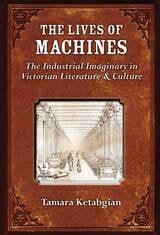
The Lives of Machines
The Industrial Imaginary in Victorian Literature and CultureTamara Ketabgian
University of Michigan Press, 2011
"The Lives of Machines is intelligent, closely argued, and persuasive, and puts forth a contention that will unsettle the current consensus about Victorian attitudes toward the machine."
---Jay Clayton, Vanderbilt University
Today we commonly describe ourselves as machines that "let off steam" or feel "under pressure." The Lives of Machines investigates how Victorian technoculture came to shape this language of human emotion so pervasively and irrevocably and argues that nothing is more intensely human and affecting than the nonhuman. Tamara Ketabgian explores the emergence of a modern and more mechanical view of human nature in Victorian literature and culture.
Treating British literature from the 1830s to the 1870s, this study examines forms of feeling and community that combine the vital and the mechanical, the human and the nonhuman, in surprisingly hybrid and productive alliances. Challenging accounts of industrial alienation that still persist, the author defines mechanical character and feeling not as erasures or negations of self, but as robust and nuanced entities in their own right. The Lives of Machines thus offers an alternate cultural history that traces sympathies between humans, animals, and machines in novels and nonfiction about factory work as well as in other unexpected literary sites and genres, whether domestic, scientific, musical, or philosophical. Ketabgian historicizes a model of affect and community that continues to inform recent theories of technology, psychology, and the posthuman.
The Lives of Machines will be of interest to students of British literature and history, history of science and of technology, novel studies, psychoanalysis, and postmodern cultural studies.
Cover image: "Power Loom Factory of Thomas Robinson," from Andrew Ure, The Philosophy of Manufactures (London: Charles Knight, 1835), frontispiece.
DIGITALCULTUREBOOKS: a collaborative imprint of the University of Michigan Press and the University of Michigan Library
The Living Dead
A Study of the Vampire in Romantic LiteratureJames B. Twitchell
Duke University Press, 1981
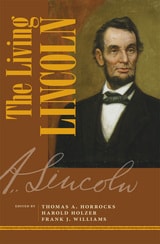
The Living Lincoln
Edited by Thomas A. Horrocks, Harold Holzer, and Frank J. Williams
Southern Illinois University Press, 2011
In an opening section focusing largely on Lincoln's formative years, insightful explorations into his early self-education and the era before his presidency come from editors Frank J. Williams and Harold Holzer, respectively. Readers will also glimpse a Lincoln rarely discerned in books: calculating politician, revealed in Matthew Pinsker's illuminating essay, and shrewd military strategist, as demonstrated by Craig L. Symonds. Stimulating discussions from Edna Greene Medford, John Stauffer, and Michael Vorenberg tell of Lincoln's friendship with Frederick Douglass, his gradualism on abolition, and his evolving thoughts on race and the Constitution to round out part two. Part three features reflections on his martyrdom and memory, including a counterfactual history from Gerald J. Prokopowicz that imagines a hypothetical second term for the president, emphasizing the differences between Lincoln and his successor, Andrew Johnson. Barry Schwartz's contribution presents original research that yields fresh insight into Lincoln's evolving legacy in the South, while Richard Wightman Fox dissects Lincoln's 1865 visit to Richmond, and Orville Vernon Burton surveys and analyzes recent Lincoln scholarship.
This thought-provoking new anthology, introduced at a major bicentennial symposium at Harvard University, offers a wide range of ideas and interpretations by some of the best-known and most widely respected historians of our time. The Living Lincoln is essential reading for those seeking a better understanding of this nation's greatest president and how his actions resonate today.
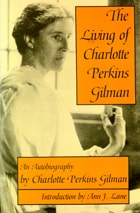
The Living of Charlotte Perkins Gilman
An AutobiographyCharlotte Perkins Gilman
University of Wisconsin Press, 1991
Charlotte Perkins Gilman (1869-1935) was one of the leading intellectuals of the American women's movement in the first two decades of the twentieth century. Moving beyond the struggle for suffrage, Gilman confronted an even larger problem—economic and social discrimination against women. Her book, Women and Economics, published in 1898, was repeatedly printed and translated into seven languages. She was a tireless traveler, lecturer, and writer and is perhaps best known for her dramatic short story, "The Yellow Wallpaper." Gilman's autobiography gives us access to the life of a remarkable and courageous woman.
Originally published in 1935, soon after Gilman's death, The Living of Charlotte Perkins Gilman has been out of print for several years. This edition includes a new introduction by Gilman's noted biographer, Anne J. Lane.
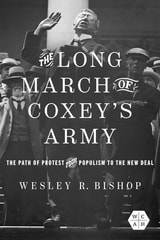
The Long March of Coxey’s Army
The Path of Protest from Populism to the New DealWesley R. Bishop
University of Illinois Press, 2027
Wesley R. Bishop explores how Coxey and his allies organized the first national protest to bring citizens to Washington, D.C. Though the march failed in its immediate goals, for the next forty years its ideas influenced America’s political parties. The demonstration pioneered marching for economic justice while its push for federal public works projects and government responsibility for unemployment helped shaped the New Deal. But in the years after the march, racism and other types of exclusion muddied hopes and tainted demands for democratic and economic fairness.
Eye-opening and insightful, The Long March of Coxey’s Army examines the influence and aftermath of an important historical event.
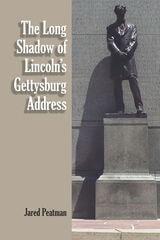
The Long Shadow of Lincoln's Gettysburg Address
Jared Peatman
Southern Illinois University Press, 2013
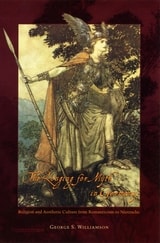
The Longing for Myth in Germany
Religion and Aesthetic Culture from Romanticism to NietzscheGeorge S. Williamson
University of Chicago Press, 2004
Through readings of key intellectuals ranging from Herder and Schelling to Wagner and Nietzsche, Williamson highlights three crucial factors in the emergence of the German engagement with myth: the tradition of Philhellenist neohumanism, a critique of contemporary aesthetic and public life as dominated by private interests, and a rejection of the Bible by many Protestant scholars as the product of a foreign, "Oriental" culture. According to Williamson, the discourse on myth in Germany remained bound up with problems of Protestant theology and confessional conflict through the nineteenth century and beyond.
A compelling adventure in intellectual history, this study uncovers the foundations of Germany's fascination with myth and its enduring cultural legacy.
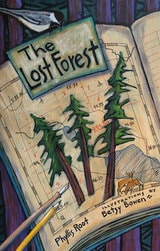
The Lost Forest
Phyllis Root
University of Minnesota Press, 2019
The story of a forest “lost” by a surveying error—and all the flora and fauna to be found there
A forest, of course, doesn’t need a map to know where to grow. But people need a map to find it. And in 1882 when surveyors set out to map a part of Minnesota, they got confused, or tired and cold (it was November), and somehow mapped a great swath of ancient trees as a lake. For more than seventy-five years, the mistake stayed on the map, and the forest remained safe from logging—no lumber baron expects to find timber in a lake, after all.
The Lost Forest tells the story of this lucky error and of the 144 acres of old-growth red and white pine it preserved. With gentle humor, Phyllis Root introduces readers to the men at their daunting task, trekking across Minnesota, measuring and marking the vast land into townships and sections and quarters. She takes us deep into a stand of virgin pine, one of the last and largest in the state, where U.S. history and natural history meet. With the help of Betsy Bowen’s finely observed and beautiful illustrations, she shows us all the life that can be found in the Lost Forest.
Accompanying the story is a wealth of information about the Cadastral Survey and about the plants and animals that inhabit forests—making the book a valuable guide for readers who might want to look even deeper into the history of Minnesota, the flora and fauna of old-growth forests, and the apportioning of land in America.
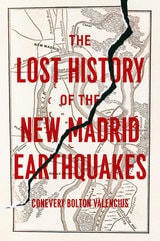
The Lost History of the New Madrid Earthquakes
Conevery Bolton Valencius
University of Chicago Press, 2013
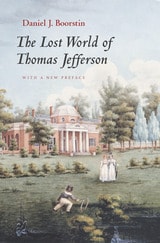
The Lost World of Thomas Jefferson
Daniel J. Boorstin
University of Chicago Press, 1993
"The volume is too subtle, too rich in ideas for anyone to do justice to it in brief summary, too heavily documented and too carefully wrought for anyone to dismiss its thesis. . . . It is a major contribution not only to Jefferson studies but to American intellectual history. . . . All who work in the history of ideas will find themselves in Mr. Boorstin's debt."—Richard Hofstadter, South Atlantic Monthly
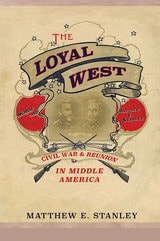
The Loyal West
Civil War and Reunion in Middle AmericaMatthew E. Stanley
University of Illinois Press, 2017
Matthew E. Stanley's intimate study explores the Civil War, Reconstruction, and sectional reunion in this bellwether region. Using the lives of area soldiers and officers as a lens, Stanley reveals a place and a strain of collective memory that was anti-rebel, anti-eastern, and anti-black in its attitudes--one that came to be at the forefront of the northern retreat from Reconstruction and toward white reunion. The Lower Middle West's embrace of black exclusion laws, origination of the Copperhead movement, backlash against liberalizing war measures, and rejection of Reconstruction were all pivotal to broader American politics. And the region's legacies of white supremacy--from racialized labor violence to sundown towns to lynching--found malignant expression nationwide, intersecting with how Loyal Westerners remembered the war.
A daring challenge to traditional narratives of section and commemoration, The Loyal West taps into a powerful and fascinating wellspring of Civil War identity and memory.
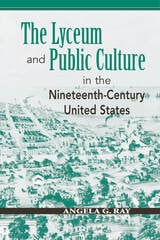
The Lyceum and Public Culture in the Nineteenth-Century United States
Angela G. Ray
Michigan State University Press, 2005
Angela Ray provides a refreshing new look at the lyceum lecture system as it developed in the United States from the 1820s to the 1880s. She argues that the lyceum contributed to the creation of an American "public" at a time when the country experienced a rapid change in land area, increasing immigration, and a revolution in transportation, communication technology, and social roles.
The history of the lyceum in the nineteenth century illustrates a process of expansion, diffusion, and eventual commercialization. In the late 1820s, a politically and economically dominant culture—the white Protestant northeastern middle class—institutionalized the practice of public debating and public lecturing for education and moral uplift. In the 1820s and 1830s, the lyceum was characterized by organized groups in cities and towns, particularly in the Northeast and the Old Northwest (now the Midwest). These groups were established to promote debate, to create a setting for study, and to provide a forum for members’ lecturing. By the 1840s and 1850s, however, most lyceums concentrated on the sponsorship of public lectures, presented for institutional profit as well as public instruction and entertainment. Eventually, lyceum lectures became a commercial enterprise and desirable platform for celebrities who wished to expand their incomes from lecturing.
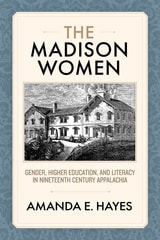
The Madison Women
Gender, Higher Education, and Literacy in Nineteenth-Century AppalachiaAmanda E Hayes
West Virginia University Press, 2024
Incorporating captivating mini-biographies of women who attended Madison College and who went on to change their communities in ways large and small, this book reveals how the lives of its students impart lessons about history, regional culture, and how we can shape the Appalachia's future.
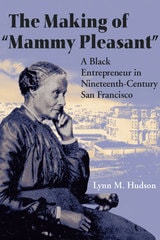
The Making of "Mammy Pleasant"
A Black Entrepreneur in Nineteenth-Century San FranciscoLynn M. Hudson
University of Illinois Press, 2002
Investigating Mary Ellen Pleasant's convoluted legacy
Mary Ellen Pleasant arrived in Gold Rush-era San Francisco a free black woman with abolitionist convictions and a predilection for entrepreneurial success. Behind the convenient and trusted disguise of "Mammy," she transformed domestic labor into enterprise, amassed remarkable real estate, wealth, and power, and gained notoriety for her work in fighting Jim Crow.
Pleasant's legacy is steeped in scandals and lore. Was she a voodoo queen who traded in sexual secrets? A madam? A murderer? In The Making of "Mammy Pleasant," Lynn M. Hudson examines the folklore of Pleasant's real and imagined powers. Emphasizing the significance of her life in the context of how it has been interpreted or ignored in the larger trends of American history, Hudson integrates fact and speculation culled from periodicals, court cases, diaries, letters, Pleasant's interviews with the San Francisco press, and various biographical and fictional accounts.
Addressing the lack of a historical record of black women's lives, the author argues that the silences and mysteries of Pleasant's past, whether never recorded or intentionally omitted, reveal as much about her life as what has been documented. Through Pleasant's life, Hudson also interrogates the constructions of race, gender, and sexuality during the formative years of California's economy and challenges popular mythology about the liberatory sexual culture of the American West.