Results by title
8812 books match the query 'Political Science' and 1911 start with t
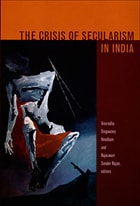
The Crisis of Secularism in India
Anuradha Dingwaney Needham and Rajeswari Sunder Rajan, eds.
Duke University Press, 2007
Scholars of history, anthropology, religion, politics, law, philosophy, and media studies take on a broad range of concerns. Some consider the history of secularism in India; others explore theoretical issues such as the relationship between secularism and democracy or the shortcomings of the categories “majority” and “minority.” Contributors examine how the debates about secularism play out in schools, the media, and the popular cinema. And they address two of the most politically charged sites of crisis: personal law and the right to practice and encourage religious conversion. Together the essays inject insightful analysis into the fraught controversy about the shortcomings and uncertain future of secularism in the world today.
Contributors. Flavia Agnes, Upendra Baxi, Shyam Benegal, Akeel Bilgrami, Partha Chatterjee, V. Geetha, Sunil Khilnani, Nivedita Menon, Ashis Nandy, Anuradha Dingwaney Needham, Gyanendra Pandey, Gyan Prakash, Arvind Rajagopal, Paula Richman, Sumit Sarkar, Dwaipayan Sen, Rajeswari Sunder Rajan, Shabnum Tejani, Romila Thapar, Ravi S. Vasudevan, Gauri Viswanathan
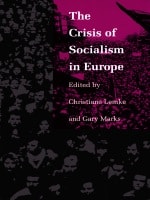
The Crisis of Socialism in Europe
Christiane Lemke and Gary Marks, eds.
Duke University Press, 1991
The collection begins with an historical overview of socialism in Western Europe and moves toward the suggestion of a framework for a post-socialist discourse. Among the topics covered are: the birth and death of communism and a regime type in Eastern Europe; how different forms of national communism were smothered by Sovietization in the postwar period; the origins of revolutions in Eastern Europe; the potential for social democracy in Hungary; the role of the Left in a reunified German; and directions for the Left in general.
Contributors. Geoff Eley, Konrad Jarausch, Herbert Kitschelt, Christiane Lemke, Andrei Markovits, Gary Marks, Wolfgang Merkel, Norman Naimark, Iván and Szonja Szelénya, Sharon Wolchik
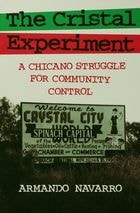
The Cristal Experiment
A Chicano Struggle for Community ControlArmando Navarro
University of Wisconsin Press, 1998
Amidst the turbulence and militancy of the 1960s and early 1970s, the Mexicano population of the dusty agricultural town of Crystal City, Texas (Cristal in Spanish), staged two electoral revolts, each time winning control of the city council and school board. The landmark city council victory in 1963 was a first for Mexican Americans in South Texas, and Cristal—the “spinach capital of the world”—became for a time the political capital of the Chicano Movement.
In The Cristal Experiment, Armando Navarro presents the most comprehensive examination to date of the rise of the Chicano political movement in Cristal, its successes and conflicts (both internal and external), and its eventual decline. He looks particularly at the larger and more successful “Second Revolt” in 1970 and its aftermath up to 1981, examining the political, economic, educational, and social changes for Mexicanos that resulted. Drawing upon nearly 100 interviews, a wealth of secondary materials, and his own experiences as a political organizer in the Chicano Movement, Navarro offers a shrewd and insightful analysis not only of the events in Cristal, but also of the workings of local politics generally, the politics of community control, and the factors inherent in the American political system that lead to the self-destruction of political movements. As both a political scientist and an organizer, he outlines important lessons to be learned from what happened in Cristal and to the Chicano Movement.

The Cross and the Flag
Papal Diplomacy and John Paul II's Struggle Against the Tyranny of the PossibleJohn Tanyi Nquah Lebui
St. Augustine's Press, 2024
What is papal diplomacy and what role does it play on the larger geopolitical stage? Why does it matter what popes say to a global audience? "As John Tanyi points out, papal diplomacy has followed a trajectory all its own over the years. In today’s globalized world, the Holy See stands out as an important communicator with a widely respected moral voice. It is often said that 'When the Pope speaks, the world listens.' What sets the diplomatic voices of the Holy Father and his envoys apart from all others is that they speak and act for the good of humanity––not just for the sovereign entity they represent, and not just for Catholics. As a former foreign minister of the Holy See, Cardinal Jean Louis Tauran, once described the mission of papal diplomats: 'Our duty is to promote and defend not only the freedom and rights of Catholic communities around the world, but also to promote certain principles without which there is no civilization.'"
The particular example of Pope John Paul II is a groundbreaking example of the critical nature of ecclesiastical diplomacy and why popes as diplomats are playing at a greater level than other statesmen. As George Weigel notes, popes must combat all the problems of the world, but also importantly what he calls the 'tyranny of the possible'––that is, in all things compromise and complacency will play a part. It is the position occupied by one man, the heir of St. Peter, to know when to defy the entirety of global politics (and sometimes what seems like common sense) to say 'yes' and 'no' definitively in light of unchanging truths.

The Cross of War
Christian Nationalism and U.S. Expansion in the Spanish-American WarMatthew McCullough
University of Wisconsin Press, 2014
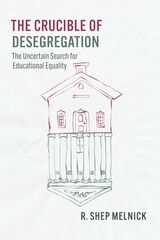
The Crucible of Desegregation
The Uncertain Search for Educational EqualityR. Shep Melnick
University of Chicago Press, 2023
In 1954, the Supreme Court delivered the landmark decision of Brown v. Board of Education—establishing the right to attend a desegregated school as a national constitutional right—but the decision contained fundamental ambiguities. The Supreme Court has never offered a clear definition of what desegregation means or laid out a framework for evaluating competing interpretations. In The Crucible of Desegregation, R. Shep Melnick examines the evolution of federal school desegregation policy from 1954 through the termination of desegregation orders in the first decades of the twenty-first century, combining legal analysis with a focus on institutional relations, particularly the interactions between federal judges and administrators. Melnick argues that years of ambiguous, inconsistent, and meandering Court decisions left lower court judges adrift, forced to apply contradictory Supreme Court precedents in a wide variety of highly charged political and educational contexts. As a result, desegregation policy has been a patchwork, with lower court judges playing a crucial role and with little opportunity to analyze what worked and what didn’t. The Crucible of Desegregation reveals persistent patterns and disagreements that continue to roil education policy.
The Crucible of Desegregation
The Uncertain Search for Educational EqualityR. Shep Melnick
University of Chicago Press, 2023
Examines the patchwork evolution of school desegregation policy.
In 1954, the Supreme Court delivered the landmark decision of Brown v. Board of Education—establishing the right to attend a desegregated school as a national constitutional right—but the decision contained fundamental ambiguities. The Supreme Court has never offered a clear definition of what desegregation means or laid out a framework for evaluating competing interpretations. In The Crucible of Desegregation, R. Shep Melnick examines the evolution of federal school desegregation policy from 1954 through the termination of desegregation orders in the first decades of the twenty-first century, combining legal analysis with a focus on institutional relations, particularly the interactions between federal judges and administrators. Melnick argues that years of ambiguous, inconsistent, and meandering Court decisions left lower court judges adrift, forced to apply contradictory Supreme Court precedents in a wide variety of highly charged political and educational contexts. As a result, desegregation policy has been a patchwork, with lower court judges playing a crucial role and with little opportunity to analyze what worked and what didn’t. The Crucible of Desegregation reveals persistent patterns and disagreements that continue to roil education policy.
The Cuba Reader
History, Culture, PoliticsAviva Chomsky, Barry Carr, and Pamela Maria Smorkaloff, eds.
Duke University Press, 2003
The Cuba Reader combines songs, paintings, photographs, poems, short stories, speeches, cartoons, government reports and proclamations, and pieces by historians, journalists, and others. Most of these are by Cubans, and many appear for the first time in English. The writings and speeches of José Martí, Fernando Ortiz, Fidel Castro, Alejo Carpentier, Che Guevera, and Reinaldo Arenas appear alongside the testimonies of slaves, prostitutes, doctors, travelers, and activists. Some selections examine health, education, Catholicism, and santería; others celebrate Cuba’s vibrant dance, music, film, and literary cultures. The pieces are grouped into chronological sections. Each section and individual selection is preceded by a brief introduction by the editors.
The volume presents a number of pieces about twentieth-century Cuba, including the events leading up to and following Castro’s January 1959 announcement of revolution. It provides a look at Cuba in relation to the rest of the world: the effect of its revolution on Latin America and the Caribbean, its alliance with the Soviet Union from the 1960s until the collapse of the Soviet bloc in 1989, and its tumultuous relationship with the United States. The Cuba Reader also describes life in the periodo especial following the cutoff of Soviet aid and the tightening of the U.S. embargo.
For students, travelers, and all those who want to know more about the island nation just ninety miles south of Florida, The Cuba Reader is an invaluable introduction.
The Cuban Counterrevolution
Jesús Arboleya
Ohio University Press, 2000
For forty years the Cuban Revolution has been at the forefront of American public opinion, yet few are knowledgeable about the history of its enemies and the responsibility of the U.S. government in organizing and sustaining the Cuban counterrevolution. Available in English for the first time, this outstanding study by Cuban historian and former diplomat Jesús Arboleya traces the evolution of the counterrevolutionary movement from its beginnings before 1959, to its transformation into the Cuban-American groups that today dominate U.S. policy toward Cuba. Arboleya also analyzes the role played by Cuban immigrants to the U.S. and the perspectives for improvement in relations between the two nations as a result of the generational and social changes that have been occurring in the Cuban-American community.

The Cuban Revolution in the 21st Century
George Lambie
Pluto Press, 2010
While most books and articles on Cuba seek to analyse the island’s socialist experiment from the perspective of internal dynamics or international relations, this book attempts to understand the revolutionary process as part of a counter-current against neoliberal globalisation.
Rather than presenting Cuba as a socialist survivor, whose performance must be measured against the standards set by the ‘international community’, George Lambie judges Cuban socialism on the goals which the revolution sets for itself. He shows that despite Cuba’s isolation in the ‘New World Order’, and the enormous pressures it has faced to ‘conform’, its faith in an alternative socialist project has continued and grown.
Now that neoliberalism is in crisis, Cuba’s promotion of socialist values is finding a renewed relevance. In this fascinating study Lambie argues that Cuba is again becoming a symbol, and practical example, of socialism in action. This book is essential reading for students of politics and Latin American studies.
The Cult Of The Court
John Brigham
Temple University Press, 1991
In recent years widespread attention has been focused on decisions handed down by the Supreme Court that grapple with passionate issues: integration, school prayer, abortion, affirmative action. The appointment of new justices is a highly charged political event although the Court is supposed to be "above" politics. Amidst the bicentennial celebration of the Constitution and almost daily reports of major confrontations awaiting the highest court’s judicial review, John Brigham presents a fresh and innovative examination of the U.S. Supreme Court as the final arbiter of constitutional interpretation.
Drawing on philosophy and anthropology, The Cult of the Court offers a social scientific investigation of an institution whose authority has come to be taken for granted. The author emphasizes that the Court is an institution and that its authority is founded less in the claim of legal expertise than in hierarchical finality—the assertion of political will, not of legal judgment. He shows how the Court has supplanted the Constitution as the authority in our political world and that what makes legal "sense" is affected by these factors of institutionalization, bureaucratization, and court-dominated constitutionalism.
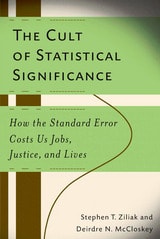
The Cult of Statistical Significance
How the Standard Error Costs Us Jobs, Justice, and LivesStephen T. Ziliak and Deirdre N. McCloskey
University of Michigan Press, 2010
“McCloskey and Ziliak have been pushing this very elementary, very correct, very important argument through several articles over several years and for reasons I cannot fathom it is still resisted. If it takes a book to get it across, I hope this book will do it. It ought to.”
—Thomas Schelling, Distinguished University Professor, School of Public Policy, University of Maryland, and 2005 Nobel Prize Laureate in Economics
“With humor, insight, piercing logic and a nod to history, Ziliak and McCloskey show how economists—and other scientists—suffer from a mass delusion about statistical analysis. The quest for statistical significance that pervades science today is a deeply flawed substitute for thoughtful analysis. . . . Yet few participants in the scientific bureaucracy have been willing to admit what Ziliak and McCloskey make clear: the emperor has no clothes.”
—Kenneth Rothman, Professor of Epidemiology, Boston University School of Health
The Cult of Statistical Significance shows, field by field, how “statistical significance,” a technique that dominates many sciences, has been a huge mistake. The authors find that researchers in a broad spectrum of fields, from agronomy to zoology, employ “testing” that doesn’t test and “estimating” that doesn’t estimate. The facts will startle the outside reader: how could a group of brilliant scientists wander so far from scientific magnitudes? This study will encourage scientists who want to know how to get the statistical sciences back on track and fulfill their quantitative promise. The book shows for the first time how wide the disaster is, and how bad for science, and it traces the problem to its historical, sociological, and philosophical roots.
Stephen T. Ziliak is the author or editor of many articles and two books. He currently lives in Chicago, where he is Professor of Economics at Roosevelt University. Deirdre N. McCloskey, Distinguished Professor of Economics, History, English, and Communication at the University of Illinois at Chicago, is the author of twenty books and three hundred scholarly articles. She has held Guggenheim and National Humanities Fellowships. She is best known for How to Be Human* Though an Economist (University of Michigan Press, 2000) and her most recent book, The Bourgeois Virtues: Ethics for an Age of Commerce (2006).
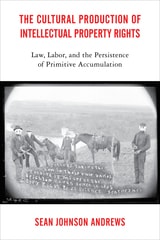
The Cultural Production of Intellectual Property Rights
Law, Labor, and the Persistence of Primitive AccumulationSean Johnson Andrews
Temple University Press, 2019
The protection and accumulation of intellectual property rights—like property rights in general—is one of the most important contemporary American values. In his cogent book, The Cultural Production of Intellectual Property Rights, Sean Johnson Andrews shows that the meaning, power, and value of intellectual properties are the consequence of an extended process of cultural production.
Johnson Andrews argues that it is deeper ideological and historical roots which demand that, in the contemporary global, digital economy, all property rights be held sacrosanct and all value must flow back to the legal owner.
Johnson Andrews explains that if we want to rebalance the protection of copyrights and trademarks, we should focus on undermining the reified culture of property that underpins capitalism as a whole. He outlines a framework for analyzing culture; situates intellectual property rights in the history of capitalist property relations; synthesizes key theories of media, politics, and law; and ultimately provides scholars and activists a path to imagining a different future where we prioritize our collective production of value in the commons.
The Cultural Revolution and Post-Mao Reforms
A Historical PerspectiveTang Tsou
University of Chicago Press, 1986

The Cultural Set Up of Comedy
Affective Politics in the United States Post 9/11Julie Webber
Intellect Books, 2013

The Culture of Inequality
Michael Lewis
University of Massachusetts Press, 1993
Why do America’s wars against poverty turn out to be wards against the poor? Why does a nation so committed to fighting crime show such a bad record of combatting it and so morbid a fascination with it? Why is American racism so deeply rooted?
These and other questions are answered in this milestone study. Its central thesis is that the national faith in individual initiative and free opportunity has become a breeding ground for guilt about our own limited successes and prejudice against all who exhibit signs of failure.
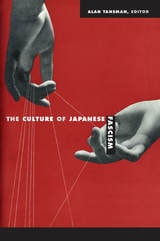
The Culture of Japanese Fascism
Alan Tansman, ed.
Duke University Press, 2009
Several contributors examine how fascism was understood in the 1930s by, for example, influential theorists, an antifascist literary group, and leading intellectuals responding to capitalist modernization. Others explore the idea that fascism’s solution to alienation and exploitation lay in efforts to beautify work, the workplace, and everyday life. Still others analyze the realization of and limits to fascist aesthetics in film, memorial design, architecture, animal imagery, a military museum, and a national exposition. Contributors also assess both manifestations of and resistance to fascist ideology in the work of renowned authors including the Nobel-prize-winning novelist and short-story writer Kawabata Yasunari and the mystery writers Edogawa Ranpo and Hamao Shirō. In the work of these final two, the tropes of sexual perversity and paranoia open a new perspective on fascist culture. This volume makes Japanese fascism available as a critical point of comparison for scholars of fascism worldwide. The concluding essay models such work by comparing Spanish and Japanese fascisms.
Contributors. Noriko Aso, Michael Baskett, Kim Brandt, Nina Cornyetz, Kevin M. Doak, James Dorsey, Aaron Gerow, Harry Harootunian, Marilyn Ivy, Angus Lockyer, Jim Reichert, Jonathan Reynolds, Ellen Schattschneider, Aaron Skabelund, Akiko Takenaka, Alan Tansman, Richard Torrance, Keith Vincent, Alejandro Yarza
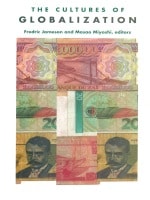
The Cultures of Globalization
Fredric Jameson and Masao Miyoshi, eds.
Duke University Press, 1998
Discussing overlapping themes of transnational consequence, the contributors to this volume describe how the global character of technology, communication networks, consumer culture, intellectual discourse, the arts, and mass entertainment have all been affected by recent worldwide trends. Appropriate to such diversity of material, the authors approach their topics from a variety of theoretical perspectives, including those of linguistics, sociology, economics, anthropology, and the law. Essays examine such topics as free trade, capitalism, the North and South, Eurocentrism, language migration, art and cinema, social fragmentation, sovereignty and nationhood, higher education, environmental justice, wealth and poverty, transnational corporations, and global culture. Bridging the spheres of economic, political, and cultural inquiry, The Cultures of Globalization offers crucial insights into many of the most significant changes occurring in today’s world.
Contributors. Noam Chomsky, Ioan Davies, Manthia Diawara, Enrique Dussel, David Harvey, Sherif Hetata, Fredric Jameson, Geeta Kapur, Liu Kang, Joan Martinez-Alier, Masao Miyoshi, Walter D. Mignolo, Alberto Moreiras, Paik Nak-chung, Leslie Sklair, Subramani, Barbara Trent
The Cunning of Gender Violence
Geopolitics and FeminismLila Abu-Lughod, Rema Hammami, and Nadera Shalhoub-Kevorkian, editors
Duke University Press, 2023
Contributors. Lila Abu-Lughod, Nina Berman, Inderpal Grewal, Rema Hammami, Janet R. Jakobsen, Shenila Khoja-Moolji, Vasuki Nesiah, Samira Shackle, Sima Shakhsari, Nadera Shalhoub-Kevorkian, Dina M Siddiqi, Shahla Talebi, Leti Volpp, Rafia Zakaria
The Cunning of Recognition
Indigenous Alterities and the Making of Australian MulticulturalismElizabeth A. Povinelli
Duke University Press, 2002
Povinelli draws on seventeen years of ethnographic research among northwest coast indigenous people and her own experience participating in land claims, as well as on public records, legal debates, and anthropological archives to examine how multicultural forms of recognition work to reinforce liberal regimes rather than to open them up to a true cultural democracy. The Cunning of Recognition argues that the inequity of liberal forms of multiculturalism arises not from its weak ethical commitment to difference but from its strongest vision of a new national cohesion. In the end, Australia is revealed as an exemplary site for studying the social effects of the liberal multicultural imaginary: much earlier than the United States and in response to very different geopolitical conditions, Australian nationalism renounced the ideal of a unitary European tradition and embraced cultural and social diversity.
While addressing larger theoretical debates in critical anthropology, political theory, cultural studies, and liberal theory, The Cunning of Recognition demonstrates that the impact of the globalization of liberal forms of government can only be truly understood by examining its concrete—and not just philosophical—effects on the world.
The Currency of Truth
Newsmaking and the Late-Socialist Imaginaries of China's Digital EraEmily H. C. Chua
University of Michigan Press, 2023
In The Currency of Truth, Emily H. C. Chua argues that news in China works less as a medium of mass communication than as a kind of currency as industry players make and use news articles to create agreements, build connections, and protect and advance their positions against one another. Looking at the ethical and professional principles that well-intentioned and civically minded journalists strive to uphold, and the challenges and doubts that they grapple with in the process, Chua brings her findings into conversation around “post-truth” news and the “crisis” of professional journalism in the West. The book encourages readers to rethink contemporary news, arguing that rather than setting out from the assumption that news works either to inform or deceive its publics, we should explore the “post-public” social and political imaginaries emerging among today’s newsmakers and remaking the terms of their practice.
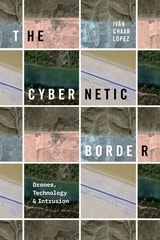
The Cybernetic Border
Drones, Technology, and IntrusionIván Chaar López
Duke University Press, 2024
The Cynical Society
The Culture of Politics and the Politics of Culture in American LifeJeffrey C. Goldfarb
University of Chicago Press, 1991
The Czech and Slovak Republics
Twenty years of Independence, 1993–2013M. Mark Stolarik
Central European University Press, 2017
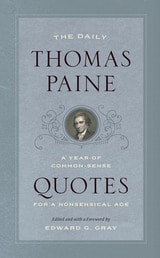
The Daily Thomas Paine
A Year of Common-Sense Quotes for a Nonsensical AgeThomas Paine
University of Chicago Press, 2020
The Daily Thomas Paine offers a year’s worth of pithy and provocative quotes from this quintessentially American figure. Editor Edward G. Gray argues that we are living in a moment that Thomas Paine might recognize—or perhaps more precisely, a moment desperate for someone whose rhetoric can ignite a large-scale social and political transformation. Paine was a master of political rhetoric, from the sarcastic insult to the diplomatic aperçu, and this book offers a sleek and approachable sampler of some of the sharpest bits from his oeuvre. As Paine himself says in the entry for January 20: “The present state of America is truly alarming to every man who is capable of reflexion.” The Daily Thomas Paine should prove equally incendiary and inspirational for contemporary readers with an eye for politics, even those who prefer the tweet to the pamphlet.
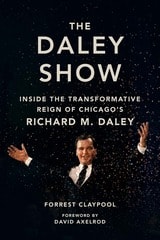
The Daley Show
Inside the Transformative Reign of Chicago's Richard M. DaleyForrest Claypool; Foreword by David Axelrod
University of Illinois Press, 2024
American cities once had mayors who actually governed.
For twenty-two years, Richard M. Daley ran Chicago with the type of authority that is unthinkable today. He reshaped downtown, triggered a jobs boom, delivered the iconic Millennium Park, turned around troubled public schools, and slashed violent crime to 40-year lows. He outfoxed Republican legislators to retain control of O’Hare Airport and expand it into the nation’s premier international aviation hub. Leveraging carefully built national political ties, he sidelined a powerful nemesis to tear down Chicago’s infamous public housing projects.
Rebuilding parts of his father’s legendary political machine through brazen (and illegal) patronage deals, he centralized power to a remarkable degree, cut deals behind closed doors, racked up piles of debt, and made long-term bets whose consequences are still unfolding.
This is not simply a biography. It is a challenge to contemporary urban orthodoxy:
Do cities thrive because of strong, decisive leaders—or despite them?
Through vivid storytelling, this book exposes how Daley consolidated power, aligned business and labor, navigated crises, survived damaging scandals, and imposed discipline on a sprawling city. It dares readers to reconsider what kind of leadership modern American cities truly need.
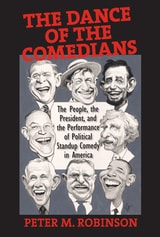
The Dance of the Comedians
The People, the President, and the Performance of Political Standup Comedy in AmericaPeter M. Robinson
University of Massachusetts Press, 2010
Why did Barack Obama court Jon Stewart and trade jokes with Stephen Colbert during the campaign of 2008? Why did Sarah Palin forgo the opportunity to earn votes on the Sunday morning political talk shows but embrace the chance to get laughs on Saturday Night Live? The Dance of the Comedians examines the history behind these questions—the merry, mocking, and highly contested anarchies of standup political comedy that have locked humorists, presidents, and their fellow Americans in an improvisational three-way “dance” since the early years of the American republic.
Peter M. Robinson shows how the performance of political humor developed as a celebration of democracy and an expression of political power, protest, and commercial profit. He places special significance on the middle half of the twentieth century, when presidents and comedians alike—from Calvin Coolidge to Ronald Reagan, from Will Rogers to Saturday Night Live's “Not Ready for Prime Time Players”—developed modern understandings of the power of laughter to affect popular opinion and political agendas, only to find the American audience increasingly willing and able to get in on the act. These years put the long-standing traditions of presidential deference profoundly in play as all three parties to American political humor—the people, the presidents, and the comedy professionals—negotiated their way between reverence for the office of the presidency and ridicule of its occupants.
Although the focus is on humor, The Dance of the Comedians illuminates the process by which Americans have come to recognize that the performance of political comedy has serious and profound consequences for those on all sides of the punch line.
The Dangerous Class
The Concept of the LumpenproletariatClyde W. Barrow
University of Michigan Press, 2020
The Danish Voter
Democratic Ideals and ChallengesRune Stubager, Kasper M. Hansen, Michael S. Lewis-Beck, and Richard Nadeau
University of Michigan Press, 2021
The authors of The Danish Voter investigate a series of interesting questions concerning voters’ reactions to these macrosocial challenges and how their reactions affect the foundations for the ideal. Indeed, due to an electoral system open to new influences, the Danish case is an important test case for theories about political development of contemporary Western societies.
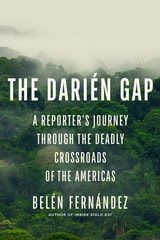
The Darién Gap
A Reporter's Journey through the Deadly Crossroads of the AmericasBelén Fernández
Rutgers University Press, 2025
The narrow Darién Gap, the only land bridge connecting South and Central America, encompasses a spectacularly hostile jungle, covered in steep mountains, dense rainforests, and flood-prone marshes. Known in Spanish as el infierno verde, or “the green hell,” it is one of the most inhospitable places in the world. Its terrain is too treacherous for roads, yet hundreds of thousands of refuge seekers contend with its horrors every year in the hopes of reaching the United States, still some three thousand miles away. And of the countless who set out for the border, an untold number never arrive.
In this book, journalist Belén Fernández travels through the Darién Gap to report on the dehumanizing and deadly stretch of land that has become a mass graveyard for migrants. Fernández’s journey brings her into contact with refuge seekers, people smugglers, law enforcement officials, and many more whose stories bring life to a place overwhelmingly associated with death. Combining history, on-the-ground reporting, travelogue, memoir, and searing politico-economic analysis, she shines light on a largely made-in-the-USA crisis that has come to define our modern era.
Engrossing and heartrending, The Darién Gap is a poignant and compassionate indictment of structural inequality and institutionalized inhumanity in a world where the have-nots must risk death for a chance at a better life—or any life at all.
The Dark Sahara
America's War on Terror in AfricaJeremy Keenan
Pluto Press, 2009
The US is keen to build a substantial military presence in Africa, citing the need to combat the growth of Al-Qaeda in Somalia, Algeria and other countries on the continent. This book reveals the secret US agenda behind the 'war on terror' in Africa and the shocking methods used to perpetuate the myth that the region is a hot-bed of Islamic terrorism.
Africa expert Jeremy Keenan points to overwhelming evidence suggesting that, from 2003, the Bush administration and Algerian government were responsible for hostage takings blamed on Islamic militants. This created a permissive public attitude, allowing the US to establish military bases in the region and pursue multiple imperial objectives in the name of security.
The shocking revelations in this book seriously undermine the mainstream view of Africa as a legitimate 'second front' in the 'war on terror'.

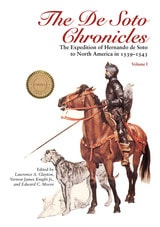
The De Soto Chronicles Vol 1
The Expedition of Hernando de Soto to North America in 1539-1543Edited by Lawrence A. Clayton, Vernon James Knight Jr., and Edward C. Moore
University of Alabama Press, 2022
1993 CHOICE OUTSTANDING ACADEMIC BOOK, SPONSORED BY CHOICE MAGAZINE
Unearthing the documents that shaped our earliest understanding of a continent.
The De Soto expedition was the first major encounter of Europeans with indigenous North Americans in the eastern half of the United States. De Soto and his army of over 600 men, including 200 cavalry, spent four years traveling through what is now Florida, Georgia, Alabama, North and South Carolina, Tennessee, Mississippi, Louisiana, Arkansas, and Texas. The De Soto Chronicles Volume 1 and Volume 2 present for the first time all four primary accounts of the De Soto expedition together in English translation.
The four primary accounts are generally referred to as Elvas, Rangel, Biedma (in Volume 1), and Garcilaso, or the Inca (in Volume 2). In this landmark 1993 publication, Clayton’s team presents the four accounts with literary and historical introductions. They further add brief essays about De Soto and the expedition, translations of De Soto documents from the Spanish Archivo General de Indias, two short biographies of De Soto, and bibliographical studies.
For anthropologists, archaeologists, and historians, The De Soto Chronicles are valued for the unique ethnological information they contain. They form the only detailed eyewitness records of the most advanced native civilization in North America—the Mississippian culture—a culture largely lost in the wake of European contact.
The De Soto Chronicles Vol 1
The Expedition of Hernando de Soto to North America in 1539-1543Lawrence A. Clayton
University of Alabama Press, 1993
1993 CHOICE OUTSTANDING ACADEMIC BOOK, SPONSORED BY CHOICE MAGAZINE
Unearthing the documents that shaped our earliest understanding of a continent.
The De Soto expedition was the first major encounter of Europeans with indigenous North Americans in the eastern half of the United States. De Soto and his army of over 600 men, including 200 cavalry, spent four years traveling through what is now Florida, Georgia, Alabama, North and South Carolina, Tennessee, Mississippi, Louisiana, Arkansas, and Texas. The De Soto Chronicles Volume 1 and Volume 2 present for the first time all four primary accounts of the De Soto expedition together in English translation.
The four primary accounts are generally referred to as Elvas, Rangel, Biedma (in Volume 1), and Garcilaso, or the Inca (in Volume 2). In this landmark 1993 publication, Clayton’s team presents the four accounts with literary and historical introductions. They further add brief essays about De Soto and the expedition, translations of De Soto documents from the Spanish Archivo General de Indias, two short biographies of De Soto, and bibliographical studies.
For anthropologists, archaeologists, and historians, The De Soto Chronicles are valued for the unique ethnological information they contain. They form the only detailed eyewitness records of the most advanced native civilization in North America—the Mississippian culture—a culture largely lost in the wake of European contact.
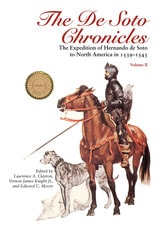
The De Soto Chronicles Vol 2
The Expedition of Hernando de Soto to North America in 1539-1543Edited by Lawrence A. Clayton, Vernon James Knight Jr., and Edward C. Moore
University of Alabama Press, 2022
A critical expansion of the documentary record of the de Soto expedition.
The De Soto expedition was the first major encounter of Europeans with indigenous North Americans in the eastern half of the United States. De Soto and his army of over 600 men, including 200 cavalry, spent four years traveling through what is now Florida, Georgia, Alabama, North and South Carolina, Tennessee, Mississippi, Louisiana, Arkansas, and Texas. The De Soto Chronicles Volume 1 and Volume 2 present for the first time all four primary accounts of the De Soto expedition together in English translation.
The four primary accounts are generally referred to as Elvas, Rangel, Biedma (in Volume 1), and Garcilaso, or the Inca (in Volume 2). In this landmark 1993 publication, Clayton’s team presents the four accounts with literary and historical introductions. They further add brief essays about De Soto and the expedition, translations of De Soto documents from the Spanish Archivo General de Indias, two short biographies of De Soto, and bibliographical studies.
For anthropologists, archaeologists, and historians, The De Soto Chronicles are valued for the unique ethnological information they contain. They form the only detailed eyewitness records of the most advanced native civilization in North America—the Mississippian culture—a culture largely lost in the wake of European contact.
The De Soto Chronicles Vol 2
The Expedition of Hernando de Soto to North America in 1539-1543Edited by Lawrence A. Clayton, Vernon James Knight Jr., and Edward C. Moore
University of Alabama Press, 1993
A critical expansion of the documentary record of the de Soto expedition.
The De Soto expedition was the first major encounter of Europeans with indigenous North Americans in the eastern half of the United States. De Soto and his army of over 600 men, including 200 cavalry, spent four years traveling through what is now Florida, Georgia, Alabama, North and South Carolina, Tennessee, Mississippi, Louisiana, Arkansas, and Texas. The De Soto Chronicles Volume 1 and Volume 2 present for the first time all four primary accounts of the De Soto expedition together in English translation.
The four primary accounts are generally referred to as Elvas, Rangel, Biedma (in Volume 1), and Garcilaso, or the Inca (in Volume 2). In this landmark 1993 publication, Clayton’s team presents the four accounts with literary and historical introductions. They further add brief essays about De Soto and the expedition, translations of De Soto documents from the Spanish Archivo General de Indias, two short biographies of De Soto, and bibliographical studies.
For anthropologists, archaeologists, and historians, The De Soto Chronicles are valued for the unique ethnological information they contain. They form the only detailed eyewitness records of the most advanced native civilization in North America—the Mississippian culture—a culture largely lost in the wake of European contact.
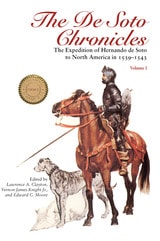
The De Soto Chronicles, 2 Volume Set
The Expedition of Hernando de Soto to North America in 1539-1543Edited by Lawrence A. Clayton, Vernon James Knight Jr., and Edward C. Moore
University of Alabama Press, 1995
1993 CHOICE OUTSTANDING ACADEMIC BOOK, SPONSORED BY CHOICE MAGAZINE
Unearthing the documents that shaped our earliest understanding of a continent.
The De Soto expedition was the first major encounter of Europeans with indigenous North Americans in the eastern half of the United States. De Soto and his army of over 600 men, including 200 cavalry, spent four years traveling through what is now Florida, Georgia, Alabama, North and South Carolina, Tennessee, Mississippi, Louisiana, Arkansas, and Texas. The De Soto Chronicles Volume 1 and Volume 2 present for the first time all four primary accounts of the De Soto expedition together in English translation.
The four primary accounts are generally referred to as Elvas, Rangel, Biedma (in Volume 1), and Garcilaso, or the Inca (in Volume 2). In this landmark 1993 publication, Clayton’s team presents the four accounts with literary and historical introductions. They further add brief essays about De Soto and the expedition, translations of De Soto documents from the Spanish Archivo General de Indias, two short biographies of De Soto, and bibliographical studies.
For anthropologists, archaeologists, and historians, The De Soto Chronicles are valued for the unique ethnological information they contain. They form the only detailed eyewitness records of the most advanced native civilization in North America—the Mississippian culture—a culture largely lost in the wake of European contact.
The DeMarco Factor
Transforming Public Will into Political PowerMichael Pertschuk
Vanderbilt University Press, 2010
DeMarco's unique strategic template, developed over two decades of serial campaigning, includes momentum-building stages over a multiyear campaign; unrelenting, skillful access to the media for engaging public support; coalitions of hundreds, even thousands, of faith, community, labor, public health, and business groups; and a hard press on candidates to support legislation before elections, rather than after they are comfortably in office. As an organizer/leader, Demarco also succeeds in his campaigns through force of personality: his unquenchable exuberance and idiosyncrasies delight and madden his opponents--sometimes his allies, too.
Michael Pertschuk, himself a veteran advocate, here chronicles three of DeMarco's campaigns, each facing a different obstacle course. His deep analysis draws out strategic and leadership lessons that engaged citizens and advocates for popular causes stonewalled by powerful lobbies can put to immediate and practical use.
The Deadlock of Democracy in Brazil
Barry Ames
University of Michigan Press, 2002

The Dealmakers of Downstate Illinois
Paul Powell, Clyde L. Choate, John H. StelleRobert E. Hartley
Southern Illinois University Press, 2016
Many people are unaware that from 1945 to 1975, downstate lawmakers dominated the Illinois political arena. In The Dealmakers of Downstate Illinois, Robert E. Hartley details the lives and contributions of three influential southern Illinois politicians, Paul Powell, Clyde Choate, and John Stelle. He describes how these “dealmakers” were able to work with Democrats and Republicans throughout the state to bring jobs and facilities to their region. Using a variety of coalitions, they maintained downstate political strength in the face of growing Chicago influence.
Hartley traces the personal histories of Powell, Choate, and Stelle, shows how they teamed up to advance a downstate political agenda, and reviews their challenges and successes. Beginning with an account of early experiences, including the battlefield courage that earned Choate the Medal of Honor as well as Stelle’s World War I experience and later entrepreneurship, the book continues with an exploration of the groundwork for their collaborative legislative agenda and their roles in the growth of Southern Illinois University and the passage of income tax legislation. Hartley reviews the importance of Powell’s relationship with Governor Stratton, Choate’s leadership of the 1972 Democratic National Convention and his relationships with Governor Walker and with Chicago interests.
The Dealmakers of Downstate Illinois is a vivid, straightforward tale of fighting in the legislative chambers, backstabbing behind the scenes, and trading special favors for votes in pursuit of not only personal gain but also the advancement of a regional agenda.
The Death Gap
How Inequality KillsDavid A. Ansell, MD
University of Chicago Press, 2017
While the contrasts and disparities among Chicago’s communities are particularly stark, the death gap is truly a nationwide epidemic—as Ansell shows, there is a thirty-five-year difference in life expectancy between the healthiest and wealthiest and the poorest and sickest American neighborhoods. If you are poor, where you live in America can dictate when you die. It doesn’t need to be this way; such divisions are not inevitable. Ansell calls out the social and cultural arguments that have been raised as ways of explaining or excusing these gaps, and he lays bare the structural violence—the racism, economic exploitation, and discrimination—that is really to blame. Inequality is a disease, Ansell argues, and we need to treat and eradicate it as we would any major illness. To do so, he outlines a vision that will provide the foundation for a healthier nation—for all.
Inequality is all around us, and often the distance between high and low life expectancy can be a matter of just a few blocks. But geography need not be destiny, urges Ansell. In The Death Gap he shows us how we can face this national health crisis head-on and take action against the circumstances that rob people of their dignity and their lives.
The Death and Life of Chinese Civil Society
Mujun Zhou
University of Michigan Press, 2026
Mujun Zhou employs the concept of interstitial space, or the space where the exercise of power has not been fully institutionalized, to examine the history of the civil society project over the past three decades and its changing relationship with other social movements. Zhou suggests that by advocating for civil society the liberals gained allies and thematized many social problems rising during China’s economic reform; however, liberals’ activism also produced new forms of power inequalities.
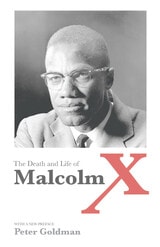
The Death and Life of Malcolm X
Peter Goldman
University of Illinois Press, 2013
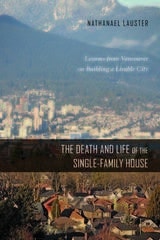
The Death and Life of the Single-Family House
Lessons from Vancouver on Building a Livable CityNathanael Lauster
Temple University Press, 2016
Vancouver today is recognized as one of the most livable cities in the world as well as an international model for sustainability and urbanism. Single-family homes in this city are “a dying breed.” Most people live in the various low-rise and high-rise urban alternatives throughout the metropolitan area.
The Death and Life of the Single-Family House explains how residents in Vancouver attempt to make themselves at home without a house. Local sociologist Nathanael Lauster has painstakingly studied the city’s dramatic transformation to curb sprawl. He tracks the history of housing and interviews residents about the cultural importance of the house as well as the urban problems it once appeared to solve.
Although Vancouver’s built environment is unique, Lauster argues that it was never predestined by geography or demography. Instead, regulatory transformations enabled the city to renovate, build over, and build around the house. Moreover, he insists, there are lessons here for the rest of North America. We can start building our cities differently, and without sacrificing their livability.
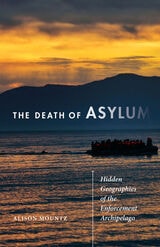
The Death of Asylum
Hidden Geographies of the Enforcement ArchipelagoAlison Mountz
University of Minnesota Press, 2020
Investigating the global system of detention centers that imprison asylum seekers and conceal persistent human rights violations
Remote detention centers confine tens of thousands of refugees, asylum seekers, and undocumented immigrants around the world, operating in a legal gray area that hides terrible human rights abuses from the international community. Built to temporarily house eight hundred migrants in transit, the immigrant “reception center” on the Italian island of Lampedusa has held thousands of North African refugees under inhumane conditions for weeks on end. Australia’s use of Christmas Island as a detention center for asylum seekers has enabled successive governments to imprison migrants from Asia and Africa, including the Sudanese human rights activist Abdul Aziz Muhamat, held there for five years.
In The Death of Asylum, Alison Mountz traces the global chain of remote sites used by states of the Global North to confine migrants fleeing violence and poverty, using cruel measures that, if unchecked, will lead to the death of asylum as an ethical ideal. Through unprecedented access to offshore detention centers and immigrant-processing facilities, Mountz illustrates how authorities in the United States, the European Union, and Australia have created a new and shadowy geopolitical formation allowing them to externalize their borders to distant islands where harsh treatment and deadly force deprive migrants of basic human rights.
Mountz details how states use the geographic inaccessibility of places like Christmas Island, almost a thousand miles off the Australian mainland, to isolate asylum seekers far from the scrutiny of humanitarian NGOs, human rights groups, journalists, and their own citizens. By focusing on borderlands and spaces of transit between regions, The Death of Asylum shows how remote detention centers effectively curtail the basic human right to seek asylum, forcing refugees to take more dangerous risks to escape war, famine, and oppression.
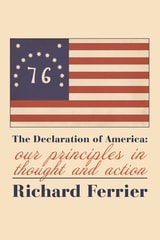
The Declaration of America
Our Principles in Thought and ActionRichard Ferrier
St. Augustine's Press, 2022
Here Ferrier transforms decades of teaching American history and its founding into a reflection on its most important document. Our troubled times call for a return to America's fundamental principles. This book shows their sources, their truth, and their lasting power. It is a labor of love, and of hope.
Anyone seeking opportunity in the United States should read this book and be reminded of the privilege and obligation of the American way of life, all contained in the Declaration of Independence.
The Decline of Comity in Congress
Eric M. Uslaner
University of Michigan Press, 1996
The Decline of Organized Labor in the United States
Michael Goldfield
University of Chicago Press, 1987
The Declining Significance of Race
Blacks and Changing American Institutions, Third EditionWilliam Julius Wilson
University of Chicago Press, 2012
When first published in 1980, The Declining Significance of Race immediately sparked controversy with its contentious thesis that race was becoming less of a deciding factor in the life chances of black Americans than class. This new edition of the seminal book includes a new afterword in which William Julius Wilson not only reflects on the debate surrounding the book, but also presents a provocative discussion of race, class, and social policy.
“The intellectual strength of this book lies in his capacity to integrate disparate findings from historical studies, social theory and research on contemporary trends into a complex and original synthesis that challenges widespread assumptions about the cause of black disadvantage and the way to remove it.”—Paul Starr, New York Times Book Review
“This publication is easily one of the most erudite and sober diagnoses of the American black situation. Students of race relations and anybody in a policy-making position cannot afford to bypass this study.”—Ernest Manheim, Sociology
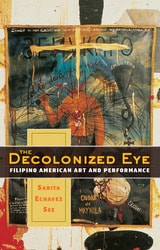
The Decolonized Eye
Filipino American Art and PerformanceSarita Echavez See
University of Minnesota Press, 2009
From the late 1980s to the present, artists of Filipino descent in the United States have produced a challenging and creative movement. In The Decolonized Eye, Sarita Echavez See shows how these artists have engaged with the complex aftermath of U.S. colonialism in the Philippines.
Focusing on artists working in New York and California, See examines the overlapping artistic and aesthetic practices and concerns of filmmaker Angel Shaw, painter Manuel Ocampo, installation artist Paul Pfeiffer, comedian Rex Navarrete, performance artist Nicky Paraiso, and sculptor Reanne Estrada to explain the reasons for their strangely shadowy presence in American culture and scholarship. Offering an interpretation of their creations that accounts for their queer, decolonizing strategies of camp, mimesis, and humor, See reveals the conditions of possibility that constitute this contemporary archive.
By analyzing art, performance, and visual culture, The Decolonized Eye illuminates the unexpected consequences of America's amnesia over its imperial history.
The Defence of Constitutionalism
Or the Czech Question in Post-National EuropeJirí Pribán
Karolinum Press, 2018